


 Скачать презентацию Geotechnology in Transition Evolution Current Practice Trends and
163774725e3eef857d4b8d1bf7610d7c.ppt
- Количество слайдов: 30
 Geotechnology in Transition: Evolution, Current Practice, Trends and Future Directions that are Moving Us Beyond Mapping GIS Seminar – Colorado State University – April 11, 2011 Understanding… What GIS IS …and Isn’t, 2) Nature of Grid-based Mapped Data, 3) Grid-based Map Analysis and Modeling, 4) Where GIS is Headed, and 5) Where Might You be Headed in GIS 1) Presentation by Joseph K. Berry W. M. Keck Scholar in Geosciences, University of Denver Special Faculty in Natural Resources, Colorado State University Principal, Berry & Associates // Spatial Information Systems 2000 S. College Ave, Suite 300, Fort Collins, CO 80525 Phone: (970) 215 -0825 Email: jberry@innovativegis. com Website at www. innovativegis. com/basis
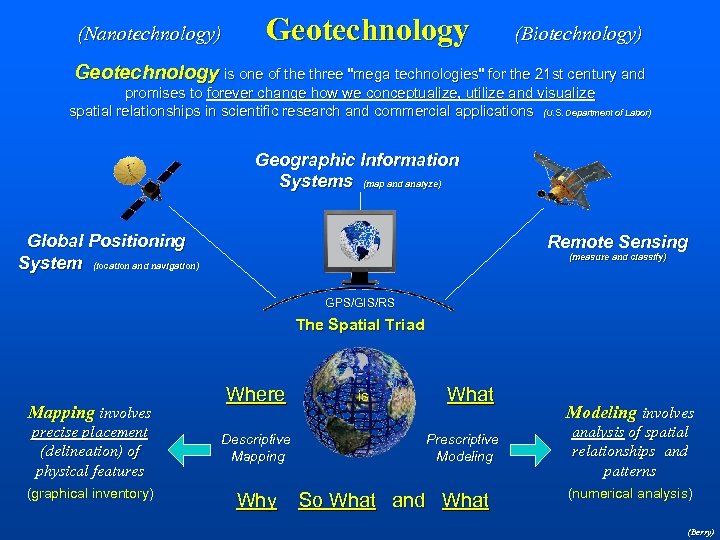 (Nanotechnology) Geotechnology (Biotechnology) Geotechnology is one of the three "mega technologies" for the 21 st century and promises to forever change how we conceptualize, utilize and visualize spatial relationships in scientific research and commercial applications (U. S. Department of Labor) Geographic Information Systems (map and analyze) Global Positioning System (location and navigation) Remote Sensing (measure and classify) GPS/GIS/RS The Spatial Triad Mapping involves Where precise placement (delineation) of physical features Descriptive Mapping (graphical inventory) Why is What Prescriptive Modeling So What and What Modeling involves analysis of spatial relationships and patterns (numerical analysis) (Berry)
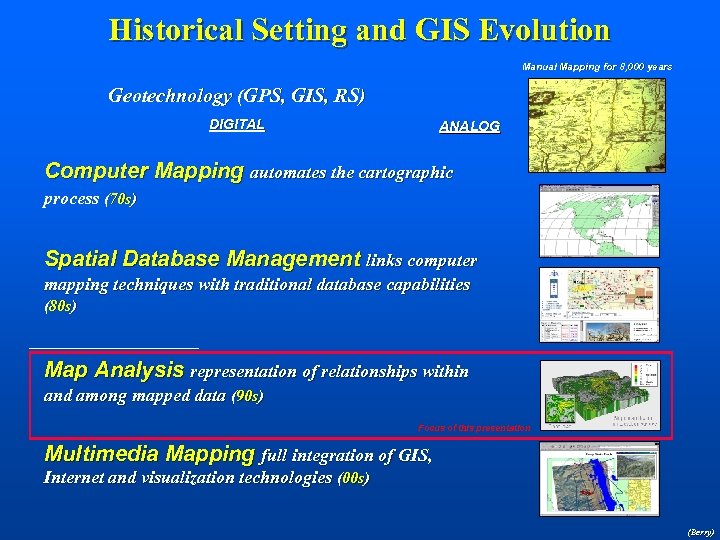 Historical Setting and GIS Evolution Manual Mapping for 8, 000 years Geotechnology (GPS, GIS, RS) DIGITAL ANALOG Computer Mapping automates the cartographic process (70 s) Spatial Database Management links computer mapping techniques with traditional database capabilities (80 s) Map Analysis representation of relationships within and among mapped data (90 s) Focus of this presentation Multimedia Mapping full integration of GIS, Internet and visualization technologies (00 s) (Berry)
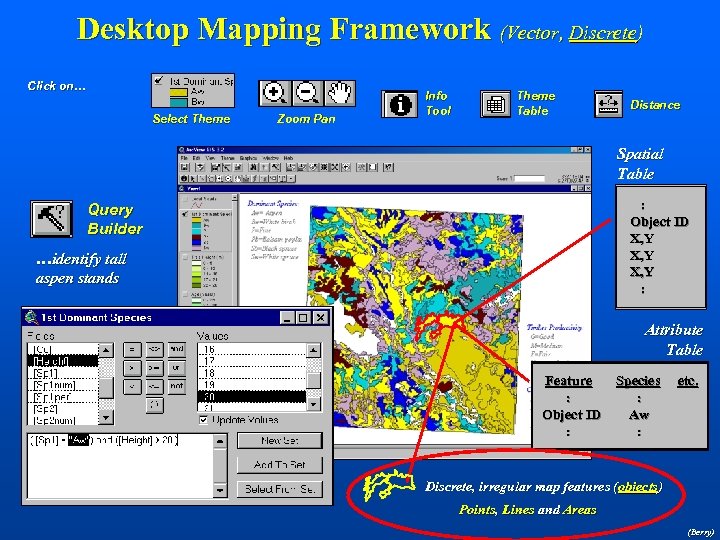 Desktop Mapping Framework (Vector, Discrete) Click on… Select Theme Zoom Pan Info Tool Theme Table Distance Spatial Table : Object ID X, Y : Query Builder …identify tall aspen stands Attribute Table Feature : Object ID : Big …over 400, 000 m 2 (40 ha)? Species : Aw : etc. Discrete, irregular map features (objects) Points, Lines and Areas (Berry)
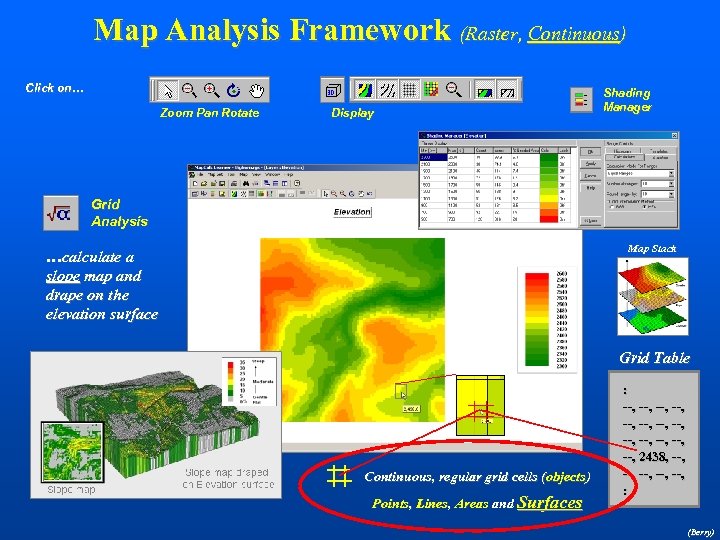 Map Analysis Framework (Raster, Continuous) Click on… Zoom Pan Rotate Display Shading Manager Grid Analysis Map Stack …calculate a slope map and drape on the elevation surface Grid Table Continuous, regular grid cells (objects) Points, Lines, Areas and Surfaces : --, --, --, --, 2438, --, --, --, : (Berry)
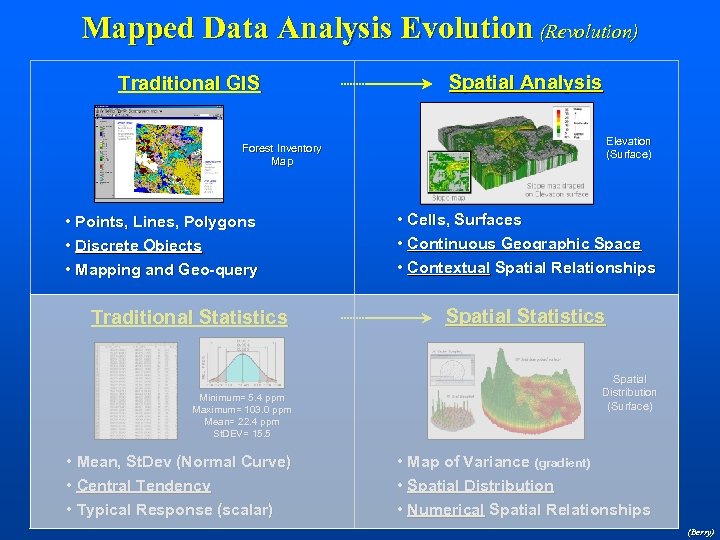 Mapped Data Analysis Evolution (Revolution) Traditional GIS Forest Inventory Map • Points, Lines, Polygons • Discrete Objects • Mapping and Geo-query Traditional Statistics Minimum= 5. 4 ppm Maximum= 103. 0 ppm Mean= 22. 4 ppm St. DEV= 15. 5 • Mean, St. Dev (Normal Curve) • Central Tendency • Typical Response (scalar) Spatial Analysis Elevation (Surface) • Cells, Surfaces • Continuous Geographic Space • Contextual Spatial Relationships Spatial Statistics Spatial Distribution (Surface) • Map of Variance (gradient) • Spatial Distribution • Numerical Spatial Relationships (Berry)
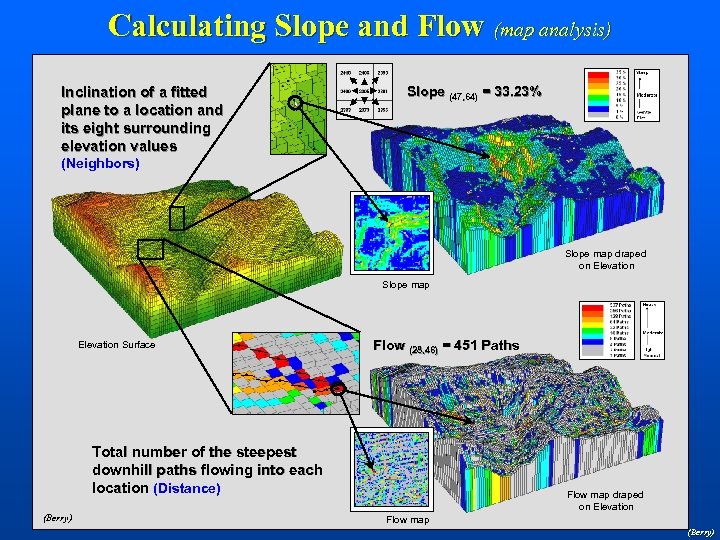 Calculating Slope and Flow (map analysis) Inclination of a fitted plane to a location and its eight surrounding elevation values Slope (47, 64) = 33. 23% (Neighbors) Slope map draped on Elevation Slope map Elevation Surface Flow (28, 46) = 451 Paths Total number of the steepest downhill paths flowing into each location (Distance) (Berry) Flow map draped on Elevation Flow map (Berry)
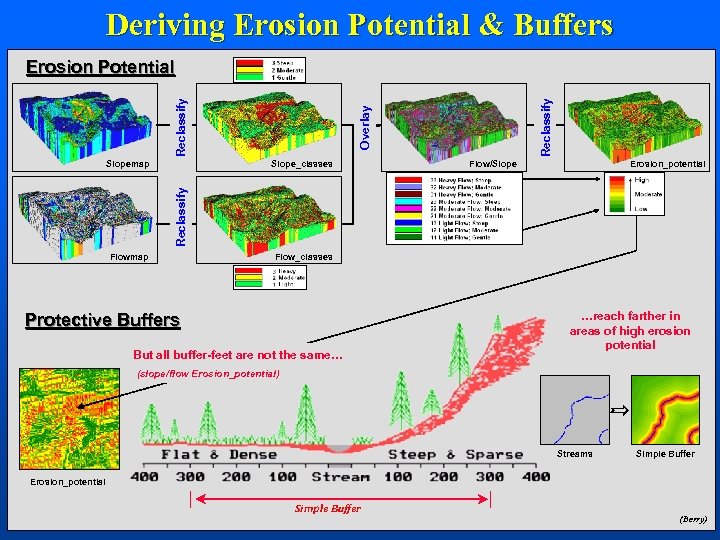 Deriving Erosion Potential & Buffers Slope_classes Reclassify Flow/Slope Erosion_potential Reclassify Slopemap Overlay Reclassify Erosion Potential Flowmap Flow_classes Protective Buffers But all buffer-feet are not the same… (slope/flow Erosion_potential) …reach farther in areas of high erosion potential Streams Simple Buffer Erosion_potential Simple Buffer (Berry)
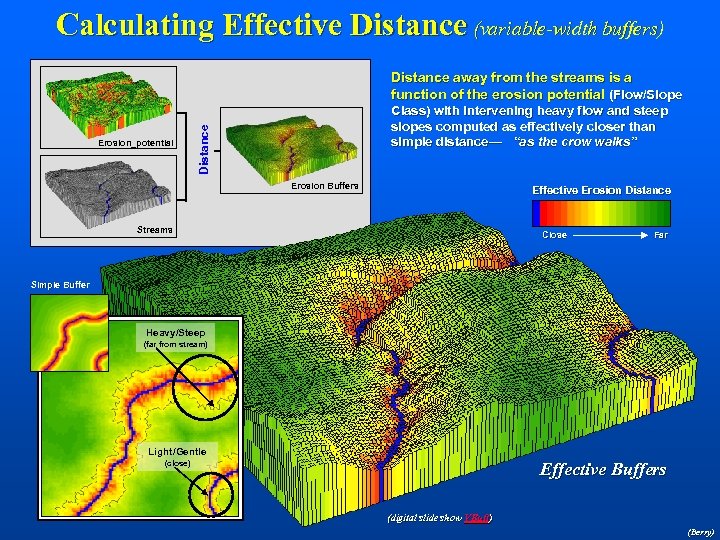 Calculating Effective Distance (variable-width buffers) Distance away from the streams is a function of the erosion potential (Flow/Slope Distance Erosion_potential Class) with intervening heavy flow and steep slopes computed as effectively closer than simple distance— “as the crow walks” Erosion Buffers Effective Erosion Distance Streams Close Far Simple Buffer Heavy/Steep (far from stream) Light/Gentle (close) Effective Buffers (digital slide show VBuff) (Berry)
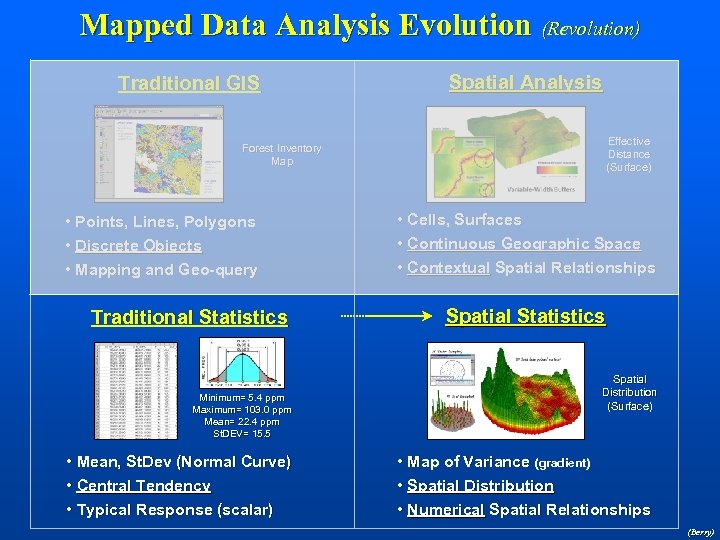 Mapped Data Analysis Evolution (Revolution) Traditional GIS Spatial Analysis Effective Distance (Surface) Forest Inventory Map • Points, Lines, Polygons • Discrete Objects • Mapping and Geo-query Traditional Statistics Minimum= 5. 4 ppm Maximum= 103. 0 ppm Mean= 22. 4 ppm St. DEV= 15. 5 • Mean, St. Dev (Normal Curve) • Central Tendency • Typical Response (scalar) • Cells, Surfaces • Continuous Geographic Space • Contextual Spatial Relationships Spatial Statistics Spatial Distribution (Surface) • Map of Variance (gradient) • Spatial Distribution • Numerical Spatial Relationships (Berry)
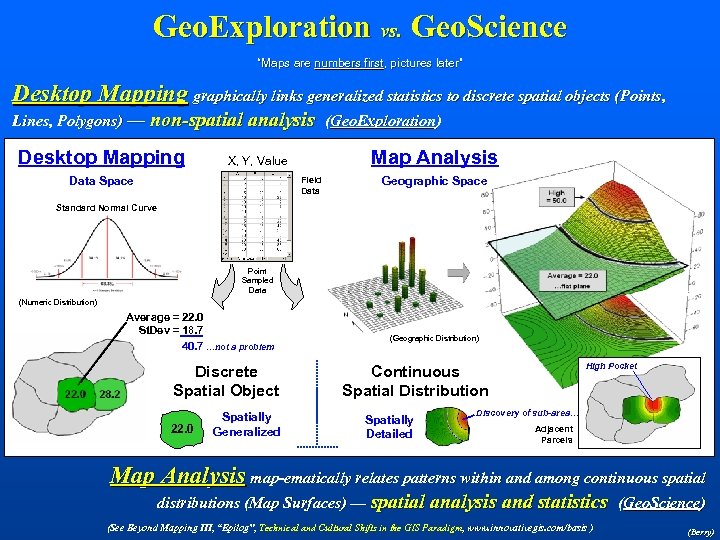 Geo. Exploration vs. Geo. Science “Maps are numbers first, pictures later” first, Desktop Mapping graphically links generalized statistics to discrete spatial objects (Points, Lines, Polygons) — non-spatial analysis (Geo. Exploration) Desktop Mapping Map Analysis X, Y, Value Data Space Field Data Geographic Space Standard Normal Curve Point Sampled Data (Numeric Distribution) Average = 22. 0 St. Dev = 18. 7 40. 7 …not a problem Discrete Spatial Object 22. 0 Spatially Generalized (Geographic Distribution) High Pocket Continuous Spatial Distribution Spatially Detailed Discovery of sub-area… Adjacent Parcels Map Analysis map-ematically relates patterns within and among continuous spatial distributions (Map Surfaces) — spatial analysis and statistics (Geo. Science) (See Beyond Mapping III, “Epilog”, Technical and Cultural Shifts in the GIS Paradigm, www. innovativegis. com/basis ) , www. innovativegis. com/basis (See Beyond Mapping III, “Epilog”, (Berry)
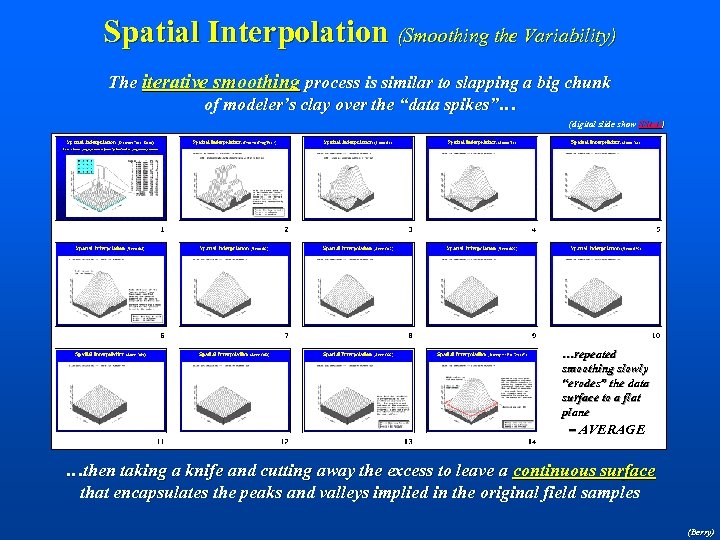 Spatial Interpolation (Smoothing the Variability) The iterative smoothing process is similar to slapping a big chunk of modeler’s clay over the “data spikes”… (digital slide show SStat 2) …repeated smoothing slowly “erodes” the data surface to a flat plane = AVERAGE …then taking a knife and cutting away the excess to leave a continuous surface that encapsulates the peaks and valleys implied in the original field samples (Berry)
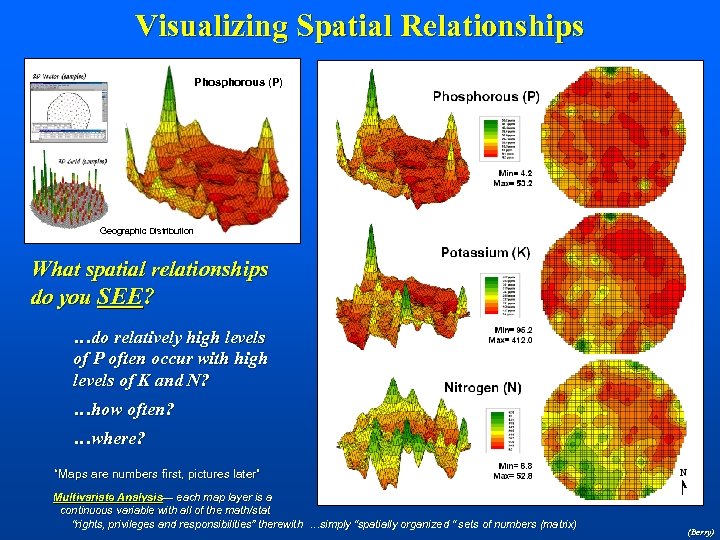 Visualizing Spatial Relationships Phosphorous (P) Geographic Distribution What spatial relationships do you SEE? …do relatively high levels of P often occur with high levels of K and N? …how often? …where? “Maps are numbers first, pictures later” Multivariate Analysis— each map layer is a Multivariate Analysis— continuous variable with all of the math/stat “rights, privileges and responsibilities” therewith …simply “spatially organized “ sets of numbers (matrix) (Berry)
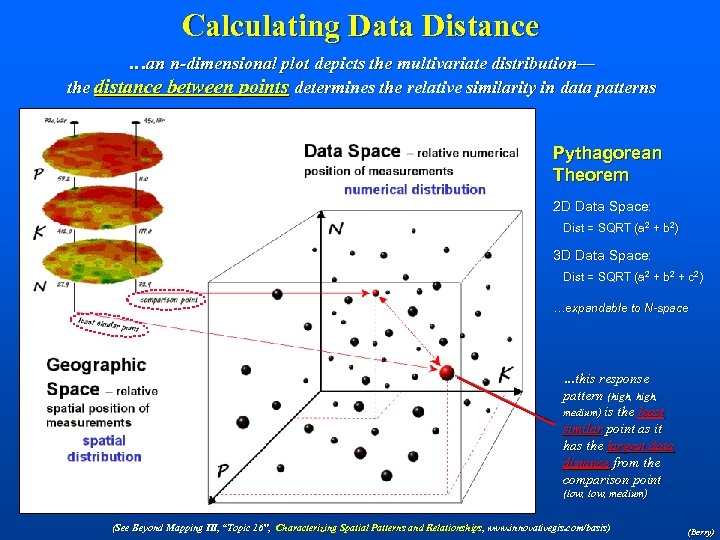 Calculating Data Distance …an n-dimensional plot depicts the multivariate distribution— the distance between points determines the relative similarity in data patterns Pythagorean Theorem 2 D Data Space: Dist = SQRT (a 2 + b 2) 3 D Data Space: Dist = SQRT (a 2 + b 2 + c 2) …expandable to N-space …this response pattern (high, medium) is the least similar point as it has the largest data distance from the comparison point (low, medium) (See Beyond Mapping III, “Topic 16”, Characterizing Spatial Patterns and Relationships, www. innovativegis. com/basis) (Berry)
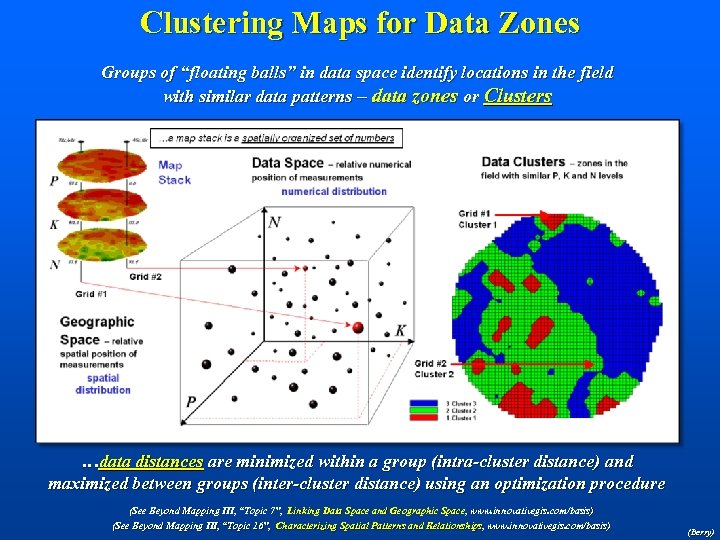 Clustering Maps for Data Zones Groups of “floating balls” in data space identify locations in the field with similar data patterns – data zones or Clusters …data distances are minimized within a group (intra-cluster distance) and maximized between groups (inter-cluster distance) using an optimization procedure (See Beyond Mapping III, “Topic 7”, Linking Data Space and Geographic Space, www. innovativegis. com/basis) (See Beyond Mapping III, “Topic 16”, Characterizing Spatial Patterns and Relationships, www. innovativegis. com/basis) (Berry)
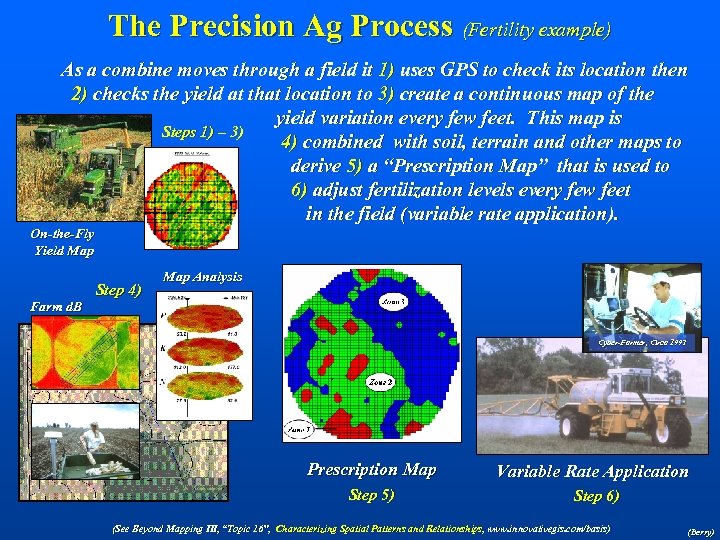 The Precision Ag Process (Fertility example) As a combine moves through a field it 1) uses GPS to check its location then 2) checks the yield at that location to 3) create a continuous map of the yield variation every few feet. This map is Steps 1) – 3) 4) combined with soil, terrain and other maps to derive 5) a “Prescription Map” that is used to 6) adjust fertilization levels every few feet in the field (variable rate application). On-the-Fly Yield Map Farm d. B Step 4) Map Analysis Cyber-Farmer, Circa 1992 Prescription Map Variable Rate Application Step 5) Step 6) (See Beyond Mapping III, “Topic 16”, Characterizing Spatial Patterns and Relationships, www. innovativegis. com/basis) (Berry)
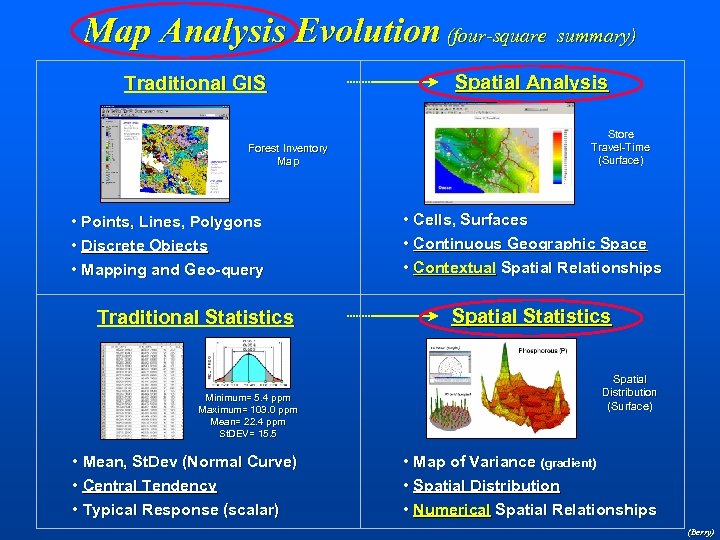 Map Analysis Evolution (four-square summary) Traditional GIS Forest Inventory Map • Points, Lines, Polygons • Discrete Objects • Mapping and Geo-query Traditional Statistics Minimum= 5. 4 ppm Maximum= 103. 0 ppm Mean= 22. 4 ppm St. DEV= 15. 5 • Mean, St. Dev (Normal Curve) • Central Tendency • Typical Response (scalar) Spatial Analysis Store Travel-Time (Surface) • Cells, Surfaces • Continuous Geographic Space • Contextual Spatial Relationships Spatial Statistics Spatial Distribution (Surface) • Map of Variance (gradient) • Spatial Distribution • Numerical Spatial Relationships (Berry)
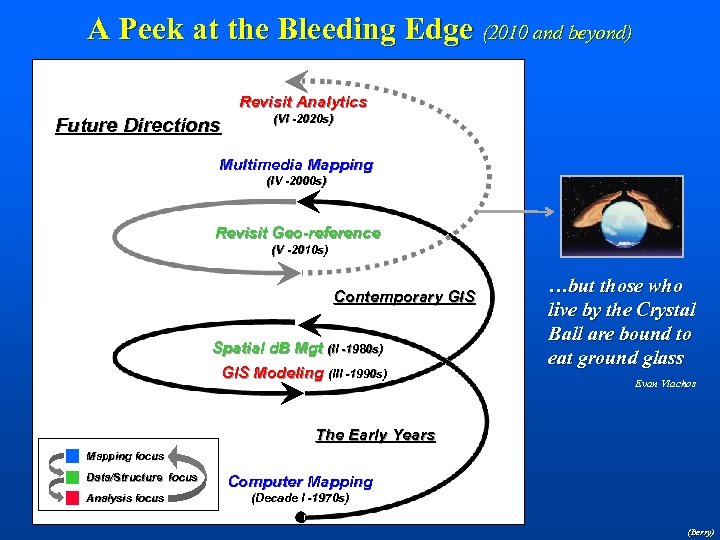 A Peek at the Bleeding Edge (2010 and beyond) Revisit Analytics Future Directions (VI -2020 s) Multimedia Mapping (IV -2000 s) Revisit Geo-reference (V -2010 s) Contemporary GIS Spatial d. B Mgt (II -1980 s) GIS Modeling (III -1990 s) …but those who live by the Crystal Ball are bound to eat ground glass Evan Vlachos The Early Years Mapping focus Data/Structure focus Analysis focus Computer Mapping (Decade I -1970 s) (Berry)
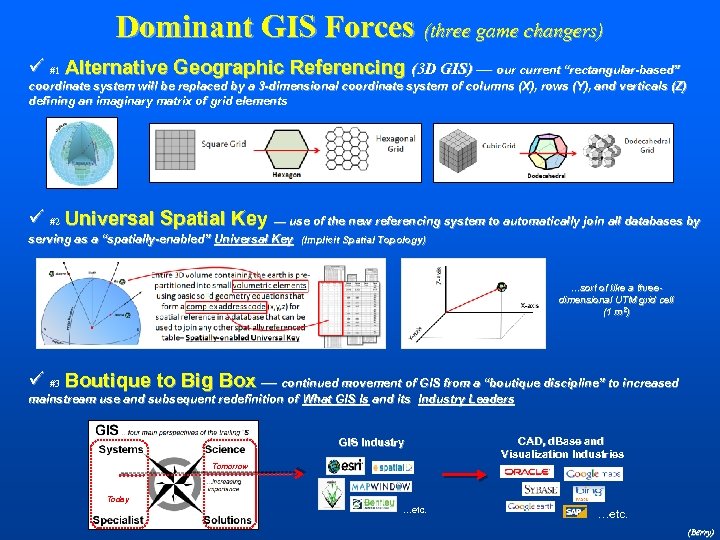 Dominant GIS Forces (three game changers) ü #1 Alternative Geographic Referencing (3 D GIS) — our current “rectangular-based” coordinate system will be replaced by a 3 -dimensional coordinate system of columns (X), rows (Y), and verticals (Z) defining an imaginary matrix of grid elements ü #2 Universal Spatial Key — use of the new referencing system to automatically join all databases by serving as a “spatially-enabled” Universal Key (Implicit Spatial Topology) serving as a “spatially-enabled” Universal Key …sort of like a threedimensional UTM grid cell (1 m 2) ü #3 Boutique to Big Box — continued movement of GIS from a “boutique discipline” to increased mainstream use and subsequent redefinition of What GIS Is and its Industry Leaders GIS Industry CAD, d. Base and Visualization Industries Tomorrow Today …etc. (Berry)
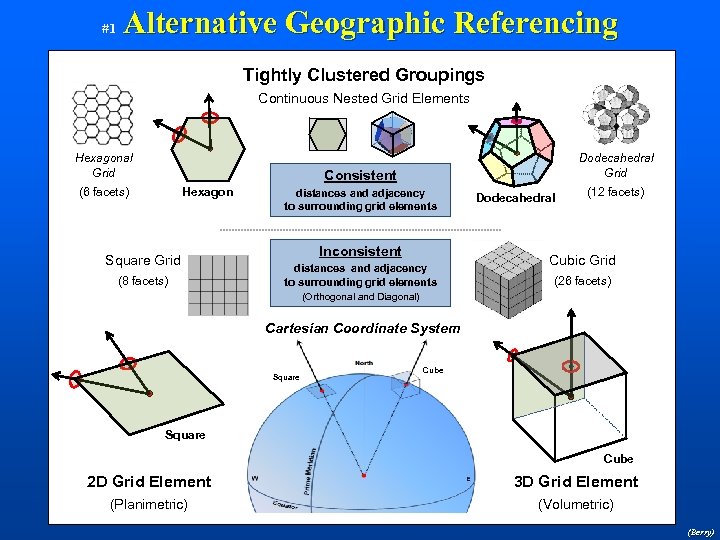 #1 Alternative Geographic Referencing Tightly Clustered Groupings Continuous Nested Grid Elements Hexagonal Grid Dodecahedral Grid Consistent (6 facets) Hexagon Square Grid (8 facets) distances and adjacency to surrounding grid elements Inconsistent distances and adjacency to surrounding grid elements Dodecahedral (12 facets) Cubic Grid (26 facets) (Orthogonal and Diagonal) Cartesian Coordinate System Square Cube 2 D Grid Element 3 D Grid Element (Planimetric) (Volumetric) (Berry)
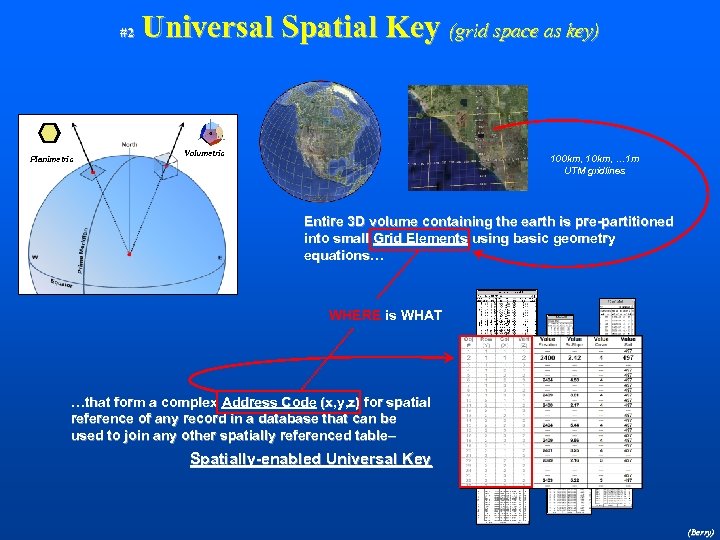 #2 Planimetric Universal Spatial Key (grid space as key) Volumetric 100 km, 10 km, … 1 m UTM gridlines Entire 3 D volume containing the earth is pre-partitioned into small Grid Elements using basic geometry equations… WHERE is WHAT …that form a complex Address Code (x, y, z) for spatial reference of any record in a database that can be used to join any other spatially referenced table– Spatially-enabled Universal Key (Berry)
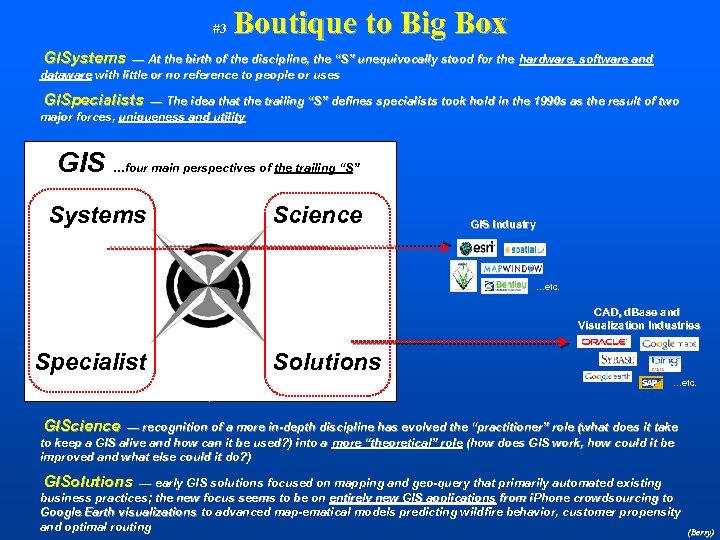 #3 Boutique to Big Box GISystems — At the birth of the discipline, the “S” unequivocally stood for the hardware, software and dataware with little or no reference to people or uses GISpecialists — The idea that the trailing “S” defines specialists took hold in the 1990 s as the result of two major forces, uniqueness and utility GIS …four main perspectives of the trailing “S” Systems Science GIS Industry …etc. CAD, d. Base and Visualization Industries Specialist Solutions …etc. GIScience — recognition of a more in-depth discipline has evolved the “practitioner” role (what does it take to keep a GIS alive and how can it be used? ) into a more “theoretical” role (how does GIS work, how could it be improved and what else could it do? ) GISolutions — early GIS solutions focused on mapping and geo-query that primarily automated existing — business practices; the new focus seems to be on entirely new GIS applications from i. Phone crowdsourcing to Google Earth visualizations to advanced map-ematical models predicting wildfire behavior, customer propensity Google Earth visualizations and optimal routing (Berry)
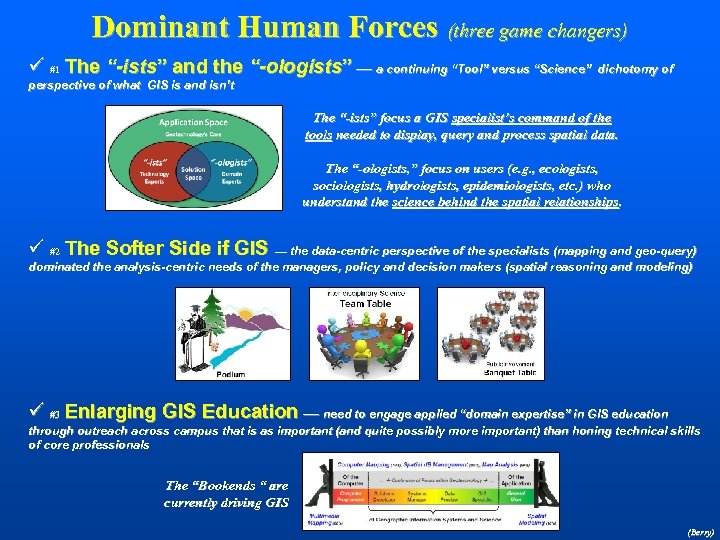 Dominant Human Forces (three game changers) ü #1 The “-ists” and the “-ologists” — a continuing “Tool” versus “Science” dichotomy of perspective of what GIS is and isn’t The “-ists” focus a GIS specialist’s command of the tools needed to display, query and process spatial data. The “-ologists, ” focus on users (e. g. , ecologists, sociologists, hydrologists, epidemiologists, etc. ) who understand the science behind the spatial relationships. ü #2 The Softer Side if GIS — the data-centric perspective of the specialists (mapping and geo-query) dominated the analysis-centric needs of the managers, policy and decision makers (spatial reasoning and modeling) ü #3 Enlarging GIS Education — need to engage applied “domain expertise” in GIS education through outreach across campus that is as important (and quite possibly more important) than honing technical skills of core professionals The “Bookends “ are currently driving GIS (Berry)
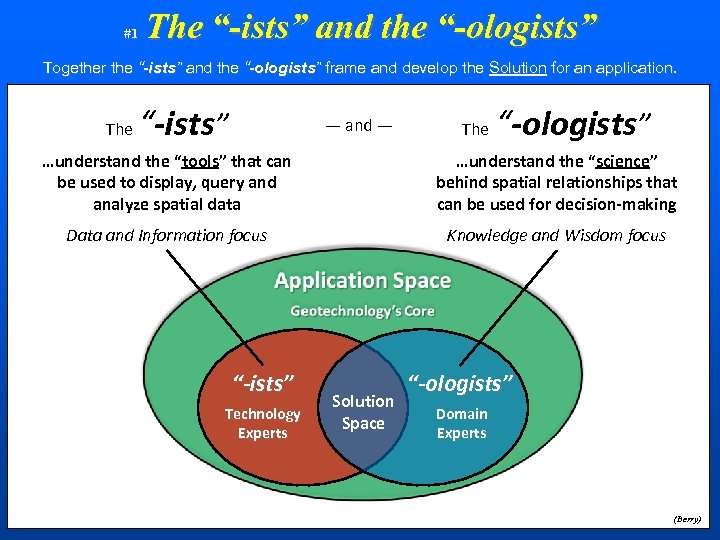 #1 The “-ists” and the “-ologists” Together the “-ists” and the “-ologists” frame and develop the Solution for an application. The “-ists” — and — The “-ologists” …understand the “tools” that can be used to display, query and analyze spatial data …understand the “science” behind spatial relationships that can be used for decision-making Data and Information focus Knowledge and Wisdom focus “-ists” Technology Experts Solution Space “-ologists” Domain Experts (Berry)
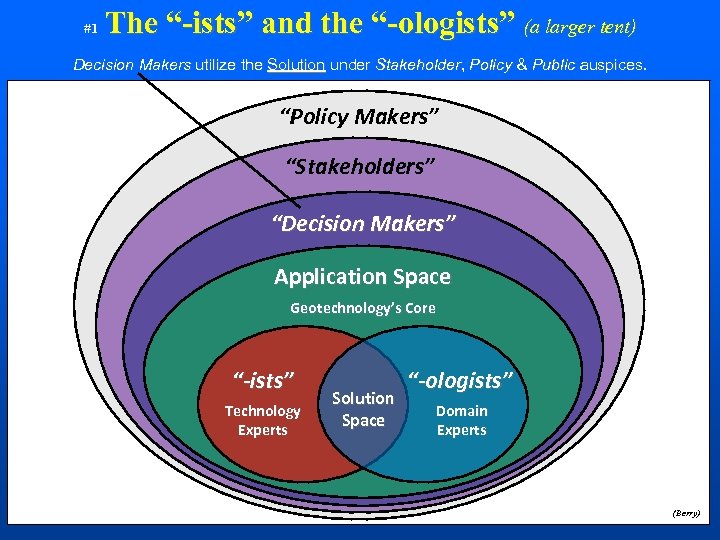 #1 The “-ists” and the “-ologists” (a larger tent) Decision Makers utilize the Solution under Stakeholder, Policy & Public auspices. “Policy Makers” “Stakeholders” “Decision Makers” Application Space Geotechnology’s Core “-ists” Technology Experts Solution Space “-ologists” Domain Experts (Berry)
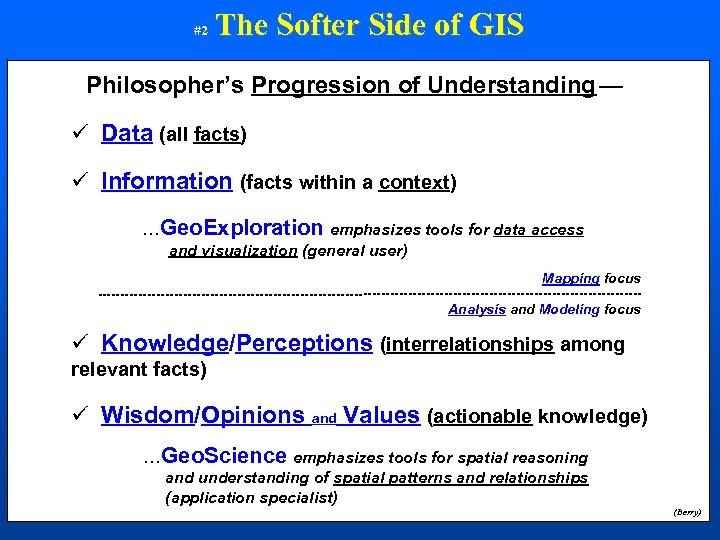 #2 The Softer Side of GIS Philosopher’s Progression of Understanding — ü Data (all facts) ü Information (facts within a context) …Geo. Exploration emphasizes tools for data access and visualization (general user) Mapping focus Analysis and Modeling focus ü Knowledge/Perceptions (interrelationships among relevant facts) ü Wisdom/Opinions and Values (actionable knowledge) …Geo. Science emphasizes tools for spatial reasoning and understanding of spatial patterns and relationships (application specialist) (Berry)
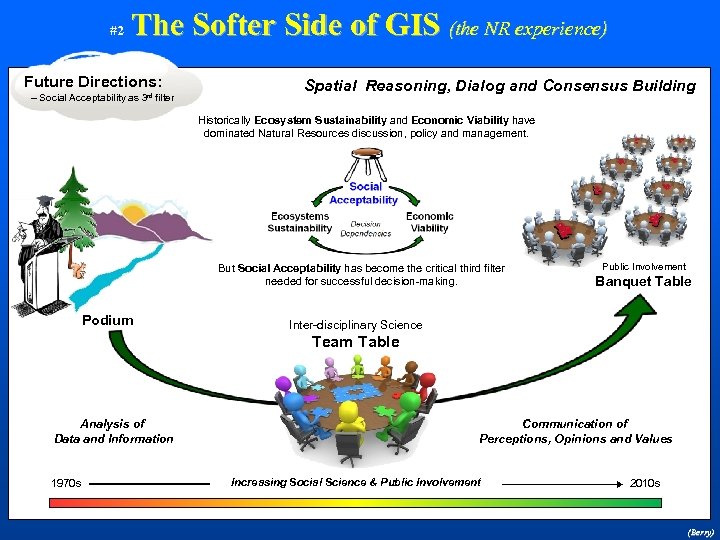 #2 The Softer Side of GIS (the NR experience) Future Directions: Social Acceptability as 3 rd filter Spatial Reasoning, Dialog and Consensus Building Historically Ecosystem Sustainability and Economic Viability have dominated Natural Resources discussion, policy and management. But Social Acceptability has become the critical third filter needed for successful decision-making. Podium Public Involvement Banquet Table Inter-disciplinary Science Team Table Analysis of Data and Information 1970 s Communication of Perceptions, Opinions and Values Increasing Social Science & Public Involvement 2010 s (Berry)
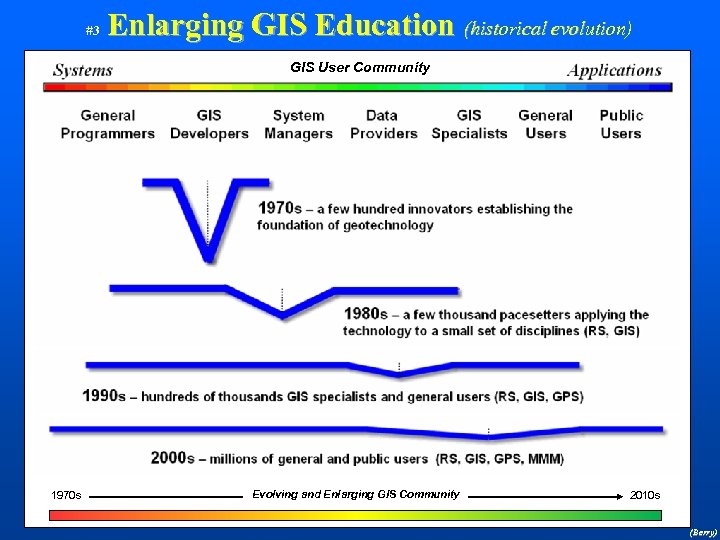 #3 Enlarging GIS Education (historical evolution) GIS User Community 1970 s Evolving and Enlarging GIS Community 2010 s (Berry)
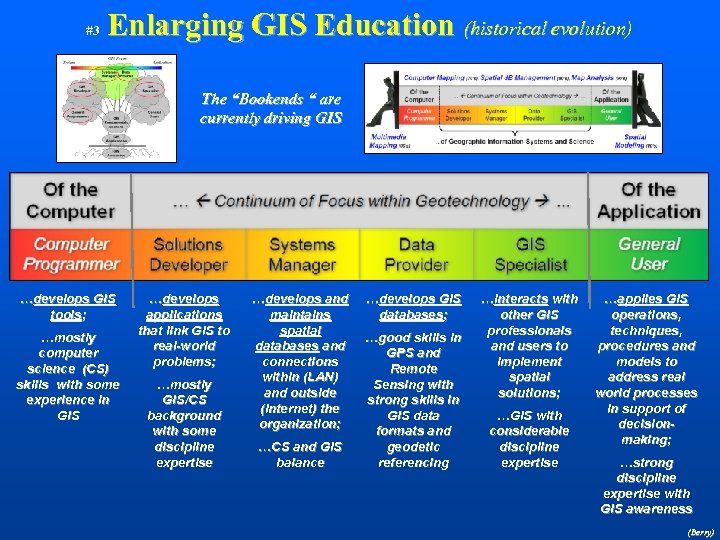 #3 Enlarging GIS Education (historical evolution) The “Bookends “ are currently driving GIS Computer Programmer– Solutions Developer– Systems Manager– Data Provider– GIS Specialist– General User– …develops GIS tools; …develops applications that link GIS to real-world problems; …develops and maintains spatial databases and connections within (LAN) and outside (Internet) the organization; …develops GIS databases; …interacts with other GIS professionals and users to implement spatial solutions; …applies GIS operations, techniques, procedures and models to address real world processes in support of decisionmaking; …mostly computer science (CS) skills with some experience in GIS …mostly GIS/CS background with some discipline expertise …CS and GIS balance …good skills in GPS and Remote Sensing with strong skills in GIS data formats and geodetic referencing …GIS with considerable discipline expertise …strong discipline expertise with GIS awareness (Berry)
 Where From Here? GIS Seminar – Colorado State University – April 11, 2011 1) What GIS IS …and Isn’t 2) Nature of Grid-based Mapped Data 3) Grid-based Map Analysis and Modeling 4) Where GIS is Headed 5) Where Might You be Headed in GIS Additional Information: A Brief History and Probable Future of Geotechnology, a white paper that distills several keynotes, presentations and papers, BASIS, Fort Collins, Colorado, July, 2006. J. K. Berry. www. innovativegis. com/basis/Papers/Other/Geotechnology_history_future. htm An Analytical Framework for GIS Modeling, a white paper describing a conceptual framework for Map Analysis and Modeling, BASIS, Fort Collins, Colorado, October, 2009. J. K. Berry. www. innovativegis. com/basis/Papers/Other/GISmodeling. Framework/ Beyond Mapping III, an online book containing Introduction, 28 Chapters and Epilog as a compilation of the popular Beyond Mapping columns published in Geo. World magazine from 1996 through present, BASIS, Fort Collins, Colorado, 2010. J. K. Berry. www. innovativegis. com/basis/Map. Analysis/ Power. Point slide set is posted at http: //www. innovativegis. com/basis/Present/CSU_2011/CSU_2011_materials. htm Graduate level GIS Modeling course materials are posted at http: //www. innovativegis. com/basis/Courses/GMcourse 11/ Joseph K. Berry Email: jberry@innovativegis. com — Website: www. innovativegis. com/basis (Berry)