


 Скачать презентацию GEOSS Architecture Implementation Pilot AIP CEN TC 287 workshop
8afab96735c71f84119f5552e29f05d0.ppt
- Количество слайдов: 49
 GEOSS Architecture Implementation Pilot (AIP) CEN/TC 287 workshop on Interoperability between INSPIRE, GMES, and GEOSS 8 -9 November 2010, JRC Hervé CAUMONT OGC Interoperability Program Team
 Intro - Focus of the workshop • Contribute to the data interoperability between: – INSPIRE data specifications – GMES data product specifications – GEOSS data • “Shape” the GMES initial operations concerning data products
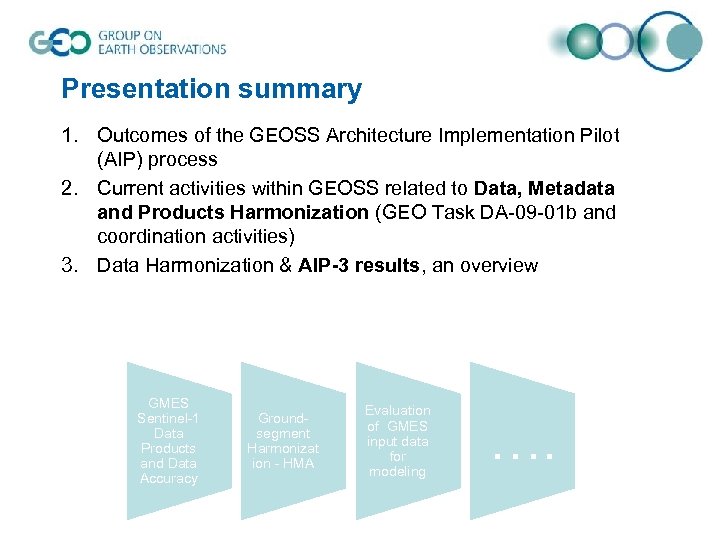 Presentation summary 1. Outcomes of the GEOSS Architecture Implementation Pilot (AIP) process 2. Current activities within GEOSS related to Data, Metadata and Products Harmonization (GEO Task DA-09 -01 b and coordination activities) 3. Data Harmonization & AIP-3 results, an overview GMES Sentinel-1 Data Products and Data Accuracy Groundsegment Harmonizat ion - HMA Evaluation of GMES input data for modeling ….
 1) GEOSS AIP Process Outcomes
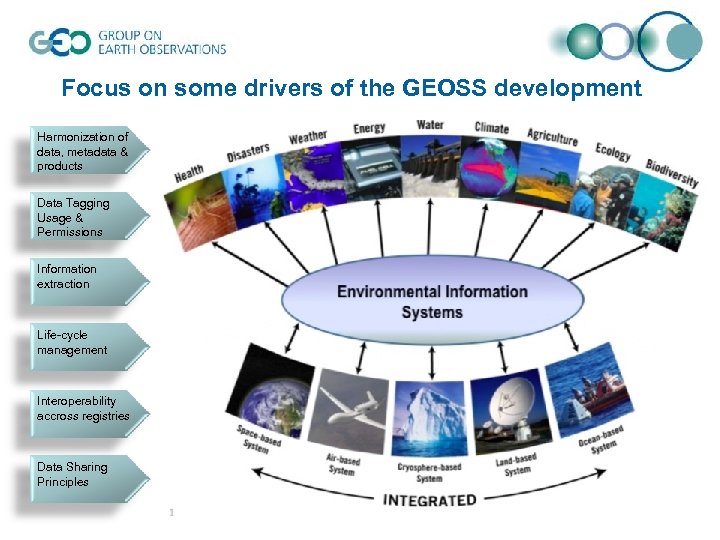 Focus on some drivers of the GEOSS development Harmonization of data, metadata & products Data Tagging Usage & Permissions Information extraction Life-cycle management Interoperability accross registries Data Sharing Principles
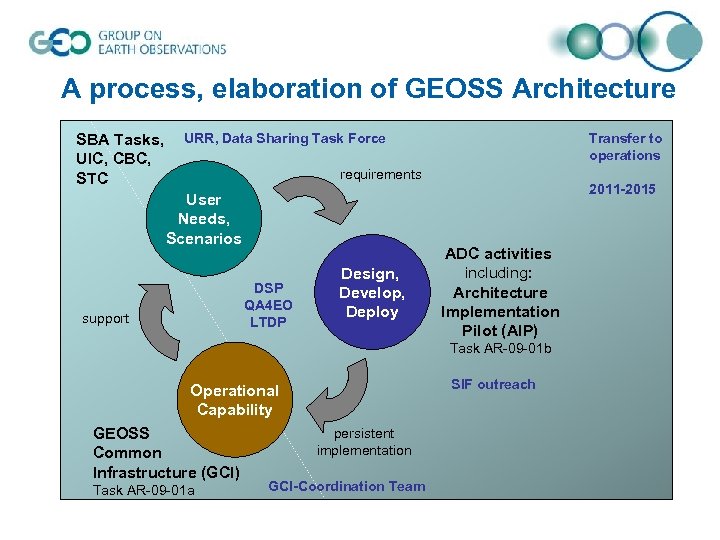 A process, elaboration of GEOSS Architecture SBA Tasks, UIC, CBC, STC URR, Data Sharing Task Force Transfer to operations requirements User Needs, Scenarios DSP QA 4 EO LTDP support Design, Develop, Deploy 2011 -2015 ADC activities including: Architecture Implementation Pilot (AIP) Task AR-09 -01 b SIF outreach Operational Capability GEOSS Common Infrastructure (GCI) Task AR-09 -01 a persistent implementation GCI-Coordination Team
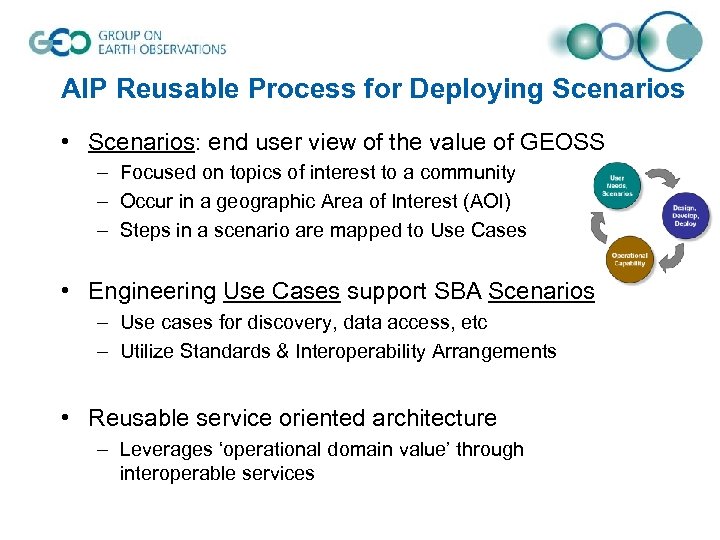 AIP Reusable Process for Deploying Scenarios • Scenarios: end user view of the value of GEOSS – Focused on topics of interest to a community – Occur in a geographic Area of Interest (AOI) – Steps in a scenario are mapped to Use Cases • Engineering Use Cases support SBA Scenarios – Use cases for discovery, data access, etc – Utilize Standards & Interoperability Arrangements • Reusable service oriented architecture – Leverages ‘operational domain value’ through interoperable services
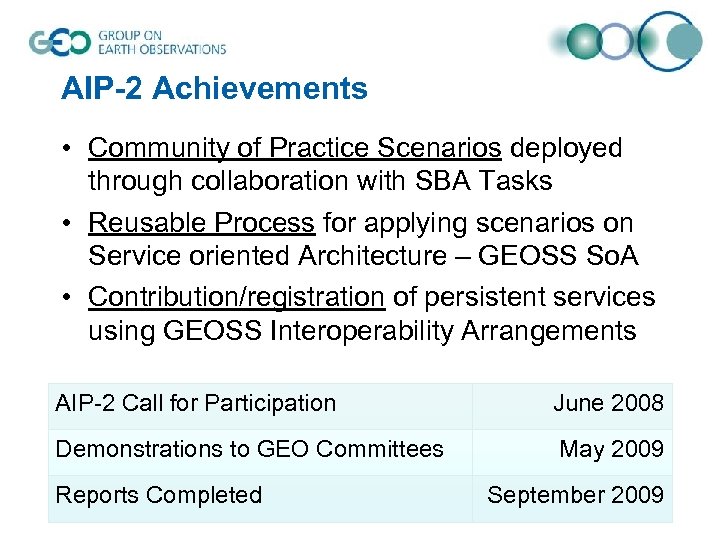 AIP-2 Achievements • Community of Practice Scenarios deployed through collaboration with SBA Tasks • Reusable Process for applying scenarios on Service oriented Architecture – GEOSS So. A • Contribution/registration of persistent services using GEOSS Interoperability Arrangements AIP-2 Call for Participation June 2008 Demonstrations to GEO Committees May 2009 Reports Completed September 2009
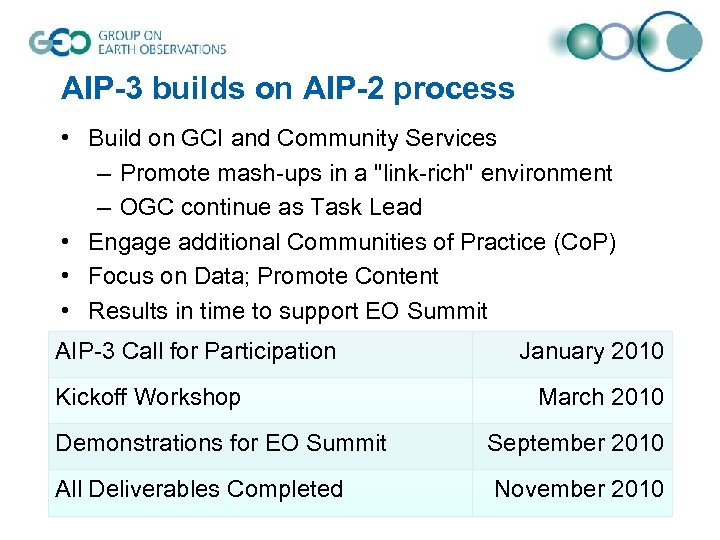 AIP-3 builds on AIP-2 process • Build on GCI and Community Services – Promote mash-ups in a "link-rich" environment – OGC continue as Task Lead • Engage additional Communities of Practice (Co. P) • Focus on Data; Promote Content • Results in time to support EO Summit AIP-3 Call for Participation Kickoff Workshop January 2010 March 2010 Demonstrations for EO Summit September 2010 All Deliverables Completed November 2010
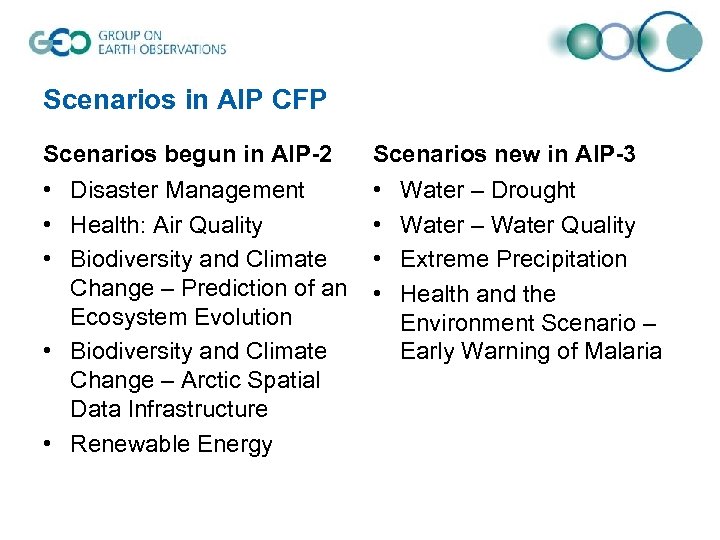 Scenarios in AIP CFP Scenarios begun in AIP-2 Scenarios new in AIP-3 • Disaster Management • Health: Air Quality • Biodiversity and Climate Change – Prediction of an Ecosystem Evolution • Biodiversity and Climate Change – Arctic Spatial Data Infrastructure • Renewable Energy • • Water – Drought Water – Water Quality Extreme Precipitation Health and the Environment Scenario – Early Warning of Malaria
 AIP-3 Status – To Date • What is working ? • What are the potential impacts on the GCI ? • What is still needed ?
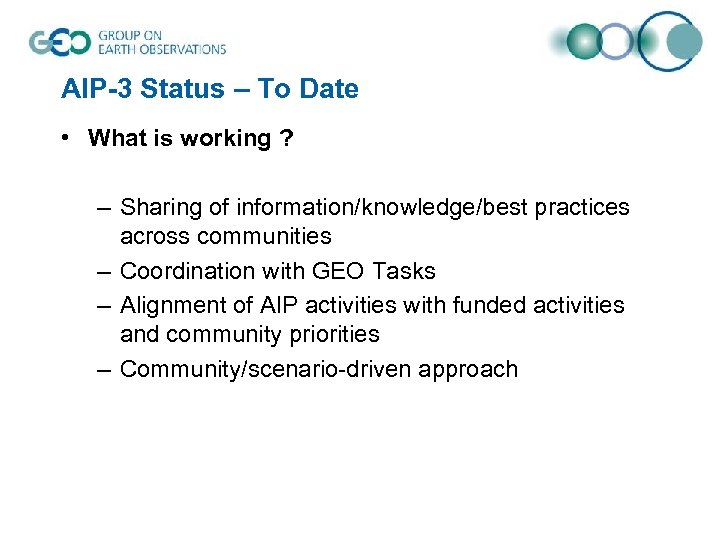 AIP-3 Status – To Date • What is working ? – Sharing of information/knowledge/best practices across communities – Coordination with GEO Tasks – Alignment of AIP activities with funded activities and community priorities – Community/scenario-driven approach
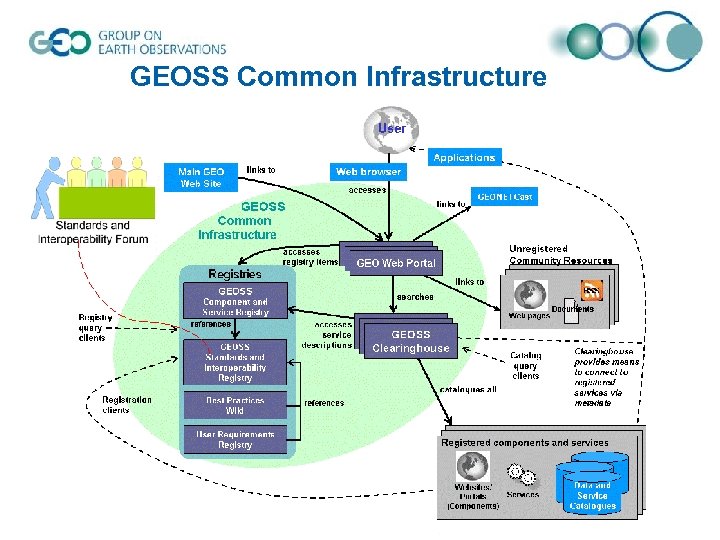
 AIP-3 Status – To Date • What are the potential impacts on the GCI ? – Data access conditions & user management • Metadata • Possible new GCI component – GEOSS Common Record • Impact on clearinghouse, CSR, etc • Data quality, lineage, etc – Semantic-enabled search • Registration of ontologies • Possible brokering component
 AIP-3 Status – To Date • What is still needed ? – More interoperability • GEOSS Common Record, Semantics, WPS Profiles • Finding the right balance – More documentation • More sharing of lessons learned • Increased usage of the GEOSS best practices wiki – Continued coordination with other GEO Tasks – Many challenges remain within communities • Challenges spanning technical and organizational issues
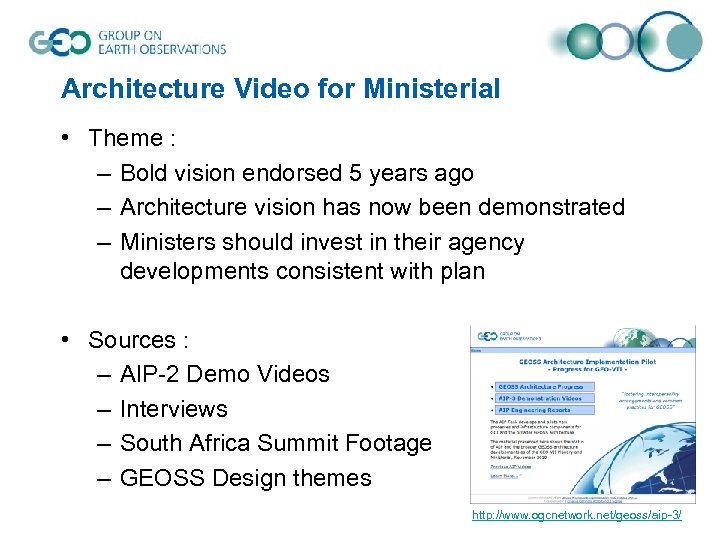 Architecture Video for Ministerial • Theme : – Bold vision endorsed 5 years ago – Architecture vision has now been demonstrated – Ministers should invest in their agency developments consistent with plan • Sources : – AIP-2 Demo Videos – Interviews – South Africa Summit Footage – GEOSS Design themes http: //www. ogcnetwork. net/geoss/aip-3/
 2) Data, Metadata & Products Harmonization Some perspectives from GEOSS AIP
 The « Data Harmonization » topic • GEO Task AR-09 -01 b (AIP) – Emergence of Data Harmonization topic, pilot and input for the GEO Task DA-09 -01 b – Emphasis on Data Quality and Uncertainty Management • GEO Task DA-09 -01 b – Data, Metadata and Products Harmonization • Other GEO Tasks (Data Integration, Global Datasets…) • INSPIRE 2010 Conference and Workshops – Numerous sessions with Data Harmonization topic • OGC – A cross-WG topic : Sensor. ML, O&M, GML, WCS… – Could be similar to OWS for service interfaces – Could reach out the Data Quality SWG
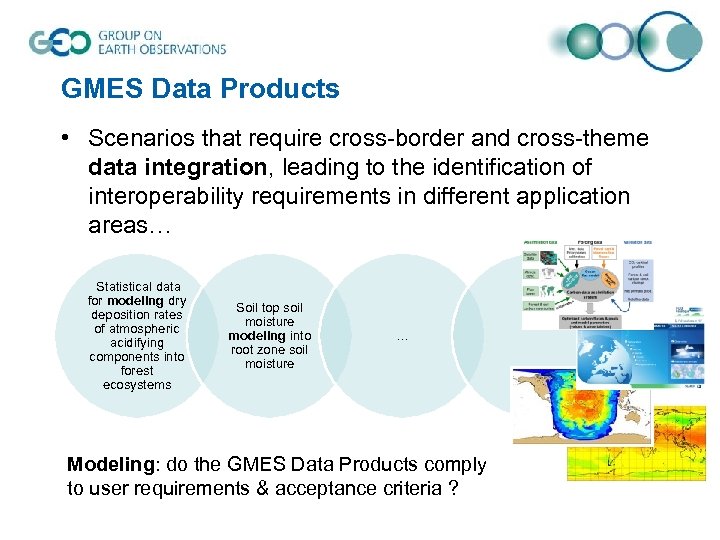 GMES Data Products • Scenarios that require cross-border and cross-theme data integration, leading to the identification of interoperability requirements in different application areas… Statistical data for modeling dry deposition rates of atmospheric acidifying components into forest ecosystems Soil top soil moisture modeling into root zone soil moisture … Modeling: do the GMES Data Products comply to user requirements & acceptance criteria ?
 INSPIRE Data Usability (GIS 4 EU)
 QA 4 EO for GEO • QA 4 EO was developed to meet the current and aspirational needs of the societal themes of the Group on Earth Observation (GEO)’s Global Earth Observation System of Systems (GEOSS) • It was prepared as a direct response to GEO task DA -06 -02 (now DA-09 -01 a) to “Develop a GEO data quality assurance strategy” • It is beginning with space-based observations, and evaluating expansion to in situ observations, taking account of existing work in this arena”
 QA 4 EO Workshop Sessions 2 -4 • « QA 4 EO and GEO » assets: • Quality assurance process • Metrology domain to be extended towards GEO SBAs • Roles for Data harmonization / Data interoperability • End to end process to identify open issues – QA 4 EO seen as a ‘badge/stamp’ – first a questionnaire to assess and auto-declare conformance – then possibly an audit process
 3) Data Harmonization & AIP-3 results An overview
 GEO Task AR-09 -01 b Architecture Implementation Pilot • Develop and pilot new process and infrastructure components for the GCI and the broader GEOSS architecture • Continuation of existing efforts, e. g. , IP 3, and new activities solicited through Calls for Participation (CFPs) “fostering interoperability arrangements and common practices for GEOSS”
 GEOSS Interoperability Arrangements - From the GEOSS 10 Year Plan Reference Document - • Interoperability through open interfaces – Interoperability specifications agreed to among contributing systems – Access to data and information through service interfaces • Open standards and intellectual property rights – GEOSS adopting standards; agreed upon by consensus, preference to formal international standards – GEOSS will not require commercial or proprietary standards – Multiple software implementations compliant with the open standards should exist – Goal is that at least one of the implementations should be available to all implementers "royalty-free"
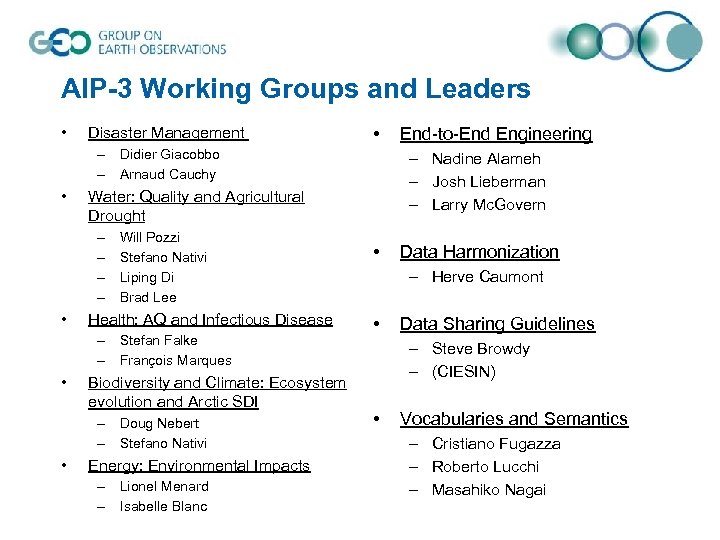 AIP-3 Working Groups and Leaders • Disaster Management • – Didier Giacobbo – Arnaud Cauchy • • Will Pozzi Stefano Nativi Liping Di Brad Lee Health: AQ and Infectious Disease – Stefan Falke – François Marques • Biodiversity and Climate: Ecosystem evolution and Arctic SDI – Doug Nebert – Stefano Nativi • – Nadine Alameh – Josh Lieberman – Larry Mc. Govern Water: Quality and Agricultural Drought – – Energy: Environmental Impacts – Lionel Menard – Isabelle Blanc End-to-End Engineering • Data Harmonization – Herve Caumont • Data Sharing Guidelines – Steve Browdy – (CIESIN) • Vocabularies and Semantics – Cristiano Fugazza – Roberto Lucchi – Masahiko Nagai
 AIP-3 results overview Data Sharing WG Semantics WG Steve Browdy, IEEE Cristiano Fugazza, JRC
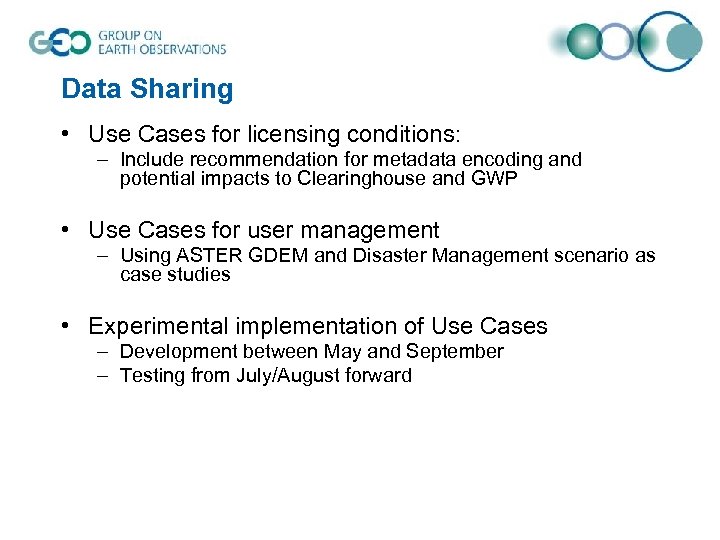 Data Sharing • Use Cases for licensing conditions: – Include recommendation for metadata encoding and potential impacts to Clearinghouse and GWP • Use Cases for user management – Using ASTER GDEM and Disaster Management scenario as case studies • Experimental implementation of Use Cases – Development between May and September – Testing from July/August forward
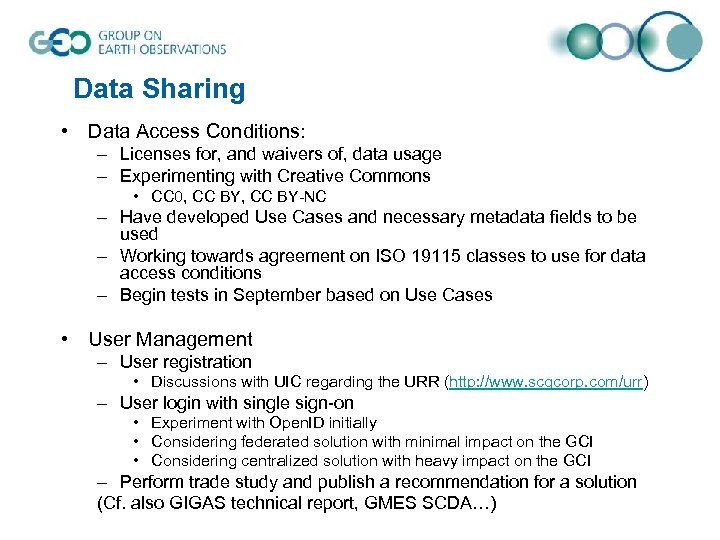 Data Sharing • Data Access Conditions: – Licenses for, and waivers of, data usage – Experimenting with Creative Commons • CC 0, CC BY-NC – Have developed Use Cases and necessary metadata fields to be used – Working towards agreement on ISO 19115 classes to use for data access conditions – Begin tests in September based on Use Cases • User Management – User registration • Discussions with UIC regarding the URR (http: //www. scgcorp. com/urr) – User login with single sign-on • Experiment with Open. ID initially • Considering federated solution with minimal impact on the GCI • Considering centralized solution with heavy impact on the GCI – Perform trade study and publish a recommendation for a solution (Cf. also GIGAS technical report, GMES SCDA…)
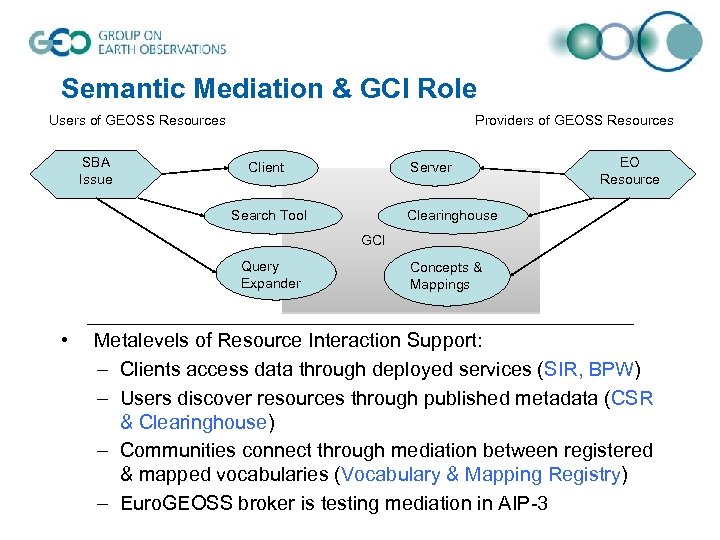 Semantic Mediation & GCI Role Users of GEOSS Resources SBA Issue Providers of GEOSS Resources Client Server Search Tool EO Resource Clearinghouse GCI Query Expander • Concepts & Mappings Metalevels of Resource Interaction Support: – Clients access data through deployed services (SIR, BPW) – Users discover resources through published metadata (CSR & Clearinghouse) – Communities connect through mediation between registered & mapped vocabularies (Vocabulary & Mapping Registry) – Euro. GEOSS broker is testing mediation in AIP-3
 AIP-3 results overview Data Harmonization WG Contribution from the GIGAS Project Andrew Woolf, Clemens Portele, Simon Cox
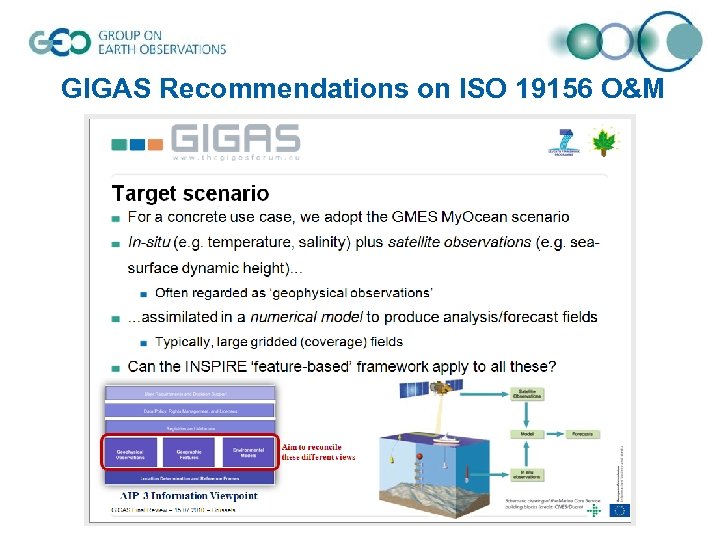 GIGAS Recommendations on ISO 19156 O&M
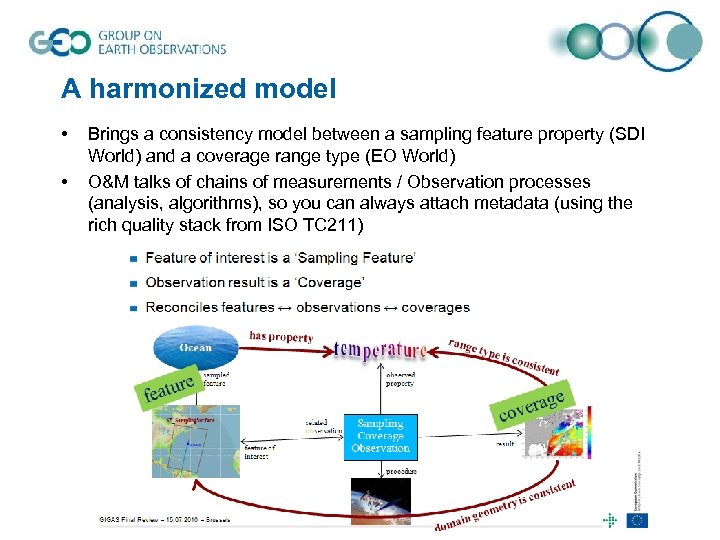 A harmonized model • • Brings a consistency model between a sampling feature property (SDI World) and a coverage range type (EO World) O&M talks of chains of measurements / Observation processes (analysis, algorithms), so you can always attach metadata (using the rich quality stack from ISO TC 211)
 AIP-3 results overview Data Harmonization Working Group Aston University & Uncert. Web project Dan Cornford
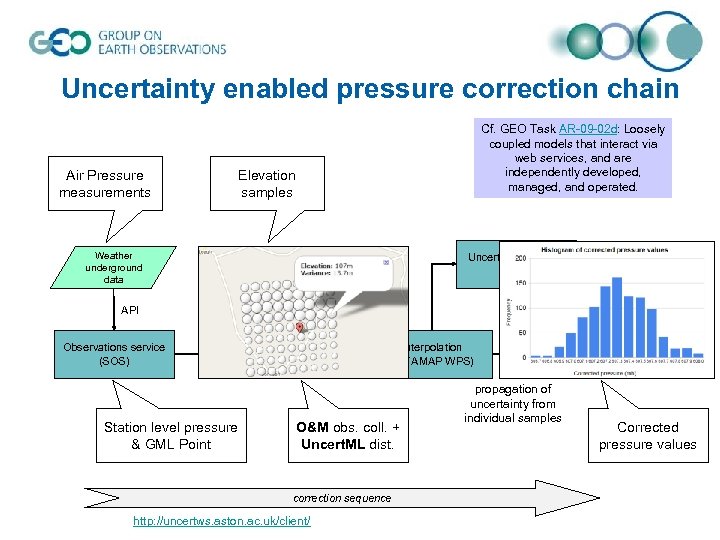 Uncertainty enabled pressure correction chain Air Pressure measurements Cf. GEO Task AR-09 -02 d: Loosely coupled models that interact via web services, and are independently developed, managed, and operated. Elevation samples Weather underground data SRTM Digital Elevation Model Uncert. ML translator (WPS) API Observations service (SOS) Elevation sampling (WPS) Station level pressure & GML Point Interpolation (INTAMAP WPS) O&M obs. coll. + Uncert. ML dist. correction sequence http: //uncertws. aston. ac. uk/client/ Pressure correction (WPS) propagation of uncertainty from individual samples Corrected pressure values
 AIP-3 results Air Quality Working Group Contribution from University of Muenster
 Air Quality working group
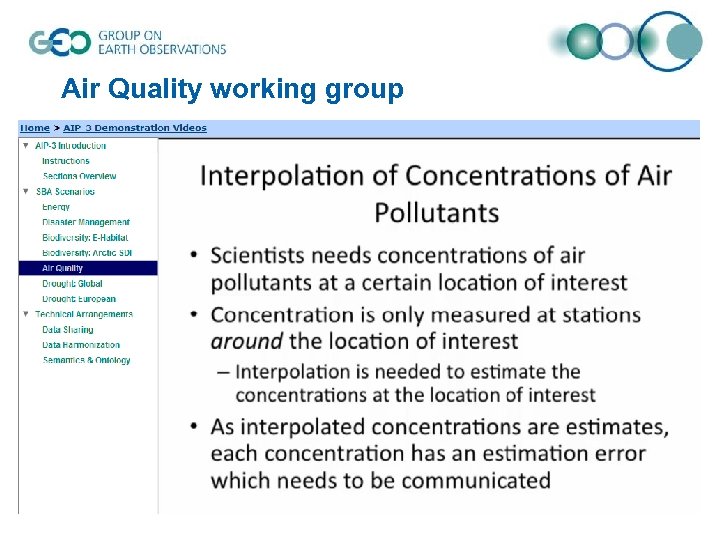
 Workflow • Interpolation is needed to estimate the concentrations of polluants at some points of interest • Interpolated concentrations are thus estimates. Estimation errors need also to be communicated. • An interpolation Web Processing Service is demonstrated • Several uncertainty types, like quantiles, which shall be returned, can be specified in the request
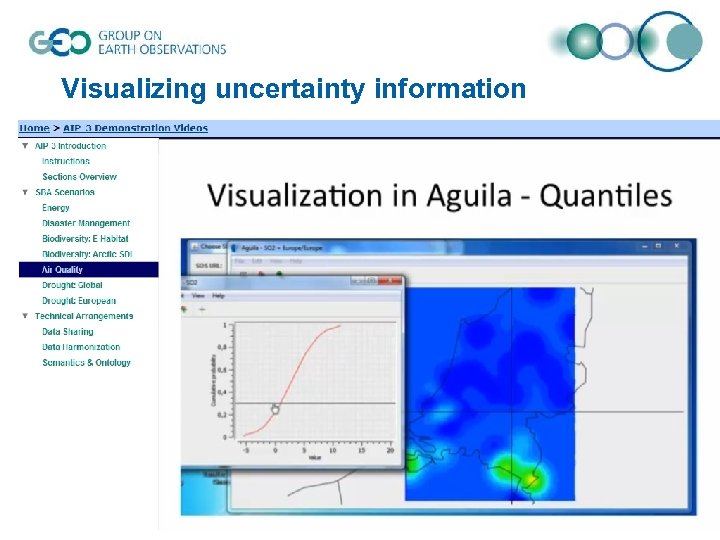 Visualizing uncertainty information
 AIP-3 results Energy Working Group Contribution from GENESIS project Lionel Menard, Mines Paris. Tech
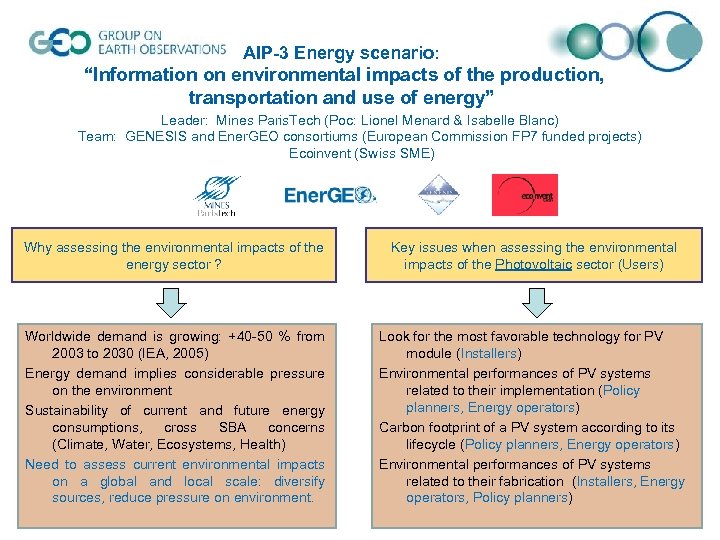 AIP-3 Energy scenario: “Information on environmental impacts of the production, transportation and use of energy” Leader: Mines Paris. Tech (Poc: Lionel Menard & Isabelle Blanc) Team: GENESIS and Ener. GEO consortiums (European Commission FP 7 funded projects) Ecoinvent (Swiss SME) Why assessing the environmental impacts of the energy sector ? Key issues when assessing the environmental impacts of the Photovoltaic sector (Users) Worldwide demand is growing: +40 -50 % from 2003 to 2030 (IEA, 2005) Energy demand implies considerable pressure on the environment Sustainability of current and future energy consumptions, cross SBA concerns (Climate, Water, Ecosystems, Health) Need to assess current environmental impacts on a global and local scale: diversify sources, reduce pressure on environment. Look for the most favorable technology for PV module (Installers) Environmental performances of PV systems related to their implementation (Policy planners, Energy operators) Carbon footprint of a PV system according to its lifecycle (Policy planners, Energy operators) Environmental performances of PV systems related to their fabrication (Installers, Energy operators, Policy planners)
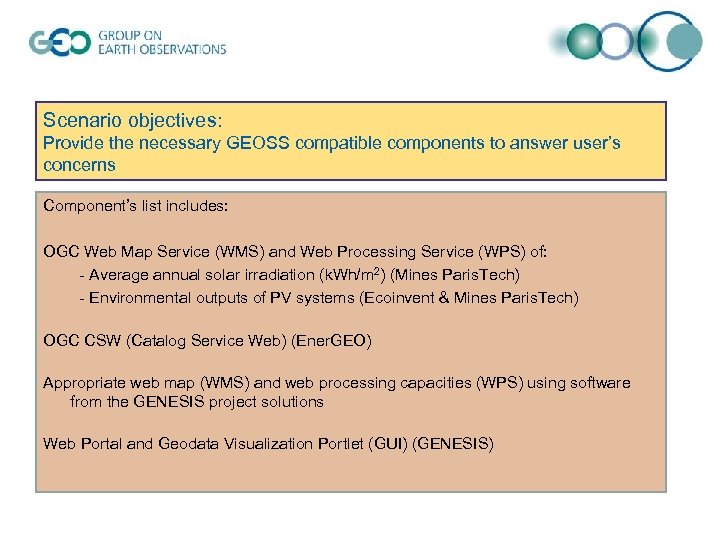 Scenario objectives: Provide the necessary GEOSS compatible components to answer user’s concerns Component’s list includes: OGC Web Map Service (WMS) and Web Processing Service (WPS) of: - Average annual solar irradiation (k. Wh/m 2) (Mines Paris. Tech) - Environmental outputs of PV systems (Ecoinvent & Mines Paris. Tech) OGC CSW (Catalog Service Web) (Ener. GEO) Appropriate web map (WMS) and web processing capacities (WPS) using software from the GENESIS project solutions Web Portal and Geodata Visualization Portlet (GUI) (GENESIS)
 Uncertainty management issues • The data resulting from processing are themselves used as observations • It could be outputs of photovoltaic systems or environmental impact indicators • In most cases, there is a need to validate (calibrate) against measurements (truth), and derive from that assessments of uncertainty • The major difficulty is having confidence in the measurements, and challenge is to use them to offer EO-derived products with "known" quality
 Energy WG findings to-date • Moved from W 3 C W*S to OGC W*S to leverage future use of resources – Transition first dreaded by proved easier than expected – Main obstacle: misunderstanding of interoperability concepts and benefits – Genesis Toolbox used (including OGC WPS) will be available free of charge under open source license • Process of registering community catalog into GEOSS harder than expected – Issues still ongoing (harvesting demands delay, discrepancies in query results between new and old resources harvested, duplication of records, etc) – Process should be improved and automated • More documentation is needed – Formal, long, detailed documentation as well as – Short, sharp, targeted simple topic videos (how to deploy your resource; how to register your resource; how to create your metadata, etc)
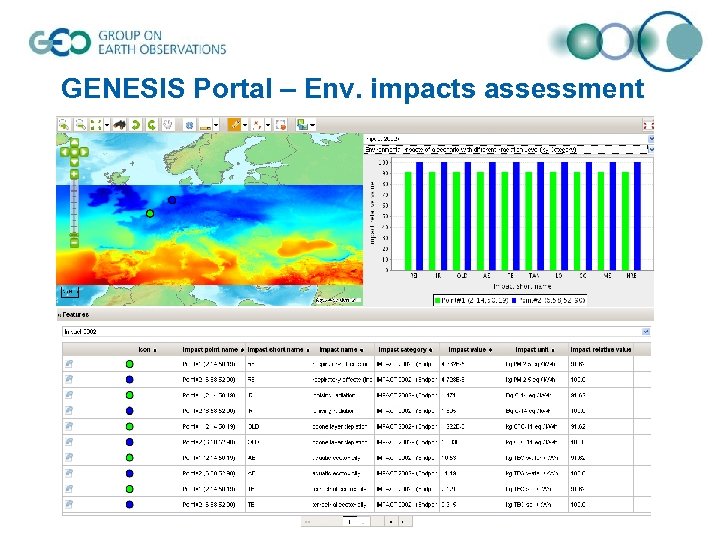 GENESIS Portal – Env. impacts assessment
 Conclusions
 AIP-3 Deliverables - 2010 • Demonstration – Demonstration of community Scenarios implemented through transverse Use Cases – Demonstrations recorded and made available via WWW • Engineering Reports To be posted in GEOSS Best Practice Wiki – Community of Practice Scenarios – Transverse Technology Use Cases – AIP-3 Summary Report • Registered Services and Components – Consolidate and increase the number of services and components registered in CSR – Support of the GEOSS operational task (AR-09 -01 a)
 References • GEO – earthobservations. org • GEO Architecture Implementation Pilot – www. ogcnetwork. net/AIpilot • GEOSS registries and SIF – geossregistries. info George Percivall percivall@myogc. org
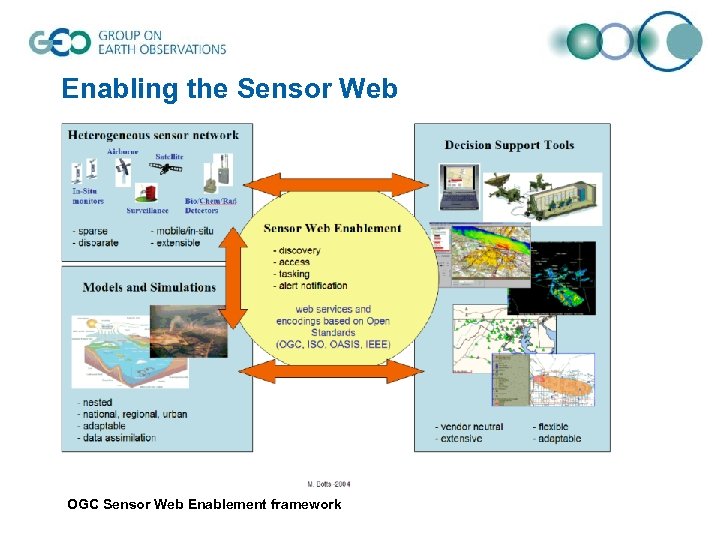 Enabling the Sensor Web OGC Sensor Web Enablement framework
 GEOSS Common Infrastructure