 Скачать презентацию Geospatial Semantic Web Is there life after geo
c7350bb63b483af3c5a1f6078726e417.ppt
- Количество слайдов: 28



Geospatial Semantic Web: Is there life after geo: lat and geo: long ? Joshua Lieberman Traverse Technologies & Open Geospatial Consortium European Geoinformatics Workshop, March 2007 jlieberman@traversetechnologies. com
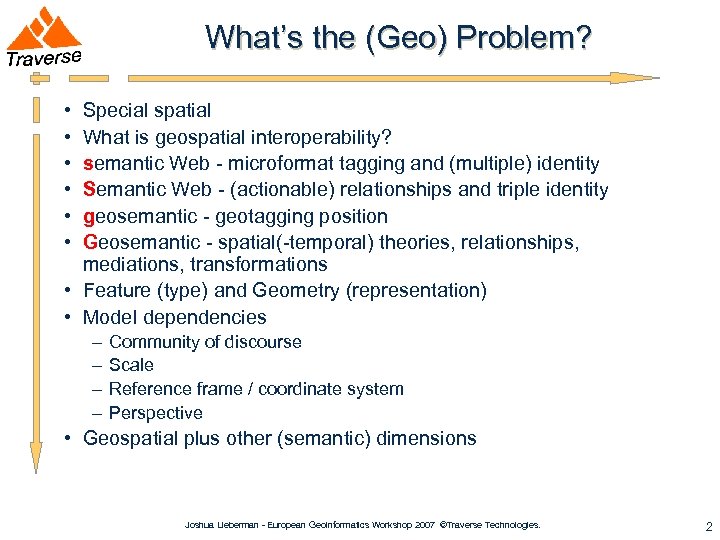
What’s the (Geo) Problem? • • • Special spatial What is geospatial interoperability? semantic Web - microformat tagging and (multiple) identity Semantic Web - (actionable) relationships and triple identity geosemantic - geotagging position Geosemantic - spatial(-temporal) theories, relationships, mediations, transformations • Feature (type) and Geometry (representation) • Model dependencies – – Community of discourse Scale Reference frame / coordinate system Perspective • Geospatial plus other (semantic) dimensions Joshua Lieberman - European Geoinformatics Workshop 2007 ©Traverse Technologies. 2
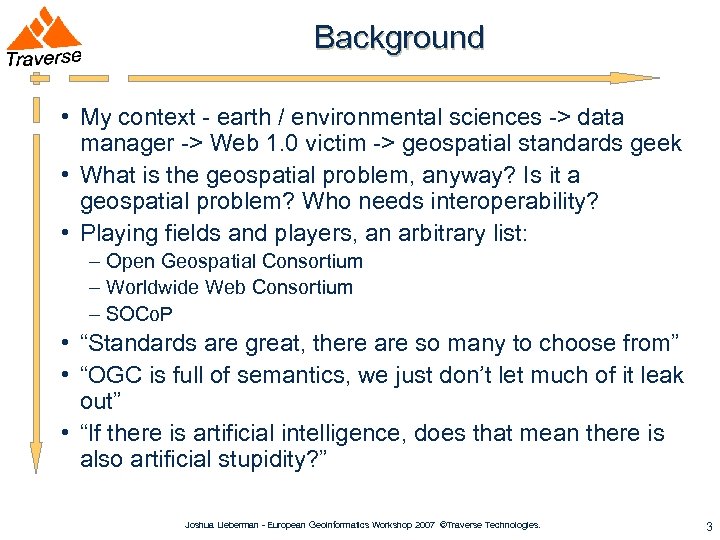
Background • My context - earth / environmental sciences -> data manager -> Web 1. 0 victim -> geospatial standards geek • What is the geospatial problem, anyway? Is it a geospatial problem? Who needs interoperability? • Playing fields and players, an arbitrary list: – Open Geospatial Consortium – Worldwide Web Consortium – SOCo. P • “Standards are great, there are so many to choose from” • “OGC is full of semantics, we just don’t let much of it leak out” • “If there is artificial intelligence, does that mean there is also artificial stupidity? ” Joshua Lieberman - European Geoinformatics Workshop 2007 ©Traverse Technologies. 3
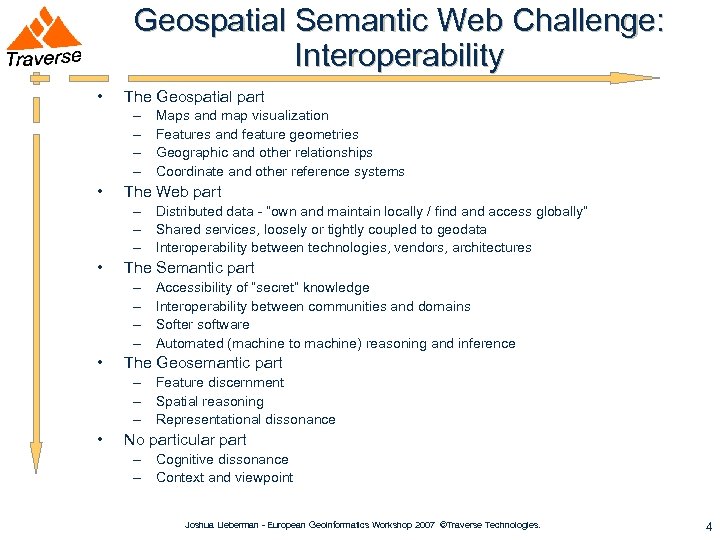
Geospatial Semantic Web Challenge: Interoperability • The Geospatial part – – • Maps and map visualization Features and feature geometries Geographic and other relationships Coordinate and other reference systems The Web part – Distributed data - “own and maintain locally / find access globally” – Shared services, loosely or tightly coupled to geodata – Interoperability between technologies, vendors, architectures • The Semantic part – – • Accessibility of “secret” knowledge Interoperability between communities and domains Softer software Automated (machine to machine) reasoning and inference The Geosemantic part – Feature discernment – Spatial reasoning – Representational dissonance • No particular part – Cognitive dissonance – Context and viewpoint Joshua Lieberman - European Geoinformatics Workshop 2007 ©Traverse Technologies. 4
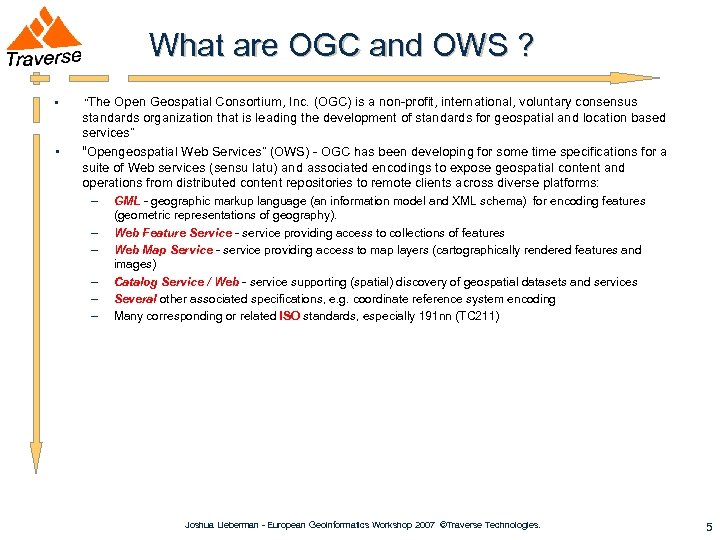
What are OGC and OWS ? • • “The Open Geospatial Consortium, Inc. (OGC) is a non-profit, international, voluntary consensus standards organization that is leading the development of standards for geospatial and location based services” “Opengeospatial Web Services” (OWS) - OGC has been developing for some time specifications for a suite of Web services (sensu latu) and associated encodings to expose geospatial content and operations from distributed content repositories to remote clients across diverse platforms: – GML - geographic markup language (an information model and XML schema) for encoding features – – – (geometric representations of geography). Web Feature Service - service providing access to collections of features Web Map Service - service providing access to map layers (cartographically rendered features and images) Catalog Service / Web - service supporting (spatial) discovery of geospatial datasets and services Several other associated specifications, e. g. coordinate reference system encoding Many corresponding or related ISO standards, especially 191 nn (TC 211) Joshua Lieberman - European Geoinformatics Workshop 2007 ©Traverse Technologies. 5
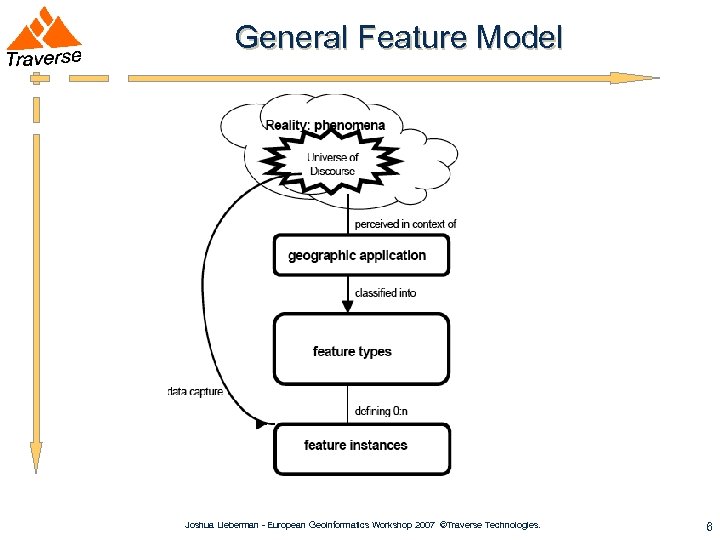
General Feature Model Joshua Lieberman - European Geoinformatics Workshop 2007 ©Traverse Technologies. 6
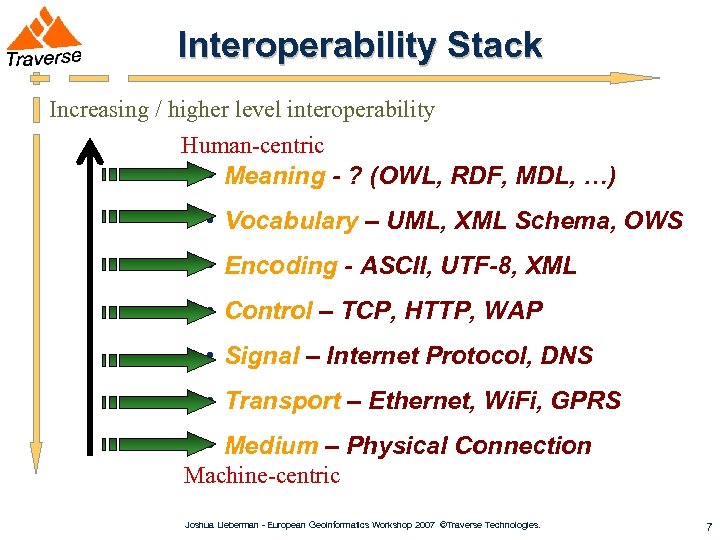
Interoperability Stack Increasing / higher level interoperability Human-centric • Meaning - ? (OWL, RDF, MDL, …) • Vocabulary – UML, XML Schema, OWS • Encoding - ASCII, UTF-8, XML • Control – TCP, HTTP, WAP • Signal – Internet Protocol, DNS • Transport – Ethernet, Wi. Fi, GPRS • Medium – Physical Connection Machine-centric Joshua Lieberman - European Geoinformatics Workshop 2007 ©Traverse Technologies. 7
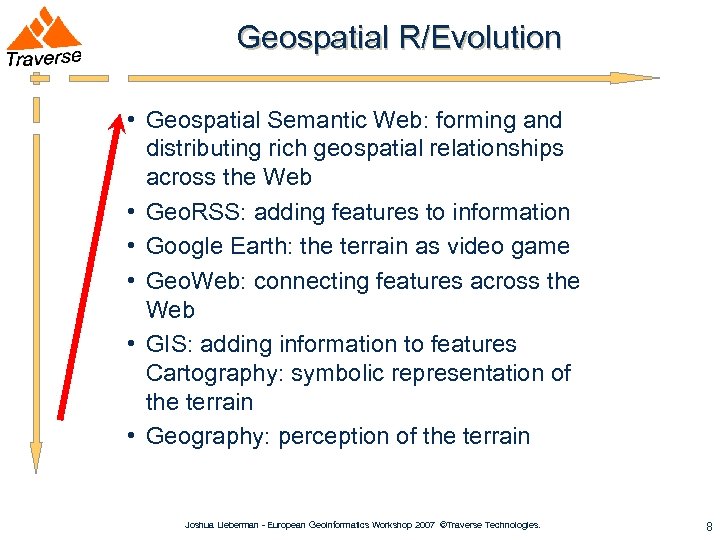
Geospatial R/Evolution • Geospatial Semantic Web: forming and distributing rich geospatial relationships across the Web • Geo. RSS: adding features to information • Google Earth: the terrain as video game • Geo. Web: connecting features across the Web • GIS: adding information to features Cartography: symbolic representation of the terrain • Geography: perception of the terrain Joshua Lieberman - European Geoinformatics Workshop 2007 ©Traverse Technologies. 8
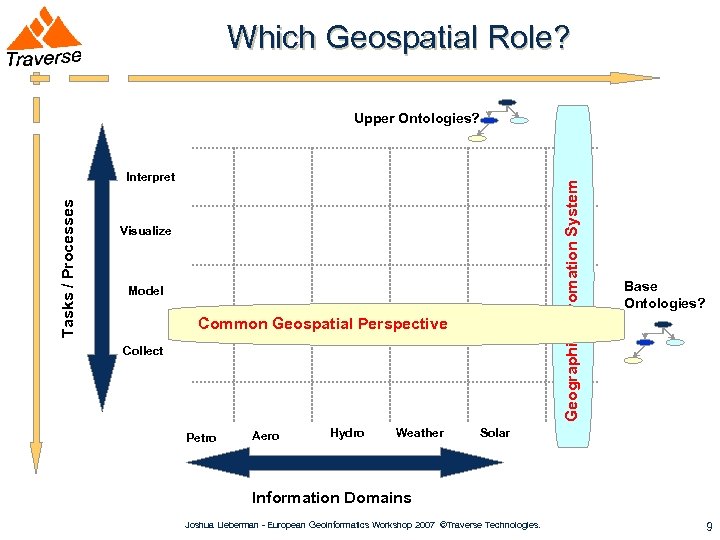
Which Geospatial Role? Upper Ontologies? Geographic Infromation System Tasks / Processes Interpret Visualize Model Common Geospatial Perspective Collect Petro Aero Hydro Weather Solar Base Ontologies? Geo Information Domains Joshua Lieberman - European Geoinformatics Workshop 2007 ©Traverse Technologies. 9
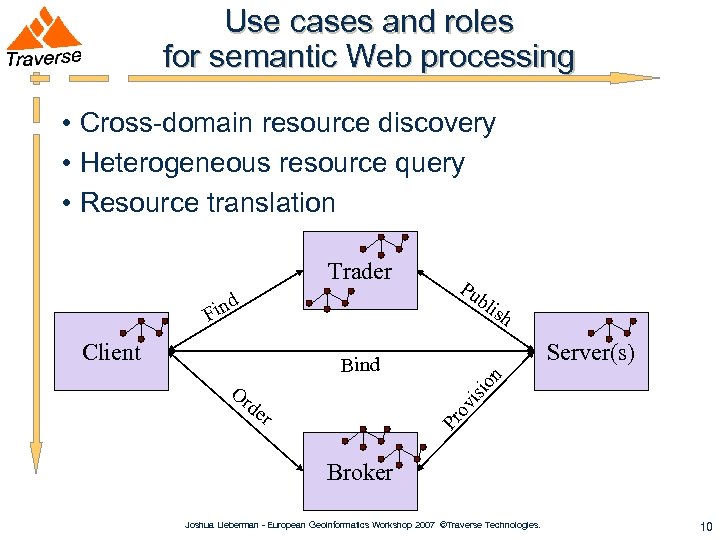
Use cases and roles for semantic Web processing • Cross-domain resource discovery • Heterogeneous resource query • Resource translation Trader Pu bli d Fin Client Server(s) isi on Bind Or sh ov de Pr r Broker Joshua Lieberman - European Geoinformatics Workshop 2007 ©Traverse Technologies. 10
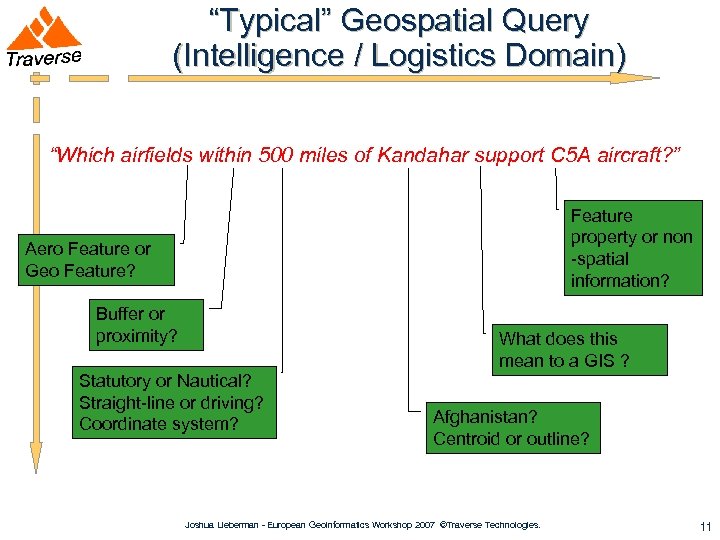
“Typical” Geospatial Query (Intelligence / Logistics Domain) “Which airfields within 500 miles of Kandahar support C 5 A aircraft? ” Feature property or non -spatial information? Aero Feature or Geo Feature? Buffer or proximity? What does this mean to a GIS ? Statutory or Nautical? Straight-line or driving? Coordinate system? Afghanistan? Centroid or outline? Joshua Lieberman - European Geoinformatics Workshop 2007 ©Traverse Technologies. 11
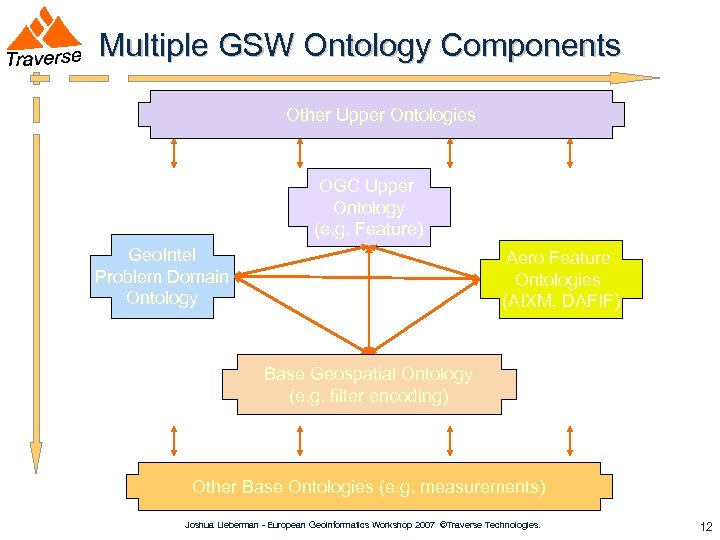
Multiple GSW Ontology Components Other Upper Ontologies OGC Upper Ontology (e. g. Feature) Geo. Intel Problem Domain Ontology Aero Feature Ontologies (AIXM, DAFIF) Base Geospatial Ontology (e. g. filter encoding) Other Base Ontologies (e. g. measurements) Joshua Lieberman - European Geoinformatics Workshop 2007 ©Traverse Technologies. 12
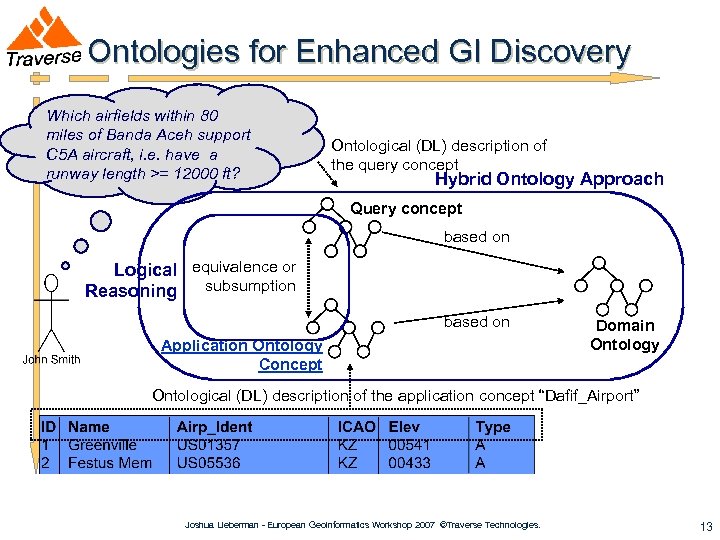
Ontologies for Enhanced GI Discovery Which airfields within 80 miles of Banda Aceh support C 5 A aircraft, i. e. have a runway length >= 12000 ft? Ontological (DL) description of the query concept Hybrid Ontology Approach Query concept based on Logical equivalence or subsumption Reasoning based on Application Ontology Concept Domain Ontology Ontological (DL) description of the application concept “Dafif_Airport” Joshua Lieberman - European Geoinformatics Workshop 2007 ©Traverse Technologies. 13
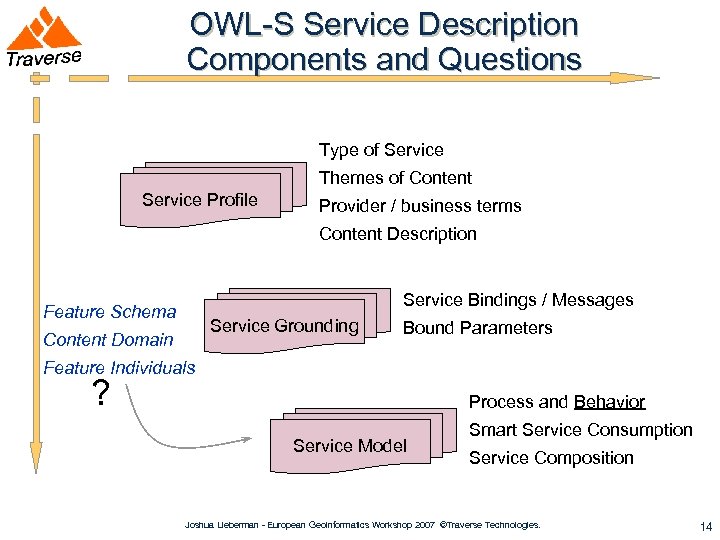
OWL-S Service Description Components and Questions Type of Service Themes of Content Service Profile Provider / business terms Content Description Service Bindings / Messages Feature Schema Service Grounding Content Domain Bound Parameters Feature Individuals ? Process and Behavior Service Model Smart Service Consumption Service Composition Joshua Lieberman - European Geoinformatics Workshop 2007 ©Traverse Technologies. 14
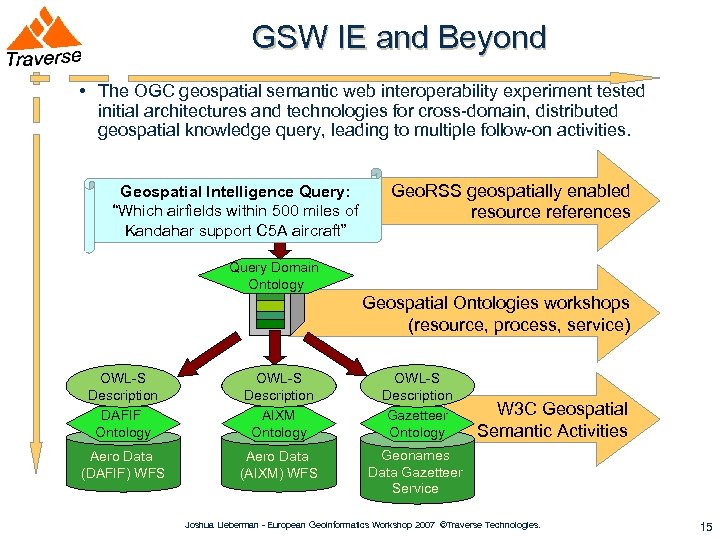
GSW IE and Beyond • The OGC geospatial semantic web interoperability experiment tested initial architectures and technologies for cross-domain, distributed geospatial knowledge query, leading to multiple follow-on activities. Geospatial Intelligence Query: “Which airfields within 500 miles of Kandahar support C 5 A aircraft” Geo. RSS geospatially enabled resource references Query Domain Ontology Geospatial Ontologies workshops (resource, process, service) OWL-S Description DAFIF Ontology OWL-S Description AIXM Ontology OWL-S Description Gazetteer Ontology Aero Data (DAFIF) WFS Aero Data (AIXM) WFS Geonames Data Gazetteer Service W 3 C Geospatial Semantic Activities Joshua Lieberman - European Geoinformatics Workshop 2007 ©Traverse Technologies. 15
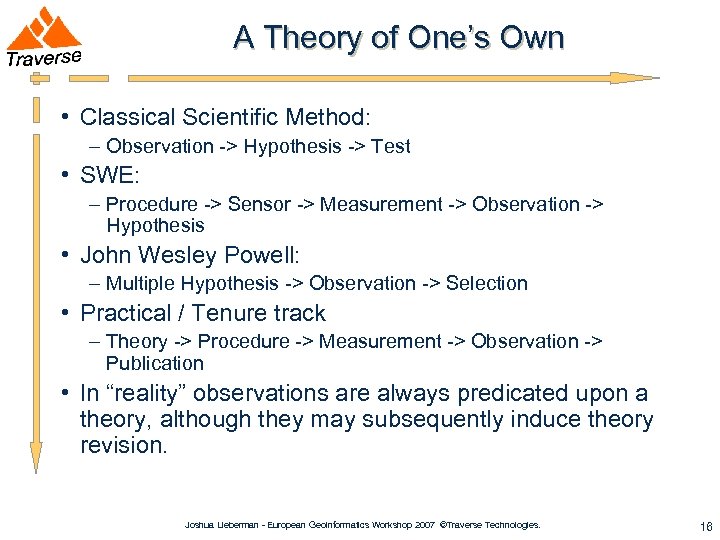
A Theory of One’s Own • Classical Scientific Method: – Observation -> Hypothesis -> Test • SWE: – Procedure -> Sensor -> Measurement -> Observation -> Hypothesis • John Wesley Powell: – Multiple Hypothesis -> Observation -> Selection • Practical / Tenure track – Theory -> Procedure -> Measurement -> Observation -> Publication • In “reality” observations are always predicated upon a theory, although they may subsequently induce theory revision. Joshua Lieberman - European Geoinformatics Workshop 2007 ©Traverse Technologies. 16
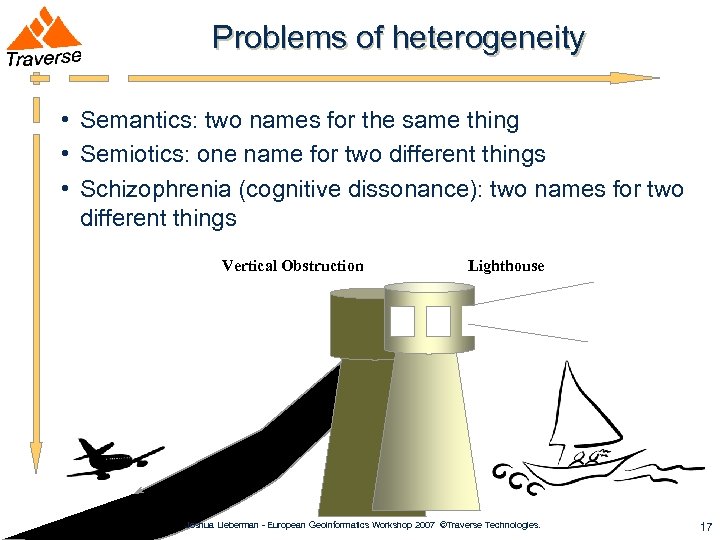
Problems of heterogeneity • Semantics: two names for the same thing • Semiotics: one name for two different things • Schizophrenia (cognitive dissonance): two names for two different things Vertical Obstruction Lighthouse Joshua Lieberman - European Geoinformatics Workshop 2007 ©Traverse Technologies. 17
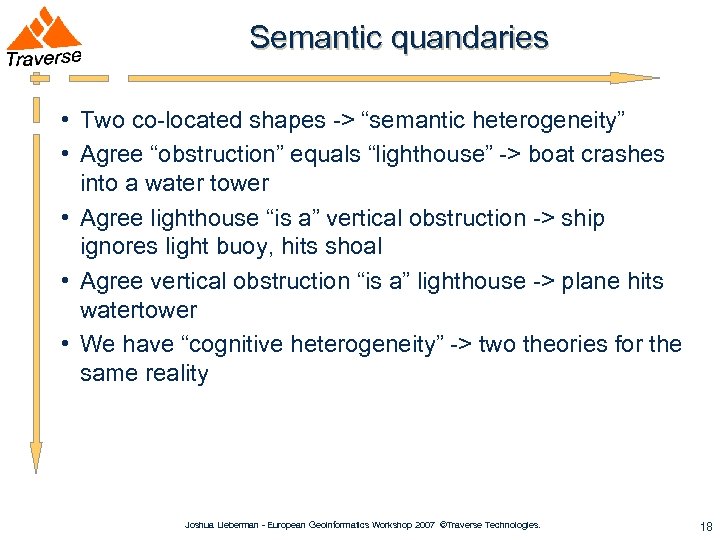
Semantic quandaries • Two co-located shapes -> “semantic heterogeneity” • Agree “obstruction” equals “lighthouse” -> boat crashes into a water tower • Agree lighthouse “is a” vertical obstruction -> ship ignores light buoy, hits shoal • Agree vertical obstruction “is a” lighthouse -> plane hits watertower • We have “cognitive heterogeneity” -> two theories for the same reality Joshua Lieberman - European Geoinformatics Workshop 2007 ©Traverse Technologies. 18
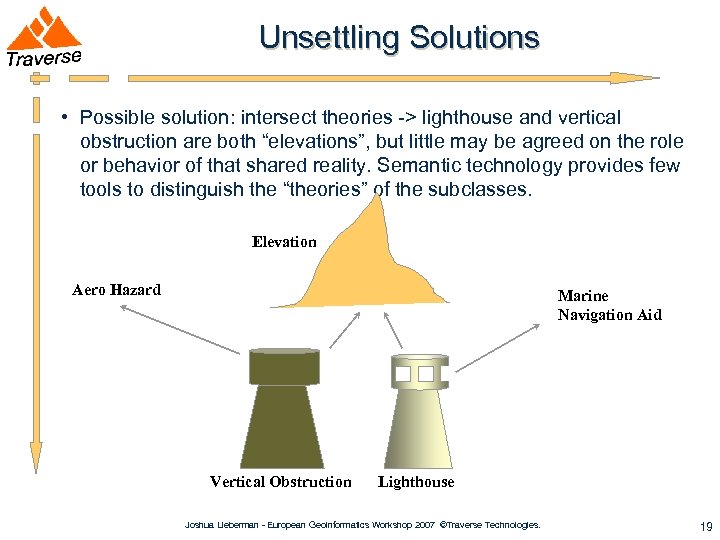
Unsettling Solutions • Possible solution: intersect theories -> lighthouse and vertical obstruction are both “elevations”, but little may be agreed on the role or behavior of that shared reality. Semantic technology provides few tools to distinguish the “theories” of the subclasses. Elevation Aero Hazard Marine Navigation Aid Vertical Obstruction Lighthouse Joshua Lieberman - European Geoinformatics Workshop 2007 ©Traverse Technologies. 19
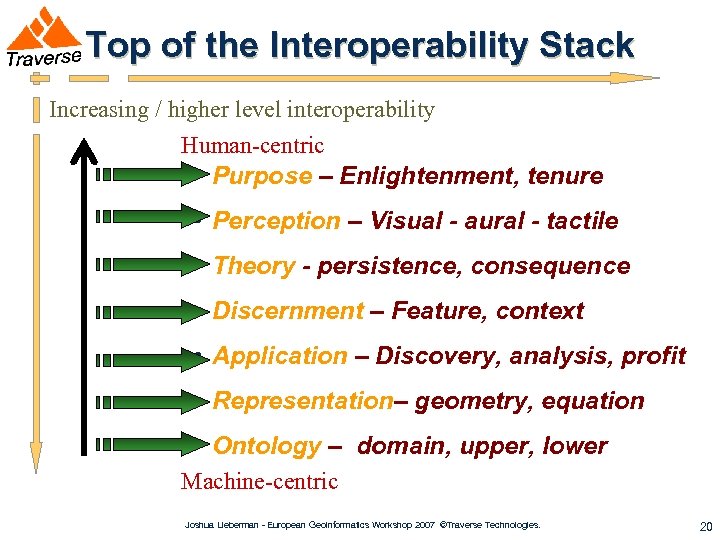
Top of the Interoperability Stack Increasing / higher level interoperability Human-centric • Purpose – Enlightenment, tenure • Perception – Visual - aural - tactile • Theory - persistence, consequence • Discernment – Feature, context • Application – Discovery, analysis, profit • Representation– geometry, equation • Ontology – domain, upper, lower Machine-centric Joshua Lieberman - European Geoinformatics Workshop 2007 ©Traverse Technologies. 20
W 3 C Geo XG • W 3 C Geospatial Incubator is a new type of activity for short-term and/or startup goals • The (proposed) Geo XG has three objectives which address needs of the Local Web: – Immediate: update and harmonization with Geo. RSS of the W 3 C Basic Geo vocabulary, aka simpler than possible geospatial ontology. – Short Term: draft recommendations for a geospatial ontology focused on Web resources and tasks. – Longer Term: draft a charter for a proposed W 3 C Local Web WG and/or IG to address issues beginning with geotags and continuing towards geospatial enablement of the Semantic Web. • Largely open to public participation • Chartered until June 2007 • http: //www. w 3. org/2005//Incubator/geo/ Joshua Lieberman - European Geoinformatics Workshop 2007 ©Traverse Technologies. 21
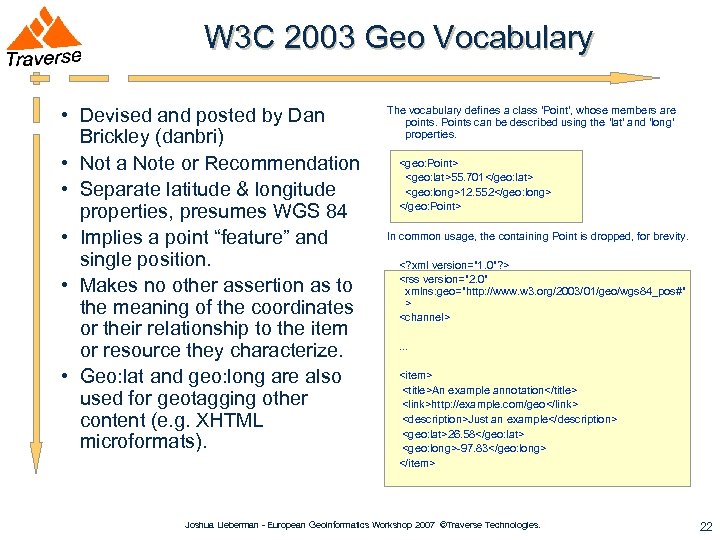
W 3 C 2003 Geo Vocabulary • Devised and posted by Dan Brickley (danbri) • Not a Note or Recommendation • Separate latitude & longitude properties, presumes WGS 84 • Implies a point “feature” and single position. • Makes no other assertion as to the meaning of the coordinates or their relationship to the item or resource they characterize. • Geo: lat and geo: long are also used for geotagging other content (e. g. XHTML microformats). The vocabulary defines a class 'Point', whose members are points. Points can be described using the 'lat' and 'long' properties. <geo: Point> <geo: lat>55. 701</geo: lat> <geo: long>12. 552</geo: long> </geo: Point> In common usage, the containing Point is dropped, for brevity. <? xml version="1. 0"? > <rss version="2. 0" xmlns: geo="http: //www. w 3. org/2003/01/geo/wgs 84_pos#" > <channel>. . . <item> <title>An example annotation</title> <link>http: //example. com/geo</link> <description>Just an example</description> <geo: lat>26. 58</geo: lat> <geo: long>-97. 83</geo: long> </item> Joshua Lieberman - European Geoinformatics Workshop 2007 ©Traverse Technologies. 22
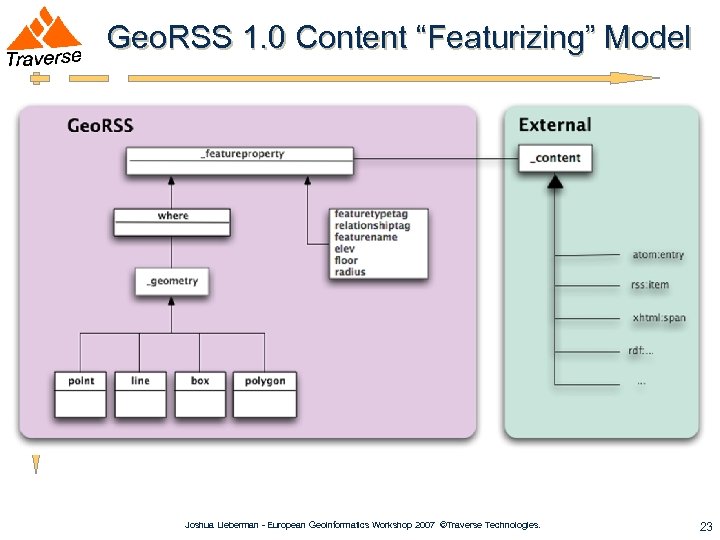
Geo. RSS 1. 0 Content “Featurizing” Model Joshua Lieberman - European Geoinformatics Workshop 2007 ©Traverse Technologies. 23
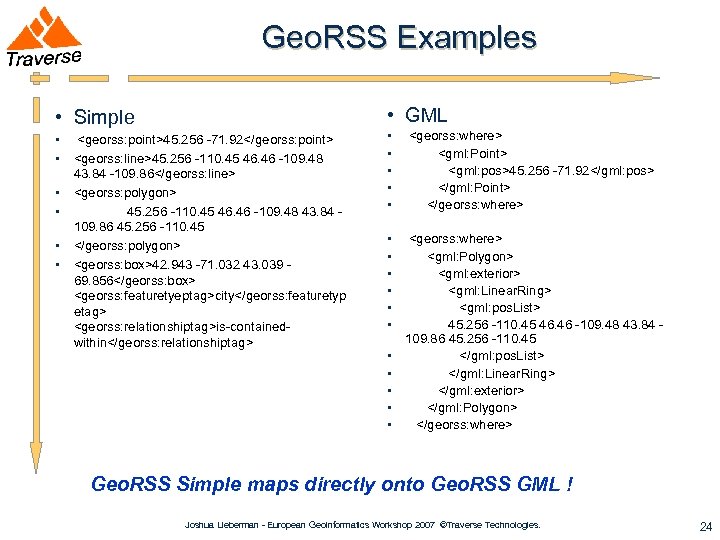
Geo. RSS Examples • Simple • GML • • <georss: where> <gml: Point> <gml: pos>45. 256 -71. 92</gml: pos> </gml: Point> </georss: where> • • • <georss: where> <gml: Polygon> <gml: exterior> <gml: Linear. Ring> <gml: pos. List> 45. 256 -110. 45 46. 46 -109. 48 43. 84 109. 86 45. 256 -110. 45 </gml: pos. List> </gml: Linear. Ring> </gml: exterior> </gml: Polygon> </georss: where> • • <georss: point>45. 256 -71. 92</georss: point> <georss: line>45. 256 -110. 45 46. 46 -109. 48 43. 84 -109. 86</georss: line> <georss: polygon> 45. 256 -110. 45 46. 46 -109. 48 43. 84 109. 86 45. 256 -110. 45 </georss: polygon> <georss: box>42. 943 -71. 032 43. 039 69. 856</georss: box> <georss: featuretyeptag>city</georss: featuretyp etag> <georss: relationshiptag>is-containedwithin</georss: relationshiptag> • • • Geo. RSS Simple maps directly onto Geo. RSS GML ! Joshua Lieberman - European Geoinformatics Workshop 2007 ©Traverse Technologies. 24
SOCo. P: Spatial Ontology Community of Practice • SOCo. P is chartered as a Community of Practice under the Best Practices Committee of the Federal CIO Council. • Charter: The strict purpose and focus of the Spatial Ontology Community of Practice (SOCo. P) is to foster collaboration among researchers, technologists & users of spatial knowledge representations and reasoning towards the development of a set of core, common spatial ontologies for use by all in the Semantic Web. As a Community of Practice SOCo. P using open collaboration and open standards, SOCo. P developed ontologies will offer increased interoperability of spatial data across government (via synchronization with Geospatial Profile of FEA & Geo. LOB) as well as across the entire spectrum of the World Wide Web (via W 3 C, ISO, OGC, etc. ). SOCo. P represents a strategic investment for ontology development, building on core ontological competencies, documenting best practices, and creating opportunities to partner with other cross domain and ontology COP groups. Among other things SOCo. P can help inventory geospatial ontologies, develop an approach to institutionalizing and streamline the effort to support the development and management of ontologies across the Geo. LOB. Joshua Lieberman - European Geoinformatics Workshop 2007 ©Traverse Technologies. 25
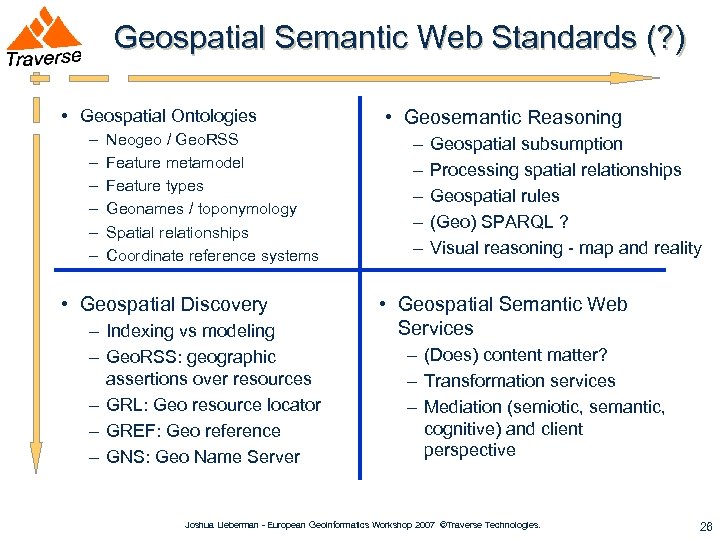
Geospatial Semantic Web Standards (? ) • Geospatial Ontologies – – – Neogeo / Geo. RSS Feature metamodel Feature types Geonames / toponymology Spatial relationships Coordinate reference systems • Geospatial Discovery – Indexing vs modeling – Geo. RSS: geographic assertions over resources – GRL: Geo resource locator – GREF: Geo reference – GNS: Geo Name Server • Geosemantic Reasoning – – – Geospatial subsumption Processing spatial relationships Geospatial rules (Geo) SPARQL ? Visual reasoning - map and reality • Geospatial Semantic Web Services – (Does) content matter? – Transformation services – Mediation (semiotic, semantic, cognitive) and client perspective Joshua Lieberman - European Geoinformatics Workshop 2007 ©Traverse Technologies. 26
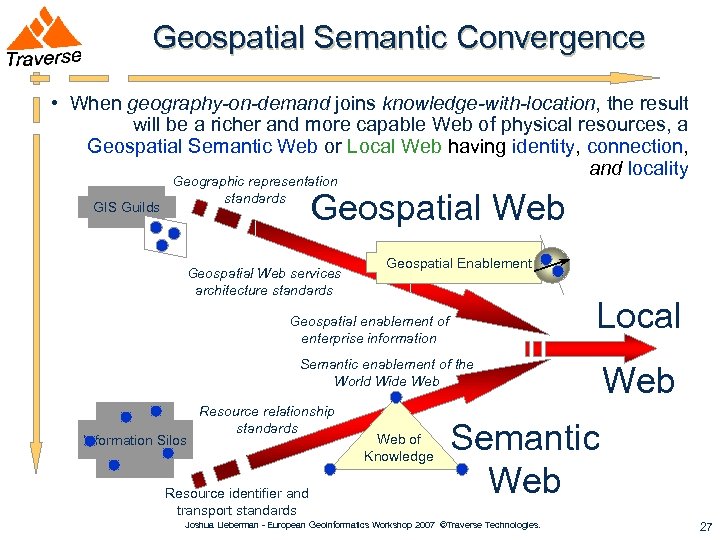
Geospatial Semantic Convergence • When geography-on-demand joins knowledge-with-location, the result will be a richer and more capable Web of physical resources, a Geospatial Semantic Web or Local Web having identity, connection, and locality GIS Guilds Geographic representation standards Geospatial Web services architecture standards Geospatial Enablement Local Geospatial enablement of enterprise information Semantic enablement of the World Wide Web Information Silos Resource relationship standards Resource identifier and transport standards Web of Knowledge Web Semantic Web Joshua Lieberman - European Geoinformatics Workshop 2007 ©Traverse Technologies. 27

What do you see is next?
Скачать презентацию Geospatial Semantic Web Is there life after geo
c7350bb63b483af3c5a1f6078726e417.ppt