 Скачать презентацию Geospatial Line of Business FGDC Steering Committee Meeting
ee22ad4b796b904f3e639b2bf5cb986e.ppt
- Количество слайдов: 19



Geospatial Line of Business FGDC Steering Committee Meeting February 15, 2007
Geospatial Lo. B – Vision and Goals Vision The Nation’s interests are served, and the core missions of Federal agencies and their partners are [met] supported, through the effective and efficient development, provision, and interoperability of geospatial data and services. Goals 1. Productive intergovernmental collaboration for geospatial-related activities and investments across all sectors and levels of government. 2. Optimized and standardized common geospatial functions, services, and processes that are responsive to customers 3. Cost efficient acquisition, processing, and access to geospatial data and information 2
Geo Lo. B Guiding Lights • The Geo Lo. B will pursue efficiencies and standardization of geospatial data and services with a business-driven focus. • Using the Federal Enterprise Architecture (FEA), the Geo Lo. B is identifying opportunities to effectively reduce the cost of government and improve service to citizens through business performance improvements. • The Geo Lo. B will work to develop processes and solutions to support agencies missions by integrating geospatial data with business applications, exponentially improving the value of data analysis and improving decision making. 3
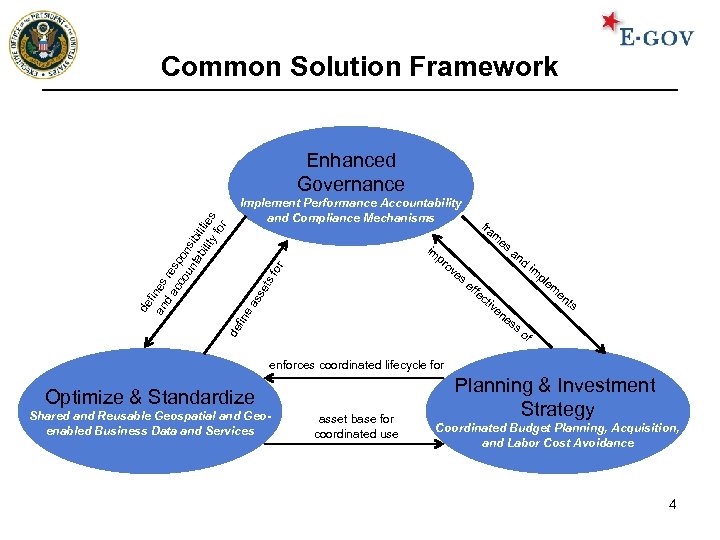
Common Solution Framework Implement Performance Accountability and Compliance Mechanisms fra m es im pr a fo r ov im ets pl em ss ct e a nd es ef fe en ts ive ne ss fin de fi an nes d a re cc spo ou ns nta ib bil ilitie ity s fo r Enhanced Governance de of enforces coordinated lifecycle for Optimize & Standardize Shared and Reusable Geospatial and Geoenabled Business Data and Services asset base for coordinated use Planning & Investment Strategy Coordinated Budget Planning, Acquisition, and Labor Cost Avoidance 4
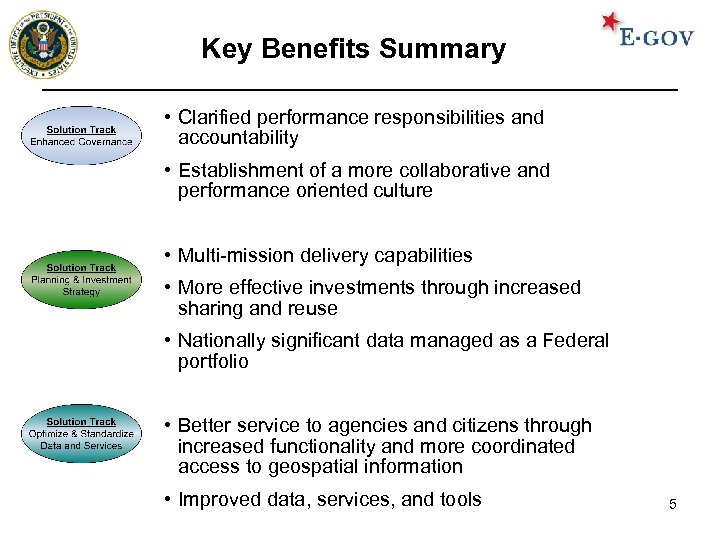
Key Benefits Summary • Clarified performance responsibilities and accountability • Establishment of a more collaborative and performance oriented culture • Multi-mission delivery capabilities • More effective investments through increased sharing and reuse • Nationally significant data managed as a Federal portfolio • Better service to agencies and citizens through increased functionality and more coordinated access to geospatial information • Improved data, services, and tools 5
Geospatial Lo. B Implementation • For Us to be successful We must…. . – have a Common View. . this will improve coordination and decision-making – share information. . we need access and we must eliminate data sharing policy inhibitors – foster interoperability by adhering to the architecture and standards requirements – support the need for speed… in today’s environment silos won’t work. . they are costly and inefficient – update/develop our Strategic plan and a roadmap…leads to a Plan for Action – and lastly…. . we need active engagement from FGDC partners to make the Lo. B a success!!! 6
Geospatial Lo. B Implementation-Workgroups • Current focus of Lo. B efforts: – BDR/Data Call Workgroup. Analyze FY 06 data call and develop a more consistent methodology and enhanced guidance for the FY 07 BDR data collection effort and analysis. • Additional workgroups – Transition Planning. Begin CS/TA transition strategy activities and solution refinement for ’ 07 – Lo. B Business Requirements. Categorize and define requirements by common business areas, develop criteria for ranking and prioritizing requirements – Common Services and Activities. Identify direct redundancies and highlight activities where agencies can work together on sharing of concepts, designs, processes, applications, data, purchasing power, and services. – Geo-Enabled Business Practices. Develop descriptions of geospatial work and benefits that can affect business decisions in the Federal government. – Budget Coding Structure. Develop a common budget coding structure and definitions to enhance and streamline agency and OMB capabilities to baseline, track, plan and ensure cost avoidance/savings. 7
Geospatial Lo. B Implementation • OMB 2007 Budget Passback Language Guidance – Define a common set of investment definitions by December 30, 2006. – Agencies should update and report to OMB by March 30, 2007, their inventories of geospatial data and systems – the Budget Data Request – NSDI data theme steward agencies, as identified in OMB Circular A-16, should also provide a status and planned development baseline for each of the 34 A-16 datasets, including establishment of target dates, costs, and tasks for completing each dataset. (milestone TBD) – Agencies should continue to support the development of the Geo Lo. B in FY 07 and FY 08 at the funding levels described in the Joint business Case. 8
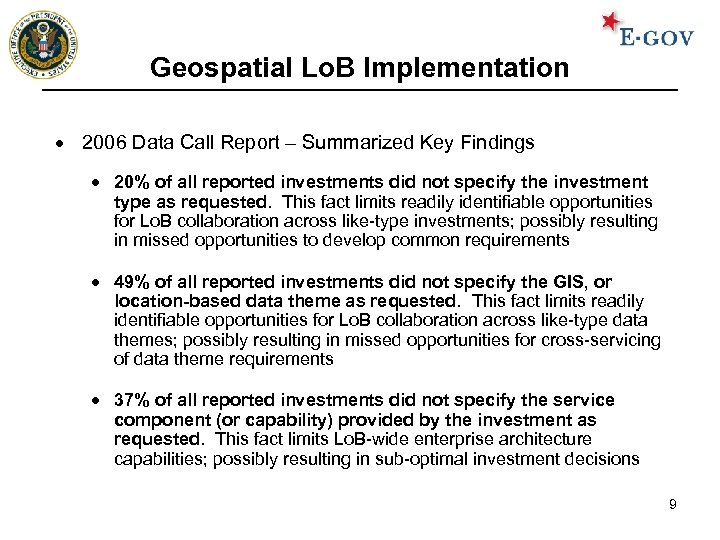
Geospatial Lo. B Implementation 2006 Data Call Report – Summarized Key Findings 20% of all reported investments did not specify the investment type as requested. This fact limits readily identifiable opportunities for Lo. B collaboration across like-type investments; possibly resulting in missed opportunities to develop common requirements 49% of all reported investments did not specify the GIS, or location-based data theme as requested. This fact limits readily identifiable opportunities for Lo. B collaboration across like-type data themes; possibly resulting in missed opportunities for cross-servicing of data theme requirements 37% of all reported investments did not specify the service component (or capability) provided by the investment as requested. This fact limits Lo. B-wide enterprise architecture capabilities; possibly resulting in sub-optimal investment decisions 9
Geospatial Lo. B Implementation • 2007 Budget Data Request (BDR) – Build upon lessons learned from the 2006 Data Call – Qualitative component to assess common business needs, data acquisition strategies, federal capabilities and priorities – Refine and consolidate the spreadsheets to target information that will be more useful in identifying and quantifying common data and services investments – Provide more succinct agency guidance to acquire data that will generate more compatible information 10
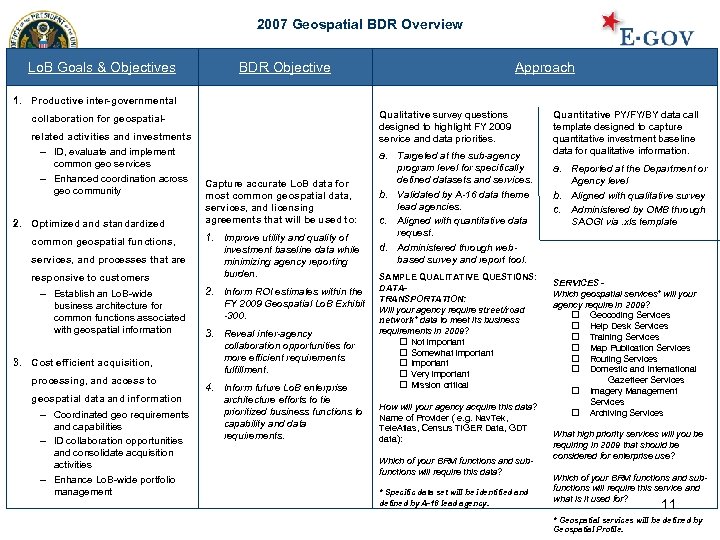
2007 Geospatial BDR Overview Lo. B Goals & Objectives BDR Objective Approach 1. Productive inter-governmental collaboration for geospatial- related activities and investments – ID, evaluate and implement common geo services – Enhanced coordination across geo community 2. Optimized and standardized common geospatial functions, services, and processes that are responsive to customers – Establish an Lo. B-wide business architecture for common functions associated with geospatial information 3. Cost efficient acquisition, processing, and access to geospatial data and information – Coordinated geo requirements and capabilities – ID collaboration opportunities and consolidate acquisition activities – Enhance Lo. B-wide portfolio management Capture accurate Lo. B data for most common geospatial data, services, and licensing agreements that will be used to: 1. Improve utility and quality of investment baseline data while minimizing agency reporting burden. 2. Inform ROI estimates within the FY 2009 Geospatial Lo. B Exhibit -300. 3. Reveal inter-agency collaboration opportunities for more efficient requirements fulfillment. 4. Inform future Lo. B enterprise architecture efforts to tie prioritized business functions to capability and data requirements. Qualitative survey questions designed to highlight FY 2009 service and data priorities. a. Targeted at the sub-agency program level for specifically defined datasets and services. b. Validated by A-16 data theme lead agencies. c. Aligned with quantitative data request. d. Administered through webbased survey and report tool. SAMPLE QUALITATIVE QUESTIONS: DATATRANSPORTATION: Will your agency require street/road network* data to meet its business requirements in 2009? Not important Somewhat important Important Very important Mission critical How will your agency acquire this data? Name of Provider ( e. g. Nav. Tek, Tele. Atlas, Census TIGER Data, GDT data): Which of your BRM functions and subfunctions will require this data? * Specific data set will be identified and defined by A-16 lead agency. Quantitative PY/FY/BY data call template designed to capture quantitative investment baseline data for qualitative information. a. Reported at the Department or Agency level b. Aligned with qualitative survey c. Administered by OMB through SAOGI via. xls template SERVICES Which geospatial services* will your agency require in 2009? Geocoding Services Help Desk Services Training Services Map Publication Services Routing Services Domestic and International Gazetteer Services Imagery Management Services Archiving Services What high priority services will you be requiring in 2009 that should be considered for enterprise use? Which of your BRM functions and subfunctions will require this service and what is it used for? 11 * Geospatial services will be defined by Geospatial Profile.
Geospatial Lo. B Implementation • Memorandum of Understanding (MOUs) and Interagency Agreements (IAs). – To formalize the business process with the Managing Partner (DOI) and participating agencies – Outlines the expectations, investments, and deliverables identified in the Joint Business Case (JBC) – Scorecard milestone - MOUs are to be completed and submitted to Managing Partner (DOI) by the end of the second quarter (March 30) 12
Geospatial Lo. B Implementation • Geo Lo. B Program Management Office (PMO) – Developing PMO Con Ops • Approximately 6 -7 FTEs • Policy direction from the FGDC Steering Committee • Management oversight by the FGDC Coordination Group (currently the Geo Lob Task Force) • Administered by the FGDC Secretariat • Currently planning to physically locate at the USGS 13
Geospatial Lo. B Implementation • Geo Lo. B Program Management Office (PMO) cont. – Establishing the PMO • Preparing the RFP for PMO support • Will organize a team of agency reps to evaluate the proposals • Anticipate that CR considerations will be addressed in the final CR this week. • Targeting April/May for granting contract 14
Geospatial Lo. B Implementation • New Workgroup Task Teams – PMO staff will support Agency representatives (FTE Lo. E in FY 07 needed across partner agencies – i. e. , participating in workgroups, providing input to products, to review and comment on Lo. B deliverables, etc. ) – To develop the products and complete the targeted milestones identified in the Common Solutions/ Target Architecture Document – Begin the development of the FY 09 Joint Business Case and funding algorithm options 15
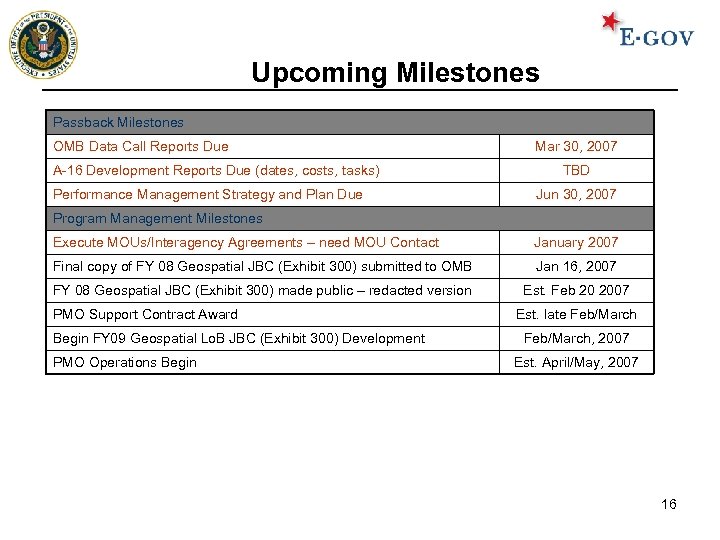
Upcoming Milestones Passback Milestones OMB Data Call Reports Due A-16 Development Reports Due (dates, costs, tasks) Performance Management Strategy and Plan Due Mar 30, 2007 TBD Jun 30, 2007 Program Management Milestones Execute MOUs/Interagency Agreements – need MOU Contact January 2007 Final copy of FY 08 Geospatial JBC (Exhibit 300) submitted to OMB Jan 16, 2007 FY 08 Geospatial JBC (Exhibit 300) made public – redacted version Est. Feb 20 2007 PMO Support Contract Award Begin FY 09 Geospatial Lo. B JBC (Exhibit 300) Development PMO Operations Begin Est. late Feb/March, 2007 Est. April/May, 2007 16
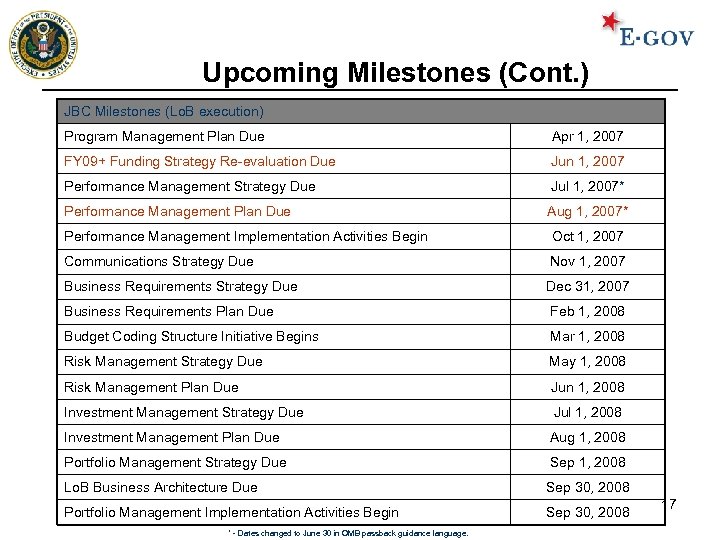
Upcoming Milestones (Cont. ) JBC Milestones (Lo. B execution) Program Management Plan Due Apr 1, 2007 FY 09+ Funding Strategy Re-evaluation Due Jun 1, 2007 Performance Management Strategy Due Jul 1, 2007* Performance Management Plan Due Aug 1, 2007* Performance Management Implementation Activities Begin Oct 1, 2007 Communications Strategy Due Nov 1, 2007 Business Requirements Strategy Due Dec 31, 2007 Business Requirements Plan Due Feb 1, 2008 Budget Coding Structure Initiative Begins Mar 1, 2008 Risk Management Strategy Due May 1, 2008 Risk Management Plan Due Jun 1, 2008 Investment Management Strategy Due Jul 1, 2008 Investment Management Plan Due Aug 1, 2008 Portfolio Management Strategy Due Sep 1, 2008 Lo. B Business Architecture Due Sep 30, 2008 Portfolio Management Implementation Activities Begin Sep 30, 2008 * - Dates changed to June 30 in OMB passback guidance language. 17
Geo Lo. B Implementation Summary • • Initiate and complete the BDR process & analysis Complete the MOU and IA process Complete the PMO Con Ops Organize A-16 reporting task (Passback requirement) Establish the PMO Complete Transition activities Organize the new Workgroups Develop Lo. B Performance Management Strategy and Plan • Develop FY 09 Joint Business Case 18
Geospatial Lo. B Implementation Thank You Questions? ? 19
Скачать презентацию Geospatial Line of Business FGDC Steering Committee Meeting
ee22ad4b796b904f3e639b2bf5cb986e.ppt