


 Скачать презентацию Geospatial Decision Support Tools for Early Warning Services
7b7f3d57900c56b49c61790ff41c40d2.ppt
- Количество слайдов: 31
 Geospatial Decision Support Tools for Early Warning Services & Disaster Risk Management Seminar on Disaster Management Geospatial World Forum 2011, 21 Jan 2011, Hyderabad, India S. Jothiganesh & G. Srinivasan Regional Integrated Multi-Hazard Early Warning System Bangkok, Thailand RIMES – Regional Integrated Multi-Hazard Early Warning System for Africa and Asia
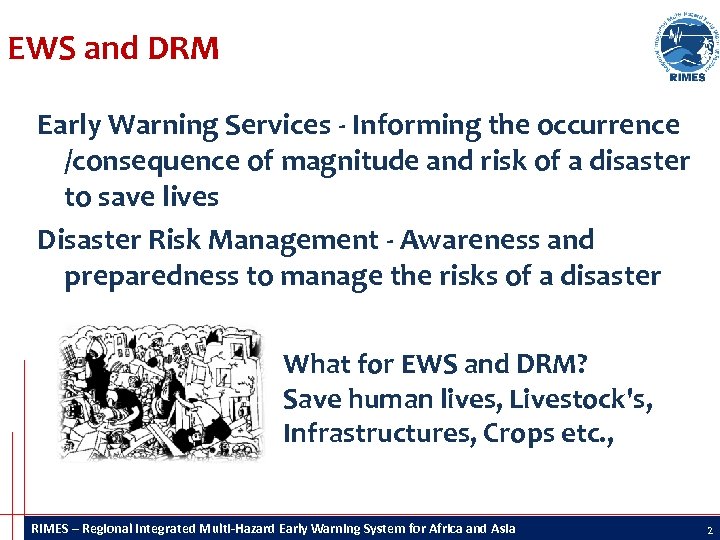 EWS and DRM Early Warning Services - Informing the occurrence /consequence of magnitude and risk of a disaster to save lives Disaster Risk Management - Awareness and preparedness to manage the risks of a disaster What for EWS and DRM? Save human lives, Livestock's, Infrastructures, Crops etc. , RIMES – Regional Integrated Multi-Hazard Early Warning System for Africa and Asia 2
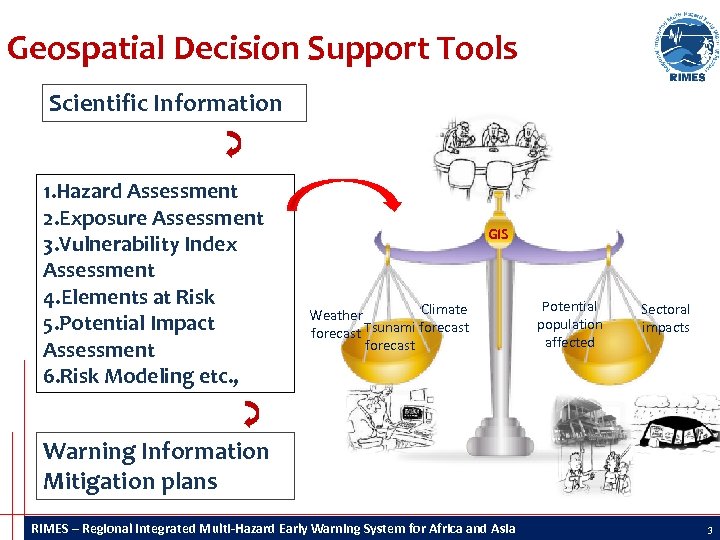 Geospatial Decision Support Tools Scientific Information 1. Hazard Assessment 2. Exposure Assessment 3. Vulnerability Index Assessment 4. Elements at Risk 5. Potential Impact Assessment 6. Risk Modeling etc. , GIS Climate Weather forecast Tsunami forecast Potential population affected Sectoral impacts Warning Information Mitigation plans RIMES – Regional Integrated Multi-Hazard Early Warning System for Africa and Asia 3
 RIMES - Early Warning Services Regional Integrated Multi-Hazard Early Warning System for Africa and Asia • International and intergovernmental institution • Generation, communication, and application of early warning information. • Provision of earthquake alerts and regional tsunami bulletins; hydro-meteorological research • Generation of localized and tailored weather and climate information of different time scales • Development of decision-support tools and new generation hazard risk information products; • Analysis of risks to climate variability and change, and identification of risk management and adaptation options; RIMES – Regional Integrated Multi-Hazard Early Warning System for Africa and Asia 4
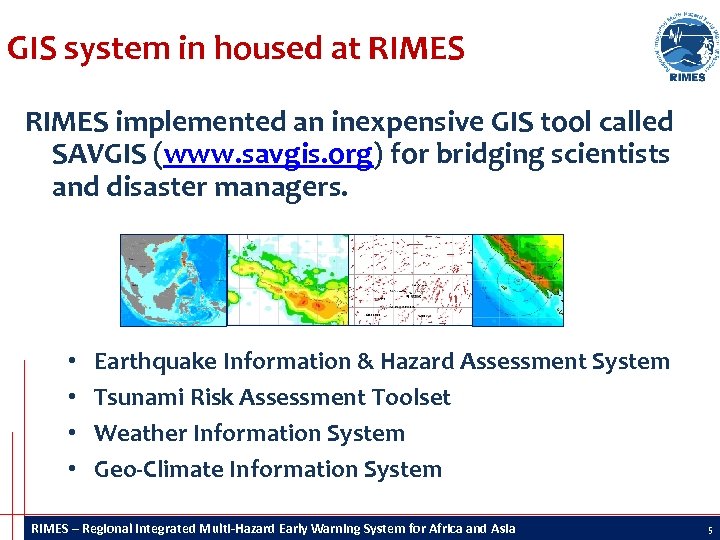 GIS system in housed at RIMES implemented an inexpensive GIS tool called SAVGIS (www. savgis. org) for bridging scientists and disaster managers. • • Earthquake Information & Hazard Assessment System Tsunami Risk Assessment Toolset Weather Information System Geo-Climate Information System RIMES – Regional Integrated Multi-Hazard Early Warning System for Africa and Asia 5
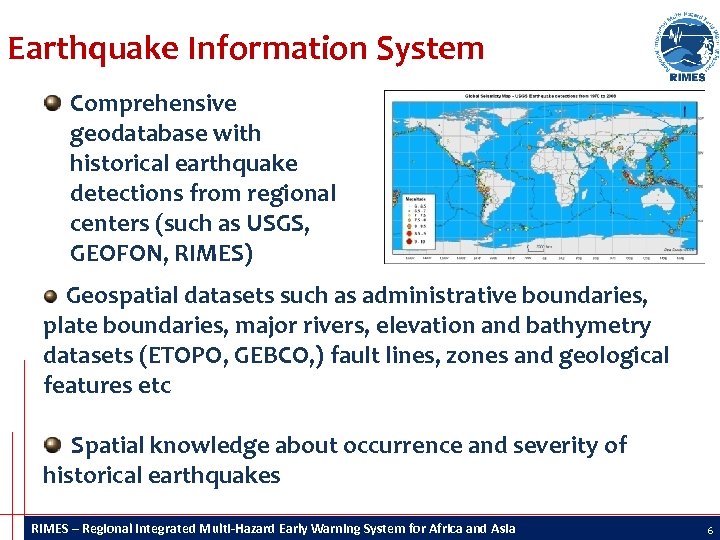 Earthquake Information System Comprehensive geodatabase with historical earthquake detections from regional centers (such as USGS, GEOFON, RIMES) Geospatial datasets such as administrative boundaries, plate boundaries, major rivers, elevation and bathymetry datasets (ETOPO, GEBCO, ) fault lines, zones and geological features etc Spatial knowledge about occurrence and severity of historical earthquakes RIMES – Regional Integrated Multi-Hazard Early Warning System for Africa and Asia 6
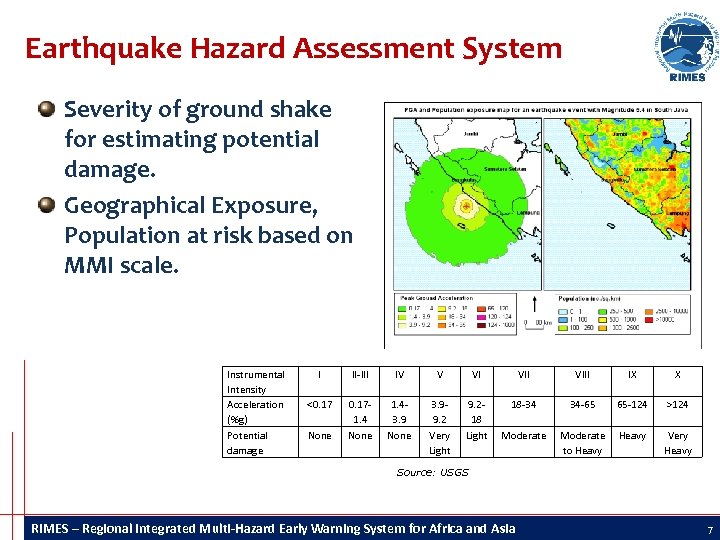 Earthquake Hazard Assessment System Severity of ground shake for estimating potential damage. Geographical Exposure, Population at risk based on MMI scale. Instrumental Intensity Acceleration (%g) Potential damage I II-III IV V VI VIII IX X <0. 171. 4 None 1. 43. 9 None 3. 99. 2 Very Light 9. 218 Light 18 -34 34 -65 65 -124 >124 Moderate to Heavy Very Heavy None Source: USGS RIMES – Regional Integrated Multi-Hazard Early Warning System for Africa and Asia 7
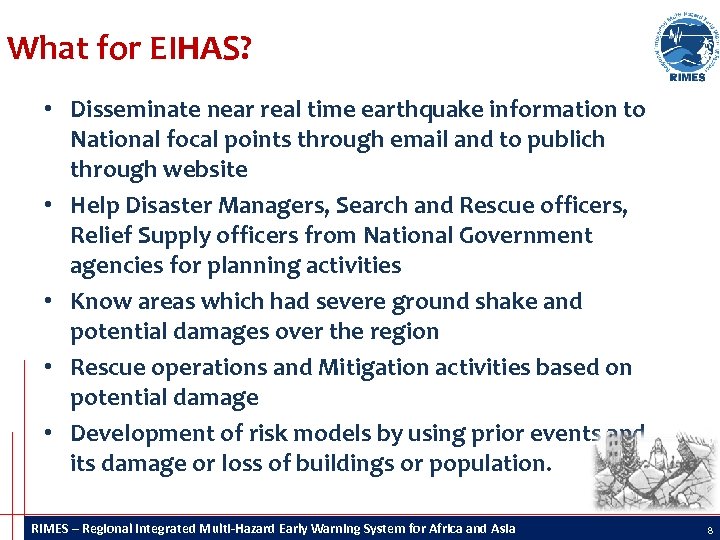 What for EIHAS? • Disseminate near real time earthquake information to National focal points through email and to publich through website • Help Disaster Managers, Search and Rescue officers, Relief Supply officers from National Government agencies for planning activities • Know areas which had severe ground shake and potential damages over the region • Rescue operations and Mitigation activities based on potential damage • Development of risk models by using prior events and its damage or loss of buildings or population. RIMES – Regional Integrated Multi-Hazard Early Warning System for Africa and Asia 8
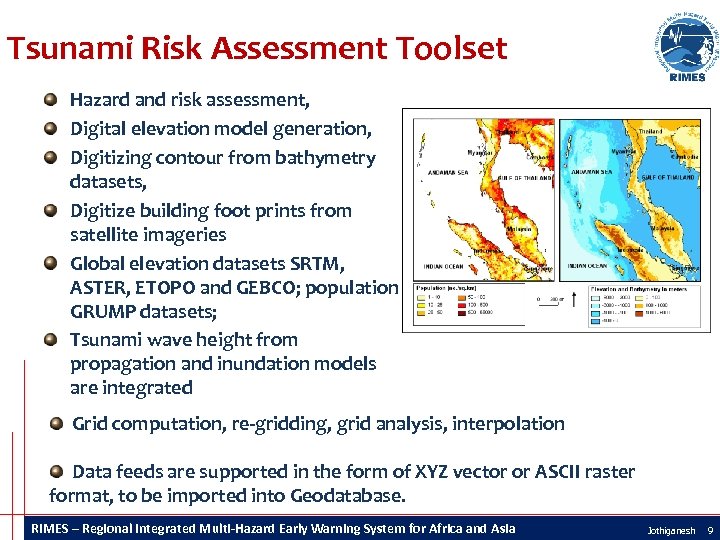 Tsunami Risk Assessment Toolset Hazard and risk assessment, Digital elevation model generation, Digitizing contour from bathymetry datasets, Digitize building foot prints from satellite imageries Global elevation datasets SRTM, ASTER, ETOPO and GEBCO; population GRUMP datasets; Tsunami wave height from propagation and inundation models are integrated Grid computation, re-gridding, grid analysis, interpolation Data feeds are supported in the form of XYZ vector or ASCII raster format, to be imported into Geodatabase. RIMES – Regional Integrated Multi-Hazard Early Warning System for Africa and Asia Jothiganesh 9
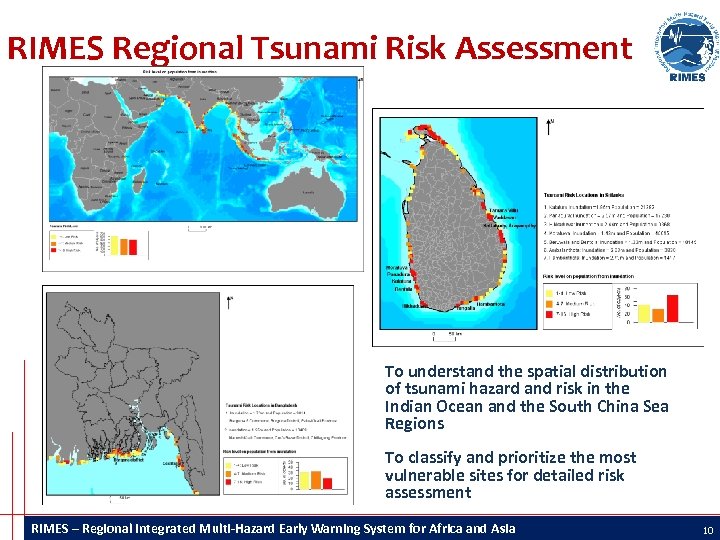 RIMES Regional Tsunami Risk Assessment To understand the spatial distribution of tsunami hazard and risk in the Indian Ocean and the South China Sea Regions To classify and prioritize the most vulnerable sites for detailed risk assessment RIMES – Regional Integrated Multi-Hazard Early Warning System for Africa and Asia 10
 What for TRAT? • Disaster Managers, Local Government officials, Insurance companies, Mitigation planning officers can use this TRAT system for planning and preparedness activities • Identifying Hazard profile of an area by bringing Inundation height or wave height from propagation or inundation scenarios with exposed elements is first step to build risk information • Modeling the damages for elements at risk will lead a way to give improved risk information along with Tsunami forecast RIMES – Regional Integrated Multi-Hazard Early Warning System for Africa and Asia 11
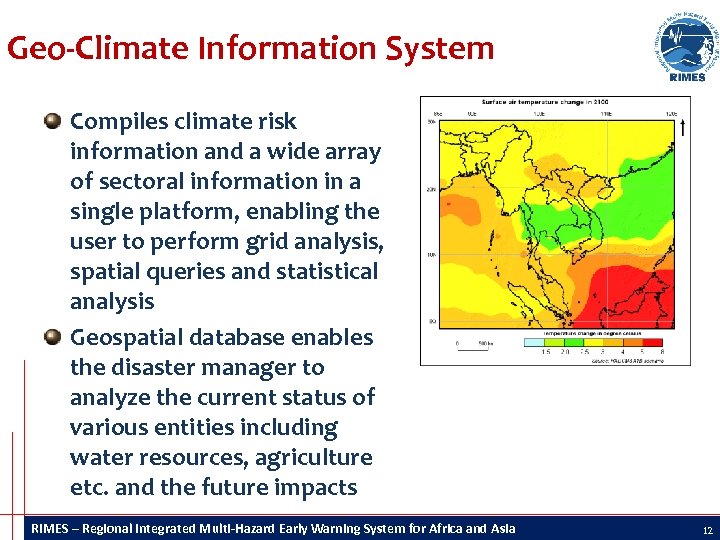 Geo-Climate Information System Compiles climate risk information and a wide array of sectoral information in a single platform, enabling the user to perform grid analysis, spatial queries and statistical analysis Geospatial database enables the disaster manager to analyze the current status of various entities including water resources, agriculture etc. and the future impacts RIMES – Regional Integrated Multi-Hazard Early Warning System for Africa and Asia 12
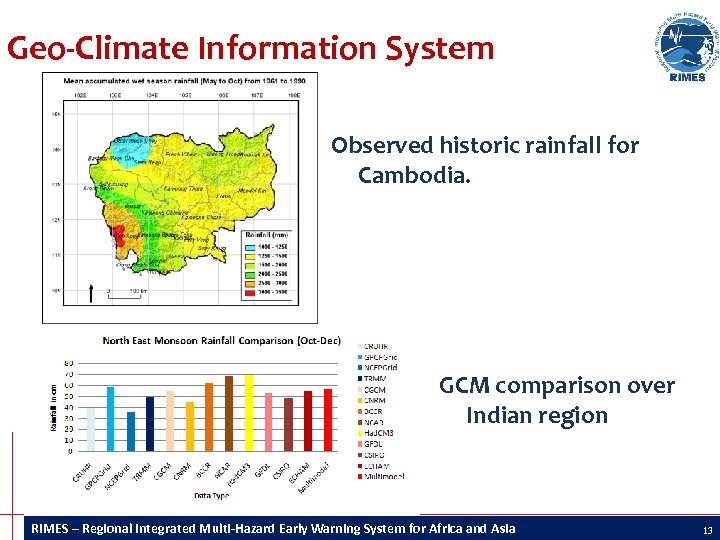 Geo-Climate Information System Observed historic rainfall for Cambodia. GCM comparison over Indian region RIMES – Regional Integrated Multi-Hazard Early Warning System for Africa and Asia 13
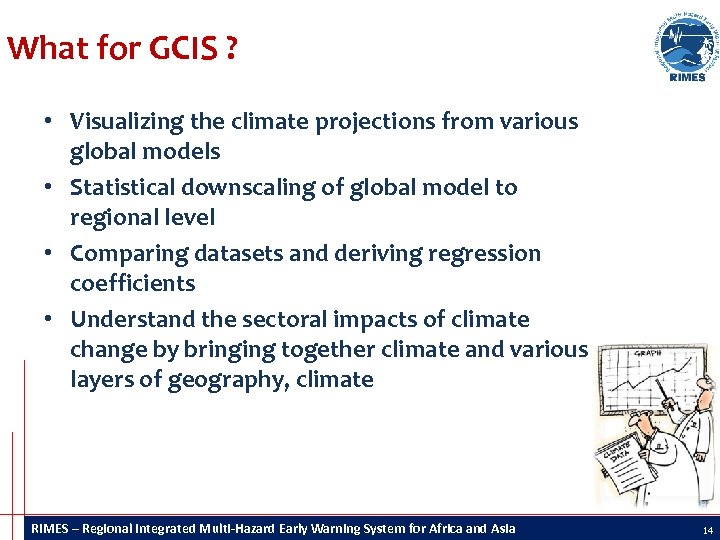 What for GCIS ? • Visualizing the climate projections from various global models • Statistical downscaling of global model to regional level • Comparing datasets and deriving regression coefficients • Understand the sectoral impacts of climate change by bringing together climate and various layers of geography, climate RIMES – Regional Integrated Multi-Hazard Early Warning System for Africa and Asia 14
 Weather Information System • Plotting weather parameters (surface, contours) such as rainfall, geo-potential height, wind speed, wind direction, mean sea level pressure etc. (Figure 3&4) • Spatial Analysis of weather information with geographic elements • Weather observational and forecast database development and management • Performing weather forecast verification and validation with observed datasets RIMES – Regional Integrated Multi-Hazard Early Warning System for Africa and Asia 15
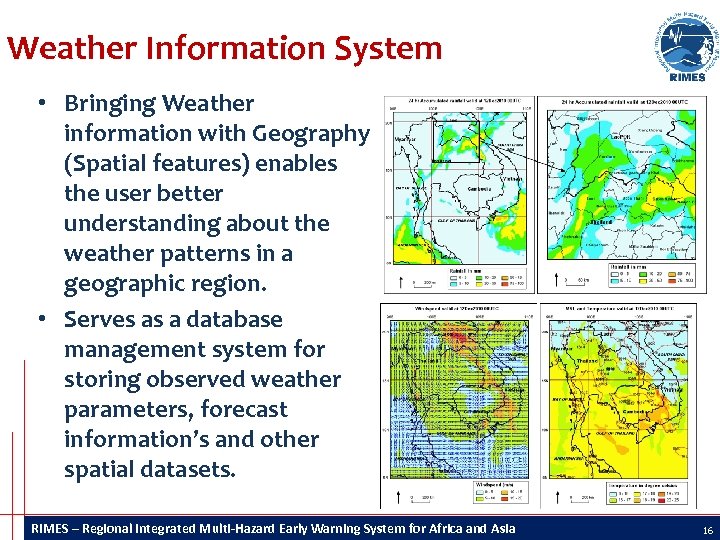 Weather Information System • Bringing Weather information with Geography (Spatial features) enables the user better understanding about the weather patterns in a geographic region. • Serves as a database management system for storing observed weather parameters, forecast information’s and other spatial datasets. RIMES – Regional Integrated Multi-Hazard Early Warning System for Africa and Asia 16
 What for WIS? Weather Database Management : Spatial and Temporal datasets of surface observatory and Forecast products Generate Value added products by adding Geographical Information to forecast. Serves to interpret and analyze scientific products Helps in Decision making purposes for issuance of warnings and verification. Exposure assessment with help of demography, environmental and socio-economic data Historical impacts analysis for deriving thresholds by case analysis. Evolving the process of generating pre-impact scenarios RIMES – Regional Integrated Multi-Hazard Early Warning System for Africa and Asia 17
 More detail about weather application…. . RIMES – Regional Integrated Multi-Hazard Early Warning System for Africa and Asia 18
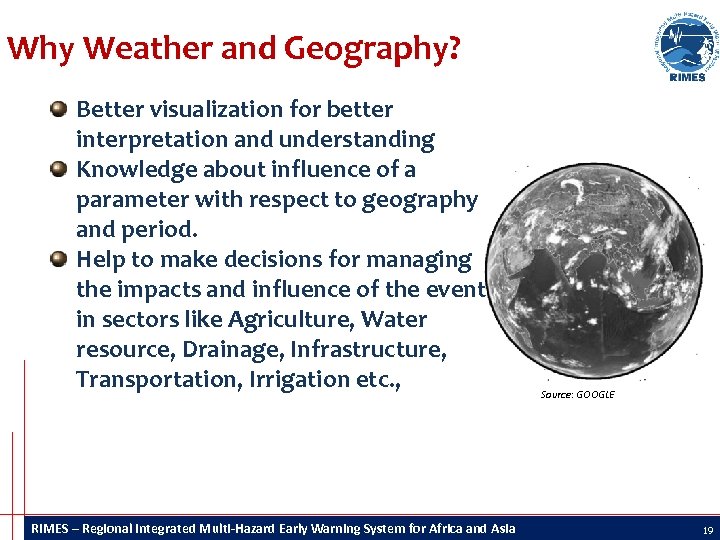 Why Weather and Geography? Better visualization for better interpretation and understanding Knowledge about influence of a parameter with respect to geography and period. Help to make decisions for managing the impacts and influence of the event in sectors like Agriculture, Water resource, Drainage, Infrastructure, Transportation, Irrigation etc. , RIMES – Regional Integrated Multi-Hazard Early Warning System for Africa and Asia Source: GOOGLE 19
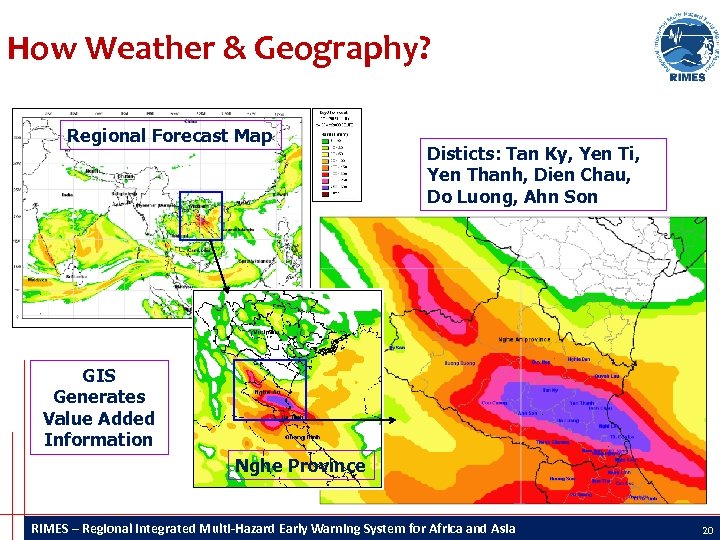 How Weather & Geography? Regional Forecast Map Disticts: Tan Ky, Yen Ti, Yen Thanh, Dien Chau, Do Luong, Ahn Son GIS Generates Value Added Information Nghe Province RIMES – Regional Integrated Multi-Hazard Early Warning System for Africa and Asia 20
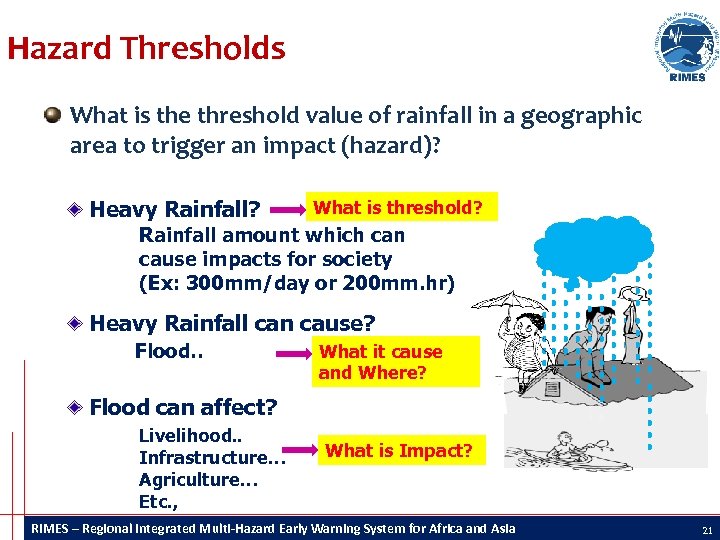 Hazard Thresholds What is the threshold value of rainfall in a geographic area to trigger an impact (hazard)? Heavy Rainfall? What is threshold? Rainfall amount which can cause impacts for society (Ex: 300 mm/day or 200 mm. hr) Heavy Rainfall can cause? Flood. . What it cause and Where? Flood can affect? Livelihood. . Infrastructure… Agriculture… Etc. , What is Impact? RIMES – Regional Integrated Multi-Hazard Early Warning System for Africa and Asia 21
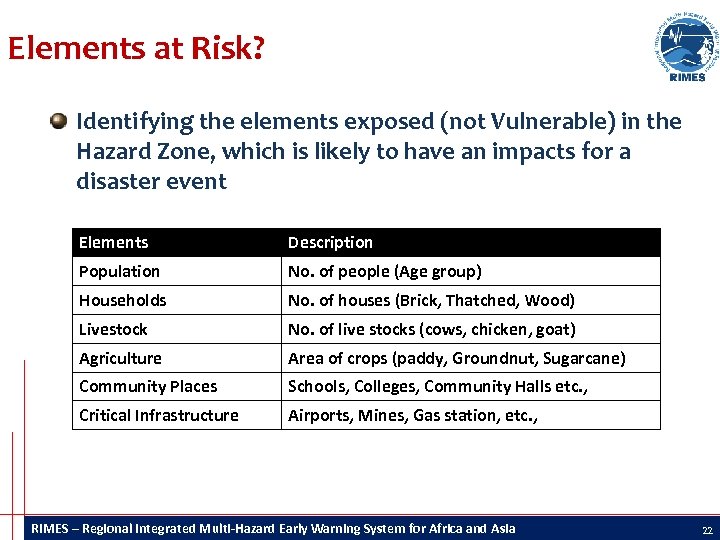 Elements at Risk? Identifying the elements exposed (not Vulnerable) in the Hazard Zone, which is likely to have an impacts for a disaster event Elements Description Population No. of people (Age group) Households No. of houses (Brick, Thatched, Wood) Livestock No. of live stocks (cows, chicken, goat) Agriculture Area of crops (paddy, Groundnut, Sugarcane) Community Places Schools, Colleges, Community Halls etc. , Critical Infrastructure Airports, Mines, Gas station, etc. , RIMES – Regional Integrated Multi-Hazard Early Warning System for Africa and Asia 22
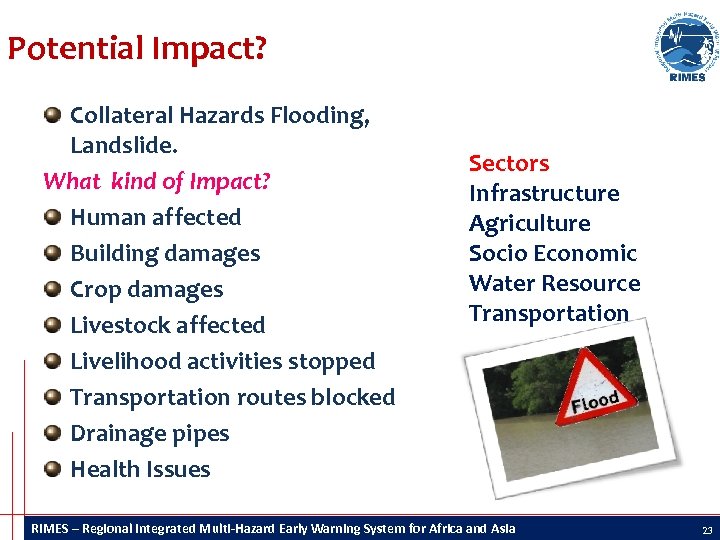 Potential Impact? Collateral Hazards Flooding, Landslide. What kind of Impact? Human affected Building damages Crop damages Livestock affected Livelihood activities stopped Transportation routes blocked Drainage pipes Health Issues Sectors Infrastructure Agriculture Socio Economic Water Resource Transportation RIMES – Regional Integrated Multi-Hazard Early Warning System for Africa and Asia 23
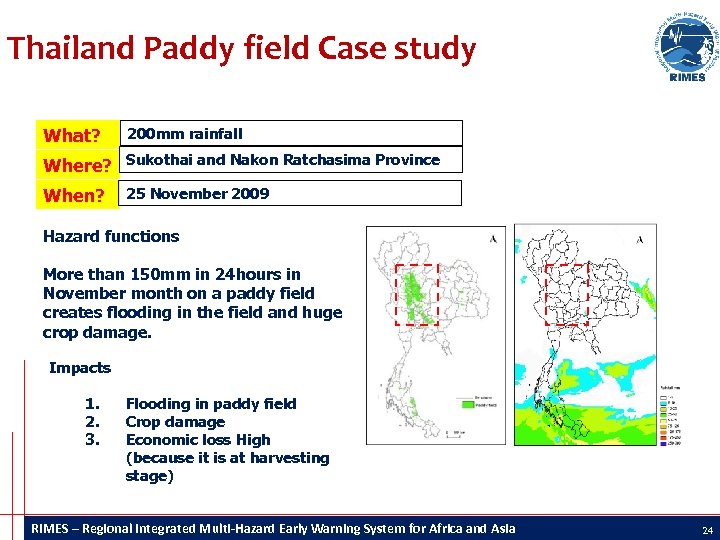 Thailand Paddy field Case study What? 200 mm rainfall Where? Sukothai and Nakon Ratchasima Province When? 25 November 2009 Hazard functions More than 150 mm in 24 hours in November month on a paddy field creates flooding in the field and huge crop damage. Impacts 1. 2. 3. Flooding in paddy field Crop damage Economic loss High (because it is at harvesting stage) RIMES – Regional Integrated Multi-Hazard Early Warning System for Africa and Asia 24
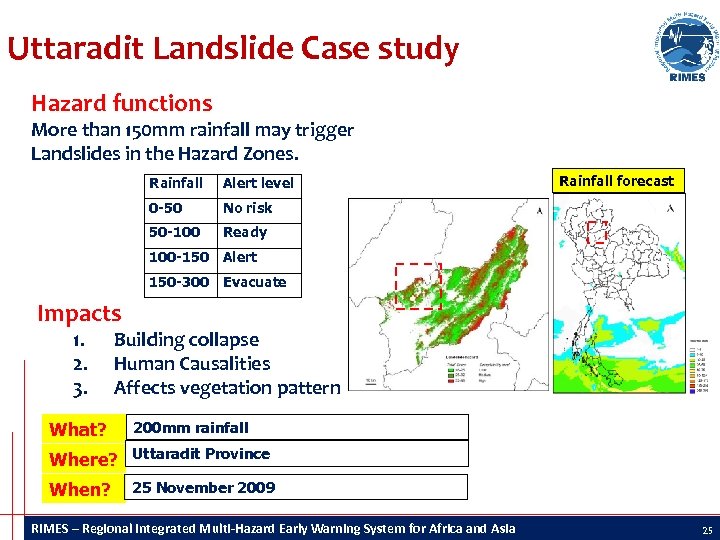 Uttaradit Landslide Case study Hazard functions More than 150 mm rainfall may trigger Landslides in the Hazard Zones. Rainfall Alert level 0 -50 No risk 50 -100 Ready 100 -150 Alert 150 -300 Rainfall forecast Evacuate Impacts 1. 2. 3. What? Building collapse Human Causalities Affects vegetation pattern 200 mm rainfall Where? Uttaradit Province When? 25 November 2009 RIMES – Regional Integrated Multi-Hazard Early Warning System for Africa and Asia 25
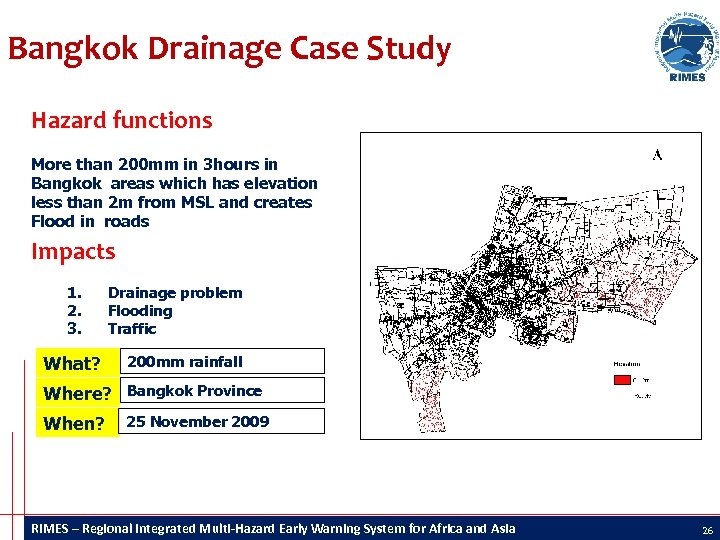 Bangkok Drainage Case Study Hazard functions More than 200 mm in 3 hours in Bangkok areas which has elevation less than 2 m from MSL and creates Flood in roads Impacts 1. 2. 3. What? Drainage problem Flooding Traffic 200 mm rainfall Where? Bangkok Province When? 25 November 2009 RIMES – Regional Integrated Multi-Hazard Early Warning System for Africa and Asia 26
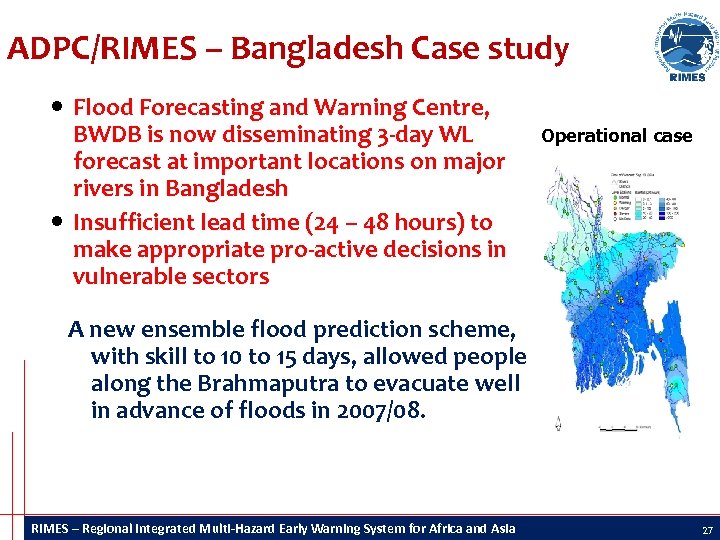 ADPC/RIMES – Bangladesh Case study Flood Forecasting and Warning Centre, BWDB is now disseminating 3 -day WL forecast at important locations on major rivers in Bangladesh Insufficient lead time (24 – 48 hours) to make appropriate pro-active decisions in vulnerable sectors Operational case A new ensemble flood prediction scheme, with skill to 10 to 15 days, allowed people along the Brahmaputra to evacuate well in advance of floods in 2007/08. RIMES – Regional Integrated Multi-Hazard Early Warning System for Africa and Asia 27
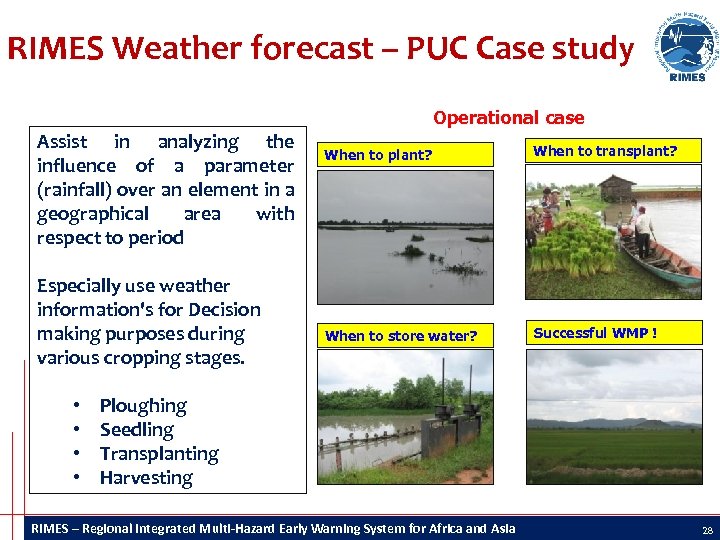 RIMES Weather forecast – PUC Case study Operational case Assist in analyzing the influence of a parameter (rainfall) over an element in a geographical area with respect to period Especially use weather information's for Decision making purposes during various cropping stages. • • When to plant? When to transplant? When to store water? Successful WMP ! Ploughing Seedling Transplanting Harvesting RIMES – Regional Integrated Multi-Hazard Early Warning System for Africa and Asia 28
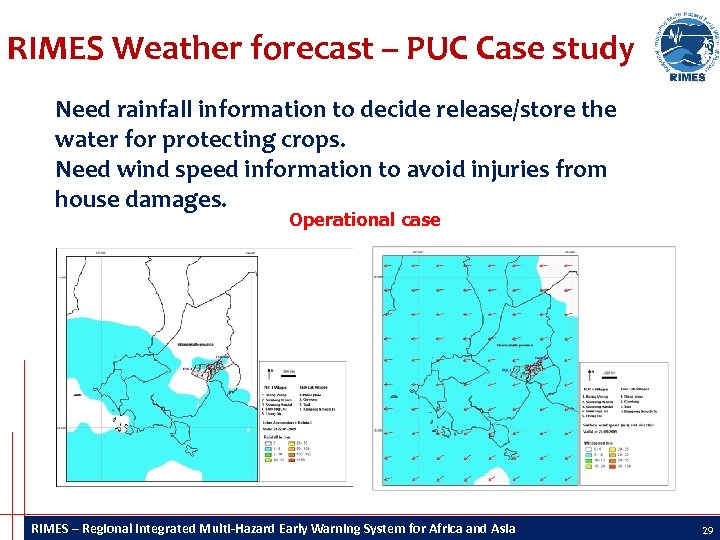 RIMES Weather forecast – PUC Case study Need rainfall information to decide release/store the water for protecting crops. Need wind speed information to avoid injuries from house damages. Operational case RIMES – Regional Integrated Multi-Hazard Early Warning System for Africa and Asia 29
 Conclusion and Recommendation • Geospatial tools has prime role in end to end early warning system ranging from observation information generation, analysis and warning generation • GIS helps in generating the user need information in terms of hazard and risk information rather than speaking in scientific language. • Efficiency tool in disaster risk management through formulating mitigation plans by assessing disaster risk over a region. • Countries are in need of inexpensive and open source GIS tools and methodologies. • Government agencies responsible for EWS/DRM should have GIS system in place for effective managing disaster risks. RIMES – Regional Integrated Multi-Hazard Early Warning System for Africa and Asia 30
 Thank you ? Que st ions jothiganesh@rimes. int RIMES – Regional Integrated Multi-Hazard Early Warning System for Africa and Asia 31