


 Скачать презентацию Georgetown Center for Children and Families Strengthening Medicaid
a66f385cbf0de60e57c13970a112f110.ppt
- Количество слайдов: 18
 Georgetown Center for Children and Families Strengthening Medicaid Project Vikki Wachino Consultant http: //ccf. georgetown. edu/index/strengthening-medicaid May 29, 2008 The Council of State Governments
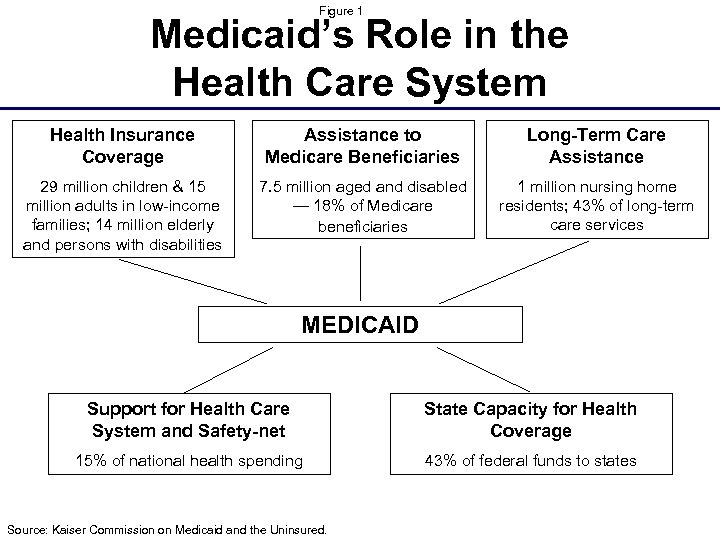 Figure 1 Medicaid’s Role in the Health Care System Health Insurance Coverage Assistance to Medicare Beneficiaries Long-Term Care Assistance 29 million children & 15 million adults in low-income families; 14 million elderly and persons with disabilities 7. 5 million aged and disabled — 18% of Medicare beneficiaries 1 million nursing home residents; 43% of long-term care services MEDICAID Support for Health Care System and Safety-net State Capacity for Health Coverage 15% of national health spending 43% of federal funds to states Source: Kaiser Commission on Medicaid and the Uninsured.
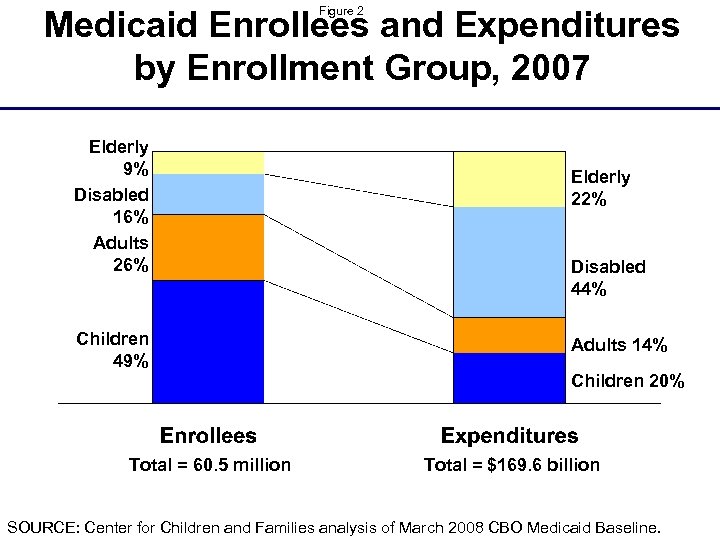 Medicaid Enrollees and Expenditures by Enrollment Group, 2007 Figure 2 Elderly 9% Disabled 16% Adults 26% Children 49% Elderly 22% Disabled 44% Adults 14% Children 20% Total = 60. 5 million Total = $169. 6 billion SOURCE: Center for Children and Families analysis of March 2008 CBO Medicaid Baseline.
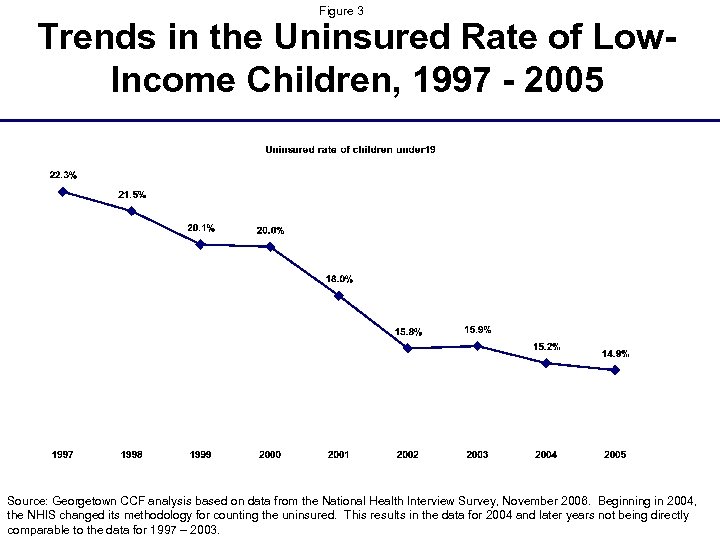 Figure 3 Trends in the Uninsured Rate of Low. Income Children, 1997 - 2005 Source: Georgetown CCF analysis based on data from the National Health Interview Survey, November 2006. Beginning in 2004, the NHIS changed its methodology for counting the uninsured. This results in the data for 2004 and later years not being directly comparable to the data for 1997 – 2003.
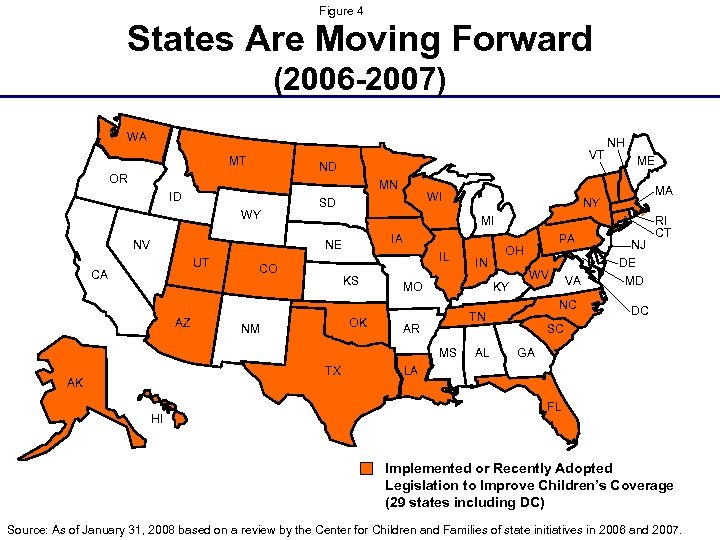 Figure 4 States Are Moving Forward (2006 -2007) WA MT VT ND OR MN ID WY NV UT AZ CO IL KS OK NM TX HI MA NY IA IN MO PA OH KY WV AR AL VA NC TN MS AK ME MI NE CA WI SD NH NJ DE RI CT MD DC SC GA LA FL Implemented or Recently Adopted Legislation to Improve Children’s Coverage (29 states including DC) Source: As of January 31, 2008 based on a review by the Center for Children and Families of state initiatives in 2006 and 2007.
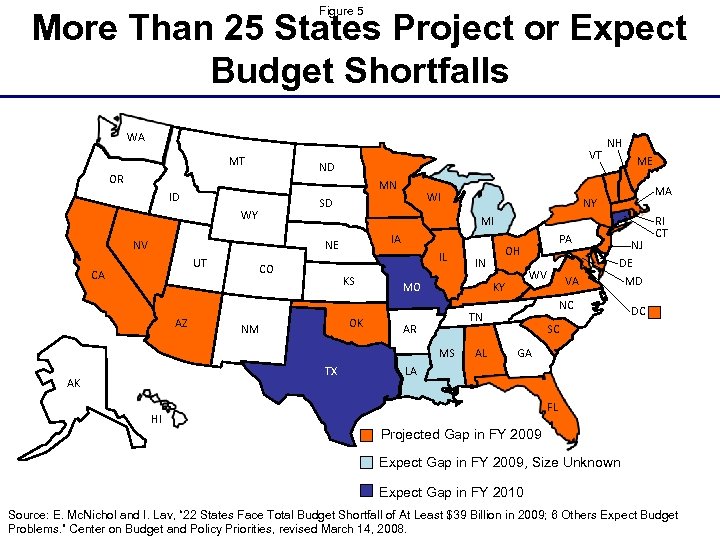 Figure 5 More Than 25 States Project or Expect Budget Shortfalls WA MT VT ND OR MN ID WY AZ CO IL KS OK NM TX IN MO PA OH WV KY AR AL NJ DE VA NC TN MS AK MA NY IA NE UT ME MI NV CA WI SD NH RI CT MD DC SC GA LA FL HI Projected Gap in FY 2009 Expect Gap in FY 2009, Size Unknown Expect Gap in FY 2010 Source: E. Mc. Nichol and I. Lav, “ 22 States Face Total Budget Shortfall of At Least $39 Billion in 2009; 6 Others Expect Budget Problems. ” Center on Budget and Policy Priorities, revised March 14, 2008.
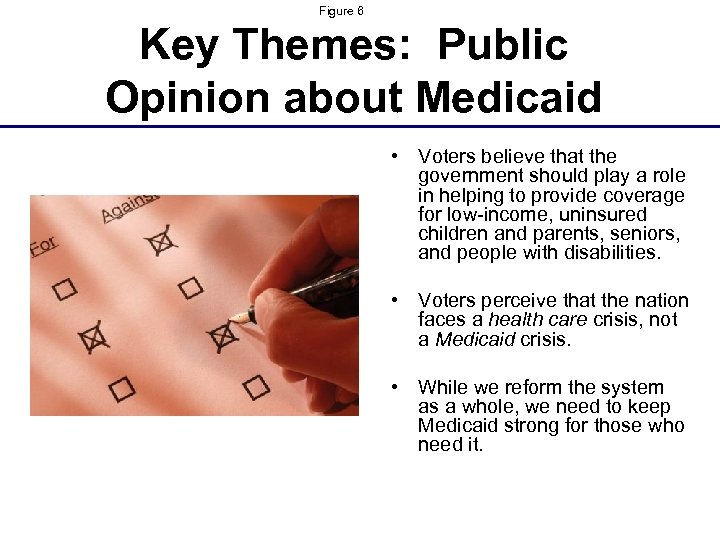 Figure 6 Key Themes: Public Opinion about Medicaid • Voters believe that the government should play a role in helping to provide coverage for low-income, uninsured children and parents, seniors, and people with disabilities. • Voters perceive that the nation faces a health care crisis, not a Medicaid crisis. • While we reform the system as a whole, we need to keep Medicaid strong for those who need it.
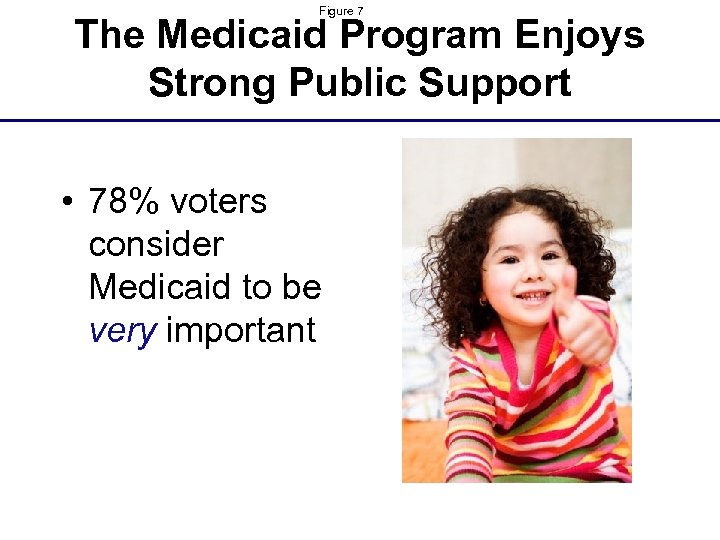 Figure 7 The Medicaid Program Enjoys Strong Public Support • 78% voters consider Medicaid to be very important
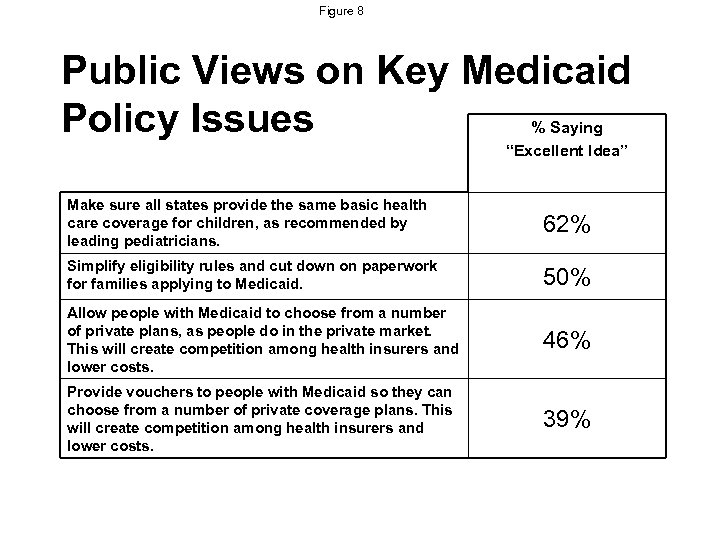 Figure 8 Public Views on Key Medicaid Policy Issues % Saying “Excellent Idea” Make sure all states provide the same basic health care coverage for children, as recommended by leading pediatricians. 62% Simplify eligibility rules and cut down on paperwork for families applying to Medicaid. 50% Allow people with Medicaid to choose from a number of private plans, as people do in the private market. This will create competition among health insurers and lower costs. 46% Provide vouchers to people with Medicaid so they can choose from a number of private coverage plans. This will create competition among health insurers and lower costs. 39%
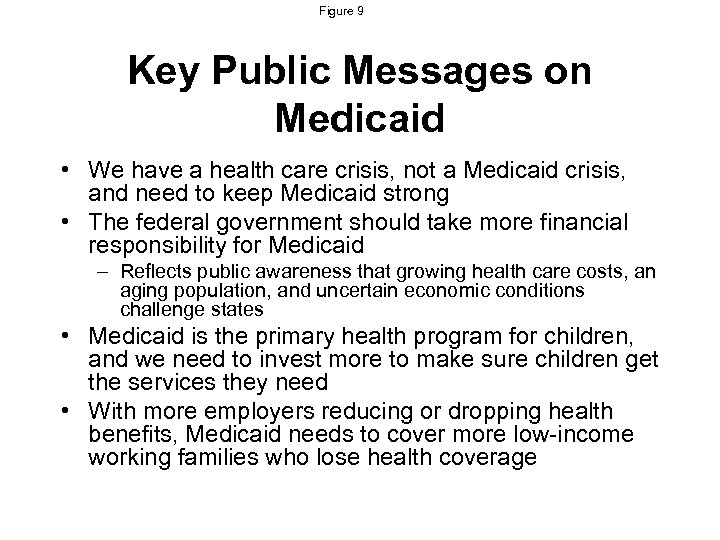 Figure 9 Key Public Messages on Medicaid • We have a health care crisis, not a Medicaid crisis, and need to keep Medicaid strong • The federal government should take more financial responsibility for Medicaid – Reflects public awareness that growing health care costs, an aging population, and uncertain economic conditions challenge states • Medicaid is the primary health program for children, and we need to invest more to make sure children get the services they need • With more employers reducing or dropping health benefits, Medicaid needs to cover more low-income working families who lose health coverage
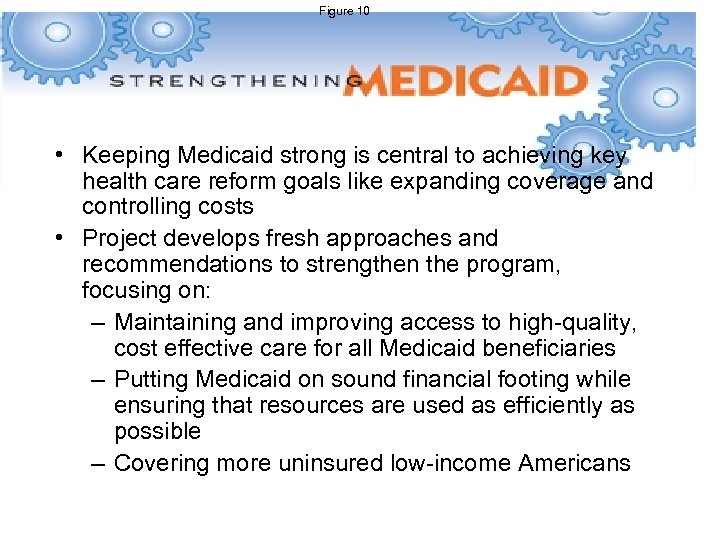 Figure 10 • Keeping Medicaid strong is central to achieving key health care reform goals like expanding coverage and controlling costs • Project develops fresh approaches and recommendations to strengthen the program, focusing on: – Maintaining and improving access to high-quality, cost effective care for all Medicaid beneficiaries – Putting Medicaid on sound financial footing while ensuring that resources are used as efficiently as possible – Covering more uninsured low-income Americans
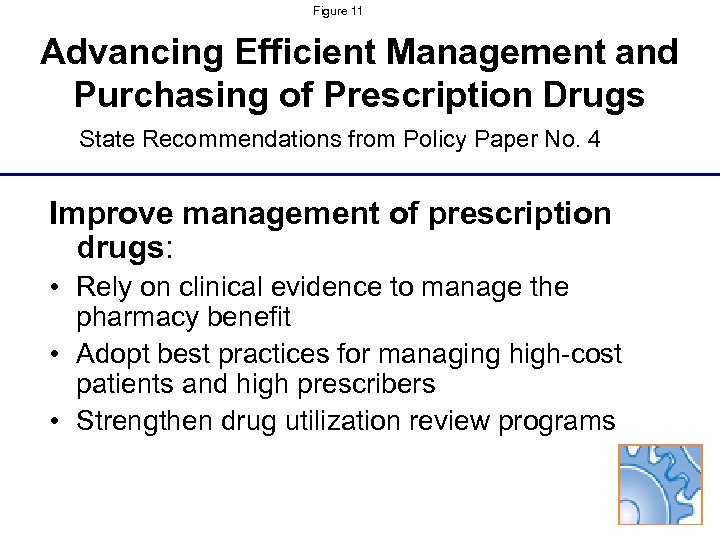 Figure 11 Advancing Efficient Management and Purchasing of Prescription Drugs State Recommendations from Policy Paper No. 4 Improve management of prescription drugs: • Rely on clinical evidence to manage the pharmacy benefit • Adopt best practices for managing high-cost patients and high prescribers • Strengthen drug utilization review programs
 Figure 12 Advancing Efficient Management and Purchasing of Prescription Drugs State Recommendations from Policy Paper No. 4 Use Medicaid’s purchasing power to get the best possible price: • Obtain supplemental rebates to maintain clinically sound preferred drug lists • Require manufacturers, pharmacies, etc. to report actual sales prices and/or acquisition costs
 Figure 13 Measuring and Improving Quality of Care in Medicaid State Recommendations from Policy Paper No. 3 • For health care to be high quality, it must be safe, effective, timely, patientcentered, equitable, and efficient, according to the Institute of Medicine • Maintaining stable enrollment is key – Lack of coverage negatively effects access and makes quality hard to manage
 Figure 14 Key Approaches to Measuring and Improving Quality State Recommendations from Policy Paper No. 3 • Develop core quality measures through a state/federal and public/private consensus development process • Federal development and reporting of quality performance across states is needed • Create state quality improvement advisory councils to coordinate across programs, develop measures, and monitor impact • States can also establish quality partnerships with providers, purchasers, and experts • Test specific pay-for-performance incentives for quality and evaluate their impact on beneficiaries, providers, and quality of care
 Figure 15 Apply Innovative Health Information Technology Approaches to Medicaid State Recommendations from Policy Paper No. 1 Refocus Medicaid IT systems on sharing health information to promote patient health: • Use electronic prescribing to reduce errors and increase efficiency • Convey health information to beneficiaries through automated telephone systems • Expand the use of electronic health records to increase coordination across providers • Improve access to electronic personal health records to give beneficiaries access to their own health information
 Figure 16 Federal Action That Could Strengthen Medicaid • Strengthen Medicaid drug rebate policies to help both states and the federal government get better prices on prescription drugs • Play a leadership role in developing quality measures, with active state participation • Stabilize Medicaid financing during economic downturns, through an automatic increase in the federal matching rate • Over the long term, realign fiscal responsibilities between the federal government and the states
 Figure 18 Georgetown Center for Children and Families Strengthening Medicaid Project • Additional issue briefs to be released this year: – Promoting good health and healthy behaviors – Premium assistance: Integrating Medicaid with private coverage – Maintaining access and improving provider payments – Simplifying coverage and reducing complexity for beneficiaries and states – Streamlining program management • Visit the Strengthening Medicaid web site: http: //ccf. georgetown. edu/index/strengtheningmedicaid.