


 Скачать презентацию George Mason School of Law Contracts I A
821f8a787d49e25221e93c77c6def9e5.ppt
- Количество слайдов: 116
 George Mason School of Law Contracts I A. Common Law Illegality F. H. Buckley fbuckley@gmu. edu 1
 We’ve discussed why promises should be binding n Now: when should they not be binding? 2
 We’ve discussed why promises should be binding n Now: when should they not be binding? n We’ve assumed that bargains make people better off. But what if they don’t? 3
 What does it mean to choose badly? 1. Immoral choices 2. Choices that Harm Others 3. Self-Defeating Choices 4
 1. Immoral Choices n Should the state enforce morals? o The Borders of Private and Public Law 5
 2. Choices that Harm Others n Third Party Externalities n But what counts as a harm? 6
 3. Self-defeating Choices o Do the parties have capacity to choose wisely o Did they consent to the choice? 7
 3. Self-defeating Choices o Capacity to Contract n “I wanted x but somehow I chose notx. ” 8
 3. Self-defeating Choices o Vices of Consent n Fraud n Duress n Unconscionability? 9
 Mill On Liberty (1859) o What does this mean? n It really is of importance, not only what men do, but also what manner of men they are that do it. Among the works of man, which human life is rightly employed in perfecting and beautifying, the first in importance surely is man himself. 10
 Immoral Choices o Wait, that was a value judgment!!!! 11
 Immoral Choices o The moral landscape: subjectivists and anti-subjectivists o Subjectivism: Each individual is the source of his personal moral judgment and there is no external basis for morality (relativism) o Anti-subjectivism: An individual’s moral judgment may be second-guessed, even when the individual holds it sincerely 12
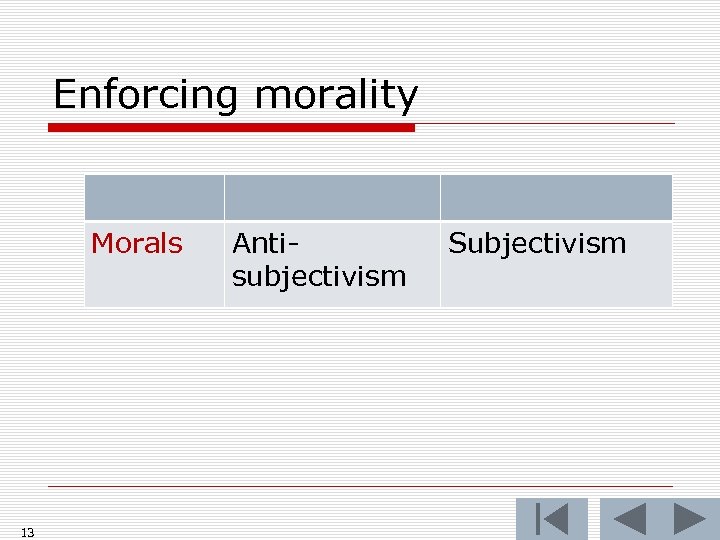 Enforcing morality Morals 13 Antisubjectivism Subjectivism
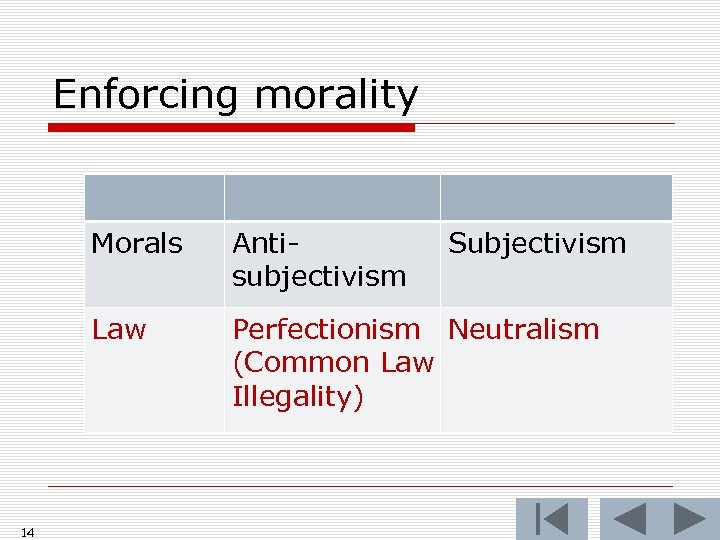 Enforcing morality Morals Law 14 Antisubjectivism Subjectivism Perfectionism Neutralism (Common Law Illegality)
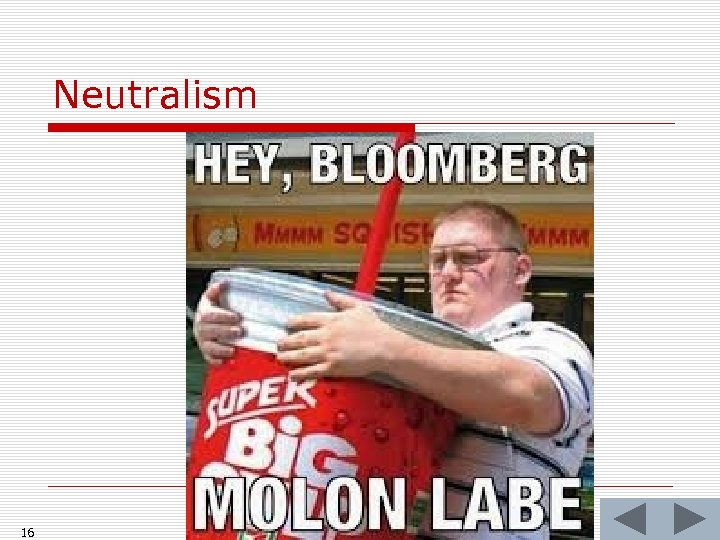
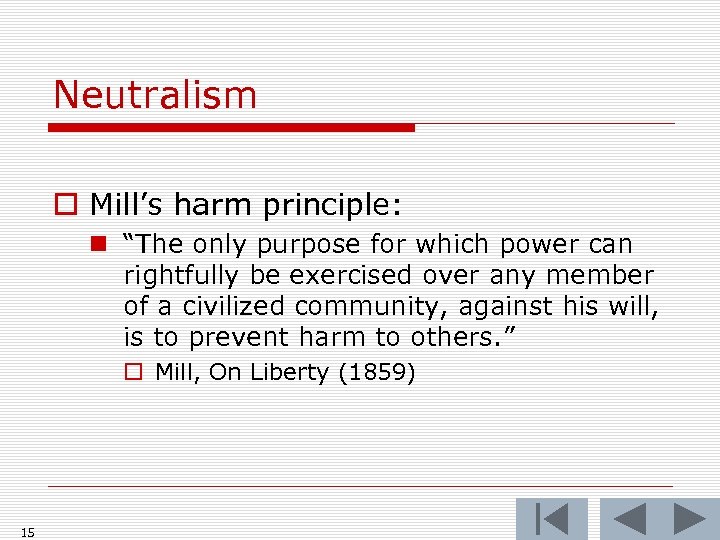 Neutralism o Mill’s harm principle: n “The only purpose for which power can rightfully be exercised over any member of a civilized community, against his will, is to prevent harm to others. ” o Mill, On Liberty (1859) 15
 Neutralism 16
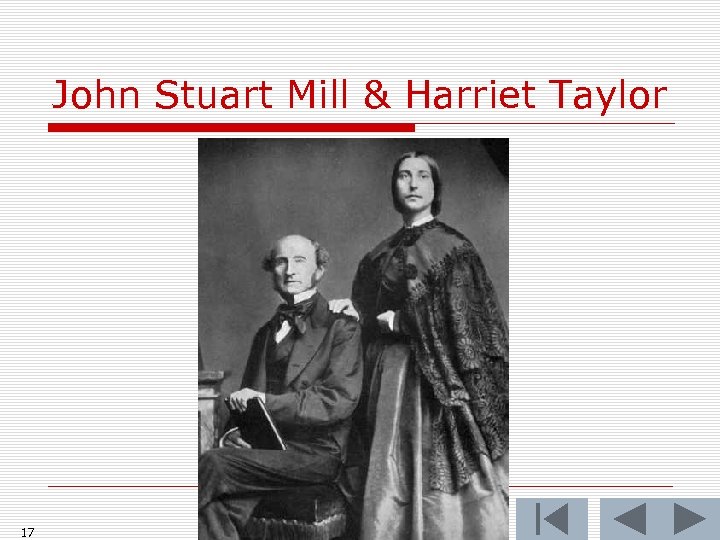 John Stuart Mill & Harriet Taylor 17
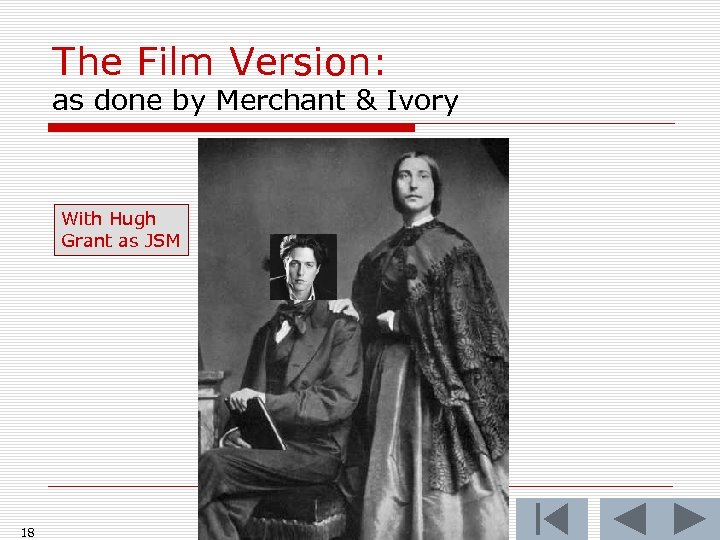 The Film Version: as done by Merchant & Ivory With Hugh Grant as JSM 18
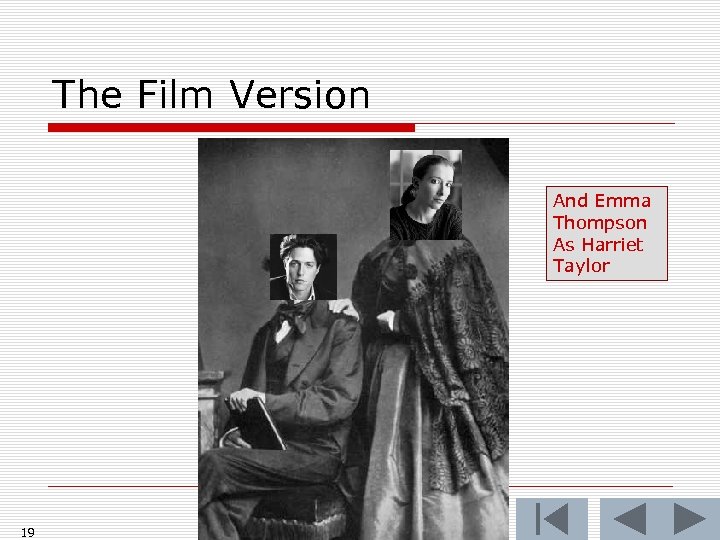 The Film Version And Emma Thompson As Harriet Taylor 19
 My Version “Hi Mom. Hi Dad. I’m home!” And Jerry Mathers As The Beaver 20
 Mill’s harm principle o What does this mean? n It is proper to state that I forego any advantage which could be derived to my argument from the idea of abstract right as a thing independent of utility. I regard utility as the ultimate appeal on all ethical questions 21
 Mill’s harm principle n “The only purpose for which power can rightfully be exercised over any member of a civilized community, against his will, is to prevent harm to others. ” o And just what does that mean? 22
 Mill’s harm principle o “The only purpose for which power can rightfully be exercised over any member of a civilized community, against his will, is to prevent harm to others. ” n Self-regarding harms don’t provide a basis for state interference 23
 Mill’s harm principle o Self-regarding harms n “And all the harm that e’er I did n I’m sure it was to none but me” o The Parting Glass 24
 Mill’s harm principle o So what does that leave? o What choices would Mill restrict? 25
 Neutralism o So what does that leave? n Other-regarding harms: Externalities 26
 Neutralism o So what does that leave? n Other-regarding harms: Externalities n Children, etc. … n “The time when mankind have become capable of being improved by free and equal discussion” 27
 The Legal Response o Statutory and Common Law Illegality 28
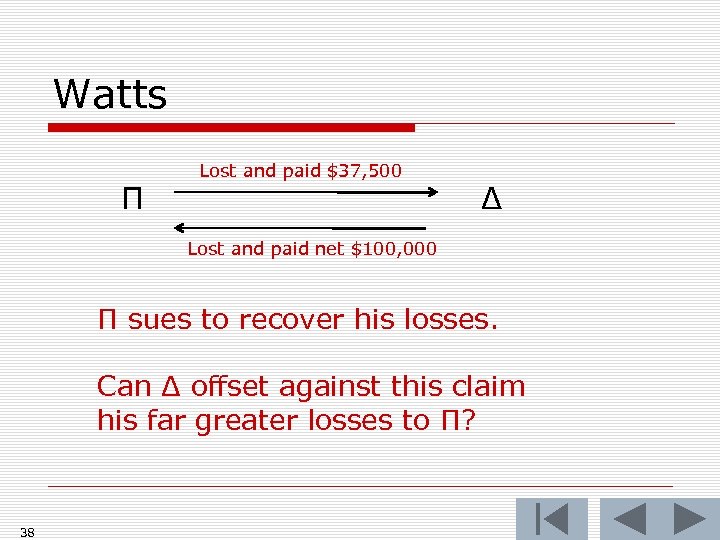
 Statutory and Common Law Illegality o Contracts rendered illegal by statute: Watts v. Malatesta 481 o Contracts illegal at common law: Baby M 487 29
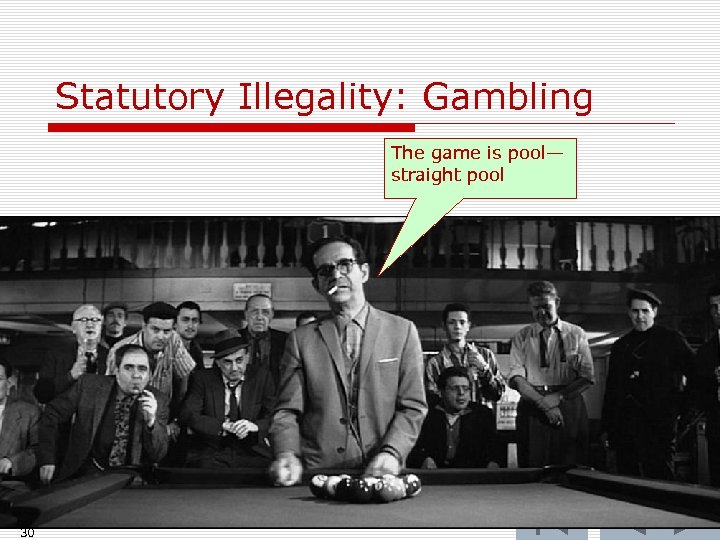 Statutory Illegality: Gambling The game is pool— straight pool 30
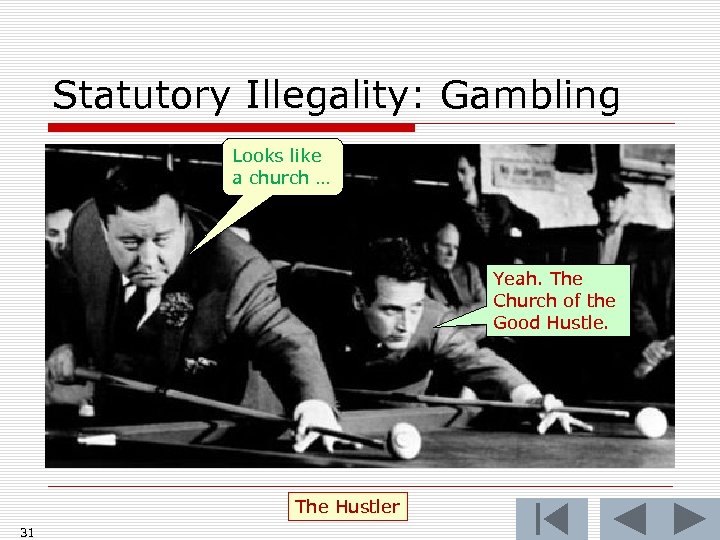 Statutory Illegality: Gambling Looks like a church … Yeah. The Church of the Good Hustle. The Hustler 31
 Why should gambling be stigmatized? 32
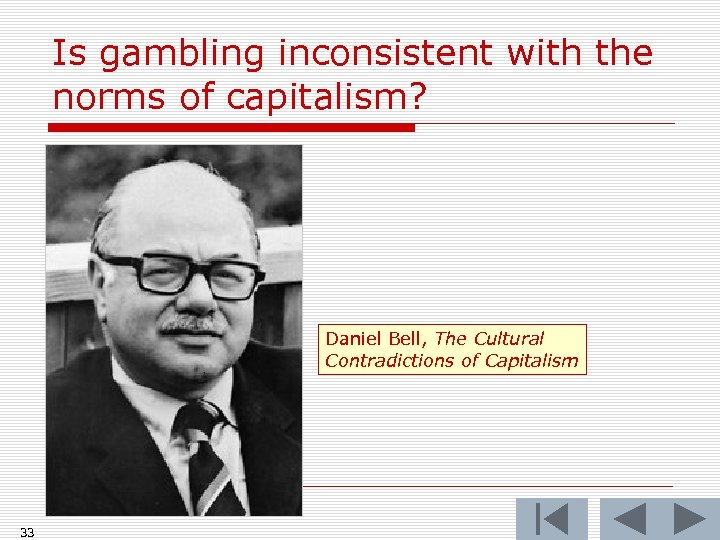 Is gambling inconsistent with the norms of capitalism? Daniel Bell, The Cultural Contradictions of Capitalism 33
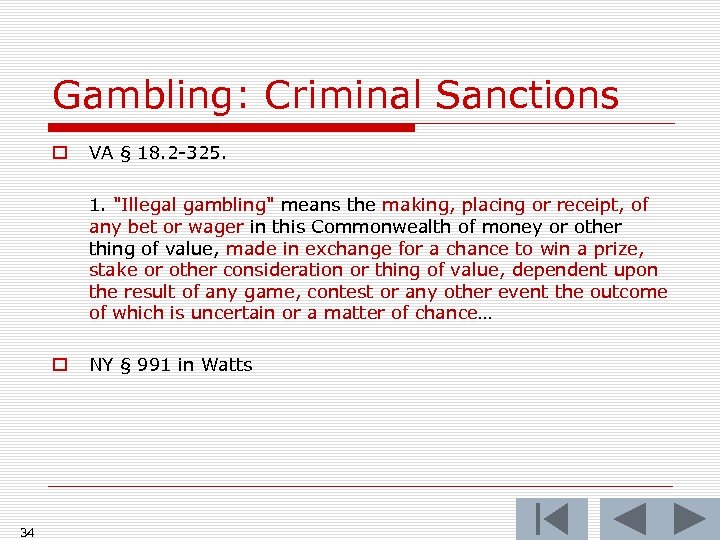 Gambling: Criminal Sanctions o VA § 18. 2 -325. 1. "Illegal gambling" means the making, placing or receipt, of any bet or wager in this Commonwealth of money or other thing of value, made in exchange for a chance to win a prize, stake or other consideration or thing of value, dependent upon the result of any game, contest or any other event the outcome of which is uncertain or a matter of chance… o 34 NY § 991 in Watts
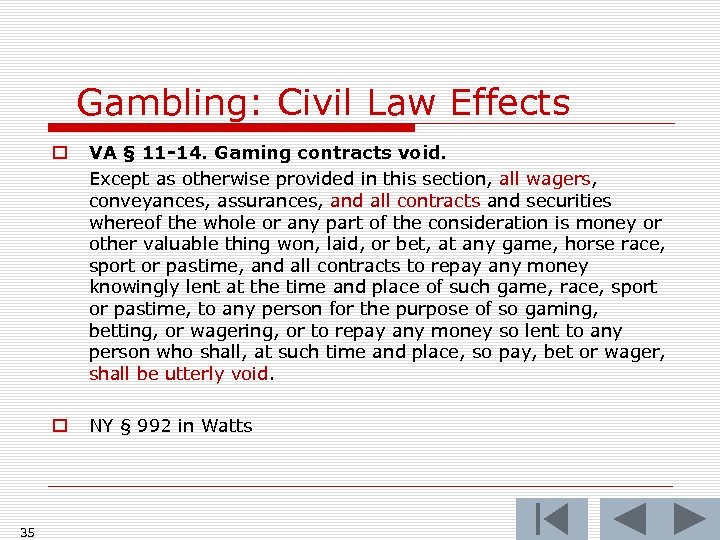 Gambling: Civil Law Effects o o 35 VA § 11 -14. Gaming contracts void. Except as otherwise provided in this section, all wagers, conveyances, assurances, and all contracts and securities whereof the whole or any part of the consideration is money or other valuable thing won, laid, or bet, at any game, horse race, sport or pastime, and all contracts to repay any money knowingly lent at the time and place of such game, race, sport or pastime, to any person for the purpose of so gaming, betting, or wagering, or to repay any money so lent to any person who shall, at such time and place, so pay, bet or wager, shall be utterly void. NY § 992 in Watts
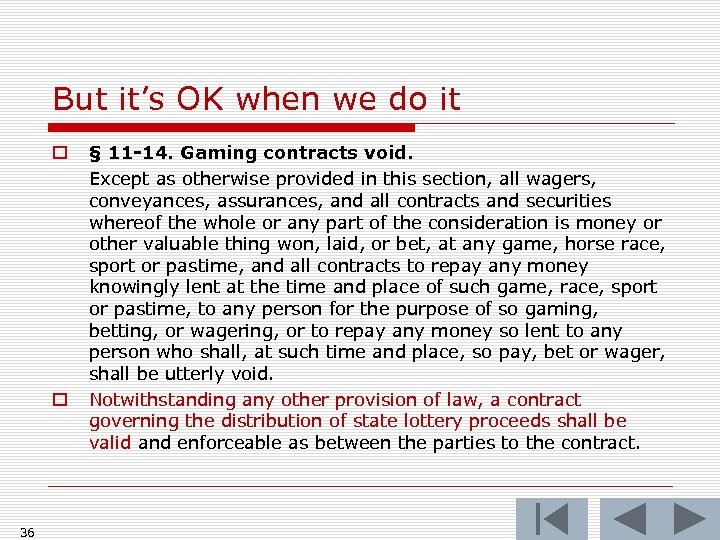 But it’s OK when we do it o o 36 § 11 -14. Gaming contracts void. Except as otherwise provided in this section, all wagers, conveyances, assurances, and all contracts and securities whereof the whole or any part of the consideration is money or other valuable thing won, laid, or bet, at any game, horse race, sport or pastime, and all contracts to repay any money knowingly lent at the time and place of such game, race, sport or pastime, to any person for the purpose of so gaming, betting, or wagering, or to repay any money so lent to any person who shall, at such time and place, so pay, bet or wager, shall be utterly void. Notwithstanding any other provision of law, a contract governing the distribution of state lottery proceeds shall be valid and enforceable as between the parties to the contract.
 Watts at 481 o What happened… 37
 Watts Π Lost and paid $37, 500 Δ Lost and paid net $100, 000 Π sues to recover his losses. Can Δ offset against this claim his far greater losses to Π? 38
 Watts o What does Ex turpi causa oritur non actio mean? 39
 Watts o What does Ex turpi causa oritur non actio mean? n Contract void as to future performance n No recovery for past debts 40
 Watts o How as this changed by NY § 994? 41
 Watts o How as this changed by NY § 994? n “any person” can recover gambling losses n But not a professional gambler 42
 Watts o How as this changed by NY § 994 o Which rule has better incentive effects? 43
 Watts o What does In pari delicto portior est conditio defendentis mean? o Crane’s dissenting judgment: Both in pari delicto 44
 Wait a minute… o Just how do professional gamblers collect their winnings? 45
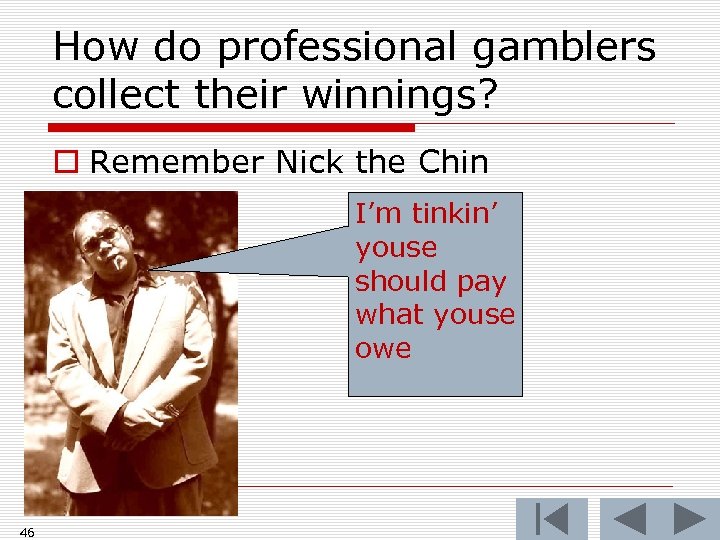 How do professional gamblers collect their winnings? o Remember Nick the Chin I’m tinkin’ youse should pay what youse owe 46
 The real problem o Is every contract made in breach of statute void for illegality? 47
 Simple regulations with no criminal penalty attached o If breached, what are the consequences in contract law? 48
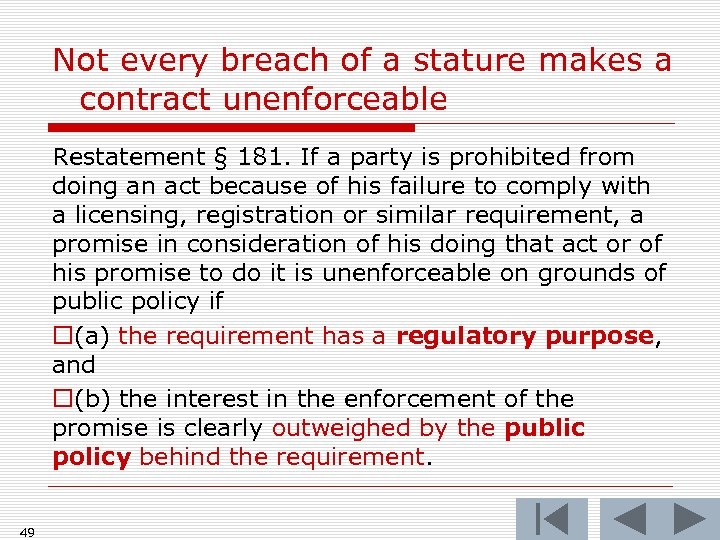 Not every breach of a stature makes a contract unenforceable Restatement § 181. If a party is prohibited from doing an act because of his failure to comply with a licensing, registration or similar requirement, a promise in consideration of his doing that act or of his promise to do it is unenforceable on grounds of public policy if o(a) the requirement has a regulatory purpose, and o(b) the interest in the enforcement of the promise is clearly outweighed by the public policy behind the requirement. 49
 Statutory Illegality o What is not a regulatory purpose n Cf. Restatement 181, Illustration 1. 50
 Statutory Illegality o What does “public policy” mean here? n Cf. Restatement § 181 illustrations 2 and 4 51
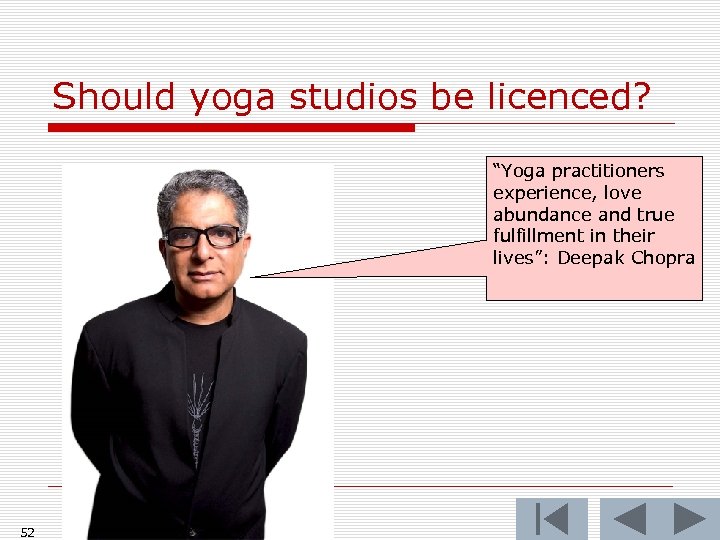 Should yoga studios be licenced? “Yoga practitioners experience, love abundance and true fulfillment in their lives”: Deepak Chopra 52
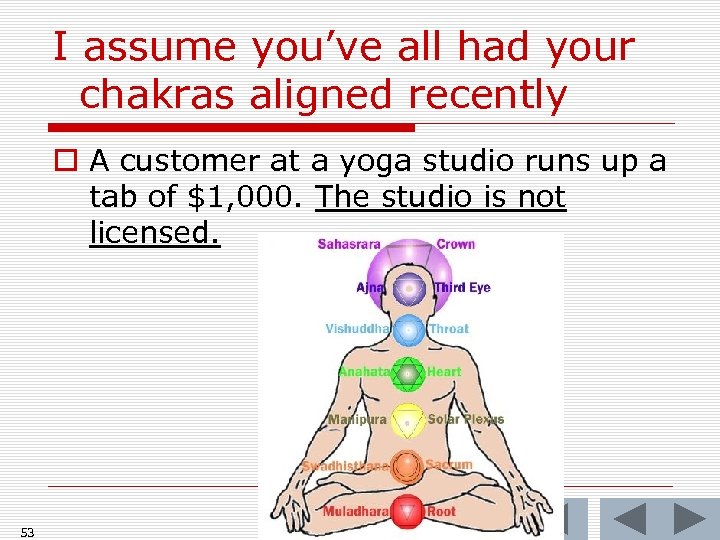 I assume you’ve all had your chakras aligned recently o A customer at a yoga studio runs up a tab of $1, 000. The studio is not licensed. 53
 I assume you’ve all had your chakras aligned recently o A customer at a yoga studio runs up a tab of $1, 000. The studio hasn’t paid city taxes for the last two years. 54
 Common Law Illegality o That was contracts illegal by statute— but what about contracts illegal at common law? 55
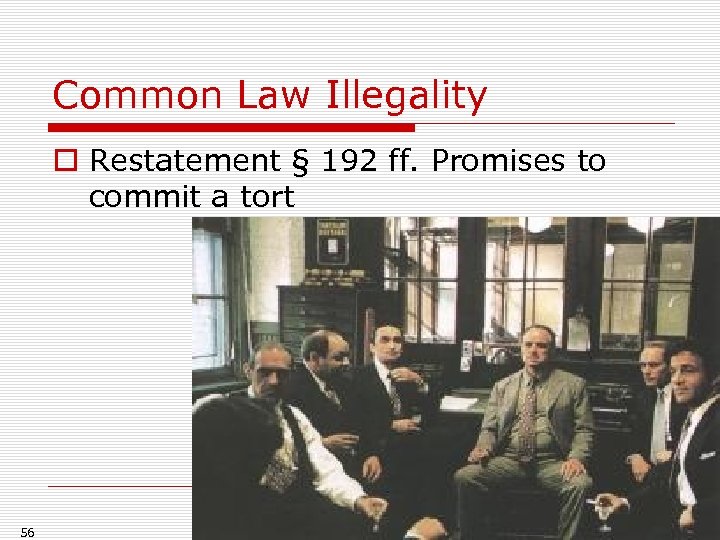 Common Law Illegality o Restatement § 192 ff. Promises to commit a tort 56
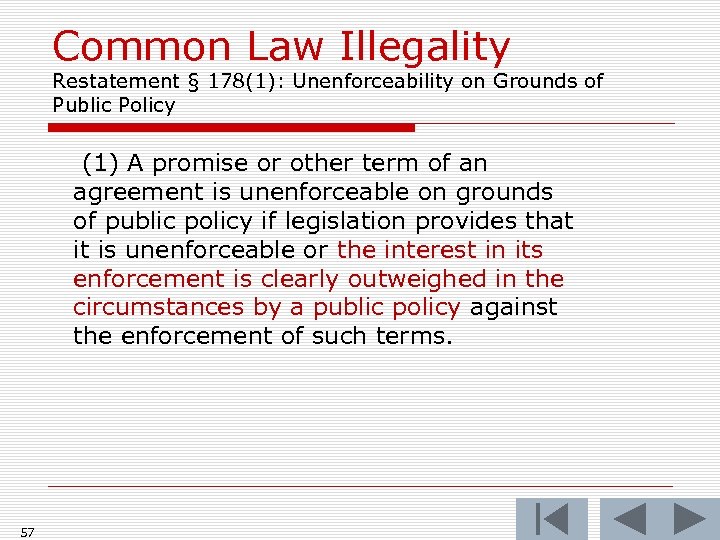 Common Law Illegality Restatement § 178(1): Unenforceability on Grounds of Public Policy (1) A promise or other term of an agreement is unenforceable on grounds of public policy if legislation provides that it is unenforceable or the interest in its enforcement is clearly outweighed in the circumstances by a public policy against the enforcement of such terms. 57
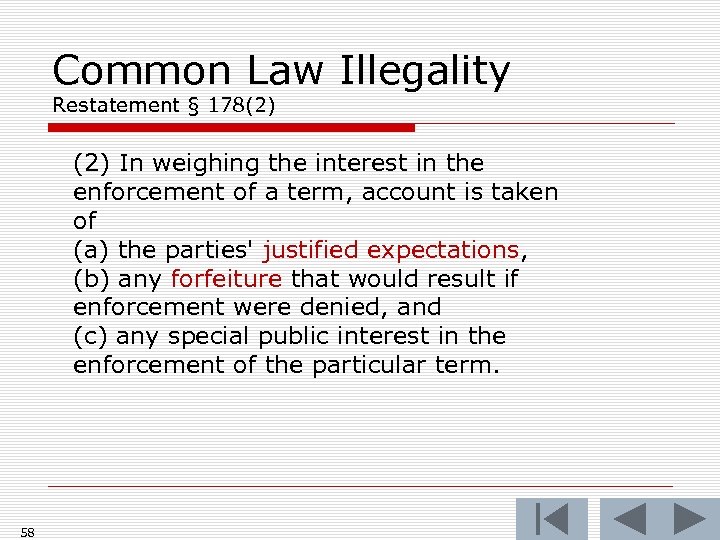 Common Law Illegality Restatement § 178(2) In weighing the interest in the enforcement of a term, account is taken of (a) the parties' justified expectations, (b) any forfeiture that would result if enforcement were denied, and (c) any special public interest in the enforcement of the particular term. 58
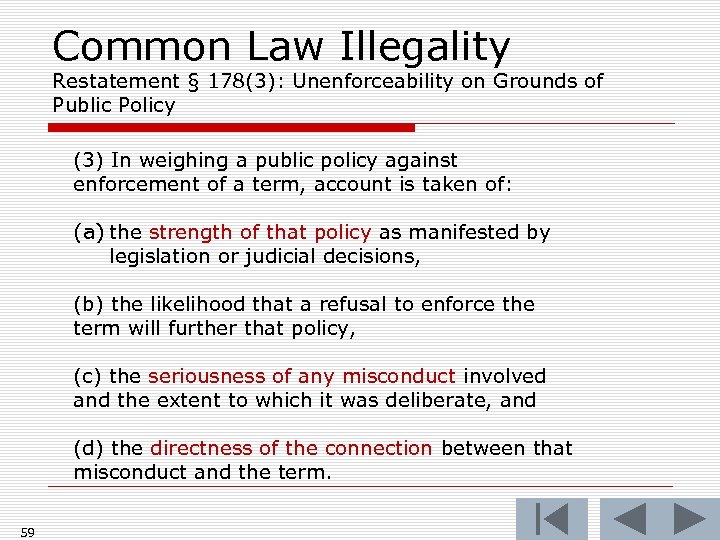 Common Law Illegality Restatement § 178(3): Unenforceability on Grounds of Public Policy (3) In weighing a public policy against enforcement of a term, account is taken of: (a) the strength of that policy as manifested by legislation or judicial decisions, (b) the likelihood that a refusal to enforce the term will further that policy, (c) the seriousness of any misconduct involved and the extent to which it was deliberate, and (d) the directness of the connection between that misconduct and the term. 59
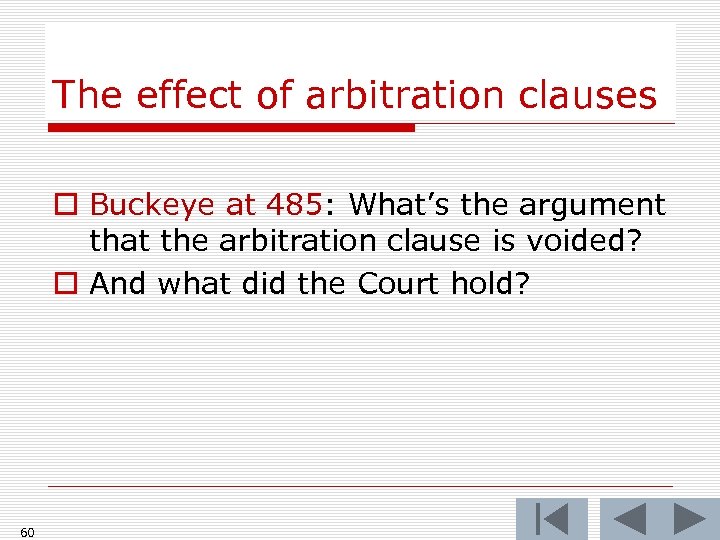 The effect of arbitration clauses o Buckeye at 485: What’s the argument that the arbitration clause is voided? o And what did the Court hold? 60
 Common Law Illegality: Baby M at 487 o What happened? 61
 Common Law Illegality: Baby M at 487 o How do you see Mary Beth Whitehead? 62
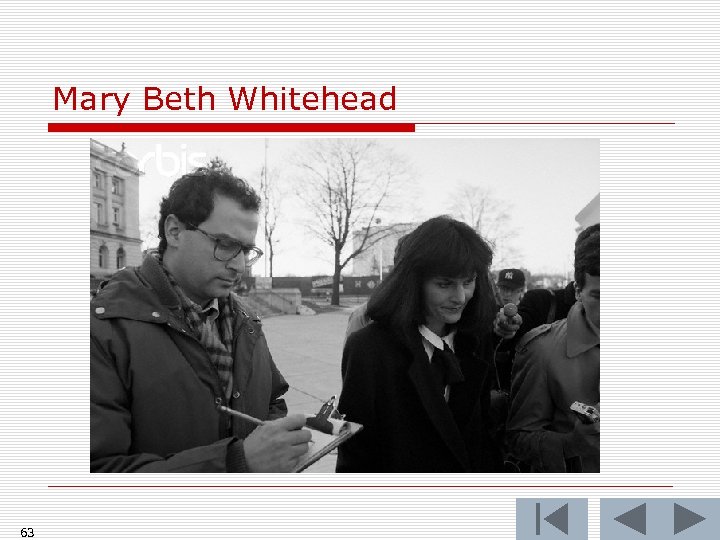 Mary Beth Whitehead 63
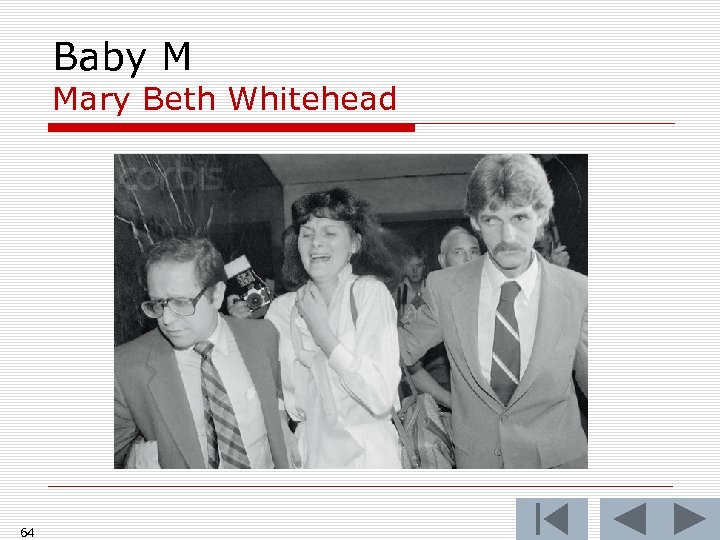 Baby M Mary Beth Whitehead 64
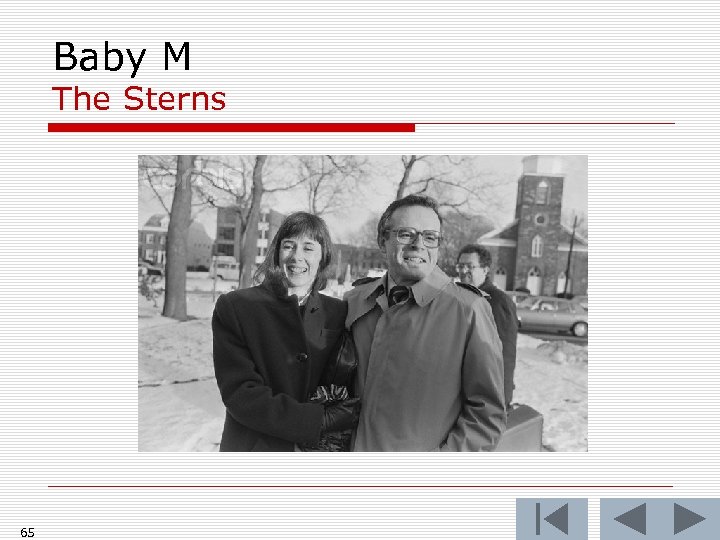 Baby M The Sterns 65
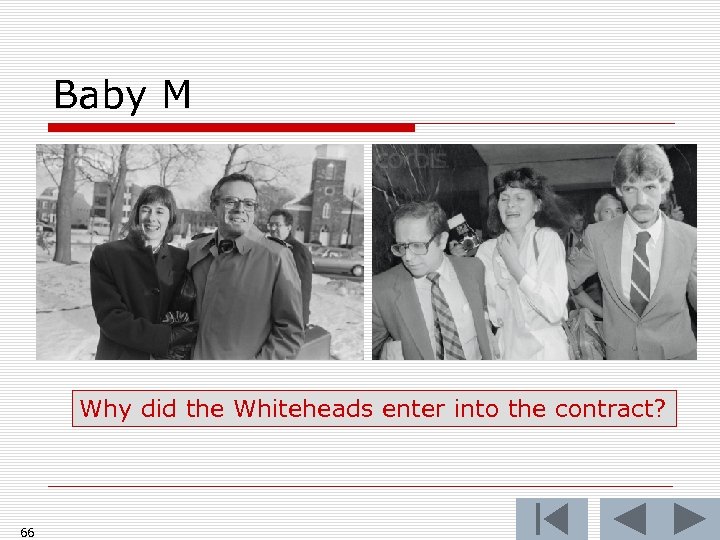 Baby M Why did the Whiteheads enter into the contract? 66
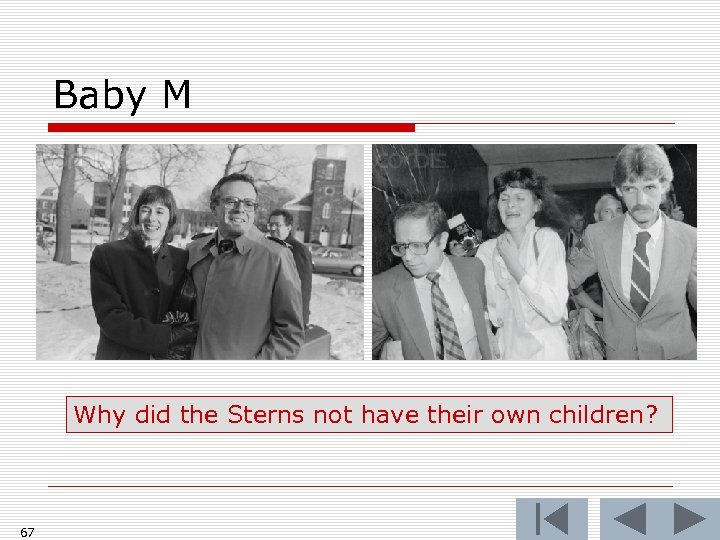 Baby M Why did the Sterns not have their own children? 67
 So what did the court hold? 68
 So what did the court hold? o Why was it contrary to statute? 69
 So what did the court hold? o Why was it contrary to public policy? 70
 So what did the court hold? o OMG, no lawyers, no psychologists to advise her!!!! 71
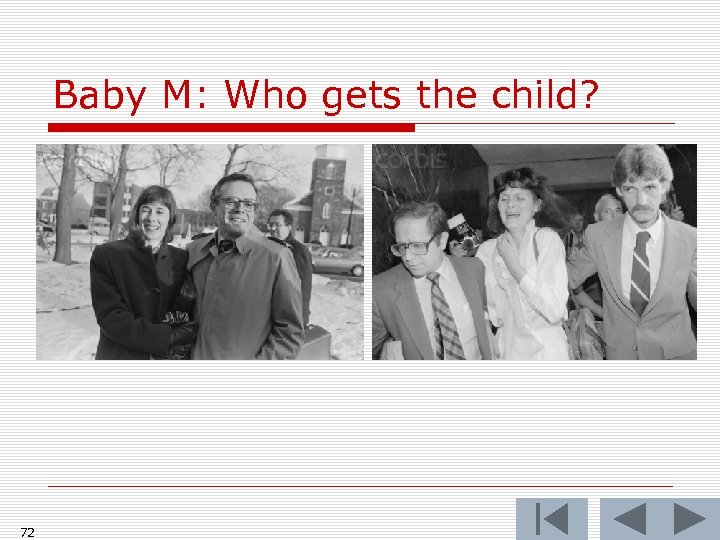 Baby M: Who gets the child? 72
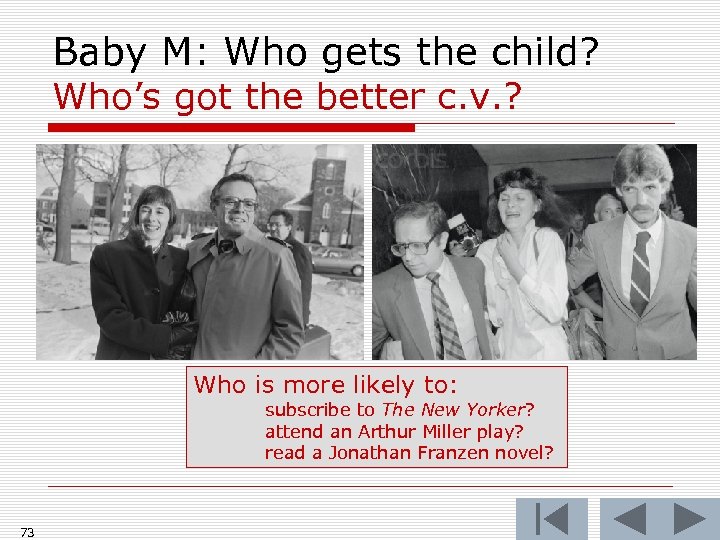 Baby M: Who gets the child? Who’s got the better c. v. ? Who is more likely to: subscribe to The New Yorker? attend an Arthur Miller play? read a Jonathan Franzen novel? 73
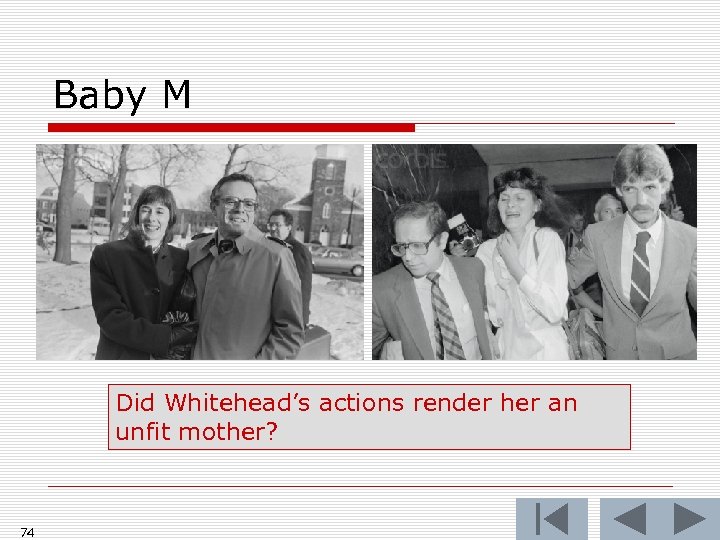 Baby M Did Whitehead’s actions render her an unfit mother? 74
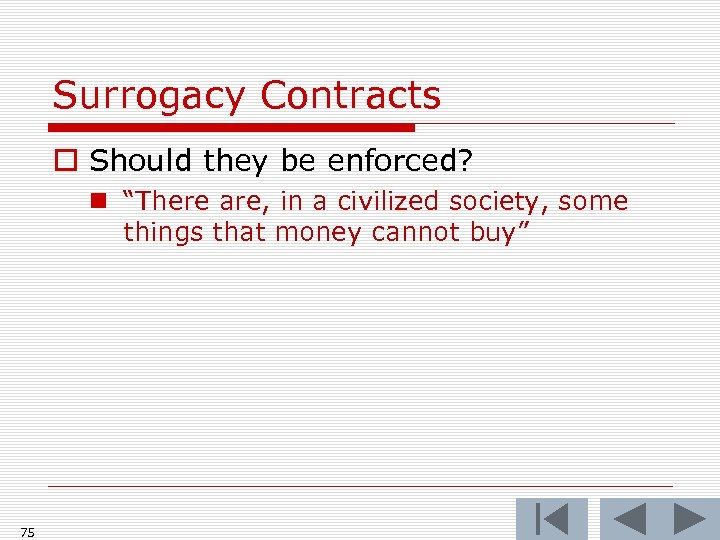 Surrogacy Contracts o Should they be enforced? n “There are, in a civilized society, some things that money cannot buy” 75
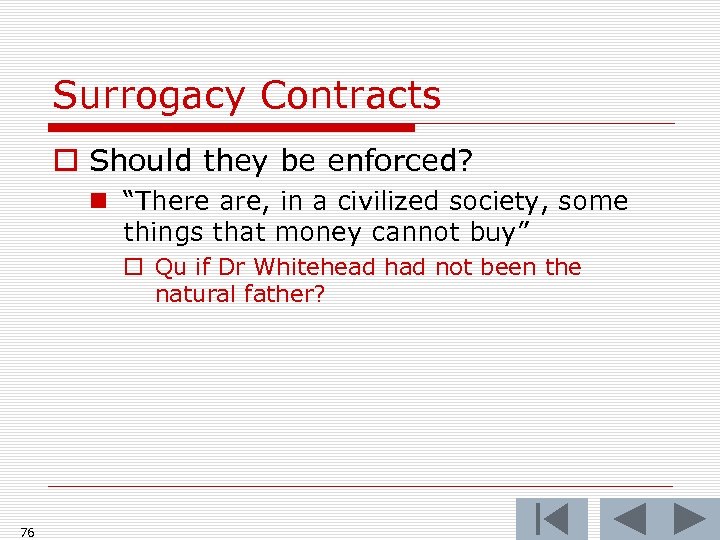 Surrogacy Contracts o Should they be enforced? n “There are, in a civilized society, some things that money cannot buy” o Qu if Dr Whitehead had not been the natural father? 76
 Surrogacy Contracts o Should they be enforced? n “There are, in a civilized society, some things that money cannot buy” o Qu sale of a kidney 77
 Surrogacy Contracts o Should they be enforced? n How would you have redrafted the Whitehead contract? 78
 Surrogacy Contracts o Should they be enforced? n Note that the industry has expanded, AFTER Baby M. 79
 Surrogacy Contracts o Should they be enforced? n Note that the industry has expanded, AFTER Baby M. n Why not just enforce them, if the yuppies win anyway? 80
 What about the following? o The sale of a child? n Why do we find this revolting? Are we wrong to do so? 81
 Recall Mill’s harm principle n “The only purpose for which power can rightfully be exercised over any member of a civilized community, against his will, is to prevent harm to others. ” o How would Mill have decided Baby M? 82
 Recall Mill’s harm principle n “The only purpose for which power can rightfully be exercised over any member of a civilized community, against his will, is to prevent harm to others. ” o What counts as a harm? 83
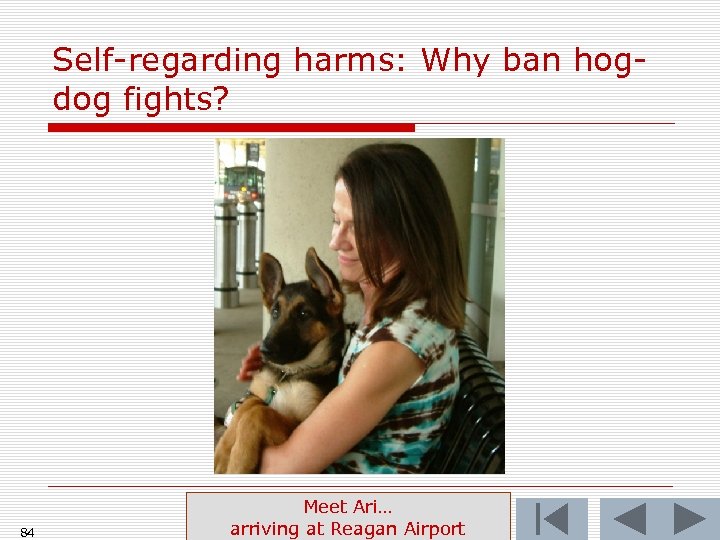 Self-regarding harms: Why ban hogdog fights? 84 Meet Ari… arriving at Reagan Airport
 Are Emotions Moral? o Most of us feel repugnance at certain things, even if we cannot articulate a rational basis for our feelings n Should this inform our moral code? n Or our legal code? 85
 Are Emotions Moral? o Most of us feel repugnance at certain things, even if we cannot articulate a rational basis for our feelings n Let’s say we are taught not to feel repugnance for desecrating a dead body, by a social worker. o Have we lost something of value? o Or have we been morally improved? 86
 Recall Mill’s harm principle n “The only purpose for which power can rightfully be exercised over any member of a civilized community, against his will, is to prevent harm to others. ” o Does this include nudges designed to better ourselves? o E. g. incentives to marriage 87
 Promises detrimental to marriage o Restatement § 190(1): a contract is illegal “if it would change some essential incident in the marriage relationship in a way detrimental to the public interest” n Cf. Illustration 5 88
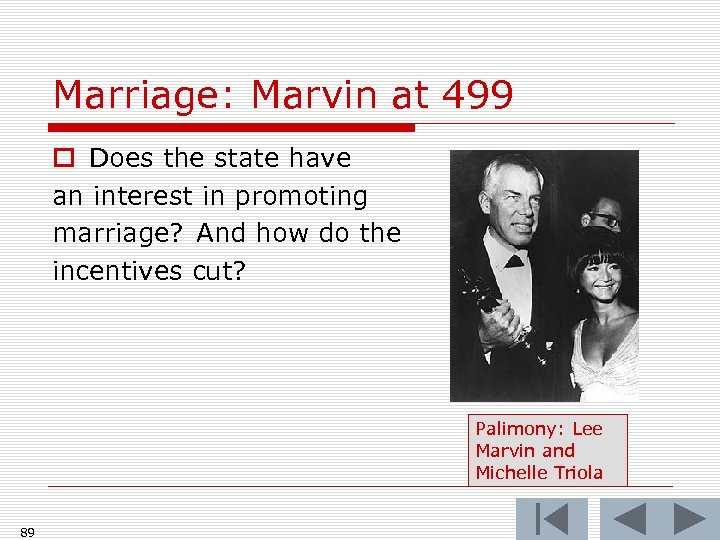 Marriage: Marvin at 499 o Does the state have an interest in promoting marriage? And how do the incentives cut? Palimony: Lee Marvin and Michelle Triola 89
 Marriage: Hewitt at 499 o Does marriage matter? o Glasco (and the casebook) describe the Hewitt’s relationship as “merely lacking legal formality” 90
 Marriage: Hewitt at 499 o Does marriage matter? o Merely lacking legal formality? n 91 Let’s say you suggest a divorce to your spouse, for that reason…
 George Mason School of Law Contracts I A. Common Law Illegality F. H. Buckley fbuckley@gmu. edu 92
 Recall Mill’s harm principle n “The only purpose for which power can rightfully be exercised over any member of a civilized community, against his will, is to prevent harm to others. ” o What counts as a harm? 93
 What counts as a harm: Externalities o Externalities are third party effects where my actions either confer a benefit or impose a cost on others. 94
 What counts as a harm: Externalities o Externalities are third party effects where my actions either confer a benefit or impose a cost on others. o External goods and bads n Public goods and the case for government 95
 Three different kinds of capital—and harm o Physical Capital (e. g. pollution) 96
 Different kinds of capital o Physical capital o Human Capital n Intelligence and health n Private virtue, good character 97
 Different kinds of capital o Physical capital o Human Capital o Social Capital o Do you care who your neighbors are? 98
 Social Externalities o Are we influenced by the moral feelings of those around us? n Raj Chetty, Nathaniel Hendren, Patrick Kline, Emmanuel Saez and Nicholas Turner, “Is the United States Still a Land of Opportunity? Recent Trends, ” NBER Working Paper 19844. 99
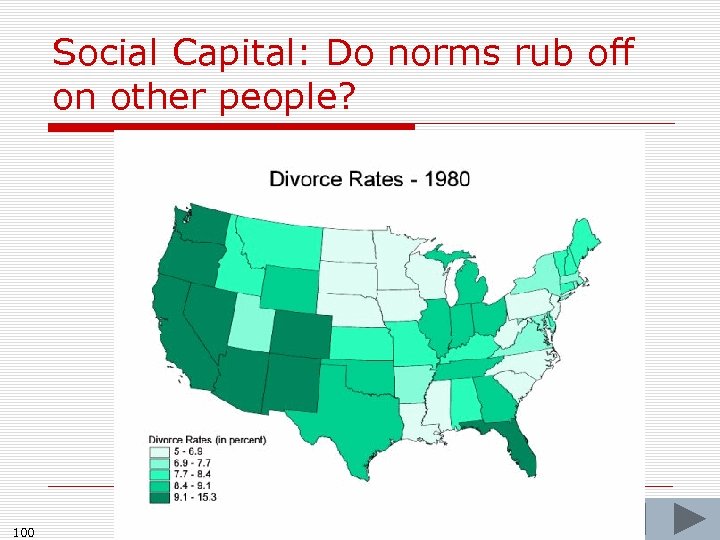 Social Capital: Do norms rub off on other people? 100
 What counts as a harm? o I fully admit that the mischief which a person does to himself, may seriously affect, both through their sympathies and their interests, those nearly connected with him, and in a minor degree, society at large. 101
 What counts as a harm? o I fully admit that the mischief which a person does to himself, may seriously affect, both through their sympathies and their interests, those nearly connected with him, and in a minor degree, society at large. n Does this provide an argument for legislating morals? 102
 Mill on the argument from social externalities o “So monstrous a principle is far more dangerous than any single interference with liberty; there is no violation of liberty which it would not justify; it acknowledges no right to any freedom whatever, except perhaps to that of holding opinions in secret, without ever disclosing them” 103
 Some remaining issues o What should be left to social norms? o Slippery slopes o Can we trust the state? 104
 Mill on Social sanctions o But disinterested benevolence can find other instruments to persuade people to their good, than whips and scourges, either of the literal or the metaphorical sort. I am the last person to undervalue the self-regarding virtues; they are only second in importance, if even second, to the social. It is equally the business of education to cultivate both. 105
 Mill on Social sanctions o But disinterested benevolence can find other instruments to persuade people to their good, than whips and scourges, either of the literal or the metaphorical sort. I am the last person to undervalue the self-regarding virtues; they are only second in importance, if even second, to the social. It is equally the business of education to cultivate both. o But consider the tyranny of social sanctions n Do we need anti-discrimination laws? 106
 The Battle of the Slippery Slopes o In a slippery slope, I want to do A and do not want to do B. But if I do A I am led into doing B. 107
 The Battle of the Slippery Slopes o In a slippery slope, I want to do A and do not want to do B. But if I do A I am led into doing B. o Is there a fallacy here? 108
 The Battle of the Slippery Slopes o In a slippery slope, I want to do A and do not want to do B. But if I do A I am led into doing B. o Is there a fallacy here? n If I do A, does that evidence a greater desire for B rather than A? 109
 The Battle of the Slippery Slopes o In a slippery slope, I want to do A and do not want to do B. But if I do A I am led into doing B. o Is there a fallacy here? o Or is this an informational problem? 110
 Slippery Slopes: Perfectionists and Neutralists o The Perfectionist fears that a slight change in moral habits will lead to the Decline and Fall of our civilization. 111
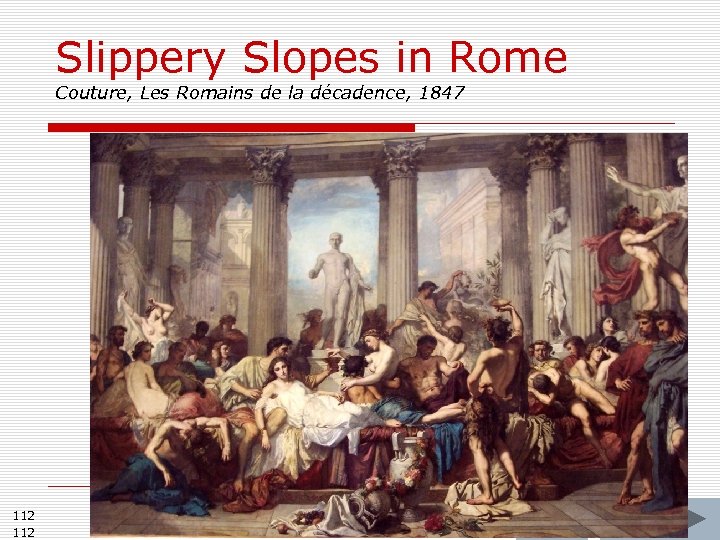 Slippery Slopes in Rome Couture, Les Romains de la décadence, 1847 112
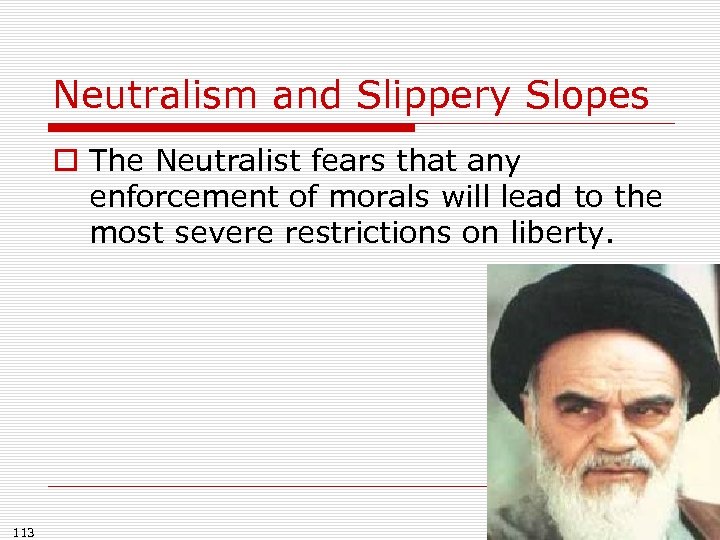 Neutralism and Slippery Slopes o The Neutralist fears that any enforcement of morals will lead to the most severe restrictions on liberty. 113
 Can the state be trusted to enforce morals? o “But the strongest of all the arguments against the interference of the public with purely personal conduct, is that when it does interfere, the odds are that it interferes wrongly, and in the wrong place. ” 114
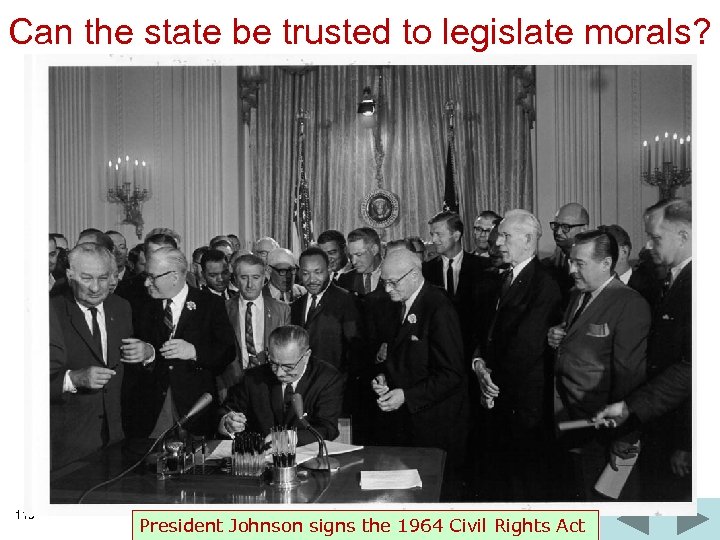 Can the state be trusted to legislate morals? 115 President Johnson signs the 1964 Civil Rights Act
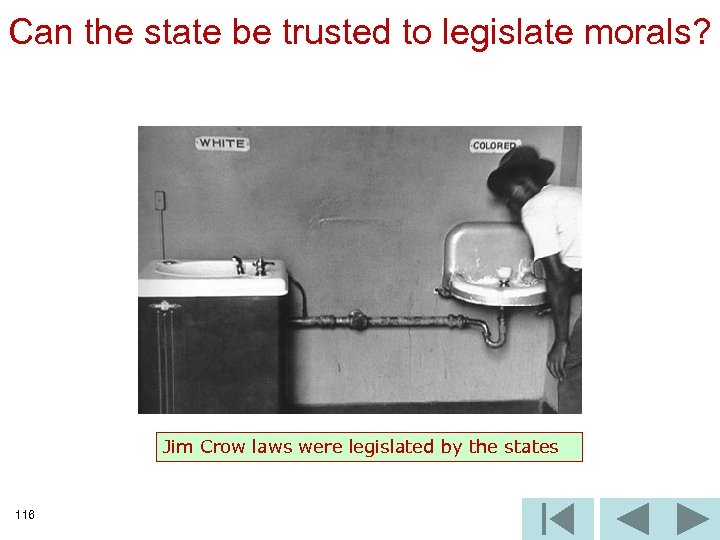 Can the state be trusted to legislate morals? Jim Crow laws were legislated by the states 116