


 Скачать презентацию Georg-August-Universität Göttingen Climate Protection in Food Supply Chains
0d3050b558656e4613dcfed042bee043.ppt
- Количество слайдов: 20
 Georg-August-Universität Göttingen Climate Protection in Food Supply Chains Anette Joswig Regional Policy and Rural Areas – Marketing and Trade of Fresh Fruits and Vegetables SS 2008 05 -31 -2008 Climate Protection in Food Supply Chains Anette Joswig
 Georg-August-Universität Göttingen Agenda 1. Greenhouse gas emissions along the food supply chain 2. Food miles 3. Case study I: Tesco 4. Case study II: Stop Climate Change System 5. Conclusion 05 -31 -2008 Agenda 2
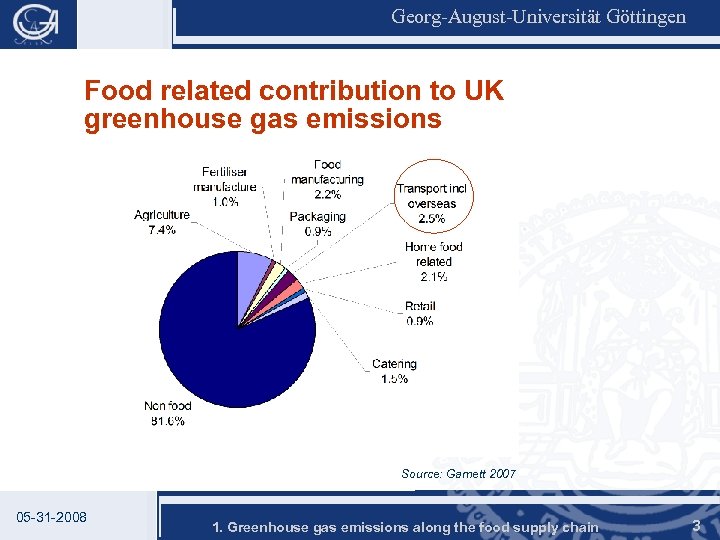 Georg-August-Universität Göttingen Food related contribution to UK greenhouse gas emissions Source: Garnett 2007 05 -31 -2008 1. Greenhouse gas emissions along the food supply chain 3
 Georg-August-Universität Göttingen Food miles = The distance food travels from the farm to consumer Large increase due to § § § Globalisation of food industry: increase in food trade Concentration of the food supply base: fewer, larger suppliers Changes in delivery patterns: regional distribution centers, larger Heavy Goods Vehicles (HGV) § Centralisation and concentration of sales in supermarkets: weekly shopping by car 05 -31 -2008 2. Food miles 4
 Georg-August-Universität Göttingen Rise in food miles is associated with an increase in: § § § Carbon dioxide emissions Air pollution Congestion Accidents Noise Infrastructure damage Environmental, social and economic impacts Total food kilometres are no adequate indicator of sustainability 05 -31 -2008 2. Food miles 5
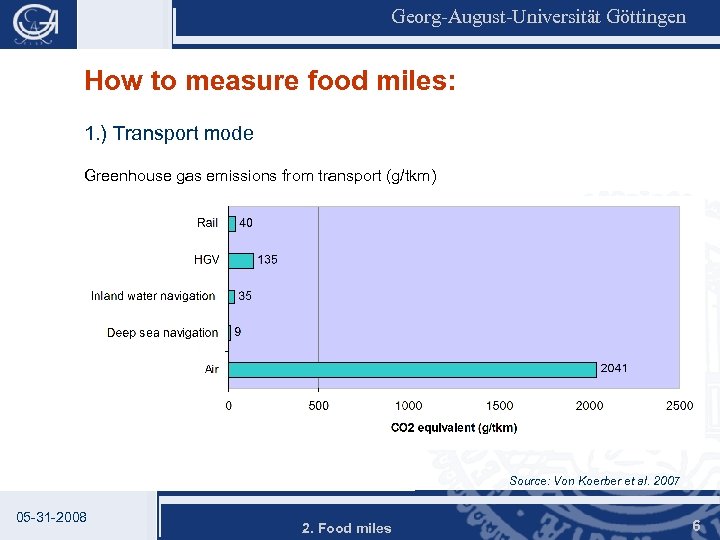 Georg-August-Universität Göttingen How to measure food miles: 1. ) Transport mode Greenhouse gas emissions from transport (g/tkm) Source: Von Koerber et al. 2007 05 -31 -2008 2. Food miles 6
 Georg-August-Universität Göttingen How to measure food miles continued 2. ) Transport efficiency 3. ) Differences in food production systems 4. ) Wider social and economic costs and benefits Effects associated with food miles are complex and system specific § Key indicators: § § urban/ HGV/ air food km total CO 2 emissions from food transport Source: Smith et al. 2005 05 -31 -2008 2. Food miles 7
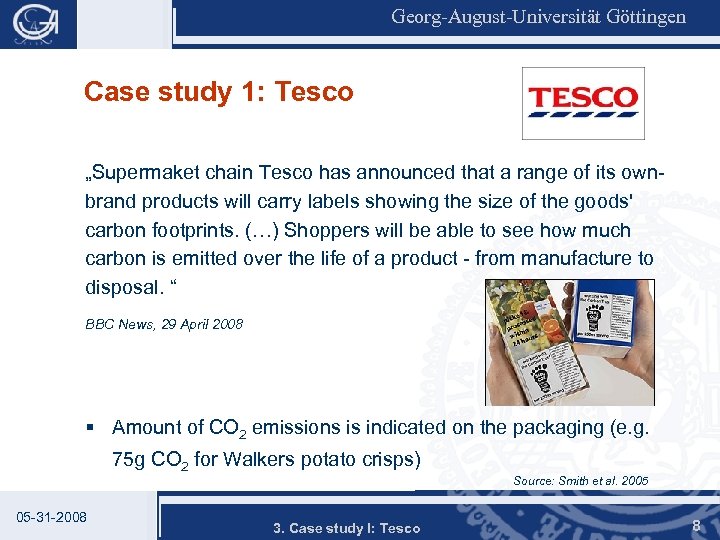 Georg-August-Universität Göttingen Case study 1: Tesco „Supermaket chain Tesco has announced that a range of its ownbrand products will carry labels showing the size of the goods' carbon footprints. (…) Shoppers will be able to see how much carbon is emitted over the life of a product - from manufacture to disposal. “ BBC News, 29 April 2008 § Amount of CO 2 emissions is indicated on the packaging (e. g. 75 g CO 2 for Walkers potato crisps) Source: Smith et al. 2005 05 -31 -2008 3. Case study I: Tesco 8
 Georg-August-Universität Göttingen Evaluation of carbon footprint labelling § Developed in partnership with the Department for Environment, Food and Rural Affairs (Defra) and the British Standards Institute high credibility § § § 05 -31 -2008 More transparancy to the consumers Simple to understand Beyond the concept of food miles But: for the time beeing only transportation costs are included For instance only four product categories (detergents, orange juice, potatoes and light bulbs) 3. Case study I: Tesco 9
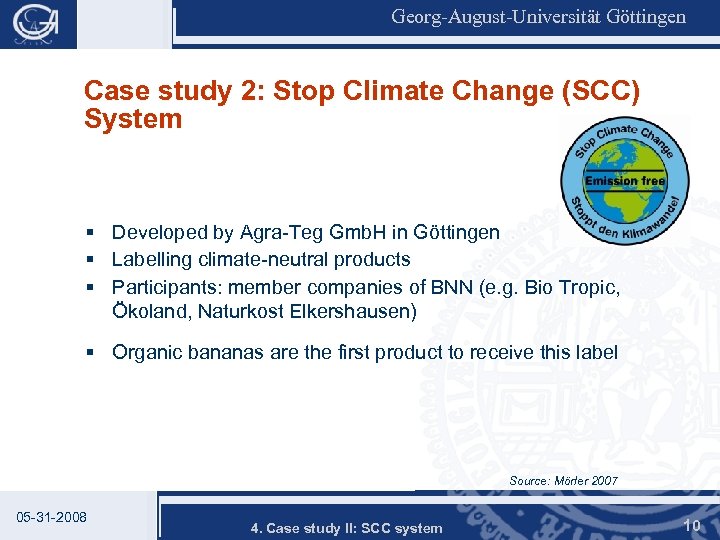 Georg-August-Universität Göttingen Case study 2: Stop Climate Change (SCC) System § Developed by Agra-Teg Gmb. H in Göttingen § Labelling climate-neutral products § Participants: member companies of BNN (e. g. Bio Tropic, Ökoland, Naturkost Elkershausen) § Organic bananas are the first product to receive this label Source: Mörler 2007 05 -31 -2008 4. Case study II: SCC system 10
 Georg-August-Universität Göttingen How does SCC work? 1. 2. 3. 4. 5. Calculate and document a product’s carbon footprint Independent certifier checks the calculated emissions Minimise GHG emissions Compensation of GHG emissions by buying emission permits (e. g. planting rainforest) Bananas are labelled as “emission free” products The system is monitored by a governing board with representatives from politics, science, organic certification bodies and consumer protection organisations. 05 -31 -2008 4. Case study II: SCC system 11
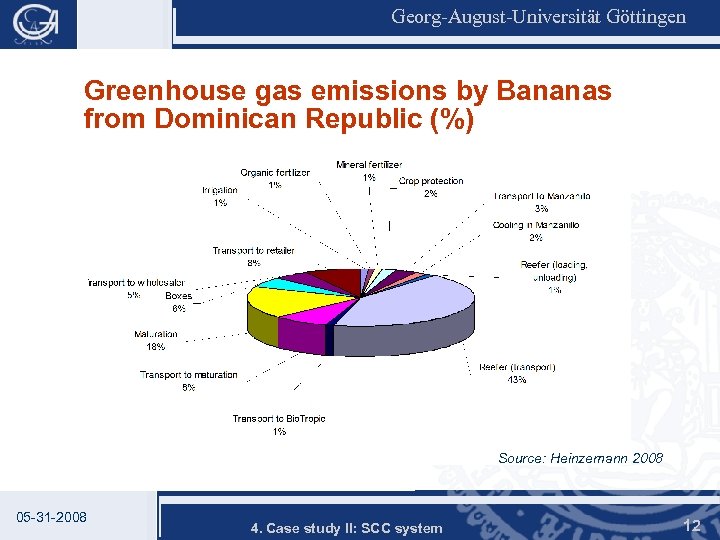 Georg-August-Universität Göttingen Greenhouse gas emissions by Bananas from Dominican Republic (%) Source: Heinzemann 2008 05 -31 -2008 4. Case study II: SCC system 12
 Georg-August-Universität Göttingen Evaluation of the SCC System § GHG emissions are not just labelled (see Tesco), but compensated § Very broad approach: (Almost) all emissions are neutralised § Transparency § High credibility through “division of powers” § The label “emission free” might be misunderstood by consumers § Climate relevant costs are included, but there are still other externalities (social, environmental) In conclusion a useful approach 05 -31 -2008 4. Case study II: SCC system 13
 Georg-August-Universität Göttingen Conclusion § Food supply chains contribute significantly to the GHG emissions § Food miles are linked with environmental, social and economic effects § The concept of food miles does not consider all climate relevant costs; therefore the whole food supply chain has to be analysed § The SCC system is a comprehensive approach to neutralise GHG emissions § Only very few, organic products are available as “emission free” § Consumers’ demand is required for the success of SCC § We are responsible for the climate. It is our decision what we buy! 05 -31 -2008 5. Conclusion 14
 Georg-August-Universität Göttingen Thank you for your attention! Anette Joswig Seminar FFV SS 08 ajoswig@gwdg. de 05 -31 -2008 15
 Georg-August-Universität Göttingen References § BBC News (2008): Supermarket trials carbon labels, available at: http: //news. bbc. co. uk/2/hi/science/nature/7371033. stm; date of access: 05 -302008. § FCRN (2007): Garnett, T. (2007): Overall UK consumption related GHGs, available at: http: //www. fcrn. org. uk/frcn. Research/index. htm; date of access: 0530 -2008. § Heinzemann, J. (2008): Stop-Climate-Change Emissionsmanagement-Systems (EMS), Präsentation, Göttingen. § Hoffrogge (2008): Emissionsfrei essen, available at: http: //www. dradio. de/dlf/sendungen/umwelt/605747/; date of access: 05 -28 -2008. § Mörler, A. (2007 a): Klimaschutz bewegt die Branche, in: BNN-Nachrichten September 2007, p. 10 -12. 05 -31 -2008 References 16
 Georg-August-Universität Göttingen § Smith, A. ; Watkiss, P. ; Tweddle, G. ; Mc. Kinnon, A. ; Browne, M. ; Hunt, A. ; Treleven, C. ; Nash, C. ; Cross, S. (2005): The Validity of Food Miles as an Indicator of Sustainable Development, available at: http: //statistics. defra. gov. uk/esg/reports/foodmiles/final. pdf; date of access: 05 -09 -2008. § Tesco (2007): Measuring Our Carbon Footprint, available at: http: //www. tesco. com/climatechange/carbon. Footprint. asp; date of access: 05 -302008. § Von Koerber, K. ; Kretschmer, J. (2007): Klimafreundlich essen: weniger Fleisch, bio, regional & frisch, in: Ökologie & Landbau Nr. 143, 3/2007, S. 20 -22, available at: http: //www. greenpeace-chiemgau. de/2008 -01 -22 -ausstellung-stadtts/klima-und-ernaehrung. pdf; date of access: 05 -13 -2008. 05 -31 -2008 References 17
 Georg-August-Universität Göttingen Additional information Supermaket chain Tesco has announced that a range of its own-brand products will carry labels showing the size of the goods' carbon footprints. Tesco said it would label 20 items, including light bulbs and potatoes, during a two-year trial of the scheme, which is operated by the Carbon Trust. Shoppers will be able to see how much carbon is emitted over the life of a product - from manufacture to disposal. The store said it was introducing the labels in response to consumer demand. "Customers tell us that it is very important to them, " said David North, Tesco's community and government director. "What they have said is that they want us to help them tackle climate change. " He added that information on products' environmental credentials was one of the key areas where shoppers wanted more information from retailers. Initially, 20 products from four categories - detergents, orange juice, potatoes and light bulbs - will carry labels displaying the items' carbon dioxide (CO 2) emissions. The Carbon Trust's scheme, launched in March 2007, is being developed in partnership with the Department for Environment, Food and Rural Affairs (Defra) and the British Standards Institute. In order for products to carry the carbon reduction label, companies have to undertake a comprehensive carbon audit of the supply chains, and commit to further CO 2 reductions over a two-year period. (http: //images. google. de/imgres? imgurl=http: //newsimg. bbc. co. uk/media/images/44607000/jpg/_44607508_juice 2 26 carbontrust. jpg&imgrefurl=http: //news. bbc. co. uk/nolpda/ifs_news/hi/newsid_7371000/7371033. stm&h=17 0&w=226&sz=29&hl=de&start=125&um=1&tbnid=036 q. Q 7 Roe 7 Xu. M: &tbnh=81&tbnw=108&prev=/images%3 Fq%3 Dcarbon%2 Bfootprint%2 Btesco%26 start%3 D 10 8%26 ndsp%3 D 18%26 um%3 D 1%26 hl%3 Dde%26 client%3 Dfirefoxa%26 rls%3 Dcom. google: de: official%26 sa%3 DN) 05 -31 -2008 18
 Georg-August-Universität Göttingen Additional information § § § 05 -31 -2008 It set out how we can use our unique relationship with customers to deliver a revolution in green consumption. It also included ambitious targets for us to reduce our own emissions. Some of the highlights include: We will begin the search for a universally accepted and commonly understood measure of the carbon footprint of the products we sell and will take the first steps towards developing a Sustainable Consumption Institute to lead this work. This will enable us to label our products so that customers can compare their carbon footprint easily. We will promote and incentivise energy efficient products through our Green Clubcard scheme and also extend Green Clubcard points to environmentally friendly products from a wider range of categories, for example organic food, products made from recycled or biodegradable materials and Fairtrade. We will also bring down the cost of going green, beginning by halving the price of energy-efficient light bulbs. We will reduce the carbon footprint of our existing stores and distribution centres around the world by 50% per cent by 2020 and ensure that all new stores we build between now and 2020 emit on average at least 50 per cent less carbon than an equivalent store in 2006. We will seek to restrict air transport to less than 1 per cent of our products and will put an aeroplane symbol on all air-freighted products in our stores. 19
 Georg-August-Universität Göttingen Additional information § § § 05 -31 -2008 The BSI Management Systems division of BSI Group is the world’s largest certification body[5]. It audits and provides certification to companies worldwide who implement management systems standards. BSI Management Systems also provides a range of training courses regarding implementation and auditing to the requirements of national and international management systems standards. It is independently accredited and delivers assessments for a wide range of standards and other specifications including: ISO 9001 (Quality), ISO 14001 (Environment), BS OHSAS 18001 (Occupational Health and Safety), ISO/IEC 27001 (previously BS 7799 for Information Security), ISO/IEC 20000 (previously BS 15000 for IT Service Management); PAS 99 (Integrated Management), BS 25999 (Business Continuity), Greenhouse Gas Emissions Verification, SA 8000 (Social Accountability) and Food Safety standards and specifications, including ISO 22000. 20