


 Скачать презентацию Geometric information for VIRTIS-M data F Tosi and
0e875cf4bb1444802a3215ecc921ef72.ppt
- Количество слайдов: 20
 Geometric information for VIRTIS-M data F. Tosi and the VIRTIS Team
 Available tools for irregular shapes • VER 2 DSK: a Unix script allowing to transform a raw shape model file (text file, properly formatted, *. ver) into a SPICEcompliant shape model file (binary, *. dsk). • TSTSHAPE. c: a procedure in the “C” language, allowing to show the aspect of a shape model (already converted into DSK format) with a given perspective and illumination. The user can set up the sub-spacecraft point, sub-solar point, distance and pixel scale to be applied, as well as the photometric function to be used in computing reflected sunlight. • RVGSS. c: a procedure in the “C” language, able to compute geometries for the central ray and 4 corners of each VIRTIS-M pixel (an input file with UTC times at midexposure for each line is needed). This code provides no computation for VIRTIS-H at the moment. VIRTIS Science Team Meeting 2
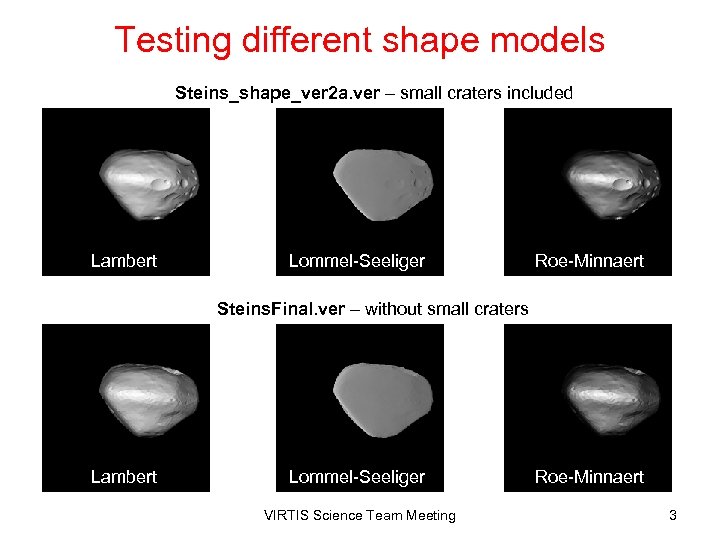 Testing different shape models Steins_shape_ver 2 a. ver – small craters included Lambert Lommel-Seeliger Roe-Minnaert Steins. Final. ver – without small craters Lambert Lommel-Seeliger VIRTIS Science Team Meeting Roe-Minnaert 3
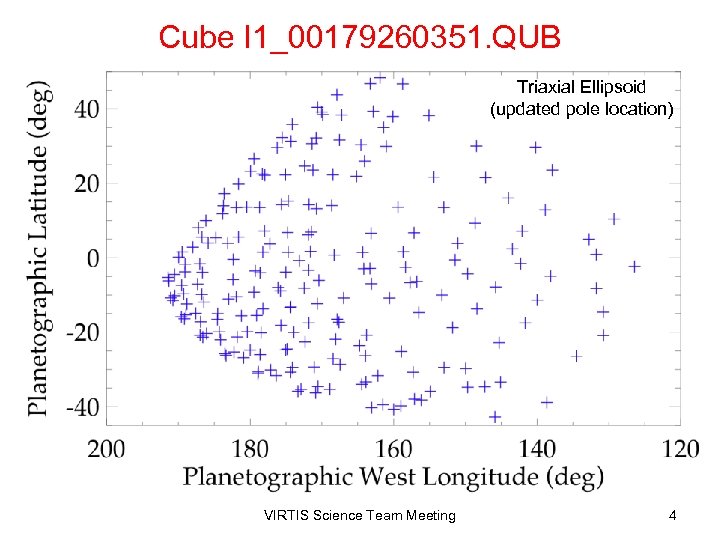 Cube I 1_00179260351. QUB Triaxial Ellipsoid (updated pole location) VIRTIS Science Team Meeting 4
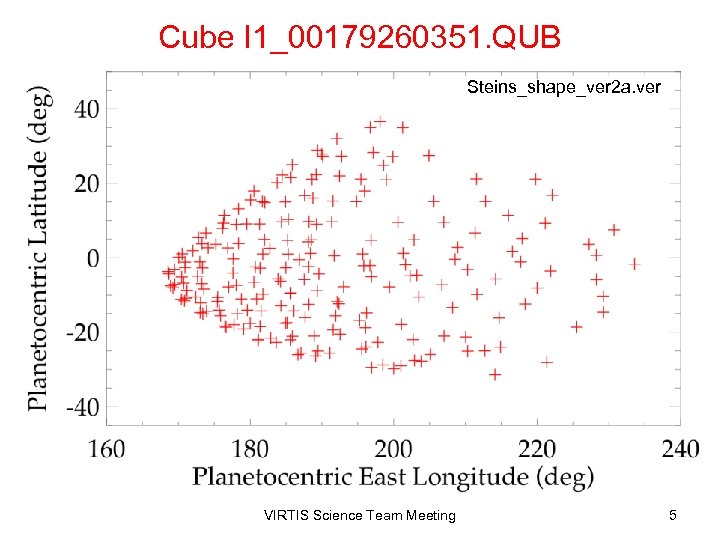 Cube I 1_00179260351. QUB Steins_shape_ver 2 a. ver VIRTIS Science Team Meeting 5
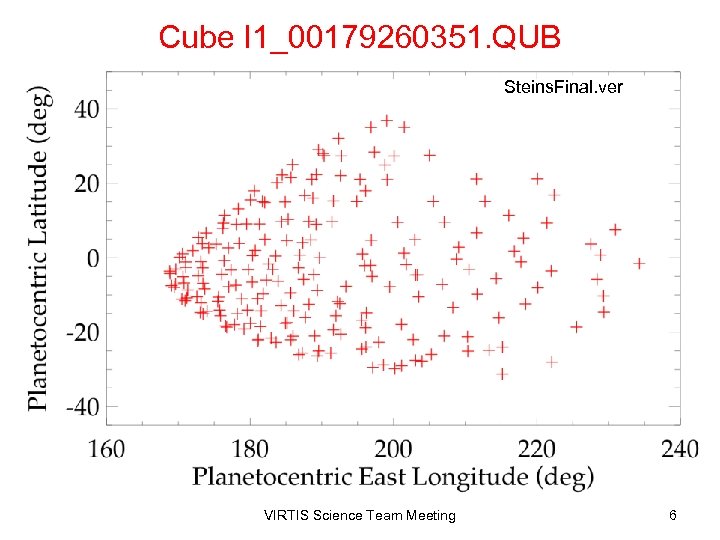 Cube I 1_00179260351. QUB Steins. Final. ver VIRTIS Science Team Meeting 6
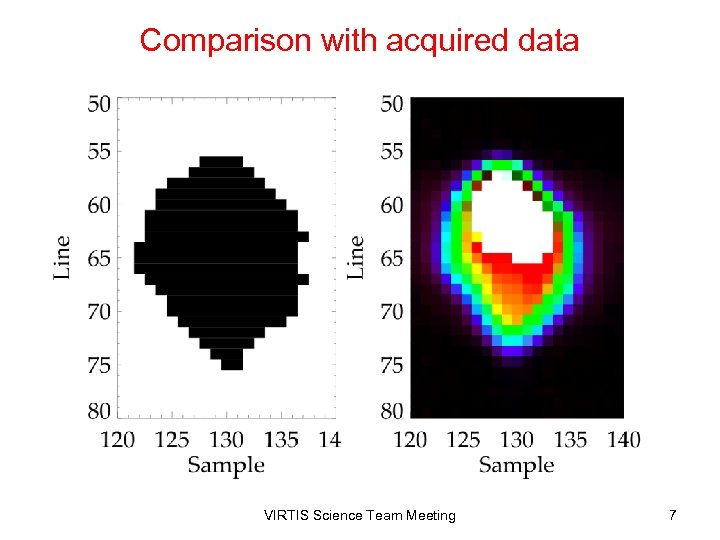 Comparison with acquired data VIRTIS Science Team Meeting 7
 VIRTIS Science Team Meeting 8
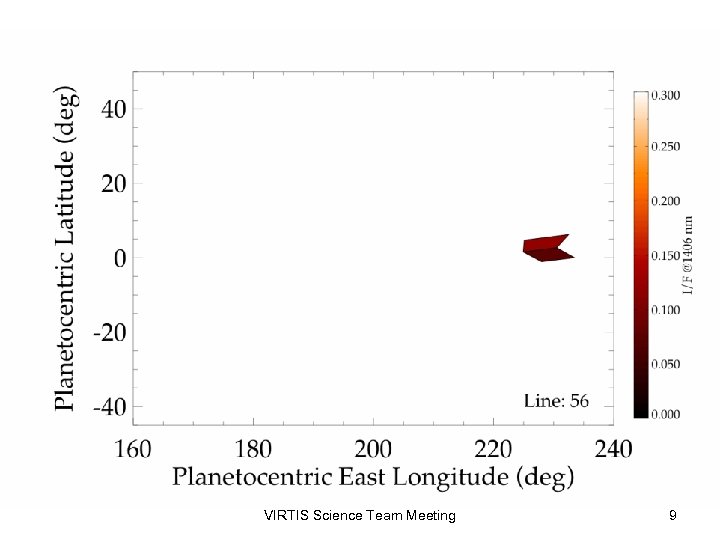 VIRTIS Science Team Meeting 9
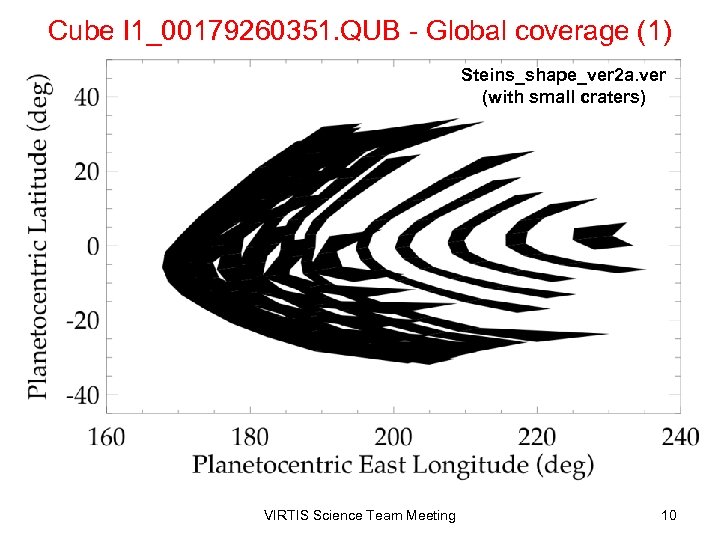 Cube I 1_00179260351. QUB - Global coverage (1) Steins_shape_ver 2 a. ver (with small craters) VIRTIS Science Team Meeting 10
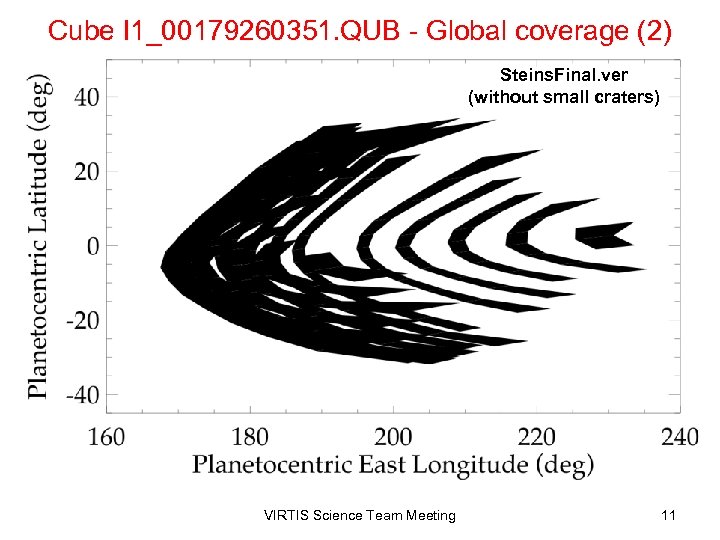 Cube I 1_00179260351. QUB - Global coverage (2) Steins. Final. ver (without small craters) VIRTIS Science Team Meeting 11
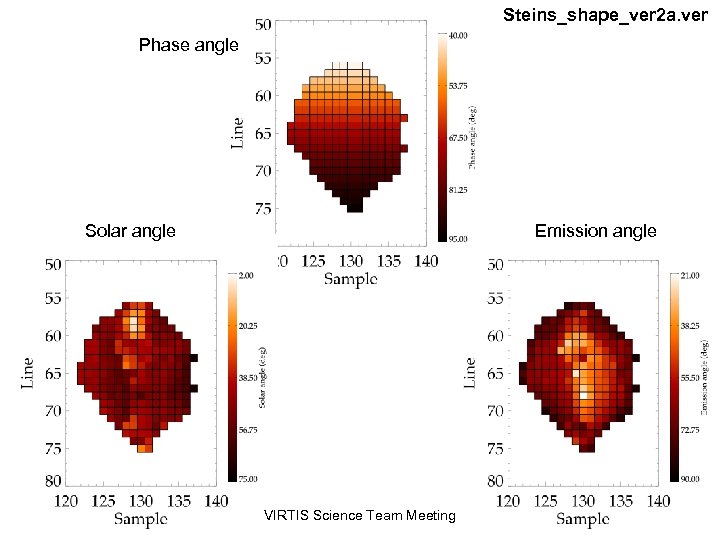 Steins_shape_ver 2 a. ver Phase angle Solar angle 30 March 2009 Emission angle VIRTIS Science Team Meeting 12
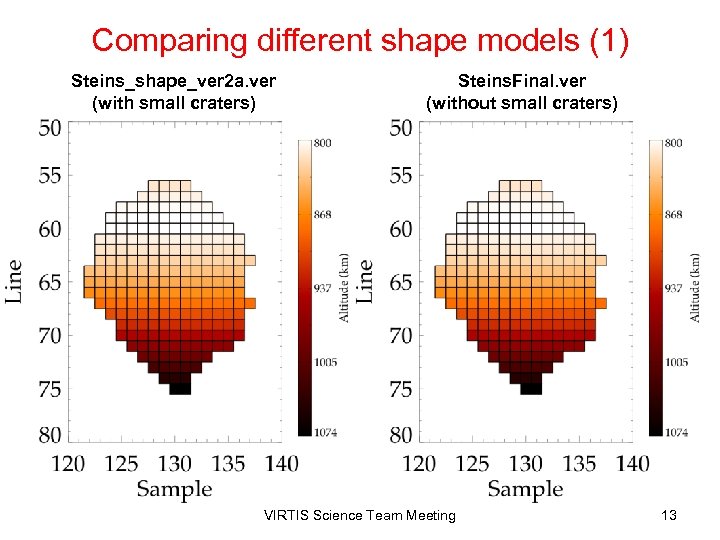 Comparing different shape models (1) Steins_shape_ver 2 a. ver (with small craters) Steins. Final. ver (without small craters) VIRTIS Science Team Meeting 13
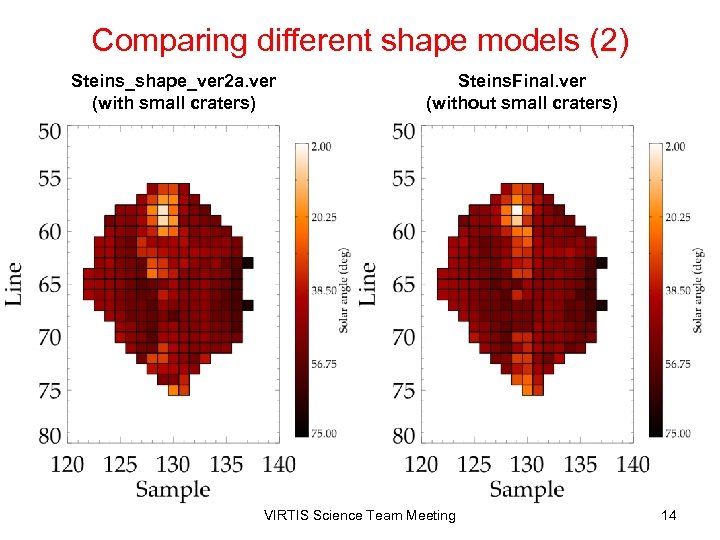 Comparing different shape models (2) Steins_shape_ver 2 a. ver (with small craters) Steins. Final. ver (without small craters) VIRTIS Science Team Meeting 14
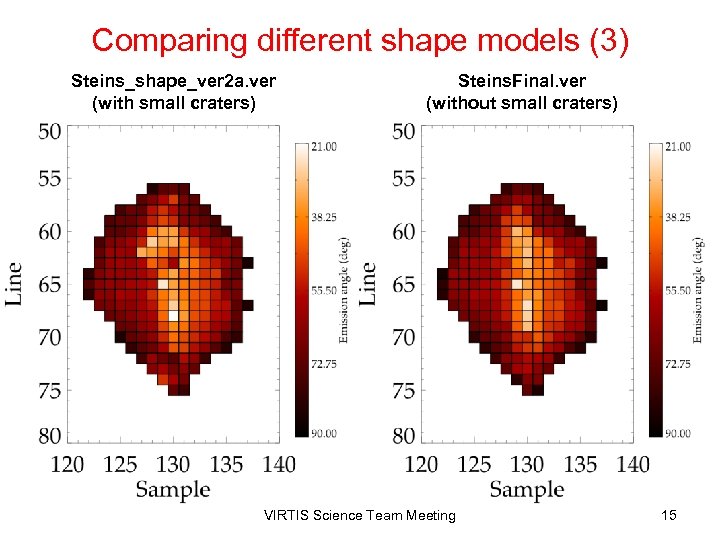 Comparing different shape models (3) Steins_shape_ver 2 a. ver (with small craters) Steins. Final. ver (without small craters) VIRTIS Science Team Meeting 15
 Available tools • The tools develoved in collaboration with Lucas Kamp (VER 2 DSK, TSTSHAPE. c, RVGSS. c) are available on the VIRTIS ftp data server @INAF/IASF (Rome), at the path: ftp: //150. 146. 136. 166/ROSETTA_GEOMETRY/SPICE/kernels/plate/ Steins/software_LWK/ • VIRTIS Co-Is can download and use this software. • To use the RVGSS. c procedure, one has to first download and install the latest CSPICE distribution. Furthermore, an input file with UTC times at mid-exposure for each acquired data is needed to run the procedure. • These tools will be very useful also for the Lutetia flyby, coming in July 2010. VIRTIS Science Team Meeting 16
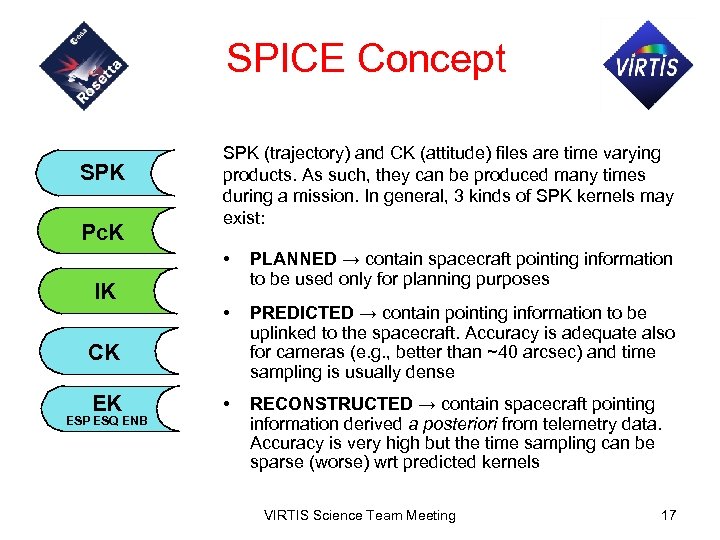 SPICE Concept SPK Pc. K SPK (trajectory) and CK (attitude) files are time varying products. As such, they can be produced many times during a mission. In general, 3 kinds of SPK kernels may exist: • IK PLANNED → contain spacecraft pointing information to be used only for planning purposes • PREDICTED → contain pointing information to be uplinked to the spacecraft. Accuracy is adequate also for cameras (e. g. , better than ~40 arcsec) and time sampling is usually dense • RECONSTRUCTED → contain spacecraft pointing information derived a posteriori from telemetry data. Accuracy is very high but the time sampling can be sparse (worse) wrt predicted kernels CK EK ESP ESQ ENB VIRTIS Science Team Meeting 17
 SPICE policy for Rosetta • SPK (trajectory) and CK (attitude) files are produced by an automated system located at ESAC, operated by the ROSETTA Science Operations Center (RSOC). • The ESOC naming convention is used both for SPK and CK files, which are converted from ESOC’s DDID Orbit and Attitude files, respectively. • For the trajectory, several SPK files are produced, describing different phases of the mission (cruise, 1 st Earth swingby, Mars Swingby, 2 nd Earth swingby, 3 rd Earth swingby, Steins asteroid flyby, Lutetia asteroid flyby, comet orbit). These products are updated periodically, until a reconstructed version is available. • There is NO reconstructed CK file since the uncertainty of the S/C positioning is worse than the uncertainty on the predicted attitude compared to the real one. As a consequence, no reconstructed file is provided by Flight Dynamics and the one used for the scenario is the latest predicted one. VIRTIS Science Team Meeting 18
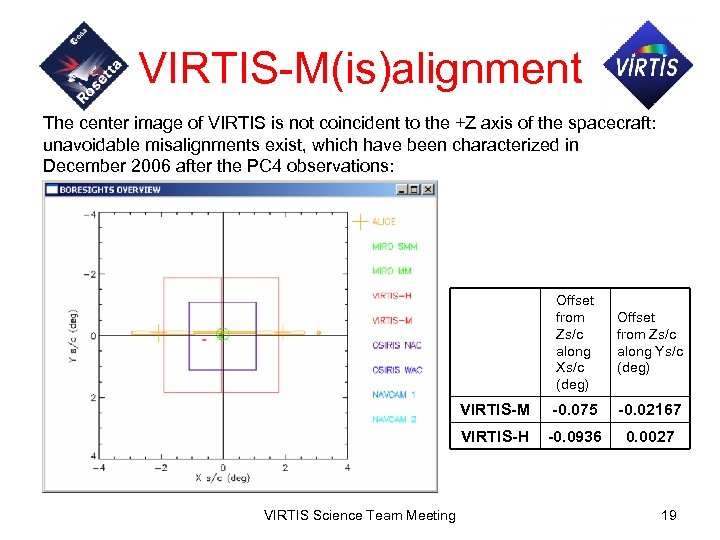 VIRTIS-M(is)alignment The center image of VIRTIS is not coincident to the +Z axis of the spacecraft: unavoidable misalignments exist, which have been characterized in December 2006 after the PC 4 observations: Offset from Zs/c along Xs/c (deg) VIRTIS-M -0. 075 -0. 02167 VIRTIS-H VIRTIS Science Team Meeting Offset from Zs/c along Ys/c (deg) -0. 0936 0. 0027 19
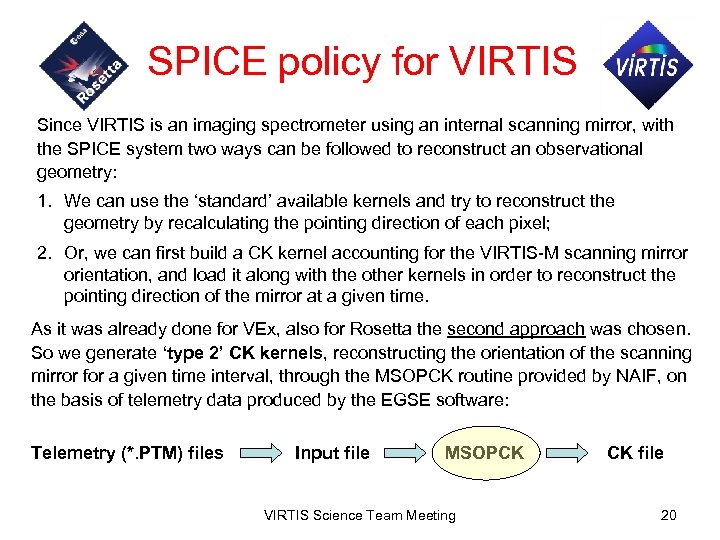 SPICE policy for VIRTIS Since VIRTIS is an imaging spectrometer using an internal scanning mirror, with the SPICE system two ways can be followed to reconstruct an observational geometry: 1. We can use the ‘standard’ available kernels and try to reconstruct the geometry by recalculating the pointing direction of each pixel; 2. Or, we can first build a CK kernel accounting for the VIRTIS-M scanning mirror orientation, and load it along with the other kernels in order to reconstruct the pointing direction of the mirror at a given time. As it was already done for VEx, also for Rosetta the second approach was chosen. So we generate ‘type 2’ CK kernels, reconstructing the orientation of the scanning mirror for a given time interval, through the MSOPCK routine provided by NAIF, on the basis of telemetry data produced by the EGSE software: Telemetry (*. PTM) files Input file MSOPCK VIRTIS Science Team Meeting CK file 20