


 Скачать презентацию GEOMAGNETISM a dynamo at the centre of the
0a95962012025fc9de127ff531ff1fdc.ppt
- Количество слайдов: 38
 GEOMAGNETISM: a dynamo at the centre of the Earth Lecture 2 How the dynamo works
 OVERVIEW • Preliminaries: timescales, waves, instabilities, symmetry • • Non-magnetic convection Magnetoconvection Kinematic dynamo action Nonlinear, self-consistent dynamos
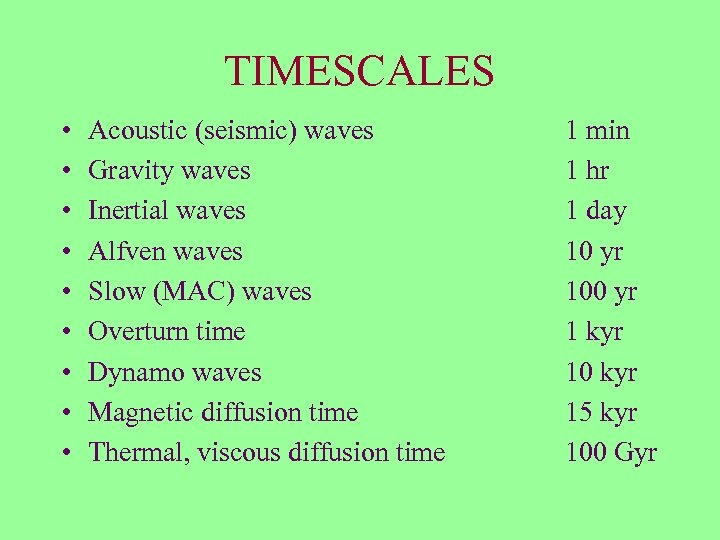 TIMESCALES • • • Acoustic (seismic) waves Gravity waves Inertial waves Alfven waves Slow (MAC) waves Overturn time Dynamo waves Magnetic diffusion time Thermal, viscous diffusion time 1 min 1 hr 1 day 10 yr 100 yr 1 kyr 10 kyr 15 kyr 100 Gyr
 SYMMETRY • Rotation has cylindrical symmetry • The core has spherical symmetry • These combine to give symmetry under inversion through the origin • Changing the sign of the magnetic field does not alter the governing equations… • …nor does translation in time
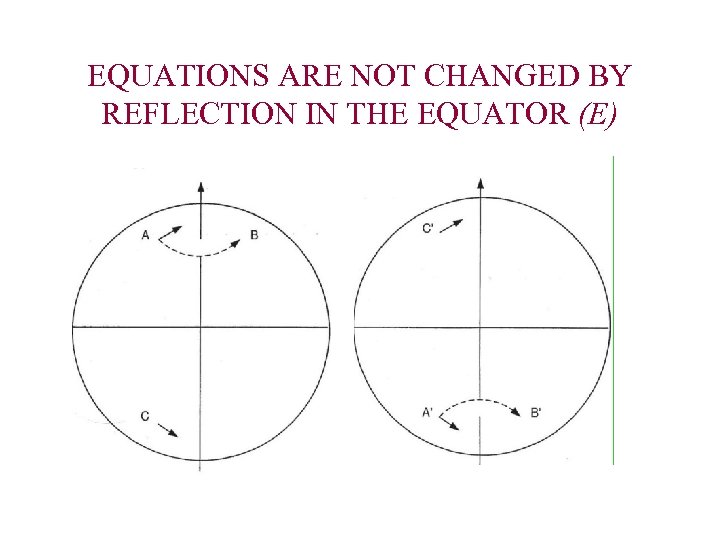 EQUATIONS ARE NOT CHANGED BY REFLECTION IN THE EQUATOR (E)
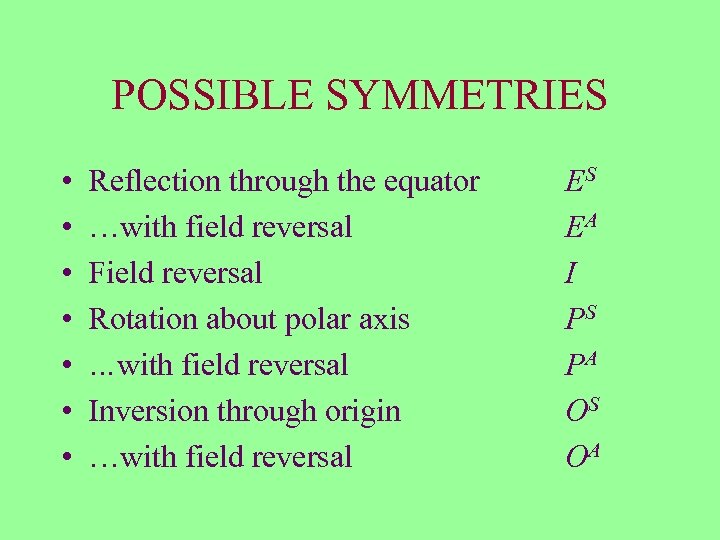 POSSIBLE SYMMETRIES • • Reflection through the equator …with field reversal Field reversal Rotation about polar axis …with field reversal Inversion through origin …with field reversal ES EA I PS PA OS OA
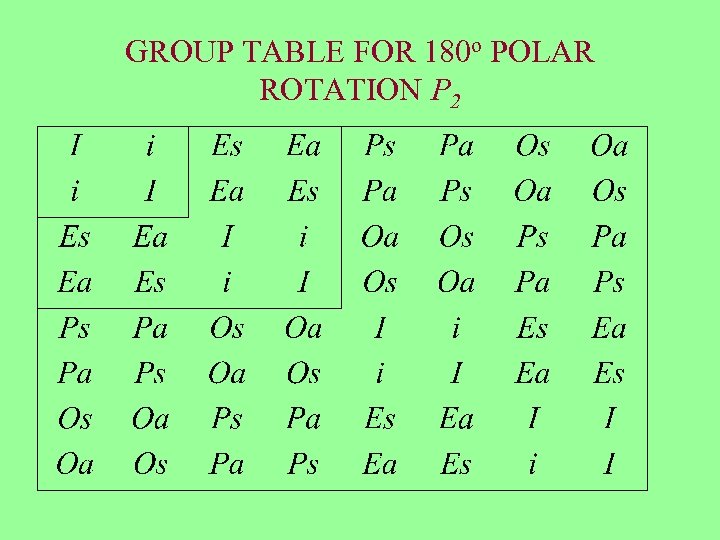 GROUP TABLE FOR 180 o POLAR ROTATION P 2
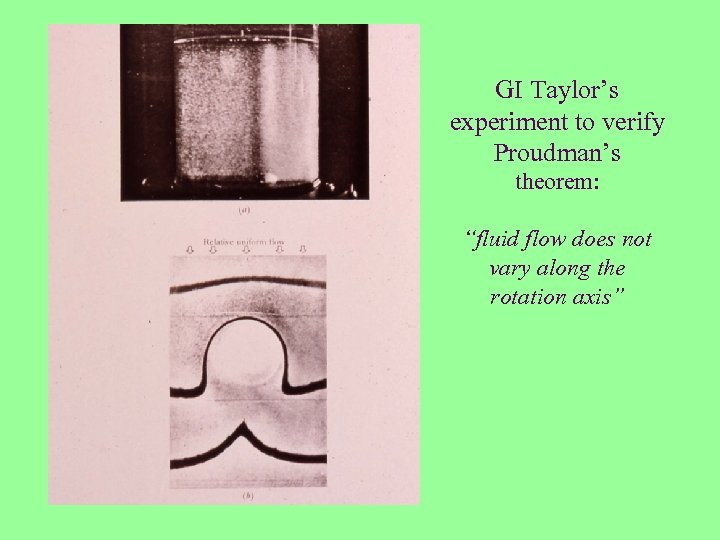 GI Taylor’s experiment to verify Proudman’s theorem: “fluid flow does not vary along the rotation axis”
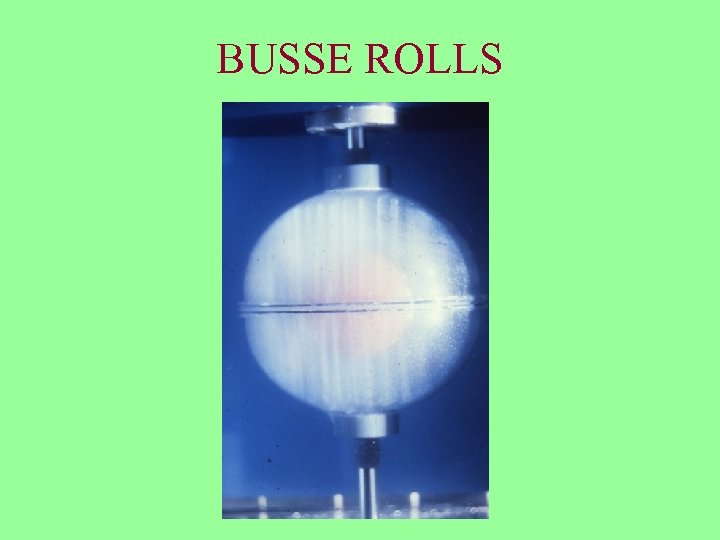 BUSSE ROLLS
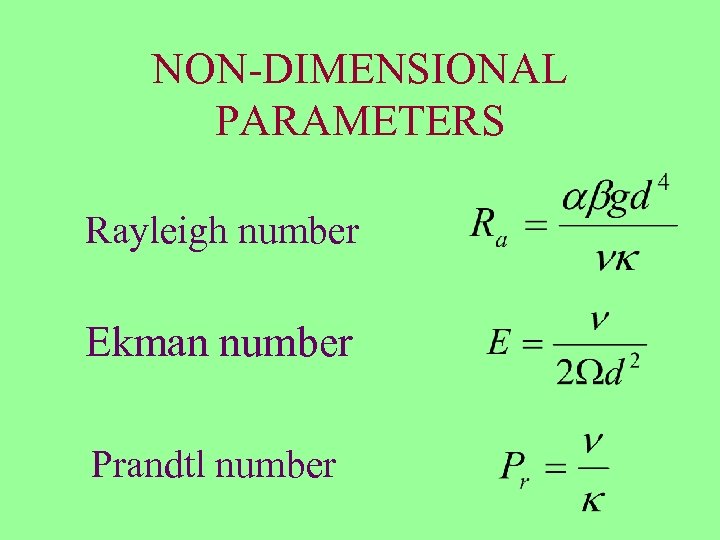 NON-DIMENSIONAL PARAMETERS Rayleigh number Ekman number Prandtl number
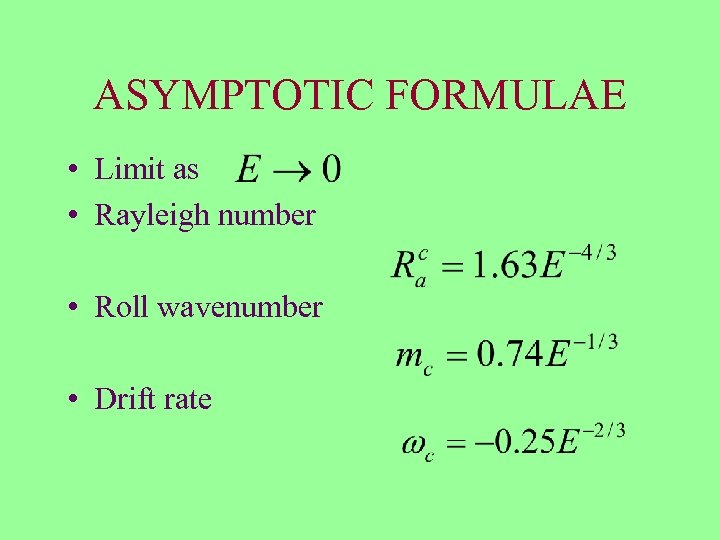 ASYMPTOTIC FORMULAE • Limit as • Rayleigh number • Roll wavenumber • Drift rate
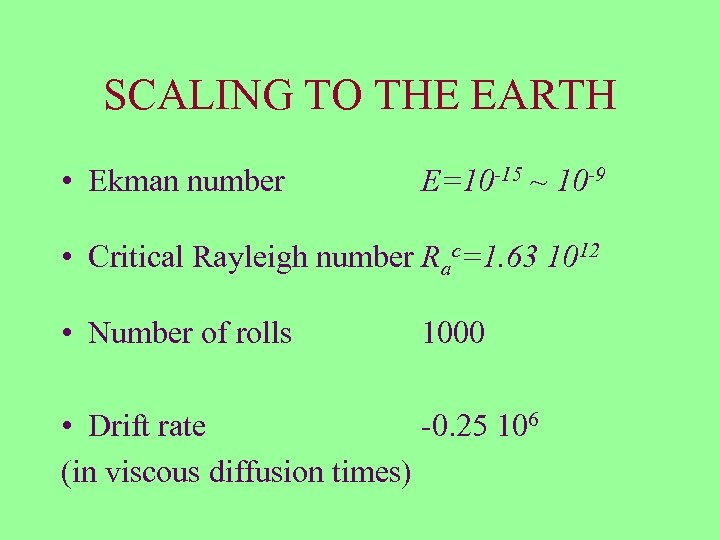 SCALING TO THE EARTH • Ekman number E=10 -15 ~ 10 -9 • Critical Rayleigh number Rac=1. 63 1012 • Number of rolls 1000 • Drift rate -0. 25 106 (in viscous diffusion times)
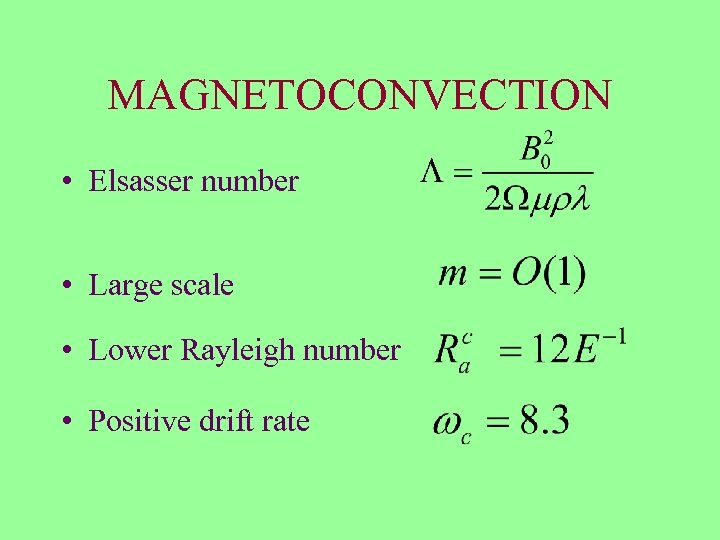 MAGNETOCONVECTION • Elsasser number • Large scale • Lower Rayleigh number • Positive drift rate
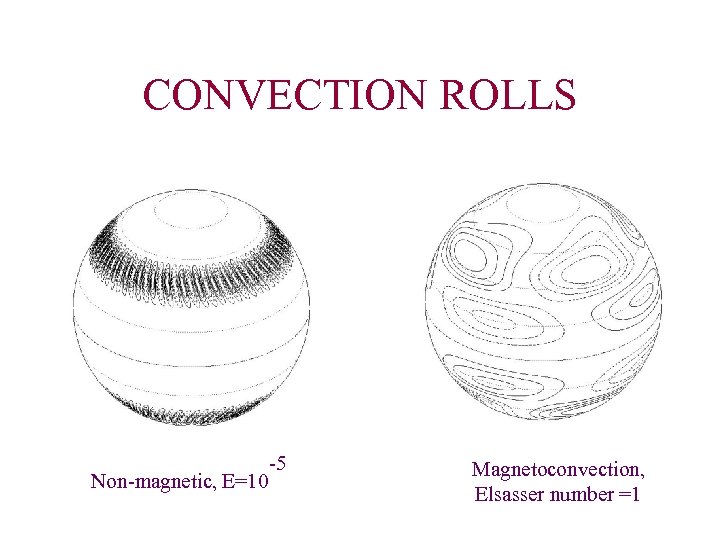 CONVECTION ROLLS Non-magnetic, E=10 -5 Magnetoconvection, Elsasser number =1
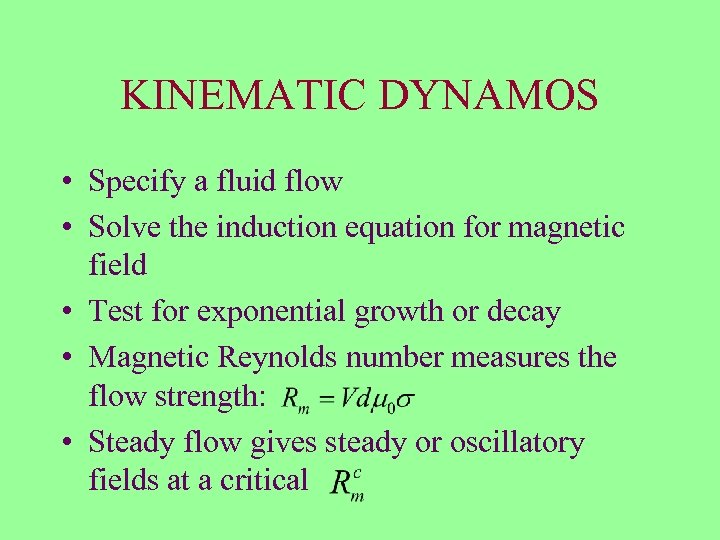 KINEMATIC DYNAMOS • Specify a fluid flow • Solve the induction equation for magnetic field • Test for exponential growth or decay • Magnetic Reynolds number measures the flow strength: • Steady flow gives steady or oscillatory fields at a critical
 REQUIREMENTS FOR DYNAMO ACTION • • Nonaxisymmetric field (Cowling) Radial motion Sufficiently large Rm Sufficiently complicated flow (helicity)
 COWLING’S LAST THEOREM? • • Nothing simple works… …and even when it does… proving that it works… is not as simple as it should be
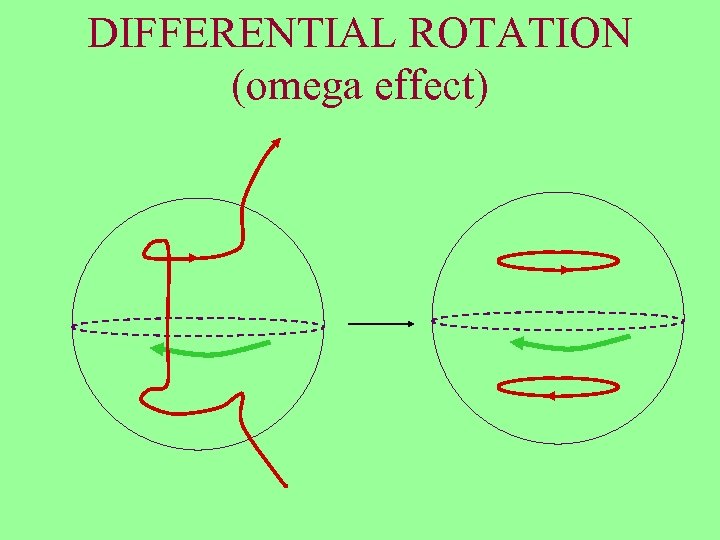 DIFFERENTIAL ROTATION (omega effect)
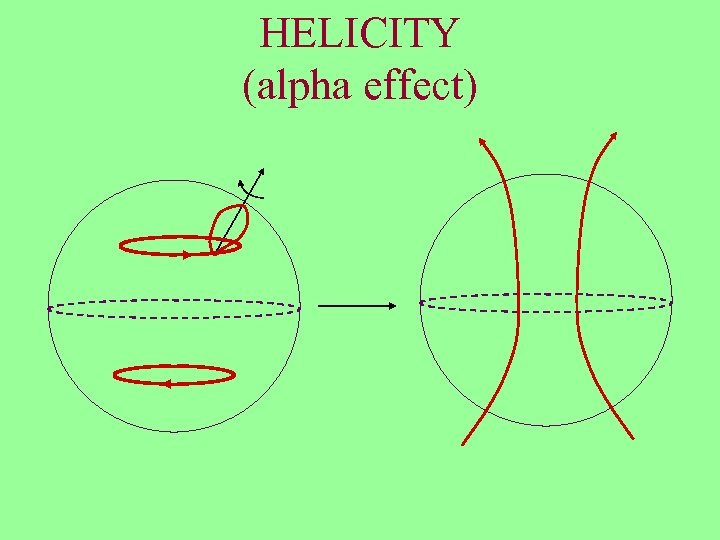 HELICITY (alpha effect)
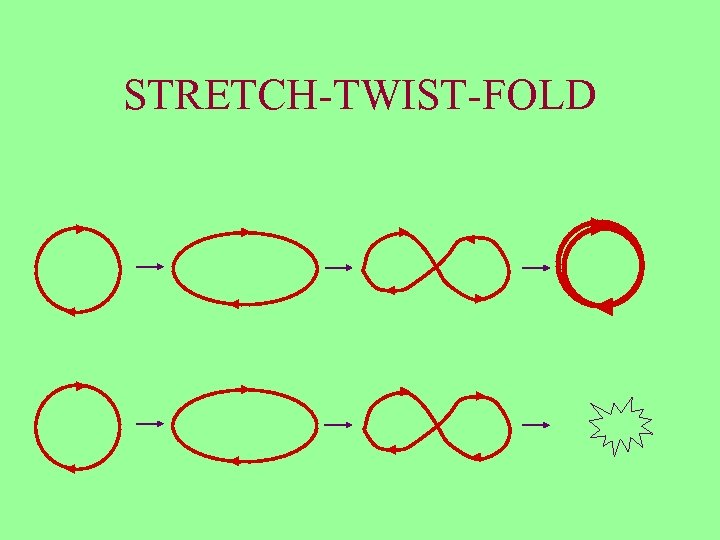 STRETCH-TWIST-FOLD
 MEAN FIELD THEORY • Small scale flow replaced by alpha effect • (Braginsky) non-axisymmetric flow replaced by alpha effect • Remember contribution to diffusivity • (Braginsky) and contribution to large scale flow (effective meridian circulation) • Solve axisymmetric equations
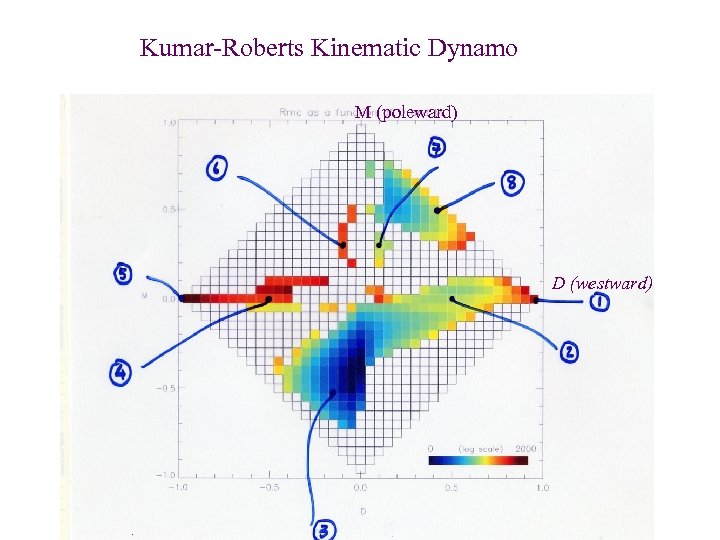
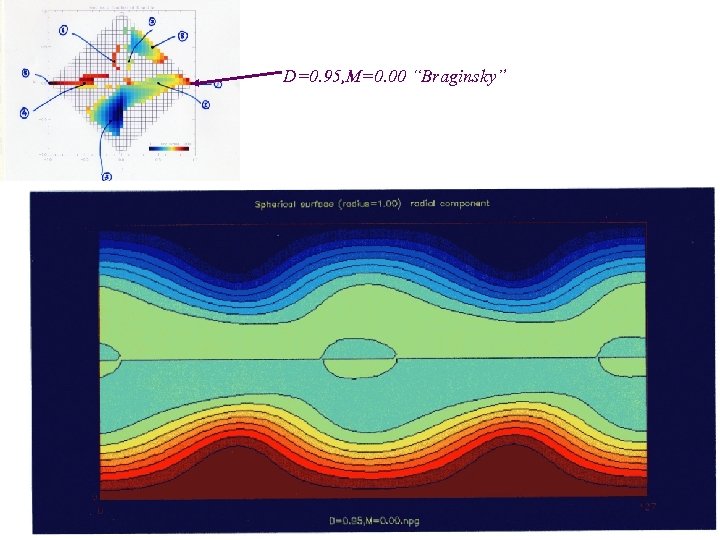
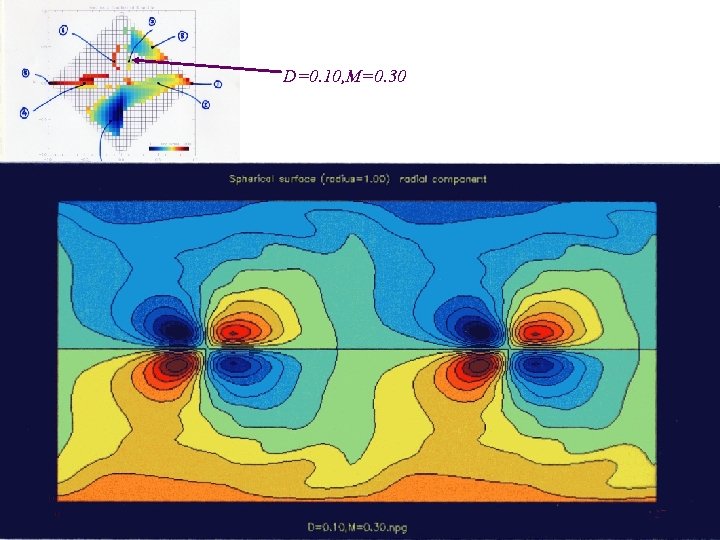
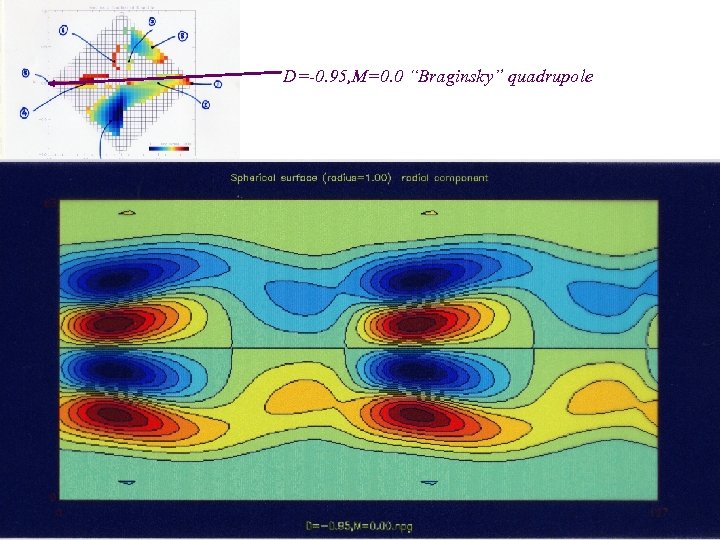
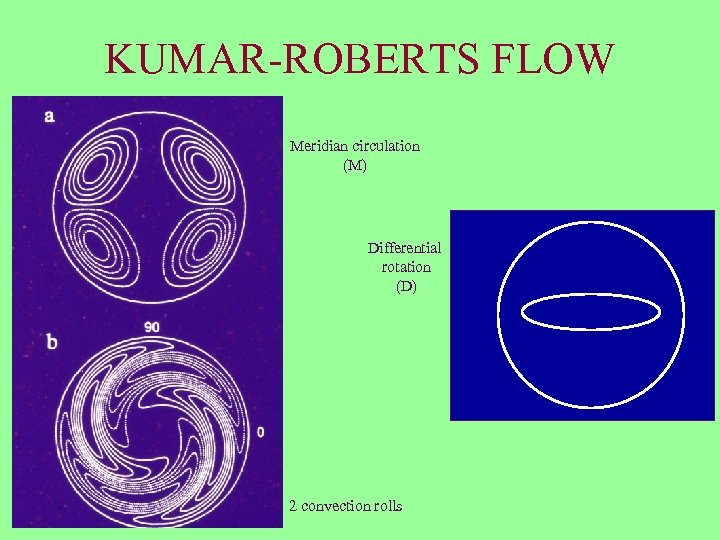 KUMAR-ROBERTS FLOW Meridian circulation (M) Differential rotation (D) 2 convection rolls
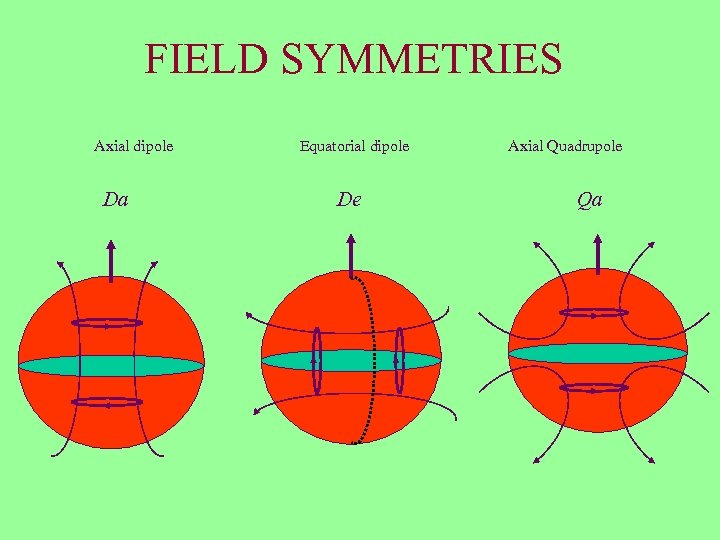 FIELD SYMMETRIES Axial dipole Da Equatorial dipole De Axial Quadrupole Qa
 Kumar-Roberts Kinematic Dynamo M (poleward) D (westward)
 D=0. 95, M=0. 00 “Braginsky”
 D=0. 10, M=0. 30
 D=-0. 95, M=0. 0 “Braginsky” quadrupole
 NONLINEAR DYNAMO • Momentum equation: rate of change of flow= inertia+coriolis+pressure+buoyancy+ viscosity+magnetic • Heat equation: rate of change of temperature= advection+diffusion • Induction equation: rate of change of magnetic field= advection+stretching+diffusion
 NONLINEAR EFFECTS • • Magnetic field reaches a maximum value Time dependence can be more complex… …including reversals There is no longer the freedom to choose the flow • The flow may resemble magnetoconvection, but there may be behaviour specific to the type of magnetic field generated
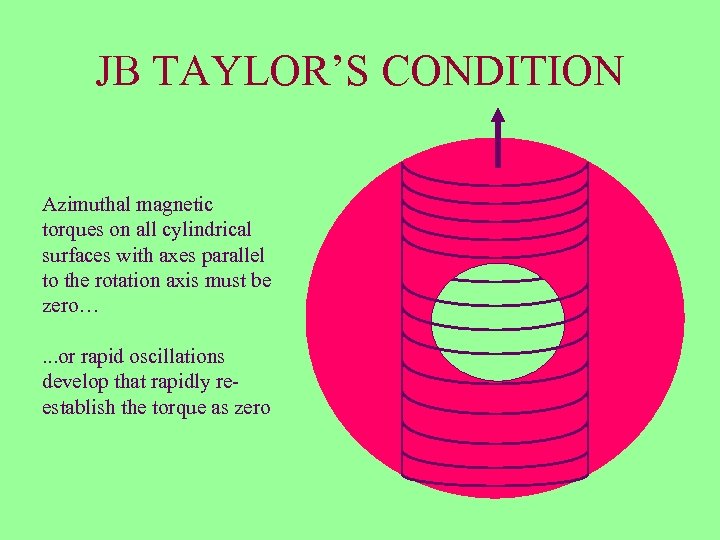 JB TAYLOR’S CONDITION Azimuthal magnetic torques on all cylindrical surfaces with axes parallel to the rotation axis must be zero…. . . or rapid oscillations develop that rapidly reestablish the torque as zero
 WEAK FIELD REGIME • • Small Elsasser number A dynamo developed buy Busse (1975) Magnetic fields exert only a small force Convection looks like non-magnetic convection • Magnetic fields generated by helicity from convection rolls + flow along the rolls induced by the boundary
 STRONG FIELD REGIME • Elsasser number about 1 • Magnetic torques balance Coriolis torques • JB Taylor condition satisfied • Convection scales like magnetoconvection
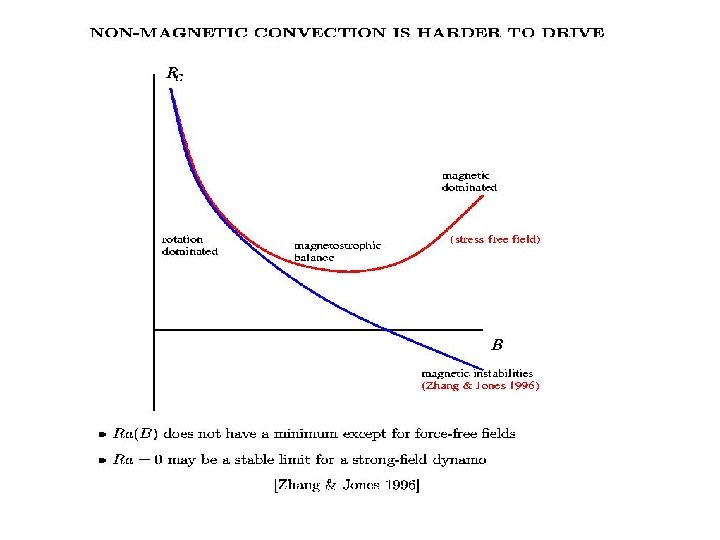
 DYNAMO CATASTROPHE • The Rayleigh number is fixed • The critical Rayleigh number depends on field strength • Vigour of convection varies with supercritical Ra… • So does the dynamo action • If the magnetic field drops, so does the vigour of convection, so does the dynamo action • The dynamo dies
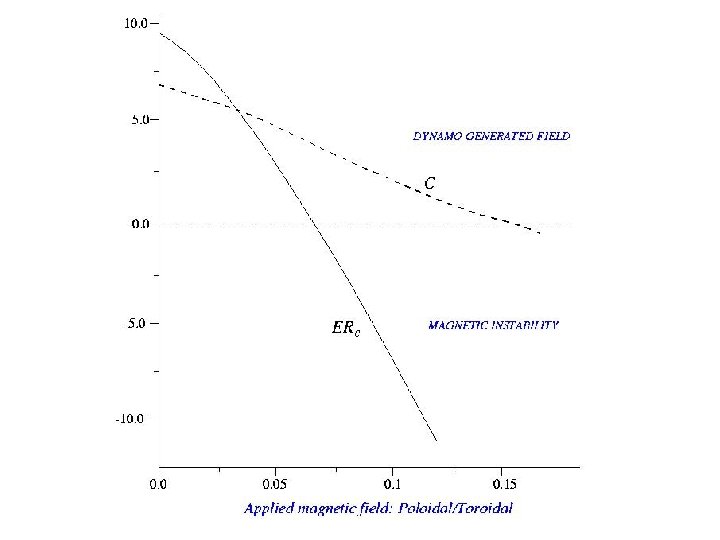
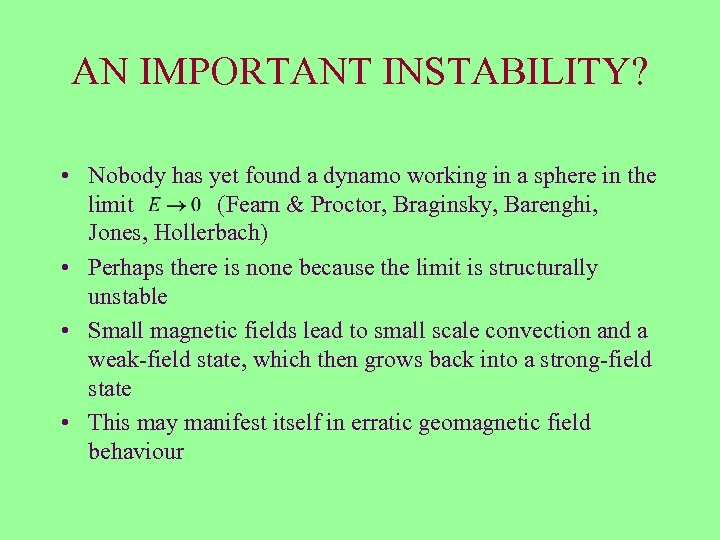 AN IMPORTANT INSTABILITY? • Nobody has yet found a dynamo working in a sphere in the limit (Fearn & Proctor, Braginsky, Barenghi, Jones, Hollerbach) • Perhaps there is none because the limit is structurally unstable • Small magnetic fields lead to small scale convection and a weak-field state, which then grows back into a strong-field state • This may manifest itself in erratic geomagnetic field behaviour
 NUMERICAL DIFFICULTIES • • • At present we cannot go below The resulting convection is large scale The large E prevents collapse to small scales… …and therefore the weak field regime Hyperdiffusivity suggests smaller E…. . . but the relevant E for small scale flow is actually larger
 CONCLUSIONS • We are still some way from modelling the geodynamo, mainly because of small E • The geodynamo may be unstable, explaining the frequent excursions, reversals, and fluctuations in intensity • Is the geodynamo in a weak-field state during an excursion? • If not, what stabilises the geodynamo?