


 Скачать презентацию Geological and tectonic evolution of the Arctic Ocean
Lectures 2-4 Arctic Ocean History.ppt
- Количество слайдов: 72
 Geological and tectonic evolution of the Arctic Ocean Lectures 2 - 4 Course: Particularities and Features of Cold Region Geology by Alexey A. Krylov, Institute of Earth Sciences, St. Petersburg State University
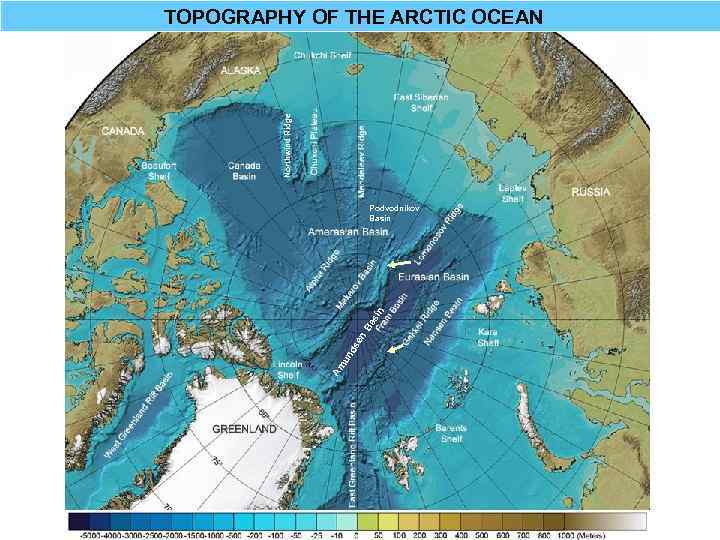 Northwind Ridge TOPOGRAPHY OF THE ARCTIC OCEAN Am un ds en Ba sin Podvodnikov Basin
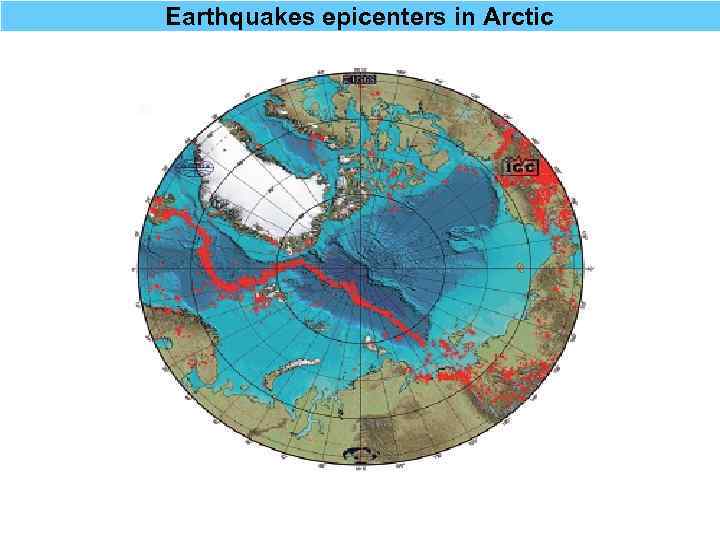 Earthquakes epicenters in Arctic
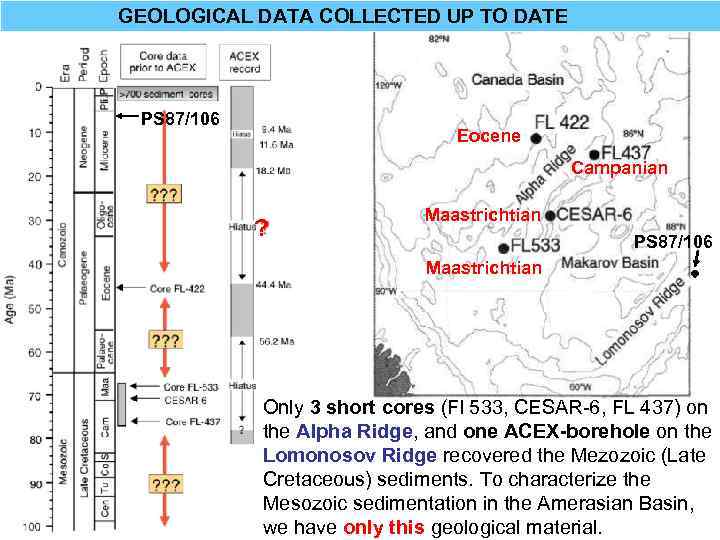 GEOLOGICAL DATA COLLECTED UP TO DATE PS 87/106 Eocene Campanian ? Maastrichtian PS 87/106 Maastrichtian Only 3 short cores (Fl 533, CESAR-6, FL 437) on the Alpha Ridge, and one ACEX-borehole on the Lomonosov Ridge recovered the Mezozoic (Late Cretaceous) sediments. To characterize the Mesozoic sedimentation in the Amerasian Basin, we have only this geological material.
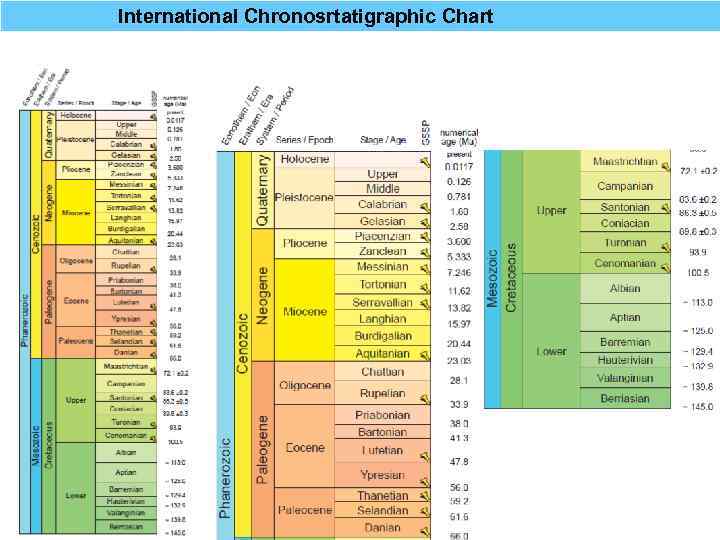 International Chronosrtatigraphic Chart
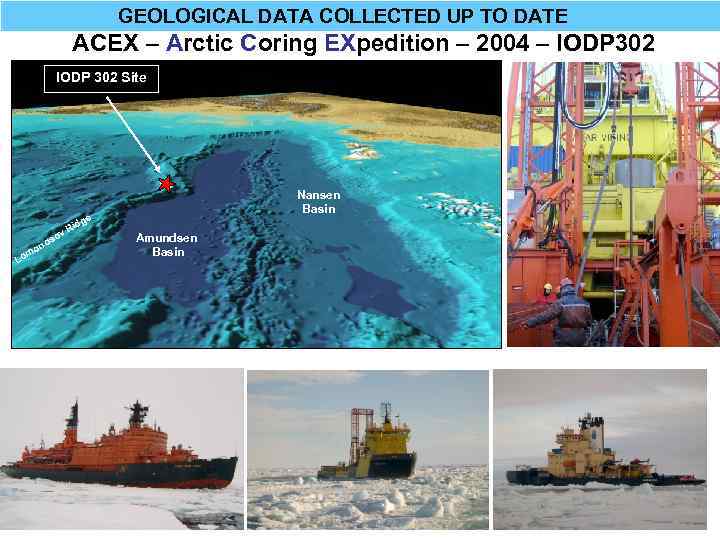 GEOLOGICAL DATA COLLECTED UP TO DATE ACEX – Arctic Coring EXpedition – 2004 – IODP 302 Site Nansen Basin e dg n mo Lo o i v. R so Amundsen Basin
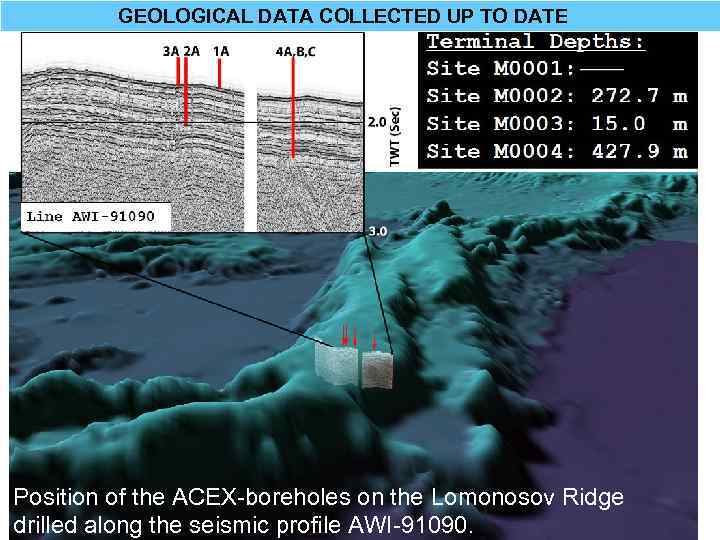 GEOLOGICAL DATA COLLECTED UP TO DATE Position of the ACEX-boreholes on the Lomonosov Ridge drilled along the seismic profile AWI-91090.
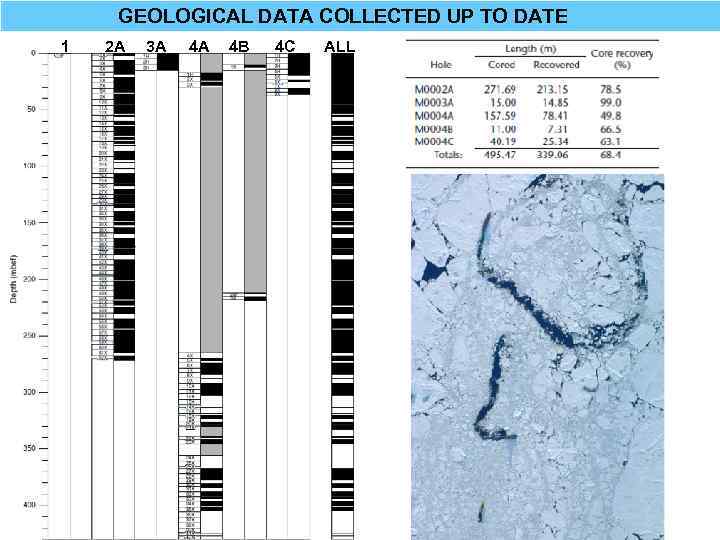 GEOLOGICAL DATA COLLECTED UP TO DATE 1 2 A 3 A 4 A 4 B 4 C ALL
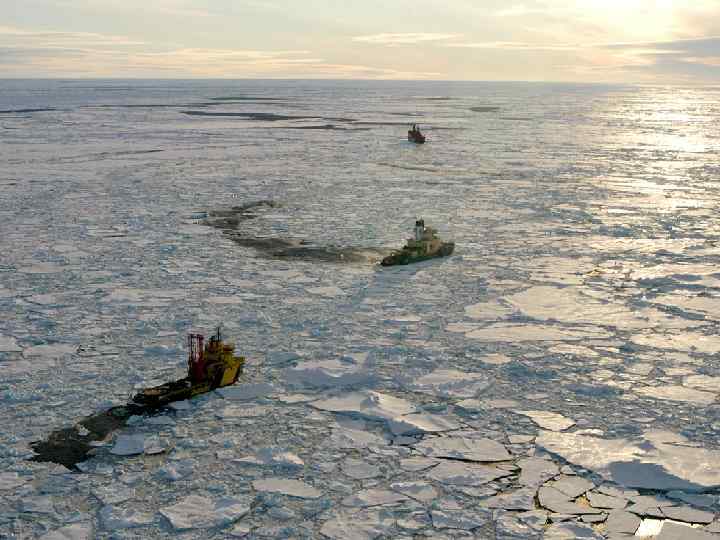
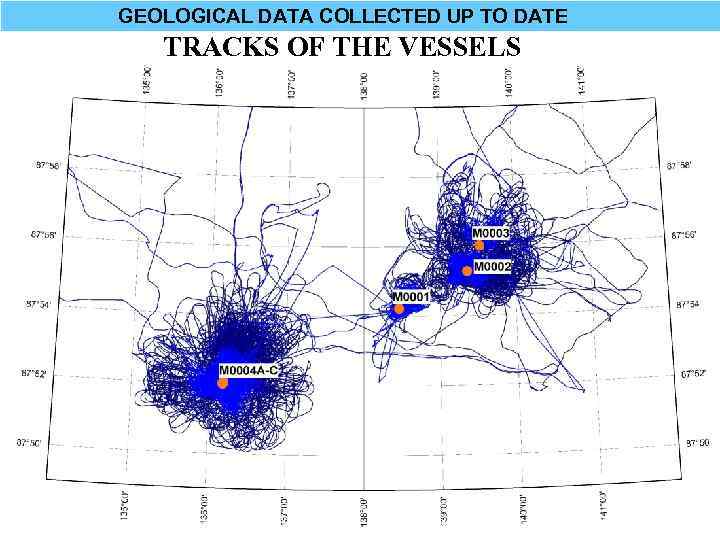 GEOLOGICAL DATA COLLECTED UP TO DATE TRACKS OF THE VESSELS
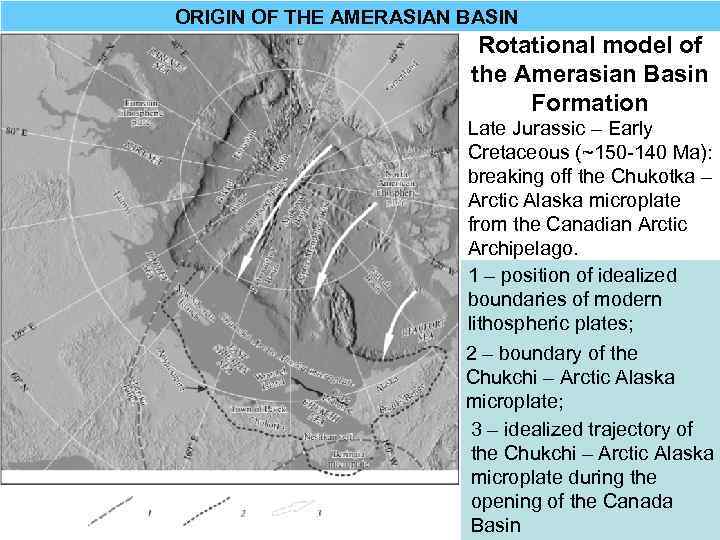 ORIGIN OF THE AMERASIAN BASIN Rotational model of the Amerasian Basin Formation Late Jurassic – Early Cretaceous (~150 -140 Ma): breaking off the Chukotka – Arctic Alaska microplate from the Canadian Arctic Archipelago. 1 – position of idealized boundaries of modern lithospheric plates; 2 – boundary of the Chukchi – Arctic Alaska microplate; 3 – idealized trajectory of the Chukchi – Arctic Alaska microplate during the opening of the Canada Basin
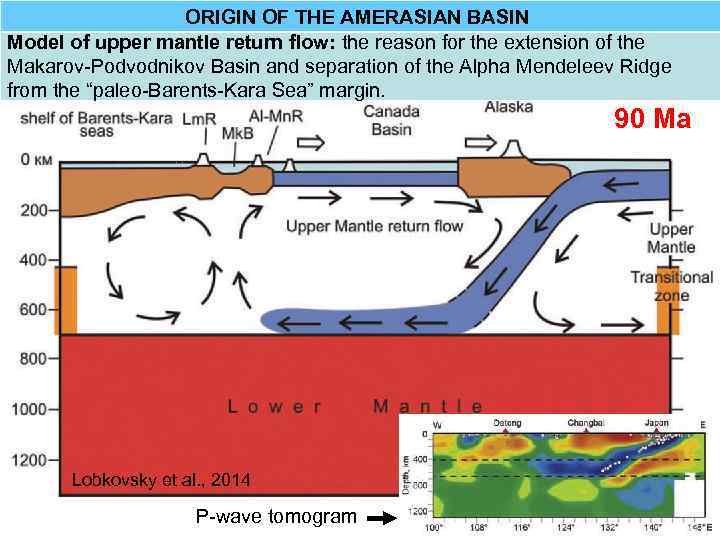 ORIGIN OF THE AMERASIAN BASIN Model of upper mantle return flow: the reason for the extension of the Makarov-Podvodnikov Basin and separation of the Alpha Mendeleev Ridge from the “paleo-Barents-Kara Sea” margin. 90 Ma Lobkovsky et al. , 2014 P-wave tomogram
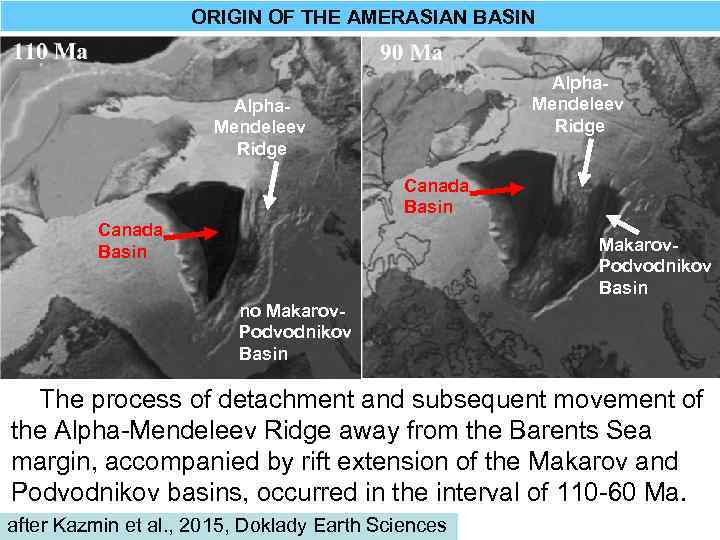 ORIGIN OF THE AMERASIAN BASIN Alpha. Mendeleev Ridge Canada Basin Makarov. Podvodnikov Basin no Makarov. Podvodnikov Basin The process of detachment and subsequent movement of the Alpha-Mendeleev Ridge away from the Barents Sea margin, accompanied by rift extension of the Makarov and Podvodnikov basins, occurred in the interval of 110 -60 Ma. after Kazmin et al. , 2015, Doklady Earth Sciences
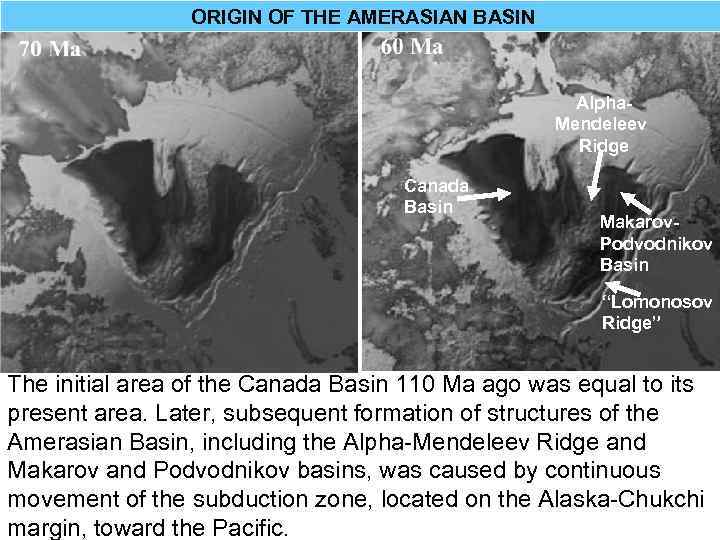 ORIGIN OF THE AMERASIAN BASIN Alpha. Mendeleev Ridge Canada Basin Makarov. Podvodnikov Basin “Lomonosov Ridge” The initial area of the Canada Basin 110 Ma ago was equal to its present area. Later, subsequent formation of structures of the Amerasian Basin, including the Alpha-Mendeleev Ridge and Makarov and Podvodnikov basins, was caused by continuous movement of the subduction zone, located on the Alaska-Chukchi margin, toward the Pacific.
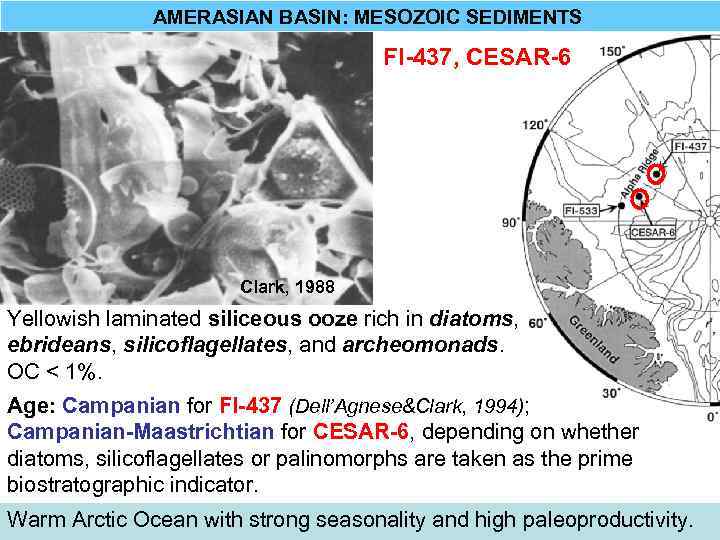 AMERASIAN BASIN: MESOZOIC SEDIMENTS Fl-437, CESAR-6 Clark, 1988 Yellowish laminated siliceous ooze rich in diatoms, ebrideans, silicoflagellates, and archeomonads. OC < 1%. Age: Campanian for Fl-437 (Dell’Agnese&Clark, 1994); Campanian-Maastrichtian for CESAR-6, depending on whether diatoms, silicoflagellates or palinomorphs are taken as the prime biostratographic indicator. Warm Arctic Ocean with strong seasonality and high paleoproductivity.
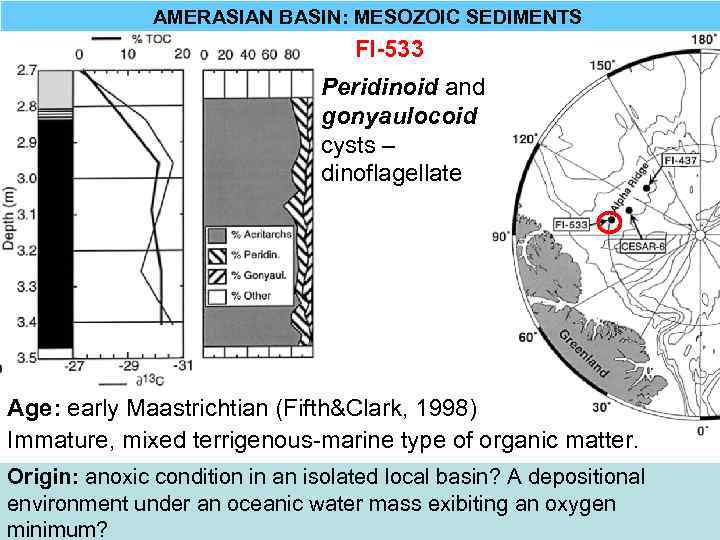 AMERASIAN BASIN: MESOZOIC SEDIMENTS Fl-533 Peridinoid and gonyaulocoid cysts – dinoflagellate Age: early Maastrichtian (Fifth&Clark, 1998) Immature, mixed terrigenous-marine type of organic matter. Origin: anoxic condition in an isolated local basin? A depositional environment under an oceanic water mass exibiting an oxygen minimum?
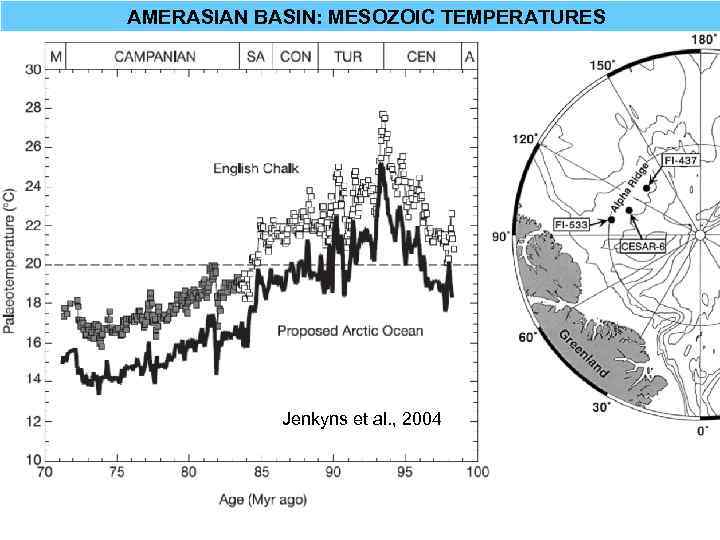 AMERASIAN BASIN: MESOZOIC TEMPERATURES Jenkyns et al. , 2004
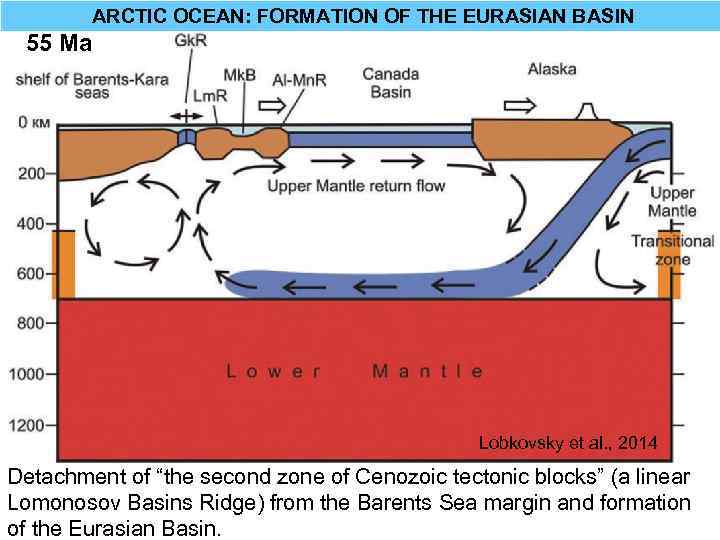 ARCTIC OCEAN: FORMATION OF THE EURASIAN BASIN 55 Ma Lobkovsky et al. , 2014 Detachment of “the second zone of Cenozoic tectonic blocks” (a linear Lomonosov Basins Ridge) from the Barents Sea margin and formation of the Eurasian Basin.
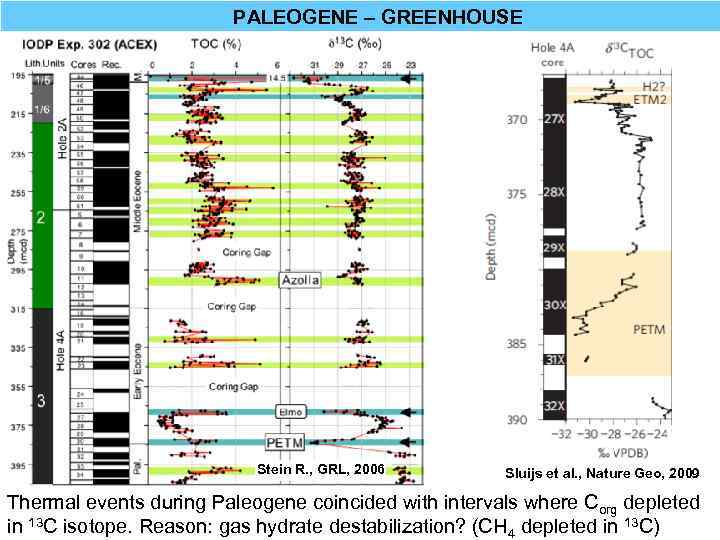 PALEOGENE – GREENHOUSE Stein R. , GRL, 2006 Sluijs et al. , Nature Geo, 2009 Thermal events during Paleogene coincided with intervals where Corg depleted in 13 C isotope. Reason: gas hydrate destabilization? (CH 4 depleted in 13 C)
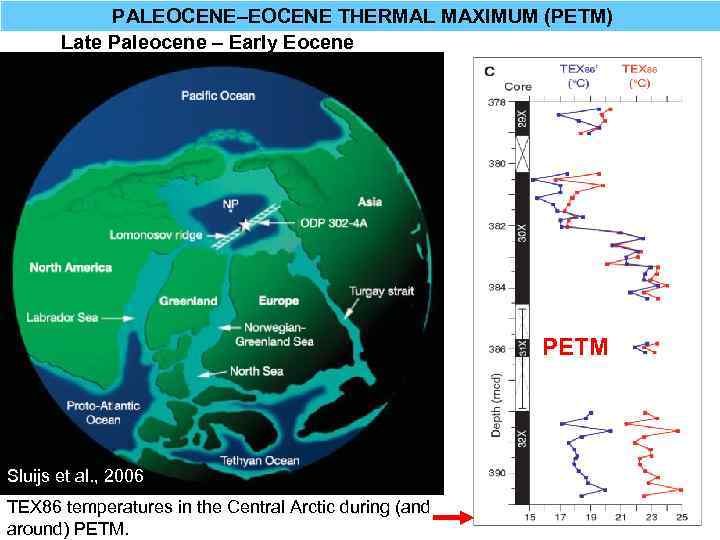 PALEOCENE–EOCENE THERMAL MAXIMUM (PETM) Late Paleocene – Early Eocene PETM Sluijs et al. , 2006 TEX 86 temperatures in the Central Arctic during (and around) PETM.
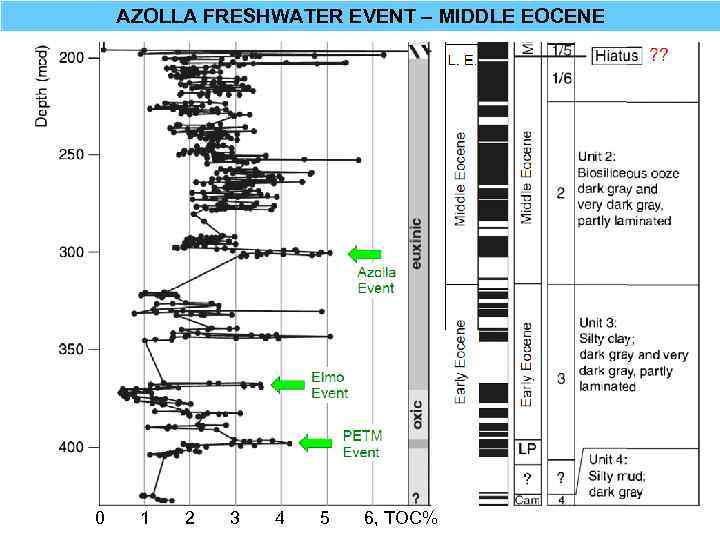 AZOLLA FRESHWATER EVENT – MIDDLE EOCENE 0 1 2 3 4 5 6, TOC%
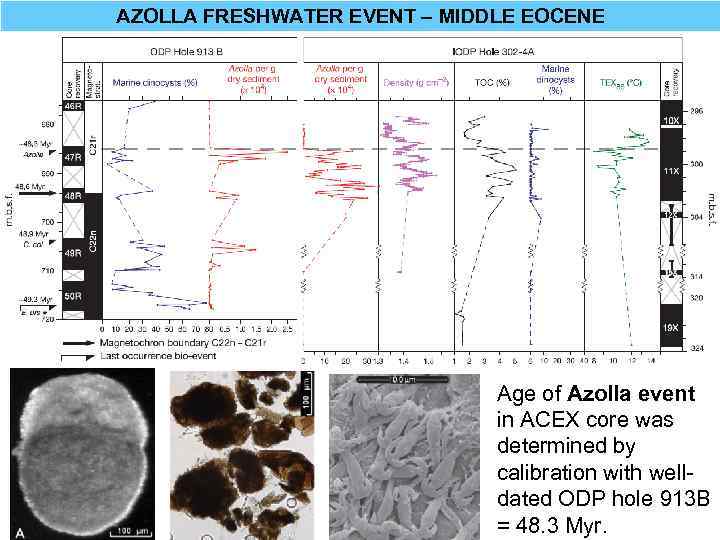 AZOLLA FRESHWATER EVENT – MIDDLE EOCENE Age of Azolla event in ACEX core was determined by calibration with welldated ODP hole 913 B = 48. 3 Myr.
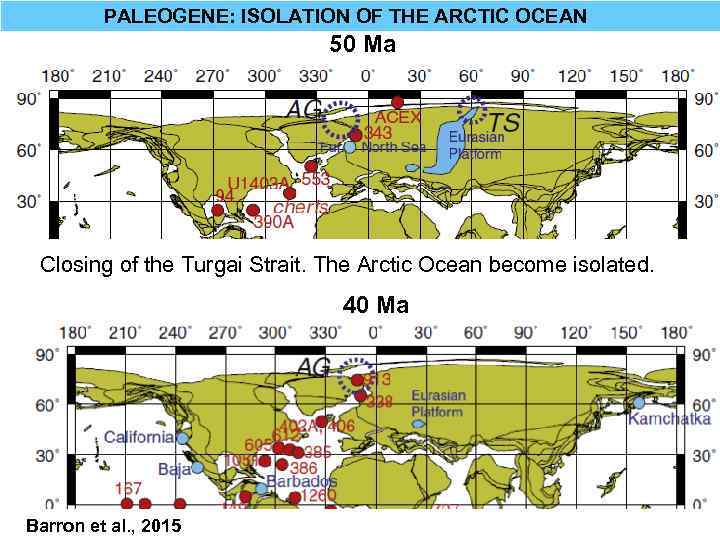 PALEOGENE: ISOLATION OF THE ARCTIC OCEAN 50 Ma Closing of the Turgai Strait. The Arctic Ocean become isolated. 40 Ma Barron et al. , 2015
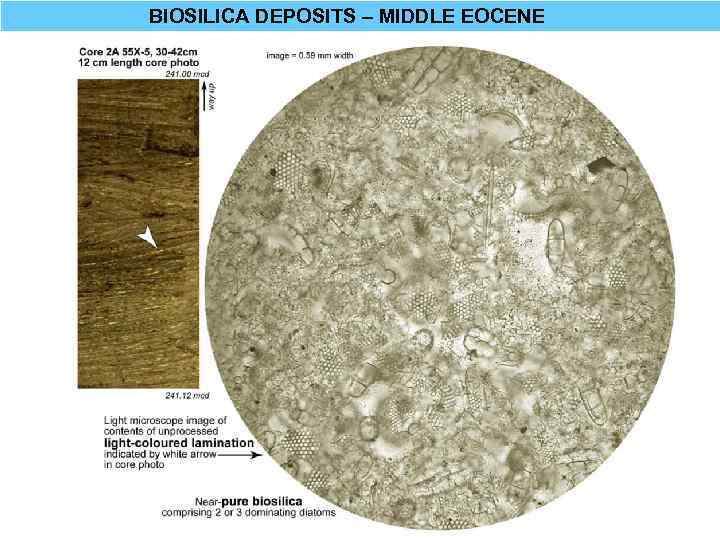
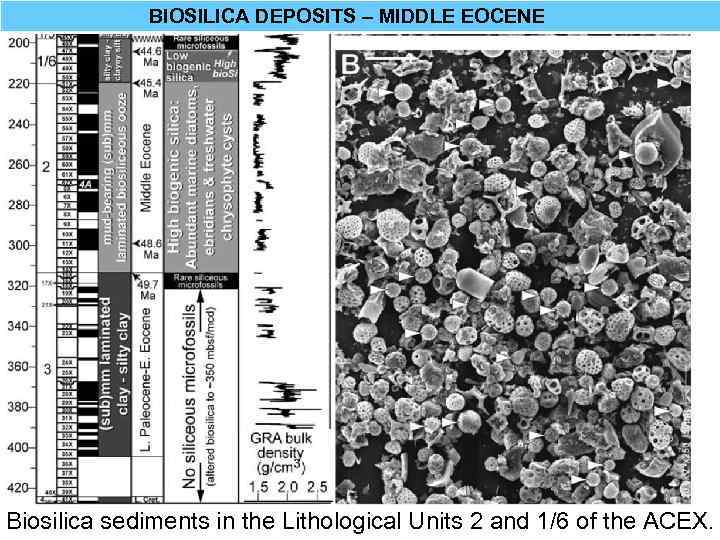 BIOSILICA DEPOSITS – MIDDLE EOCENE Biosilica sediments in the Lithological Units 2 and 1/6 of the ACEX.
 BIOSILICA DEPOSITS – MIDDLE EOCENE
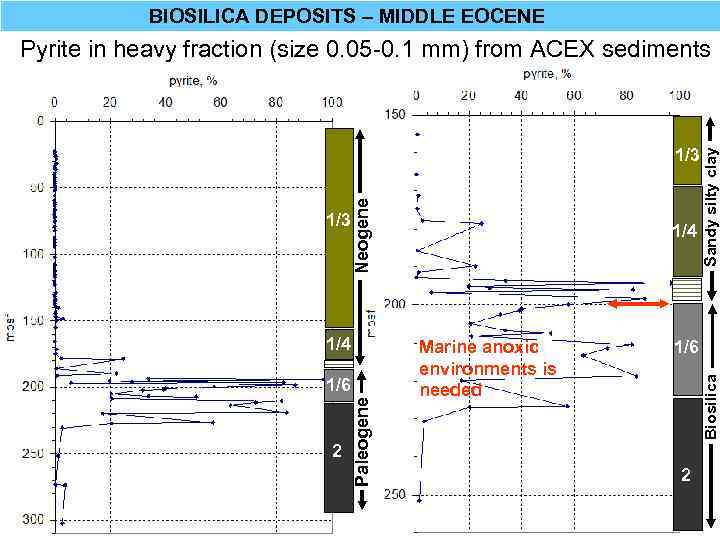 BIOSILICA DEPOSITS – MIDDLE EOCENE 1/4 2 Paleogene 1/6 1/4 Marine anoxic environments is needed 1/6 Biosilica 1/3 Neogene 1/3 Sandy silty clay Pyrite in heavy fraction (size 0. 05 -0. 1 mm) from ACEX sediments 2
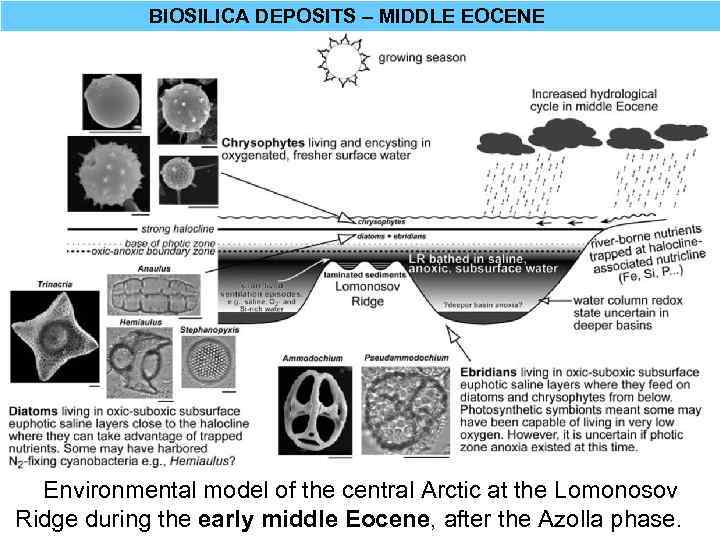 BIOSILICA DEPOSITS – MIDDLE EOCENE Environmental model of the central Arctic at the Lomonosov Ridge during the early middle Eocene, after the Azolla phase.
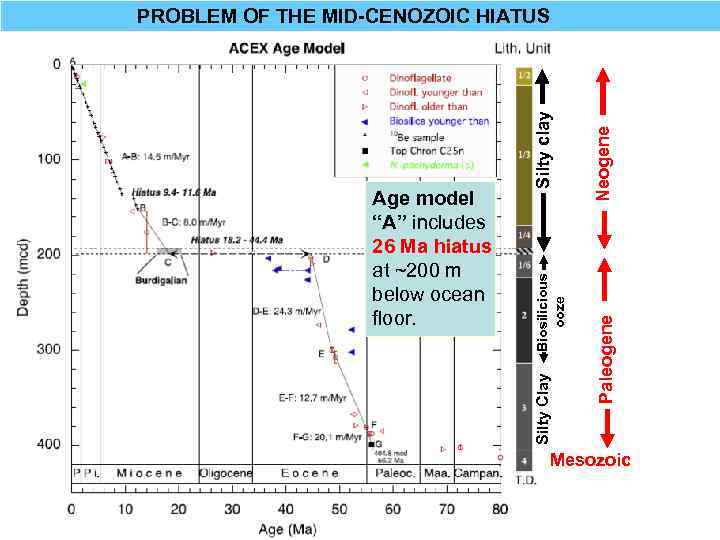 Neogene Paleogene Biosilicious ooze Silty Clay Age model “A” includes 26 Ma hiatus at ~200 m below ocean floor. Silty clay PROBLEM OF THE MID-CENOZOIC HIATUS Mesozoic
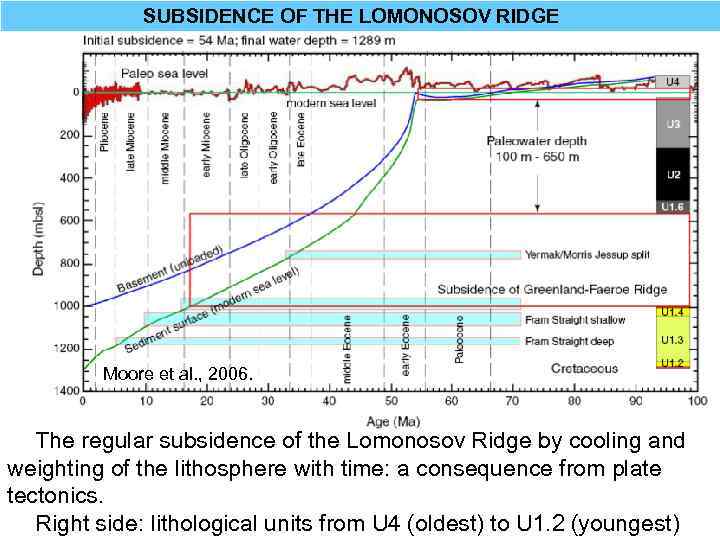 SUBSIDENCE OF THE LOMONOSOV RIDGE Moore et al. , 2006. The regular subsidence of the Lomonosov Ridge by cooling and weighting of the lithosphere with time: a consequence from plate tectonics. Right side: lithological units from U 4 (oldest) to U 1. 2 (youngest)
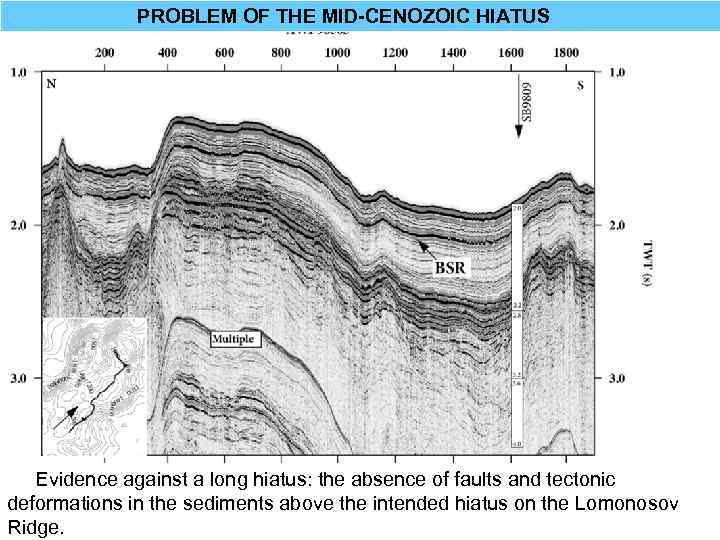 PROBLEM OF THE MID-CENOZOIC HIATUS Evidence against a long hiatus: the absence of faults and tectonic deformations in the sediments above the intended hiatus on the Lomonosov Ridge.
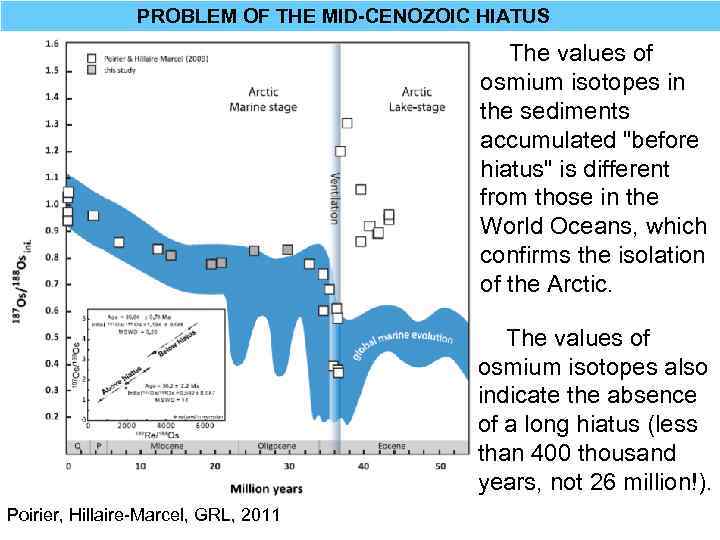 ПРОБЛЕМА СРЕДНЕ-КАЙНОЗОЙСКОГО ПЕРЕРЫВА PROBLEM OF THE MID-CENOZOIC HIATUS The values of osmium isotopes in the sediments accumulated "before hiatus" is different from those in the World Oceans, which confirms the isolation of the Arctic. The values of osmium isotopes also indicate the absence of a long hiatus (less than 400 thousand years, not 26 million!). Poirier, Hillaire-Marcel, GRL, 2011
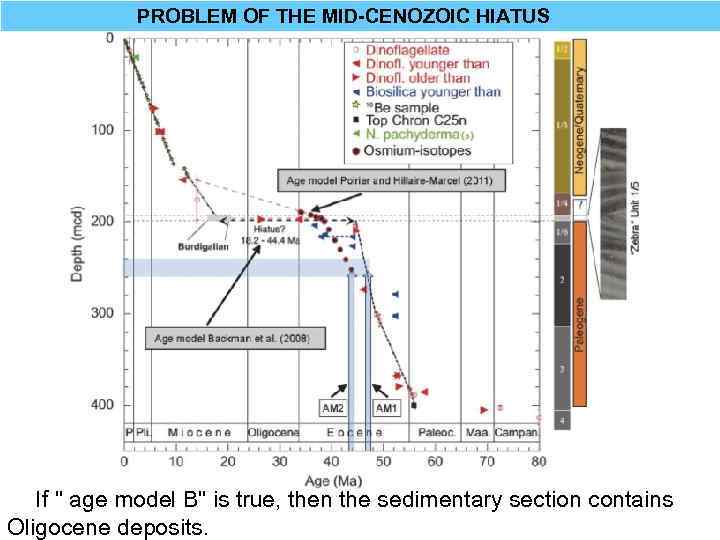 ПРОБЛЕМА СРЕДНЕ-КАЙНОЗОЙСКОГО ПЕРЕРЫВА PROBLEM OF THE MID-CENOZOIC HIATUS If " age model B" is true, then the sedimentary section contains Oligocene deposits.
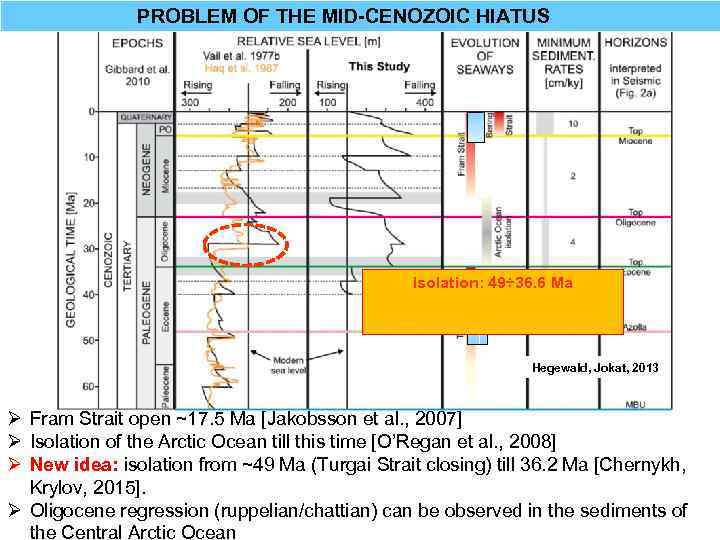 ПРОБЛЕМА СРЕДНЕ-КАЙНОЗОЙСКОГО ПЕРЕРЫВА PROBLEM OF THE MID-CENOZOIC HIATUS Isolation: 49÷ 36. 6 Ма Hegewald, Jokat, 2013 Ø Fram Strait open ~17. 5 Ma [Jakobsson et al. , 2007] Ø Isolation of the Arctic Ocean till this time [O’Regan et al. , 2008] Ø New idea: isolation from ~49 Ma (Turgai Strait closing) till 36. 2 Ma [Chernykh, Krylov, 2015]. Ø Oligocene regression (ruppelian/chattian) can be observed in the sediments of the Central Arctic Ocean
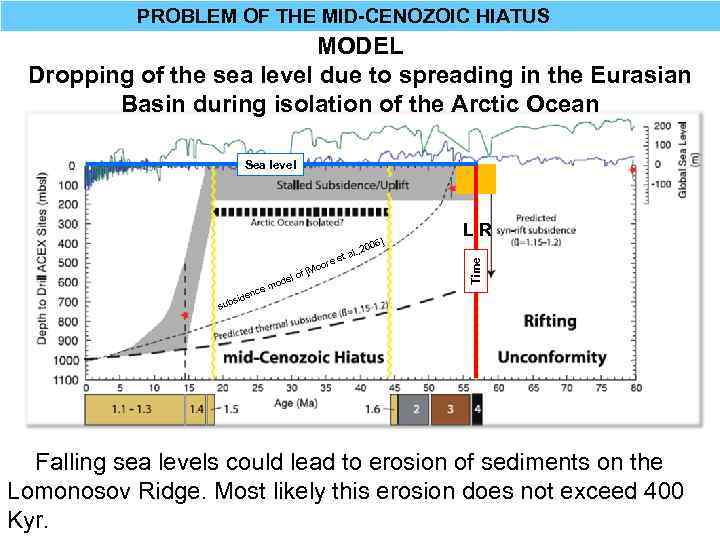 ПРОБЛЕМА СРЕДНЕ-КАЙНОЗОЙСКОГО ПЕРЕРЫВА PROBLEM OF THE MID-CENOZOIC HIATUS MODEL Dropping of the sea level due to spreading in the Eurasian Basin during isolation of the Arctic Ocean Sea level e enc sid sub [M Time l of de mo LR , 2 t al. ee oor ] 006 Falling sea levels could lead to erosion of sediments on the Lomonosov Ridge. Most likely this erosion does not exceed 400 Kyr.
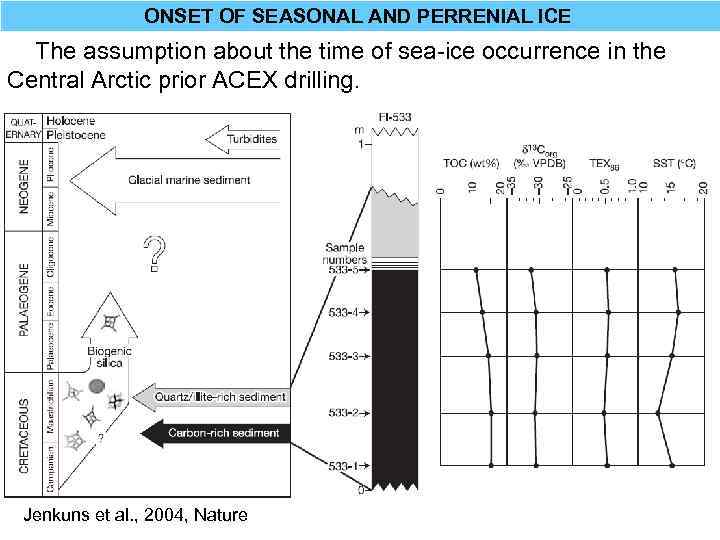 ONSET OF SEASONAL AND PERRENIAL ICE The assumption about the time of sea-ice occurrence in the Central Arctic prior ACEX drilling. Jenkuns et al. , 2004, Nature
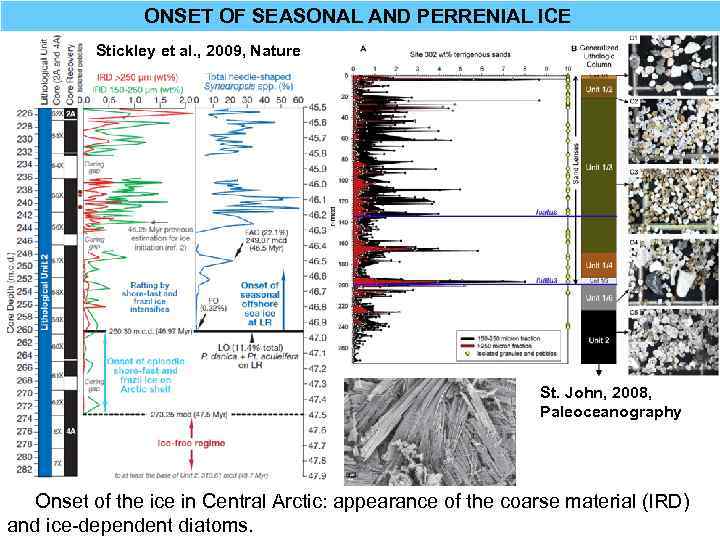 ONSET OF SEASONAL AND PERRENIAL ICE Stickley et al. , 2009, Nature St. John, 2008, Paleoceanography Onset of the ice in Central Arctic: appearance of the coarse material (IRD) and ice-dependent diatoms.
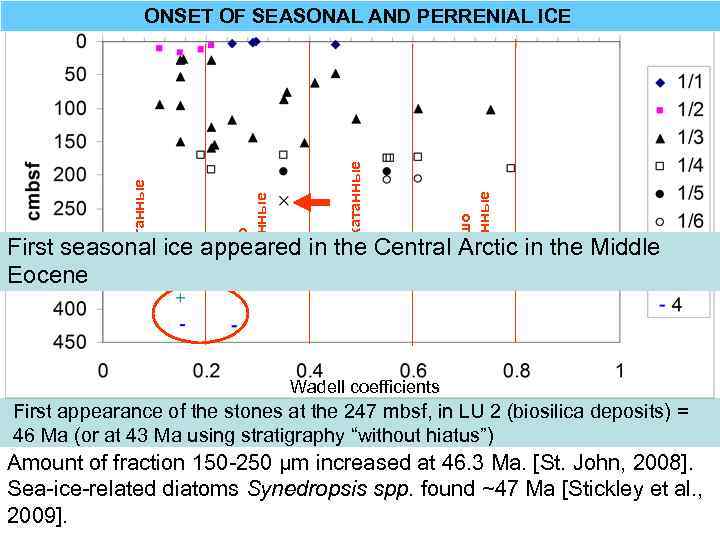 Хорошо окатанные Полуокатанные Плохо окатанные Неокатанные ONSET OF SEASONAL AND PERRENIAL ICE First seasonal ice appeared in the Central Arctic in the Middle Eocene Wadell coefficients First appearance of the stones at the 247 mbsf, in LU 2 (biosilica deposits) = 46 Ma (or at 43 Ma using stratigraphy “without hiatus”) Amount of fraction 150 -250 μm increased at 46. 3 Ma. [St. John, 2008]. Sea-ice-related diatoms Synedropsis spp. found ~47 Ma [Stickley et al. , 2009].
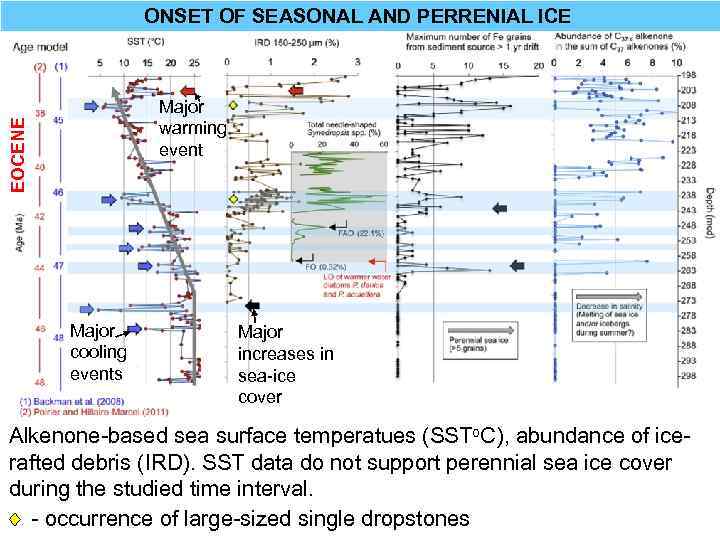 ONSET OF SEASONAL AND PERRENIAL ICE EOCENE Major warming event Major cooling events Major increases in sea-ice cover Alkenone-based sea surface temperatues (SSTo. C), abundance of icerafted debris (IRD). SST data do not support perennial sea ice cover during the studied time interval. - occurrence of large-sized single dropstones
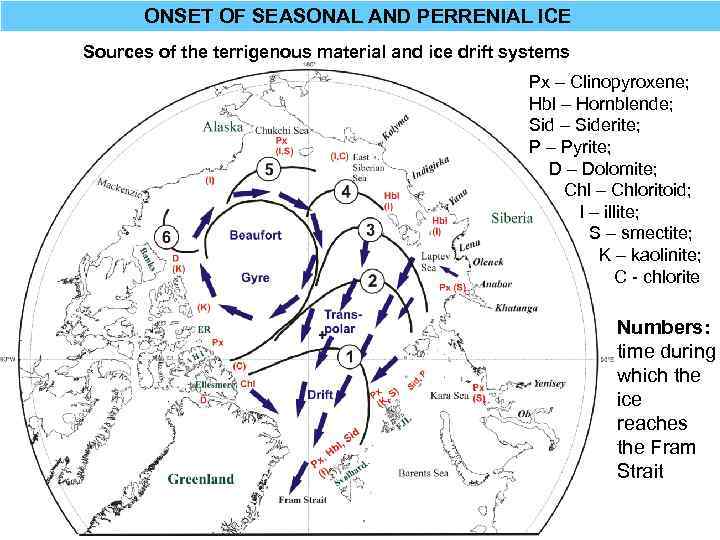 ONSET OF SEASONAL AND PERRENIAL ICE Sources of the terrigenous material and ice drift systems Px – Clinopyroxene; Hbl – Hornblende; Sid – Siderite; P – Pyrite; D – Dolomite; Chl – Chloritoid; I – illite; S – smectite; K – kaolinite; C - chlorite Numbers: time during which the ice reaches the Fram Strait
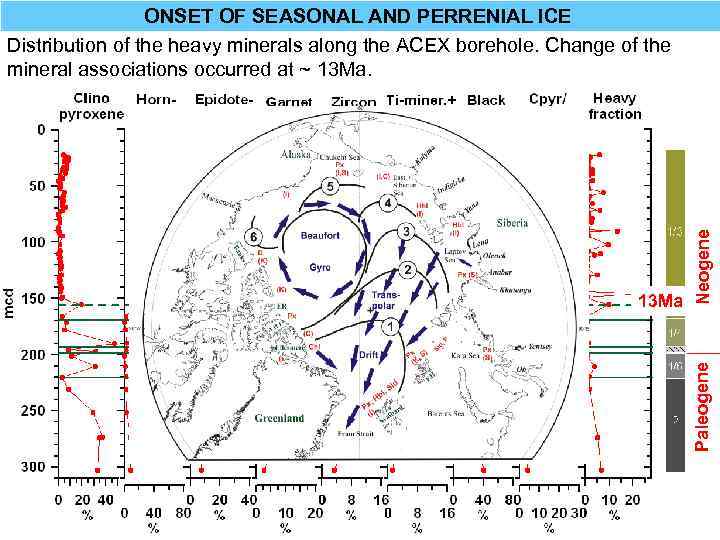 Paleogene 13 Ma Neogene ONSET OF SEASONAL AND PERRENIAL ICE Distribution of the heavy minerals along the ACEX borehole. Сhange of the mineral associations occurred at ~ 13 Ma.
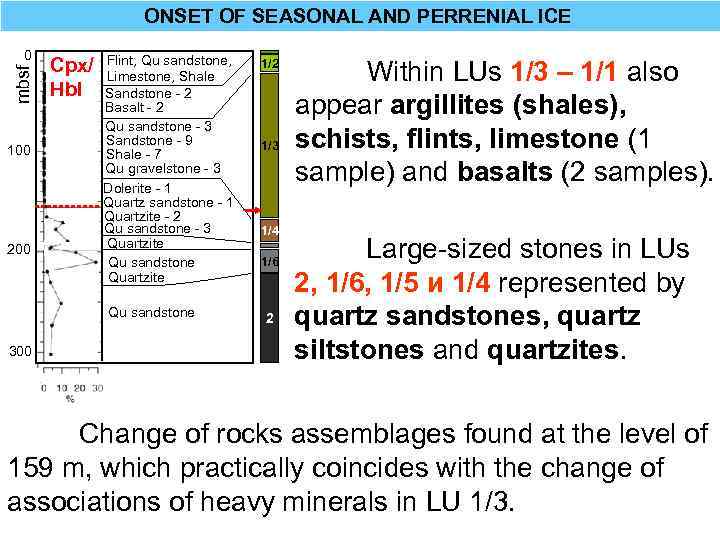 ONSET OF SEASONAL AND PERRENIAL ICE mbsf 0 100 200 Cpx/ Hbl Flint, Qu sandstone, Limestone, Shale Sandstone - 2 Basalt - 2 Qu sandstone - 3 Sandstone - 9 Shale - 7 Qu gravelstone - 3 Dolerite - 1 Quartz sandstone - 1 Quartzite - 2 Qu sandstone - 3 Quartzite Qu sandstone 300 1/2 1/3 1/4 1/6 2 Within LUs 1/3 – 1/1 also appear argillites (shales), schists, flints, limestone (1 sample) and basalts (2 samples). Large-sized stones in LUs 2, 1/6, 1/5 и 1/4 represented by quartz sandstones, quartz siltstones and quartzites. Сhange of rocks assemblages found at the level of 159 m, which practically coincides with the change of associations of heavy minerals in LU 1/3.
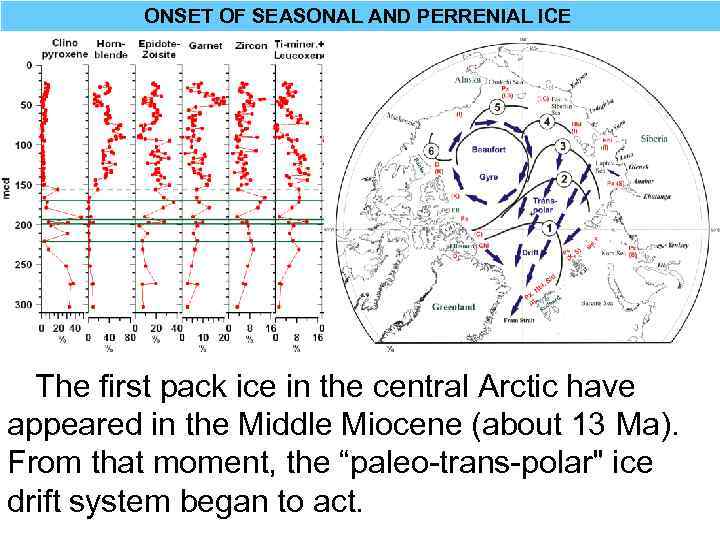 ONSET OF SEASONAL AND PERRENIAL ICE The first pack ice in the central Arctic have appeared in the Middle Miocene (about 13 Ma). From that moment, the “paleo-trans-polar" ice drift system began to act.
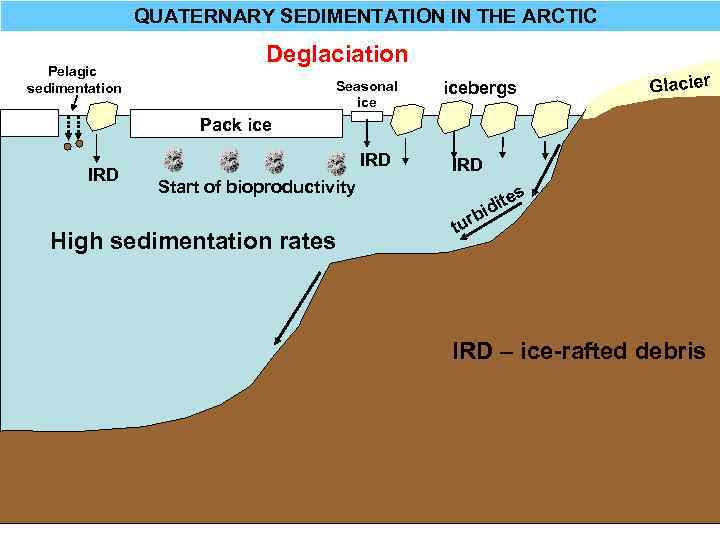
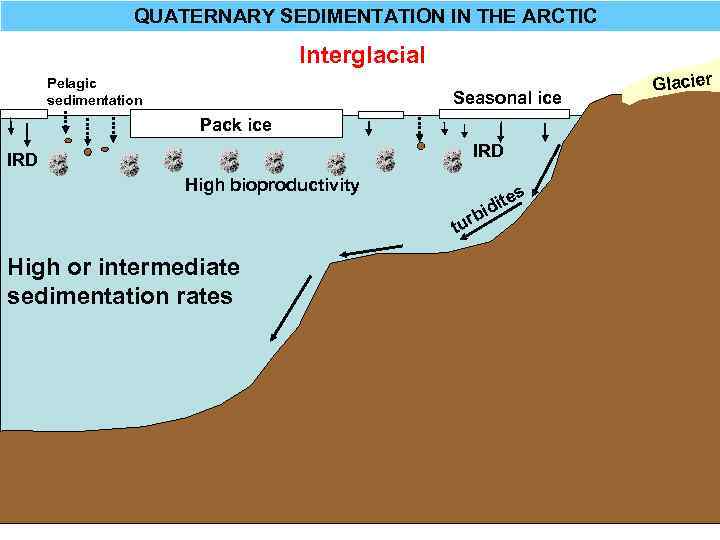
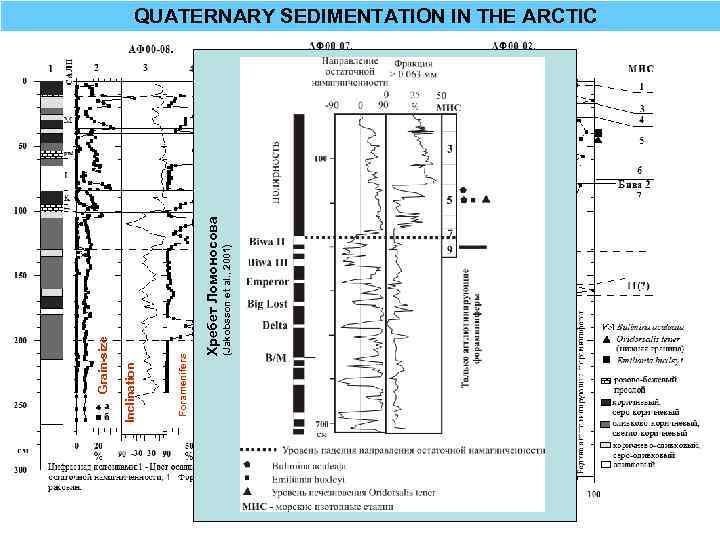
 QUATERNARY SEDIMENTATION IN THE ARCTIC Three scenarios of sedimentation 1) Glaciation. The ocean is covered with pack ice. Lack of benthic and planktonic organisms. Sedimentation rates are minimal. 2) Deglaciation. Degradation of glaciers. The appearance of a large number of icebergs. The transfer of coarse material. Pack ice and icebergs are melting rapidly. The appearance of benthic and planktonic organisms. High rates of sedimentation. 3) Interglacial. Modern Arctic Ocean. The predominance of clay and silt material. The abundance of benthic and planktonic organisms. The intermediate sedimentation rates.
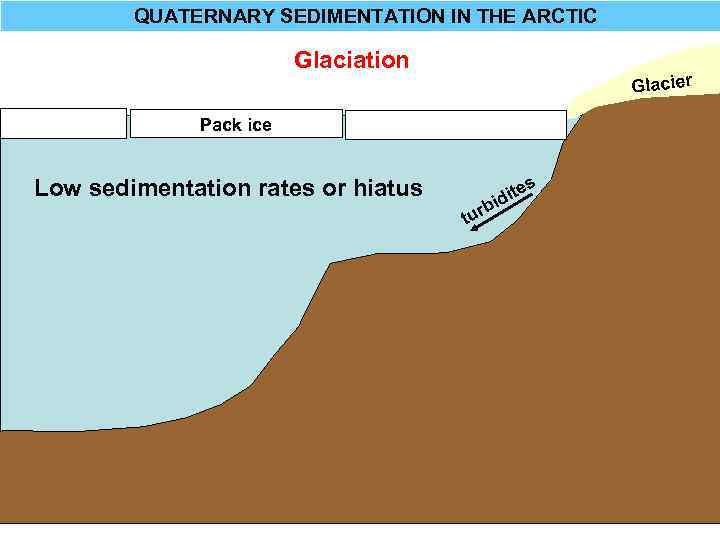 QUATERNARY SEDIMENTATION IN THE ARCTIC Glaciation Glacier Pack ice Low sedimentation rates or hiatus b tur s ite id
 QUATERNARY SEDIMENTATION IN THE ARCTIC Pelagic sedimentation Deglaciation Seasonal ice Glacier icebergs Pack ice IRD IRD Start of bioproductivity High sedimentation rates s b tur e dit i IRD – ice-rafted debris
 QUATERNARY SEDIMENTATION IN THE ARCTIC Interglacial Pelagic sedimentation Seasonal ice Pack ice IRD High bioproductivity s b tur High or intermediate sedimentation rates e dit i Glacier
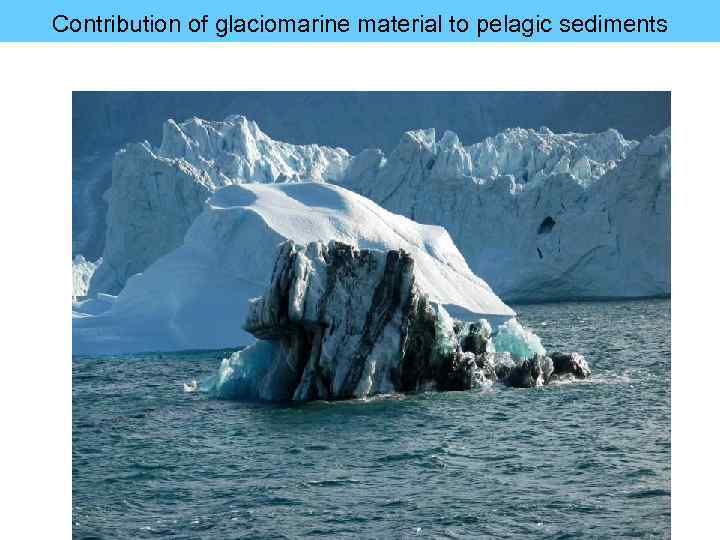
 Contribution of glaciomarine material to pelagic sediments
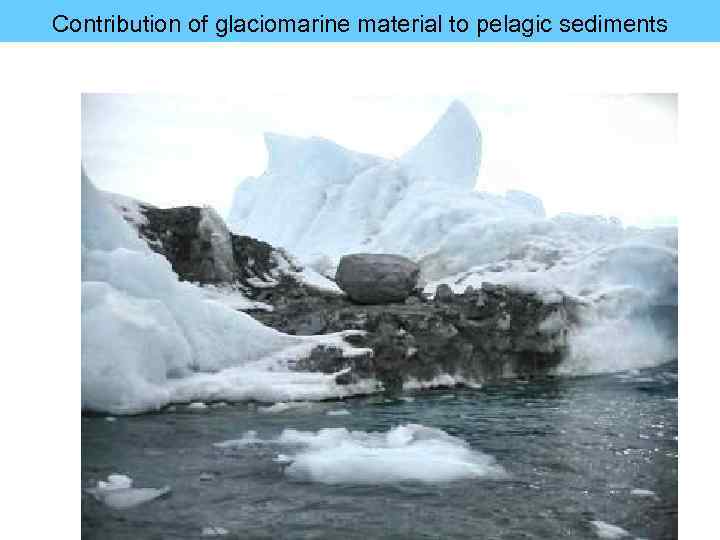
 Contribution of glaciomarine material to pelagic sediments
 Contribution of glaciomarine material to pelagic sediments
 Contribution of glaciomarine material to pelagic sediments
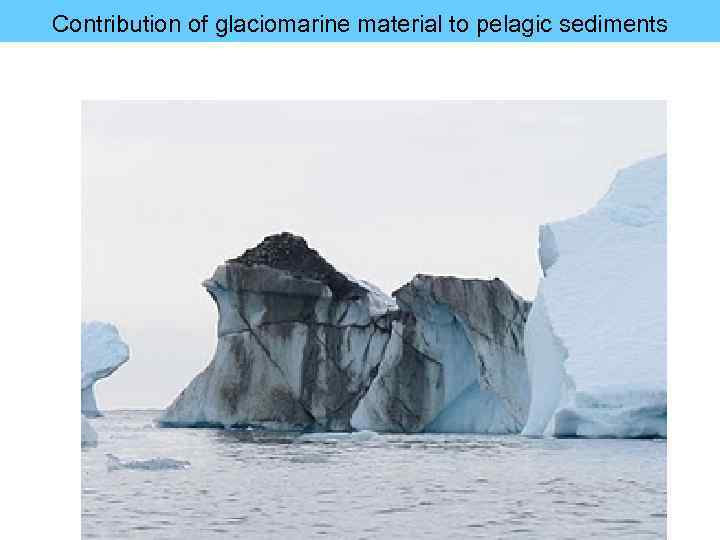 Contribution of glaciomarine material to pelagic sediments
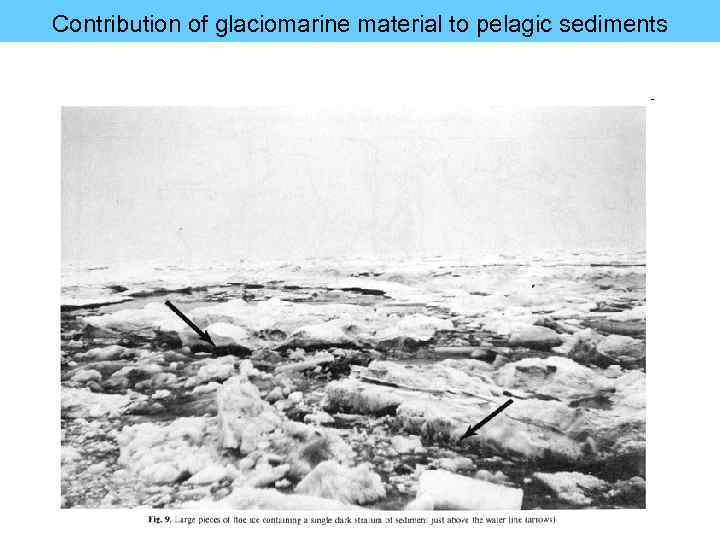
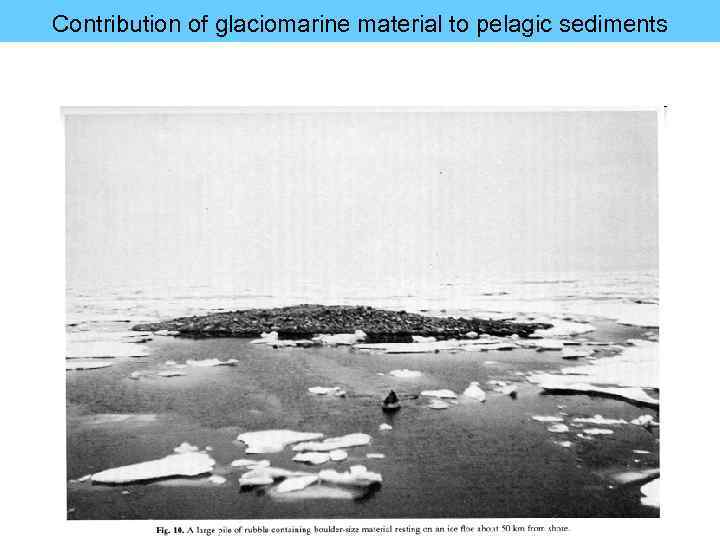
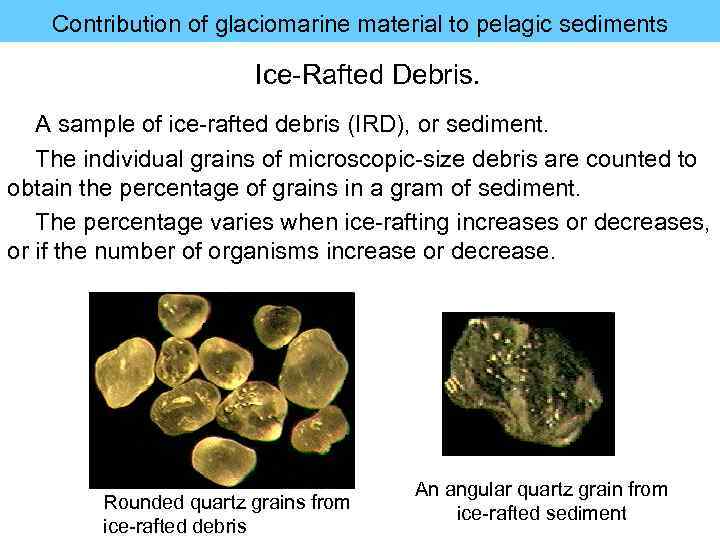 Contribution of glaciomarine material to pelagic sediments Ice-Rafted Debris. A sample of ice-rafted debris (IRD), or sediment. The individual grains of microscopic-size debris are counted to obtain the percentage of grains in a gram of sediment. The percentage varies when ice-rafting increases or decreases, or if the number of organisms increase or decrease. Rounded quartz grains from ice-rafted debris An angular quartz grain from ice-rafted sediment
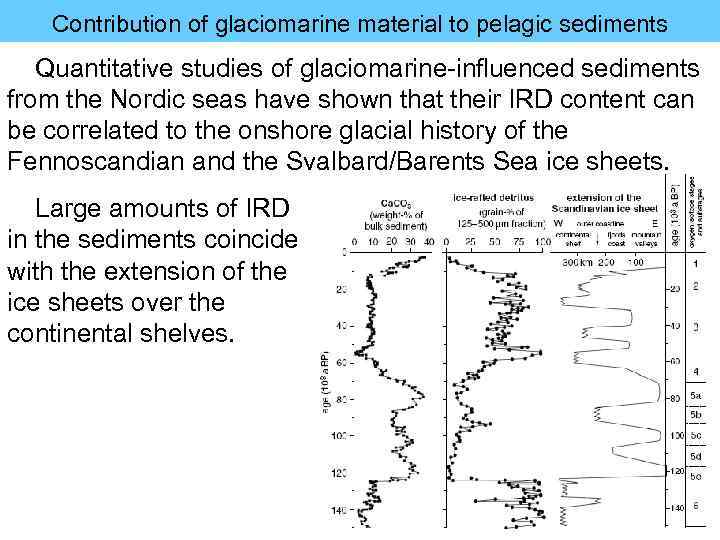 Contribution of glaciomarine material to pelagic sediments Quantitative studies of glaciomarine-influenced sediments from the Nordic seas have shown that their IRD content can be correlated to the onshore glacial history of the Fennoscandian and the Svalbard/Barents Sea ice sheets. Large amounts of IRD in the sediments coincide with the extension of the ice sheets over the continental shelves.
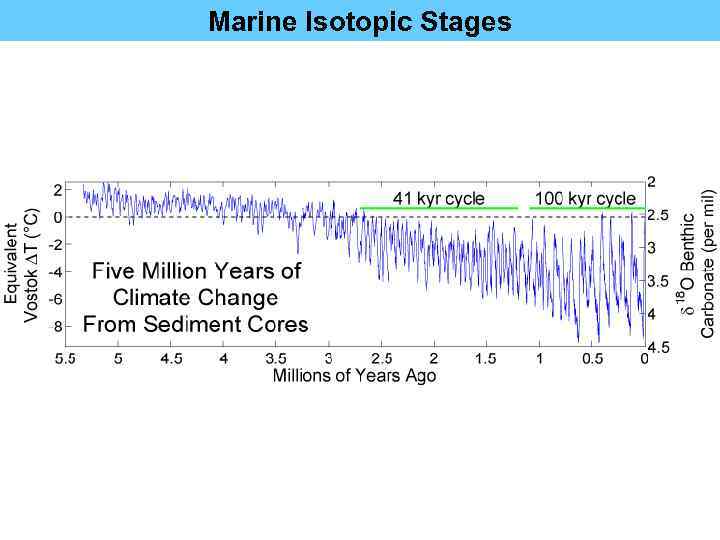
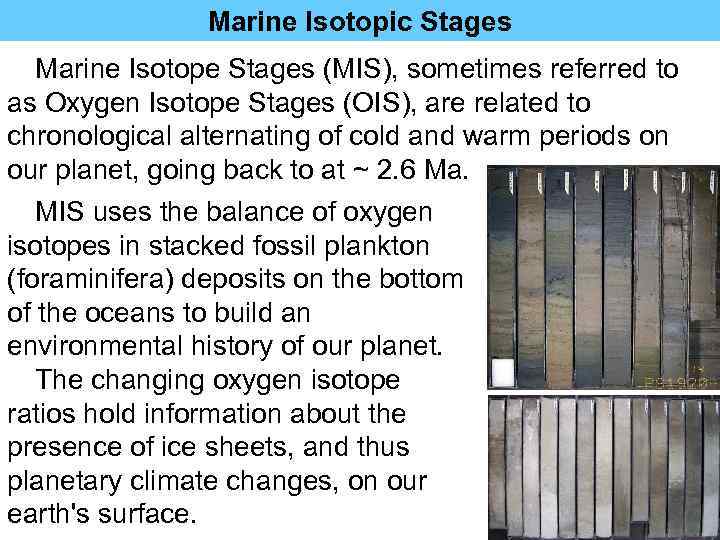 Marine Isotopic Stages Marine Isotope Stages (MIS), sometimes referred to as Oxygen Isotope Stages (OIS), are related to chronological alternating of cold and warm periods on our planet, going back to at ~ 2. 6 Ma. MIS uses the balance of oxygen isotopes in stacked fossil plankton (foraminifera) deposits on the bottom of the oceans to build an environmental history of our planet. The changing oxygen isotope ratios hold information about the presence of ice sheets, and thus planetary climate changes, on our earth's surface.
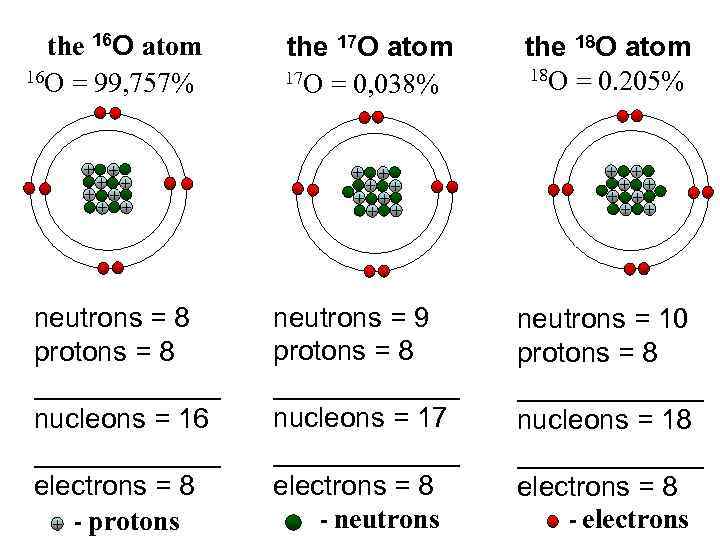 the 16 О atom 16 О = 99, 757% + + + + neutrons = 8 protons = 8 ______ nucleons = 16 ______ electrons = 8 + - protons the 17 О atom 17 О = 0, 038% + + + + neutrons = 9 protons = 8 ______ nucleons = 17 ______ electrons = 8 - neutrons the 18 О atom 18 О = 0. 205% + + + + neutrons = 10 protons = 8 ______ nucleons = 18 ______ electrons = 8 - electrons
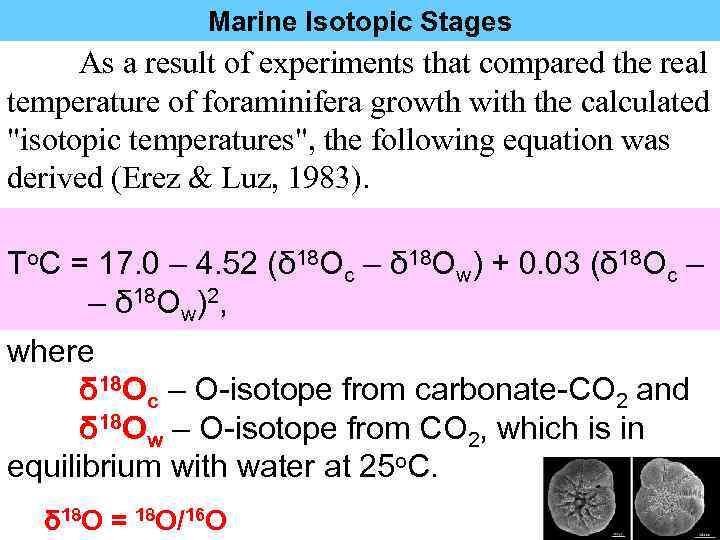 Marine Isotopic Stages As a result of experiments that compared the real temperature of foraminifera growth with the calculated "isotopic temperatures", the following equation was derived (Erez & Luz, 1983). To. C = 17. 0 – 4. 52 (δ 18 Oc – δ 18 Ow) + 0. 03 (δ 18 Oc – – δ 18 Ow)2, where δ 18 Ос – О-isotope from carbonate-CO 2 and δ 18 Оw – О-isotope from СО 2, which is in equilibrium with water at 25 о. С. δ 18 О = 18 O/16 O
 Marine Isotopic Stages
 Inclination Foraminifers Grain-size Inclination Фораминиферы Гранулометрия (Jakobsson et al. , 2001) Хребет Ломоносова Foramenifers Inclination Grain-size QUATERNARY SEDIMENTATION IN THE ARCTIC
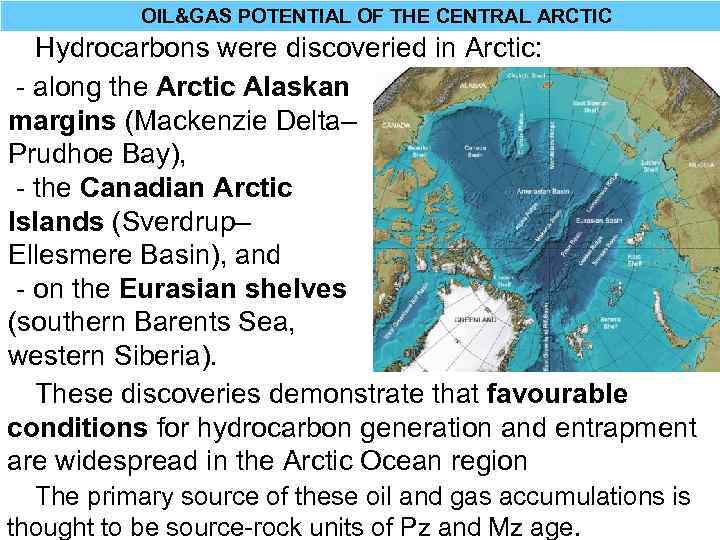 OIL&GAS POTENTIAL OF THE CENTRAL ARCTIC Hydrocarbons were discoveried in Arctic: - along the Arctic Alaskan margins (Mackenzie Delta– Prudhoe Bay), - the Canadian Arctic Islands (Sverdrup– Ellesmere Basin), and - on the Eurasian shelves (southern Barents Sea, western Siberia). These discoveries demonstrate that favourable conditions for hydrocarbon generation and entrapment are widespread in the Arctic Ocean region The primary source of these oil and gas accumulations is thought to be source-rock units of Pz and Mz age.
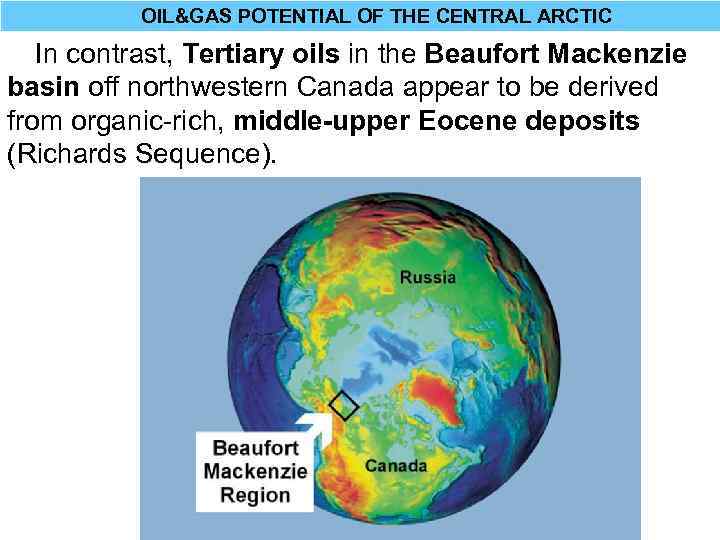 OIL&GAS POTENTIAL OF THE CENTRAL ARCTIC In contrast, Tertiary oils in the Beaufort Mackenzie basin off northwestern Canada appear to be derived from organic-rich, middle-upper Eocene deposits (Richards Sequence).
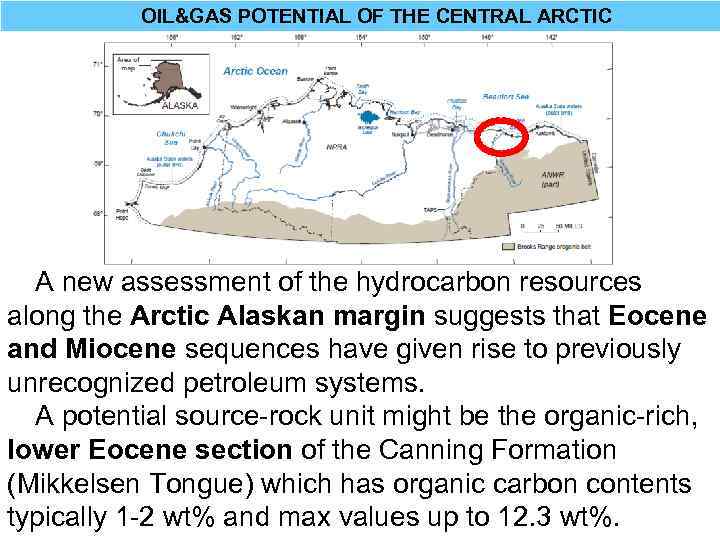 OIL&GAS POTENTIAL OF THE CENTRAL ARCTIC A new assessment of the hydrocarbon resources along the Arctic Alaskan margin suggests that Eocene and Miocene sequences have given rise to previously unrecognized petroleum systems. A potential source-rock unit might be the organic-rich, lower Eocene section of the Canning Formation (Mikkelsen Tongue) which has organic carbon contents typically 1 -2 wt% and max values up to 12. 3 wt%.
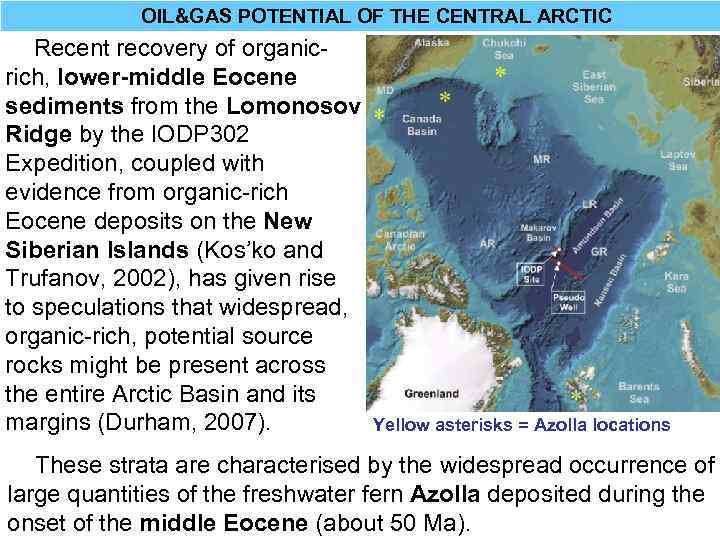 OIL&GAS POTENTIAL OF THE CENTRAL ARCTIC Recent recovery of organicrich, lower-middle Eocene sediments from the Lomonosov Ridge by the IODP 302 Expedition, coupled with evidence from organic-rich Eocene deposits on the New Siberian Islands (Kos’ko and Trufanov, 2002), has given rise to speculations that widespread, organic-rich, potential source rocks might be present across the entire Arctic Basin and its margins (Durham, 2007). Yellow asterisks = Azolla locations These strata are characterised by the widespread occurrence of large quantities of the freshwater fern Azolla deposited during the onset of the middle Eocene (about 50 Ma).
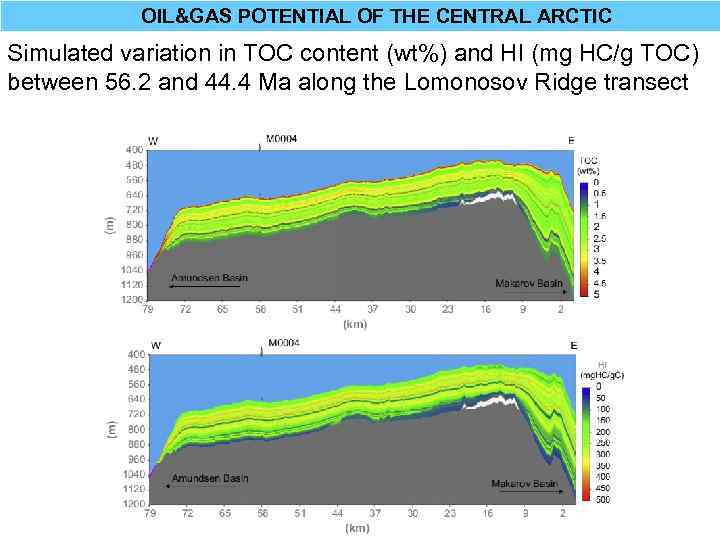 OIL&GAS POTENTIAL OF THE CENTRAL ARCTIC Simulated variation in TOC content (wt%) and HI (mg HC/g TOC) between 56. 2 and 44. 4 Ma along the Lomonosov Ridge transect
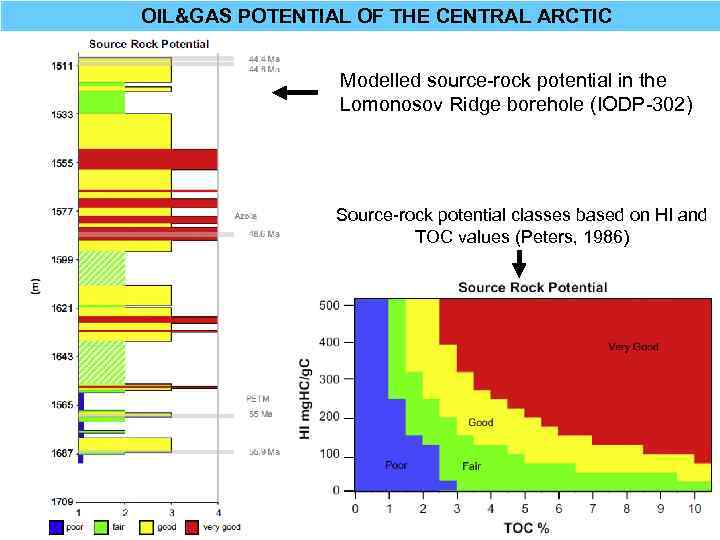 OIL&GAS POTENTIAL OF THE CENTRAL ARCTIC Modelled source-rock potential in the Lomonosov Ridge borehole (IODP-302) Source-rock potential classes based on HI and TOC values (Peters, 1986)
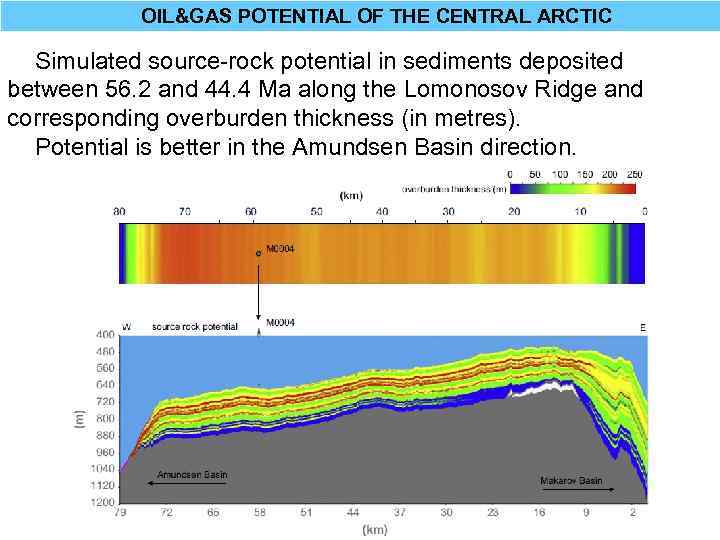 OIL&GAS POTENTIAL OF THE CENTRAL ARCTIC Simulated source-rock potential in sediments deposited between 56. 2 and 44. 4 Ma along the Lomonosov Ridge and corresponding overburden thickness (in metres). Potential is better in the Amundsen Basin direction.
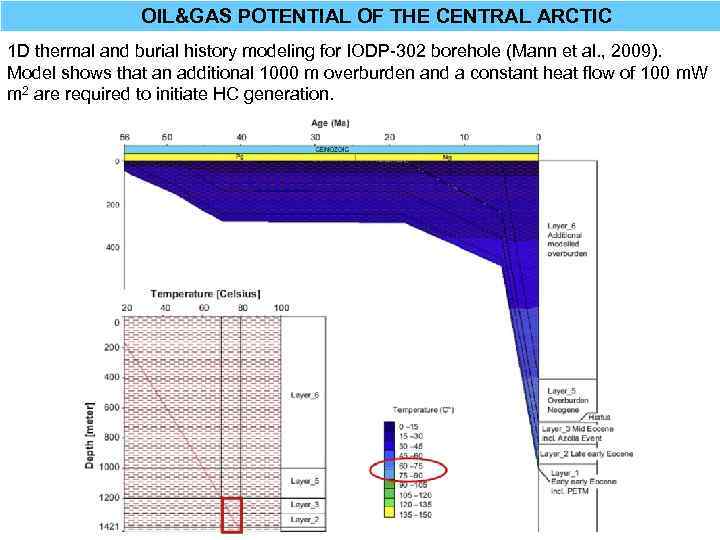 OIL&GAS POTENTIAL OF THE CENTRAL ARCTIC 1 D thermal and burial history modeling for IODP-302 borehole (Mann et al. , 2009). Model shows that an additional 1000 m overburden and a constant heat flow of 100 m. W m 2 are required to initiate HC generation.
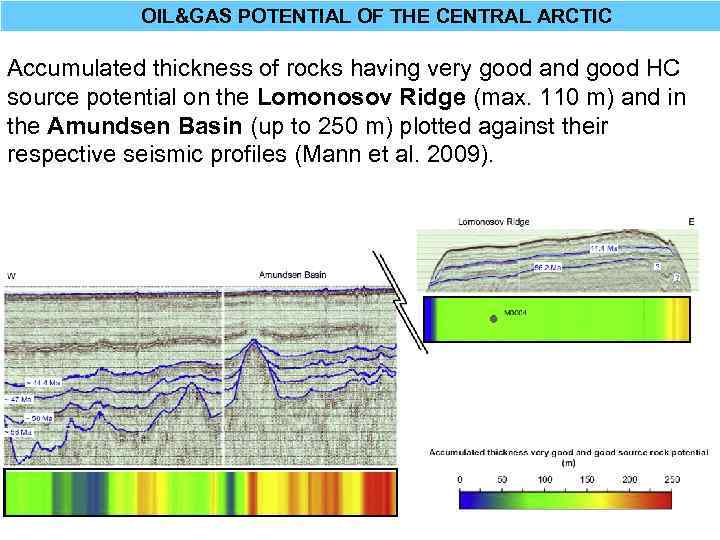 OIL&GAS POTENTIAL OF THE CENTRAL ARCTIC Accumulated thickness of rocks having very good and good HC source potential on the Lomonosov Ridge (max. 110 m) and in the Amundsen Basin (up to 250 m) plotted against their respective seismic profiles (Mann et al. 2009).
 CONCLUSION 1) Canadian Basin began to form in the Late Jurassic – Early Cretaceous (~150 -140 Ma) due to breaking off the Chukotka–Arctic Alaska microplate from the Canadian Arctic Archipelago. 2) The process of detachment and subsequent movement of the Alpha-Mendeleev Ridge away from the Barents Sea margin, accompanied by rift extension of the Makarov and Podvodnikov basins, occurred in the interval of 110 -60 Ma. 3) Mesozoic sediments in the Amerasian Basin represented mainly by siliceous ( «diatom-bearing”) sediments. 4) Detachment of the Lomonosov Ridge from the Barents Sea margin and formation of the Eurasian Basin began ~58 Ma (Late Paleocene).
 CONCLUSION 5) Two age models (“A” and “B”) may be used for the characterization of ACEX sediment. Age model “A” includes a 26 My-long hiatus (covering the Oligocene, Eocene and Late Early Miocene). Model “B” includes a hiatus of less than 400 Ky. Model “B” seems more reliable from the standpoint of plate tectonics. In favor of a short hiatus indicates the absence of significant erosion of sediment, confirmed by a detailed analysis of the dropstones and heavy minerals distribution. 6) During the late Paleocene-early Eocene terrigenous shelf sediments accumulated on the Lomonosov Ridge (and in the Eurasian Basin): LU 3 in the ACEX-well. Accumulation of biosiliceous sediments began in the Middle Eocene: LU 2 -1/6 in the ACEX-well. For a long time the Arctic Ocean was an isolated basin.
 CONCLUSION 7) In the Late Eocene (36. 6 Ma) Fram Strait opened and the isolation of the Arctic Ocean terminated. Pelagic terrigenous sediments of lithological units 1/6 - 1/1 began to accumulate. 8) The first seasonal ices appeared in the central Arctic in the Middle Eocene and the further evolution of the Arctic basin was accompanied by a gradual cooling of the climate. 9) The first pack ice in the central Arctic have appeared in the Middle Miocene (about 13 Ma). From that moment, trans-polar drift ice system began working.
 CONCLUSION 10) Sources of sedimentary material that is carried by ice (icebergs) was fairly stable in geological history. For the Eurasian basin this is a mainly "Siberian sources", and for Amerasian basin - "Canadian. “ This indicates the general (large-scale) stability of the basic systems of modern ice drift (trans-Polar and the Beaufort gyre) in the geological past.
 THANK YOU FOR ATTENTION!