


 Скачать презентацию Geoid Computations At NGS Where Are We And
2ba726033f8a19580455ad7f655f9b7d.ppt
- Количество слайдов: 32
 Geoid Computations At NGS: Where Are We And Where Are We Going? Yan Ming Wang Geodesist NGS/NOAA Brown-Bag January 19, 2010
 Overview • Geoid computation fundamentals and NGS geoid computation history • The latest geoid models: USGG 09 and GEOID 09 • Challenges to cm-geoid computations
 Where the geoid is used • Vertical datum definition H(Orth)=h(Ellip)-N(grav) • Ocean circulation MODT=MSSH(Altim)-N(Grav) • Crustal motion (future? ): subsidence and uplift H=h(Ellip)-N(grav)+[hdot(ellip)-Ndot]*DT
 Fundamentals of geoid computation 1. Newton’ gravitation law (integration) Difficulty: the density of the Earth’s interior masses is never known accurately 2. Geodetic boundary value problems: from free boundary to fix-boundary (differentiation) One solution: Stokes integral: requires gravity measured on the Earth’s surface everywhere Another solution: Spherical harmonic series as solution of GBVPs ……
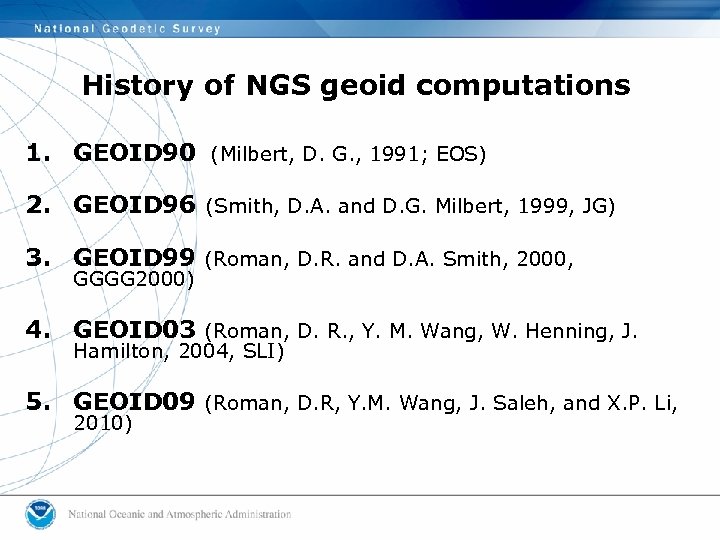 History of NGS geoid computations 1. GEOID 90 (Milbert, D. G. , 1991; EOS) 2. GEOID 96 (Smith, D. A. and D. G. Milbert, 1999, JG) 3. GEOID 99 (Roman, D. R. and D. A. Smith, 2000, GGGG 2000) 4. GEOID 03 (Roman, D. R. , Y. M. Wang, W. Henning, J. Hamilton, 2004, SLI) 5. GEOID 09 (Roman, D. R, Y. M. Wang, J. Saleh, and X. P. Li, 2010)
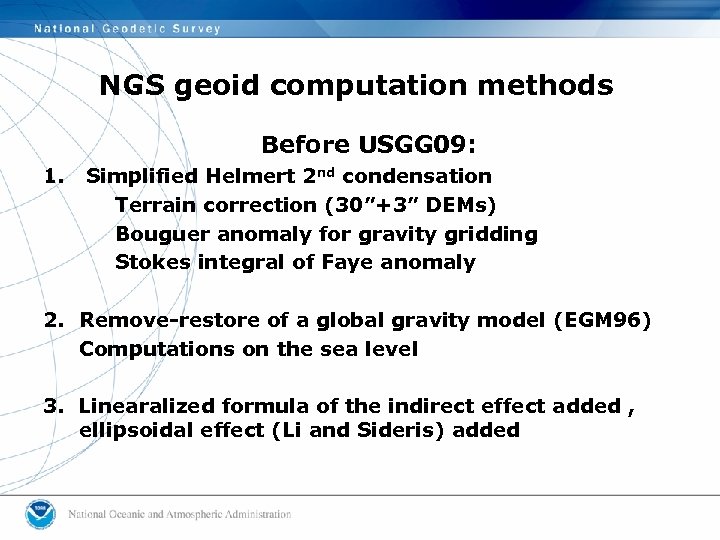 NGS geoid computation methods Before USGG 09: 1. Simplified Helmert 2 nd condensation Terrain correction (30”+3” DEMs) Bouguer anomaly for gravity gridding Stokes integral of Faye anomaly 2. Remove-restore of a global gravity model (EGM 96) Computations on the sea level 3. Linearalized formula of the indirect effect added , ellipsoidal effect (Li and Sideris) added
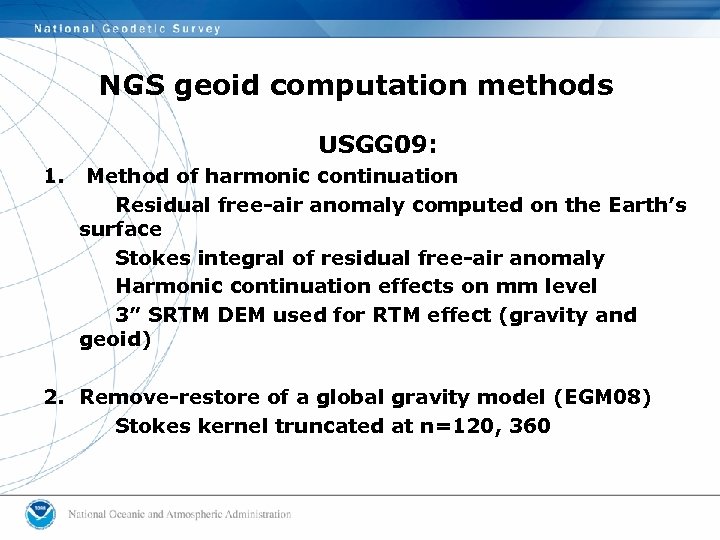 NGS geoid computation methods USGG 09: 1. Method of harmonic continuation Residual free-air anomaly computed on the Earth’s surface Stokes integral of residual free-air anomaly Harmonic continuation effects on mm level 3” SRTM DEM used for RTM effect (gravity and geoid) 2. Remove-restore of a global gravity model (EGM 08) Stokes kernel truncated at n=120, 360
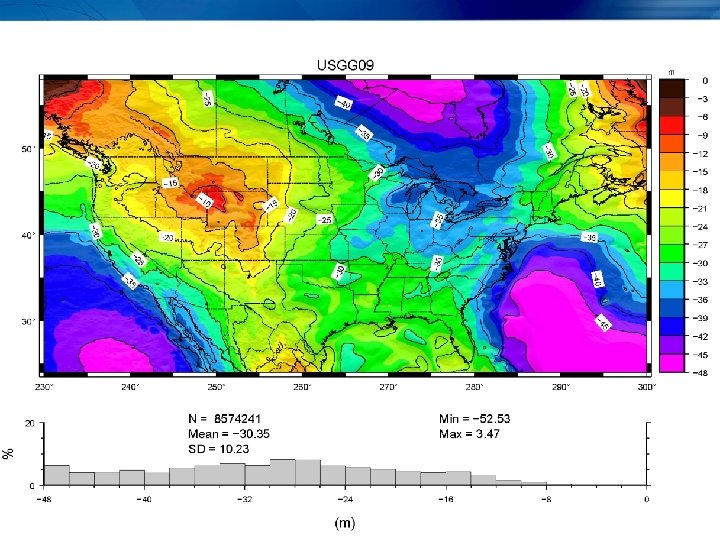
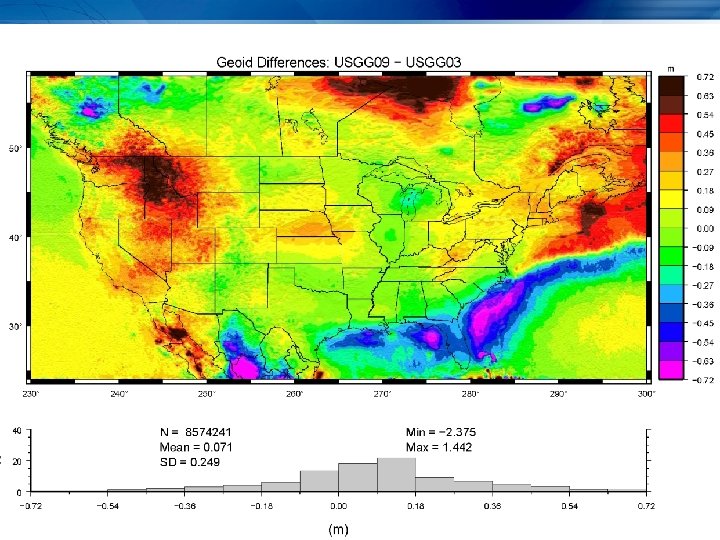
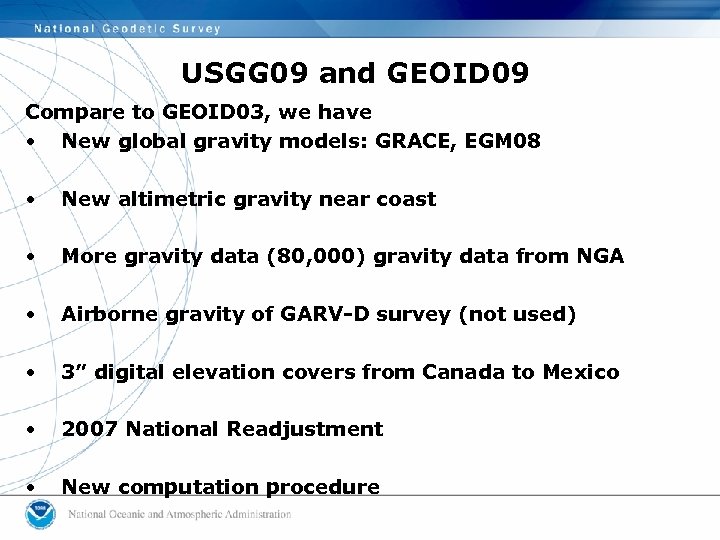 USGG 09 and GEOID 09 Compare to GEOID 03, we have • New global gravity models: GRACE, EGM 08 • New altimetric gravity near coast • More gravity data (80, 000) gravity data from NGA • Airborne gravity of GARV-D survey (not used) • 3” digital elevation covers from Canada to Mexico • 2007 National Readjustment • New computation procedure
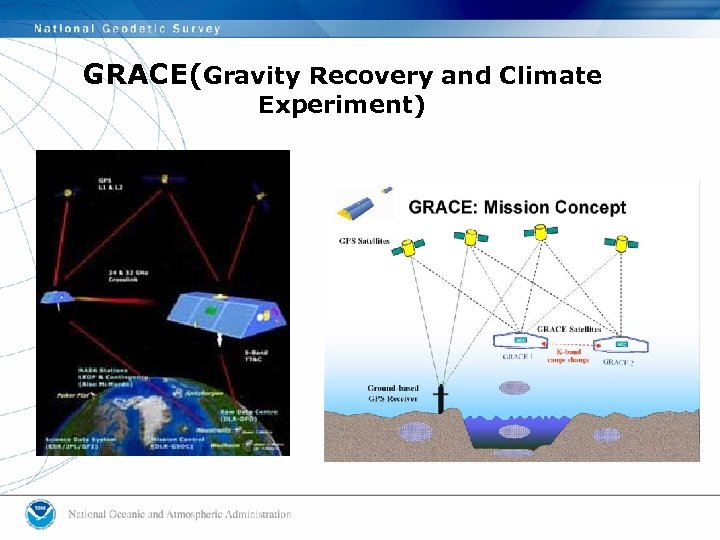 GRACE(Gravity Recovery and Climate Experiment)
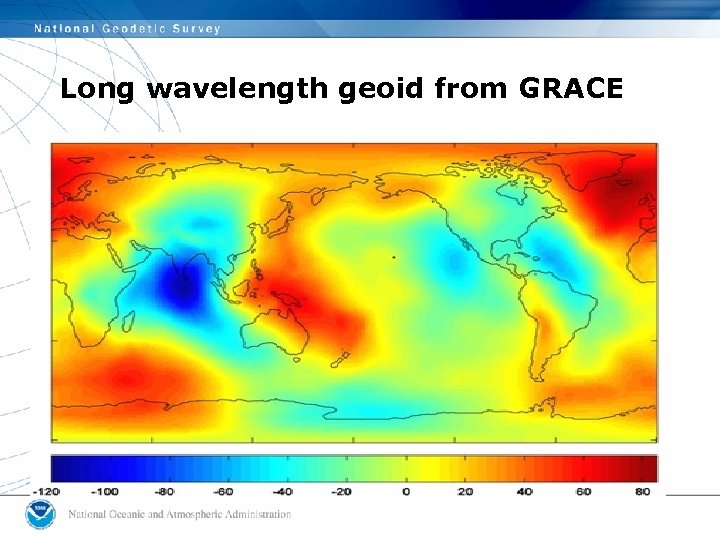 Long wavelength geoid from GRACE
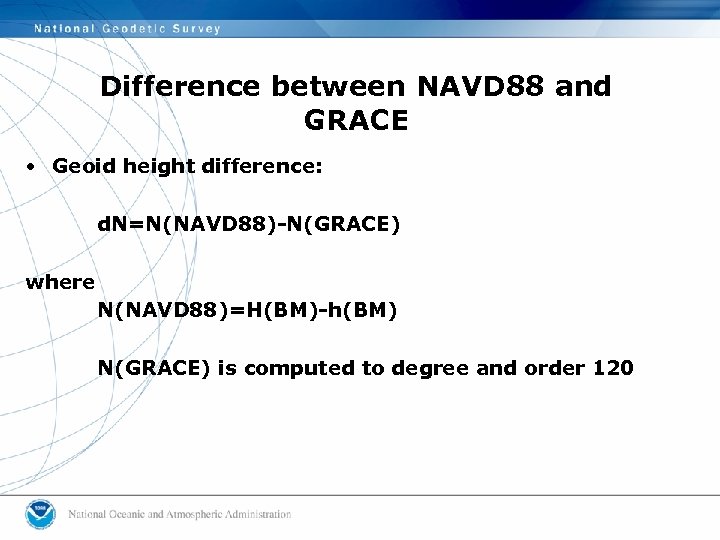 Difference between NAVD 88 and GRACE • Geoid height difference: d. N=N(NAVD 88)-N(GRACE) where N(NAVD 88)=H(BM)-h(BM) N(GRACE) is computed to degree and order 120
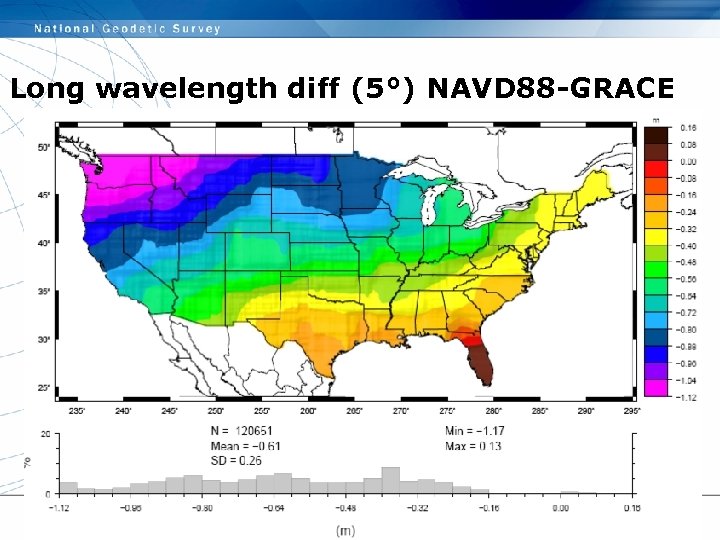 Long wavelength diff (5°) NAVD 88 -GRACE
 EGM 08 • GRACE satellite only at low degree and order • Using global terrestrial/altimetry gravity data in 5’ mean, geophysical model fill-in in areas with no data • Using SRTM elevation for topographic reduction and geoid conversion • Model developed to degree and order 2160
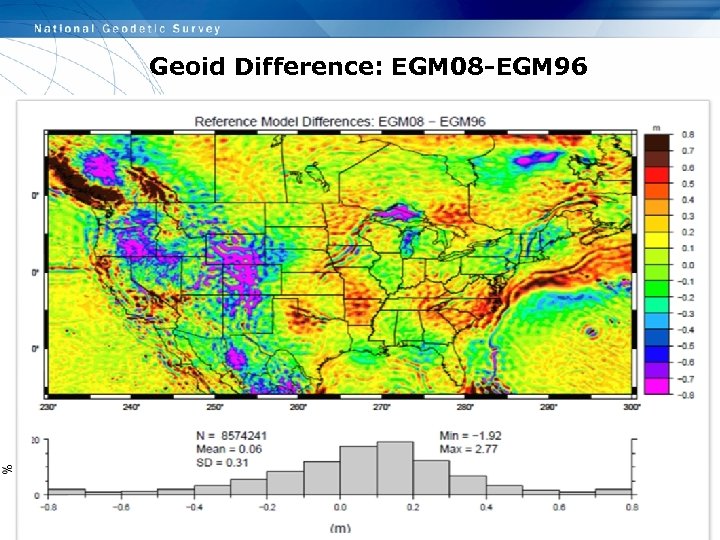 Geoid Difference: EGM 08 -EGM 96
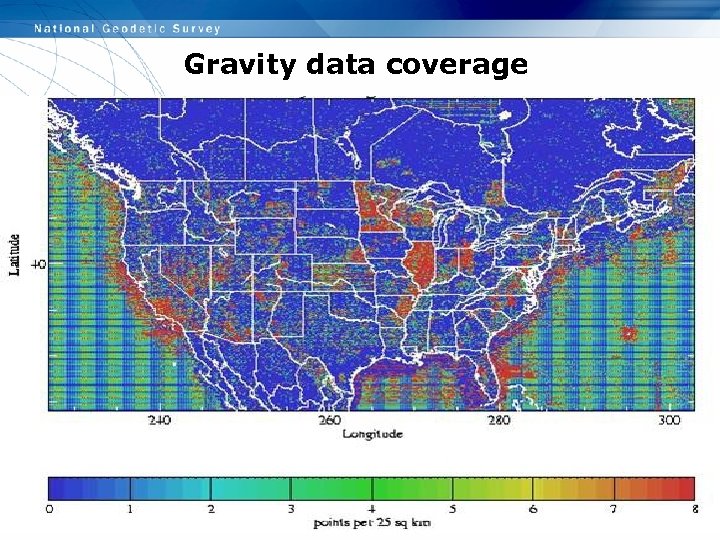 Gravity data coverage
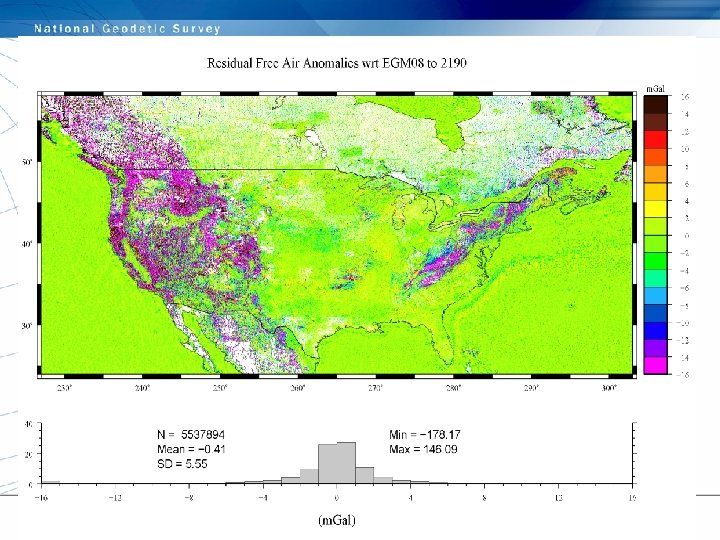
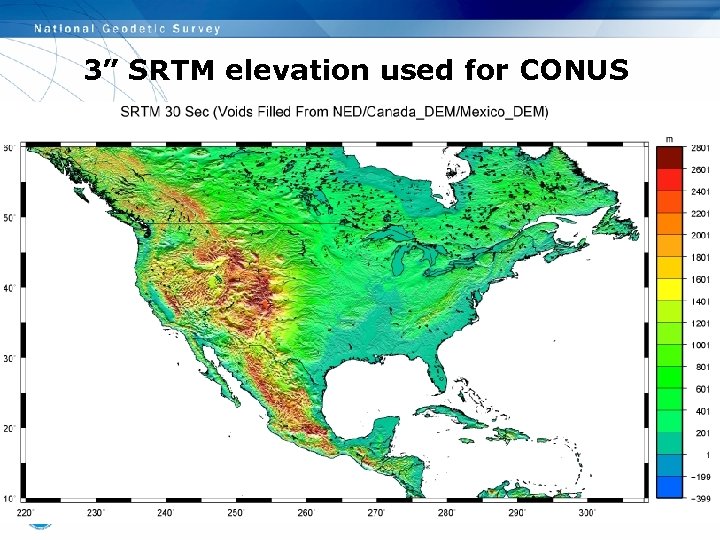 3” SRTM elevation used for CONUS
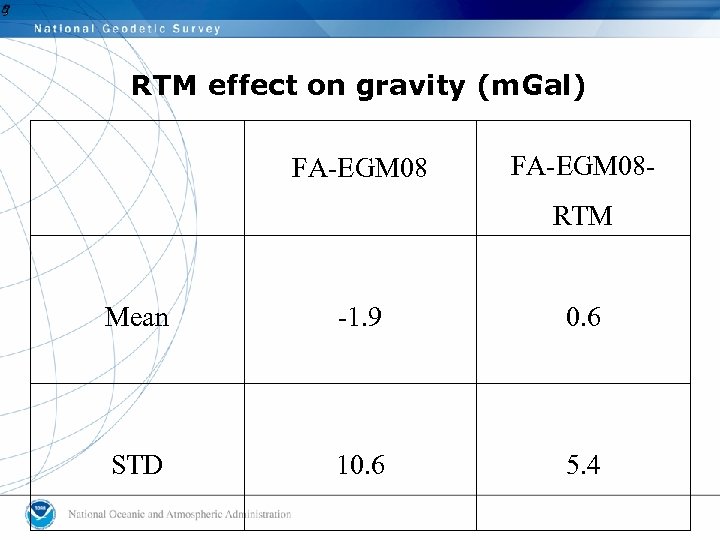 RTM effect on gravity (m. Gal) FA-EGM 08 RTM Mean -1. 9 0. 6 STD 10. 6 5. 4
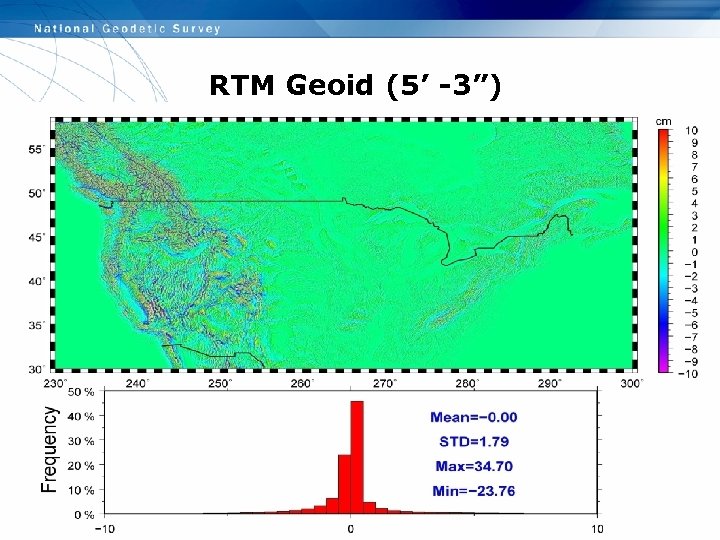 RTM Geoid (5’ -3”)
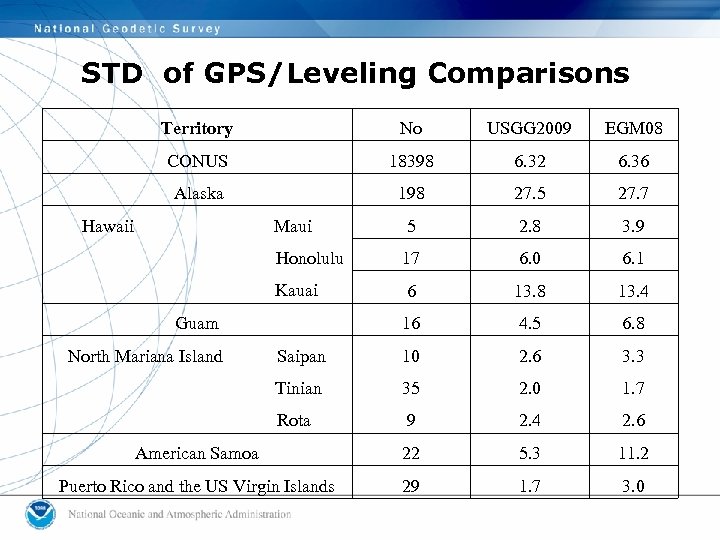 STD of GPS/Leveling Comparisons Territory No USGG 2009 EGM 08 CONUS 18398 6. 32 6. 36 Alaska 198 27. 5 27. 7 Maui 5 2. 8 3. 9 Honolulu 17 6. 0 6. 1 Kauai 6 13. 8 13. 4 16 4. 5 6. 8 Saipan 10 2. 6 3. 3 Tinian 35 2. 0 1. 7 Rota 9 2. 4 2. 6 American Samoa 22 5. 3 11. 2 Puerto Rico and the US Virgin Islands 29 1. 7 3. 0 Hawaii Guam North Mariana Island
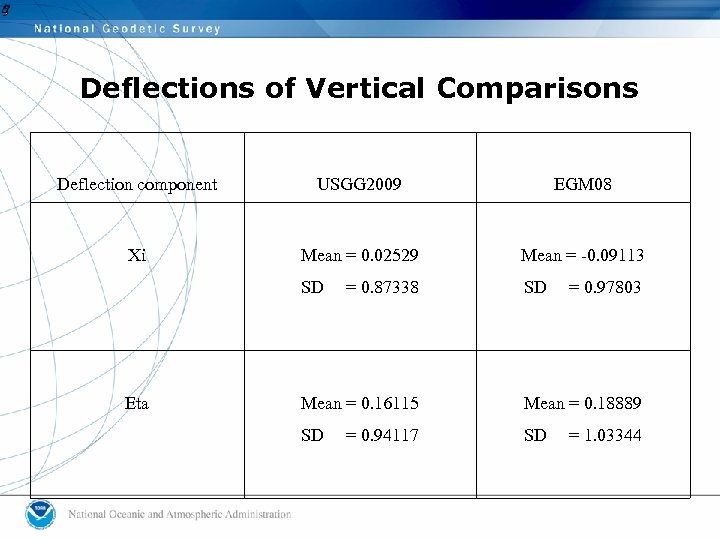 Deflections of Vertical Comparisons Deflection component USGG 2009 EGM 08 Xi Mean = 0. 02529 Mean = -0. 09113 SD SD Eta = 0. 87338 = 0. 97803 Mean = 0. 16115 Mean = 0. 18889 SD SD = 0. 94117 = 1. 03344
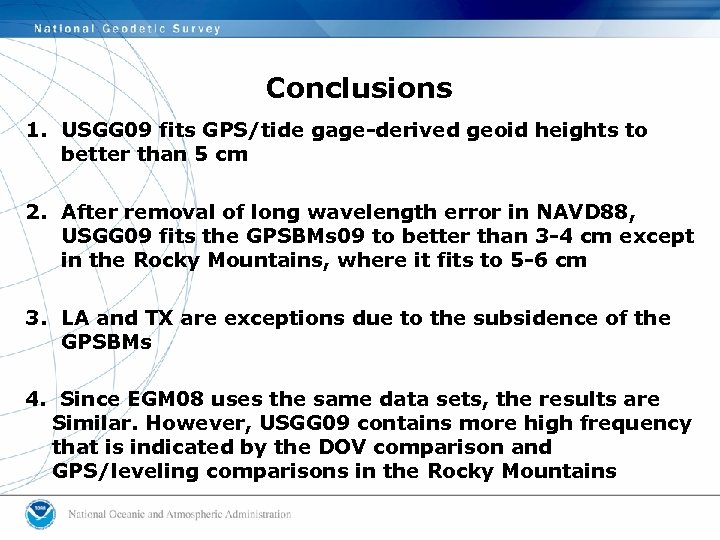 Conclusions 1. USGG 09 fits GPS/tide gage-derived geoid heights to better than 5 cm 2. After removal of long wavelength error in NAVD 88, USGG 09 fits the GPSBMs 09 to better than 3 -4 cm except in the Rocky Mountains, where it fits to 5 -6 cm 3. LA and TX are exceptions due to the subsidence of the GPSBMs 4. Since EGM 08 uses the same data sets, the results are Similar. However, USGG 09 contains more high frequency that is indicated by the DOV comparison and GPS/leveling comparisons in the Rocky Mountains
 What Next? Goal: a gravimetric geoid with absolute accuracy of 1 -2 cm We need: 1. Accurate theory/computation method (why N America geoid is different when computed by Canada and US? ) 2. Accurate and evenly distributed gravity data 3. Very accurate topographic effects to gravity and geoid, accurate mass density of topography 4. Data fusion 5. Gravimetric geoid validation methods and data sets
 Accurate theory/computation method • Investigate/review the non-linear effect in GBVPs. • Investigate the topographic effect, impact of varying mass density • Harmonic downward continuation effect (error? ) • Investigate an optimal way in use of the potential number differences in gravimetric geoid computation • Investigate/review data requirement for cm-geoid • Develop a synthetic gravity model for theory/computation method validation
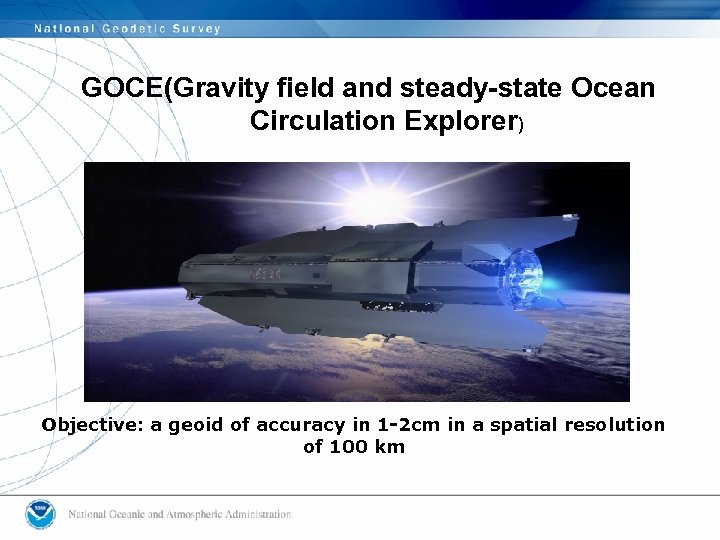 GOCE(Gravity field and steady-state Ocean Circulation Explorer) Objective: a geoid of accuracy in 1 -2 cm in a spatial resolution of 100 km
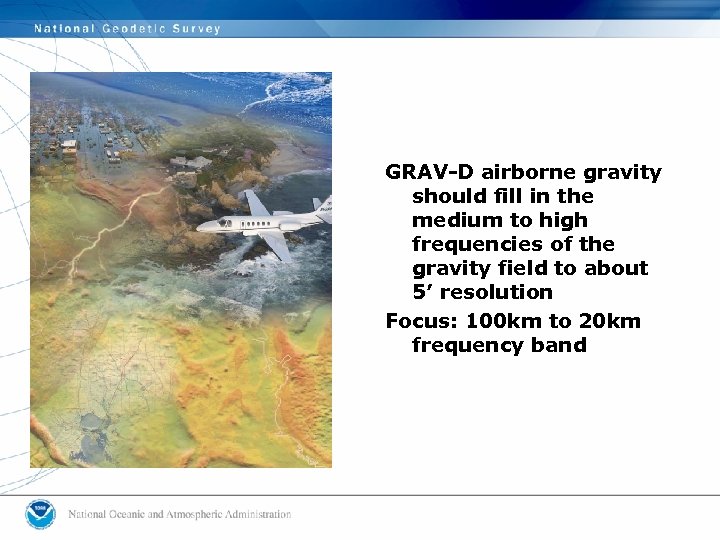 GRAV-D airborne gravity should fill in the medium to high frequencies of the gravity field to about 5’ resolution Focus: 100 km to 20 km frequency band
 Accurate topographic effects to gravity and geoid • To model topographic effect in spherical harmonic series to degree and order 2160 (5’ resolution) • To compute topographic effect from 5’ to 3” by Newtonian integration • How big is the impact of varying density on the geoid?
 Data Fusion An optimal way to combine the following data sets: • Satellite models + topo spherical harmonics (to 100 km resolution) • Surface gravity data + GRAV-D (100 km to 20 KM? ) • Topography (30 KM to 100 m) • Potential number differences from GPS/leveling (from 1 km to 100 meters? )
 Gravimetric geoid validation methods and data sets • Short wavelength: DOV, potential number differences • Few long unconstraint GPS/leveling lines • Tide gauge data sets (mean sea level + mean ODT + GPS ) • Astrogeodetic geoid?
 Q&A NGS geoid web site http: //www. ngs. noaa. gov/GEOID/ Acknowledgment: Figures and tables provided by Jarir Saleh and Xiaopeng Li