


 Скачать презентацию GEOGRAPHICAL POSITION OF CANADA Canada occupies a
GEOGRAPHICAL POSITION OF CANADA.pptx
- Количество слайдов: 9
 GEOGRAPHICAL POSITION OF CANADA
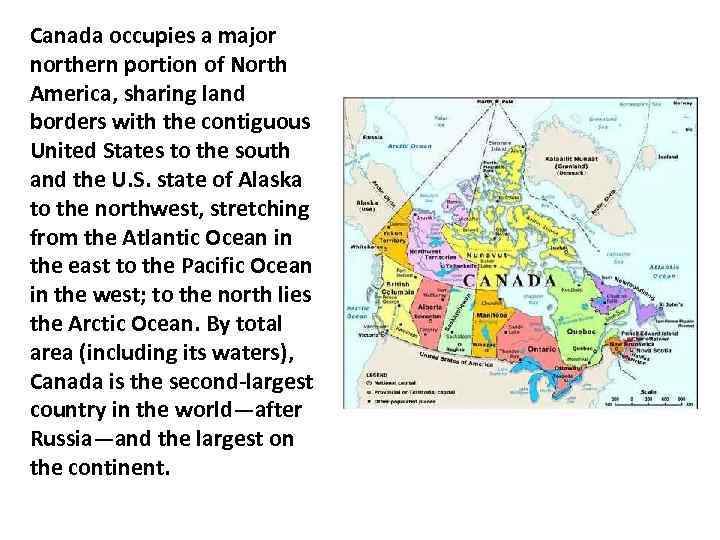 Canada occupies a major northern portion of North America, sharing land borders with the contiguous United States to the south and the U. S. state of Alaska to the northwest, stretching from the Atlantic Ocean in the east to the Pacific Ocean in the west; to the north lies the Arctic Ocean. By total area (including its waters), Canada is the second-largest country in the world—after Russia—and the largest on the continent.
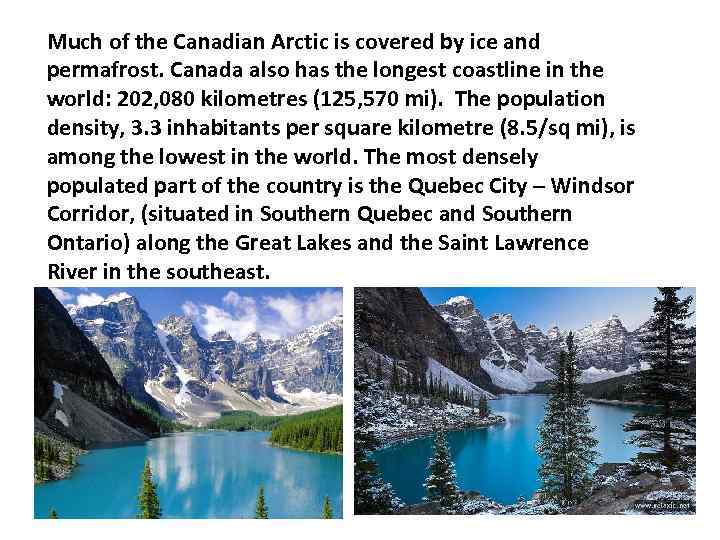 Much of the Canadian Arctic is covered by ice and permafrost. Canada also has the longest coastline in the world: 202, 080 kilometres (125, 570 mi). The population density, 3. 3 inhabitants per square kilometre (8. 5/sq mi), is among the lowest in the world. The most densely populated part of the country is the Quebec City – Windsor Corridor, (situated in Southern Quebec and Southern Ontario) along the Great Lakes and the Saint Lawrence River in the southeast.
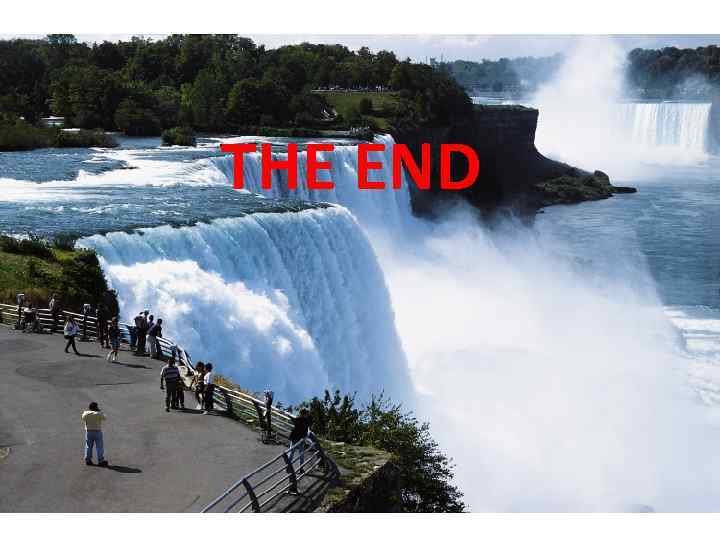
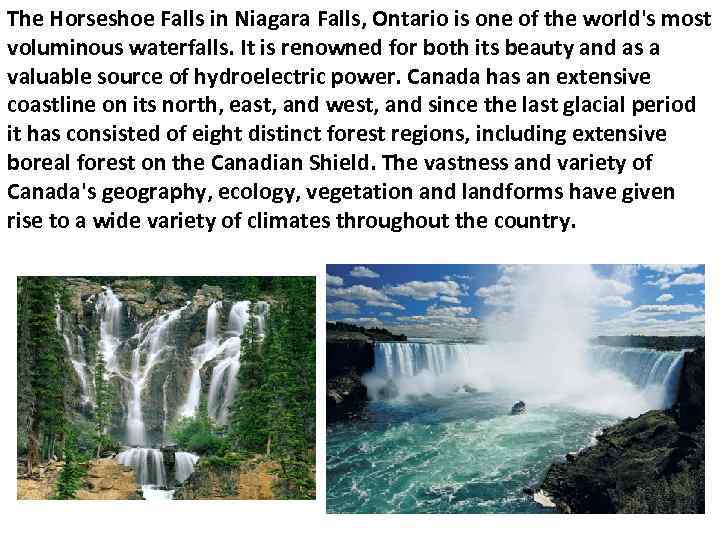 The Horseshoe Falls in Niagara Falls, Ontario is one of the world's most voluminous waterfalls. It is renowned for both its beauty and as a valuable source of hydroelectric power. Canada has an extensive coastline on its north, east, and west, and since the last glacial period it has consisted of eight distinct forest regions, including extensive boreal forest on the Canadian Shield. The vastness and variety of Canada's geography, ecology, vegetation and landforms have given rise to a wide variety of climates throughout the country.
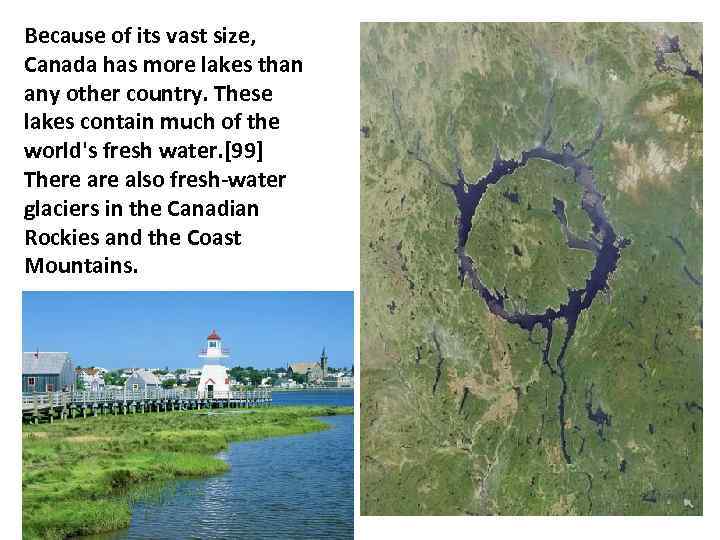 Because of its vast size, Canada has more lakes than any other country. These lakes contain much of the world's fresh water. [99] There also fresh-water glaciers in the Canadian Rockies and the Coast Mountains.
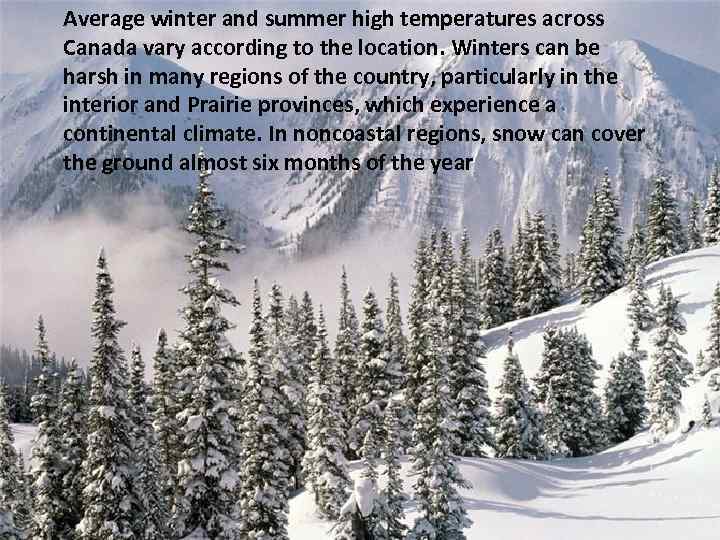 Average winter and summer high temperatures across Canada vary according to the location. Winters can be harsh in many regions of the country, particularly in the interior and Prairie provinces, which experience a continental climate. In noncoastal regions, snow can cover the ground almost six months of the year
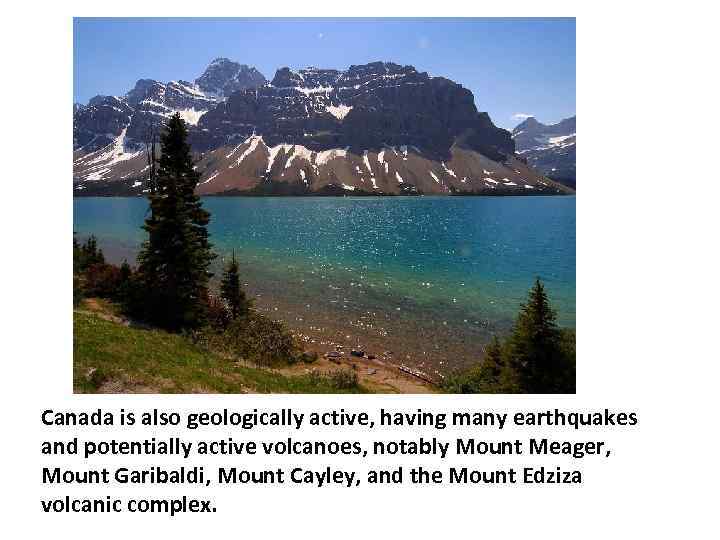 Canada is also geologically active, having many earthquakes and potentially active volcanoes, notably Mount Meager, Mount Garibaldi, Mount Cayley, and the Mount Edziza volcanic complex.
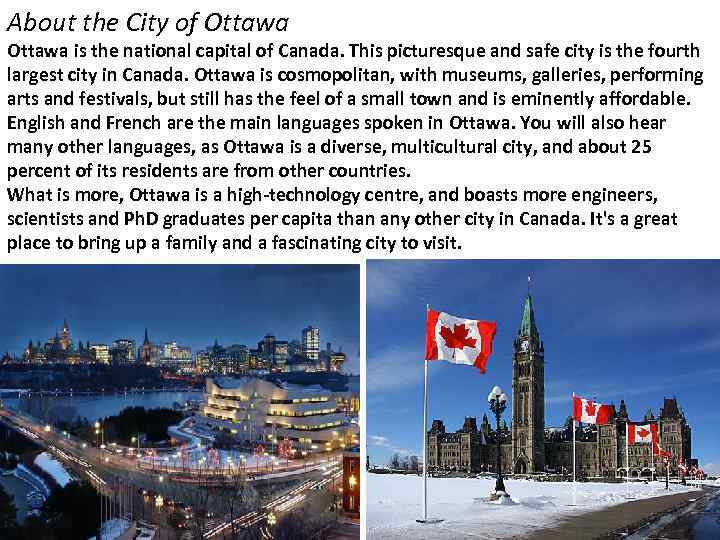 About the City of Ottawa is the national capital of Canada. This picturesque and safe city is the fourth largest city in Canada. Ottawa is cosmopolitan, with museums, galleries, performing arts and festivals, but still has the feel of a small town and is eminently affordable. English and French are the main languages spoken in Ottawa. You will also hear many other languages, as Ottawa is a diverse, multicultural city, and about 25 percent of its residents are from other countries. What is more, Ottawa is a high-technology centre, and boasts more engineers, scientists and Ph. D graduates per capita than any other city in Canada. It's a great place to bring up a family and a fascinating city to visit.
 THE END