 Скачать презентацию Geographical Indications Protecting territory brands for the benefit
879d2ac0a4a7e65d8118fbff32a99748.ppt
- Количество слайдов: 12



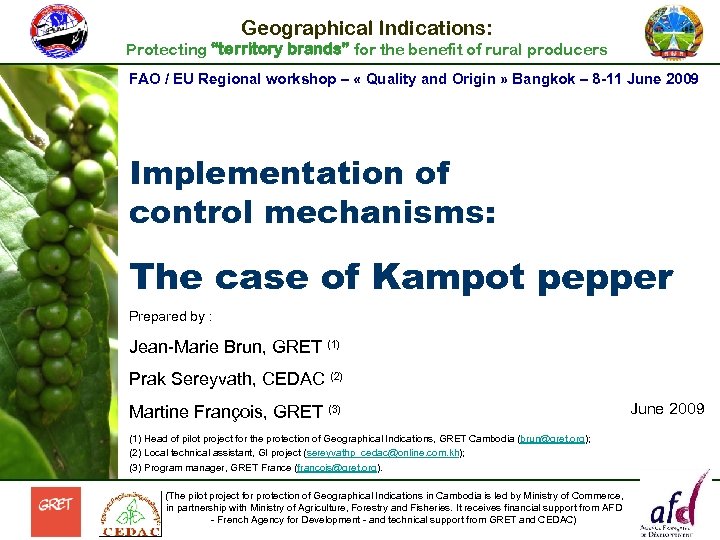
Geographical Indications: Protecting “territory brands” for the benefit of rural producers FAO / EU Regional workshop – « Quality and Origin » Bangkok – 8 -11 June 2009 Implementation of control mechanisms: The case of Kampot pepper Prepared by : Jean-Marie Brun, GRET (1) Prak Sereyvath, CEDAC (2) Martine François, GRET (3) June 2009 (1) Head of pilot project for the protection of Geographical Indications, GRET Cambodia (brun@gret. org); (2) Local technical assistant, GI project (sereyvathp_cedac@online. com. kh); (3) Program manager, GRET France (francois@gret. org). (The pilot project for protection of Geographical Indications in Cambodia is led by Ministry of Commerce, in partnership with Ministry of Agriculture, Forestry and Fisheries. It receives financial support from AFD - French Agency for Development - and technical support from GRET and CEDAC)
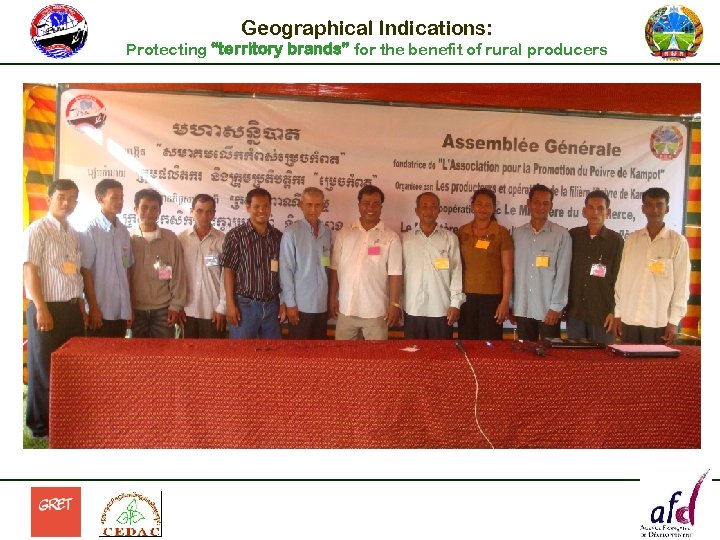
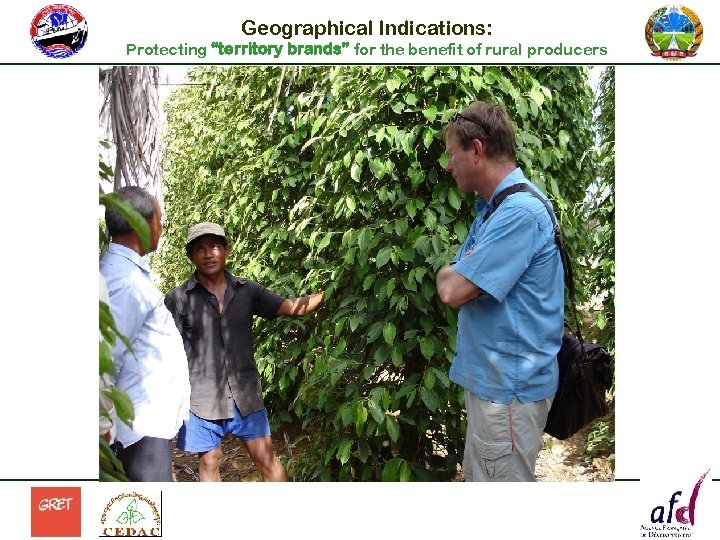
Geographical Indications: Protecting “territory brands” for the benefit of rural producers Background: Pilot GI on Kampot pepper have a long history and reputation. Its current revival and the growing interest for this pepper is a strong asset, but also lead to misuses of « Kampot pepper » name. Fake products are marketed in Cambodia and abroad. Since late 2007, producers in Kampot pepper have been mobilized and received information and support on the concept of GI. In 2008, a first book of specification was developed by producers and operators. An inter-professional association (KPPA) was created and registered, and control plans and tools have been drafted. 2009 season of production was a first « real-scale test » : producers and companies registered with KPPA and started to apply the Book of Specifications, to record their production and sales. KPPA has implemented the internal control for the first year, and process and results were reviewed in early June 2009. Application for GI registration shall be submitted in the next 2 months.
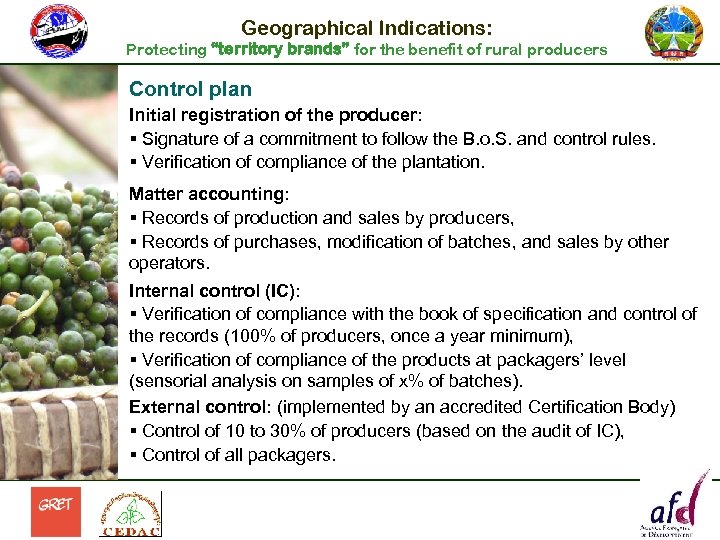
Geographical Indications: Protecting “territory brands” for the benefit of rural producers Control plan Initial registration of the producer: Signature of a commitment to follow the B. o. S. and control rules. Verification of compliance of the plantation. Matter accounting: Records of production and sales by producers, Records of purchases, modification of batches, and sales by other operators. Internal control (IC): Verification of compliance with the book of specification and control of the records (100% of producers, once a year minimum), Verification of compliance of the products at packagers’ level (sensorial analysis on samples of x% of batches). External control: (implemented by an accredited Certification Body) Control of 10 to 30% of producers (based on the audit of IC), Control of all packagers.
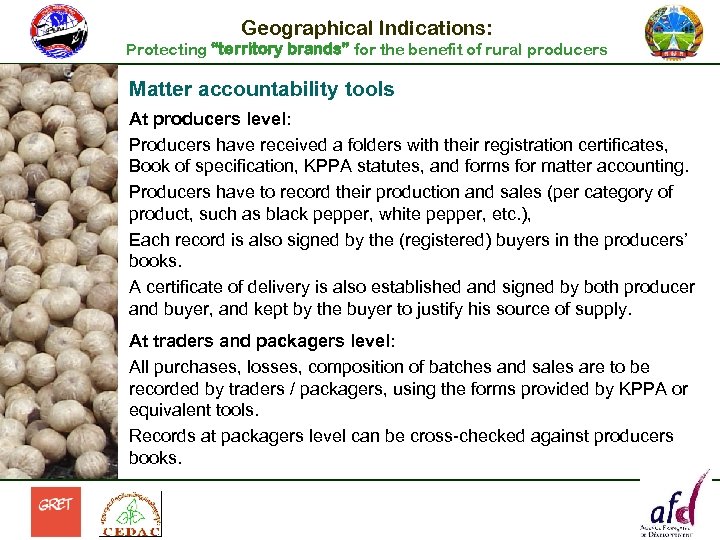
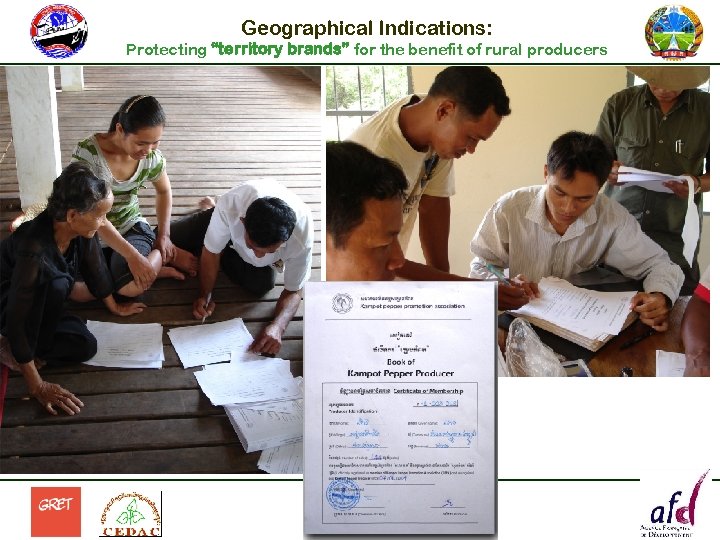
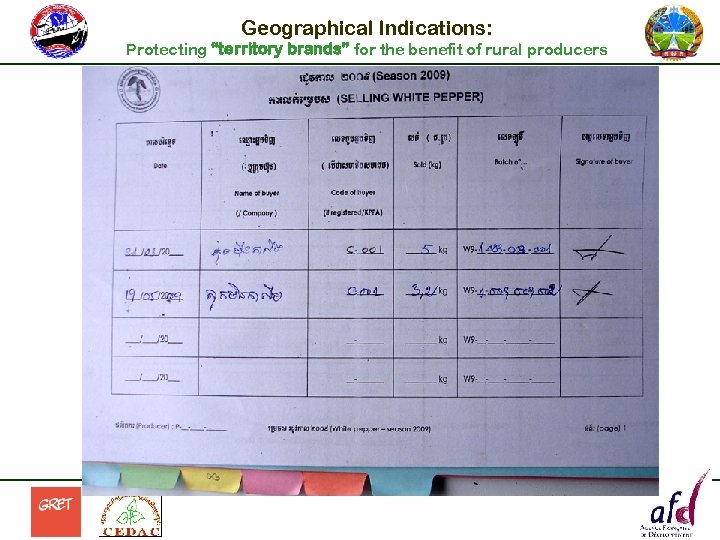
Geographical Indications: Protecting “territory brands” for the benefit of rural producers Matter accountability tools At producers level: Producers have received a folders with their registration certificates, Book of specification, KPPA statutes, and forms for matter accounting. Producers have to record their production and sales (per category of Date kg Batch n° product, such as black pepper, white pepper, etc. ), Signature Buyer’s Buyer Each record is also signed by the (registered) buyers in the producers’ code books. A certificate of delivery is also established and signed by both producer 25 1 03 027 003 C 001 Farmlink 01 03 09 and buyer, and kept by the buyer to justify his source of supply. At traders and packagers level: All purchases, losses, composition of batches and sales are to be recorded by traders / packagers, using the forms provided by KPPA or equivalent tools. Records at packagers level can be cross-checked against producers books.
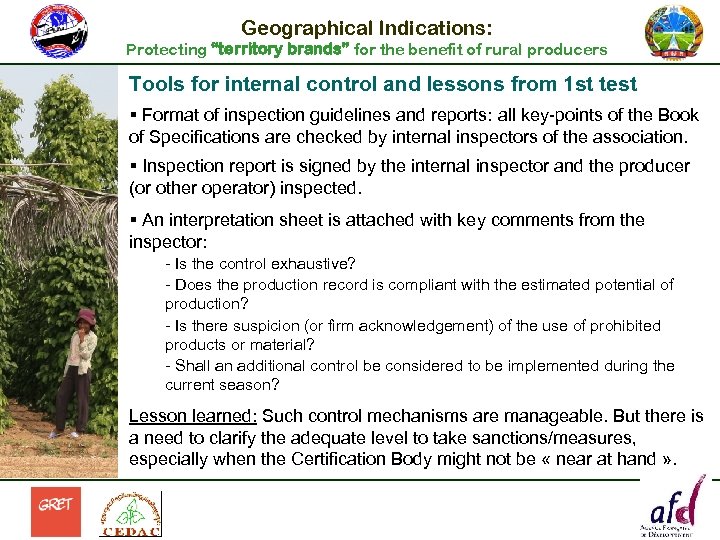
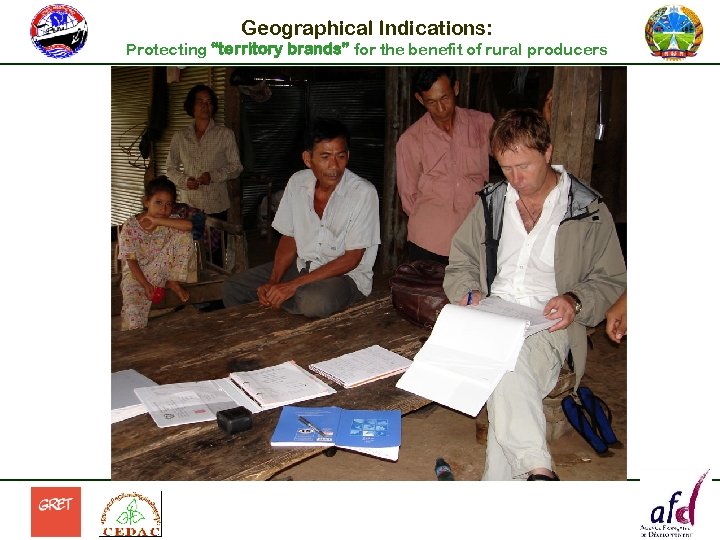
Geographical Indications: Protecting “territory brands” for the benefit of rural producers Tools for internal control and lessons from 1 st test Format of inspection guidelines and reports: all key-points of the Book of Specifications are checked by internal inspectors of the association. Inspection report is signed by the internal inspector and the producer (or other operator) inspected. An interpretation sheet is attached with key comments from the inspector: - Is the control exhaustive? - Does the production record is compliant with the estimated potential of production? - Is there suspicion (or firm acknowledgement) of the use of prohibited products or material? - Shall an additional control be considered to be implemented during the current season? Lesson learned: Such control mechanisms are manageable. But there is a need to clarify the adequate level to take sanctions/measures, especially when the Certification Body might not be « near at hand » .
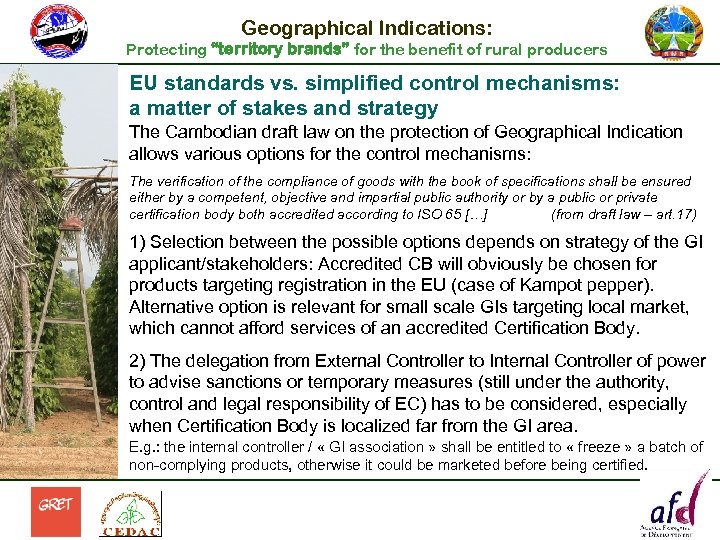
Geographical Indications: Protecting “territory brands” for the benefit of rural producers EU standards vs. simplified control mechanisms: a matter of stakes and strategy The Cambodian draft law on the protection of Geographical Indication allows various options for the control mechanisms: The verification of the compliance of goods with the book of specifications shall be ensured either by a competent, objective and impartial public authority or by a public or private certification body both accredited according to ISO 65 […] (from draft law – art. 17) 1) Selection between the possible options depends on strategy of the GI applicant/stakeholders: Accredited CB will obviously be chosen for products targeting registration in the EU (case of Kampot pepper). Alternative option is relevant for small scale GIs targeting local market, which cannot afford services of an accredited Certification Body. 2) The delegation from External Controller to Internal Controller of power to advise sanctions or temporary measures (still under the authority, control and legal responsibility of EC) has to be considered, especially when Certification Body is localized far from the GI area. E. g. : the internal controller / « GI association » shall be entitled to « freeze » a batch of non-complying products, otherwise it could be marketed before being certified.
Geographical Indications: Protecting “territory brands” for the benefit of rural producers
Geographical Indications: Protecting “territory brands” for the benefit of rural producers
Geographical Indications: Protecting “territory brands” for the benefit of rural producers
Geographical Indications: Protecting “territory brands” for the benefit of rural producers
Geographical Indications: Protecting “territory brands” for the benefit of rural producers
Geographical Indications: Protecting “territory brands” for the benefit of rural producers Thank you
Скачать презентацию Geographical Indications Protecting territory brands for the benefit
879d2ac0a4a7e65d8118fbff32a99748.ppt