


 Скачать презентацию GEO 201 Chapter 2 Many Worlds Geographies of
0610d0c499dce648351af89f4afd950e.ppt
- Количество слайдов: 47
 GEO 201 Chapter 2 Many Worlds: Geographies of Cultural Difference
 Cultures and Cultural Differences Cultures can change when they come into contact with another culture. Ex: Western culture, like U. S. culture, has helped to shape other cultures, and other cultures have helped to shape U. S. culture. Ex: The idea of globalization Is every new idea adopted or only some? Are those ideas adapted to fit in with the new culture?
 Some terms to know Social Customs are a part of culture. Geographers strive to understand the reasons for such differences and the relationship between social customs and the land. Custom is the frequent repetition of an act so that it becomes characteristic of a group. Culture is a shared set of meanings we use every day. Ex: values, beliefs, practices, language, family, religion or ideas about religion, gender They can be re-evaluated from time to time
 In examining culture, geographers look at both material and non-material culture. Material Culture: things you can touch or see; it includes all objects, things made and used by the group. Ex: tools, utensils, buildings, furniture, cars, clothing, musical instruments Non-Material Culture: things you say or hear; aural/oral. Ex: stories, folklore, legends, songs, beliefs, superstitions
 Your text divides culture into 3 types: popular, folk, and indigenous In general: Popular Culture consists of large, heterogeneous groups of people who change with the times; as norms change, so do they. Folk Culture is made up of people who retain traditional ways, simpler ways. Indigenous Culture is “native” or “of native origin”. They are of a distinct culture that was present before the dominant culture or people took over; tribes.
 Folk Culture is a group that is: Small Isolated Cohesive Conservative Nearly self-sufficient Homogeneous in custom and race Strong family or clan structure Highly developed rituals Order is maintained through sanctions based in religion or family
 Interpersonal relationships are strong Tradition is most important Change comes infrequently and slowly Little division of labor into specialized duties; people must perform a variety of jobs; duties at times may differ between sexes Most goods are handmade Subsistence economy is prevalent Individualism and social classes are not developed Ex: Amish and the Eskimo
 Characteristics of Popular Culture: Constantly changing Made up of large, heterogeneous groups of people Based mainly in urban areas Material goods are mass-produced by machines Money economy prevails Relationships are numerous and less personal than in folk culture Family structure is weaker People are mobile & less attached to a place
 Distinct division of labor into specialized jobs Great amount of leisure time for many Secular institutions of control like police, courts, & military that take the place of family and church for maintaining control or order By-word, most important word is change Other noticeable words are: growth, trend fad, & progress Globalization
 Indigenous Culture This is a rather new distinction. This used to be considered part of Folk Culture because many of the characteristics are the same. Indigenous means “ of native origin” People are often tribal. They have a distinct culture Their social, cultural, & economic conditions set them apart from the dominant society The people are descendants of those present when the state or territory was conquered
 Their histories are very different from both popular and folk cultures Indigenous people are those who were colonized and are now minorities in their own homelands. Folk and Indigenous Cultures can be seen as subcultures of the dominant culture.
 Themes: Region Material and non-material cultures can vary from place to place and can change over time -- quickly in popular culture and more slowly in folk and indigenous cultures Material Culture from Folk Cultures: in the U. S. we see remnants of at least 13 folk cultures. German Pennsylvania: Swiss-German type of barn with overhanging “forebay” and is separate from the house, p 34 , fig. 2. 3
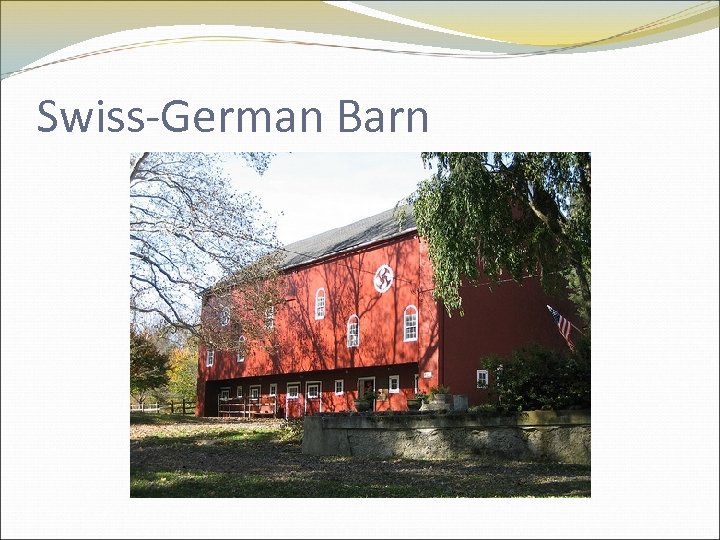 Swiss-German Barn
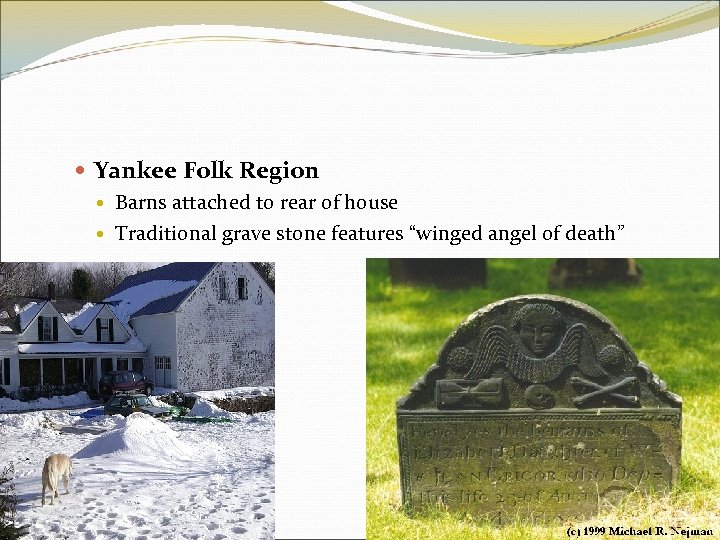 Yankee Folk Region Barns attached to rear of house Traditional grave stone features “winged angel of death”
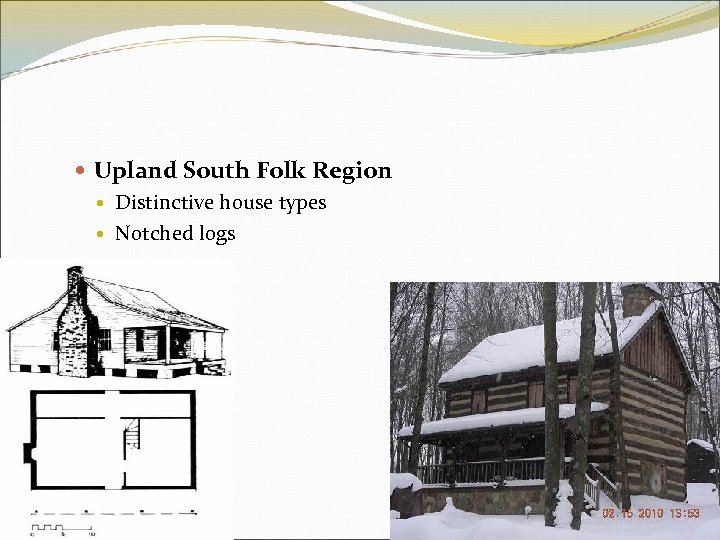 Upland South Folk Region Distinctive house types Notched logs
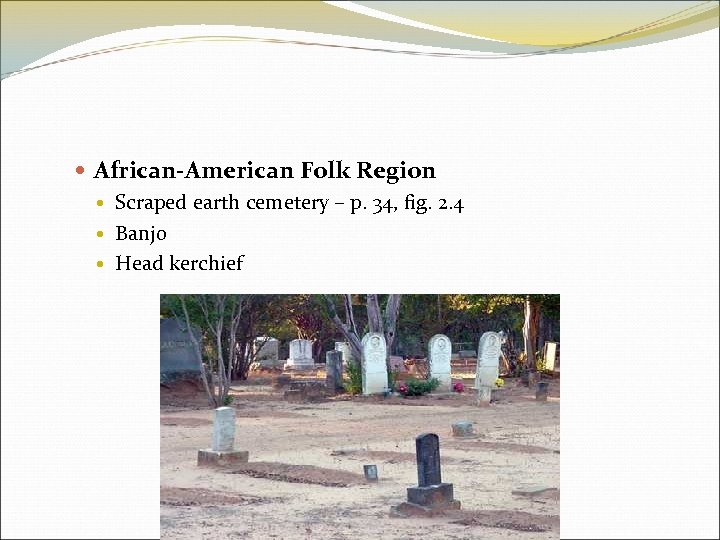 African-American Folk Region Scraped earth cemetery – p. 34, fig. 2. 4 Banjo Head kerchief
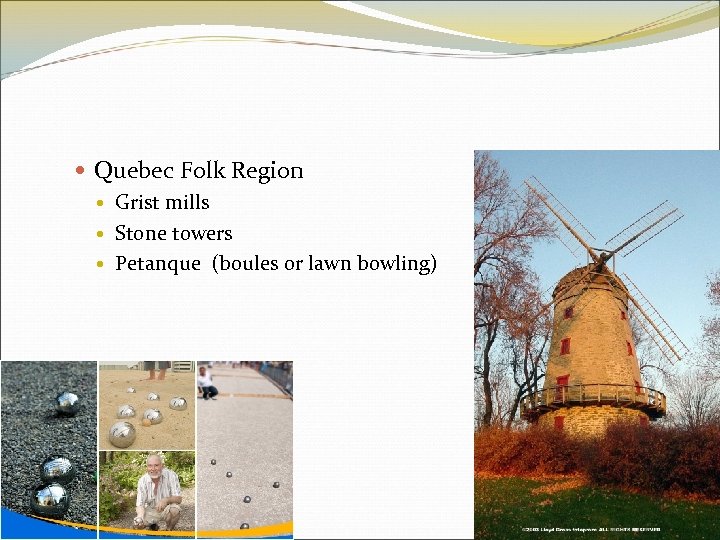 Quebec Folk Region Grist mills Stone towers Petanque (boules or lawn bowling)
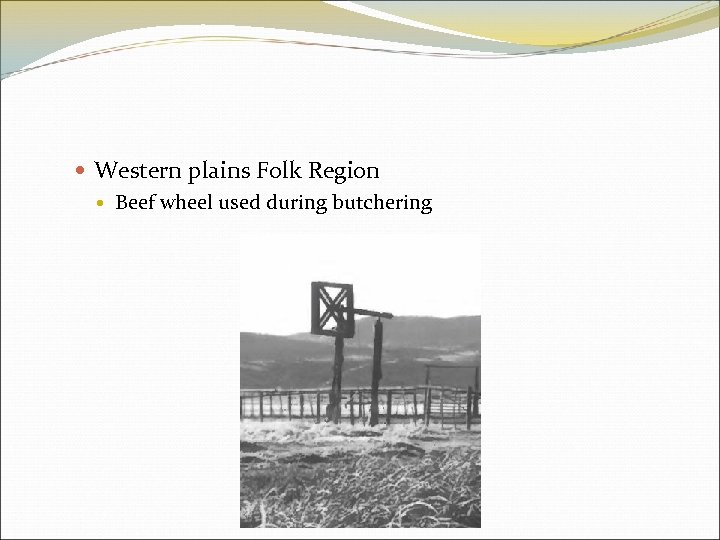 Western plains Folk Region Beef wheel used during butchering
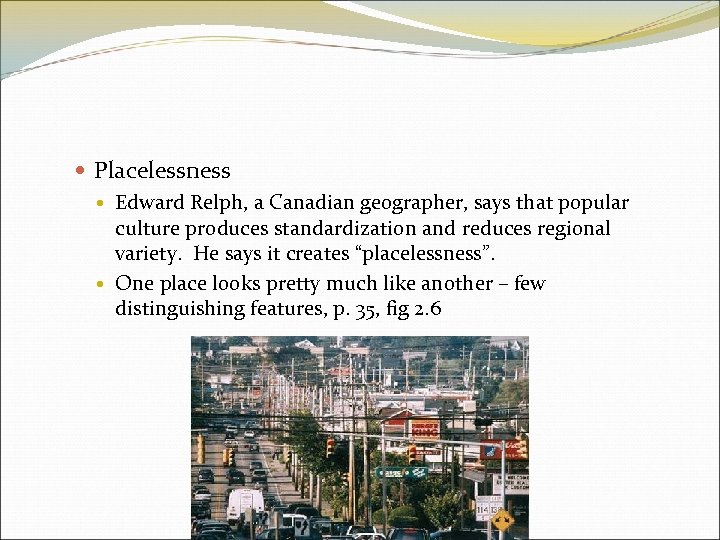 Placelessness Edward Relph, a Canadian geographer, says that popular culture produces standardization and reduces regional variety. He says it creates “placelessness”. One place looks pretty much like another – few distinguishing features, p. 35, fig 2. 6
 Geographers believe that people’s mobility weakens attachments to places and contributes to “placelessness” Geographer Michael Weiss says that zipcodes can indicate what one can expect to find there; Gray Power: retirement areas, upper middle class Old Yankee Rows: older ethnic neighborhoods in the northeast High school education Like bowling and hockey Live in row houses or duplexes
 Norma-Rae-ville Non-union factory workers Eat lots of canned stew Have trouble earning a living Subcultures in the U. S. have their own lifestyles, dress codes, spokespeople, and food preferences. Page 36, fig. 2. 8
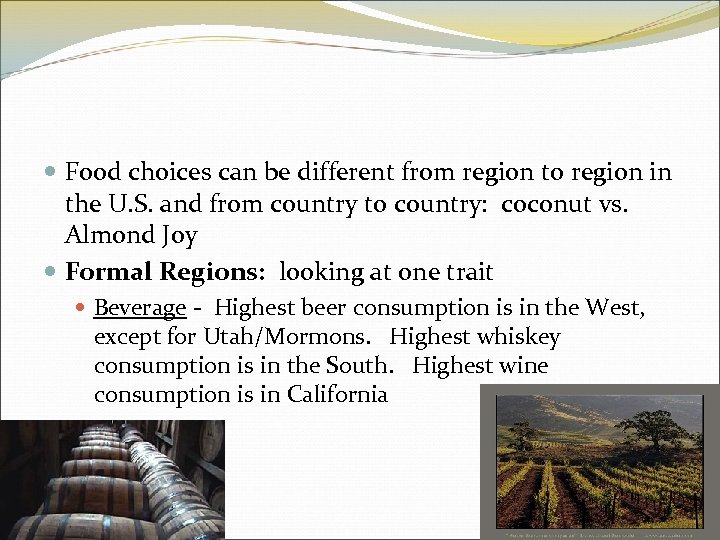 Food choices can be different from region to region in the U. S. and from country to country: coconut vs. Almond Joy Formal Regions: looking at one trait Beverage - Highest beer consumption is in the West, except for Utah/Mormons. Highest whiskey consumption is in the South. Highest wine consumption is in California
 Food - Southern choices are grits, barbecued beef/pork, fried chicken, chicken fried steak Fast Food Restaurants - more in the South and the N. E. has the fewest When fast food restaurants move to other countries, they adapt to the new culture if they want to sell their food. Example: In India, they use local sauces at Mc. Donald’s
 Indigenous Culture Regions Usually found in more isolated areas few roads or communication systems found in mountainous areas or in arid areas live away from the national culture They may also practice swidden or shifting cultivation. They may also follow animism or possibly Christianity.
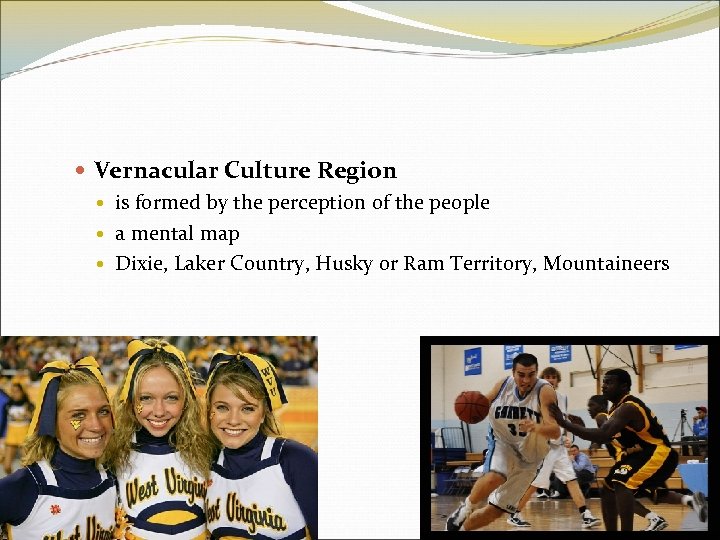 Vernacular Culture Region is formed by the perception of the people a mental map Dixie, Laker Country, Husky or Ram Territory, Mountaineers
 Mobility There is slow if any movement in folk and indigenous cultures. Popular culture is mobile: new means of transportation, fast communication using radio, T. V. , the internet, & the phone. Popular culture is stratified and information often moves hierarchically first. Ex: Mc. Donald’s: began in 1955 in the U. S. and spread first to major cities before diffusing contagiously. The exception is Wal-Mart: started in small towns and then spread to larger areas.
 Advertizing is essential for the quick diffusion of goods, ideas in popular culture. We are bombarded with it It gets us to buy things we don’t really want or need. Sometimes giving the origin of a product lures consumers to buy the product: New Zealand Wool, Irish or Belgian Lace, French Camembert, Greek Feta Sometimes the place of origin can hurt sales: South African Krugeraands during Apartheid (boycotts)
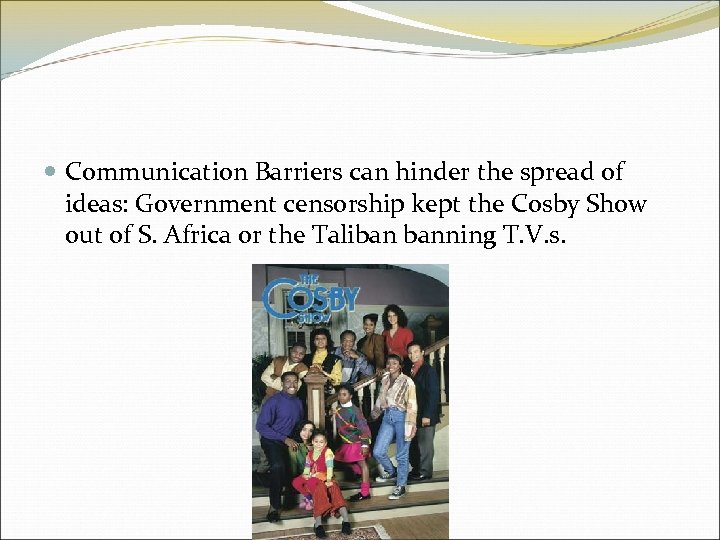 Communication Barriers can hinder the spread of ideas: Government censorship kept the Cosby Show out of S. Africa or the Taliban banning T. V. s.
 Globalization There has been some homogenizing of cultures: more leisure time, computers, T. V. , music, movies, mobility. This is called the convergence hypothesis. Cultures are converging, coming together. There were more pronounced differences from region to region 100 years ago than there are today. Globalization can and does lead to tension and struggle. This can be followed by resistance , slow transformation, and adaptation
 People respond in different ways They accept or reject certain ideas and practices of the global world, and they might adapt them to their cultures. By rejecting something, they have reasserted their national identity By adapting the product to their culture, they have reasserted their national identity
 Place Image We have perceptions about different areas whether we have lived there, worked there, visited there, or only heard about the place through the media Images might be inaccurate , misleading, or correct. Our decisions concerning tourism and migration can be influenced by these images.
 Nature-Culture 2 Questions: How is nature related to cultural differences? How do cultures interact with nature? People who work with the land have a different view of nature than those who don’t. Ex: Farmer vs. City Dweller There is a different view of nature by those in a folk culture and by those in popular culture.
 Those of Folk and Indigenous Cultures had/have intimate, useful knowledge of nature called ITK or intimate technical knowledge. Globalization is making this knowledge less useful. In globalization with its new technology and new crops, this knowledge is often ignored. Indigenous peoples play and have played a major role in conserving biodiversity. They took care of nature because they acknowledge its forces and use its bounty – Subsistence Economy
 Popular culture with its consumerism does not Are we learning to think about and take care of nature? Folk Ecology When Folk Cultures migrate, they usually look for a place that reminds them of where they are from. Ex: Swiss settled in Garrett County -- Glotfelty Family
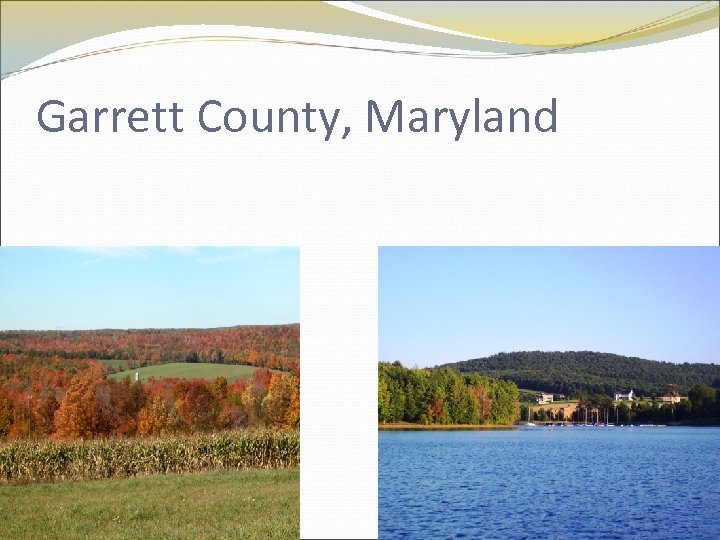 Garrett County, Maryland
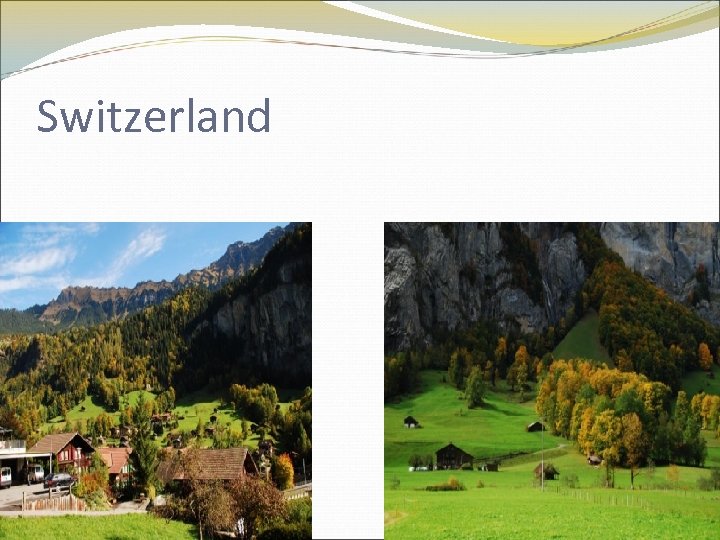 Switzerland
 Gendered Nature Ecofeminism – men and women have different jobs Men and women have different relationships with nature and the landscape Women are involved with seeding, weeding, and harvesting in folk and indigenous cultures (grow) Men clear and cultivate the land ( some see as destruction) Because men and women have different jobs, they have different knowledge Women in indigenous cultures are often the leaders and activists in movements concerning the environment.
 Popular Culture and Nature less directly tied to the physical environment don’t usually earn a living from the land no direct experiences with farming, mining, & logging Popular culture is tied to consumption, buying stuff without thinking about the physical impact their “stuff” has on the environment
 Popular culture does use the land for recreation: jet skis, snowmobiles, 4 -wheelers, cruises But do the people think about the damage they do to the land water?
 Cultural Landscape Do different cultures have distinctive cultural landscapes? Folk Culture pp. 52, 53 Traditional buildings that are functional and conservative Used the materials at hand No plans, just a mental image Chimney and kitchen placement are important Shape of roof important Location of doors and windows important
 Folk Houses in the U. S. & Canada Yankee Folk House – p. 53 Wooden frame construction Various floor plans and sizes 2 ½ storey house with chimney in the middle, & 2 rooms deep One change to it was the upright and wing house; it was big because it was also a workplace in winter Top row p. 53
 Upland South – row 2 p. 53 Built for hot climates Smaller Notched logs 2 log rooms under one roof with breezeway for air circulation Chimney on outside of house Called a dogtrot house There is also the saddlebag house
 African Folk Dwelling – p. 54 d. Shotgun house One room in width 2 -4 rooms in depth All doors line up, so if you shot a gun through the front door, it could go right out the back door.
 Quebec Folk House – p. 53 Has a cellar with main storey on top of it Attic rooms under a curved roof Porch Summer kitchen stone
 Ontario Farm House – p. 53 1 ½ storeys Brick Gabled front dormer African House – p. 55 -polygonal -main house -sometimes has separate kitchen -thatched or aluminum roof -uses local materials
 Popular Culture Landscapes Leisure landscapes: shopping centers, malls, indoor ice rinks, roller coasters, golf courses, Disney World Amenity landscapes: area with attractive, natural features: lakes, forests, mountains; places for vacation or retirement P. 56 Elitist landscapes: for those with money, education, and expensive tastes: French Riviera, Gentleman Farm P. 59
 Popular Landscape in U. S. Cult of bigness in U. S. Casual chaos Gobbledegook P. 59