


 Скачать презентацию Genomic translations of Fenugreek Trigonella foenumgraecum to derive
d78649cc080393cd65df53fdb72cb71f.ppt
- Количество слайдов: 29
 Genomic translations of Fenugreek (Trigonella foenumgraecum) to derive its proteomic insights Geetika Jethra, Priya Gupta, Jyoti Mihra, Alka Pawar and Sharda Choudhary Presented By: Geetika Jethra Young Profession II National Research Centre on Seed Spices Tabiji, Ajmer
 Seed Spices Indian spices include a variety of spices grown across the Indian subcontinent and mostly categorised under Apicaeae family. Spices are used for flavour, colour, aroma and preservation of food or beverages in almost all of the Indian Cuisines. But the database available on Apicaeae and Fabaceae family is sparsely populated with sequences.
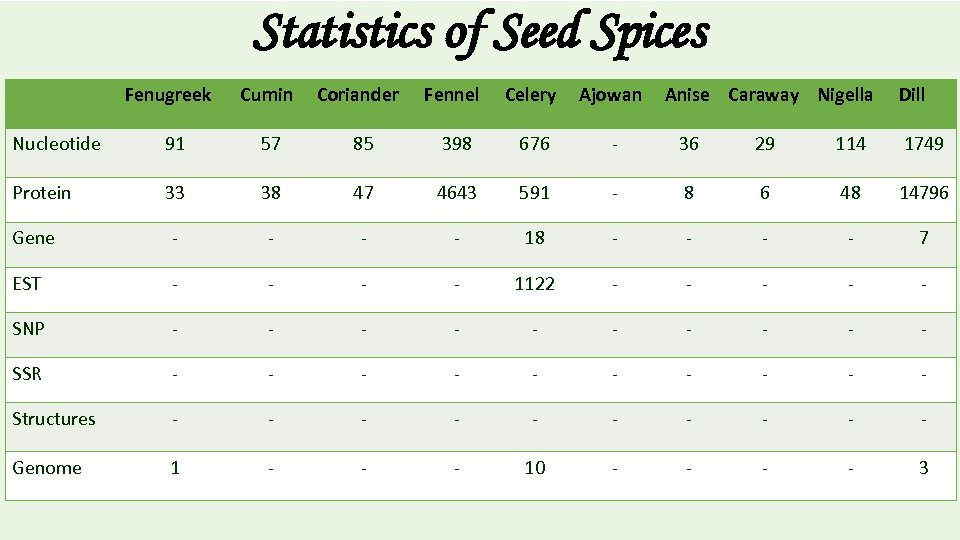 Statistics of Seed Spices Fenugreek Cumin Coriander Fennel Celery Ajowan Anise Caraway Nigella Dill Nucleotide 91 57 85 398 676 - 36 29 114 1749 Protein 33 38 47 4643 591 - 8 6 48 14796 Gene - - 18 - - 7 EST - - 1122 - - - SNP - - - - - SSR - - - - - Structures - - - - - Genome 1 - - - 10 - - 3
 Fenugreek (Trigonella foenum-graecum) Fenugreek is commonly known as methi in Hindi It is an important leguminous spices and well known aromatic and medicinal herb. Fenugreek is used as both seed and leaf. Fenugreek seed contains carbohydrate (48%), protein (25. 5%), mucilaginous matter (20%), fat (7. 9%), and saponin (4. 8%). Inspite of large potential and high content of protein in fenugreek seeds, however, no reports on molecular structure predictions is available on Trigonella spp. native to this region.
 An Introduction to Bioinformatics is the application of computer technology for the management of biological information. Computers are used to gather, store, analyse and integrate biological and genetic information which can then be applied to gene-based sequence determination and structure prediction. In the present study, Fenugreek (Trigonella foenum-graecum)protein models were designed and generated using in-silico tools.
 NCBI National Centre for Biotechnology Information (http: //www. ncbi. nlm. nih. gov/) The raw data was collected from NCBI a public domain for the structural analysis. It is a comprehensive website for biologists including: biology-related databases, tools for viewing and analyzing automated systems for storing and retrieval
 NCBI - Home Page (http: //www. ncbi. nlm. nih. gov/)
 Calculation of Physicochemical properties Prot. Param : A tool which allows the computation of various physical and chemical parameters for a given protein. (http: //www. expasy. org/tools/Protparam) ØMolecular weight ØTheoretical PI ØAmino acid composition ØAtomic composition ØInstability index ØAliphatic index and ØGrand average of hydropathicity (GRAVY)
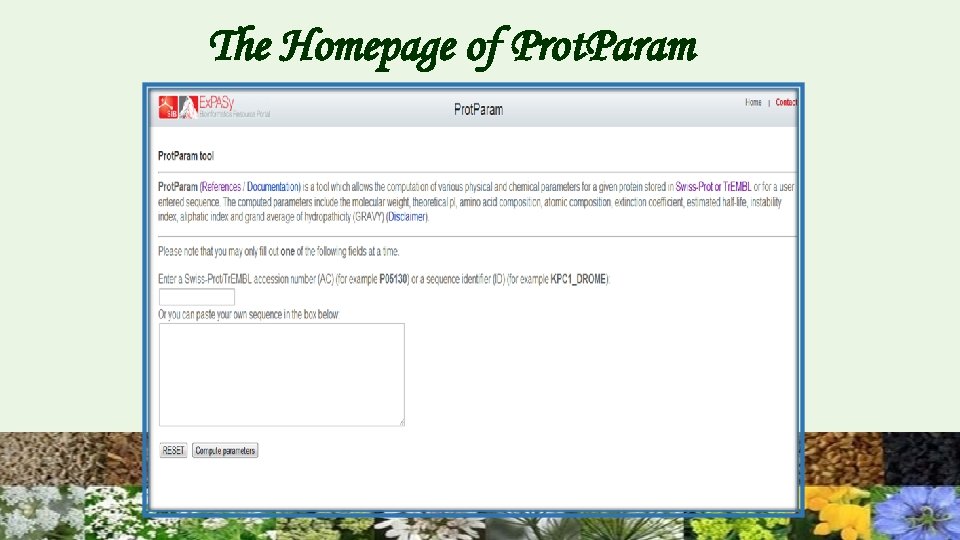 The Homepage of Prot. Param
 Secondary Structure Prediction GORIV PSIPRED
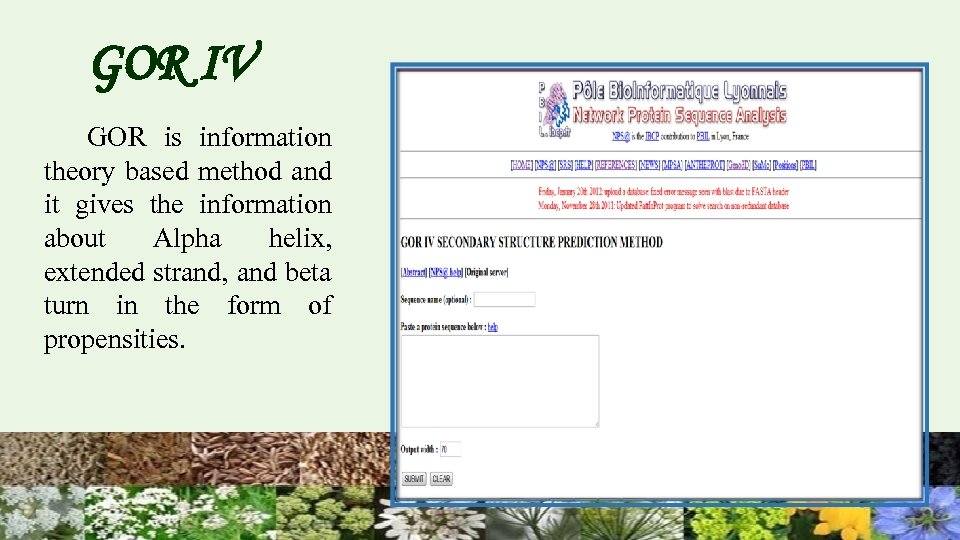 GOR IV GOR is information theory based method and it gives the information about Alpha helix, extended strand, and beta turn in the form of propensities.
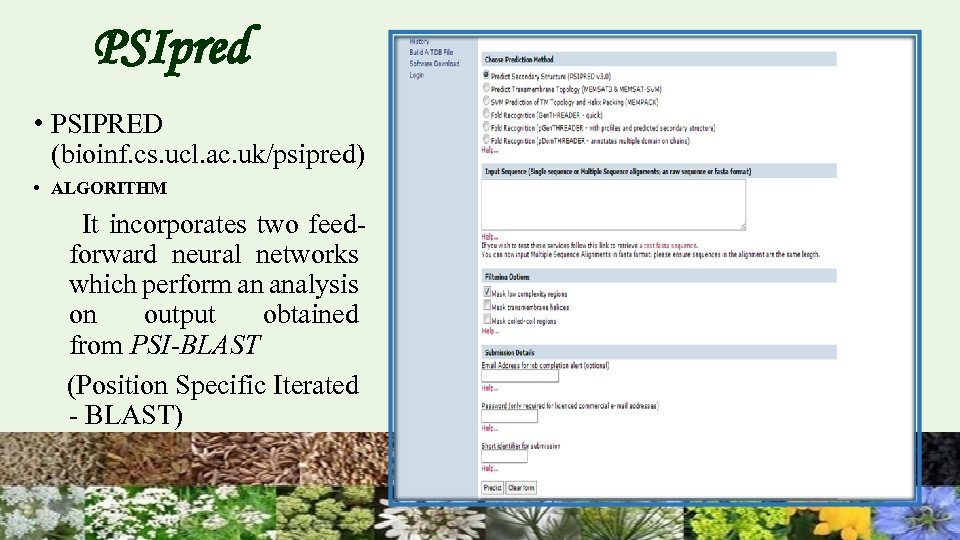 PSIpred • PSIPRED (bioinf. cs. ucl. ac. uk/psipred) • ALGORITHM It incorporates two feedforward neural networks which perform an analysis on output obtained from PSI-BLAST (Position Specific Iterated - BLAST)
 Tertiary structure Prediction Swiss model Phyre 2 I-TASSER.
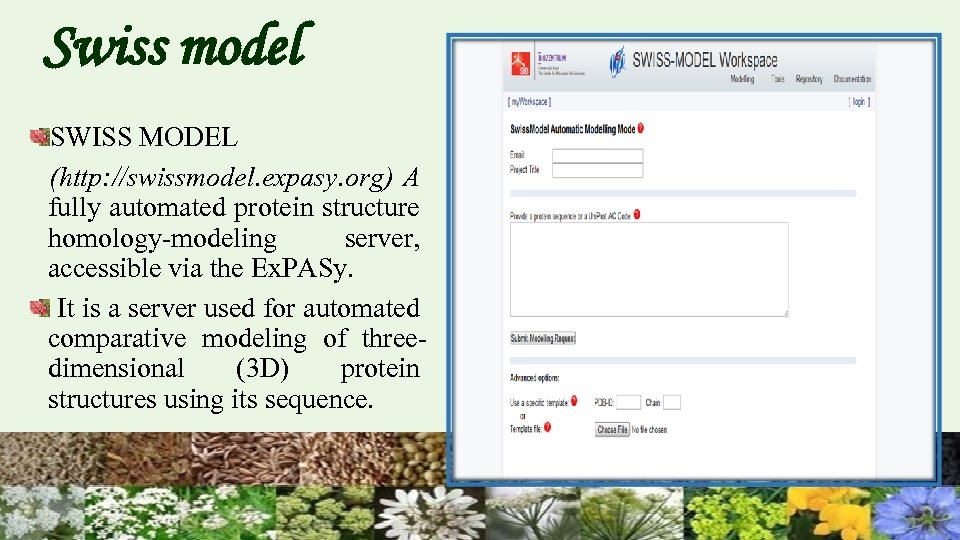 Swiss model SWISS MODEL (http: //swissmodel. expasy. org) A fully automated protein structure homology-modeling server, accessible via the Ex. PASy. It is a server used for automated comparative modeling of threedimensional (3 D) protein structures using its sequence.
 PHYRE 2 Protein Homology/Analog. Y Recognition Engine (http: //www. sbg. bio. ic. ac. uk/Phyre 2/html/page. cgi? id=index) Web-based services for protein structure prediction. Generates reliable protein models when other widely used methods such as PSI-BLAST cannot.
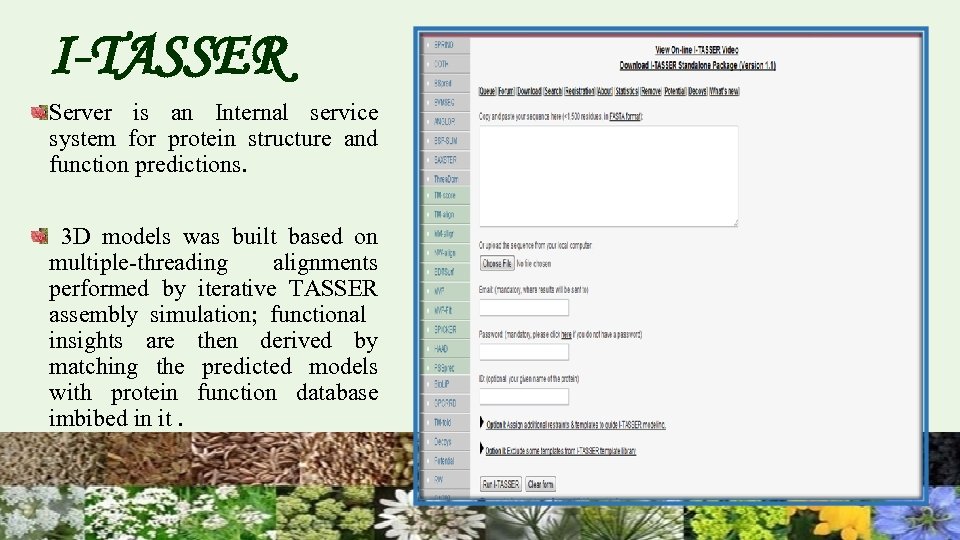 I-TASSER Server is an Internal service system for protein structure and function predictions. 3 D models was built based on multiple-threading alignments performed by iterative TASSER assembly simulation; functional insights are then derived by matching the predicted models with protein function database imbibed in it.
 Result and Discussion
 Physicochemical-properties Prot. Param computes various physicochemical properties from the protein sequence. The parameters computed by the Server include the molecular weight, theoretical p. I, amino acid composition, atomic composition, extinction coefficient, estimated half life, instability index, aliphatic index, and grand average of hydropathicity (GRAVY).
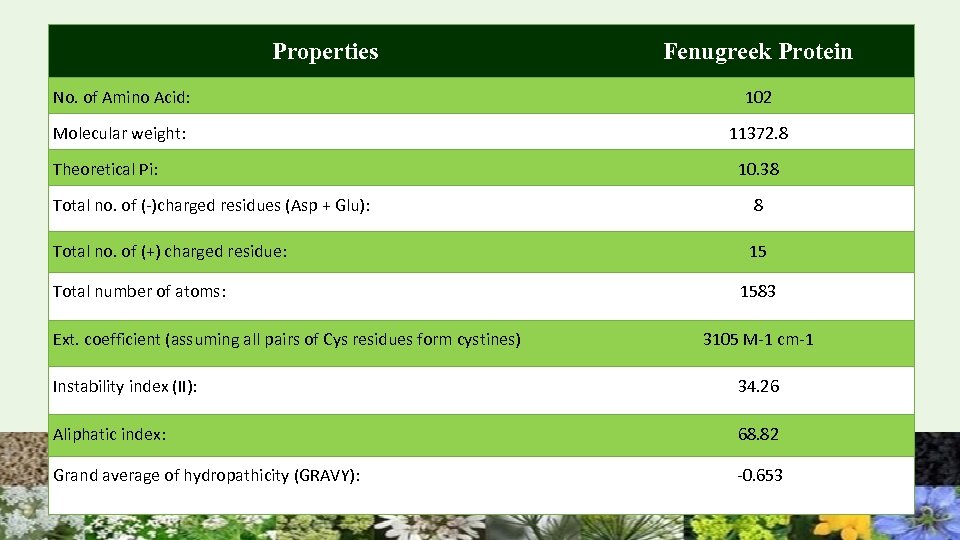 Properties Fenugreek Protein No. of Amino Acid: 102 Molecular weight: 11372. 8 Theoretical Pi: 10. 38 Total no. of (-)charged residues (Asp + Glu): 8 Total no. of (+) charged residue: 15 Total number of atoms: Ext. coefficient (assuming all pairs of Cys residues form cystines) 1583 3105 M-1 cm-1 Instability index (II): 34. 26 Aliphatic index: 68. 82 Grand average of hydropathicity (GRAVY): -0. 653
 Secondary structure GOR IV PSIPRED Secondary structure of protein was predicted by the formation of alpha helix and ß-sheets. The results revealed that random coil (69. 61%) dominated among secondary structure elements and alpha helices (4. 90%) and extended strand (25. 49%) were also present
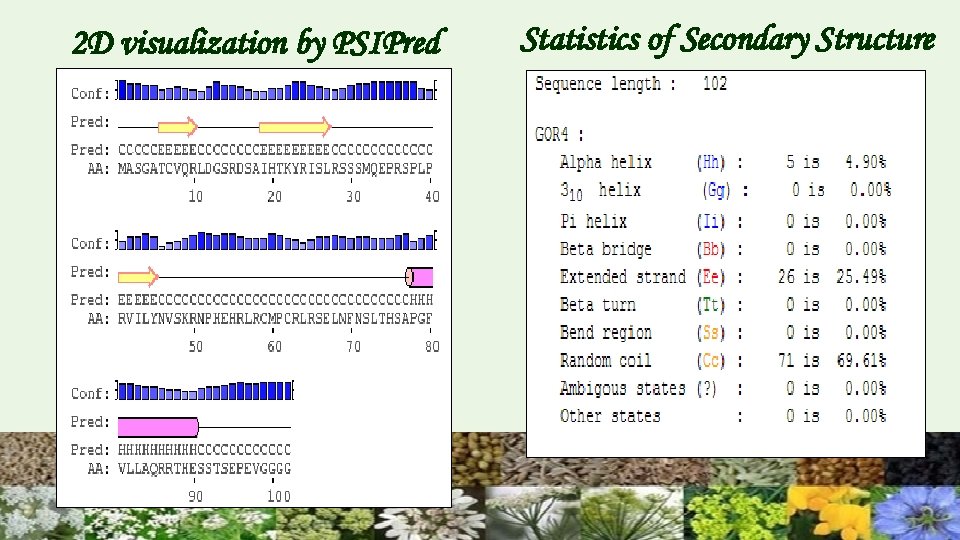 2 D visualization by PSIPred Statistics of Secondary Structure
 Tertiary Structure Prediction Swiss model is homology based method Automated mode was used to get tertiary structure. But on the basis of structure validation the structure was found to be inappropriate. Next Phyre 2, I-TASSER were used for 3 D structure generation. These are threading based software. Verification : Through the Structural Analysis and Verification Server (SAVS) the structure by Phyre 2 was found to be better as compared to others.
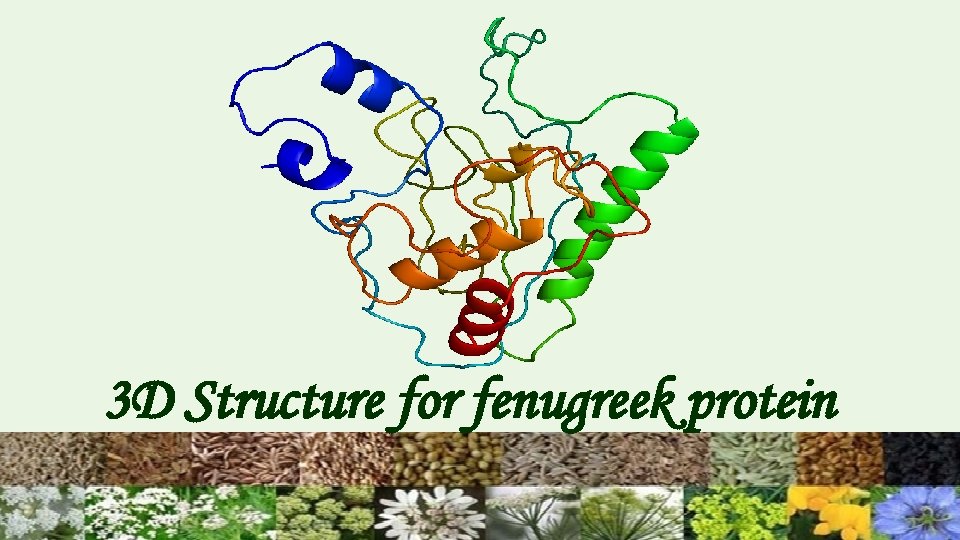 3 D Structure for fenugreek protein
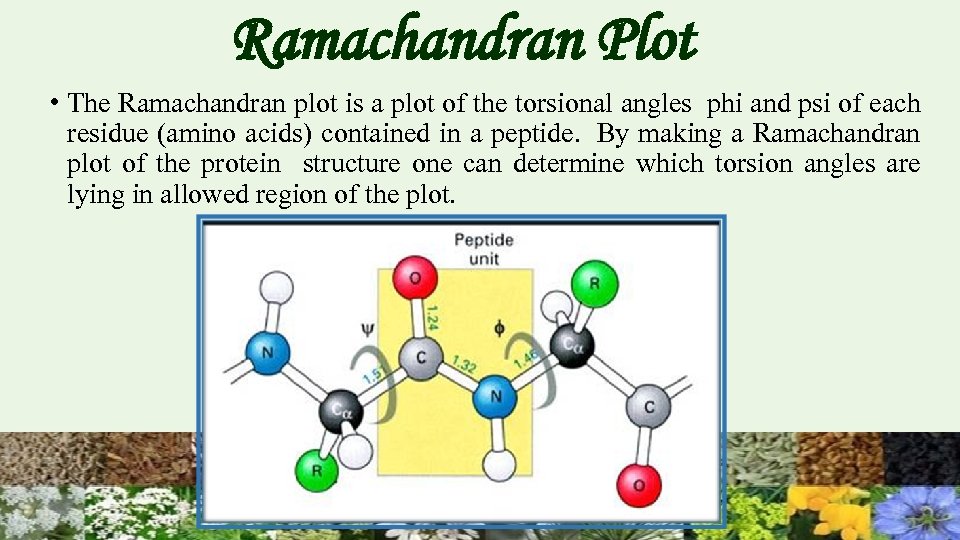 Ramachandran Plot • The Ramachandran plot is a plot of the torsional angles phi and psi of each residue (amino acids) contained in a peptide. By making a Ramachandran plot of the protein structure one can determine which torsion angles are lying in allowed region of the plot.
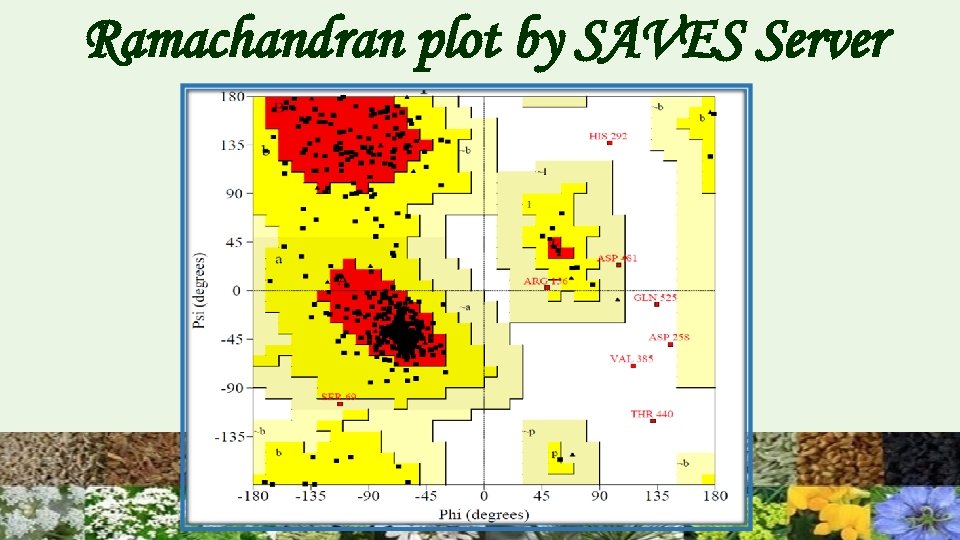 Ramachandran plot by SAVES Server
 Conclusion The predicted protein is stable, globular and basic in nature having pore lining, depicting it as transmembrane protein The identified protein of fenugreek showed homology with the protein domain of humans and E-coli illustrating that the database available on Apicaeae and Fabaceae family are sparsely populated with sequences. FFPred predicted its functions in 2 categories: 1) Biological Process: phosphate-containing compound metabolic process with a probability of 95. 9% and 2) Molecular function: ATP binding with 98. 1% probability.
 References Bukhari, S. B. , Bhanger, M. I. and Memon S. , (2008). Antioxidative Activity of Extracts from Fenugreek Seeds (Trigonella foenum-graecum) Pak. J. Anal. Environ. Chem. 9: 78 -83. Gill S. C. and Von Hippel P. H. , (1989). Extinction coefficient. Anal. Biochem. 182: 319 - 328. Guermeur Y. , Geourjon C. , Gallinari P. And Deleage G. (1999). Improved performance in protein secondary structure prediction by inhomogeneous score combination. Bioinformatics, 15: 413– 21. Guruprasad K. , Reddy B. V. P and Pandit M. W. , (1990). Correlation between stability of a protein and its dipeptide composition: a novel approach for predicting in vivo stability of a protein from its primary sequence. Prot. Eng. 4: 155 -164.
 Harish, Gupta, A. K. , Ram, K. , Singh, B. , Phulwaria M. and Shekhawat N. S. , (2011). Molecular and Biochemical Characterization of Different Accessions of Fenugreek (Trigonella foenum-graecum L. ) Libyan Agri. Research Center J. International 2: 150154. Helambe S. S. and Dande R. P. , (2012). Fenugreek (Trigonella foenum-graecum L. ): An Overview, IJCPR. 2: 169 -187 Ikai A. J. , (1980). Thermo stability and aliphatic index of globular proteins. J. Biochem. 88: 1895 -1898. Jethra G. , Mishra A. K. , Pandey P. S. and Chandrasekharan H. , (2012) Structure and Function prediction of unknown wheat protein using LOMENTS and I-TASSER. Indian Journal of Agricultural Sciences 82: 867– 74. Zhang Y. , (2008). Progress and challenges in protein structure prediction. Current Opinion in Structural Biology, 18: 342 -348.
 GROW MORE FOOD BECAUSE IT IS THE VERY ESSENCE OF OUR LIFE