


 Скачать презентацию Genomic ORFans Past Present and Future Naomi Siew
f0933fa697f3f1e2303e6040b665158f.ppt
- Количество слайдов: 26
 Genomic ORFans: Past, Present and Future Naomi Siew and Daniel Fischer Ben-Gurion University Be’er-Sheva, Israel
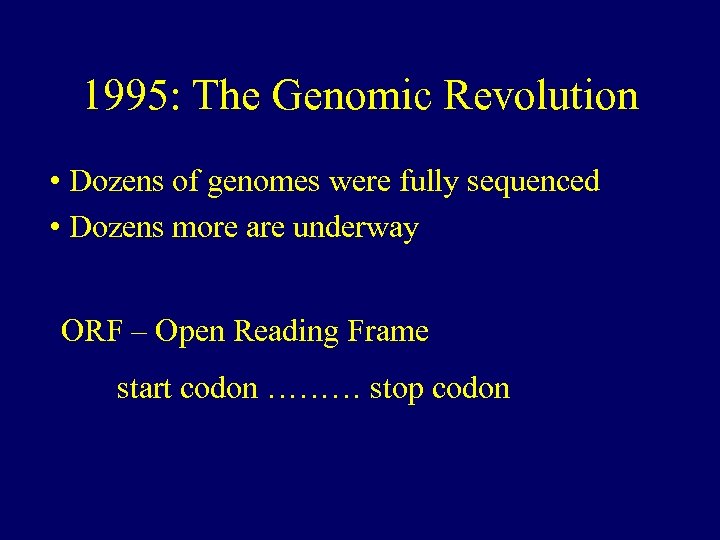 1995: The Genomic Revolution • Dozens of genomes were fully sequenced • Dozens more are underway ORF – Open Reading Frame start codon ……… stop codon
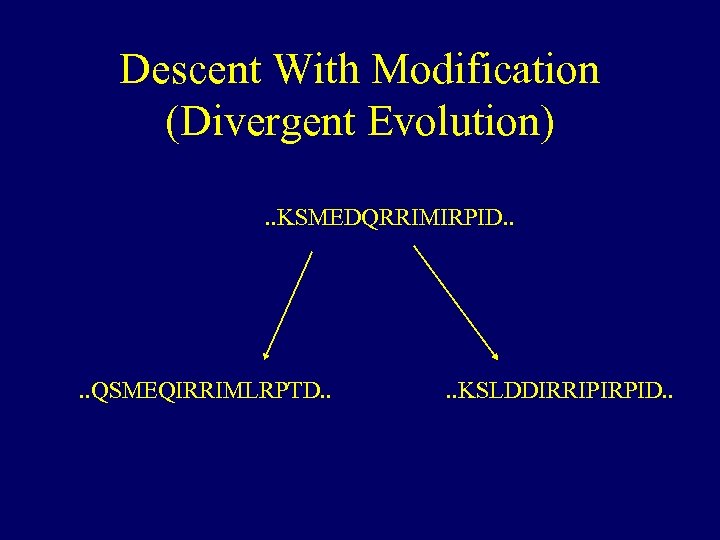 Descent With Modification (Divergent Evolution). . KSMEDQRRIMIRPID. . QSMEQIRRIMLRPTD. . KSLDDIRRIPIRPID. .
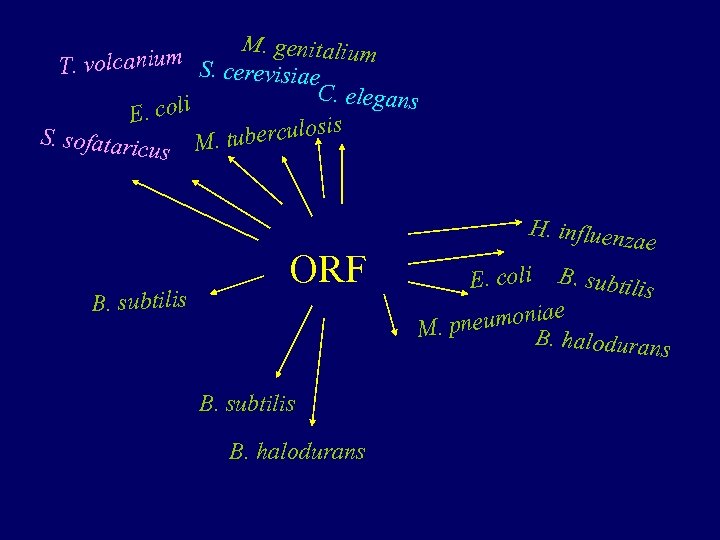 M. genitalium T. volcanium S. cerevisiae C. elegans oli E. c erculosis b S. sofatari cus M. tu B. subtilis ORF B. subtilis B. halodurans H. influenz ae E. coli B. subtilis e neumonia M. p B. halodurans
 Orphan ORFs = ORFans (Fischer and Eisenberg, Bioinformatics, 15(9), 1999) Singleton ORFan : An ORF that has no sequence similarity to any other sequence in the databases. Little can be inferred about ORFans using bioinformatic tools.
 20 -30% of ORFs in each new genome are singleton ORFans.
 ORFans May Be… • New, previously unseen proteins, (with new function, new structure) unique to one organism (species-specific). • Distant relatives of known families (similar function, similar 3 D structure) whose sequence diverged beyond recognition by sequence comparison tools.
 The Puzzle of ORFans • If new ORFs, where did they come from? How did they evolve? • If distant relatives, why aren’t there similar sequences? Where are the intermediates?
 Census and Dynamics of ORFans • Built a database of fully sequenced genomes. • Added genomes one by one in chronological order of publication. • For each ORF, ran BLAST: if there is a match non-ORFan if there is no match ORFan Previous ORFans can become non-ORFans.
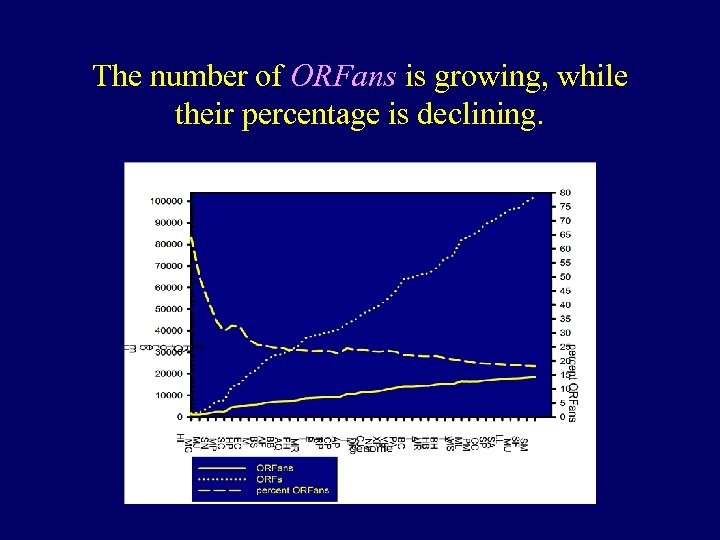 The number of ORFans is growing, while their percentage is declining.
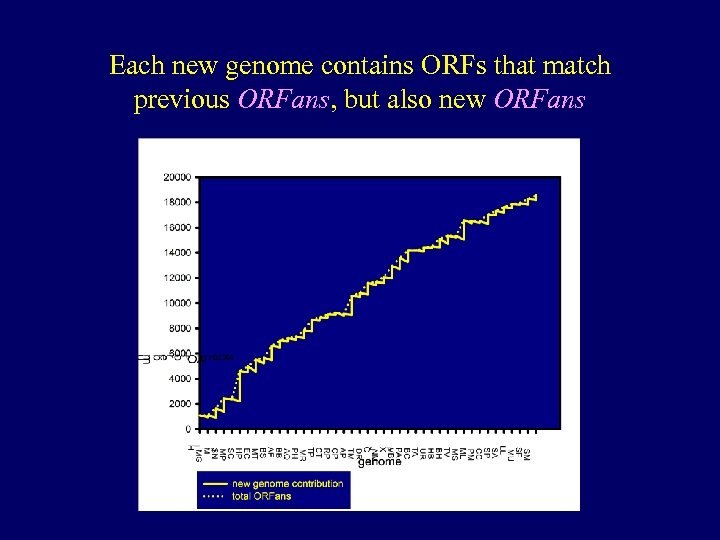 Each new genome contains ORFs that match previous ORFans, but also new ORFans
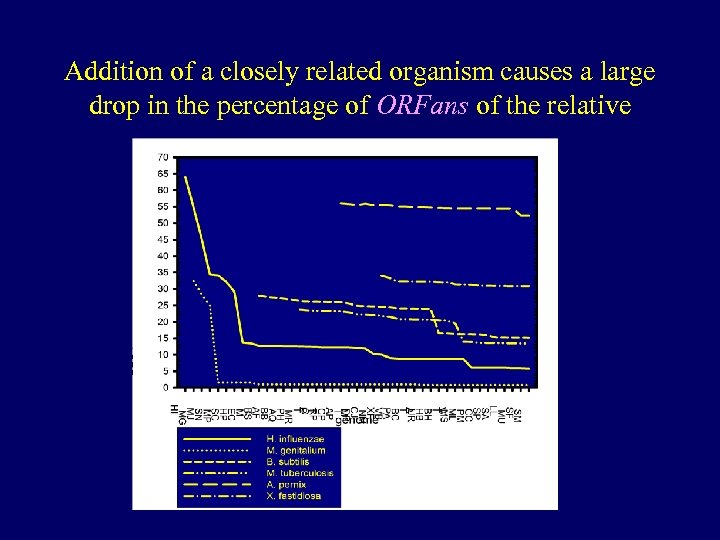 Addition of a closely related organism causes a large drop in the percentage of ORFans of the relative
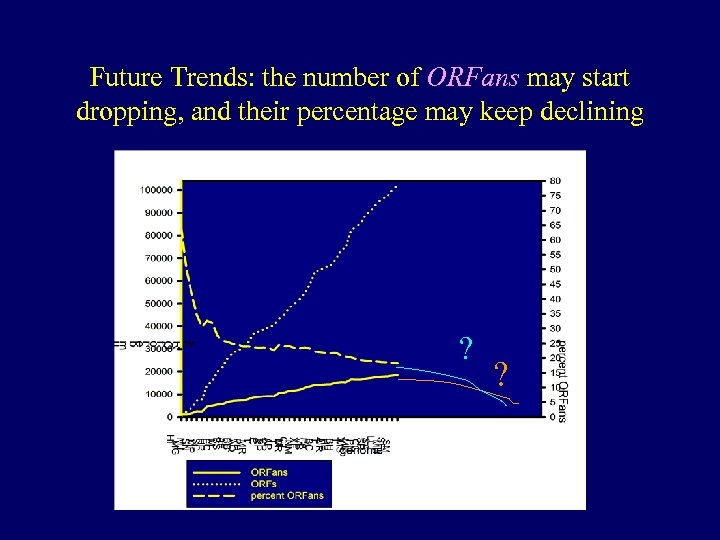 Future Trends: the number of ORFans may start dropping, and their percentage may keep declining ? ?
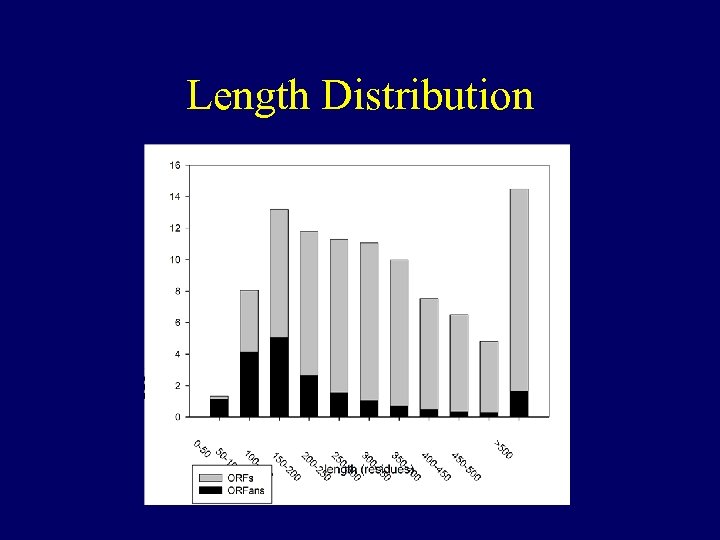 Length Distribution
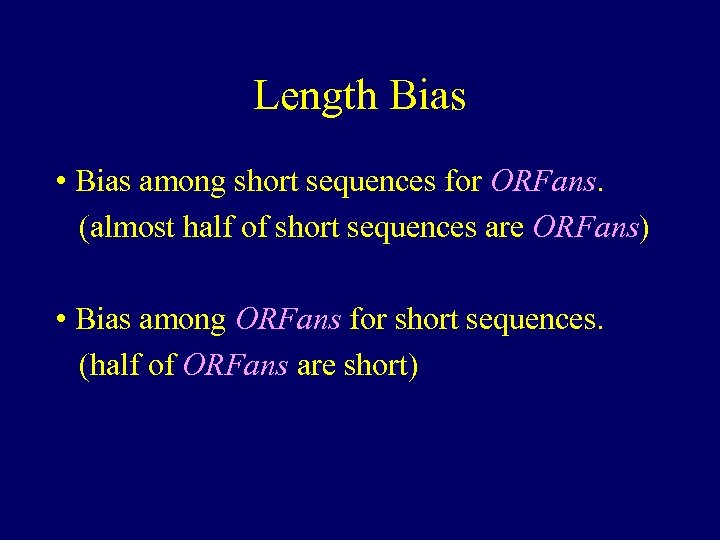 Length Bias • Bias among short sequences for ORFans. (almost half of short sequences are ORFans) • Bias among ORFans for short sequences. (half of ORFans are short)
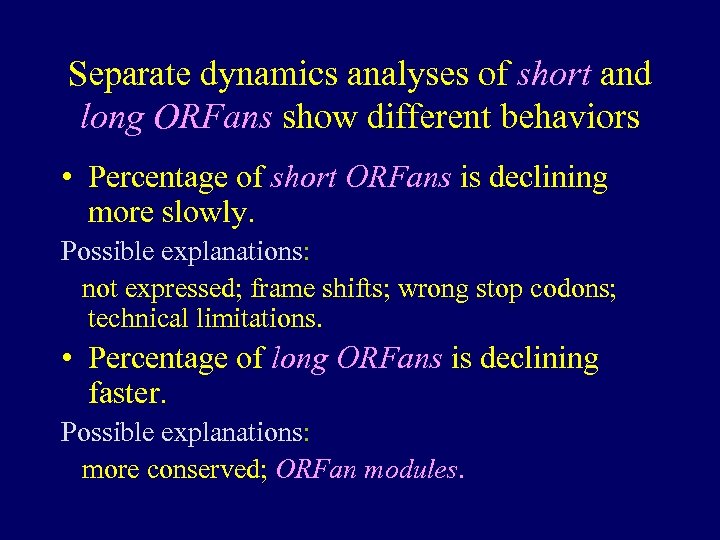 Separate dynamics analyses of short and long ORFans show different behaviors • Percentage of short ORFans is declining more slowly. Possible explanations: not expressed; frame shifts; wrong stop codons; technical limitations. • Percentage of long ORFans is declining faster. Possible explanations: more conserved; ORFan modules.
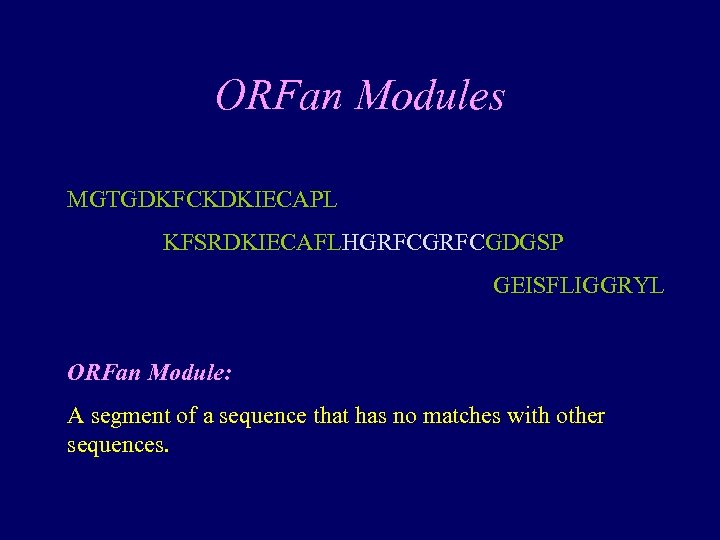 ORFan Modules MGTGDKFCKDKIECAPL KFSRDKIECAFLHGRFCGDGSP GEISFLIGGRYL ORFan Module: A segment of a sequence that has no matches with other sequences.
 Interim Conclusions • Evolution has left us with two types of sequences: homologs and ORFans. • The number of singleton ORFans has been growing. • Their percentage is diminishing.
 Interim Conclusions II • There is a bias towards short sequences among singleton ORFans, and vice versa. • Most longer singleton ORFans may disappear with time. • New genomes of closely related organisms will have fewer singleton ORFans.
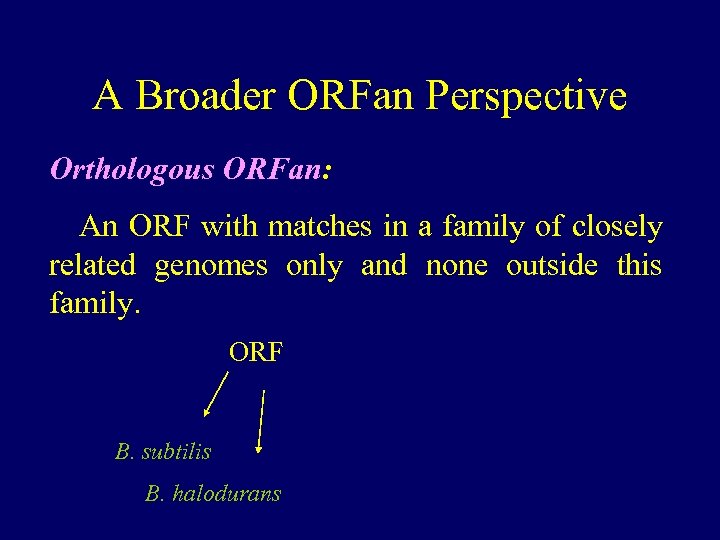 A Broader ORFan Perspective Orthologous ORFan: An ORF with matches in a family of closely related genomes only and none outside this family. ORF B. subtilis B. halodurans
 • Currently orthologous ORFans are counted as non-ORFans. • Family-specific? • Most probably expressed proteins.
 Paralogous ORFan: An ORF with matches in the same genome only and none outside the genome.
 • Currently paralogous ORFans are counted as non-ORFans. • Species-specific? • Most probably expressed proteins.
 Future and On-Going Work • • • Study the other types of ORFans (orthologous, paralogous, modules). Try to assign distantly related ORFans to known families: * in silico: using more sensitive bioinformatic tools such as fold recognition. * In the lab: determining the 3 D structure of selected ORFans. However, even if all ORFans were assigned to known families, the puzzle of their evolution will still remain.
 Ongoing in silico/experimental ORFan studies in BGU • Mini-structural genomics project to study selected paralogous ORFans in the archeon Halobacterium NRC-15. Bioinformatics (our group) Archea biology (Dr. Gerry Eichler) Crystallography (Prof. Boaz Sha’anan)
 Acknowledgements Prof. Joel Bernstein Department of Chemistry, BGU