


 Скачать презентацию Genetics of Chiari Type 1 Malformation Christina Markunas
b9547ee78a8d5d1c0255ba0d315f81e5.ppt
- Количество слайдов: 56
 Genetics of Chiari Type 1 Malformation Christina Markunas Ph. D. Candidate Center for Human Genetics Duke University Medical Center
 Outline • Brief genetics review • Why study the genetics of a disease? • Why do we think CM 1/S has a genetic component? • What genetic approaches can we take? • Discuss previous and current genetic studies of CM 1
 Outline • Brief genetics review • Why study the genetics of a disease? • Why do we think CM 1/S has a genetic component? • What genetic approaches can we take? • Discuss previous and current genetic studies of CM 1
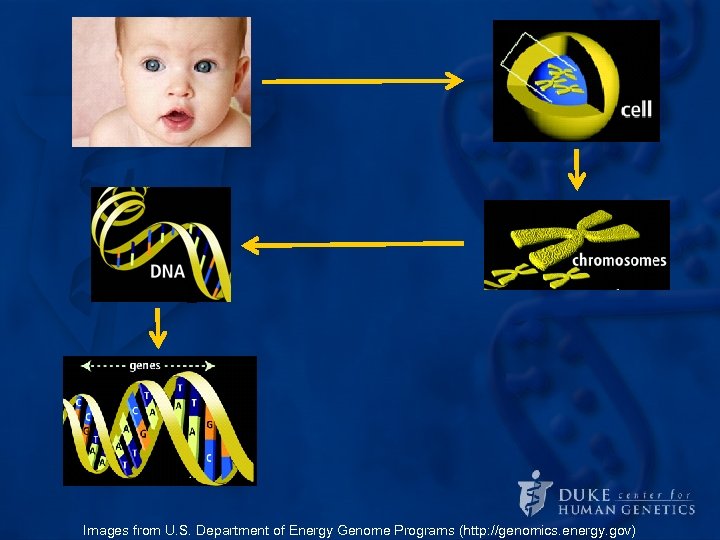 Images from U. S. Department of Energy Genome Programs (http: //genomics. energy. gov)
 Genes • Humans have >20, 000 genes • Instructions or blueprints for our body • Receive ½ our genes from mom and ½ our genes from dad • Genes produce proteins that help determine how we grow and develop
 Why study the genetics of a disease? • Development of genetic tests – More accurate and quicker diagnoses – Testing for at-risk family members • Better understanding of disease mechanism • Potential new therapies/treatments
 Why do we think CM 1 has a genetic component? • Familial Clustering • Twin Studies • Co-segregation with known genetic syndromes • Heritability estimates of posterior fossa measurements • Preliminary evidence from a linkage screen
 Why do we think CM 1 has a genetic component? • Familial Clustering • Twin Studies • Co-segregation with known genetic syndromes • Heritability estimates of posterior fossa measurements • Preliminary evidence from a linkage screen
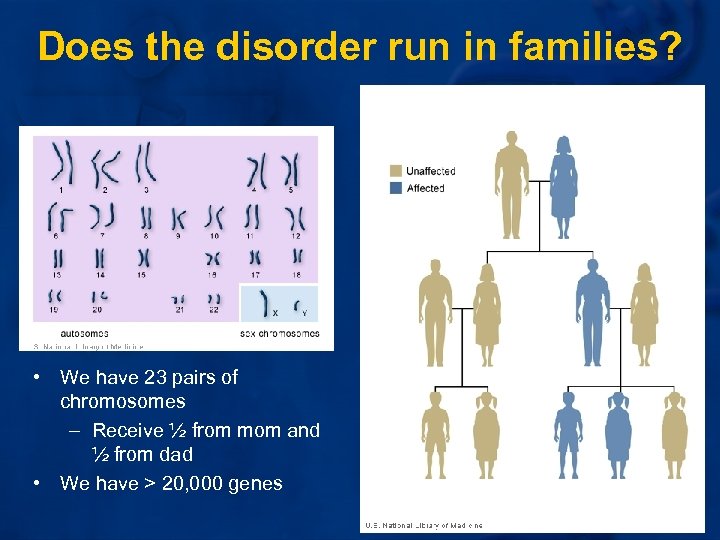 Does the disorder run in families? • We have 23 pairs of chromosomes – Receive ½ from mom and ½ from dad • We have > 20, 000 genes
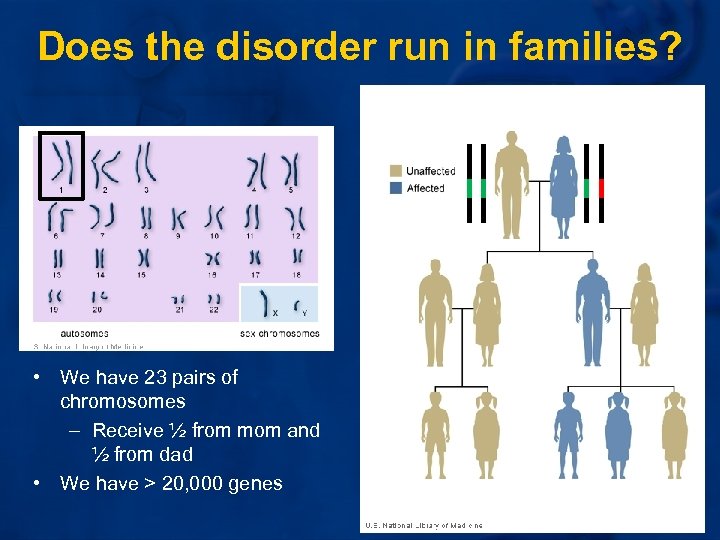 Does the disorder run in families? • We have 23 pairs of chromosomes – Receive ½ from mom and ½ from dad • We have > 20, 000 genes
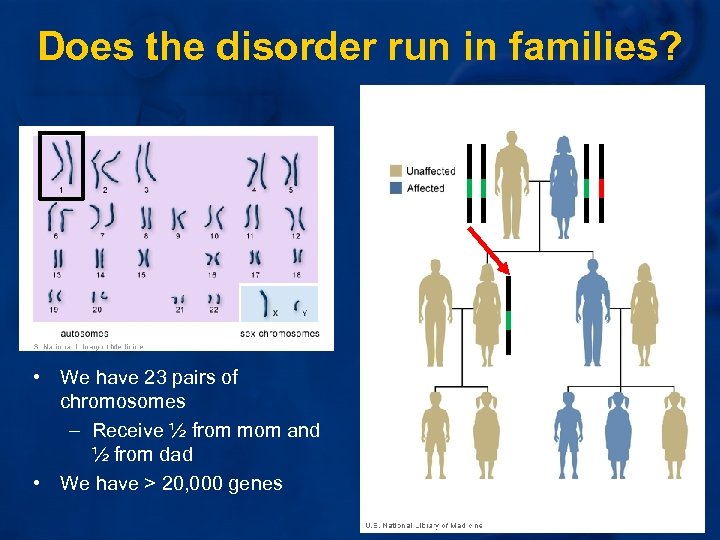 Does the disorder run in families? • We have 23 pairs of chromosomes – Receive ½ from mom and ½ from dad • We have > 20, 000 genes
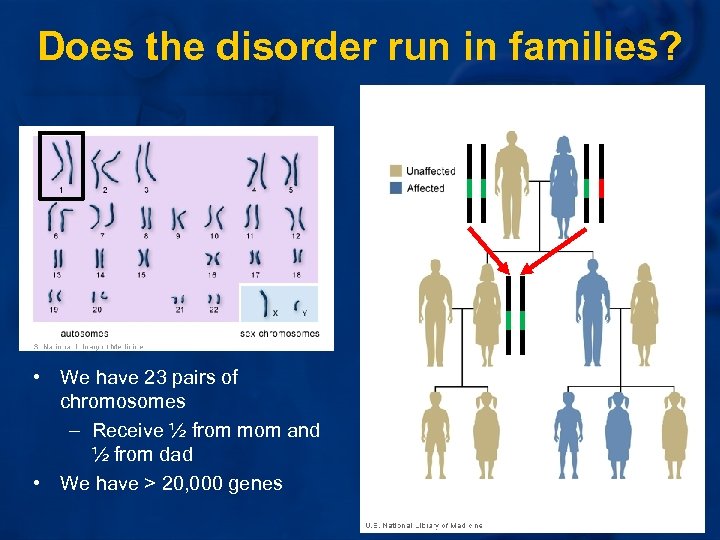 Does the disorder run in families? • We have 23 pairs of chromosomes – Receive ½ from mom and ½ from dad • We have > 20, 000 genes
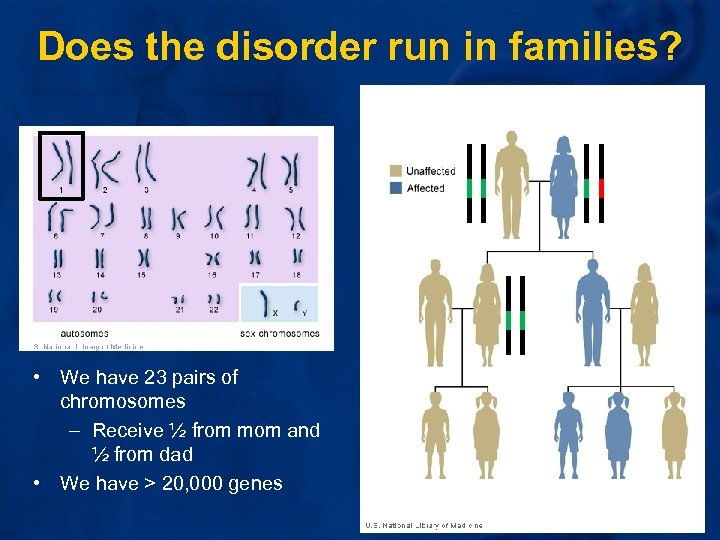 Does the disorder run in families? • We have 23 pairs of chromosomes – Receive ½ from mom and ½ from dad • We have > 20, 000 genes
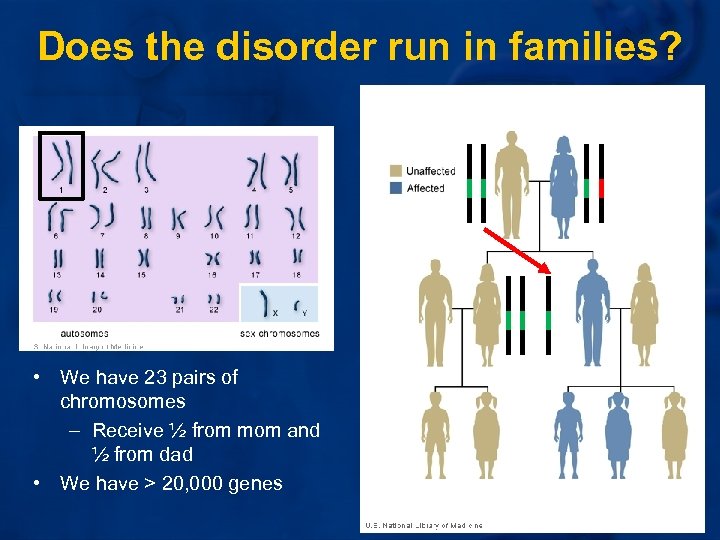 Does the disorder run in families? • We have 23 pairs of chromosomes – Receive ½ from mom and ½ from dad • We have > 20, 000 genes
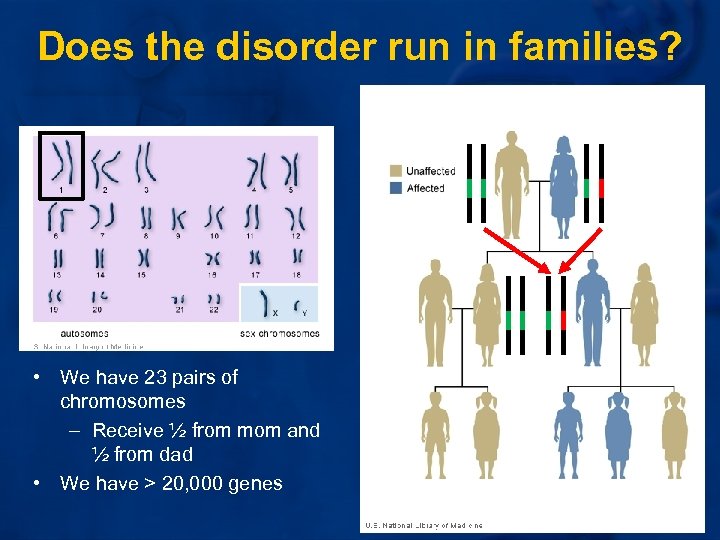 Does the disorder run in families? • We have 23 pairs of chromosomes – Receive ½ from mom and ½ from dad • We have > 20, 000 genes
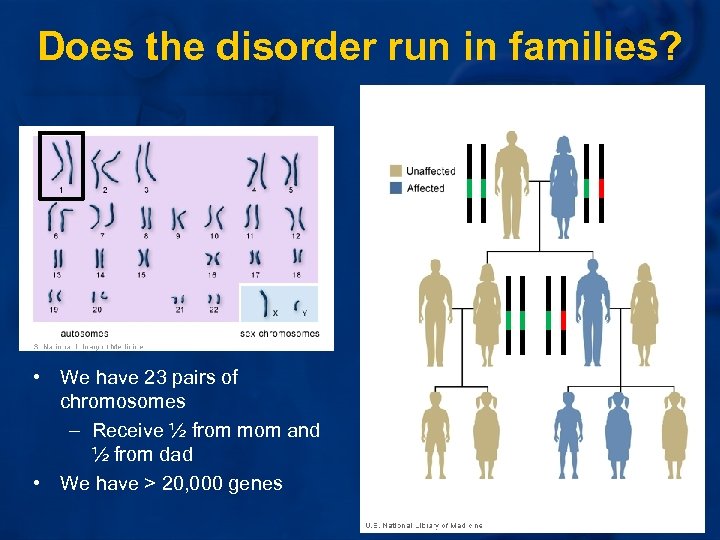 Does the disorder run in families? • We have 23 pairs of chromosomes – Receive ½ from mom and ½ from dad • We have > 20, 000 genes
 CM 1/S in Families • Milhorat, et al. Neurosurgery 1999 – 43/364 symptomatic patients (12%) reported that they had ≥ 1 close relative with CM 1/S – An additional 72 patients (20%) reported that they had ≥ 1 close relative with symptoms similar to their own • Additional studies – Speer, et al. Neurosurgical Focus 2000 – Szewka, et al. Pediatr. Neurol. 2006 – Boyles, et al. Am J Med Genet A 2006 • We have collected >100 CM 1/S multiplex families
 Why do we think CM 1 has a genetic component? • Familial Clustering • Twin Studies • Co-segregation with known genetic syndromes • Heritability estimates of posterior fossa measurements • Preliminary evidence from a linkage screen
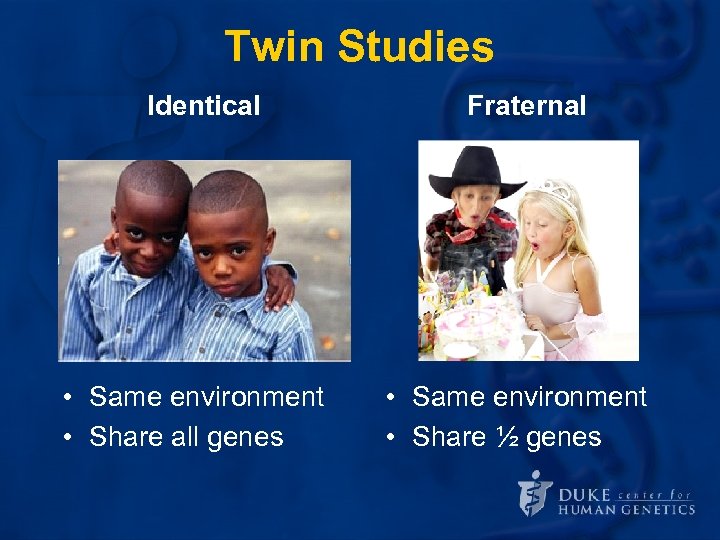 Twin Studies Identical • Same environment • Share all genes Fraternal • Same environment • Share ½ genes
 CM 1 Twin Studies • Higher concordance between 3 sets of identical twins compared to 3 sets of fraternal twins – Speer, et al. Journal of Genetic Counseling. 2003 • Concordance between identical twins and triplets – – Atkinson, et al. Neurosurgery. 1998 Stovner, et al. Ann Neurol. 1992 Szewka, et al. Pediatr. Neurol. 2006 Cavendar, et al. J. Neurosurg. 1995
 Why do we think CM 1 has a genetic component? • Familial Clustering • Twin Studies • Co-segregation with known genetic syndromes • Heritability estimates of posterior fossa measurements • Preliminary evidence from a linkage screen
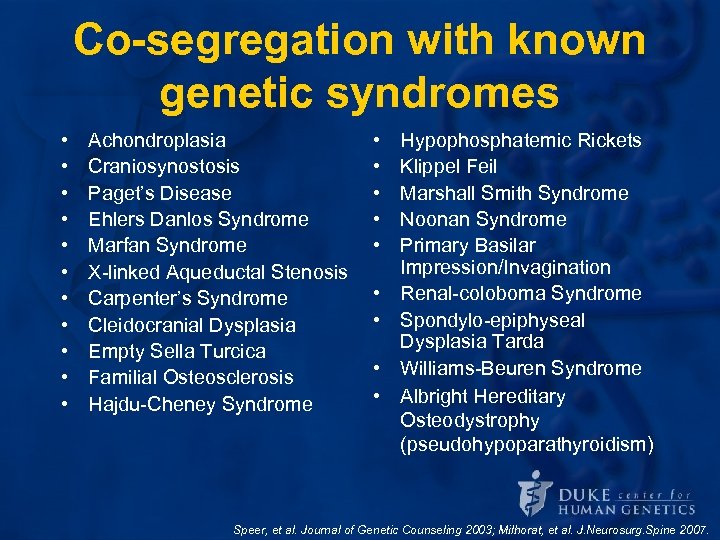 Co-segregation with known genetic syndromes • • • Achondroplasia Craniosynostosis Paget’s Disease Ehlers Danlos Syndrome Marfan Syndrome X-linked Aqueductal Stenosis Carpenter’s Syndrome Cleidocranial Dysplasia Empty Sella Turcica Familial Osteosclerosis Hajdu-Cheney Syndrome • • • Hypophosphatemic Rickets Klippel Feil Marshall Smith Syndrome Noonan Syndrome Primary Basilar Impression/Invagination Renal-coloboma Syndrome Spondylo-epiphyseal Dysplasia Tarda Williams-Beuren Syndrome Albright Hereditary Osteodystrophy (pseudohypoparathyroidism) Speer, et al. Journal of Genetic Counseling 2003; Milhorat, et al. J. Neurosurg. Spine 2007.
 Why do we think CM 1 has a genetic component? • Familial Clustering • Twin Studies • Co-segregation with known genetic syndromes • Heritability estimates of posterior fossa measurements • Preliminary evidence from a linkage screen
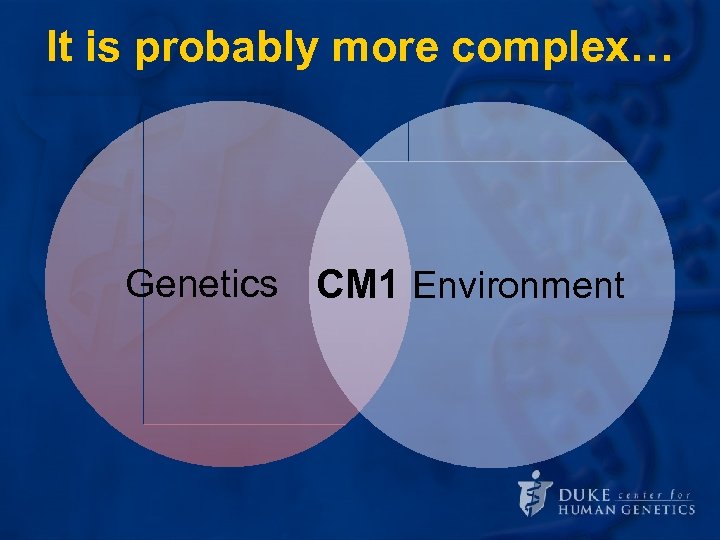 It is probably more complex… Genetics CM 1 Environment
 Outline • Brief genetics review • Why study the genetics of a disease? • Why do we think CM 1/S has a genetic component? • What genetic approaches can we take? • Discuss previous and current genetic studies of CM 1
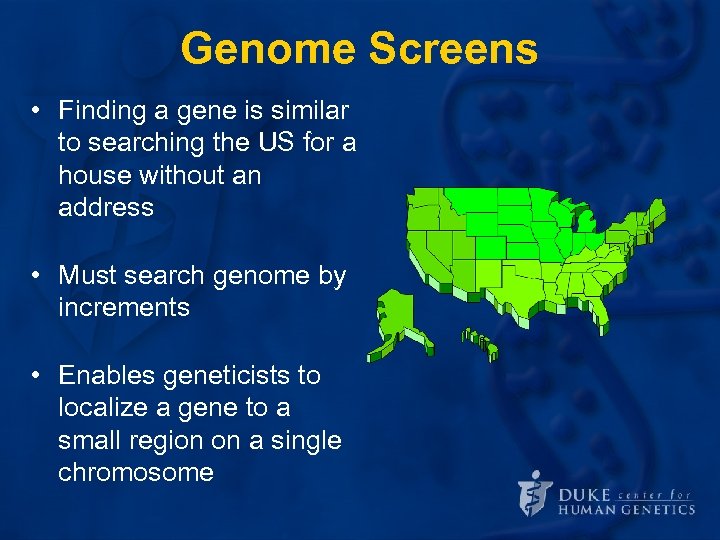 Genome Screens • Finding a gene is similar to searching the US for a house without an address • Must search genome by increments • Enables geneticists to localize a gene to a small region on a single chromosome
 Genetic Approach to a Disease
 Genetic Approach to a Disease Define the phenotype
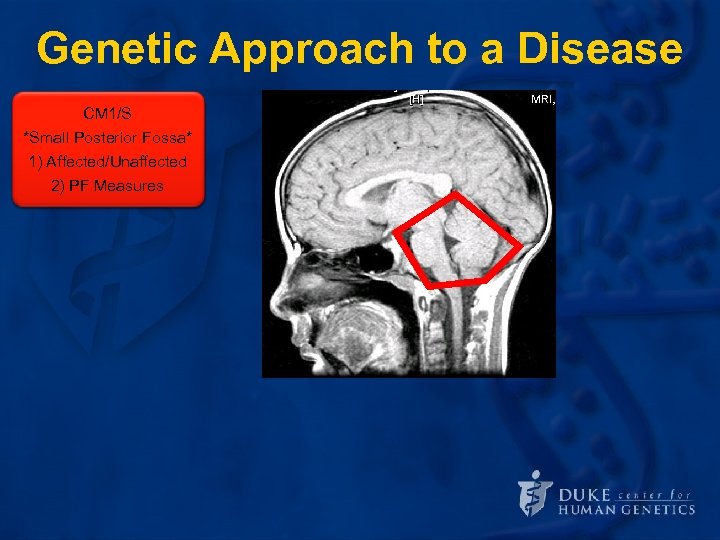
 Genetic Approach to a Disease CM 1/S *Small Posterior Fossa* Define the 1) Affected/Unaffected phenotype 2) PF Measures
 Genetic Approach to a Disease CM 1/S *Small Posterior Fossa* Define the 1) Affected/Unaffected phenotype 2) PF Measures Look for -Familial clustering evidence of a -Twin Studies genetic -Co-segregation with Genetic Syndromes component Perform Initial Linkage Analysis
 Genetic Approach to a Disease CM 1/S *Small Posterior Fossa* Define the 1) Affected/Unaffected phenotype 2) PF Measures
 Genetic Approach to a Disease CM 1/S *Small Posterior Fossa* Define the 1) Affected/Unaffected phenotype 2) PF Measures Look for evidence of a genetic component
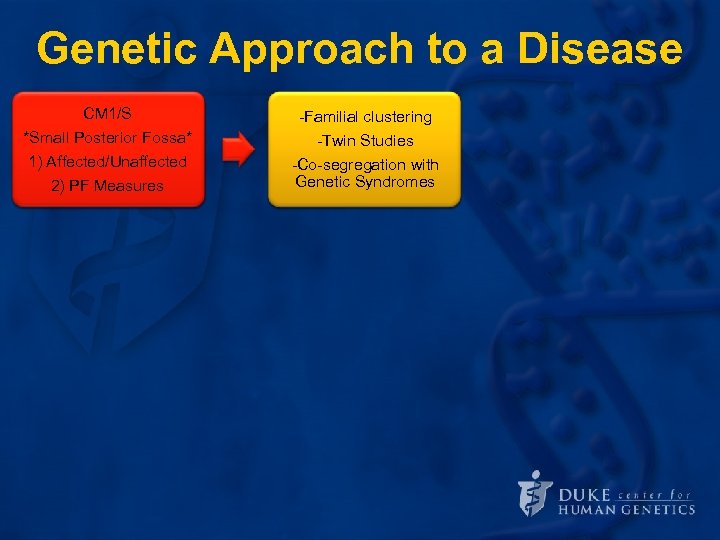 Genetic Approach to a Disease CM 1/S *Small Posterior Fossa* Define the 1) Affected/Unaffected phenotype 2) PF Measures Look for -Familial clustering evidence of a -Twin Studies genetic -Co-segregation with Genetic Syndromes component
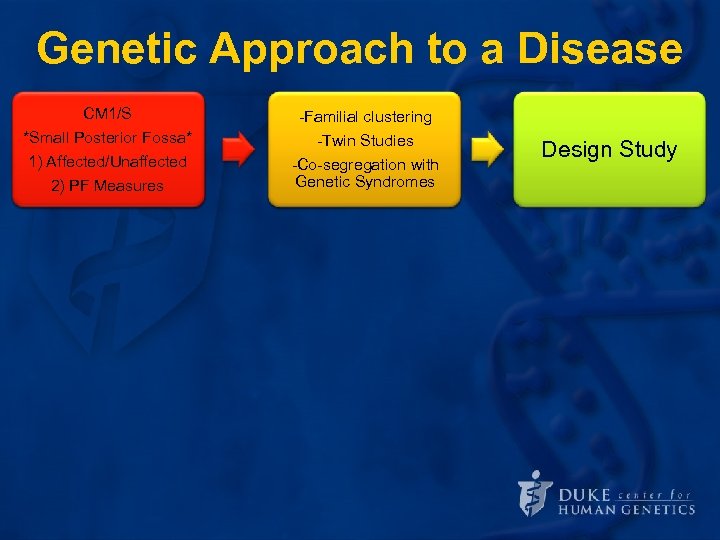 Genetic Approach to a Disease CM 1/S *Small Posterior Fossa* Define the 1) Affected/Unaffected phenotype 2) PF Measures Look for -Familial clustering evidence of a -Twin Studies genetic -Co-segregation with Genetic Syndromes component Design Study
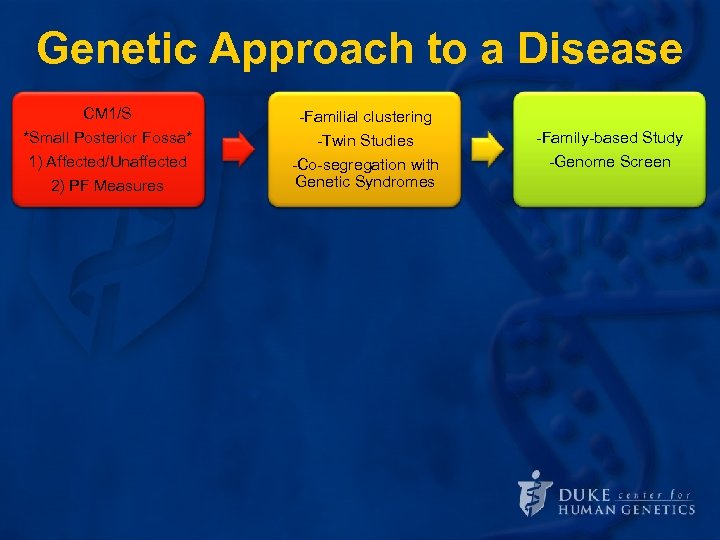 Genetic Approach to a Disease CM 1/S *Small Posterior Fossa* Define the 1) Affected/Unaffected phenotype 2) PF Measures Look for -Familial clustering evidence of a -Twin Studies genetic -Co-segregation with Genetic Syndromes component -Family-based Study Design -Genome Screen Experiment
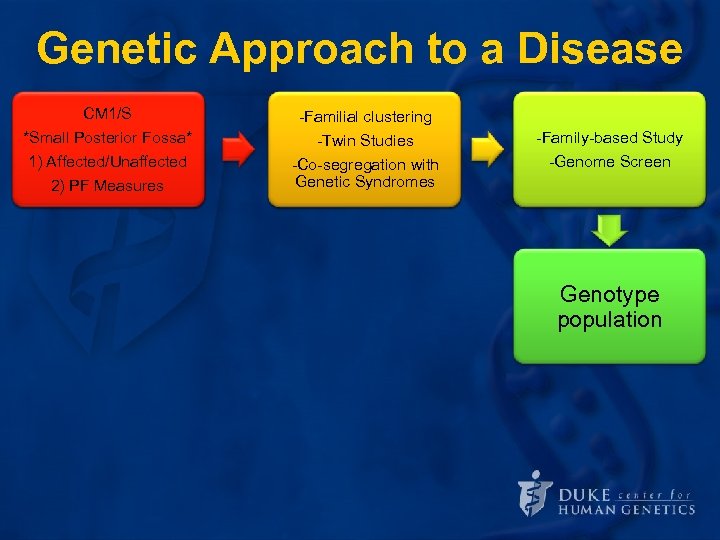 Genetic Approach to a Disease CM 1/S *Small Posterior Fossa* Define the 1) Affected/Unaffected phenotype 2) PF Measures Look for -Familial clustering evidence of a -Twin Studies genetic -Co-segregation with Genetic Syndromes component -Family-based Study Design -Genome Screen Experiment Genotype population
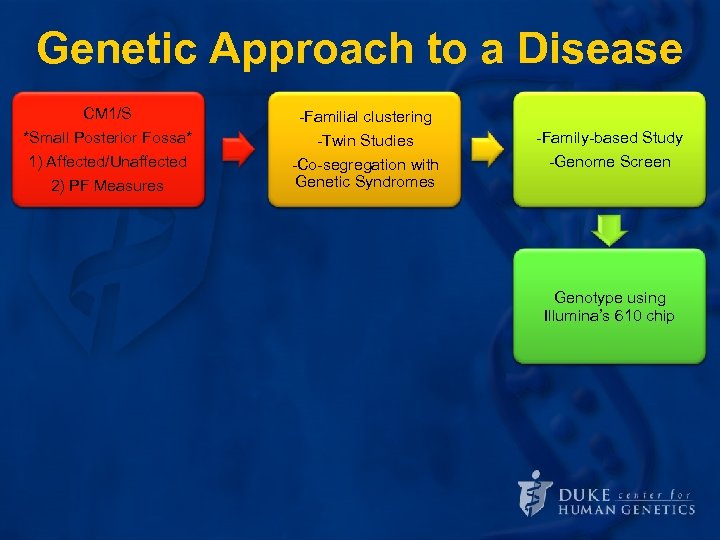 Genetic Approach to a Disease CM 1/S *Small Posterior Fossa* Define the 1) Affected/Unaffected phenotype 2) PF Measures Look for -Familial clustering evidence of a -Twin Studies genetic -Co-segregation with Genetic Syndromes component -Family-based Study Design -Genome Screen Experiment Genotype using Illumina’s 610 chip population
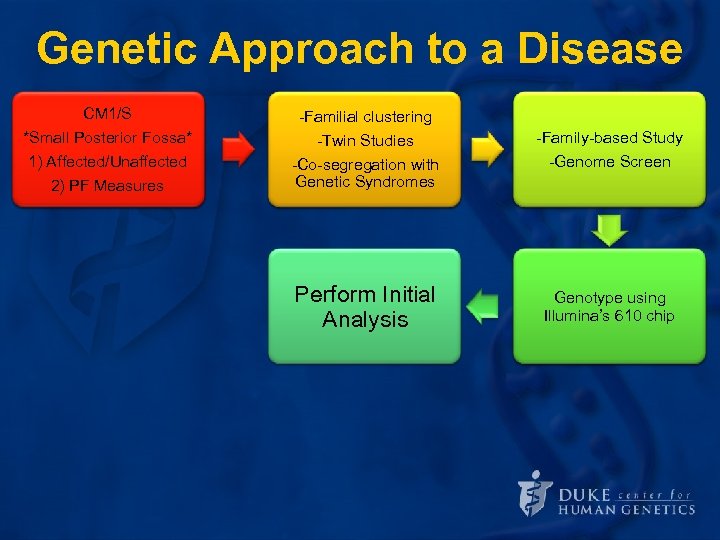 Genetic Approach to a Disease CM 1/S *Small Posterior Fossa* Define the 1) Affected/Unaffected phenotype 2) PF Measures Look for -Familial clustering evidence of a -Twin Studies genetic -Co-segregation with Genetic Syndromes component -Family-based Study Design -Genome Screen Experiment Perform Initial Analysis Genotype using Illumina’s 610 chip population
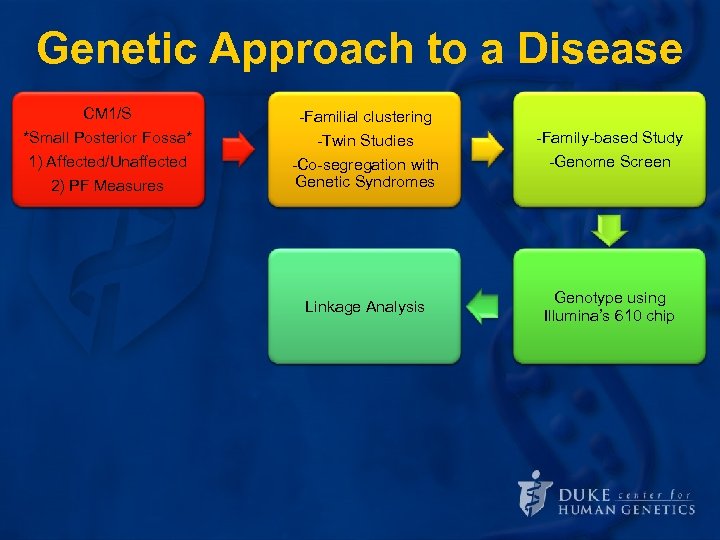 Genetic Approach to a Disease CM 1/S *Small Posterior Fossa* Define the 1) Affected/Unaffected phenotype 2) PF Measures Look for -Familial clustering evidence of a -Twin Studies genetic -Co-segregation with Genetic Syndromes component -Family-based Study Design -Genome Screen Experiment Perform Initial Linkage Analysis Genotype using Illumina’s 610 chip population
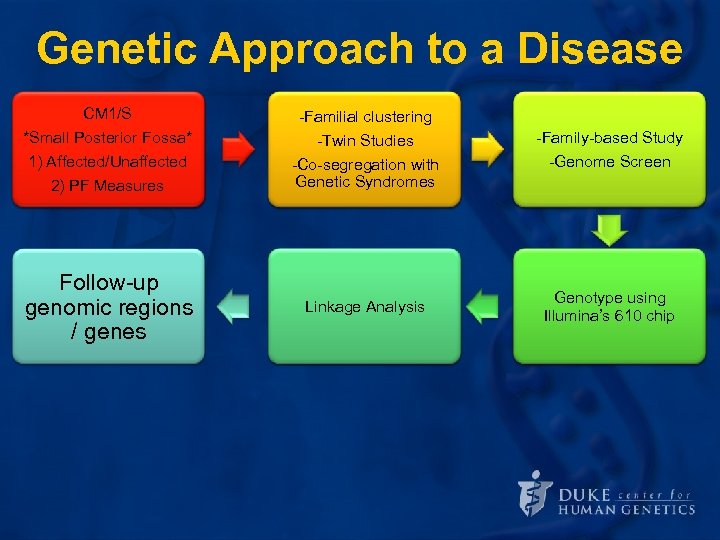 Genetic Approach to a Disease CM 1/S *Small Posterior Fossa* Define the 1) Affected/Unaffected phenotype 2) PF Measures Follow-up genomic regions / genes Look for -Familial clustering evidence of a -Twin Studies genetic -Co-segregation with Genetic Syndromes component -Family-based Study Design -Genome Screen Experiment Perform Initial Linkage Analysis Genotype using Illumina’s 610 chip population
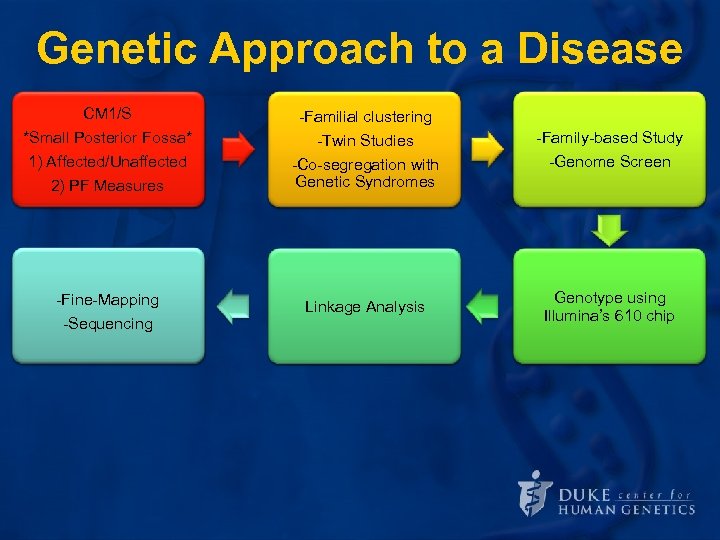 Genetic Approach to a Disease CM 1/S *Small Posterior Fossa* Define the 1) Affected/Unaffected phenotype 2) PF Measures Follow-up -Fine-Mapping genomic regions -Sequencing / genes Look for -Familial clustering evidence of a -Twin Studies genetic -Co-segregation with Genetic Syndromes component -Family-based Study Design -Genome Screen Experiment Perform Initial Linkage Analysis Genotype using Illumina’s 610 chip population
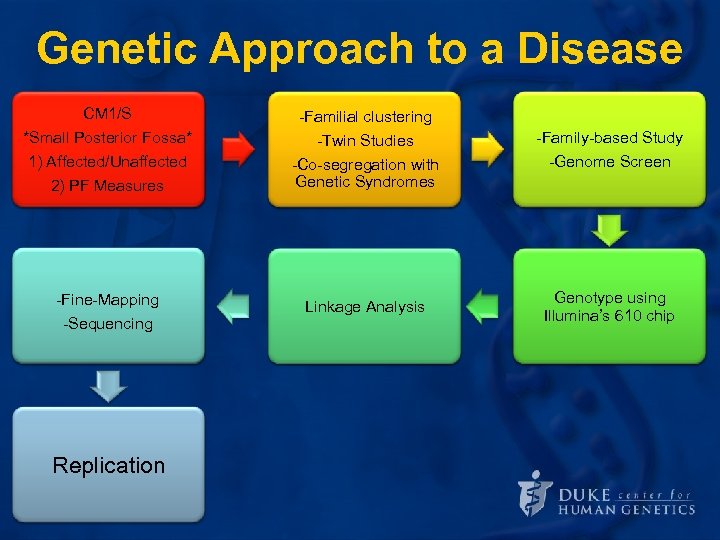 Genetic Approach to a Disease CM 1/S *Small Posterior Fossa* Define the 1) Affected/Unaffected phenotype 2) PF Measures Follow-up -Fine-Mapping genomic regions -Sequencing / genes Replication Look for -Familial clustering evidence of a -Twin Studies genetic -Co-segregation with Genetic Syndromes component -Family-based Study Design -Genome Screen Experiment Perform Initial Linkage Analysis Genotype using Illumina’s 610 chip population
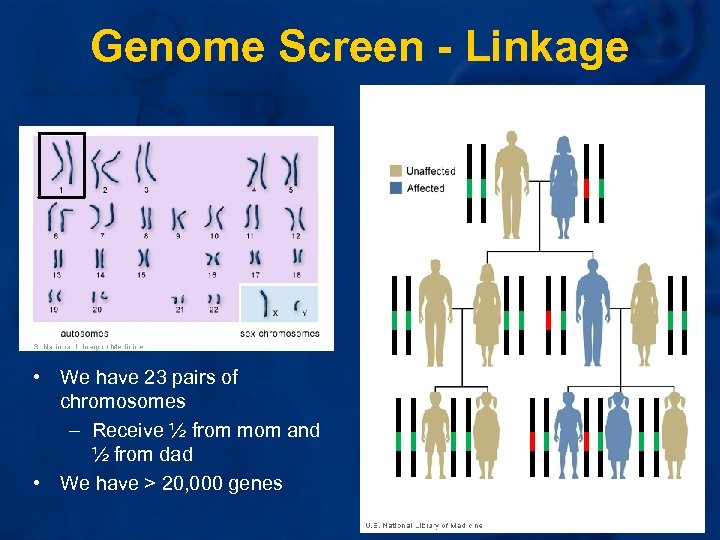 Genome Screen - Linkage • We have 23 pairs of chromosomes – Receive ½ from mom and ½ from dad • We have > 20, 000 genes
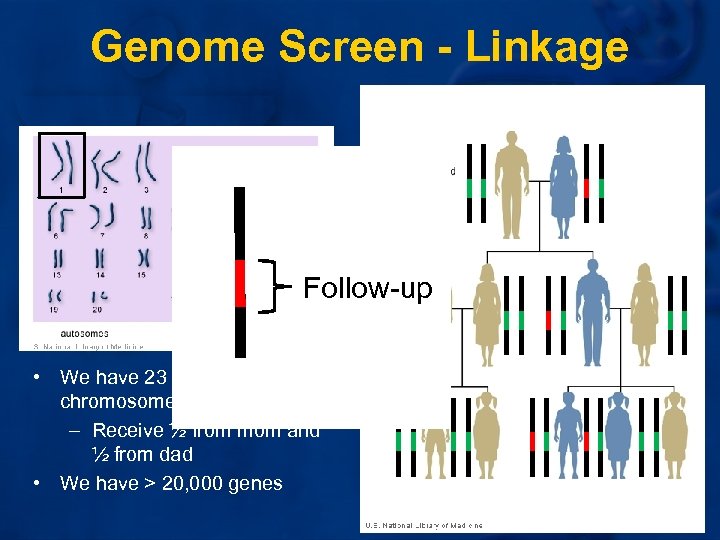 Genome Screen - Linkage Follow-up • We have 23 pairs of chromosomes – Receive ½ from mom and ½ from dad • We have > 20, 000 genes
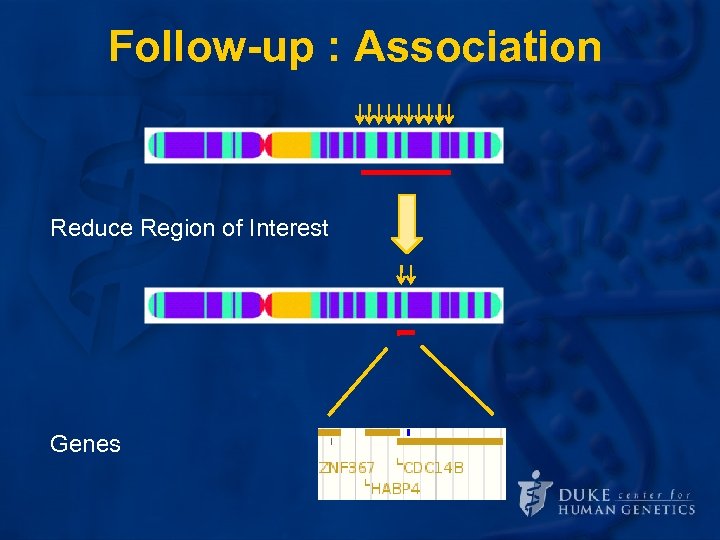 Follow-up : Association Reduce Region of Interest Genes
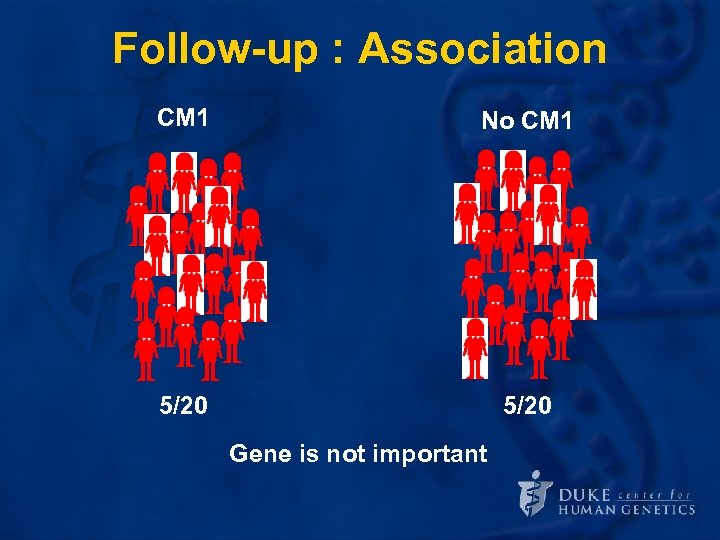 Follow-up : Association CM 1 No CM 1 5/20 Gene is not important
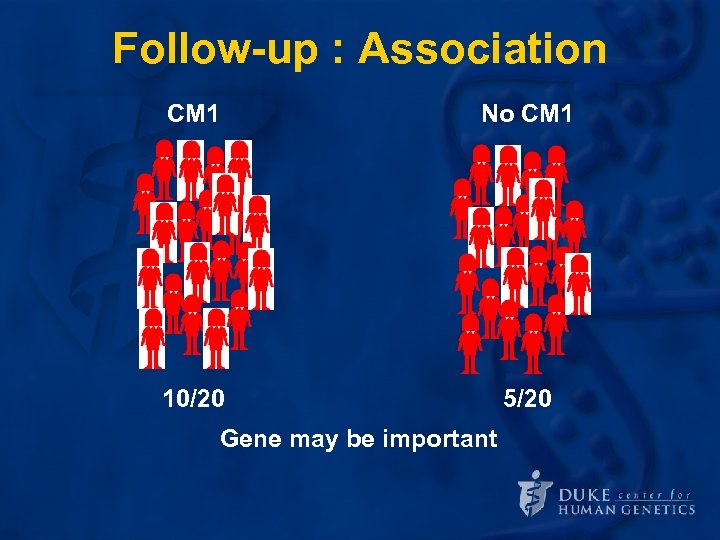 Follow-up : Association CM 1 No CM 1 10/20 5/20 Gene may be important
 Outline • Brief genetics review • Why study the genetics of a disease? • Why do we think CM 1/S has a genetic component? • What genetic approaches can we take? • Discuss previous and current genetic studies of CM 1
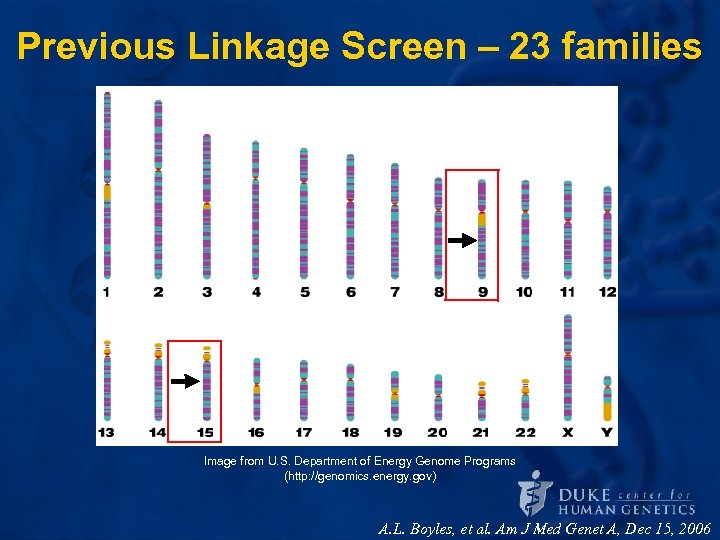 Previous Linkage Screen – 23 families Image from U. S. Department of Energy Genome Programs (http: //genomics. energy. gov) A. L. Boyles, et al. Am J Med Genet A, Dec 15, 2006
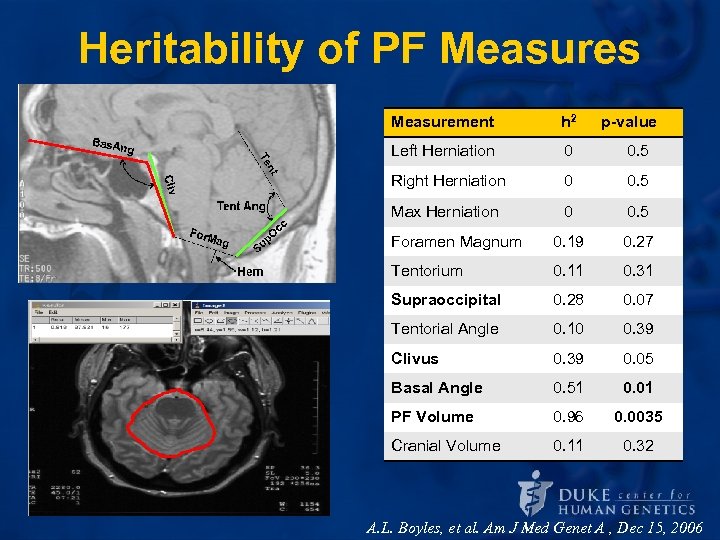 Heritability of PF Measures Measurement h 2 p-value Left Herniation 0 0. 5 Right Herniation 0 0. 5 Max Herniation 0 0. 5 Foramen Magnum 0. 19 0. 27 Tentorium 0. 11 0. 31 Supraoccipital 0. 28 0. 07 Tentorial Angle 0. 10 0. 39 Clivus 0. 39 0. 05 Basal Angle 0. 51 0. 01 PF Volume 0. 96 0. 0035 Cranial Volume 0. 11 0. 32 A. L. Boyles, et al. Am J Med Genet A , Dec 15, 2006
 Current Ascertainment • Continued enrollment of CM 1/S multiplex families (>100 families ascertained thus far) • Collecting: – – Medical records Family history Pre-surgical MRIs Questionnaire • • Symptoms Associated conditions Disease onset Pregnancy History
 Current Genome Screen • Phase I – 234 individuals from 40 CM 1/S families – Genotyping and Quality Control: Complete – Analysis: In progress • Phase II – Genotype another 240 individuals – Goal is to complete in the fall…
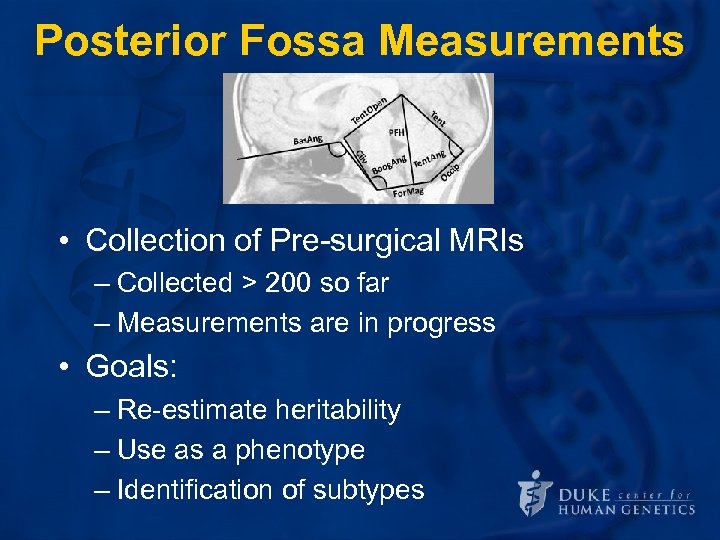 Posterior Fossa Measurements • Collection of Pre-surgical MRIs – Collected > 200 so far – Measurements are in progress • Goals: – Re-estimate heritability – Use as a phenotype – Identification of subtypes
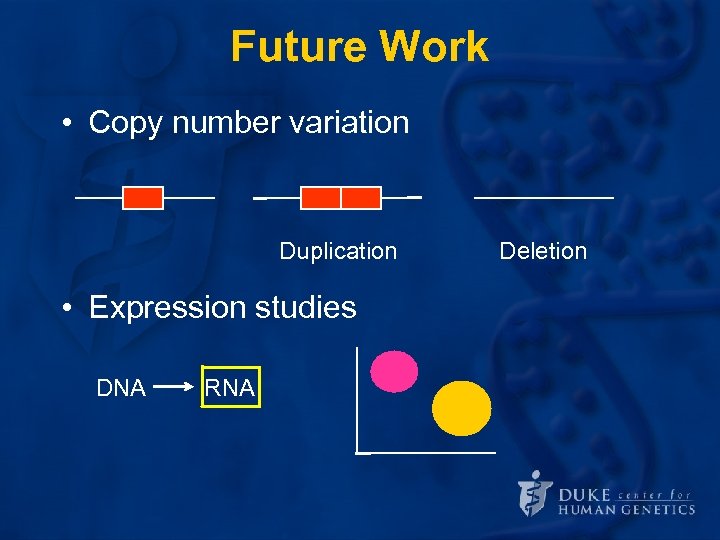 Future Work • Copy number variation Duplication • Expression studies DNA RNA Deletion
 Interested? • Please pick up a study brochure after the session • Feel free to contact the study coordinator with any questions: – Phone: 1 -877 -385 -2626 – Email: chiari@chg. duhs. duke. edu
 Acknowledgements • • • Principal Investigator: Allison Ashley-Koch, Ph. D. Principal Investigator: Simon Gregory, Ph. D. Herbert Fuchs, M. D. , Ph. D. Gerald Grant, M. D. David Enterline, M. D. Funding provided by: Heidi Cope, M. S. , C. G. C. • National Institutes of Karen Soldano Health (NINDS) Shonda Evans • Conquer Chiari Kaiti Dunlap