


 Скачать презентацию Genetics Evolution Series Copyright 2005 Version
4e46850de2b1e3618ac99218ec55e03e.ppt
- Количество слайдов: 45
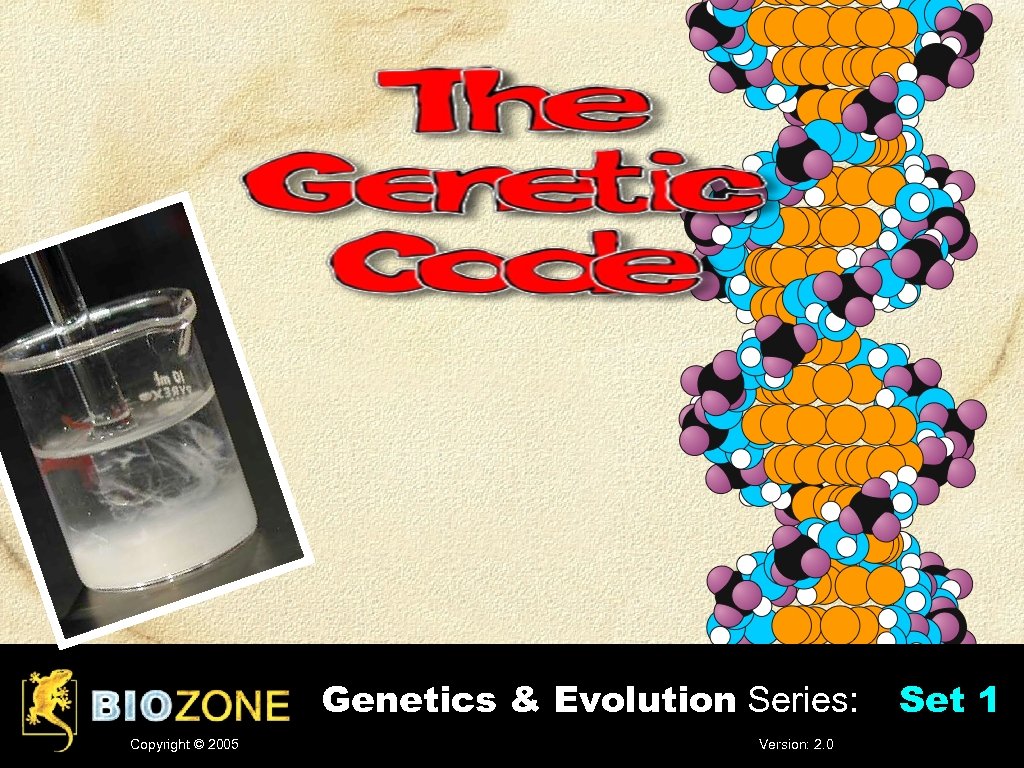 Genetics & Evolution Series: Copyright © 2005 Version: 2. 0 Set 1
 DNA and protein synthesis • Learn these slides in conjunction with the Intranet pages that explain what your need to learn and your textbook. • Your textbook lacks information on certain sections – use these PP slides as your notes. • Work that you are not required to learn is marked for data response only or for interest. • In some slides there may be more detail than you are required to know – your teacher will help you determine the detail needed.
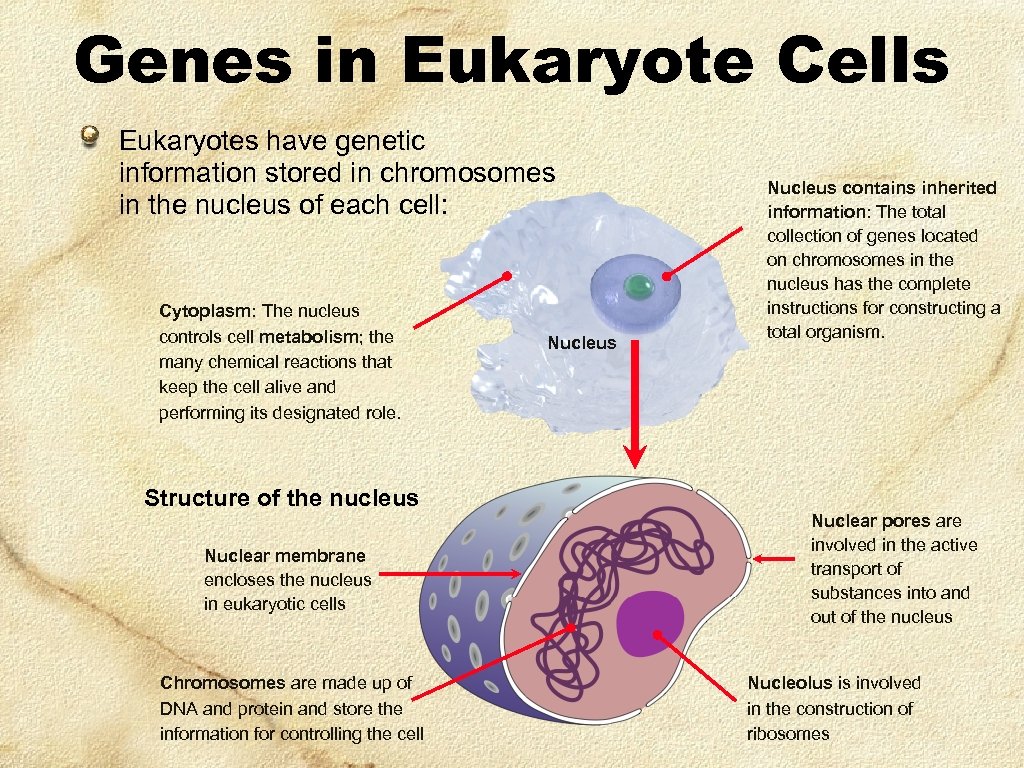 Genes in Eukaryote Cells Eukaryotes have genetic information stored in chromosomes in the nucleus of each cell: Cytoplasm: The nucleus controls cell metabolism; the many chemical reactions that keep the cell alive and performing its designated role. Structure of the nucleus Nuclear membrane encloses the nucleus in eukaryotic cells Chromosomes are made up of DNA and protein and store the information for controlling the cell Nucleus contains inherited information: The total collection of genes located on chromosomes in the nucleus has the complete instructions for constructing a total organism. Nuclear pores are involved in the active transport of substances into and out of the nucleus Nucleolus is involved in the construction of ribosomes
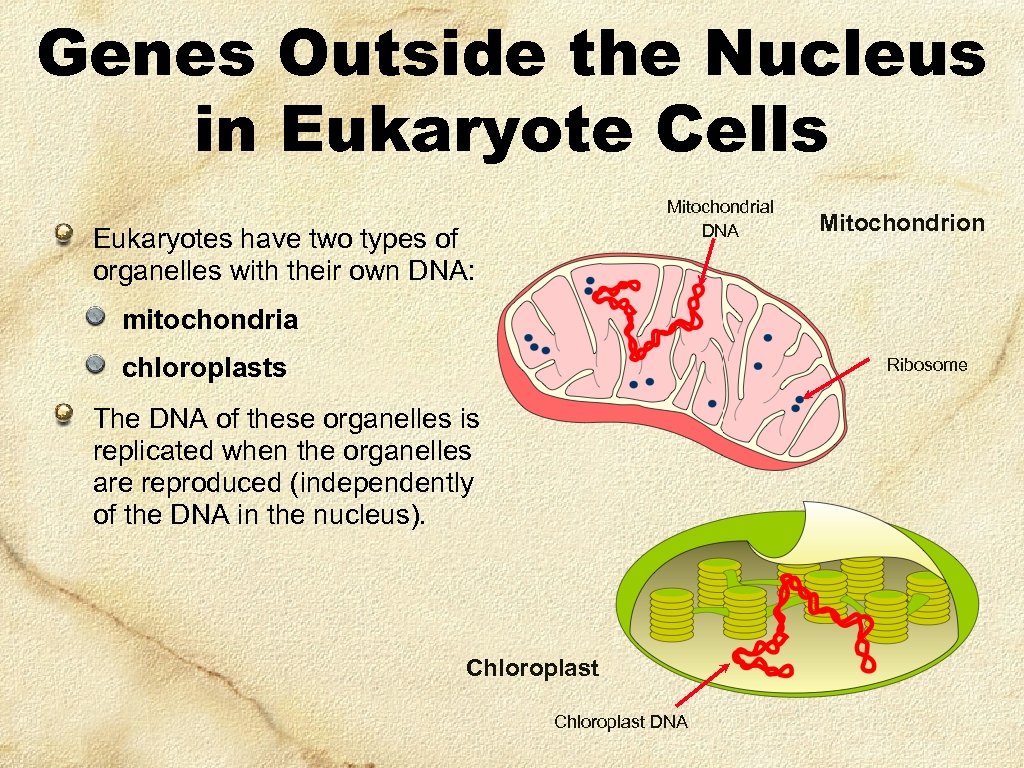 Genes Outside the Nucleus in Eukaryote Cells Mitochondrial DNA Eukaryotes have two types of organelles with their own DNA: Mitochondrion mitochondria chloroplasts Ribosome The DNA of these organelles is replicated when the organelles are reproduced (independently of the DNA in the nucleus). Chloroplast DNA
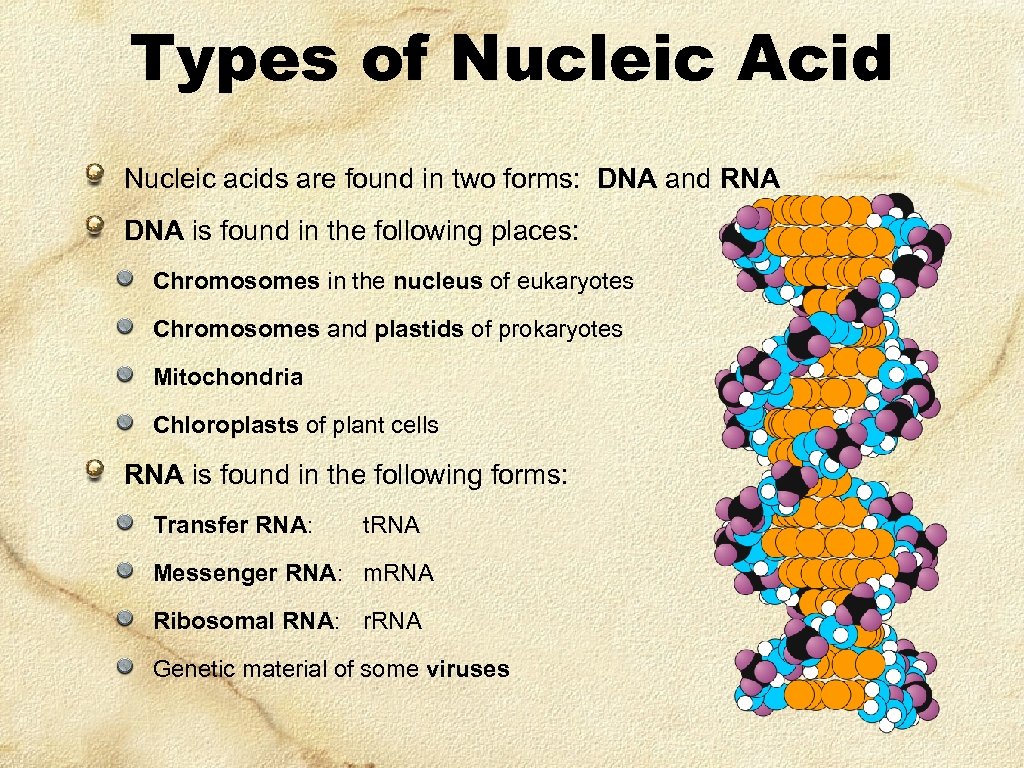 Types of Nucleic Acid Nucleic acids are found in two forms: DNA and RNA DNA is found in the following places: Chromosomes in the nucleus of eukaryotes Chromosomes and plastids of prokaryotes Mitochondria Chloroplasts of plant cells RNA is found in the following forms: Transfer RNA: t. RNA Messenger RNA: m. RNA Ribosomal RNA: r. RNA Genetic material of some viruses
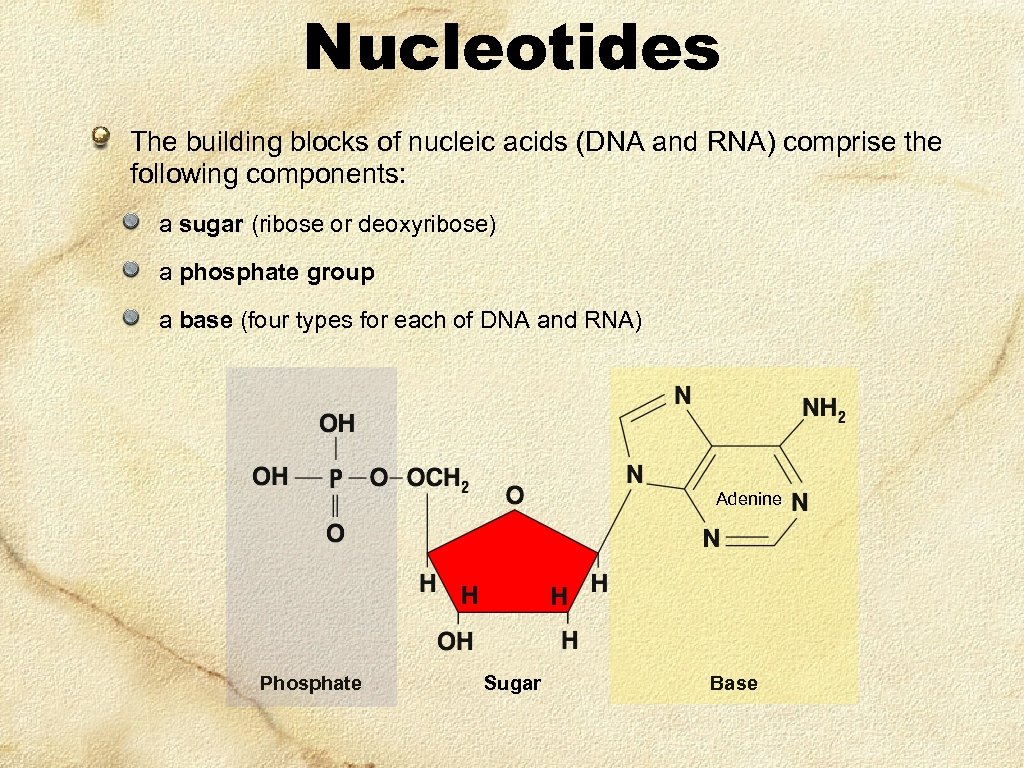 Nucleotides The building blocks of nucleic acids (DNA and RNA) comprise the following components: a sugar (ribose or deoxyribose) a phosphate group a base (four types for each of DNA and RNA) Adenine Phosphate Sugar Base
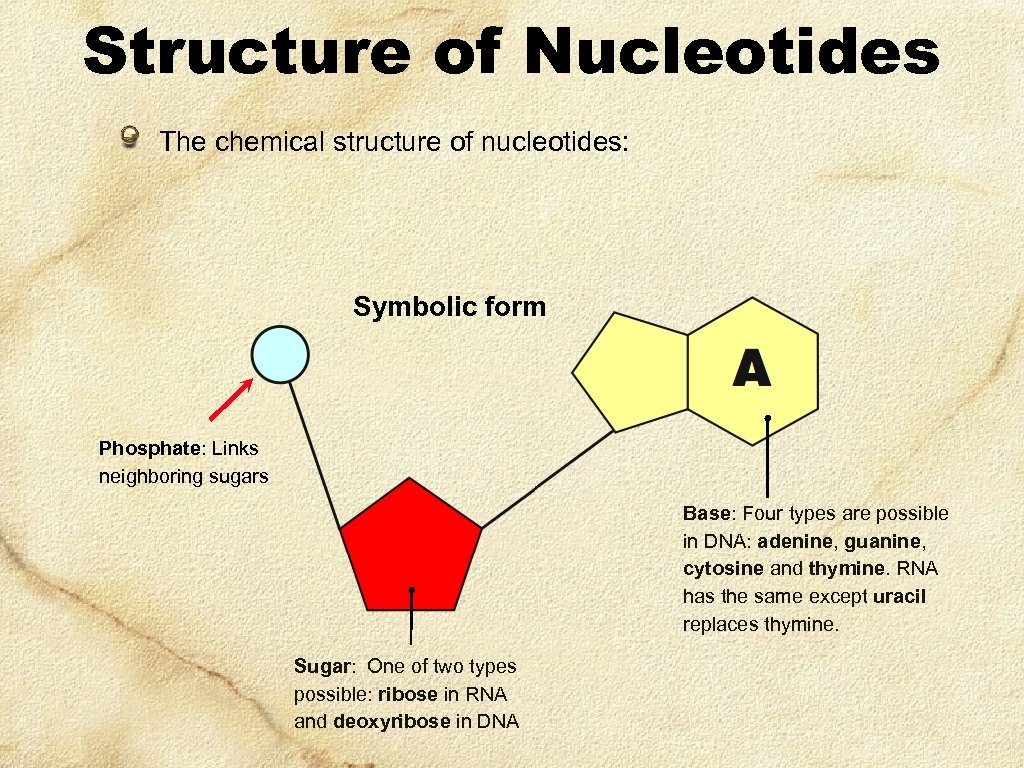 Structure of Nucleotides The chemical structure of nucleotides: Symbolic form Phosphate: Links neighboring sugars Base: Four types are possible in DNA: adenine, guanine, cytosine and thymine. RNA has the same except uracil replaces thymine. Sugar: One of two types possible: ribose in RNA and deoxyribose in DNA
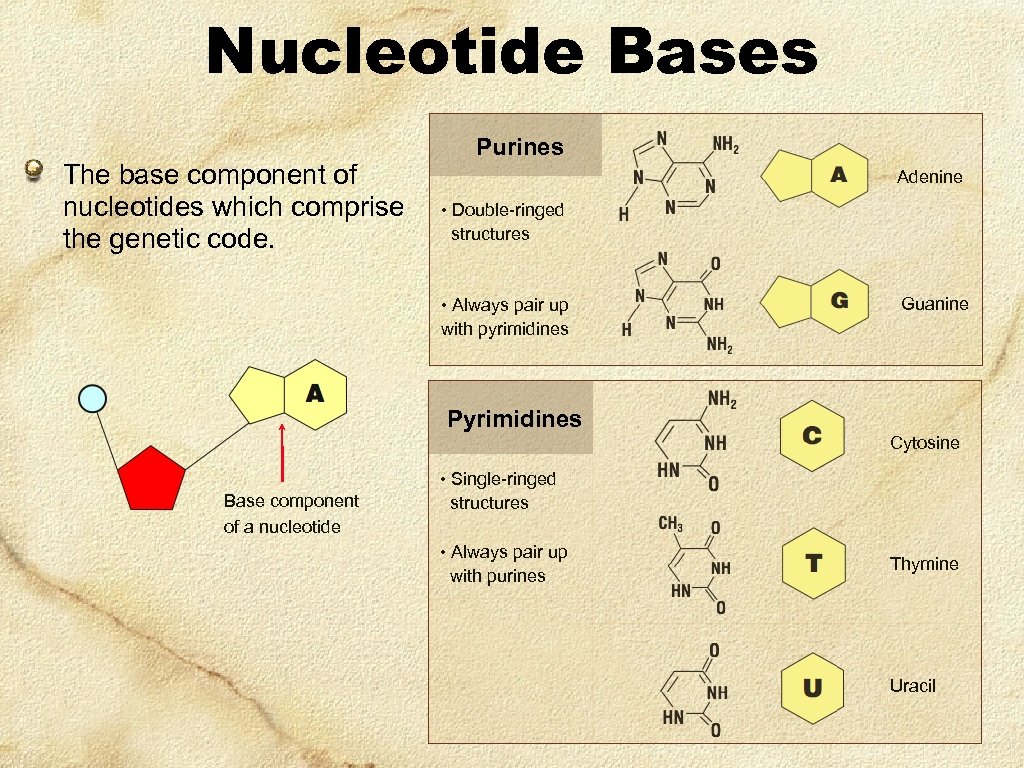 Nucleotide Bases The base component of nucleotides which comprise the genetic code. Purines Adenine • Double-ringed structures • Always pair up with pyrimidines Guanine Pyrimidines Cytosine Base component of a nucleotide • Single-ringed structures • Always pair up with purines Thymine Uracil
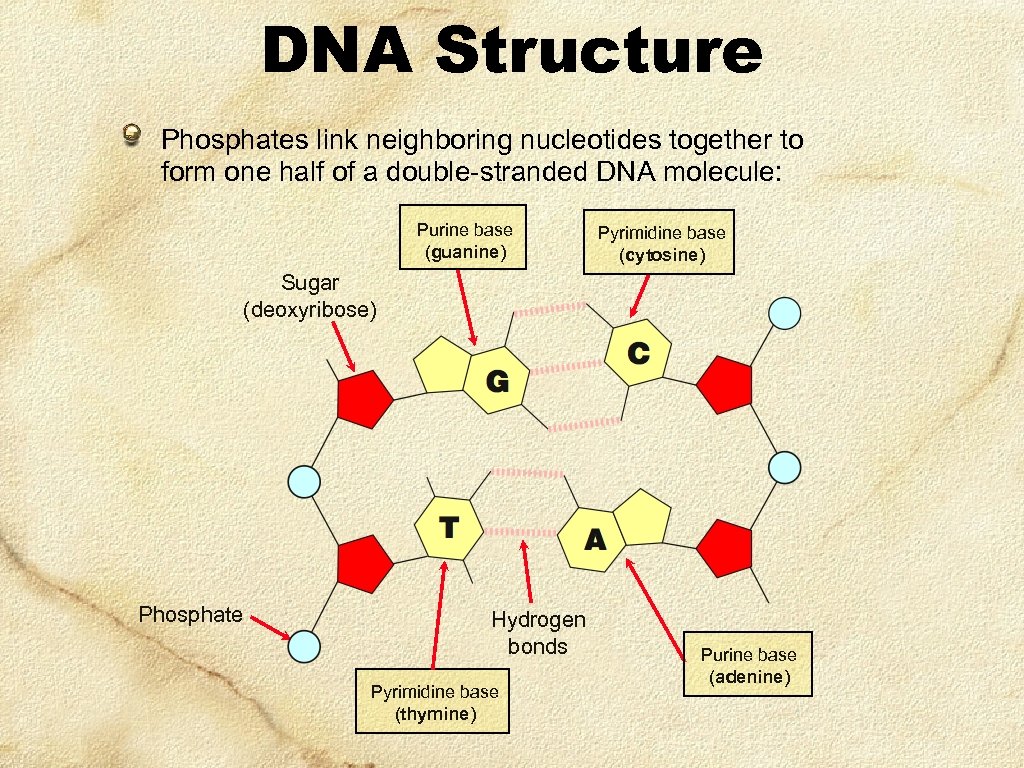 DNA Structure Phosphates link neighboring nucleotides together to form one half of a double-stranded DNA molecule: Purine base (guanine) Pyrimidine base (cytosine) Sugar (deoxyribose) Phosphate Hydrogen bonds Pyrimidine base (thymine) Purine base (adenine)
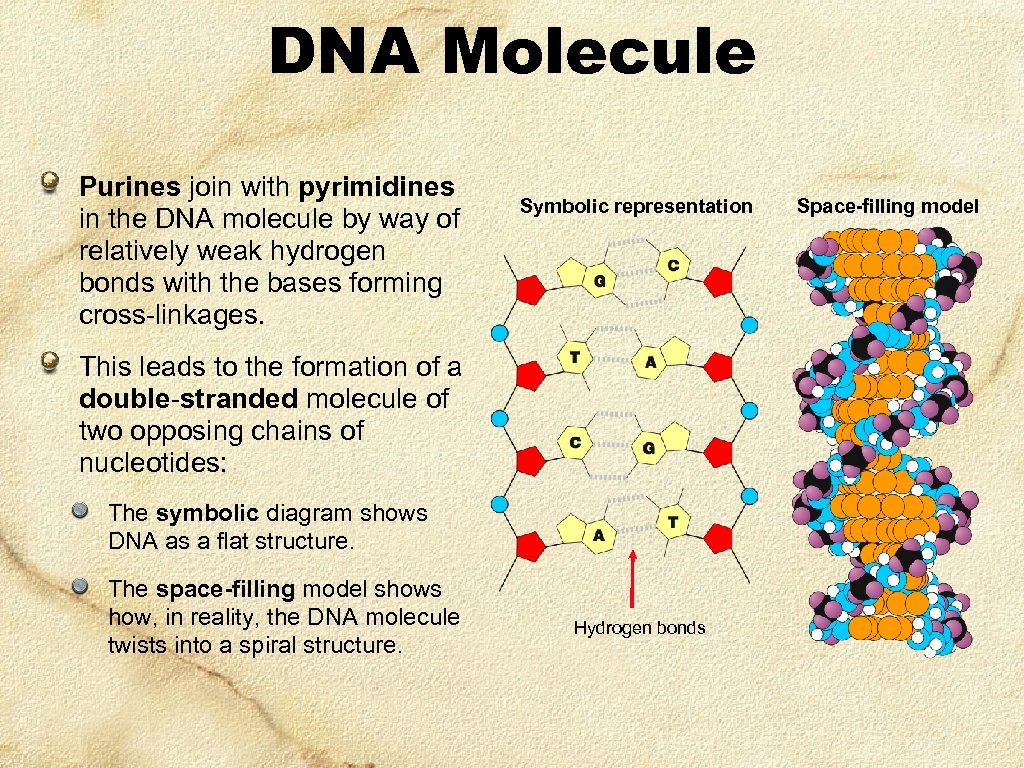 DNA Molecule Purines join with pyrimidines in the DNA molecule by way of relatively weak hydrogen bonds with the bases forming cross-linkages. Symbolic representation This leads to the formation of a double-stranded molecule of two opposing chains of nucleotides: The symbolic diagram shows DNA as a flat structure. The space-filling model shows how, in reality, the DNA molecule twists into a spiral structure. Hydrogen bonds Space-filling model
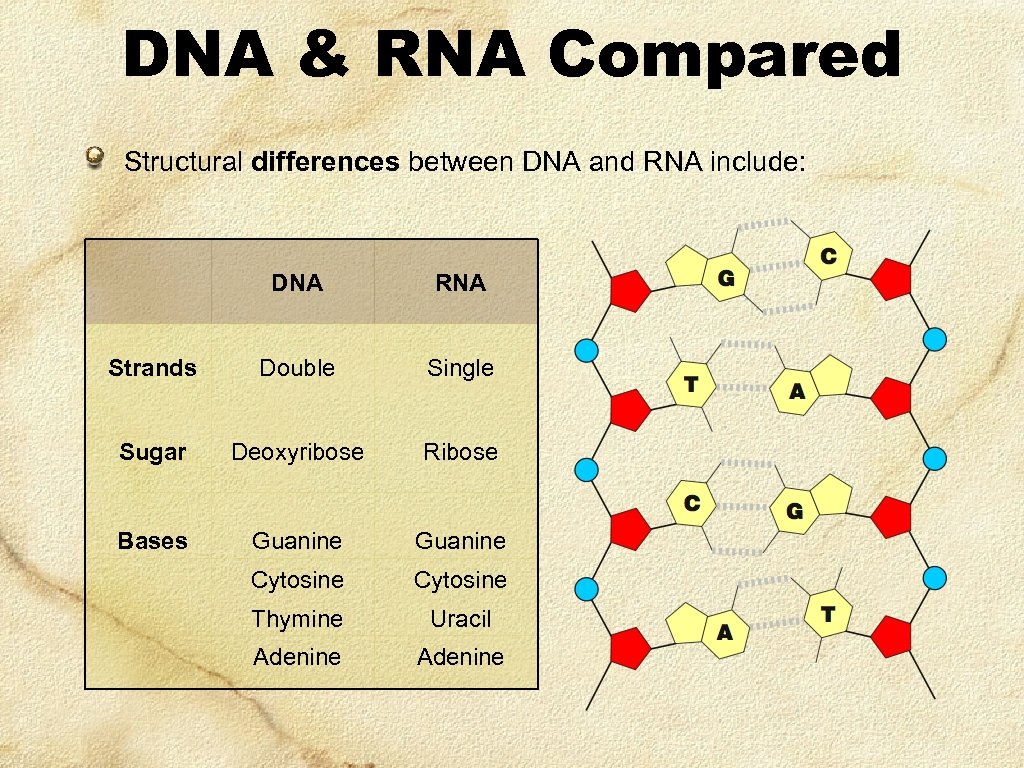 DNA & RNA Compared Structural differences between DNA and RNA include: DNA RNA Strands Double Single Sugar Deoxyribose Ribose Bases Guanine Cytosine Thymine Uracil Adenine
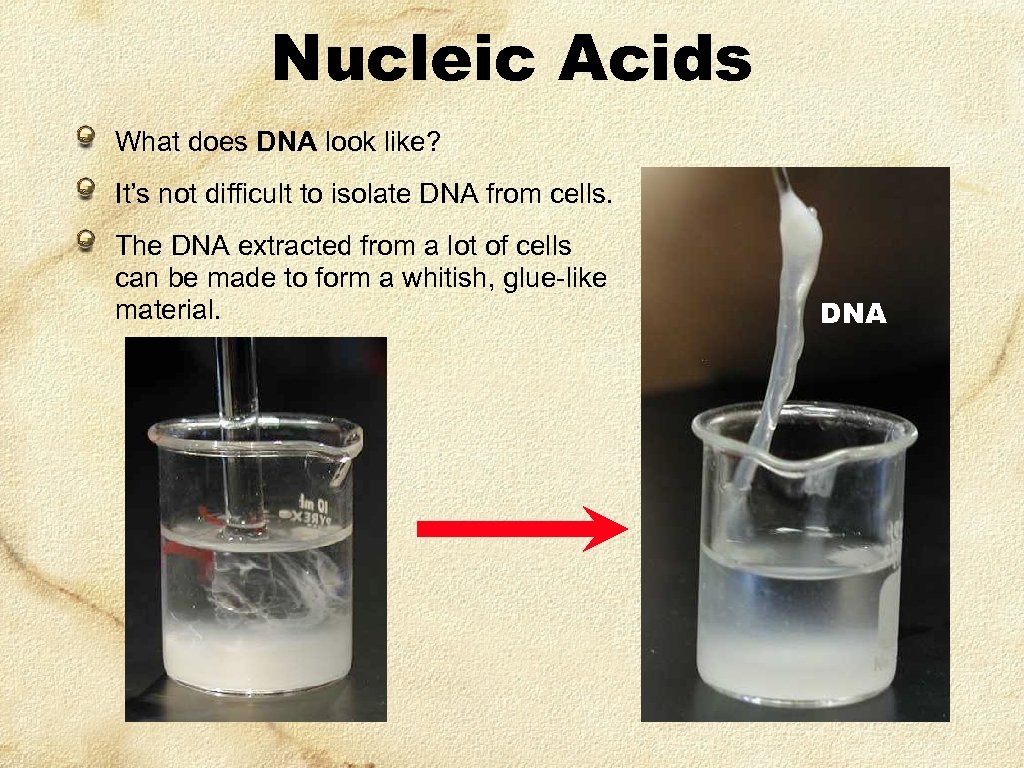 Nucleic Acids What does DNA look like? It’s not difficult to isolate DNA from cells. The DNA extracted from a lot of cells can be made to form a whitish, glue-like material. DNA
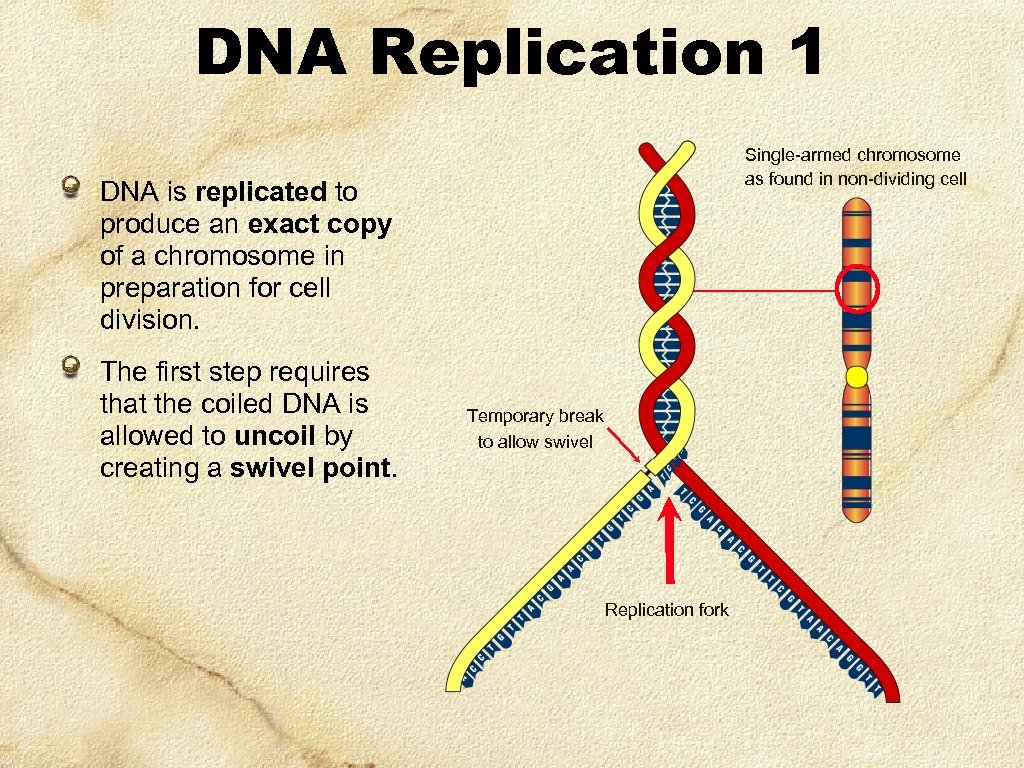 DNA Replication 1 Single-armed chromosome as found in non-dividing cell DNA is replicated to produce an exact copy of a chromosome in preparation for cell division. The first step requires that the coiled DNA is allowed to uncoil by creating a swivel point. Temporary break to allow swivel Replication fork
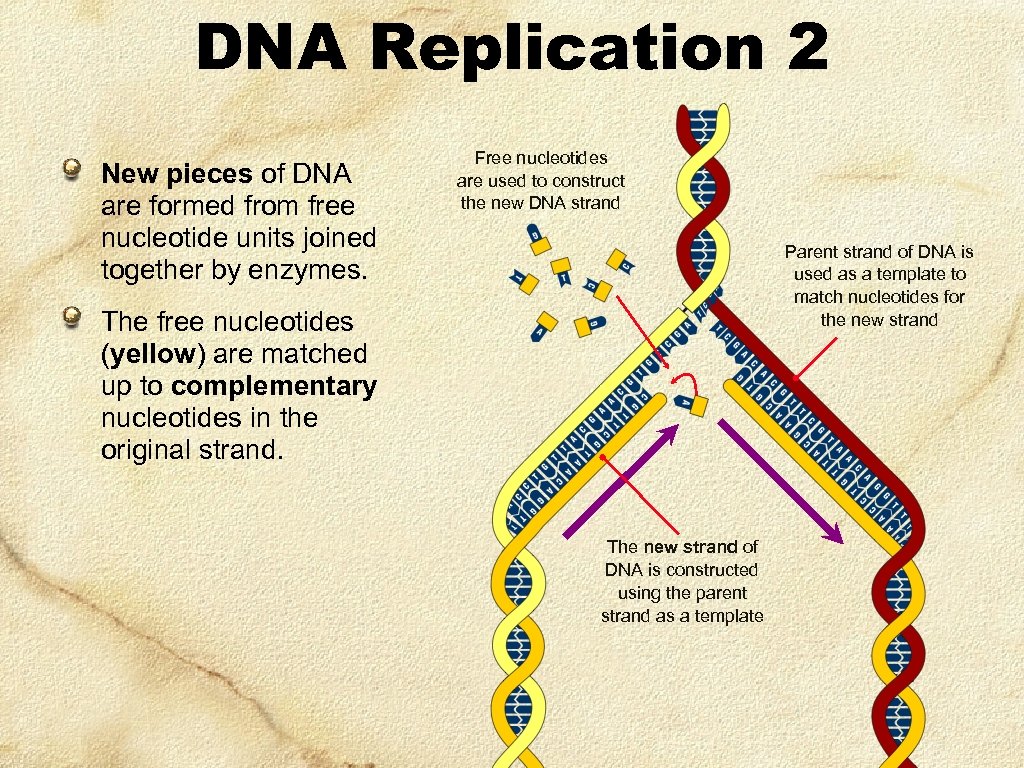 DNA Replication 2 New pieces of DNA are formed from free nucleotide units joined together by enzymes. Free nucleotides are used to construct the new DNA strand Parent strand of DNA is used as a template to match nucleotides for the new strand The free nucleotides (yellow) are matched up to complementary nucleotides in the original strand. The new strand of DNA is constructed using the parent strand as a template
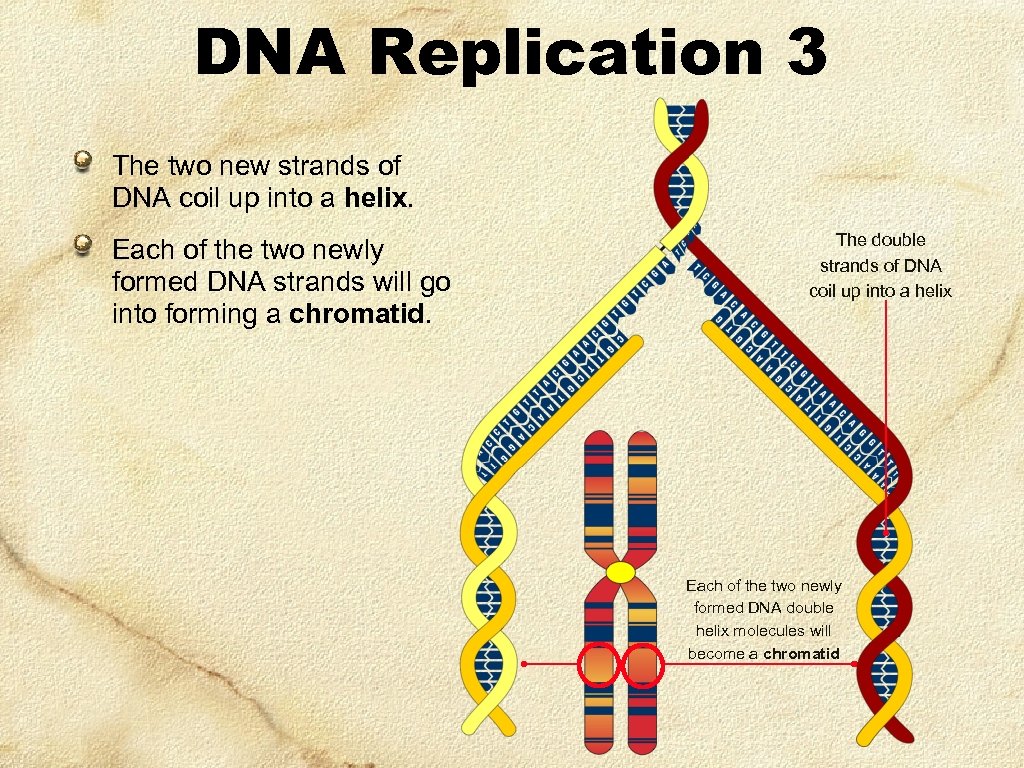 DNA Replication 3 The two new strands of DNA coil up into a helix. Each of the two newly formed DNA strands will go into forming a chromatid. The double strands of DNA coil up into a helix Each of the two newly formed DNA double helix molecules will become a chromatid
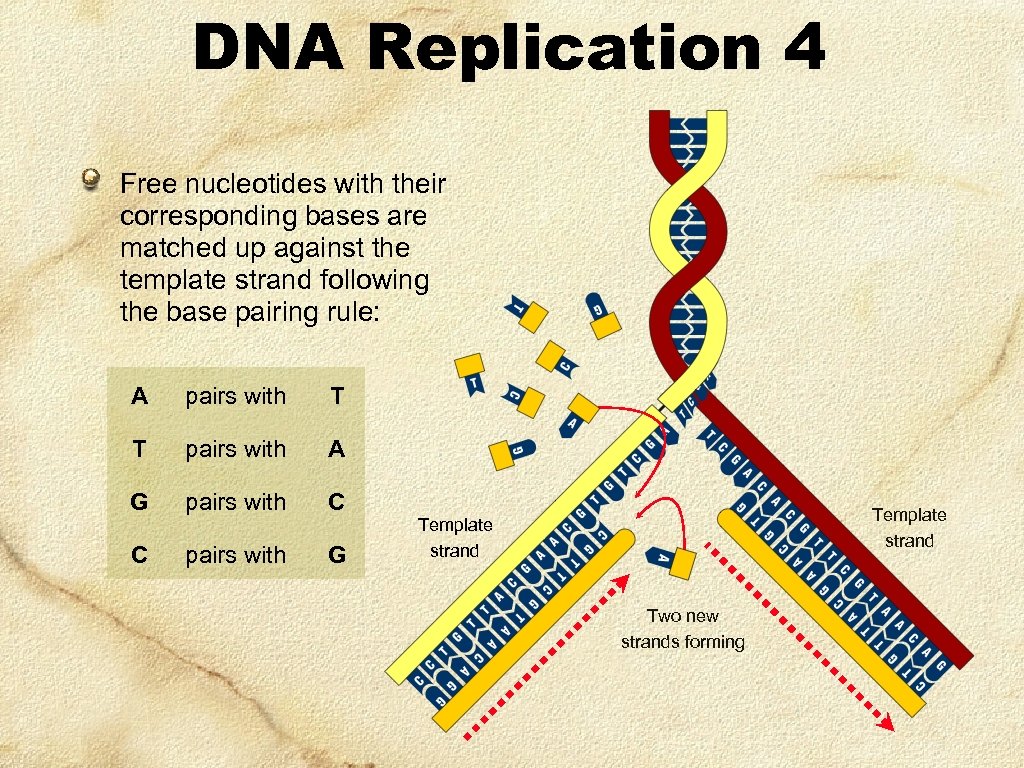 DNA Replication 4 Free nucleotides with their corresponding bases are matched up against the template strand following the base pairing rule: A pairs with T T pairs with A G pairs with C C pairs with G Template strand Two new strands forming
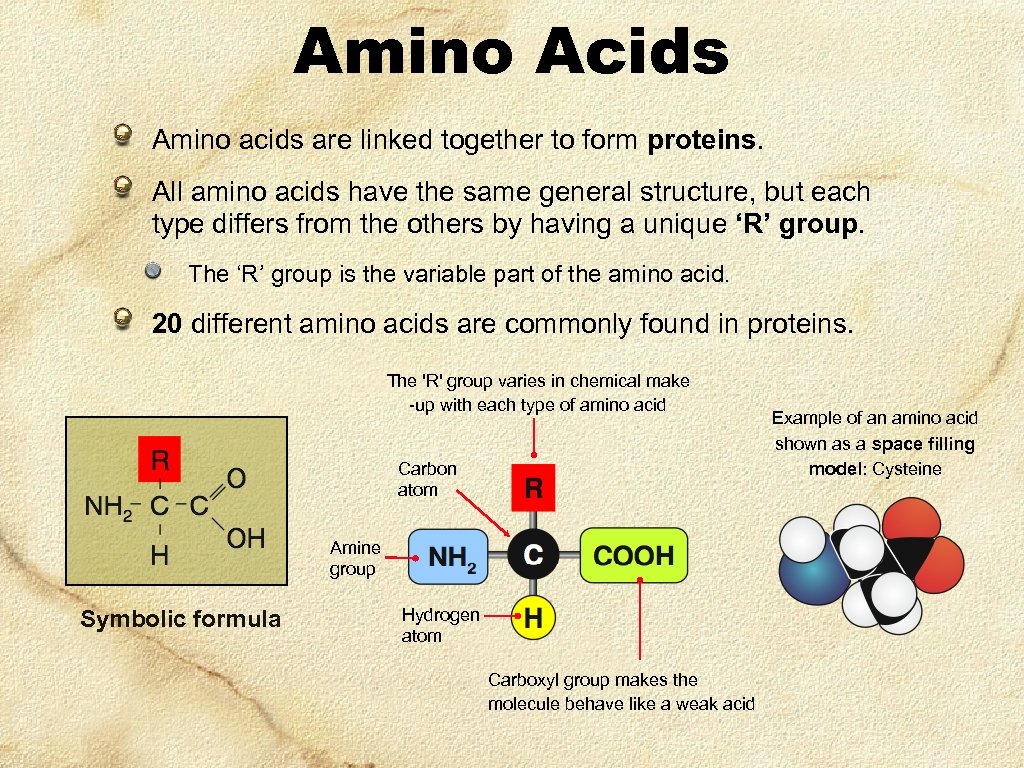 Amino Acids Amino acids are linked together to form proteins. All amino acids have the same general structure, but each type differs from the others by having a unique ‘R’ group. The ‘R’ group is the variable part of the amino acid. 20 different amino acids are commonly found in proteins. The 'R' group varies in chemical make -up with each type of amino acid Carbon atom Amine group Symbolic formula Hydrogen atom Carboxyl group makes the molecule behave like a weak acid Example of an amino acid shown as a space filling model: Cysteine
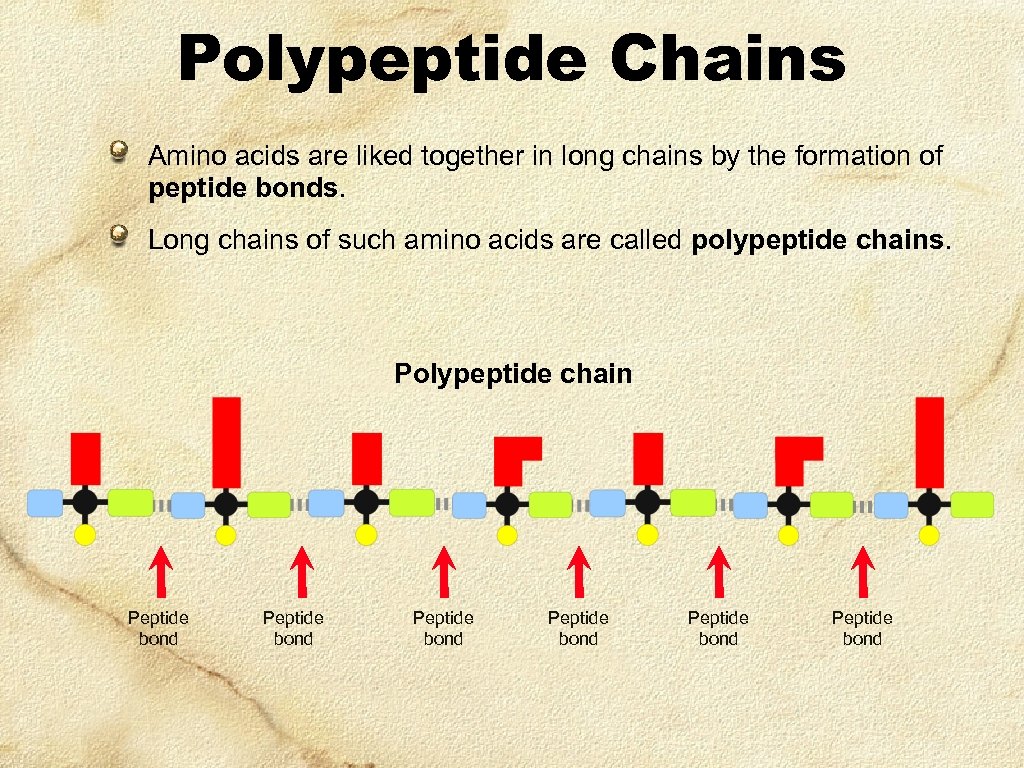 Polypeptide Chains Amino acids are liked together in long chains by the formation of peptide bonds. Long chains of such amino acids are called polypeptide chains. Polypeptide chain Peptide bond Peptide bond
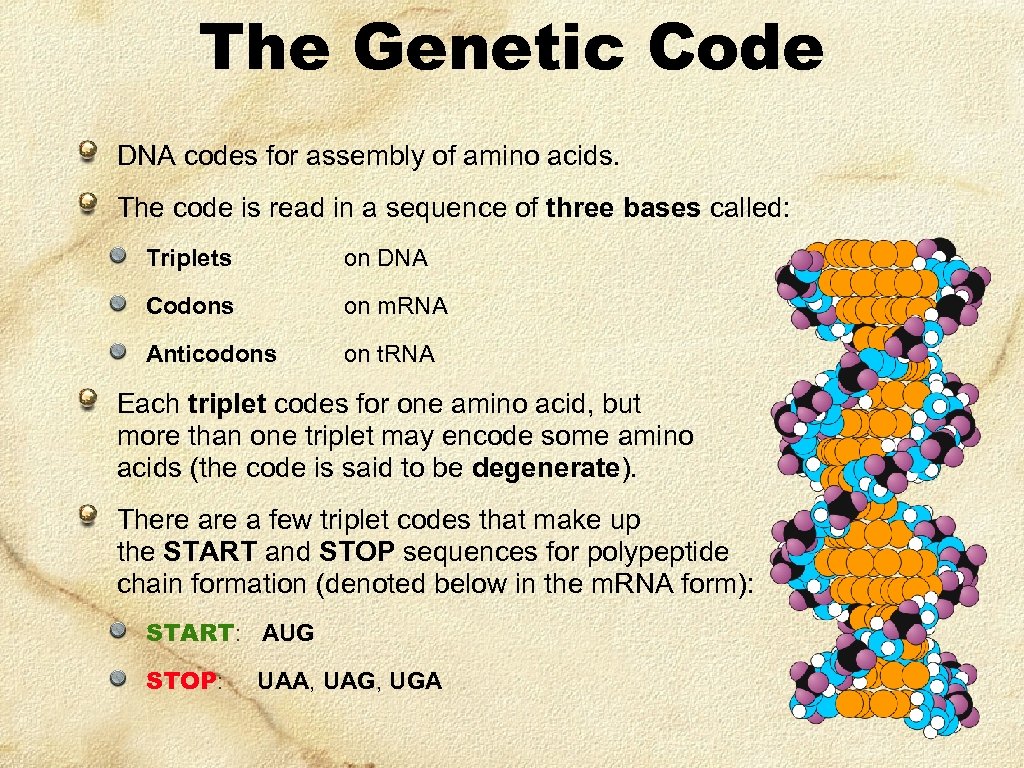 The Genetic Code DNA codes for assembly of amino acids. The code is read in a sequence of three bases called: Triplets on DNA Codons on m. RNA Anticodons on t. RNA Each triplet codes for one amino acid, but more than one triplet may encode some amino acids (the code is said to be degenerate). There a few triplet codes that make up the START and STOP sequences for polypeptide chain formation (denoted below in the m. RNA form): START: AUG STOP: UAA, UAG, UGA
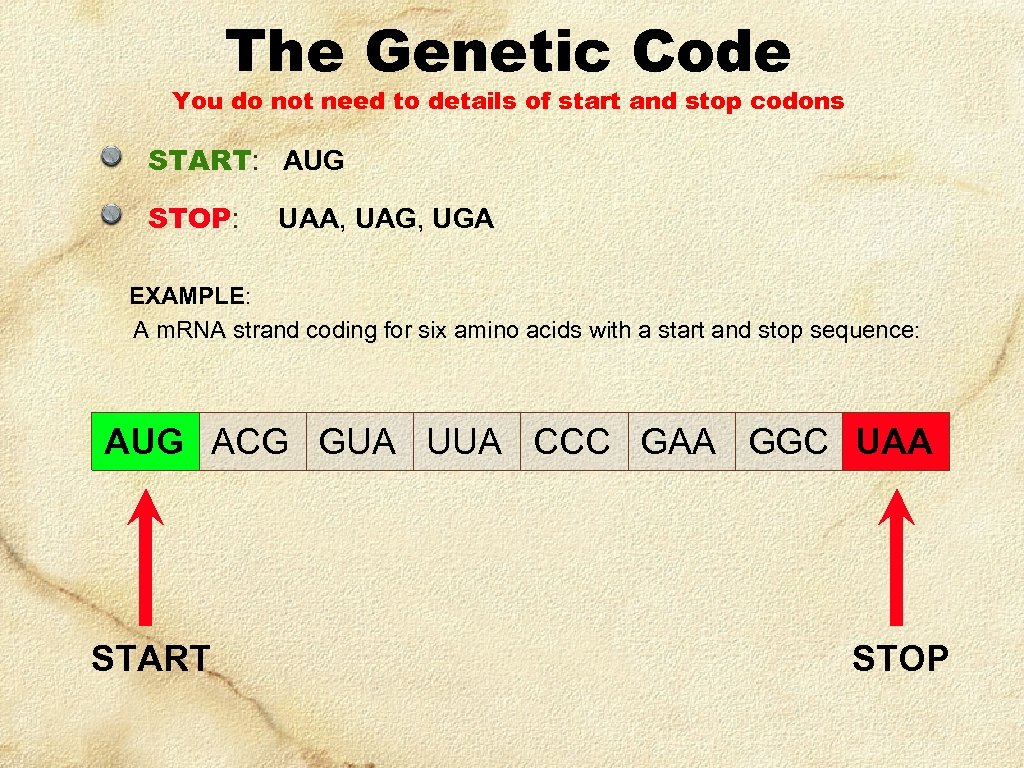 The Genetic Code You do not need to details of start and stop codons START: AUG STOP: UAA, UAG, UGA EXAMPLE: A m. RNA strand coding for six amino acids with a start and stop sequence: AUG ACG GUA UUA CCC GAA GGC UAA START STOP
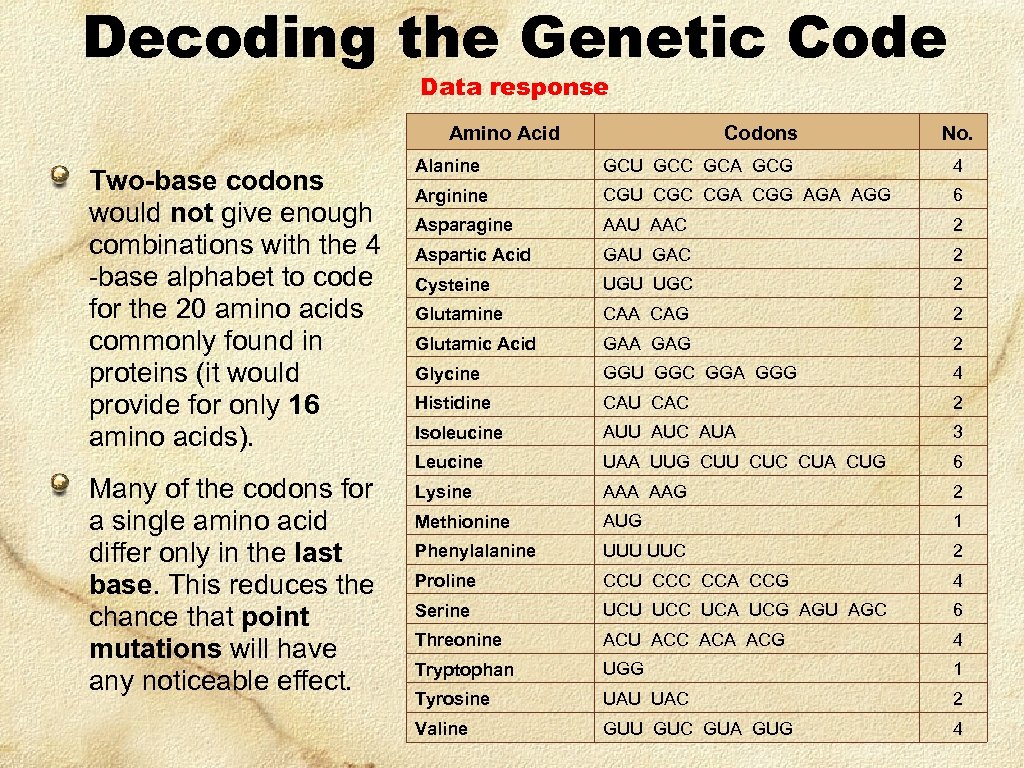 Decoding the Genetic Code Data response Amino Acid Two-base codons would not give enough combinations with the 4 -base alphabet to code for the 20 amino acids commonly found in proteins (it would provide for only 16 amino acids). Many of the codons for a single amino acid differ only in the last base. This reduces the chance that point mutations will have any noticeable effect. Codons No. Alanine GCU GCC GCA GCG 4 Arginine CGU CGC CGA CGG AGA AGG 6 Asparagine AAU AAC 2 Aspartic Acid GAU GAC 2 Cysteine UGU UGC 2 Glutamine CAA CAG 2 Glutamic Acid GAA GAG 2 Glycine GGU GGC GGA GGG 4 Histidine CAU CAC 2 Isoleucine AUU AUC AUA 3 Leucine UAA UUG CUU CUC CUA CUG 6 Lysine AAA AAG 2 Methionine AUG 1 Phenylalanine UUU UUC 2 Proline CCU CCC CCA CCG 4 Serine UCU UCC UCA UCG AGU AGC 6 Threonine ACU ACC ACA ACG 4 Tryptophan UGG 1 Tyrosine UAU UAC 2 Valine GUU GUC GUA GUG 4
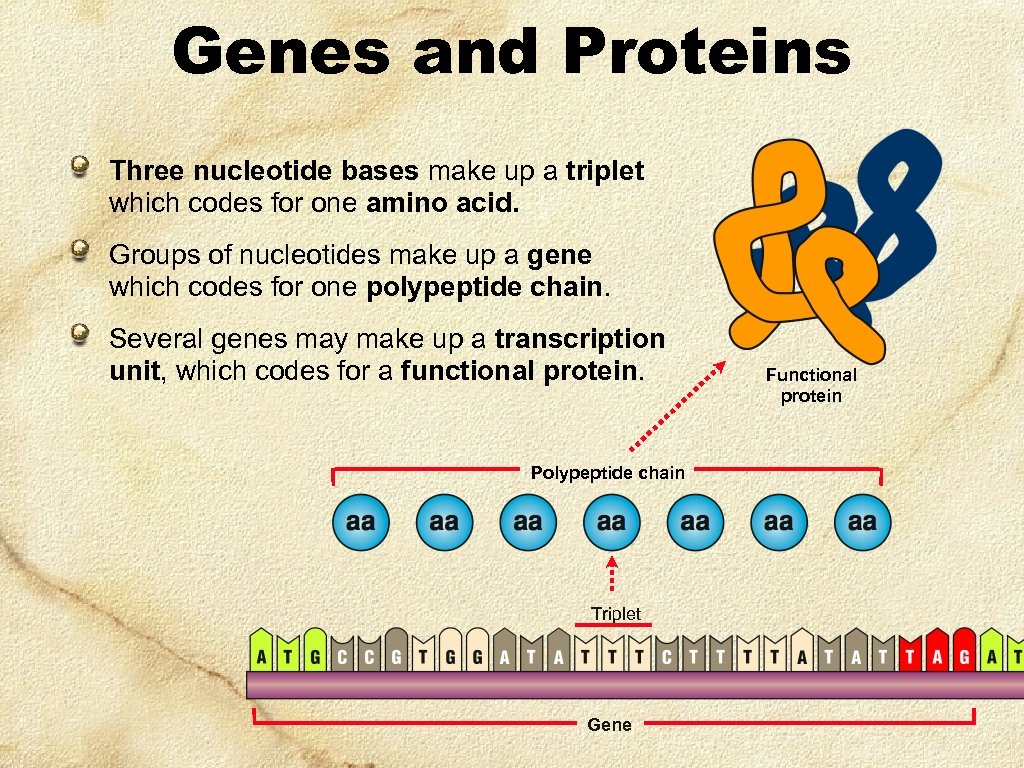 Genes and Proteins Three nucleotide bases make up a triplet which codes for one amino acid. Groups of nucleotides make up a gene which codes for one polypeptide chain. Several genes may make up a transcription unit, which codes for a functional protein. Polypeptide chain Triplet Gene Functional protein
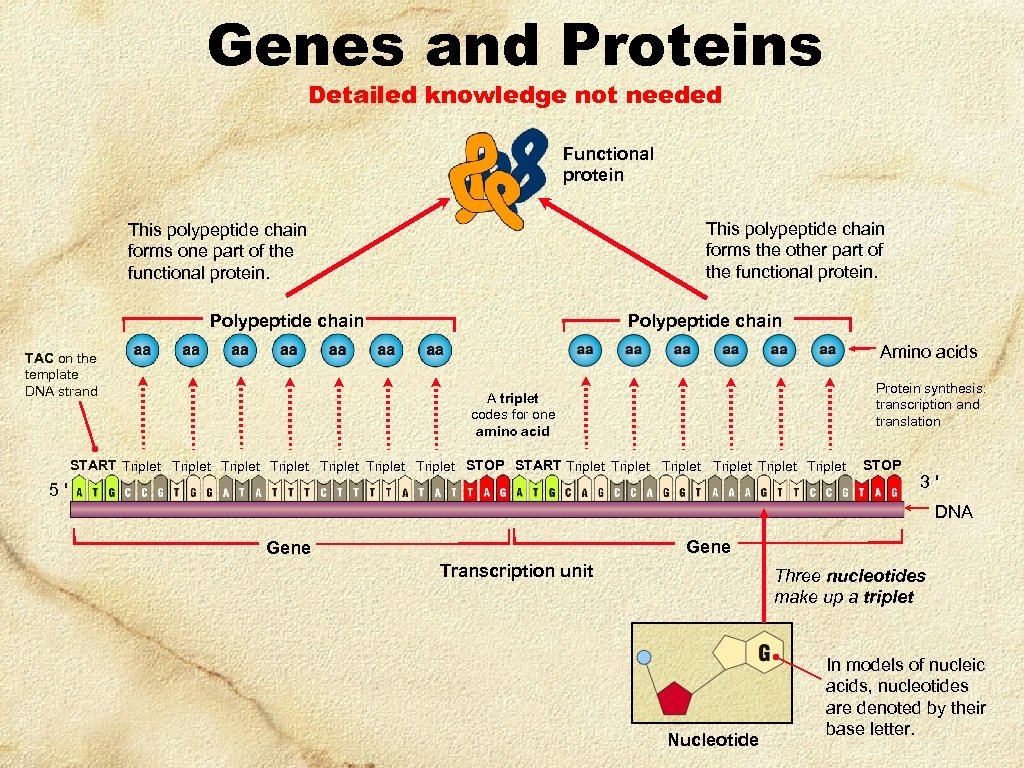 Genes and Proteins Detailed knowledge not needed Functional protein This polypeptide chain forms the other part of the functional protein. This polypeptide chain forms one part of the functional protein. Polypeptide chain Amino acids TAC on the template DNA strand Protein synthesis: transcription and translation A triplet codes for one amino acid START Triplet Triplet STOP START Triplet Triplet 5' STOP 3' DNA Gene Transcription unit Three nucleotides make up a triplet Nucleotide In models of nucleic acids, nucleotides are denoted by their base letter.
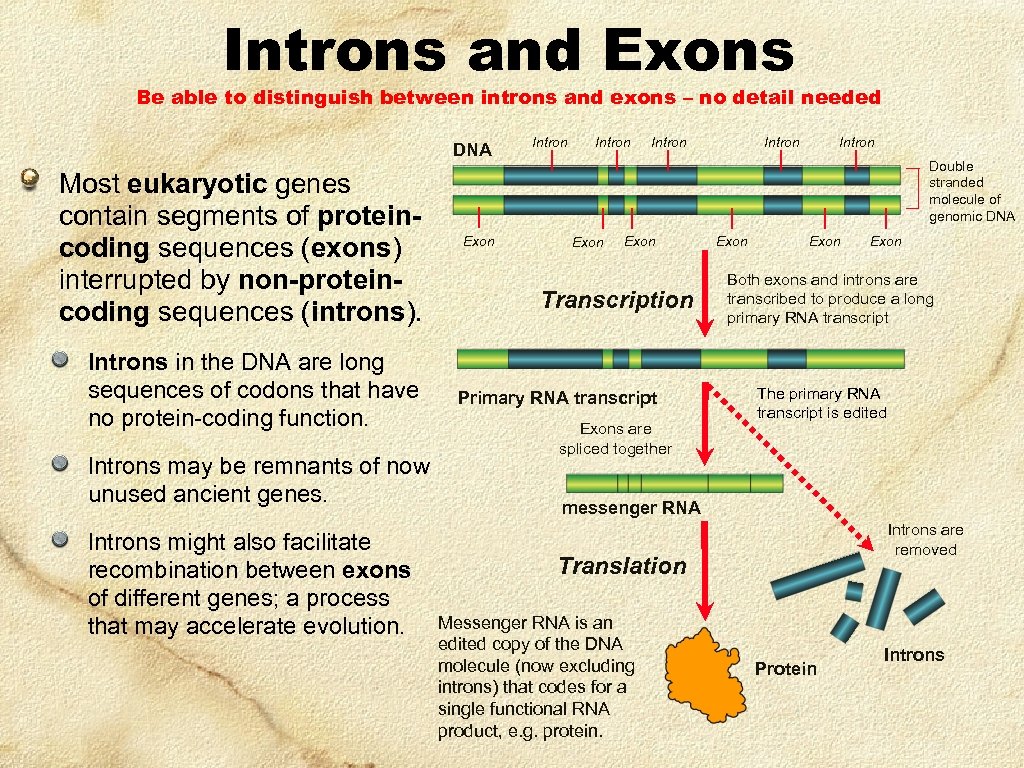 Introns and Exons Be able to distinguish between introns and exons – no detail needed DNA Most eukaryotic genes contain segments of proteincoding sequences (exons) interrupted by non-proteincoding sequences (introns). Introns in the DNA are long sequences of codons that have no protein-coding function. Introns may be remnants of now unused ancient genes. Introns might also facilitate recombination between exons of different genes; a process that may accelerate evolution. Exon Intron Intron Double stranded molecule of genomic DNA Exon Transcription Primary RNA transcript Exons are spliced together Exon Both exons and introns are transcribed to produce a long primary RNA transcript The primary RNA transcript is edited messenger RNA Introns are removed Translation Messenger RNA is an edited copy of the DNA molecule (now excluding introns) that codes for a single functional RNA product, e. g. protein. Protein Introns
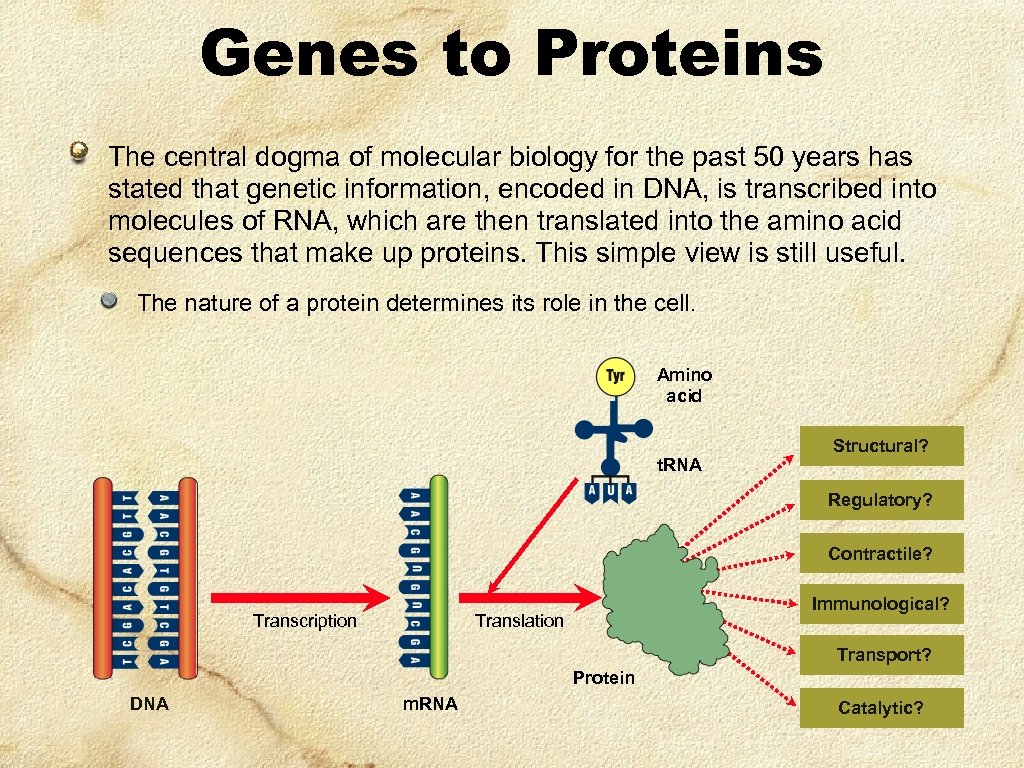 Genes to Proteins The central dogma of molecular biology for the past 50 years has stated that genetic information, encoded in DNA, is transcribed into molecules of RNA, which are then translated into the amino acid sequences that make up proteins. This simple view is still useful. The nature of a protein determines its role in the cell. Amino acid t. RNA Structural? Regulatory? Contractile? Immunological? Translation Transcription Transport? Protein DNA m. RNA Catalytic?
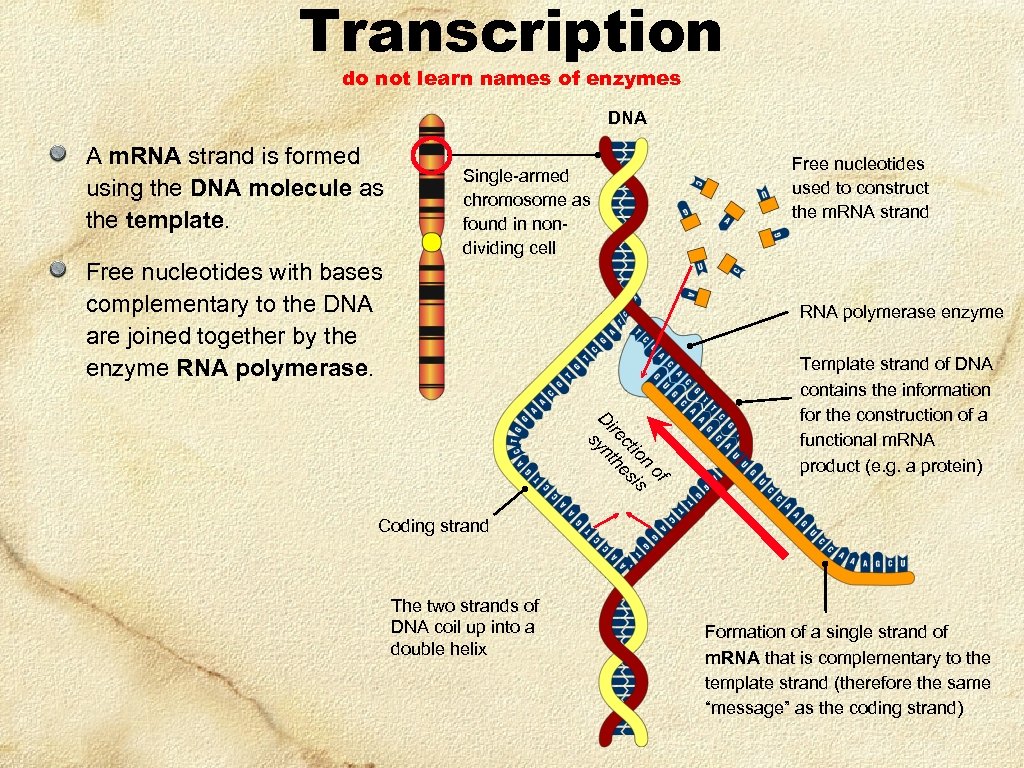 Transcription do not learn names of enzymes DNA A m. RNA strand is formed using the DNA molecule as the template. Single-armed chromosome as found in nondividing cell Free nucleotides with bases complementary to the DNA are joined together by the enzyme RNA polymerase. Free nucleotides used to construct the m. RNA strand RNA polymerase enzyme of n io is ct es ire th D yn s Template strand of DNA contains the information for the construction of a functional m. RNA product (e. g. a protein) Coding strand The two strands of DNA coil up into a double helix Formation of a single strand of m. RNA that is complementary to the template strand (therefore the same “message” as the coding strand)
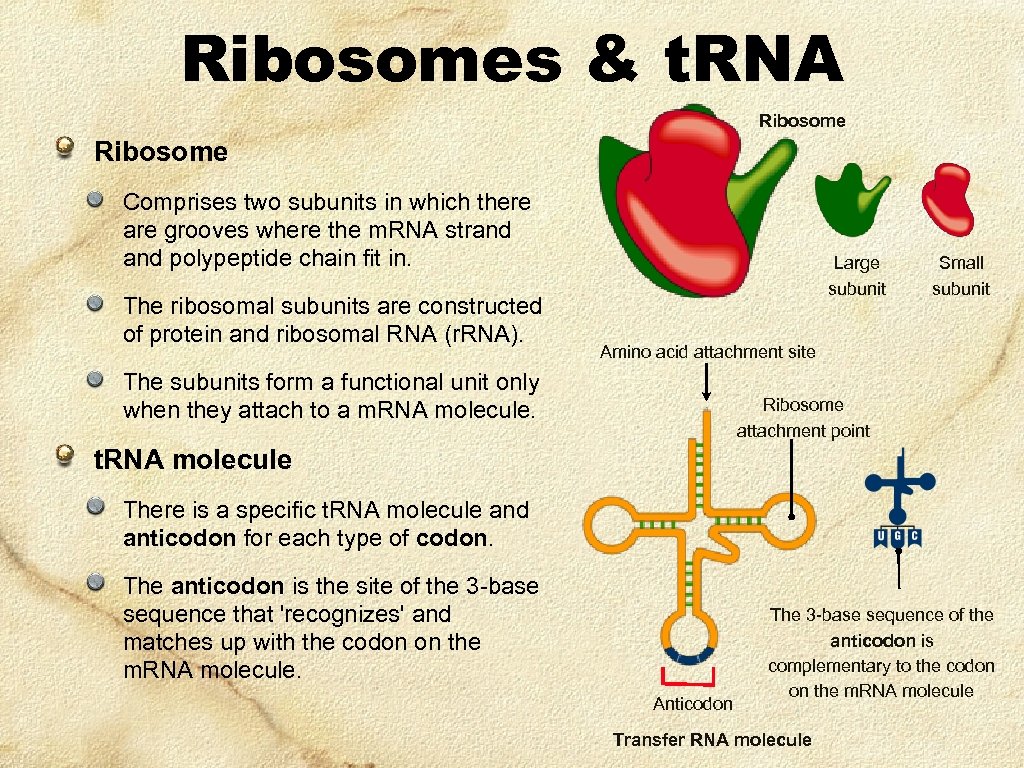 Ribosomes & t. RNA Ribosome Comprises two subunits in which there are grooves where the m. RNA strand polypeptide chain fit in. The ribosomal subunits are constructed of protein and ribosomal RNA (r. RNA). Large subunit Small subunit Amino acid attachment site The subunits form a functional unit only when they attach to a m. RNA molecule. Ribosome attachment point t. RNA molecule There is a specific t. RNA molecule and anticodon for each type of codon. The anticodon is the site of the 3 -base sequence that 'recognizes' and matches up with the codon on the m. RNA molecule. Anticodon The 3 -base sequence of the anticodon is complementary to the codon on the m. RNA molecule Transfer RNA molecule
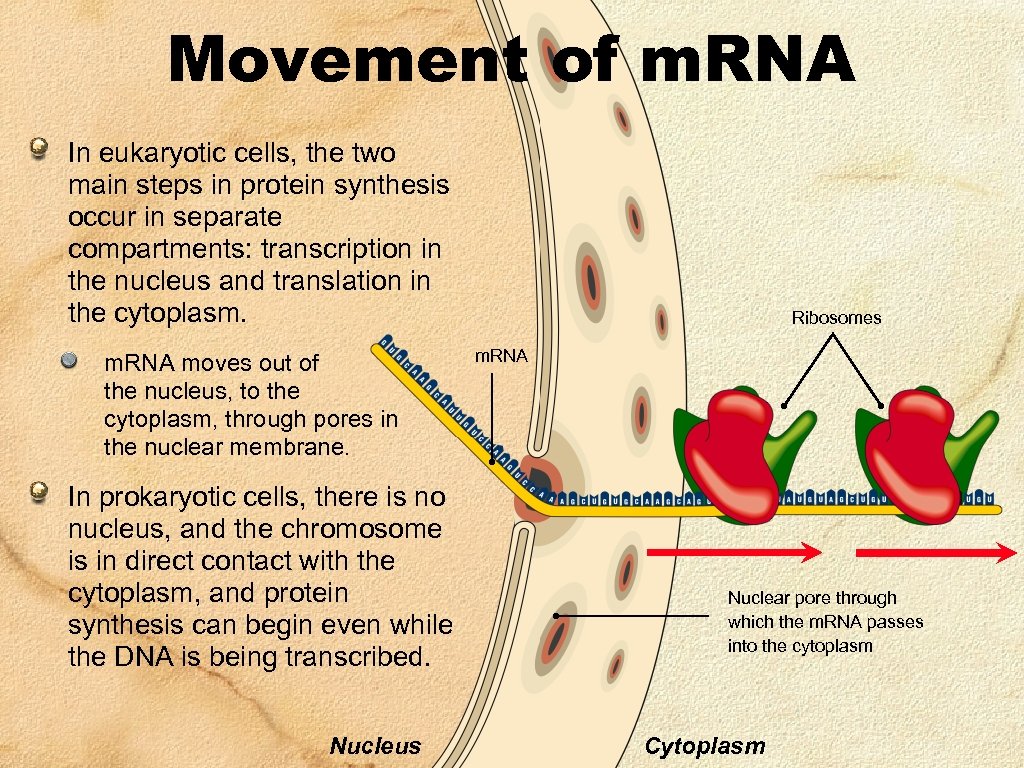 Movement of m. RNA In eukaryotic cells, the two main steps in protein synthesis occur in separate compartments: transcription in the nucleus and translation in the cytoplasm. m. RNA moves out of the nucleus, to the cytoplasm, through pores in the nuclear membrane. In prokaryotic cells, there is no nucleus, and the chromosome is in direct contact with the cytoplasm, and protein synthesis can begin even while the DNA is being transcribed. Nucleus Ribosomes m. RNA Nuclear pore through which the m. RNA passes into the cytoplasm Cytoplasm
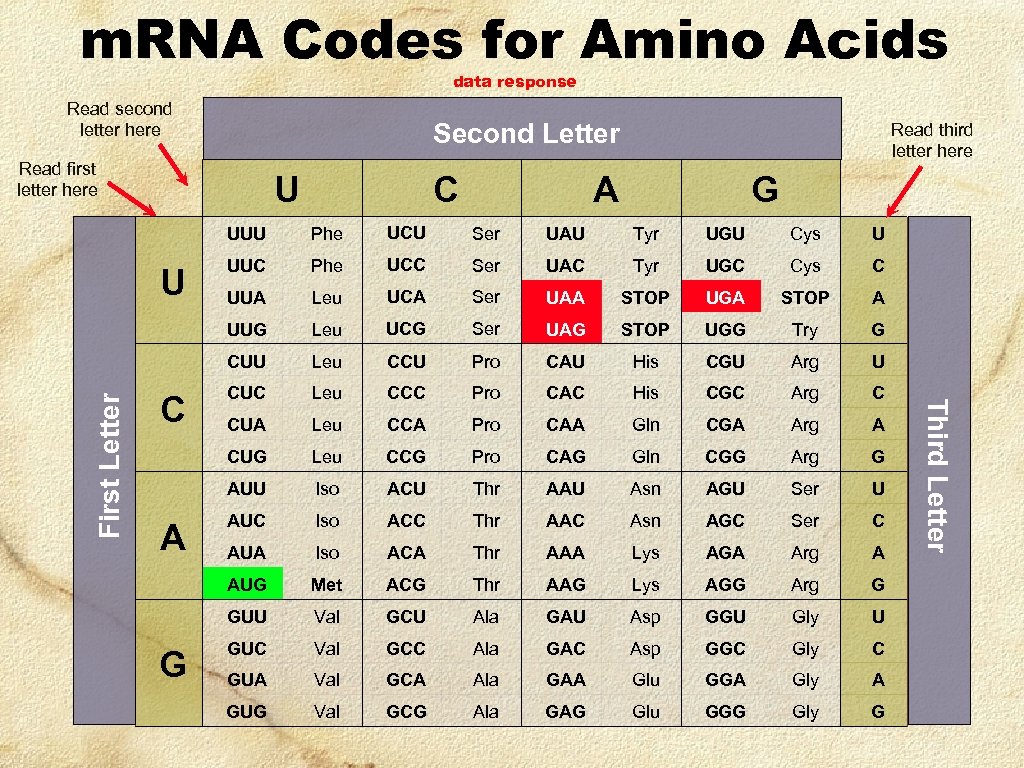 m. RNA Codes for Amino Acids data response Read second letter here Second Letter Read first letter here U C Read third letter here A G First Letter Tyr UGU Cys U UUC Phe UCC Ser UAC Tyr UGC Cys C UUA Leu UCA Ser UAA STOP UGA STOP A Leu UCG Ser UAG STOP UGG Try G Leu CCU Pro CAU His CGU Arg U CUC Leu CCC Pro CAC His CGC Arg C CUA Leu CCA Pro CAA Gln CGA Arg A Leu CCG Pro CAG Gln CGG Arg G AUU Iso ACU Thr AAU Asn AGU Ser U AUC Iso ACC Thr AAC Asn AGC Ser C AUA Iso ACA Thr AAA Lys AGA Arg A AUG Met ACG Thr AAG Lys AGG Arg G GUU G UAU CUG A Ser CUU C UCU UUG U Phe Val GCU Ala GAU Asp GGU Gly U GUC Val GCC Ala GAC Asp GGC Gly C GUA Val GCA Ala GAA Glu GGA Gly A GUG Val GCG Ala GAG Glu GGG Gly G Third Letter UUU
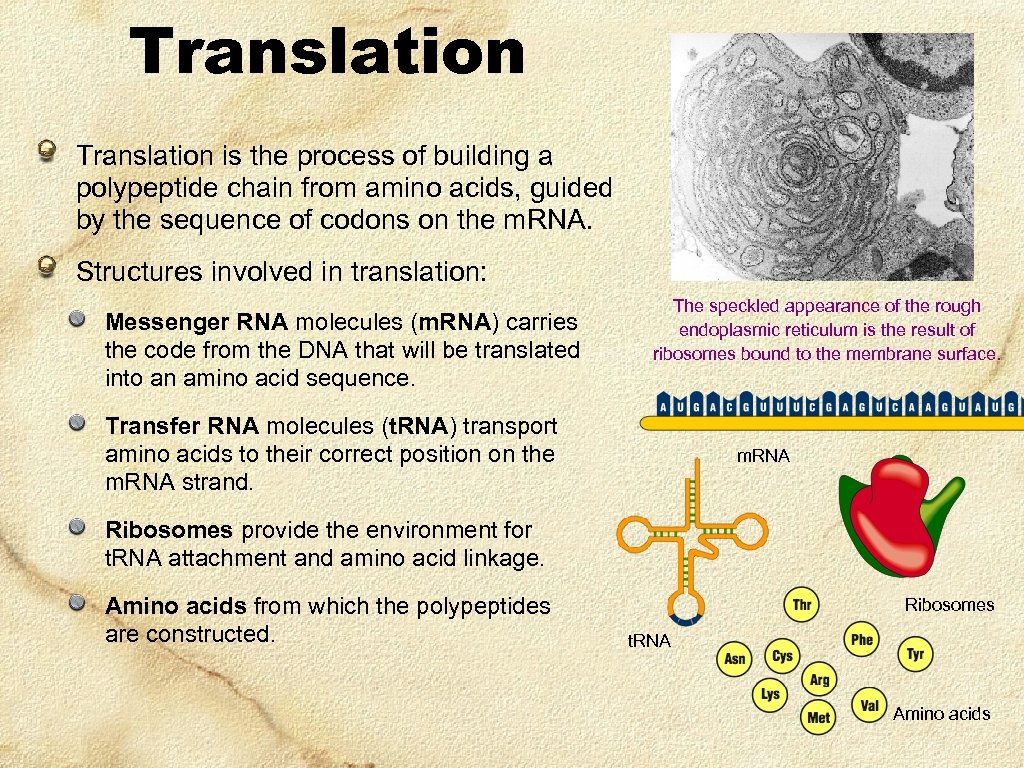 Translation is the process of building a polypeptide chain from amino acids, guided by the sequence of codons on the m. RNA. Structures involved in translation: Messenger RNA molecules (m. RNA) carries the code from the DNA that will be translated into an amino acid sequence. The speckled appearance of the rough endoplasmic reticulum is the result of ribosomes bound to the membrane surface. Transfer RNA molecules (t. RNA) transport amino acids to their correct position on the m. RNA strand. m. RNA Ribosomes provide the environment for t. RNA attachment and amino acid linkage. Amino acids from which the polypeptides are constructed. Ribosomes t. RNA Amino acids
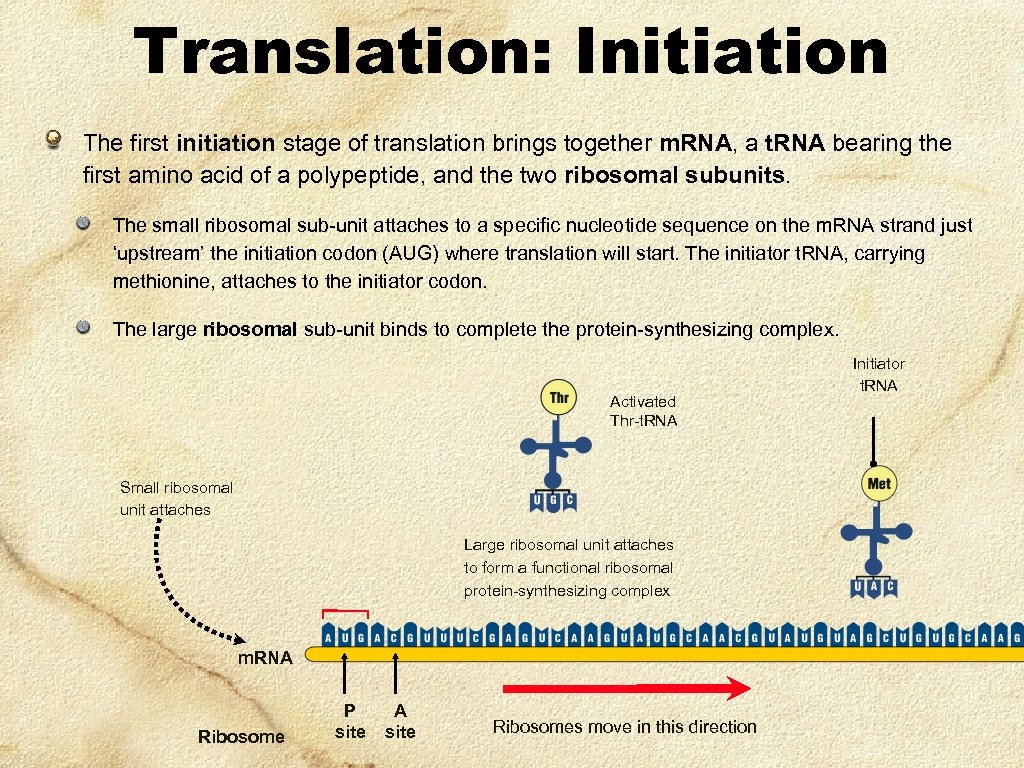 Translation: Initiation The first initiation stage of translation brings together m. RNA, a t. RNA bearing the first amino acid of a polypeptide, and the two ribosomal subunits. The small ribosomal sub-unit attaches to a specific nucleotide sequence on the m. RNA strand just ‘upstream’ the initiation codon (AUG) where translation will start. The initiator t. RNA, carrying methionine, attaches to the initiator codon. The large ribosomal sub-unit binds to complete the protein-synthesizing complex. Activated Thr-t. RNA Small ribosomal unit attaches Large ribosomal unit attaches to form a functional ribosomal protein-synthesizing complex m. RNA Ribosome P site A site Ribosomes move in this direction Initiator t. RNA
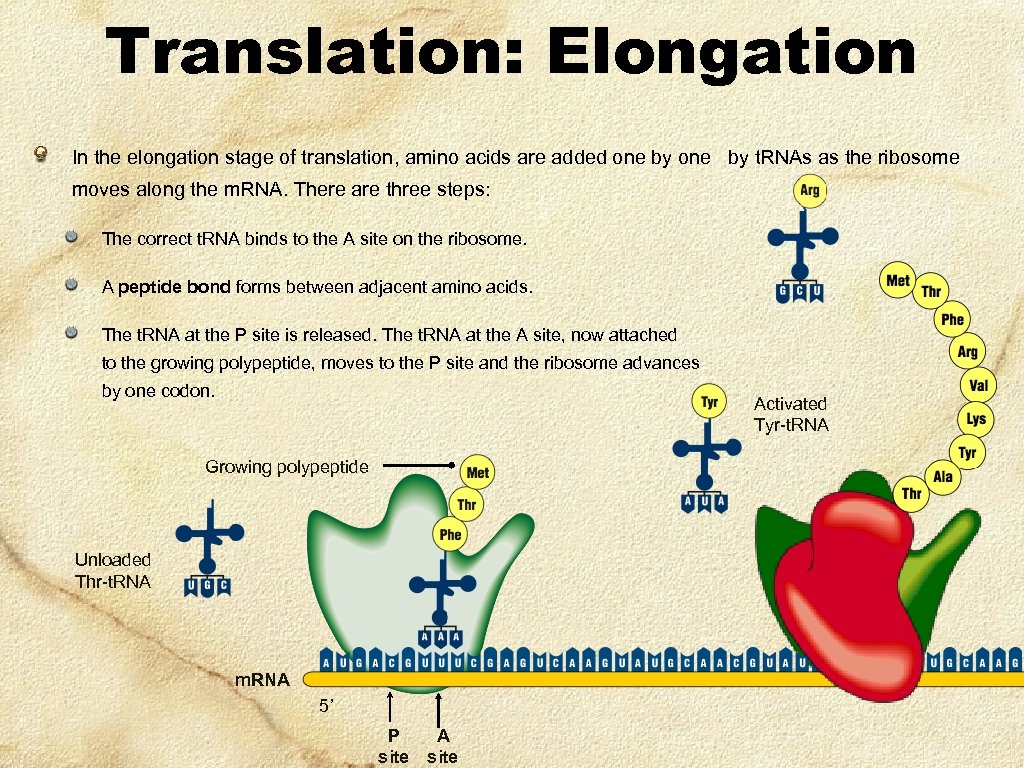 Translation: Elongation In the elongation stage of translation, amino acids are added one by t. RNAs as the ribosome moves along the m. RNA. There are three steps: The correct t. RNA binds to the A site on the ribosome. A peptide bond forms between adjacent amino acids. The t. RNA at the P site is released. The t. RNA at the A site, now attached to the growing polypeptide, moves to the P site and the ribosome advances by one codon. Activated Tyr-t. RNA Growing polypeptide Unloaded Thr-t. RNA m. RNA 5’ P site A site
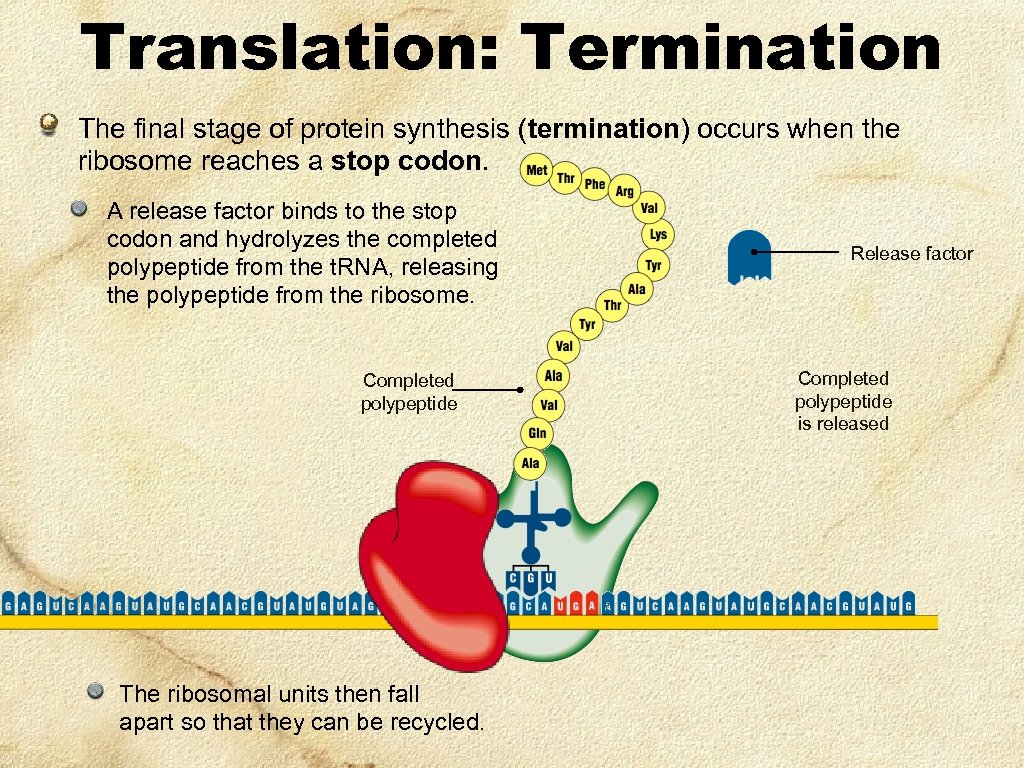 Translation: Termination The final stage of protein synthesis (termination) occurs when the ribosome reaches a stop codon. A release factor binds to the stop codon and hydrolyzes the completed polypeptide from the t. RNA, releasing the polypeptide from the ribosome. Completed polypeptide The ribosomal units then fall apart so that they can be recycled. Release factor Completed polypeptide is released
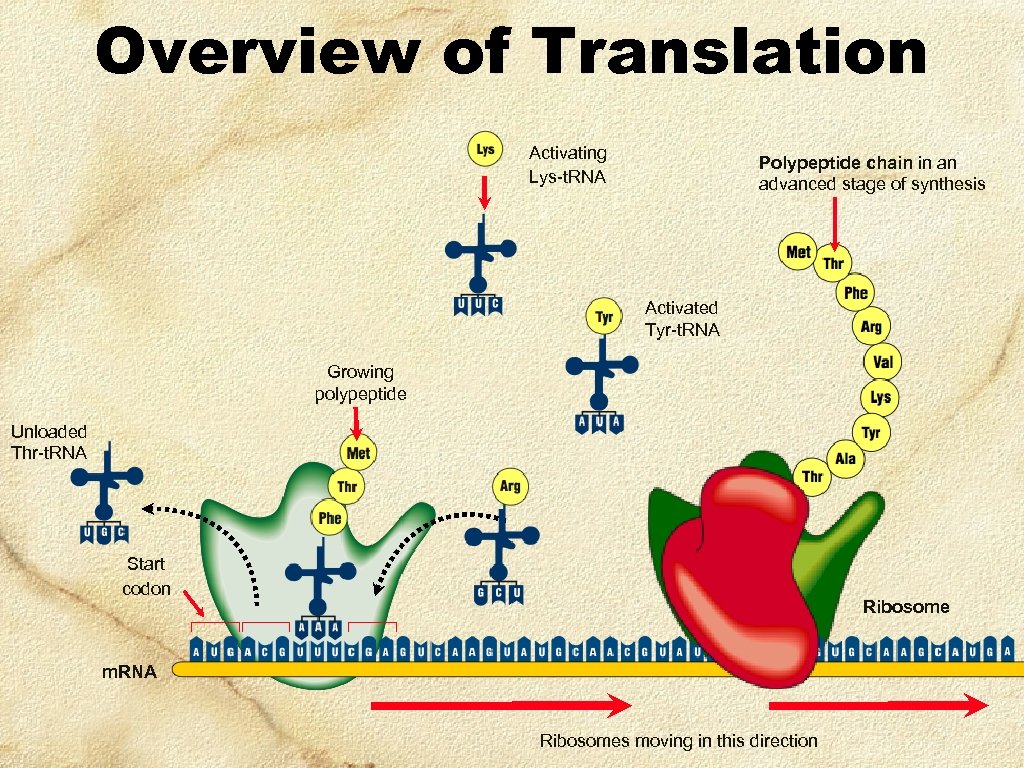 Overview of Translation Activating Lys-t. RNA Polypeptide chain in an advanced stage of synthesis Activated Tyr-t. RNA Growing polypeptide Unloaded Thr-t. RNA Start codon Ribosome m. RNA Ribosomes moving in this direction
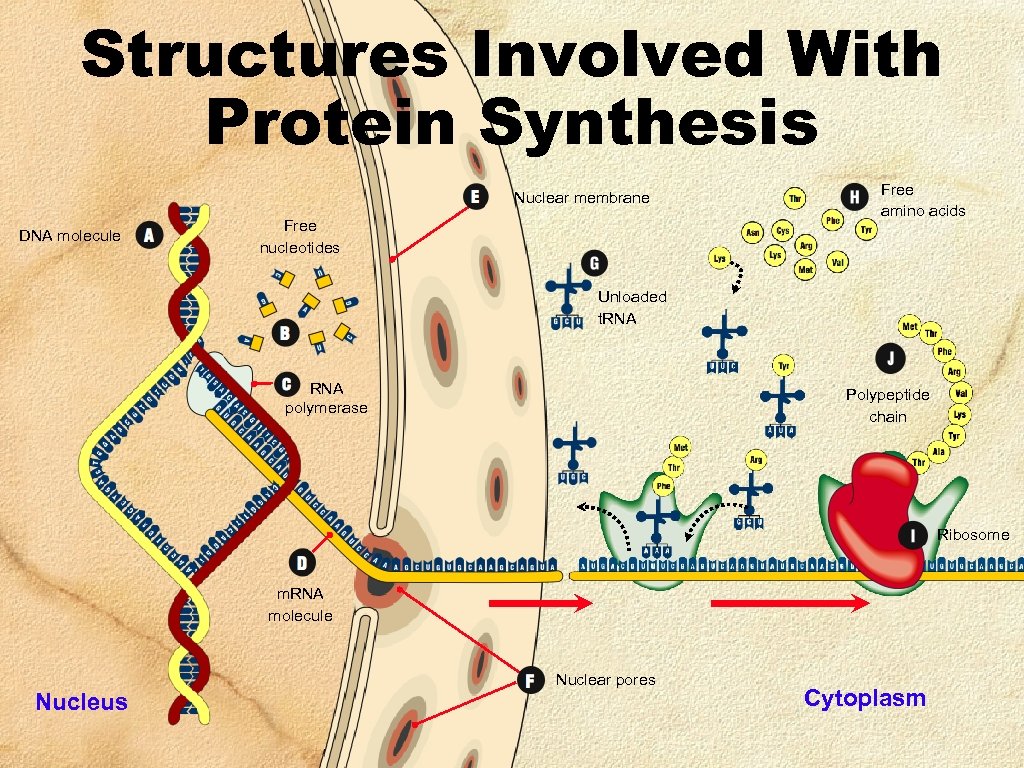 Structures Involved With Protein Synthesis Nuclear membrane DNA molecule Free nucleotides Free amino acids Unloaded t. RNA polymerase Polypeptide chain Ribosome m. RNA molecule Nuclear pores Nucleus Cytoplasm
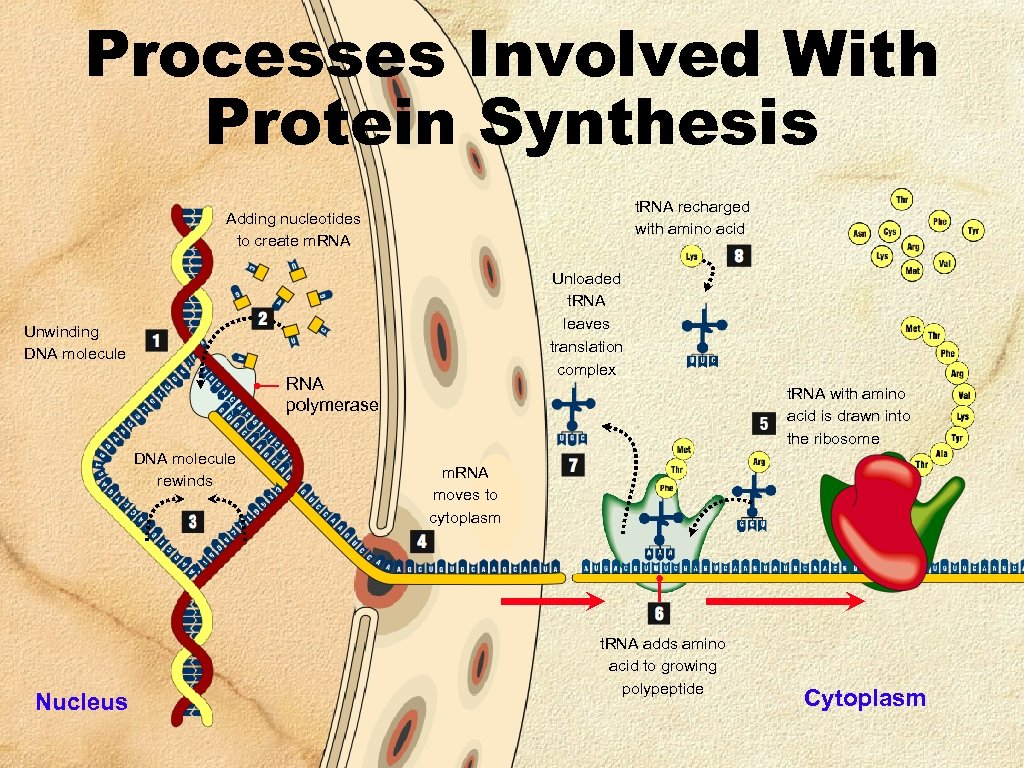 Processes Involved With Protein Synthesis t. RNA recharged with amino acid Adding nucleotides to create m. RNA Unloaded t. RNA leaves translation complex Unwinding DNA molecule RNA polymerase DNA molecule rewinds Nucleus t. RNA with amino acid is drawn into the ribosome m. RNA moves to cytoplasm t. RNA adds amino acid to growing polypeptide Cytoplasm
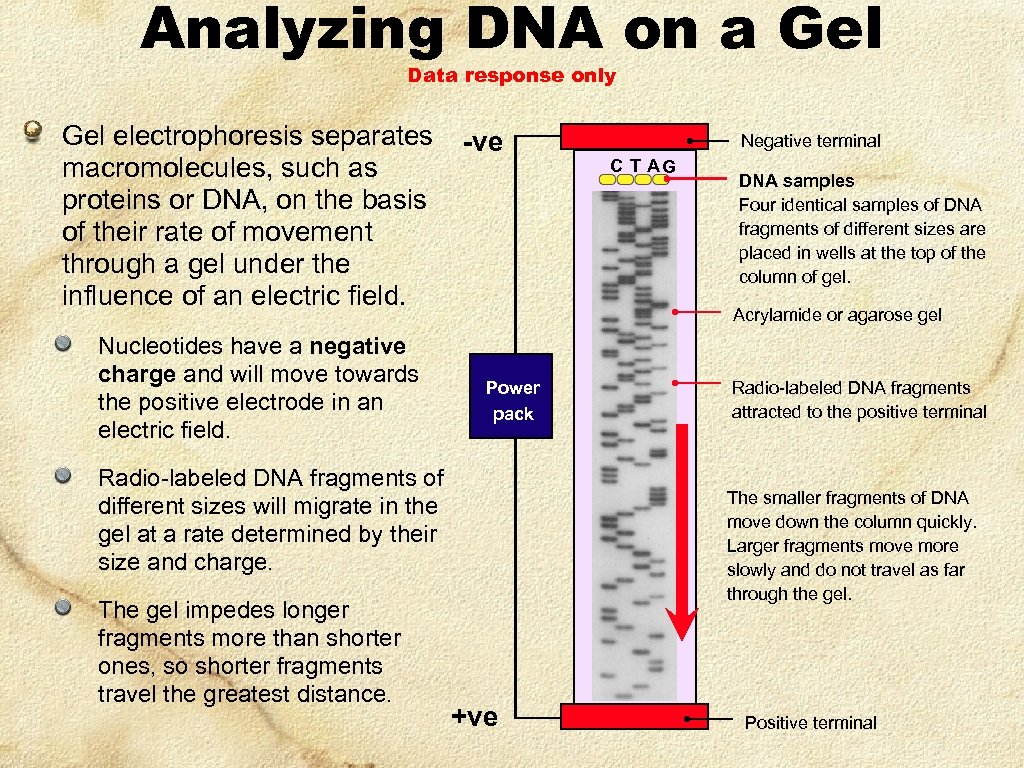 Analyzing DNA on a Gel Data response only Gel electrophoresis separates macromolecules, such as proteins or DNA, on the basis of their rate of movement through a gel under the influence of an electric field. Nucleotides have a negative charge and will move towards the positive electrode in an electric field. -ve C T AG DNA samples Four identical samples of DNA fragments of different sizes are placed in wells at the top of the column of gel. Acrylamide or agarose gel Power pack Radio-labeled DNA fragments of different sizes will migrate in the gel at a rate determined by their size and charge. The gel impedes longer fragments more than shorter ones, so shorter fragments travel the greatest distance. Negative terminal Radio-labeled DNA fragments attracted to the positive terminal The smaller fragments of DNA move down the column quickly. Larger fragments move more slowly and do not travel as far through the gel. +ve Positive terminal
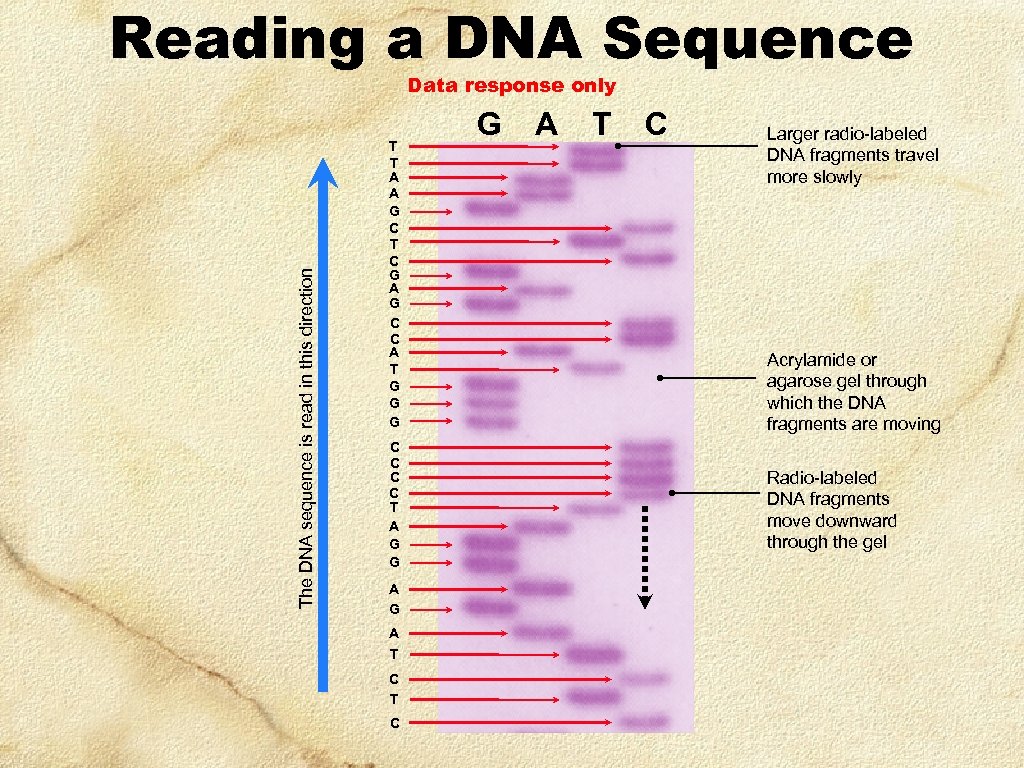 Reading a DNA Sequence The DNA sequence is read in this direction Data response only T T A A G C T C G A G C C A T G G G C C T A G G A T C Larger radio-labeled DNA fragments travel more slowly Acrylamide or agarose gel through which the DNA fragments are moving Radio-labeled DNA fragments move downward through the gel
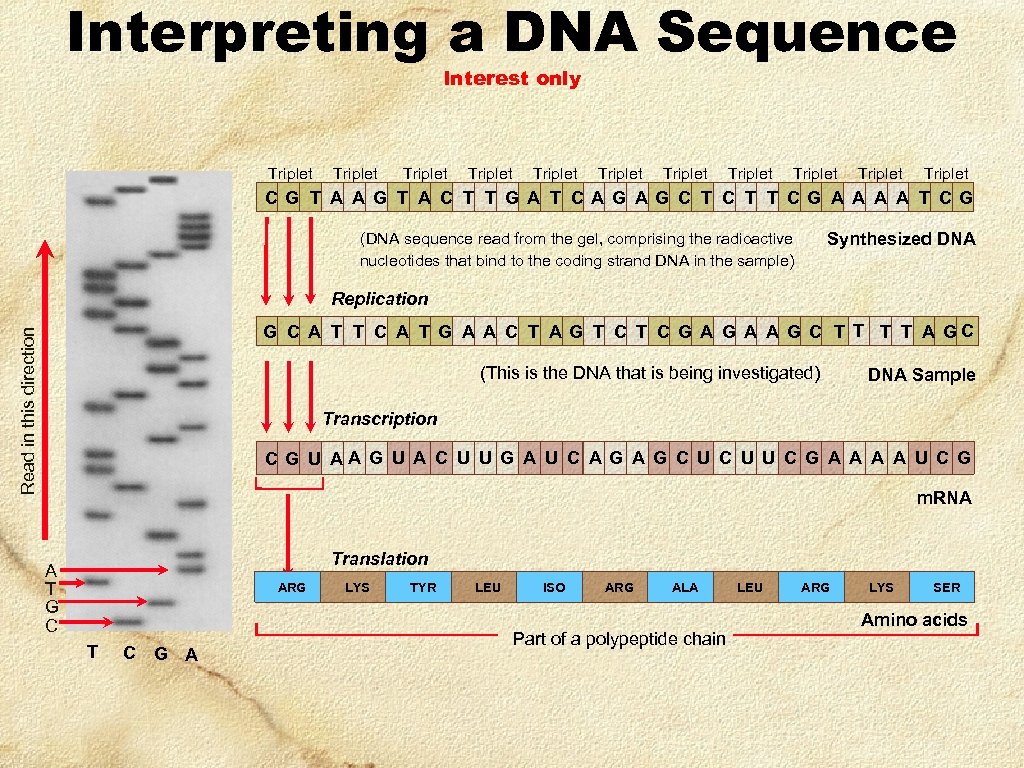 Interpreting a DNA Sequence Interest only Triplet Triplet Triplet C G T A A G T A C T T G A T C A G C T T C G A A T CG (DNA sequence read from the gel, comprising the radioactive nucleotides that bind to the coding strand DNA in the sample) Synthesized DNA Replication Read in this direction G C A T T C A T G A A C T A G T C G A A G C T T A GC (This is the DNA that is being investigated) DNA Sample Transcription C G U AA G U A C U U G A U C A G C U U C G A A U C G m. RNA Translation A T G C ARG T C G A LYS TYR LEU ISO ARG ALA Part of a polypeptide chain LEU ARG LYS SER Amino acids
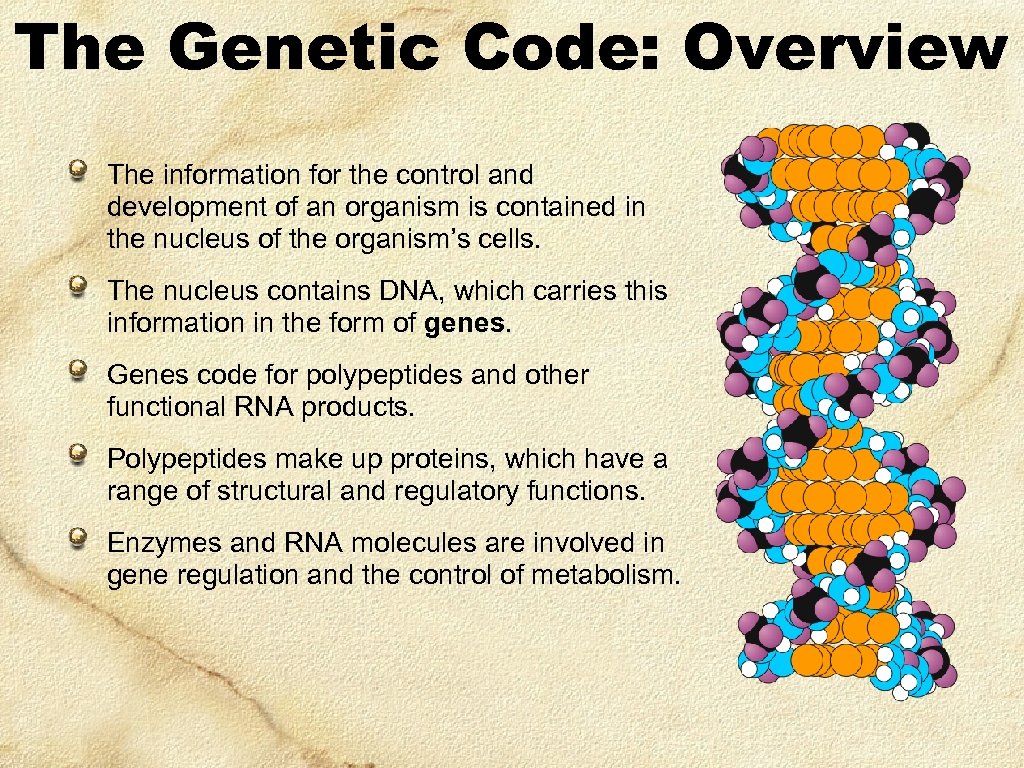 The Genetic Code: Overview The information for the control and development of an organism is contained in the nucleus of the organism’s cells. The nucleus contains DNA, which carries this information in the form of genes. Genes code for polypeptides and other functional RNA products. Polypeptides make up proteins, which have a range of structural and regulatory functions. Enzymes and RNA molecules are involved in gene regulation and the control of metabolism.
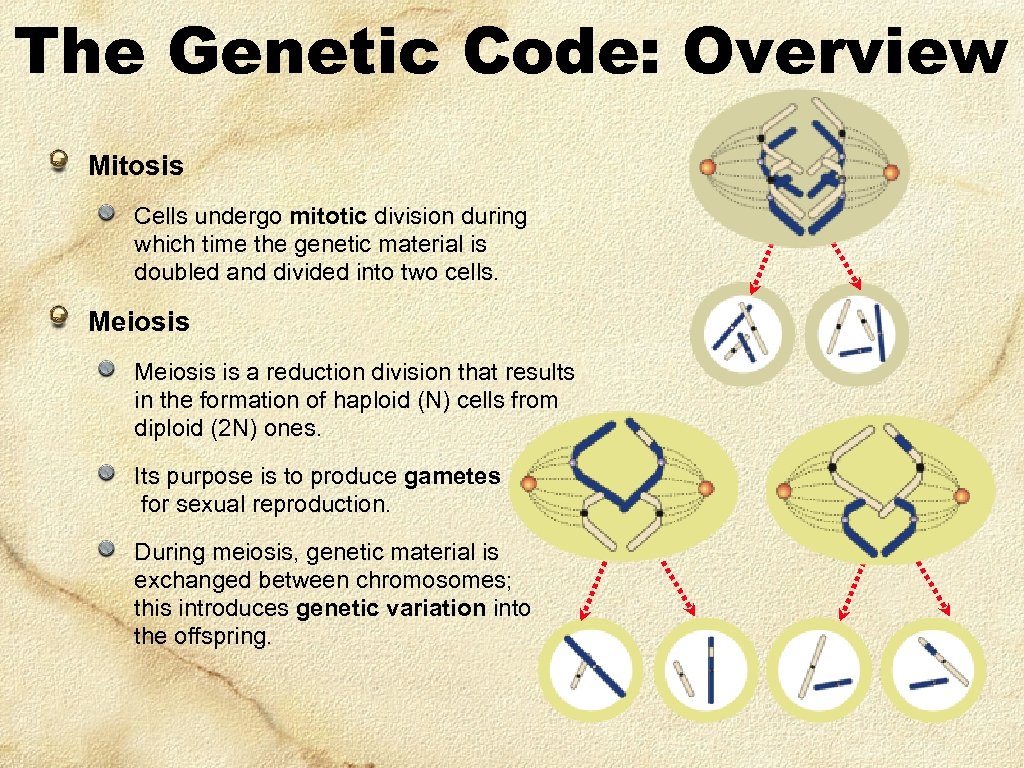 The Genetic Code: Overview Mitosis Cells undergo mitotic division during which time the genetic material is doubled and divided into two cells. Meiosis is a reduction division that results in the formation of haploid (N) cells from diploid (2 N) ones. Its purpose is to produce gametes for sexual reproduction. During meiosis, genetic material is exchanged between chromosomes; this introduces genetic variation into the offspring.
 Terms of Use 1. Biozone International retains copyright to the intellectual property included in this presentation file, with acknowledgement that certain photos are used under license and are credited appropriately on the next screen. 2. You MAY: a. Use these slides for presentations in your classrooms using a data projector, active whiteboard, and overhead projector. b. Place these files on the school’s intranet (school computer network), but not in contradiction of clause 3 (a) below. c. Edit and customise this file by adding, deleting, and modifying information to better suit your needs. d. Place these presentation files on any computer within the school, including staff laptops. 3. You MAY NOT: a. Put these presentation files onto the internet or on a service that may be accessed offsite from the campus. b. Print these files onto paper for distribution to students. c. Create a NEW document using any of the graphics/images in this presentation file. d. Incorporate any part of this presentation file for the production of another commercial product. e. REMOVE any of the references to Biozone, the copyright notices, photo credits, or terms of use from this file.
 Photo Credits Photographic images are used under licence from the following photo libraries: Corel Corporation Professional Photos (various titles, including: Science & Medicine, Agriculture). Art. Today. com Clipart. com Photo. Disc Inc. Hemera Technologies Inc. Photo. Objects. com CDC Public Health Image Library (PHIL) Additional artwork and photographs are the property of Biozone International Ltd. BIOZONE International Ltd | P. O. Box 13 -034, 109 Cambridge Road, Hamilton, NEW ZEALAND Phone: + 64 7 856 -8104 | Fax: + 64 7 856 -9243 | E-mail: sales@biozone. co. nz | Internet: www. biozone. co. nz Copyright © 2005 Biozone International Ltd All rights reserved
 Presentation MEDIA See our other titles: 300 screens 550 screens See full details on our web site: www. thebiozone. com/media. html