


 Скачать презентацию Genetic Programming GP quick overview l l
8d38674348771c8afb1387d6dc35814e.ppt
- Количество слайдов: 28
 Genetic Programming
 GP quick overview l l l Developed: USA in the 1990’s Early names: J. Koza Typically applied to: l l Attributed features: l l machine learning tasks (prediction, classification…) competes with neural nets and alike needs huge populations (thousands) slow Special: l l non-linear chromosomes: trees, graphs mutation possible but not necessary (disputed!)
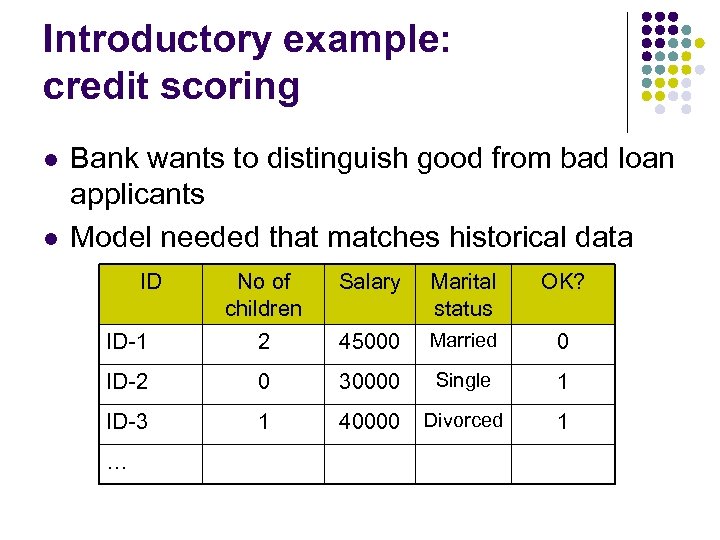 Introductory example: credit scoring l l Bank wants to distinguish good from bad loan applicants Model needed that matches historical data ID No of children Salary Marital status OK? ID-1 2 45000 Married 0 ID-2 0 30000 Single 1 ID-3 1 40000 Divorced 1 …
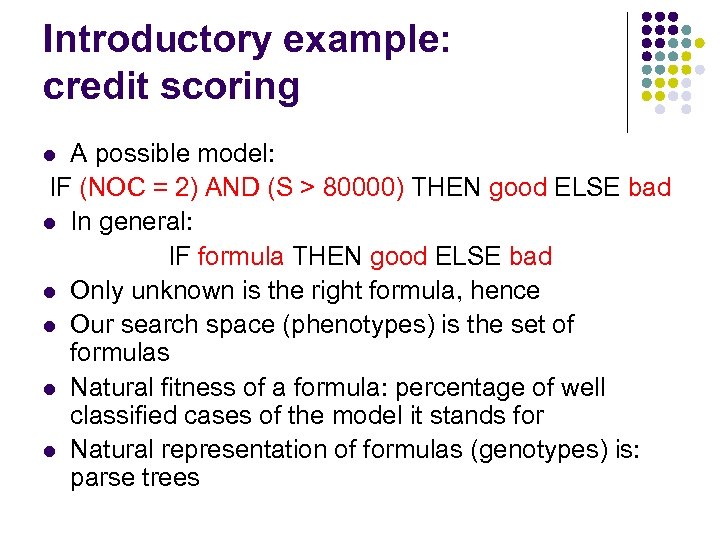 Introductory example: credit scoring A possible model: IF (NOC = 2) AND (S > 80000) THEN good ELSE bad l In general: IF formula THEN good ELSE bad l Only unknown is the right formula, hence l Our search space (phenotypes) is the set of formulas l Natural fitness of a formula: percentage of well classified cases of the model it stands for l Natural representation of formulas (genotypes) is: parse trees l
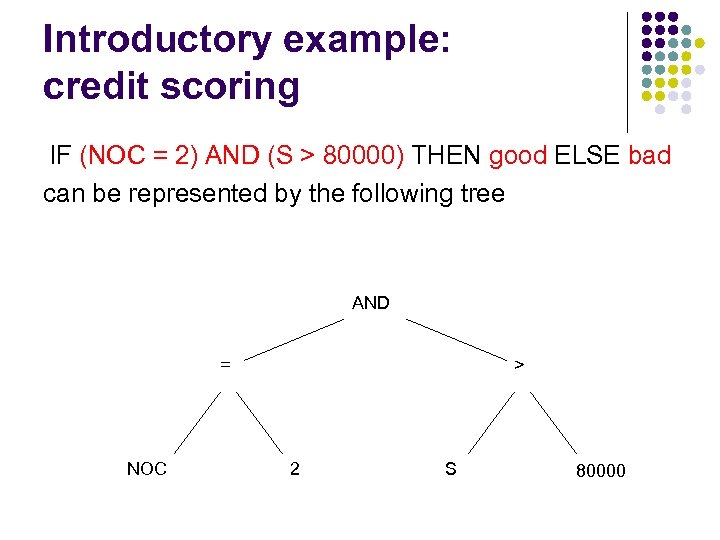 Introductory example: credit scoring IF (NOC = 2) AND (S > 80000) THEN good ELSE bad can be represented by the following tree AND = NOC > 2 S 80000
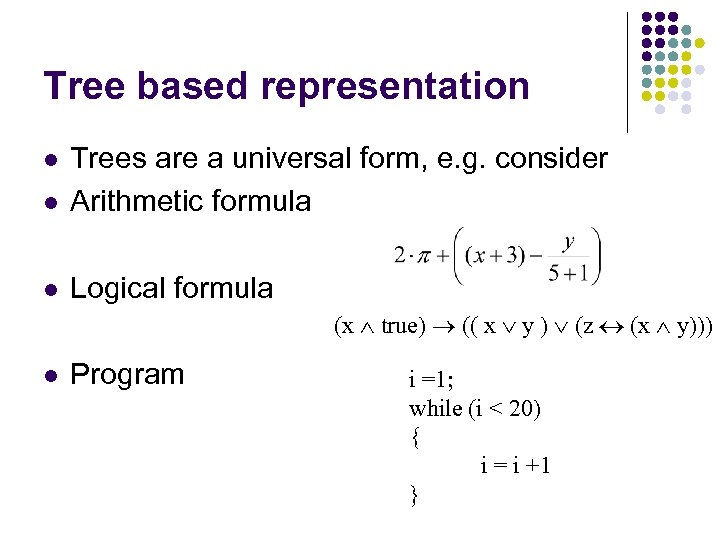 Tree based representation l Trees are a universal form, e. g. consider Arithmetic formula l Logical formula l (x true) (( x y ) (z (x y))) l Program i =1; while (i < 20) { i = i +1 }
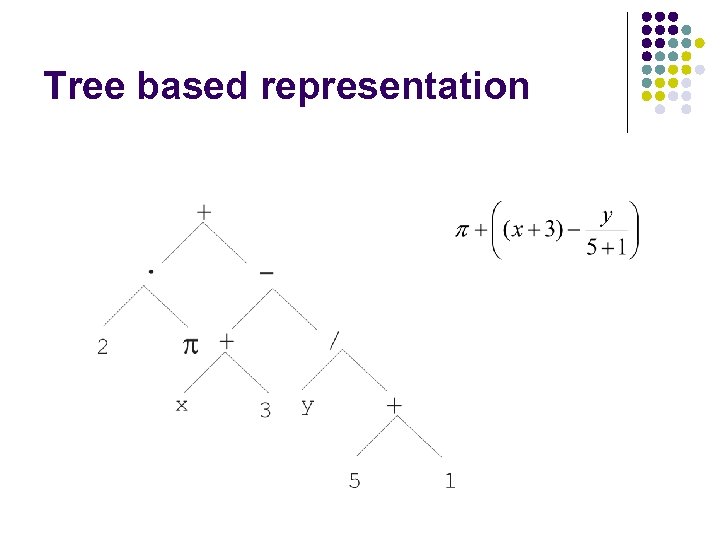 Tree based representation
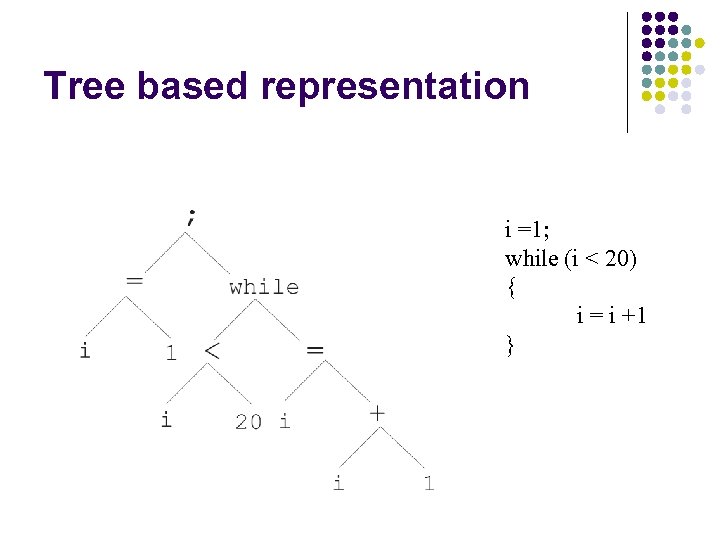 Tree based representation i =1; while (i < 20) { i = i +1 }
 Tree based representation l l In GA, ES, EP chromosomes are linear structures (bit strings, integer string, realvalued vectors, permutations) Tree shaped chromosomes are non-linear structures In GA, ES, EP the size of the chromosomes is fixed Trees in GP may vary in depth and width
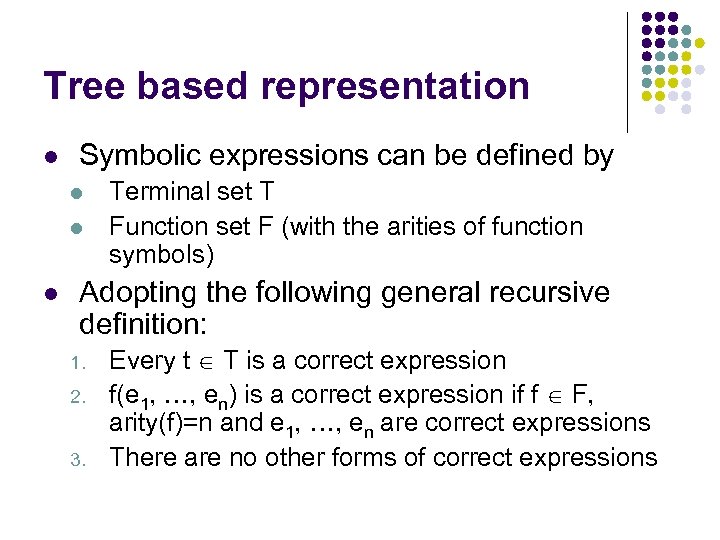 Tree based representation l Symbolic expressions can be defined by l l l Terminal set T Function set F (with the arities of function symbols) Adopting the following general recursive definition: 1. 2. 3. Every t T is a correct expression f(e 1, …, en) is a correct expression if f F, arity(f)=n and e 1, …, en are correct expressions There are no other forms of correct expressions
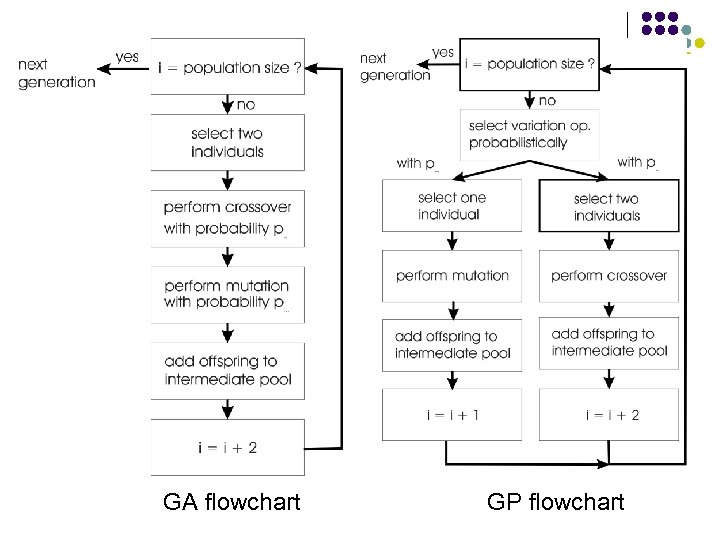 GA flowchart GP flowchart
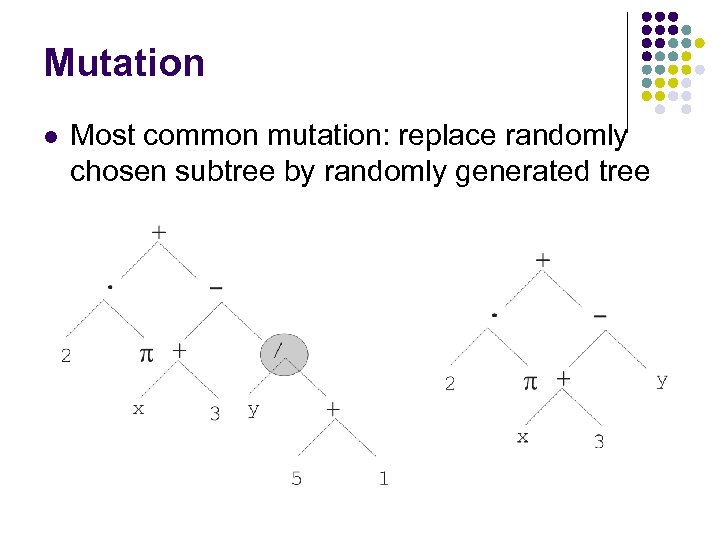 Mutation l Most common mutation: replace randomly chosen subtree by randomly generated tree
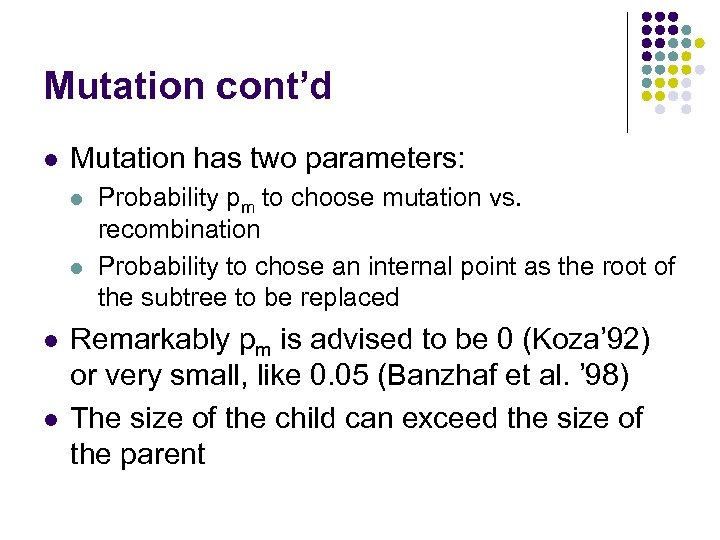 Mutation cont’d l Mutation has two parameters: l l Probability pm to choose mutation vs. recombination Probability to chose an internal point as the root of the subtree to be replaced Remarkably pm is advised to be 0 (Koza’ 92) or very small, like 0. 05 (Banzhaf et al. ’ 98) The size of the child can exceed the size of the parent
 Recombination l l Most common recombination: exchange two randomly chosen subtrees among the parents Recombination has two parameters: l l l Probability pc to choose recombination vs. mutation Probability to chose an internal point within each parent as crossover point The size of offspring can exceed that of the parents
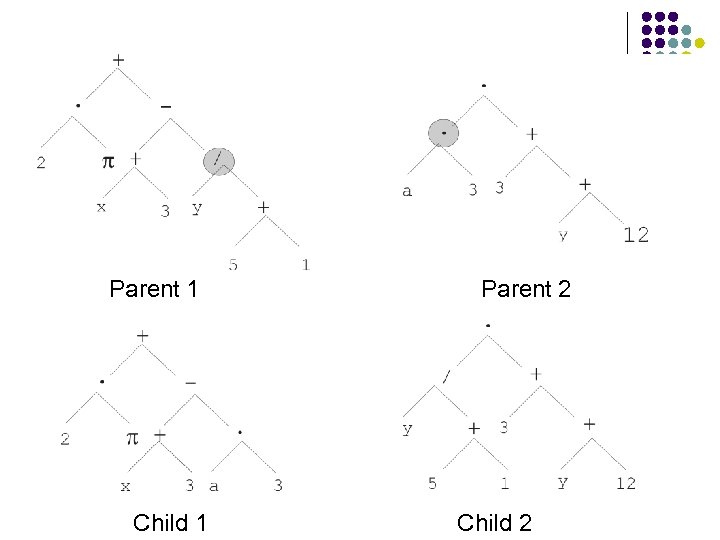 Parent 1 Child 1 Parent 2 Child 2
 Selection l l Parent selection typically fitness proportionate Over-selection in very large populations l l l rank population by fitness and divide it into two groups: group 1: best x% of population, group 2 other (100 -x)% 80% of selection operations chooses from group 1, 20% from group 2 for pop. size = 1000, 2000, 4000, 8000 x = 32%, 16%, 8%, 4% motivation: to increase efficiency, %’s come from rule of thumb Survivor selection: l l Typical: generational scheme (thus none) Recently steady-state is becoming popular for its elitism
 Initialisation l l Maximum initial depth of trees Dmax is set Full method (each branch has depth = Dmax): l l l Grow method (each branch has depth Dmax): l l l nodes at depth d < Dmax randomly chosen from function set F nodes at depth d = Dmax randomly chosen from terminal set T nodes at depth d < Dmax randomly chosen from F T nodes at depth d = Dmax randomly chosen from T Common GP initialisation: ramped half-and-half, where grow & full method each deliver half of initial population
 Bloat l l l Bloat = “survival of the fattest”, i. e. , the tree sizes in the population are increasing over time Ongoing research and debate about the reasons Needs countermeasures, e. g. l l Prohibiting variation operators that would deliver “too big” children Parsimony pressure: penalty for being oversized
 Problems involving “physical” environments l l l Trees for data fitting vs. trees (programs) that are “really” executable Execution can change the environment the calculation of fitness Example: robot controller Fitness calculations mostly by simulation, ranging from expensive to extremely expensive (in time) But evolved controllers are often to very good
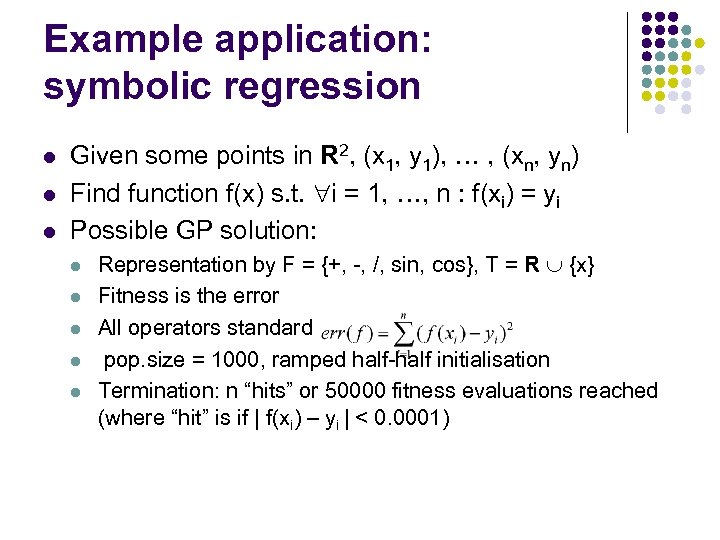 Example application: symbolic regression l l l Given some points in R 2, (x 1, y 1), … , (xn, yn) Find function f(x) s. t. i = 1, …, n : f(xi) = yi Possible GP solution: l l l Representation by F = {+, -, /, sin, cos}, T = R {x} Fitness is the error All operators standard pop. size = 1000, ramped half-half initialisation Termination: n “hits” or 50000 fitness evaluations reached (where “hit” is if | f(xi) – yi | < 0. 0001)
 Discussion Is GP: The art of evolving computer programs ? Means to automated programming of computers? GA with another representation?
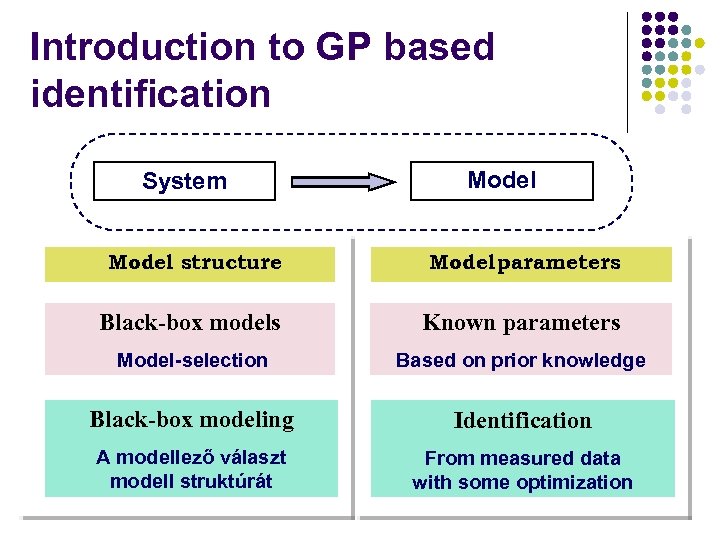 Introduction to GP based identification System Model structure Model parameters Black-box models Known parameters Model-selection Based on prior knowledge Black-box modeling Identification A modellező választ modell struktúrát From measured data with some optimization
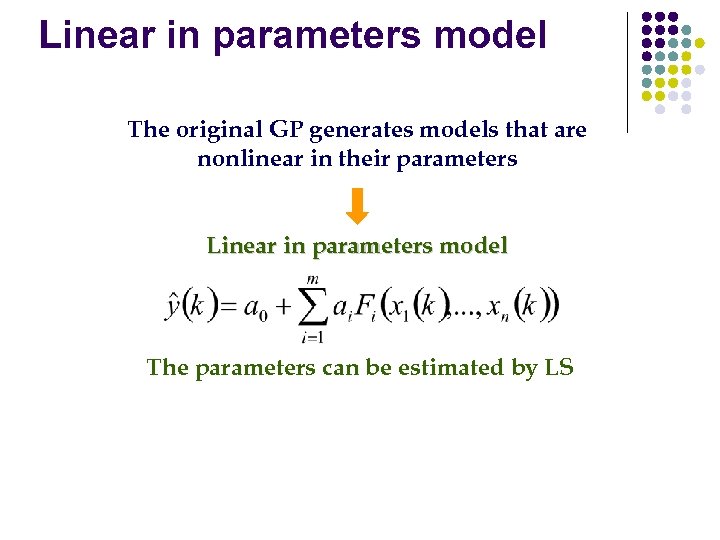 Linear in parameters model The original GP generates models that are nonlinear in their parameters Linear in parameters model The parameters can be estimated by LS
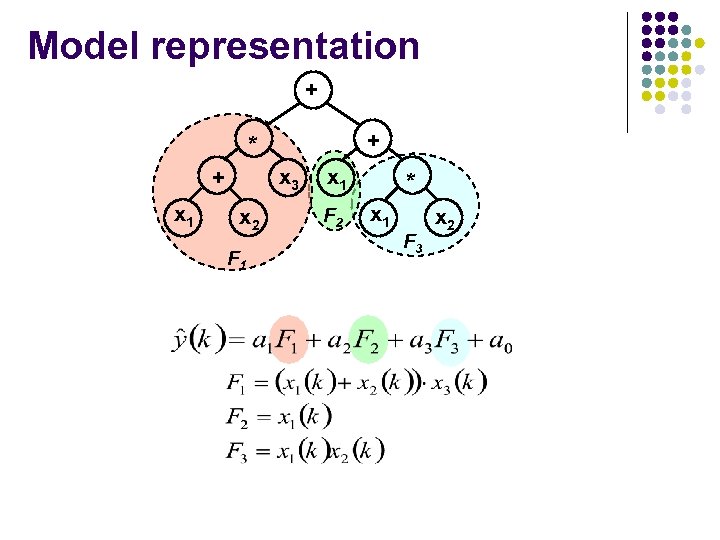 Model representation + + * x 3 + x 1 x 2 F 1 x 1 F 2 * x 1 F 3 x 2
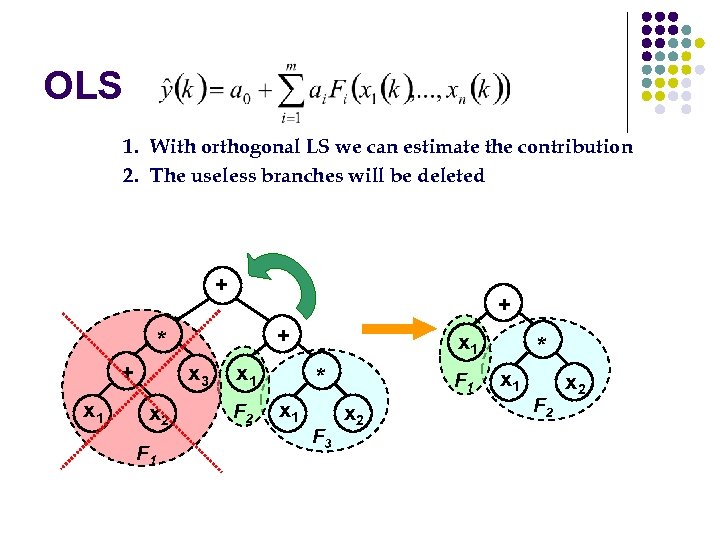 OLS 1. With orthogonal LS we can estimate the contribution 2. The useless branches will be deleted + + + * x 3 + x 1 x 2 F 1 x 1 F 2 x 1 * x 1 F 3 F 1 x 2 * x 1 F 2 x 2
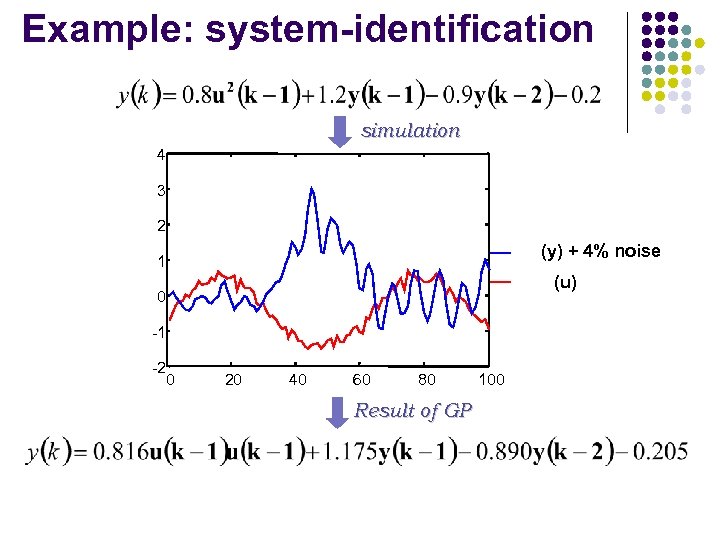 Example: system-identification simulation 4 3 2 (y) + 4% noise 1 (u) 0 -1 -2 0 20 40 60 80 Result of GP 100
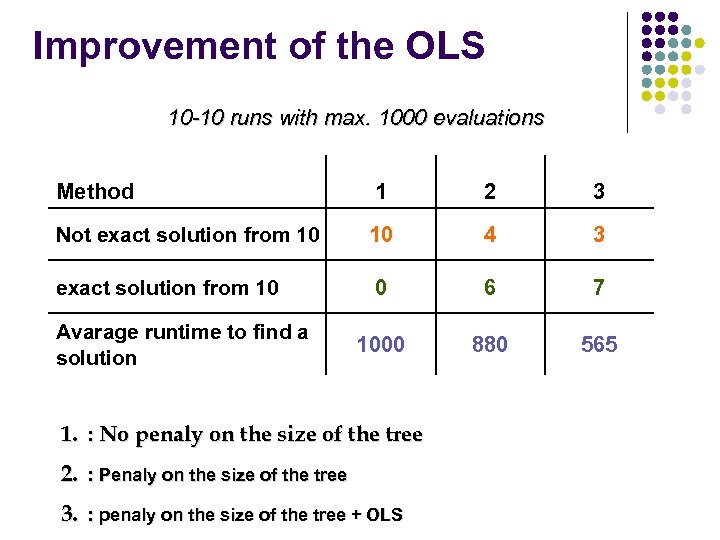 Improvement of the OLS 10 -10 runs with max. 1000 evaluations Method 1 2 3 Not exact solution from 10 10 4 3 exact solution from 10 0 6 7 1000 880 565 Avarage runtime to find a solution 1. : No penaly on the size of the tree 2. : Penaly on the size of the tree 3. : penaly on the size of the tree + OLS
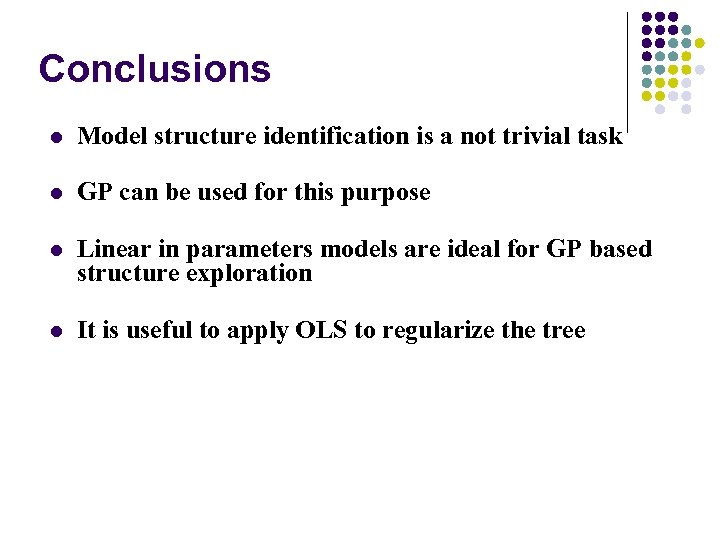 Conclusions l Model structure identification is a not trivial task l GP can be used for this purpose l Linear in parameters models are ideal for GP based structure exploration l It is useful to apply OLS to regularize the tree