


 Скачать презентацию Genetic predisposition to cardiovascular diseases in the offspring
новый для распечатки.pptx
- Количество слайдов: 23
 Genetic predisposition to cardiovascular diseases in the offspring of population exposed to radiation in result of nuclear tests Semey State Medical University, Student Saberbekov S. Supevisers: Pivina L. M. , Madieva M. R.
 Actuality • The large territories of Kazakhstan were exposed to radioactive fallout due to air and ground nuclear tests on the Semipalatinsk Test Site. The present time the most of people living in the ecologically unfavorable conditions are the offspring of exposed population. Cardiovascular diseases lead in the structure of morbidity and mortality in the region.
 • Genetic or hereditary factors can play a significant role in the development of cardiovascular diseases, so the present time molecular genetic analysis is very important for identification of polymorphic sites (SNP single nucleotide polymorphism, with replacement one nucleotide for another). Any single gene polymorphism can explain about 1 -8 % of the total risk of the disease in the population, but the additive effect of several of these risk factors can be up to 20 -70 % of the total risk due to genetic factors.
 Objective is study of genetic predisposition to developing of cardiovascular diseases (CVD) in the offspring of population exposed to radiation.
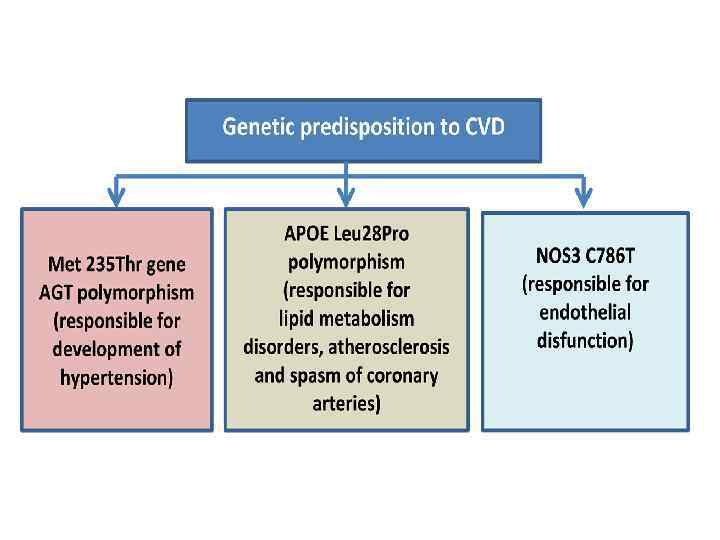
 • К слайду выше We have analyzed the frequency of polymorphisms for Met 235 Thr gene AGT which is responsible for development of hypertension, Leu 28 Pro gene APOE which is responsible for lipid metabolism disorders, atherosclerosis and spasm of coronary arteries, and C 786 T gene NOS 3 which is responsible for endothelial dysfunction
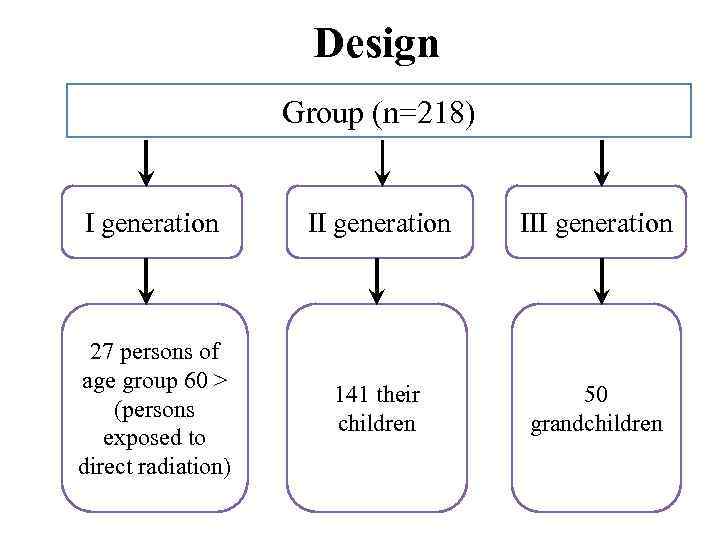 Design Group (n=218) I generation IІ generation III generation 27 persons of age group 60 > (persons exposed to direct radiation) 141 their children 50 grandchildren
 Total 218 people were examined. Selection was based on the family principle including 27 persons of age group 60 > (I generation of persons exposed to direct radiation), 141 their children (II generation) and 50 grandchildren (III generation).
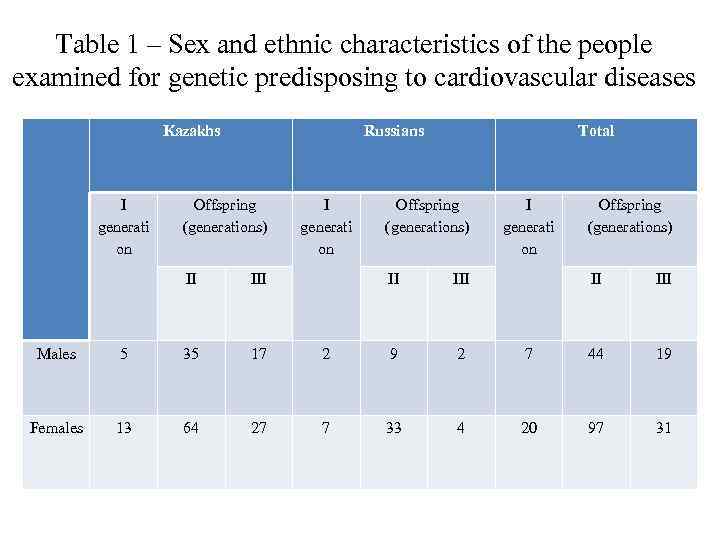 Table 1 – Sex and ethnic characteristics of the people examined for genetic predisposing to cardiovascular diseases Kazakhs I generati on Russians Offspring (generations) II I generati on III Total Offspring (generations) II I generati on III Offspring (generations) II III Males 5 35 17 2 9 2 7 44 19 Females 13 64 27 7 33 4 20 97 31
 • It is known that ethnic differences are important in the inheritance of some genotypes which may play a role in the predisposition to certain diseases. Therefore, a comparative analysis was conducted separately for Kazakh and Russian people. 140 males and 296 females; 161 Kazakhs and 57 Russian were included to our study.
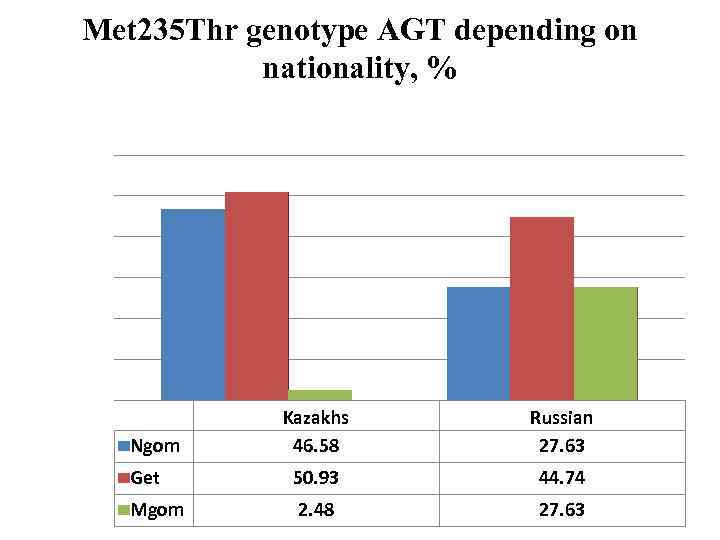 Met 235 Thr genotype AGT depending on nationality, % Kazakhs 46. 58 Russian 27. 63 Get 50. 93 44. 74 Mgom 2. 48 27. 63 Ngom
 • The frequency of the homozygous mutant allele Met 235 Thr in the people of Russian nationality was almost ten times higher than in Kazakhs ethnic group.
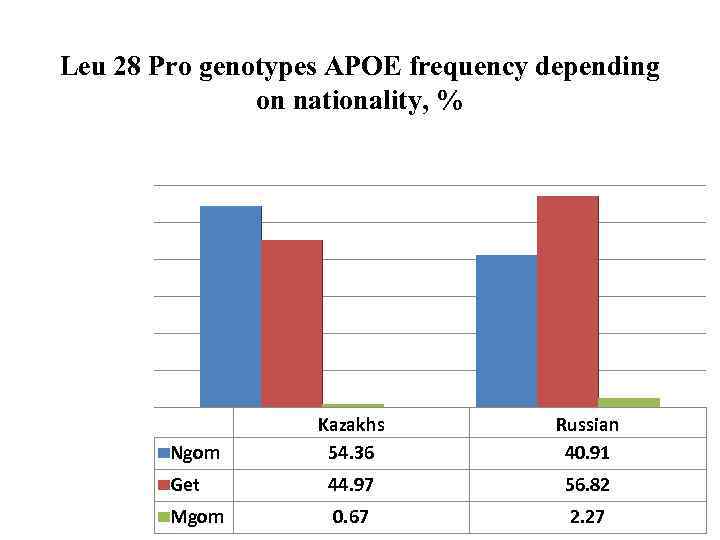 Leu 28 Pro genotypes APOE frequency depending on nationality, % Kazakhs 54. 36 Russian 40. 91 Get 44. 97 56. 82 Mgom 0. 67 2. 27 Ngom
 • Heterozygous and homozygous mutant genotypes APOE Leu 28 Pro in the Russian occurred significantly more frequently than in the Kazakh population
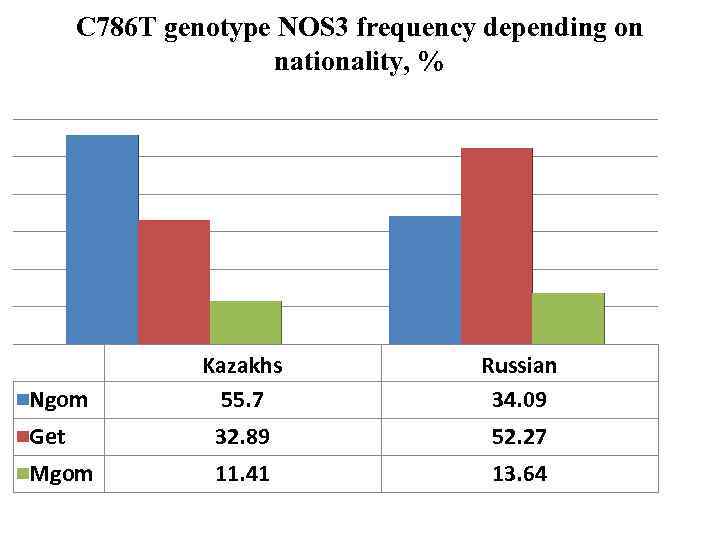 C 786 T genotype NOS 3 frequency depending on nationality, % Kazakhs 55. 7 Russian 34. 09 Get 32. 89 52. 27 Mgom 11. 41 13. 64 Ngom
 • Heterozygous and homozygous mutant genotypes APOE Leu 28 Pro in the Russian occurred significantly more frequently than in the Kazakh population
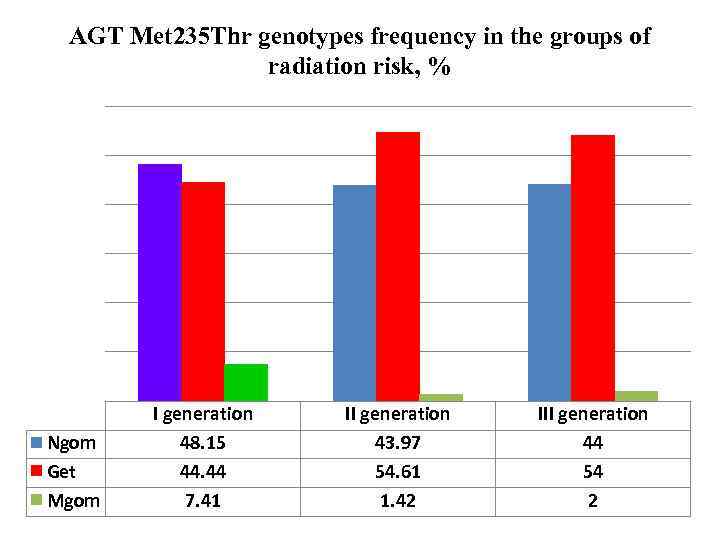 AGT Met 235 Thr genotypes frequency in the groups of radiation risk, % Ngom Get Mgom І generation 48. 15 44. 44 7. 41 ІІ generation 43. 97 54. 61 1. 42 ІІІ generation 44 54 2
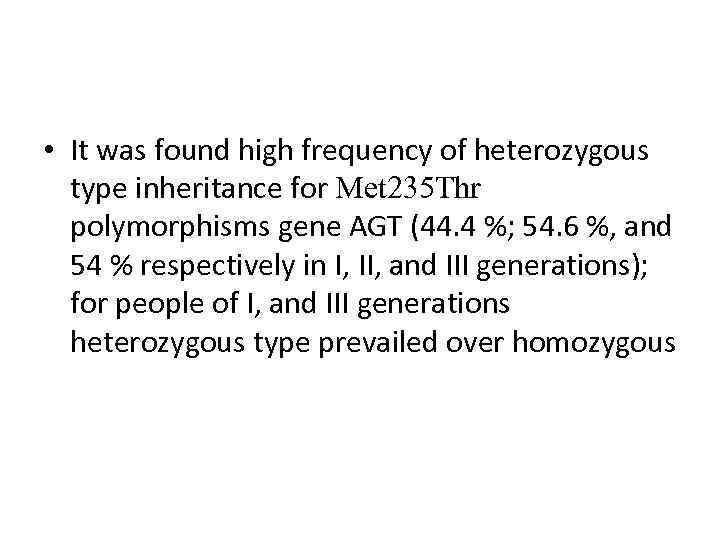 • It was found high frequency of heterozygous type inheritance for Met 235 Thr polymorphisms gene AGT (44. 4 %; 54. 6 %, and 54 % respectively in I, II, and III generations); for people of I, and III generations heterozygous type prevailed over homozygous
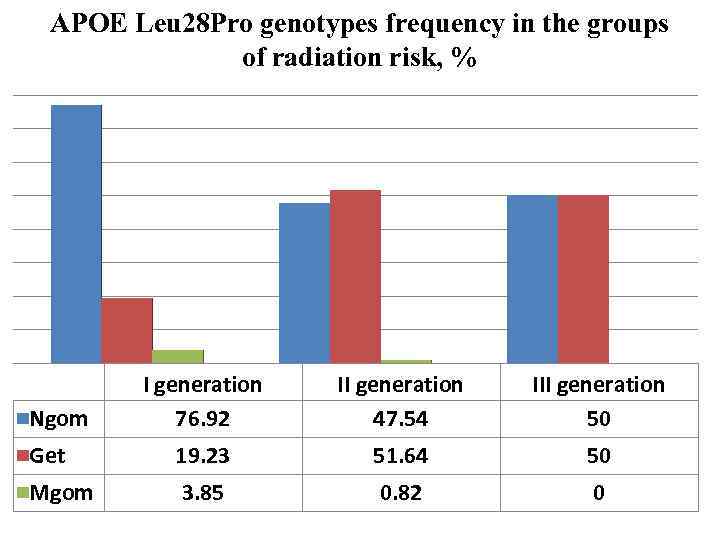 APOE Leu 28 Pro genotypes frequency in the groups of radiation risk, % I generation 76. 92 II generation 47. 54 III generation 50 Get 19. 23 51. 64 50 Mgom 3. 85 0. 82 0 Ngom
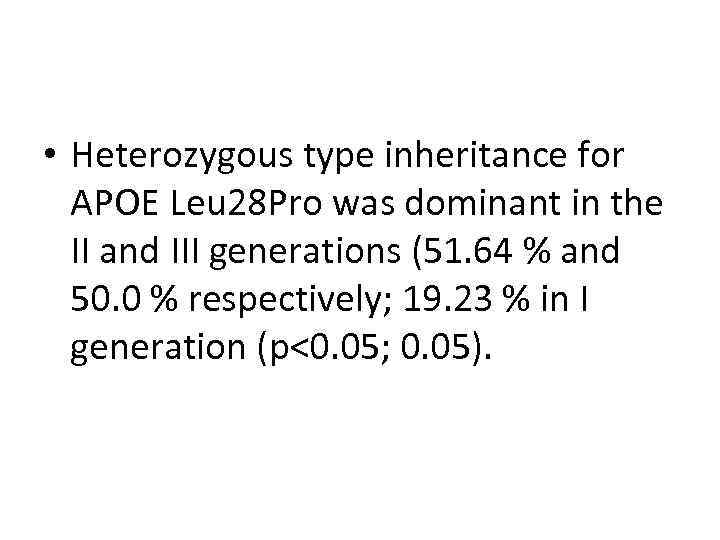 • Heterozygous type inheritance for APOE Leu 28 Pro was dominant in the II and III generations (51. 64 % and 50. 0 % respectively; 19. 23 % in I generation (р<0. 05; 0. 05).
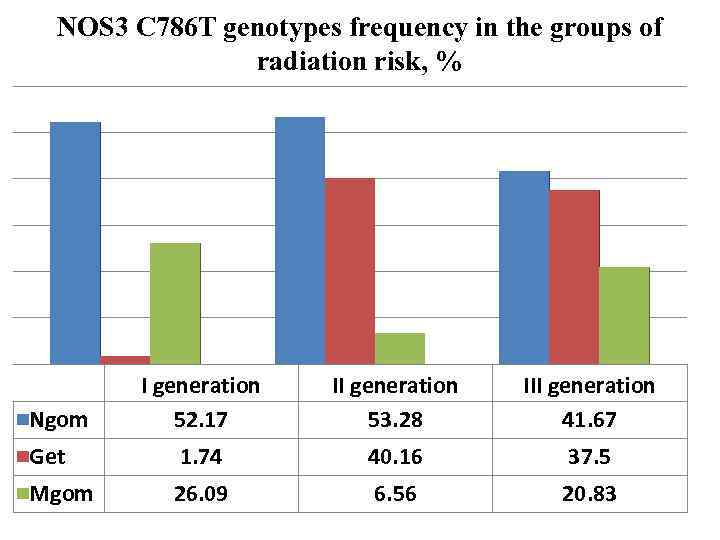 NOS 3 C 786 T genotypes frequency in the groups of radiation risk, % I generation 52. 17 II generation 53. 28 III generation 41. 67 Get 1. 74 40. 16 37. 5 Mgom 26. 09 6. 56 20. 83 Ngom
 • It was found unexpected high frequency of monozygotic pathological mutations for NOS 3 C 786 T genotype in the people of I and III generation (26. 1 % and 20. 83 % respectively).
 Conclusion Results of study indicate the possible inheritance of pathological mutations of genes responsible for developing of disorders of lipid metabolism, endothelial dysfunction and hypertension in the offspring of exposed to radiation people in the both (Kazakh and Russian) ethnic groups.