


 Скачать презентацию Genetic Evaluation for Small Ruminants George R Wiggans
fc372683a4729d2e3a2e7bd20657b5ab.ppt
- Количество слайдов: 35
 Genetic Evaluation for Small Ruminants George R. Wiggans Animal Improvement Programs Laboratory Agricultural Research Service, USDA, Beltsville, MD wiggans@aipl. arsusda. gov 2005 2004
 Why small ruminants? w Important contributors to the world supply of meat, milk, and fiber w Can utilize pasture not suitable for cattle w More suitable for small scale operations w People enjoy associating with them CORNELL ADGA 2005 (2) G. R. WIGGANS 2005 2004
 Why genetic selection? w Genetic selection can improve fitness, utility, and profitability w Females must be bred to provide replacements and initiate milk production w Mate selection is an opportunity to make genetic change CORNELL ADGA 2005 (3) G. R. WIGGANS 2005 2004
 Selection is a continuous process w Decisions - Which females to breed - Which males to use - Which specific matings to make - Which progeny to raise - Which females to keep and breed w Goals - Improve production and efficiency - Avoiding inbreeding - Correct faults CORNELL ADGA 2005 (4) G. R. WIGGANS 2005 2004
 Why genetic evaluations? w A valuable tool for genetic selection w Allows for comparison of animals in different environments w Can include all of the information available for each animal w Greatest impact on progress is from selection for males CORNELL ADGA 2005 (5) G. R. WIGGANS 2005 2004
 What is an evaluation? Phenotype = Genotype + Environment w Phenotype is measurable - Pounds of milk produced - Stature w An evaluation is an estimate of Genotype CORNELL ADGA 2005 (6) G. R. WIGGANS 2005 2004
 Steps in genetic evaluation w Define a breeding goal w Measure traits related to the goal w Record pedigree to allow detection of relationships across generations w Identify non-genetic factors that affect records and could bias evaluations - Make adjustments - Include in the model w Define an evaluation model CORNELL ADGA 2005 (7) G. R. WIGGANS 2005 2004
 Examples of breeding goals w Increased milk, fat, or protein yield w Increased average daily gain w Increased weaning weight w Optimal birth weight w Optimal litter size w Improved conformation score (overall and linear) CORNELL ADGA 2005 (8) G. R. WIGGANS 2005 2004
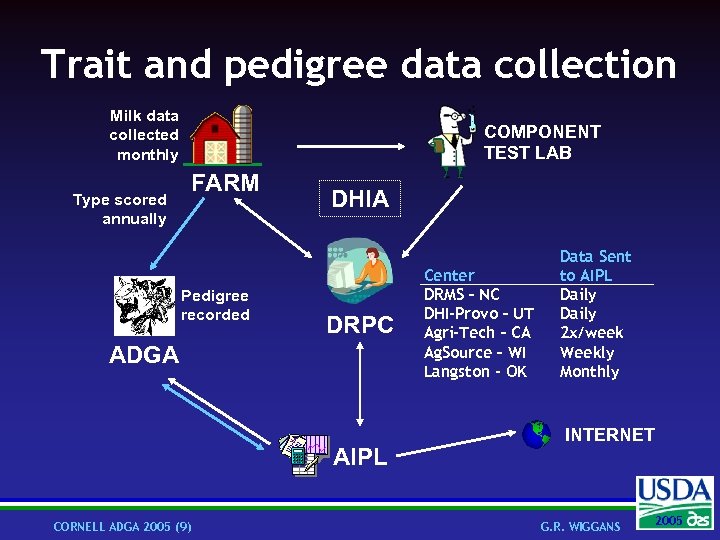 Trait and pedigree data collection Milk data collected monthly Type scored annually COMPONENT TEST LAB FARM Pedigree recorded DHIA DRPC ADGA AIPL CORNELL ADGA 2005 (9) Center DRMS – NC DHI-Provo – UT Agri-Tech – CA Ag. Source – WI Langston - OK Data Sent to AIPL Daily 2 x/week Weekly Monthly INTERNET G. R. WIGGANS 2005 2004
 Examples of non-genetic factors w Age w Lactation w Season w Litter size w Milking frequency w Herd CORNELL ADGA 2005 (11) G. R. WIGGANS 2005 2004
 Evaluation model w An equation that indicates what factors contribute to an observation w Separates the genetic component from other factors w Solutions predict the genetic potential of progeny CORNELL ADGA 2005 (12) G. R. WIGGANS 2005 2004
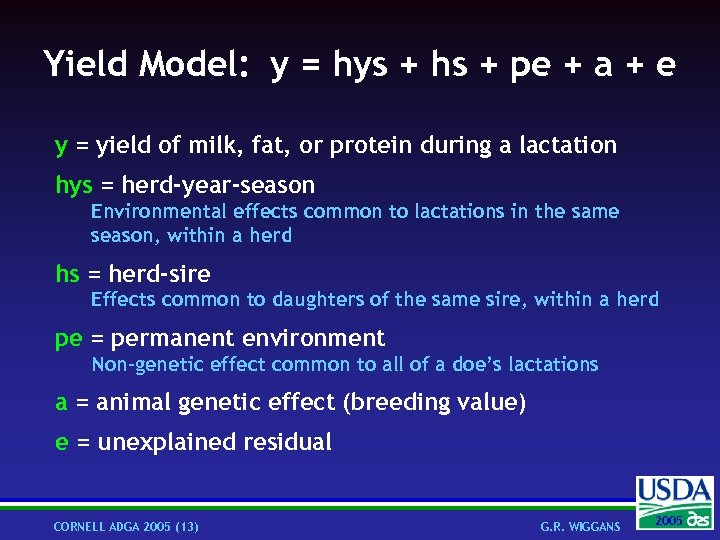 Yield Model: y = hys + hs + pe + a + e y = yield of milk, fat, or protein during a lactation hys = herd-year-season Environmental effects common to lactations in the same season, within a herd hs = herd-sire Effects common to daughters of the same sire, within a herd pe = permanent environment Non-genetic effect common to all of a doe’s lactations a = animal genetic effect (breeding value) e = unexplained residual CORNELL ADGA 2005 (13) G. R. WIGGANS 2005 2004
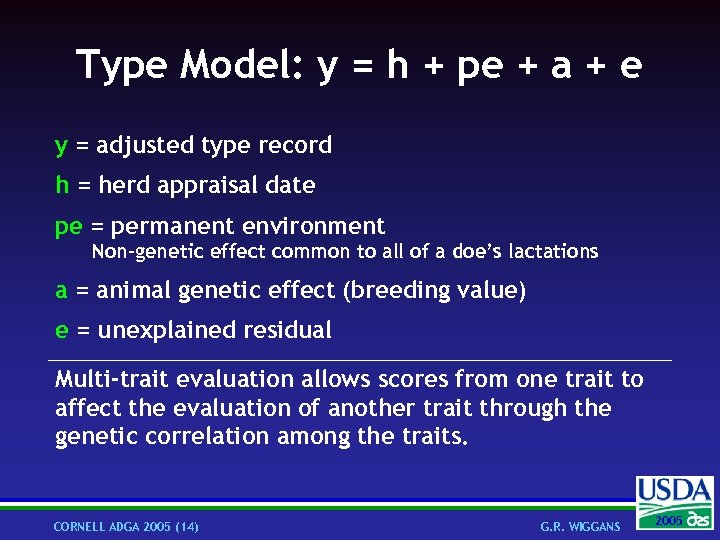 Type Model: y = h + pe + a + e y = adjusted type record h = herd appraisal date pe = permanent environment Non-genetic effect common to all of a doe’s lactations a = animal genetic effect (breeding value) e = unexplained residual Multi-trait evaluation allows scores from one trait to affect the evaluation of another trait through the genetic correlation among the traits. CORNELL ADGA 2005 (14) G. R. WIGGANS 2005 2004
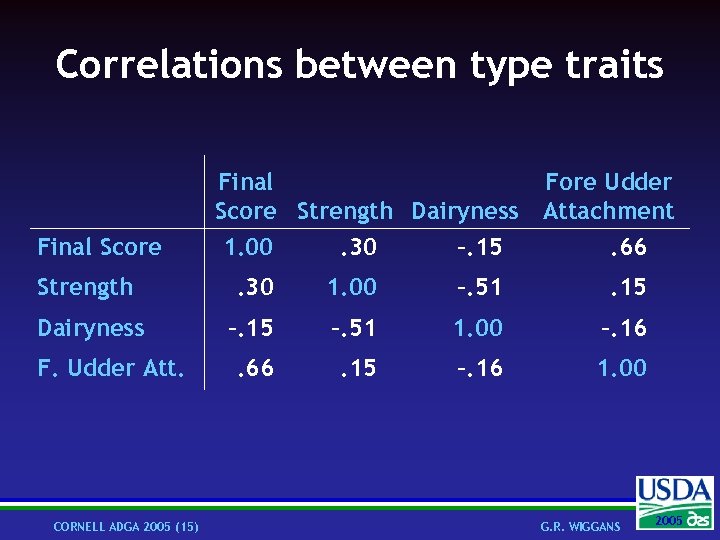 Correlations between type traits Final Score Strength Dairyness 1. 00. 30 –. 15 Fore Udder Attachment. 66 Strength . 30 1. 00 –. 51 . 15 Dairyness –. 15 –. 51 1. 00 –. 16 . 66 . 15 –. 16 1. 00 F. Udder Att. CORNELL ADGA 2005 (15) G. R. WIGGANS 2005 2004
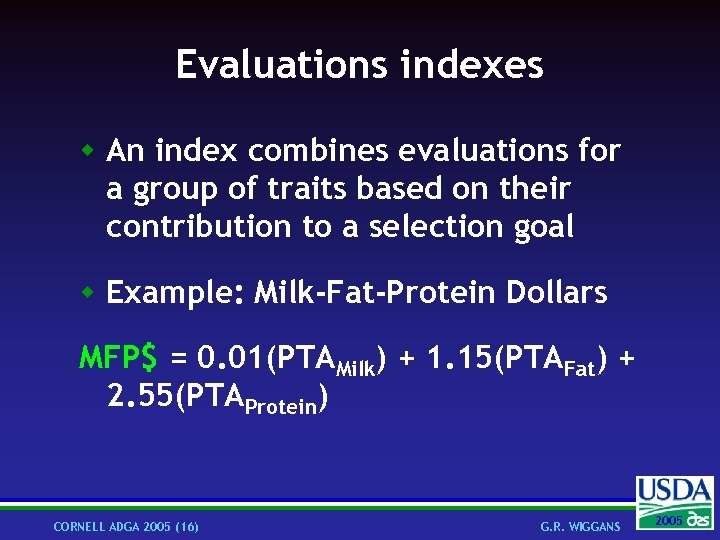 Evaluations indexes w An index combines evaluations for a group of traits based on their contribution to a selection goal w Example: Milk-Fat-Protein Dollars MFP$ = 0. 01(PTAMilk) + 1. 15(PTAFat) + 2. 55(PTAProtein) CORNELL ADGA 2005 (16) G. R. WIGGANS 2005 2004
 Why evaluations go wrong w Important factors ignored - Litter size - Milking Frequency - Preferential treatment w Unlucky - Current data not representative of future data - Traits with low heritability require large numbers to be accurate w Recording errors - Wrong daughters assigned to a sire CORNELL ADGA 2005 (17) G. R. WIGGANS 2005 2004
 Factors affecting value of data w Completeness of ID and parentage reporting w Years herd has collected data w Size of herd w Frequency of testing and component determination CORNELL ADGA 2005 (18) G. R. WIGGANS 2005 2004
 Factors affecting evaluation accuracy w Number of daughters w Number of lactation records w Completeness of pedigree data w Numbers of females kidding in same herd-year-seasons w Numbers of males with daughter records in same herd-year-seasons CORNELL ADGA 2005 (19) G. R. WIGGANS 2005 2004
 How accurate are evaluations? w Reliability measures the amount of information contributing to an evaluation w Increases at a decreasing rate as daughters are added w Also affected by: - Number of contemporaries - Reliability of parents’ evaluations - Heritability of the trait CORNELL ADGA 2005 (20) G. R. WIGGANS 2005 2004
 What do the numbers mean? w Evaluations are predictions - The true value is unknown w The predictions rank animals relative to one another using a defined base w The base is the zero- or center-point for evaluations - For example: the performance of animals born in a given year CORNELL ADGA 2005 (21) G. R. WIGGANS 2005 2004
 Expressing evaluations w Estimated Breeding value (EBV) Animal’s own genetic value w Predicted Transmitting ability (PTA) ½ EBV Expected contribution to progeny CORNELL ADGA 2005 (22) G. R. WIGGANS 2005 2004
 Factors in genetic improvement w Heritability is the portion of total variation due to genetics Milk: 25% Type: 19% (r. udder arch) — 52% (stature) w Rate of genetic improvement is determined by: - Generation interval - Selection intensity - Heritability CORNELL ADGA 2005 (23) G. R. WIGGANS 2005 2004
 Increasing genetic improvement w Use artificial insemination (AI) to use better males in more herds w Identify promising young males for progeny testing (PT) - Use in a representative group of breedings and observe the actual success of progeny w Focus on larger herds to improve accuracy CORNELL ADGA 2005 (24) G. R. WIGGANS 2005 2004
 Dairy cattle improvement program w Pre-select only promising bulls for PT w Select only the best of the PT bulls for widespread use - Only about 1 in 10 PT bulls enter active service w Remove bulls from active service as better new bulls become available - Bulls remain active only a few years CORNELL ADGA 2005 (25) G. R. WIGGANS 2005 2004
 Alternative to waiting for PT w Use young males for most breedings w Replace males quickly w Bank semen of young males w Use frozen semen from superior proven males as sires of next generation of young males CORNELL ADGA 2005 (26) G. R. WIGGANS 2005 2004
 Central vs. on-farm testing w Availability of: - Central Test Stations - Effective genetic evaluation system w Traits analyzed support selection goals w Active participation of many breeders in the centralized data repository CORNELL ADGA 2005 (27) G. R. WIGGANS 2005 2004
 Centralized performance test w Determine genetic differences of individuals from different herds - Does NOT compare herds or breeders w Optimal environment - Allows for ADG and feed conversion testing - Ultrasound testing of final meat products - Marketing venue w Typically only males evaluated w Phenotype compared CORNELL ADGA 2005 (28) G. R. WIGGANS 2005 2004
 On-farm testing w Comparisons - Within herd - Across herd through evaluations w Data collection for many traits w Low cost w Whole herd test - Records and genetic evaluation of all animals w Genotype compared CORNELL ADGA 2005 (29) G. R. WIGGANS 2005 2004
 Available evaluations w AIPL Dairy goat - Milk, fat, and protein yields - 14 conformation traits - http: //aipl. arsusda. gov w Boer Goat Improvement Network - http: //www. abga. org w National Sheep Improvement Program - http: //www. nsip. org w Ram testing stations CORNELL ADGA 2005 (30) G. R. WIGGANS 2005 2004
 Pennsylvania meat goat and ram performance tests w Livestock Evaluation Center (LEC) in Centre County w Purebred males born Sept — Feb w Starts in April - 84 days for rams - 70 days for goats w ADG and US testing w Results combined in an index CORNELL ADGA 2005 (31) G. R. WIGGANS 2005 2004
 AIPL dairy goat evaluations w Yield evaluations in July w Type evaluations in December w Evaluations provided to ADGA, DRPC, and publicly via the internet w Web services at: http: //aipl. arsusda. gov/query/public/ tdb. shtml#Goats. TBL CORNELL ADGA 2005 (32) G. R. WIGGANS 2005 2004
 AIPL web services w Queries provide display of: - Pedigree information - Yield records - Herd test characteristics - Genetic evaluations • Does and bucks • Yield and type w Access information using: - ID number - Animal name - Herd code CORNELL ADGA 2005 (33) G. R. WIGGANS 2005 2004
 Evaluations in other countries w Australia: Lamb. Plan http: //www. mla. com. au/lambplan w Canada: Goats http: //www. aps. uoguelph. ca/~gking/Ag_2350/ goat. htm http: //www. goats. ca w Israel: Dairy Sheep and Goats http: //www. sheep-goats. org. il/about. htm CORNELL ADGA 2005 (34) G. R. WIGGANS 2005 2004
 Sequencing the genome w Single Nucleotide Polymorphisms (SNP) - enable identification of the source for segments of chromosomes w Parentage verification - DNA sequences must match those of a parent - Known sequences can suggest unknown parent ID w EBV calculated for chromosome segments - Sum the value of segments to approximate evaluation - Accuracy approaches progeny test CORNELL ADGA 2005 (35) G. R. WIGGANS 2005 2004
 Wrap up w Genetic principles apply across species w Selection is the method for genetic improvement w Genetic evaluations improve selection accuracy w Accurate evaluations also require adequate data and an appropriate model w Evaluations are based on comparisons - Differences for non-genetic reasons must be removed w DNA technology is of great interest - Still requires reliable evaluations CORNELL ADGA 2005 (36) G. R. WIGGANS 2005 2004