


 Скачать презентацию GENESIS WHO DO YOU THINK YOU ARE HISTORY
f5d896c7be1a13a22b86ccaf119006d7.ppt
- Количество слайдов: 18
 GENESIS: WHO DO YOU THINK YOU ARE? HISTORY IS NOT THE PAST AND THE PAST IS NOT HISTORY. YOU CAN WRITE HISTORY HOWEVER YOU WANT TO WRITE IT. GENESIS IS WRITTEN IN “GENERATION SPACE AND TIME” AND FOLLOWS THE RULES OF SUCH HISTORY GENESIS IS A COMPILATION BOOK, COMPOSED FROM VARIOUS SOURCES ( J, D, E, P ) IT POINTS BEYOND ITSELF TO GOD
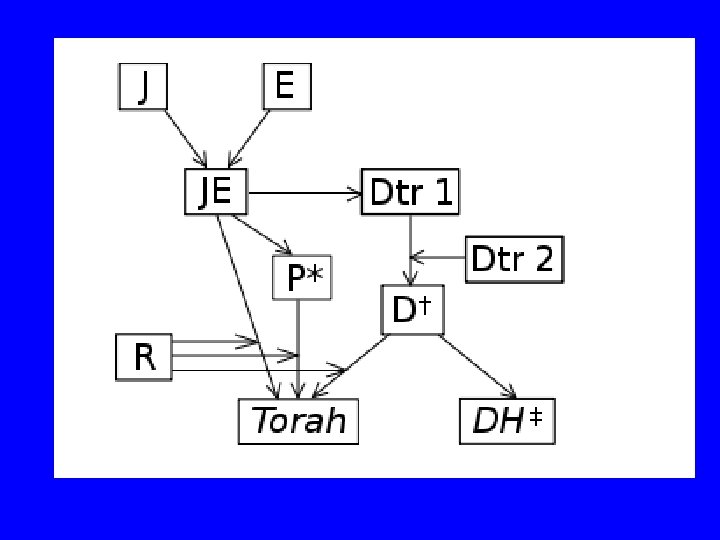
 Deuteronomy 26: 5 Then you shall declare before the Lord your God: "My father was a wandering Aramean, and he went down into Egypt with a few people and lived there and became a great nation, powerful and numerous.
 READ GENESIS 11: 8 -9 HOW DOES THE GENESIS AUTHOR LINK CHAPTERS 111 WITH THE STORY OF ABRAHAM?
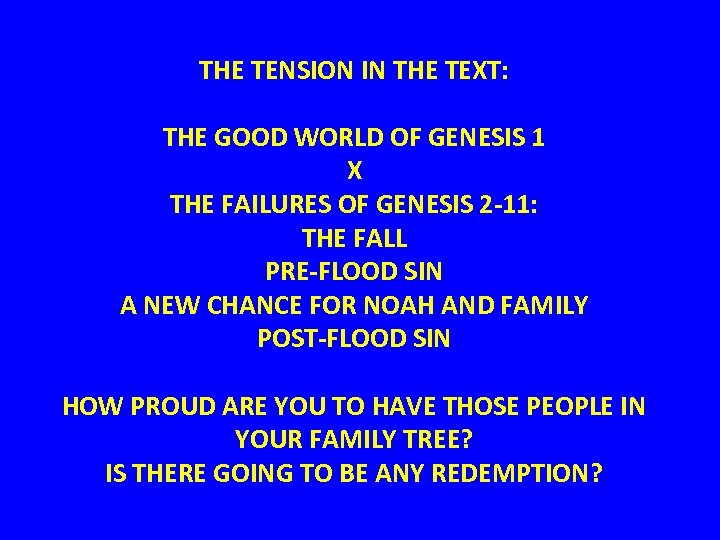 THE TENSION IN THE TEXT: THE GOOD WORLD OF GENESIS 1 X THE FAILURES OF GENESIS 2 -11: THE FALL PRE-FLOOD SIN A NEW CHANCE FOR NOAH AND FAMILY POST-FLOOD SIN HOW PROUD ARE YOU TO HAVE THOSE PEOPLE IN YOUR FAMILY TREE? IS THERE GOING TO BE ANY REDEMPTION?
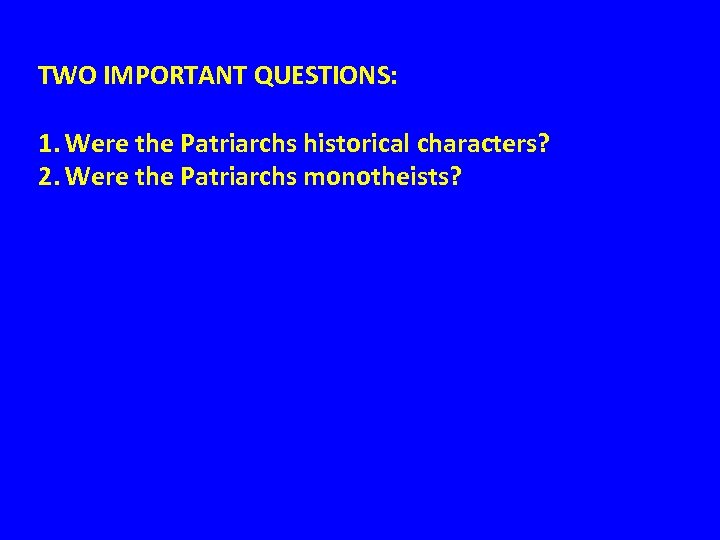 TWO IMPORTANT QUESTIONS: 1. Were the Patriarchs historical characters? 2. Were the Patriarchs monotheists?
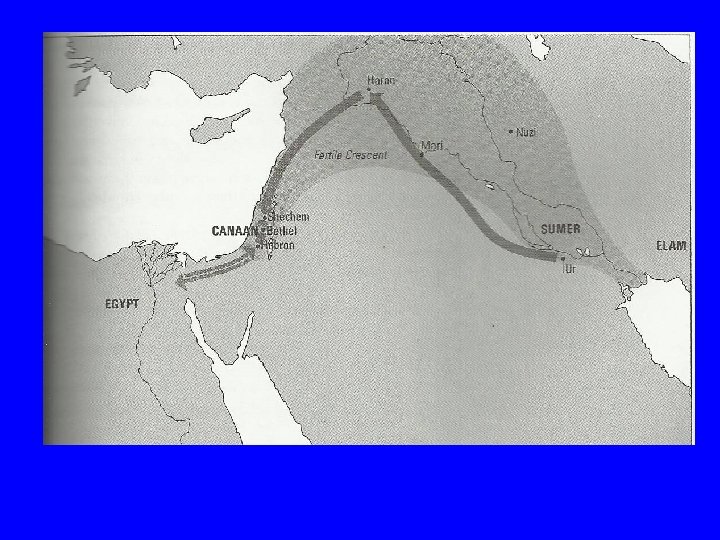
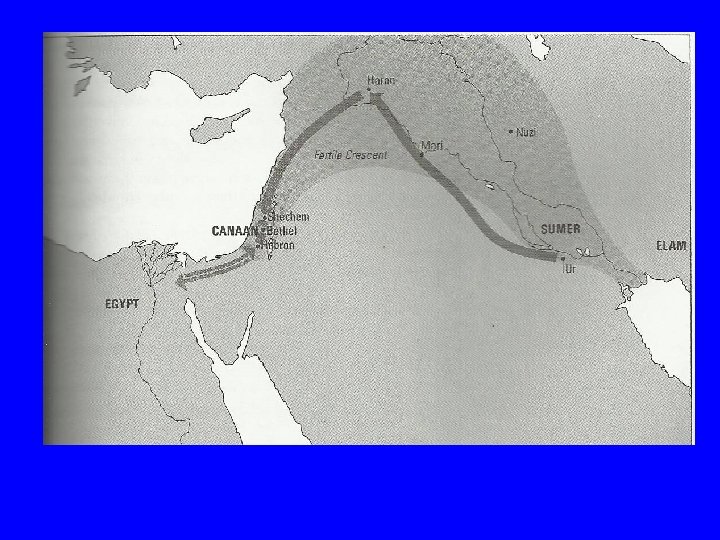
 Abraham’s Journey: From Haran in the kingdom of Mari. ( The Hebrew mss of Genesis 11 mention Ur but the LXX places Abraham’s ancestry as being in the “kingdom of the Chaldeans. ” Abraham’s roots were strongest in Haran – in Genesis 24: 4 he calls it “my country and sends his servant there to find a wife for Isaac ) We know a good deal about the kingdom of Mari
 1. Haran is mentioned in the administrative documents of Mari 2. The names that emerge from the documents correspond to the names in Genesis 3. The patriarchal life-style was typical of the period. The Egyptian book The Tale of Sinuhe depicts a nomadic chief around 1900 BC. The nomadic way of life was common. 4. The social and legal customs of the Patriarchs fit better with a date of around 1900 BC rather than later Israel ( eg. Lev 18: 9, 11 &18 concerning marriage ) John Bright: “We can assert with full confidence that Abraham, Isaac and Jacob were actual historical individuals. . . A part of that migration of seminomadic clans which brought a new population to Palestine in the early centuries of the second millennium BC”
 Were they monotheists? Answer: Not always. Probably not even usually. The Pentateuch found its present form at the time of the Babylonian Captivity or afterwards. The Jews only became strict monotheists after the Babylonian Captivity. You can read much of the Old Testament as an ongoing war of attrition between the strict monotheist minority and the polytheist majority. Remember: the victors always write the history of the war.
 Were they monotheists? Jacob and his family were not: Genesis 31: 19 ( but see 35: 1 -5 where they had a change of heart ) In Elijah’s day monotheism was a minority religion in Israel ( 1 Kings 19: 14 -18 )
 The books of the Bible were assembled to form the Canon of Scripture, but what is the organizing theme? 1) The Diachronic Method: Von Rad argued that there is no central, unifying theme, just a development of theology over time (dia-chronos ) The book of Genesis ( for example ) was assembled in its final form during or after the Exile. But the sources it uses are much older ( some of them probably 500 years or more ) and each reflects the needs and aims of the particular group that wrote them in their time. The aim of this method is to peel the layers of Scripture off and look at each source in its day, and thus tell the story of religion in Israel this way. ( That’s OK, but it runs the risk of missing the point of the books themselves and losing any organizing theme )
 The books of the Bible were assembled to form the Canon of Scripture, but what is the organizing theme? 2) Salvation-History The story of Israel is really one of Salvation-history ( in German: Heilsgeschischte): God’s working in history to deliver his people. He is the God who acts. In Christian theology Christ’s life, death and resurrection is the midpoint of Salvation History between the creation and the return of Christ.
 The books of the Bible were assembled to form the Canon of Scripture, but what is the organizing theme? 3) The Covenant. This is a binding agreement between two or more parties. A formally sealed agreement. Many examples in the Bible, but the ones that interest here are the ones between God and the people. The main examples are: Adam ( Genesis 2: 17) Noah (Genesis 9 ) Moses ( Deuteronomy 29: 1) David ( 2 Samuel 7 ) Walter Eichrodt is particularly remembered for his making “Covenant” the organizing theme.
 The books of the Bible were assembled to form the Canon of Scripture, but what is the organizing theme? 4) Promise ( plus related words such as blessing, oath etc. ) Walter Kaiser, Jr. in The Promise-Plan of God: A Biblical Theology of the Old and New Testaments argues that God’s promise is the link which holds the Old Testament together and also links it to the New Testament. “God gave a promise to Abraham, and through him to mankind; a promise eternally fulfilled and fulfilling in the history of Israel; and chiefly fulfilled in Jesus Christ. . The promise was also expressed by formulas such as `I will be your God, you shall be My people, and I will dwell in the midst of you' or the redemptive self-assertion formula scattered in part or in full form 125 times throughout the OT: `I am the Lord your God who brought you up out of the Land of Egypt. ' It could also be seen as a divine plan in history which promised to bring a universal blessing through the agency of an unmerited, divine choice of a human offspring. "
 Exercise: Read Genesis 12: 1 -10 What is the contract here? Who initiates it? What are the conditions? What are the expected outcomes? Which of these is Abraham going to enjoy in his lifetime? At what points in Israel’s history would this passage be especially important? Which groups in Israel’s history would make most use of this passage? Are the immediate events disappointing?
 Next Week: Abraham the Famous New Testament Character. Genesis 15 and 17 and beyond. Homework: Please read all the chapters in Genesis which refer to Abraham