


 Скачать презентацию Generalized Indexing for Energy-Efficient Access to Partially Ordered
106dc3911da3cc3b9a99397d8a1486ab.ppt
- Количество слайдов: 26
 Generalized Indexing for Energy-Efficient Access to Partially Ordered Broadcast Data in Wireless Networks Dimitrios Katsaros 1, 2 Nikos Dimokas 1 Yannis Manolopoulos 1 1 Informatics 2 Computer Dept. , Aristotle University, Thessaloniki, Greece & Comm. Engineering Dept. , University of Thessaly, Volos, Greece 10 th IEEE IDEAS Symposium, New Delhi, India, 11 -13/12/2006 1
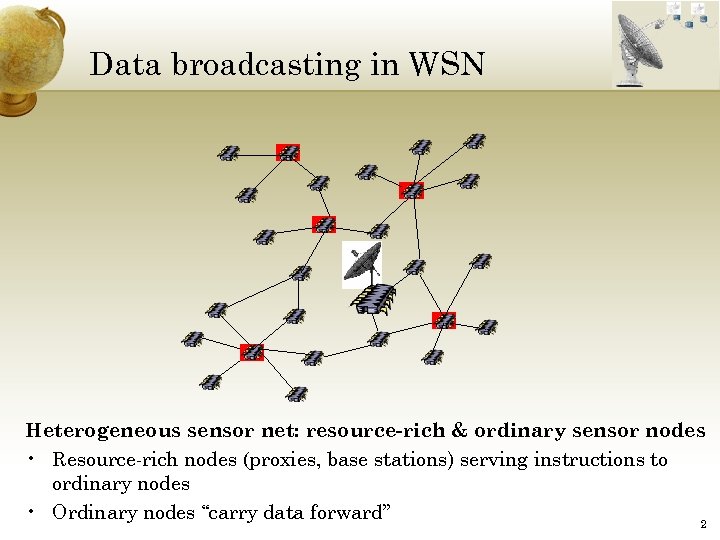 Data broadcasting in WSN Heterogeneous sensor net: resource-rich & ordinary sensor nodes • Resource-rich nodes (proxies, base stations) serving instructions to ordinary nodes • Ordinary nodes “carry data forward” 2
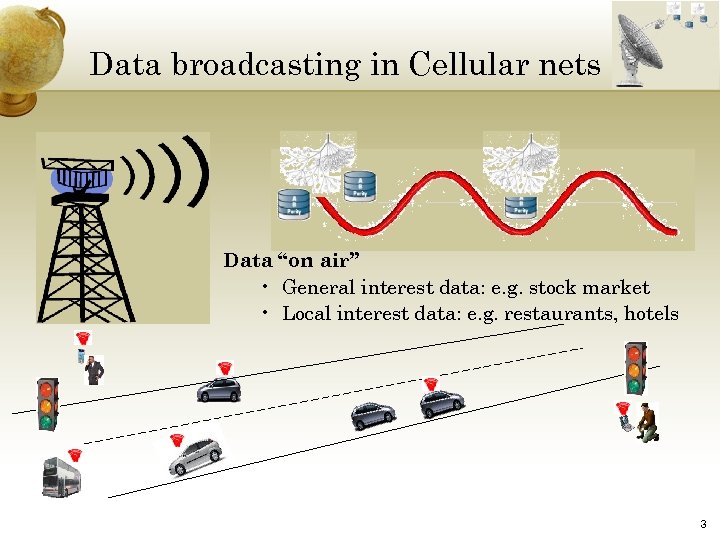 Data broadcasting in Cellular nets Data “on air” • General interest data: e. g. stock market • Local interest data: e. g. restaurants, hotels 3
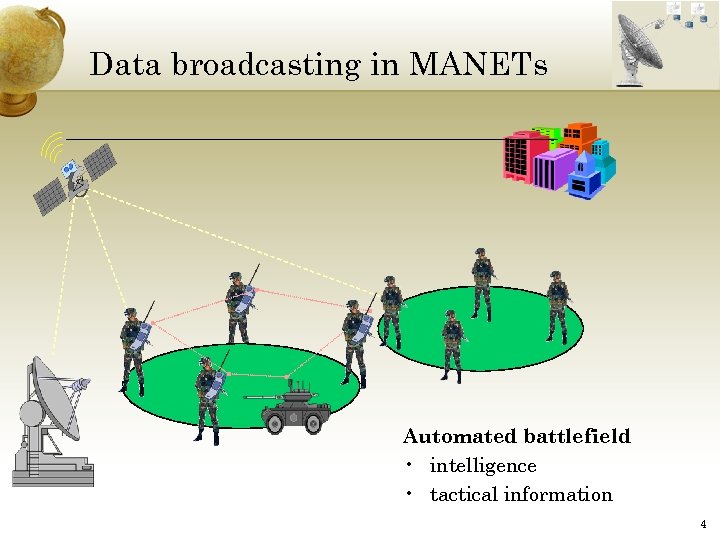 Data broadcasting in MANETs Automated battlefield • intelligence • tactical information 4
 Data broadcasting characteristics • Contradictory requirements: • • Small access latency, i. e. , the time between when a node needs some data and the moment the node gets these data Small tuning time, i. e. , the time a node spends monitoring the communication channel (to save energy) • To achieve energy savings: • • Mobile hosts support active or doze mode Ordinary sensor nodes support active (transmit, receive, idle) or sleeping mode • Characteristics: • • Not all data are of interest to all clients (skewed access pattern) Not necessary global ordering among data (only partial ordering) 5
 Low energy consumption Indexing • Common in the database world • B+-trees, R-trees, Hashing …. etc. • Complication • • magnetic disk: random access medium broadcast channel: “one-dimensional” medium • Broadcast indexing (so far) only for global data ordering • Variations of B-trees, skip-lists, hashing, signatures • Good for uniform access pattern • Variations of Huffman and Alphabetic trees • Unbalanced structures (not binary but k-ary) • Good for skewed access pattern • Our proposal : the POBI index supports • • • Skewed access pattern Partial data ordering Generalizes Huffman trees and Alphabetic trees 6
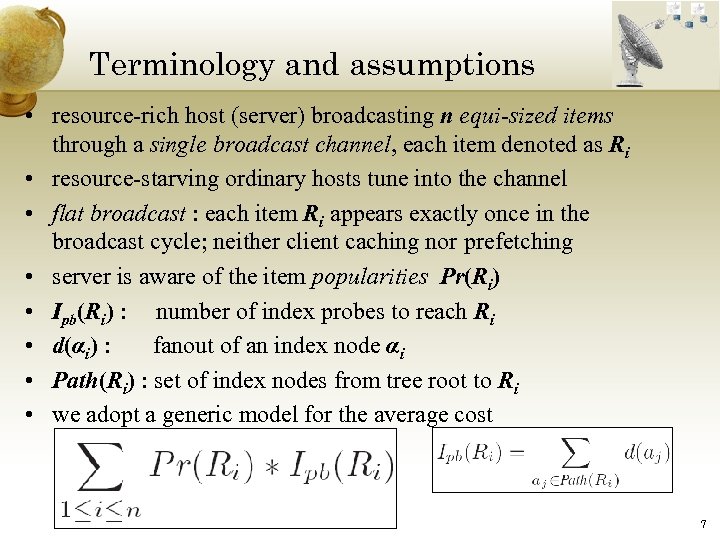 Terminology and assumptions • resource-rich host (server) broadcasting n equi-sized items through a single broadcast channel, each item denoted as Ri • resource-starving ordinary hosts tune into the channel • flat broadcast : each item Ri appears exactly once in the broadcast cycle; neither client caching nor prefetching • server is aware of the item popularities Pr(Ri) • Ipb(Ri) : number of index probes to reach Ri • d(αi) : fanout of an index node αi • Path(Ri) : set of index nodes from tree root to Ri • we adopt a generic model for the average cost 7
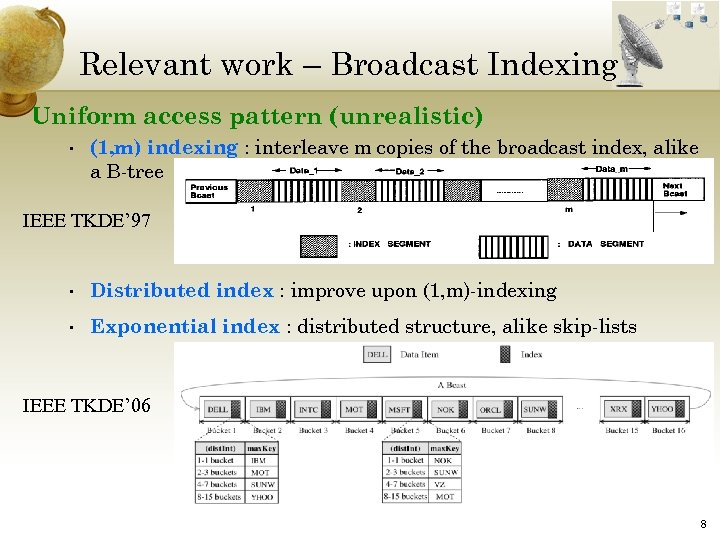 Relevant work – Broadcast Indexing Uniform access pattern (unrealistic) • (1, m) indexing : interleave m copies of the broadcast index, alike a B-tree IEEE TKDE’ 97 • Distributed index : improve upon (1, m)-indexing • Exponential index : distributed structure, alike skip-lists IEEE TKDE’ 06 8
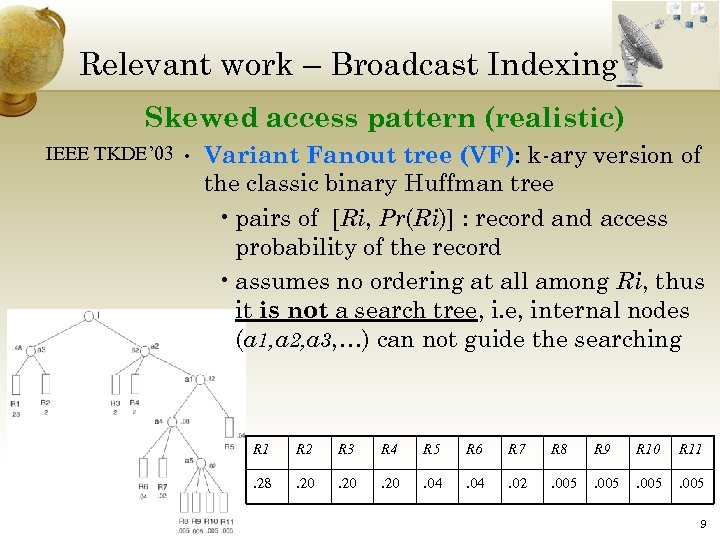 Relevant work – Broadcast Indexing Skewed access pattern (realistic) IEEE TKDE’ 03 • Variant Fanout tree (VF): k-ary version of the classic binary Huffman tree • pairs of [Ri, Pr(Ri)] : record and access probability of the record • assumes no ordering at all among Ri, thus it is not a search tree, internal nodes (a 1, a 2, a 3, …) can not guide the searching R 1 R 2 R 3 R 4 R 5 R 6 R 7 R 8 R 9 R 10 R 11 . 28 . 20 . 04 . 02 . 005 9
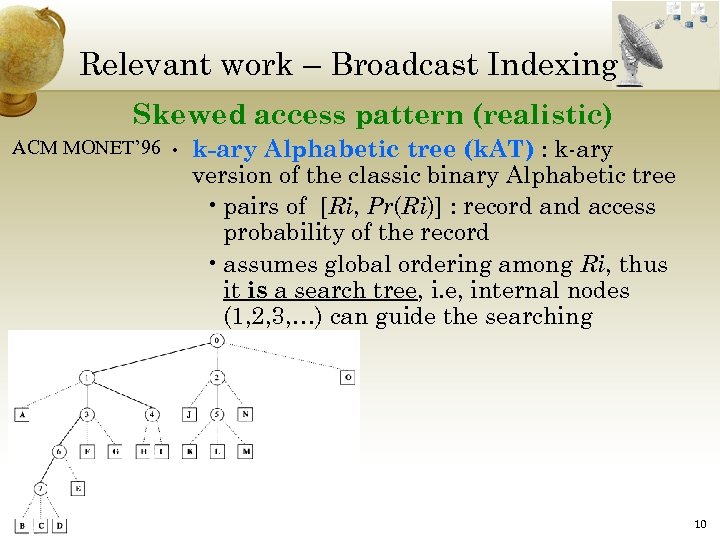 Relevant work – Broadcast Indexing Skewed access pattern (realistic) ACM MONET’ 96 • k-ary Alphabetic tree (k. AT) : k-ary version of the classic binary Alphabetic tree • pairs of [Ri, Pr(Ri)] : record and access probability of the record • assumes global ordering among Ri, thus it is a search tree, internal nodes (1, 2, 3, …) can guide the searching 10
 Less relevant – WSN Indexing • index is NOT BROADCASTED over the channel, but STORED in distributed fashion among nodes • examples • • • GHT : distributed geographic hashing scheme DIM : based on the k-d quadtree structure: divides network into zones; each node mapped to one zone; maps m-d space to zones; zones organized into a virtual binary tree DIFS : based on the quadtree structure: every node (except the root) has more than one parent for relieving hot-spots DIST : based on the quadtree structure: different spatial resolutions TSAR : based on Skip Graphs 11
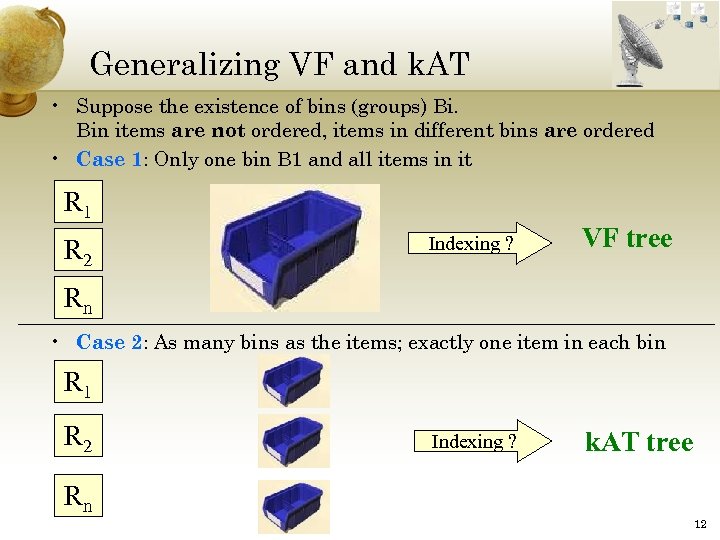 Generalizing VF and k. AT • Suppose the existence of bins (groups) Bi. Bin items are not ordered, items in different bins are ordered • Case 1: Only one bin B 1 and all items in it R 1 R 2 Indexing ? VF tree Rn • Case 2: As many bins as the items; exactly one item in each bin R 1 R 2 Rn Indexing ? k. AT tree 12
 POBI: Generalizing VF and k. AT • A bin may contain more than one item • • If only one bin, then previous Case 1 If as many bins as items, then previous Case 2 • Practical problem instances • • • Sensor measurements : temperature vs. humidity Battlefields : enemy movements vs. friendly losses Cellular : different projections of relations 13
 POBI: Problem definition • Problem definition • • • n data items and their access probabilities m number of bins and a membership function construct the index with minimal cost by respecting the partial order, i. e. , in an inorder tree traversal x precedes y, if x Bi and y Bj and i
 POBI design – First attempts • Brute force exponentially many permutations • generate all possible permutation of the n items obeying group membership and inter-group ordering • build an alphabetic tree for the groups • Random ordering inside each group and build k-ary alphabetic tree for the grpoups: k. ATr • Sort the items of each group in non-descending (non-increasing) order and build an alphabetic tree for the groups: k. ATi (k. ATd) 15
 POBI design – Final attempt • Objective: push the less popular items of each group deeper into the resulting broadcast tree • Method • create subtrees; each subtree corresponds to one group (bin) • treat each subtree as a node; the subtree’s cost is its root’s weight • apply alphabetic tree construction method to all subtrees • Challenge: devise a subtree creation method 16
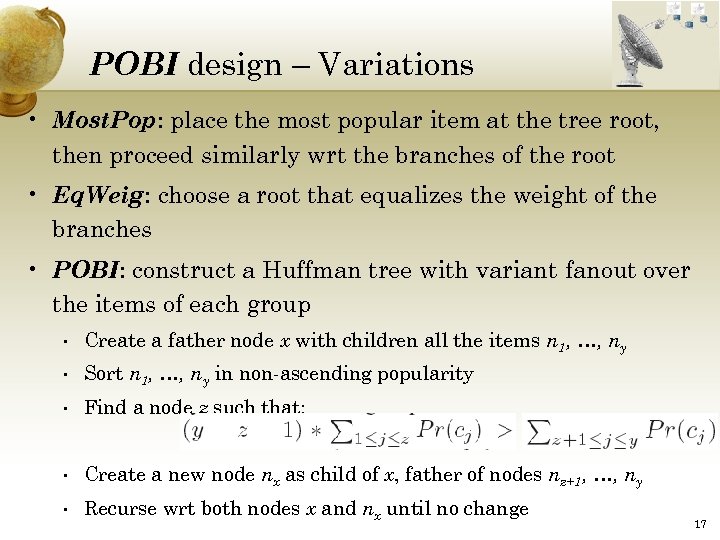 POBI design – Variations • Most. Pop: place the most popular item at the tree root, then proceed similarly wrt the branches of the root • Eq. Weig: choose a root that equalizes the weight of the branches • POBI: construct a Huffman tree with variant fanout over the items of each group • Create a father node x with children all the items n 1, …, ny • Sort n 1, …, ny in non-ascending popularity • Find a node z such that: • Create a new node nx as child of x, father of nodes nz+1, …, ny • Recurse wrt both nodes x and nx until no change 17
 Evaluation setting • Since no prior similar work exists, we compare: • • Straightforward extension of VF, with random ordering inside each group Straightforward extension of k. AT, with random ordering inside each group k. ATi and k. ATd Most. Pop and Eq. Weig and POBI • Evaluation wrt: • • number of items, default 500 number of groups, default 10 relative group size, default 0. 1 (Zipf skew theta) relative group popularity, default 0. 1 (Zipf skew theta) • Performance metric • Index access cost 18
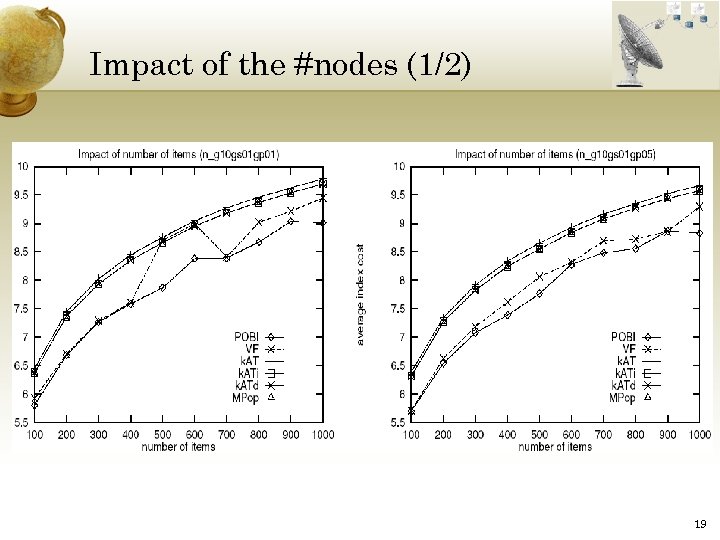 Impact of the #nodes (1/2) 19
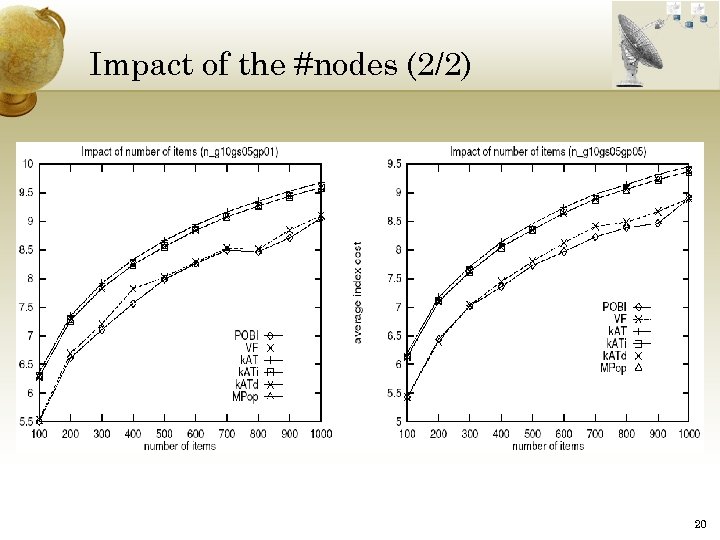 Impact of the #nodes (2/2) 20
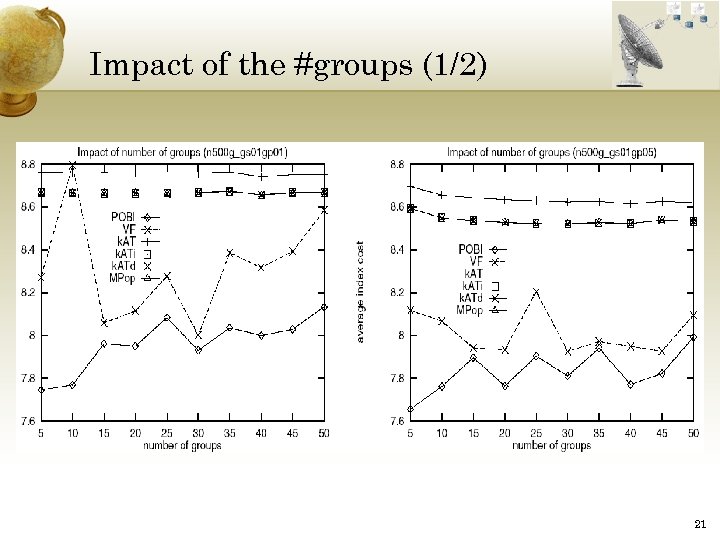 Impact of the #groups (1/2) 21
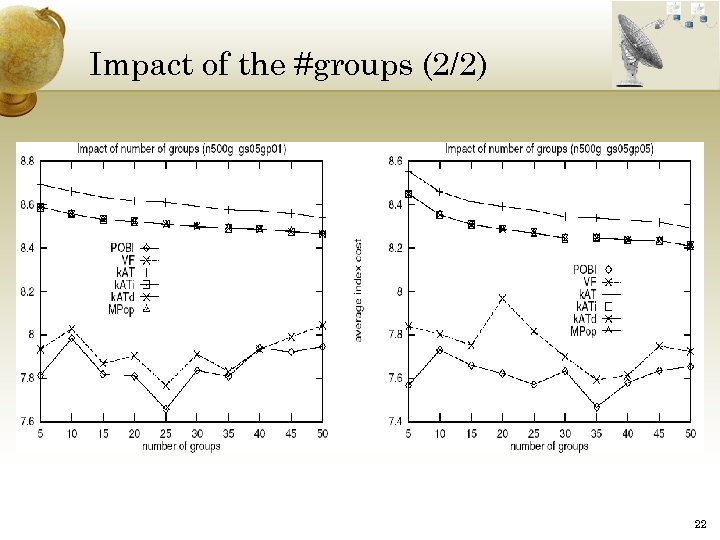 Impact of the #groups (2/2) 22
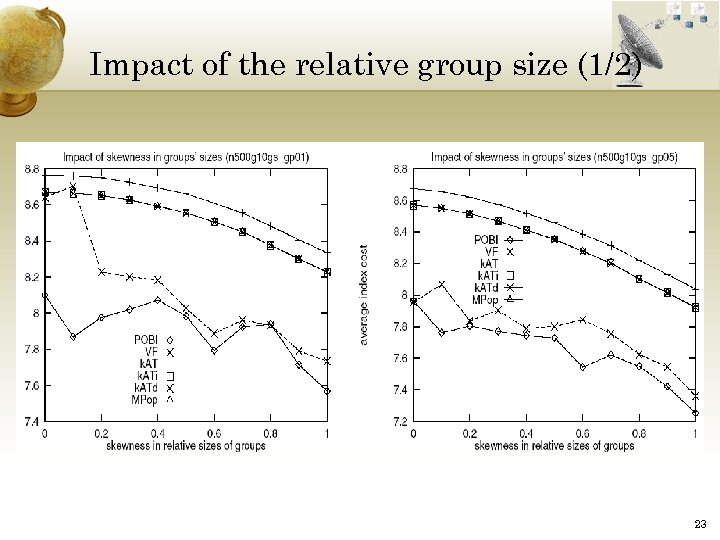 Impact of the relative group size (1/2) 23
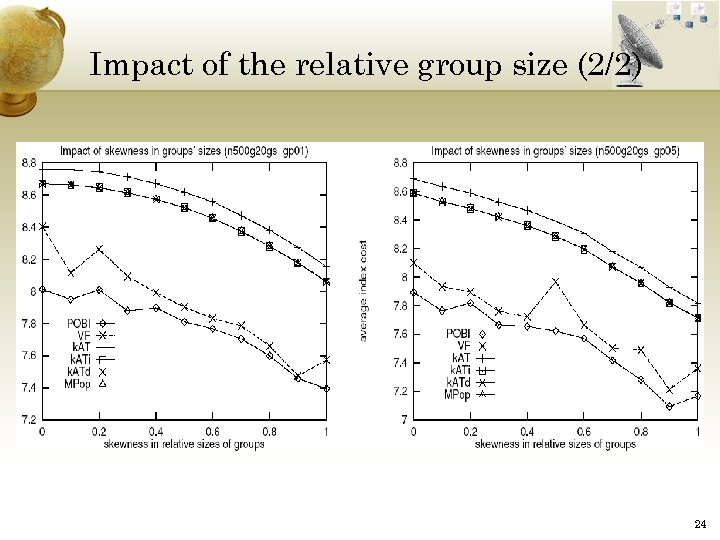 Impact of the relative group size (2/2) 24
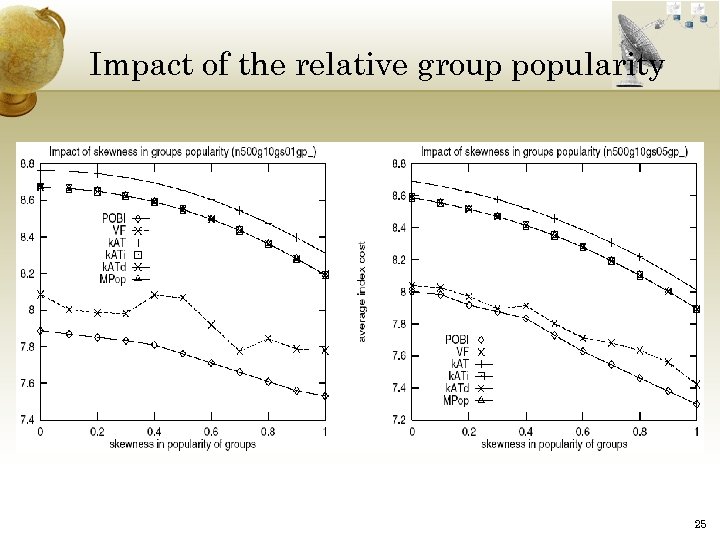 Impact of the relative group popularity 25
 Summary and contributions • Defined and investigated for the first time indexing broadcast information of partially ordered data • Proved that it naturally generalizes two problems proposed earlier in the literature • Proposed approximate algorithms to generate the broadcast search trees; optimal algorithms require solving exponential number of subproblems • Simulated an environment to evaluate the performance • POBI – Partial Ordering Broadcast Index has been proven to prevail 26