


 Скачать презентацию GENERAL RULES OF PROCEDURE Points Motions
GENERAL RULES OF PROCEDURE.pptx
- Количество слайдов: 10
 GENERAL RULES OF PROCEDURE Points & Motions
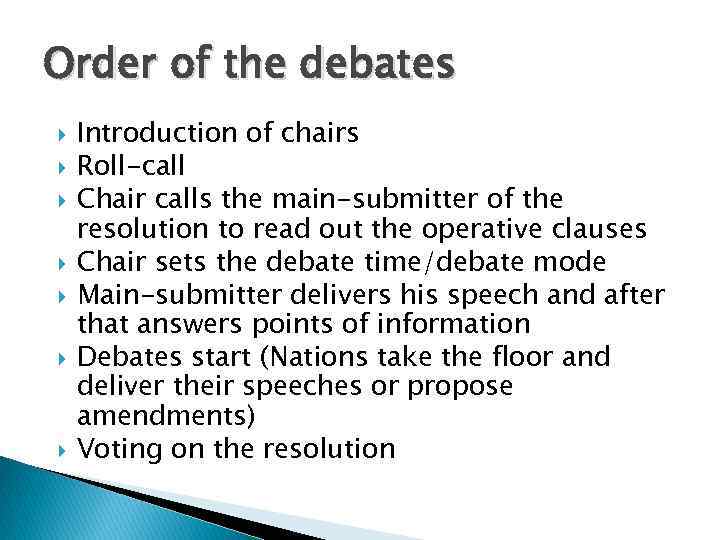 Order of the debates Introduction of chairs Roll-call Chair calls the main-submitter of the resolution to read out the operative clauses Chair sets the debate time/debate mode Main-submitter delivers his speech and after that answers points of information Debates start (Nations take the floor and deliver their speeches or propose amendments) Voting on the resolution
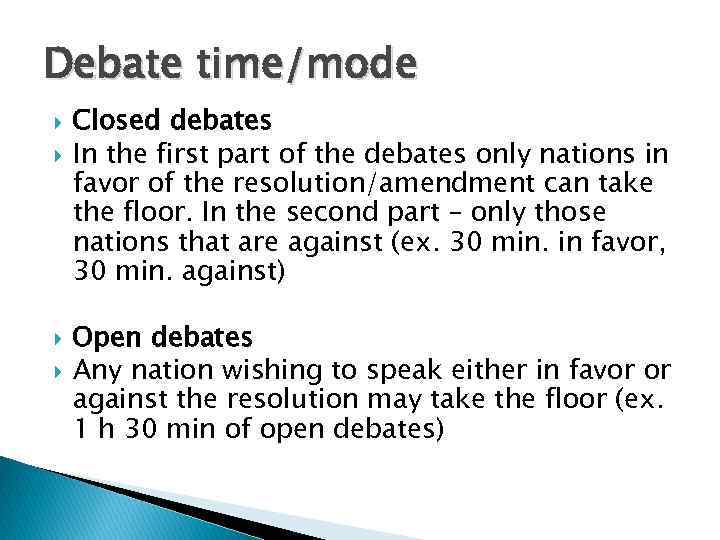 Debate time/mode Closed debates In the first part of the debates only nations in favor of the resolution/amendment can take the floor. In the second part – only those nations that are against (ex. 30 min. in favor, 30 min. against) Open debates Any nation wishing to speak either in favor or against the resolution may take the floor (ex. 1 h 30 min of open debates)
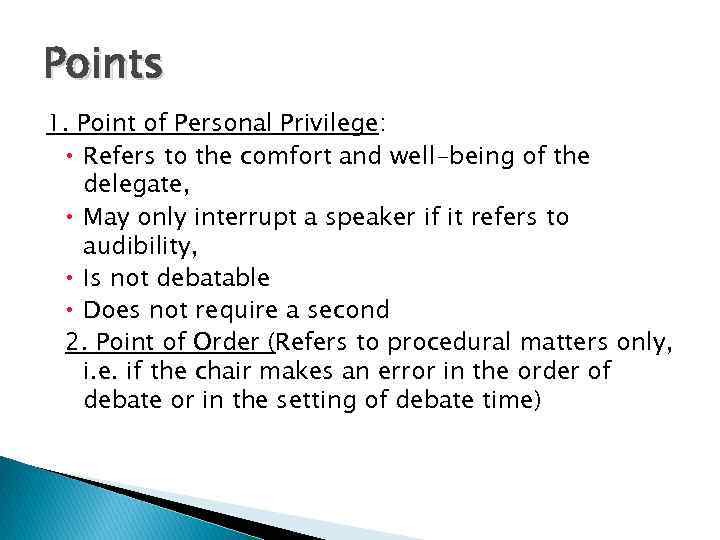 Points 1. Point of Personal Privilege: Refers to the comfort and well-being of the delegate, May only interrupt a speaker if it refers to audibility, Is not debatable Does not require a second 2. Point of Order (Refers to procedural matters only, i. e. if the chair makes an error in the order of debate or in the setting of debate time)
 3. Point of information to the speaker (A question directed to the delegate having the floor, and who has indicated that he is willing to answer points of information): Must be formulated in the form of a question, i. e. "Is the speaker aware that. " A short introductory statement may precede the question, Only ONE question by the same questioner. There will be no dialogue between speaker and questioner on the floor 4. Right to follow up
 5. Point of Information to the Chair: A question to the chair, May not interrupt a speaker, Can refer to almost anything, from issues to personal priorities 6. Point of Parliamentary Enquiry: ◦ Point of information to the chair concerning Rules of Procedures, ◦ Example: "Could the Chair please explain to the house what is meant by closed debate? "
 Motions 1. "Motion to move to the previous question“ During open debates calls for the closure of debate and vote, During closed debates calls for moving into the time against; 2. "Motion adjourn the debate“: Calls for the temporary disposal of a resolution, Practically means the death of the resolution, due to lack of time
 3. "Motion to reconsider a resolution“ (Calls for a re-debate and re-vote of a motion that has already been discussed (adopted or rejected) 4. “Motion to extend debate time” (Calls for extension of the debates) 5. “Motion to divide the house” (roll-call vote; may be used in case of arguable results of the previous voting procedure)
 Final questions Imagine that you are losing consciousness during the debates. What point will you use? Chair said that the time in favor of the amendment has elapsed but you have a speech in favor. What are you going to do? What’s the difference between the Point of order and the Point of Parliamentary Enquiry? The house has just voted on the resolution – 25 votes in favor and 27 against. You think that the votes haven’t been counted right. What motion will you use? At the end of the day you feel that the house is tired and almost nobody wants to speak. What can you do to end the debates?
 THANK YOU FOR YOUR ATTENTION!