

General Psychology lecture 8 -9 Thinking and

 Скачать презентацию General Psychology lecture 8 -9 Thinking and
General Psychology lecture 8-9.ppt
- Количество слайдов: 17
General Psychology lecture 8 -9 Thinking and Intelligence. 1. Interrelation of cognitive areas 2. Thinking and language 3. Problem solving 4. Intelligence 5. Creativity
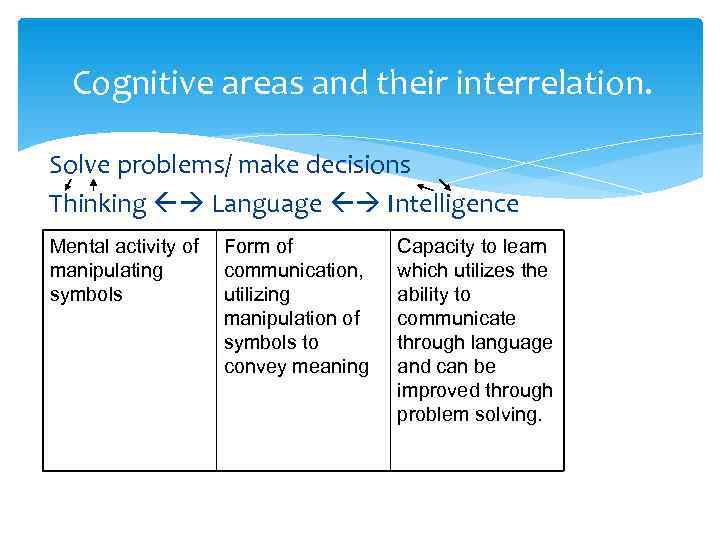
Cognitive areas and their interrelation. Solve problems/ make decisions Thinking Language Intelligence Mental activity of Form of Capacity to learn manipulating communication, which utilizes the symbols utilizing ability to manipulation of communicate symbols to through language convey meaning and can be improved through problem solving.
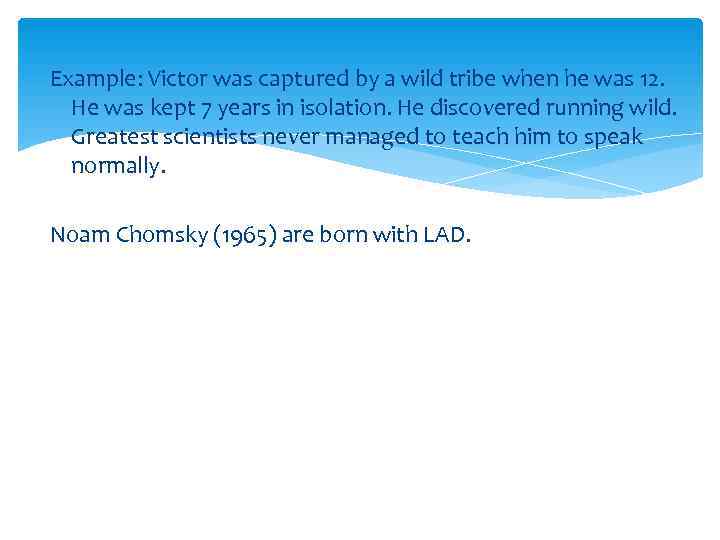
Example: Victor was captured by a wild tribe when he was 12. He was kept 7 years in isolation. He discovered running wild. Greatest scientists never managed to teach him to speak normally. Noam Chomsky (1965) are born with LAD.
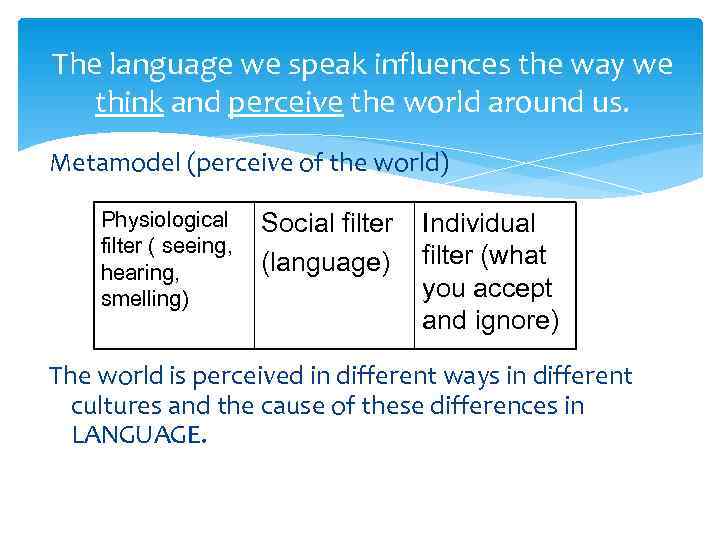
The language we speak influences the way we think and perceive the world around us. Metamodel (perceive of the world) Physiological Social filter Individual filter ( seeing, filter (what hearing, (language) smelling) you accept and ignore) The world is perceived in different ways in different cultures and the cause of these differences in LANGUAGE.
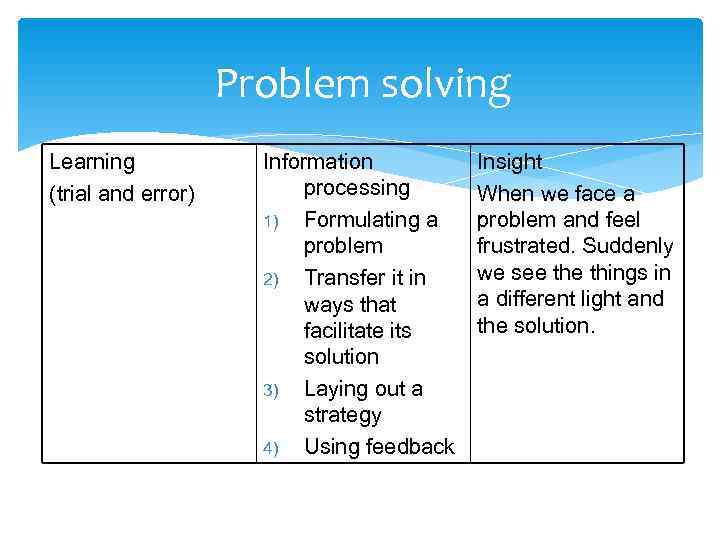
Problem solving Learning Information Insight (trial and error) processing When we face a 1) Formulating a problem and feel problem frustrated. Suddenly 2) Transfer it in we see things in ways that a different light and facilitate its the solution. solution 3) Laying out a strategy 4) Using feedback
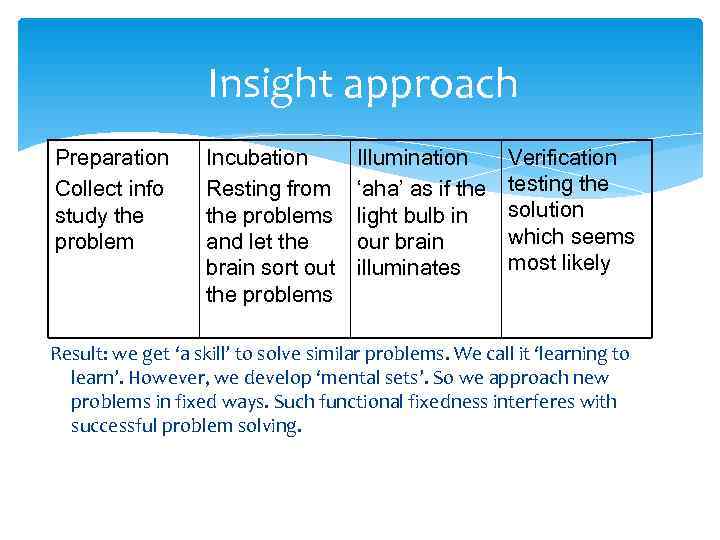
Insight approach Preparation Incubation Illumination Verification Collect info Resting from ‘aha’ as if the testing the study the problems light bulb in solution problem and let the our brain which seems brain sort out illuminates most likely the problems Result: we get ‘a skill’ to solve similar problems. We call it ‘learning to learn’. However, we develop ‘mental sets’. So we approach new problems in fixed ways. Such functional fixedness interferes with successful problem solving.
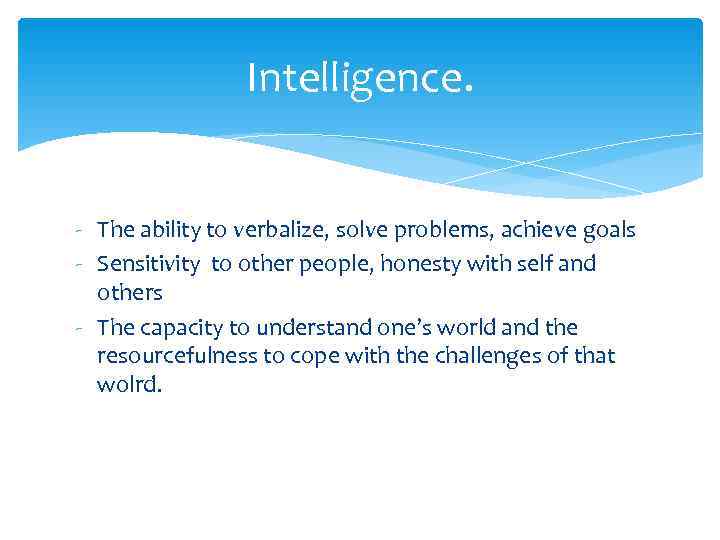
Intelligence. - The ability to verbalize, solve problems, achieve goals - Sensitivity to other people, honesty with self and others - The capacity to understand one’s world and the resourcefulness to cope with the challenges of that wolrd.
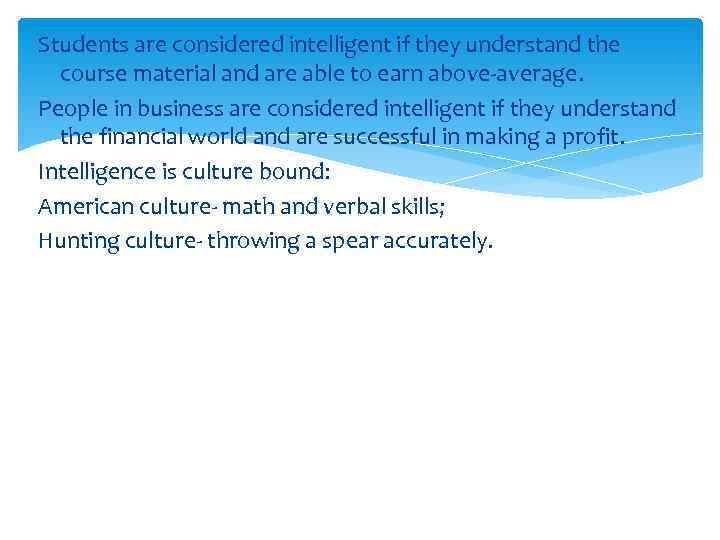
Students are considered intelligent if they understand the course material and are able to earn above-average. People in business are considered intelligent if they understand the financial world and are successful in making a profit. Intelligence is culture bound: American culture- math and verbal skills; Hunting culture- throwing a spear accurately.
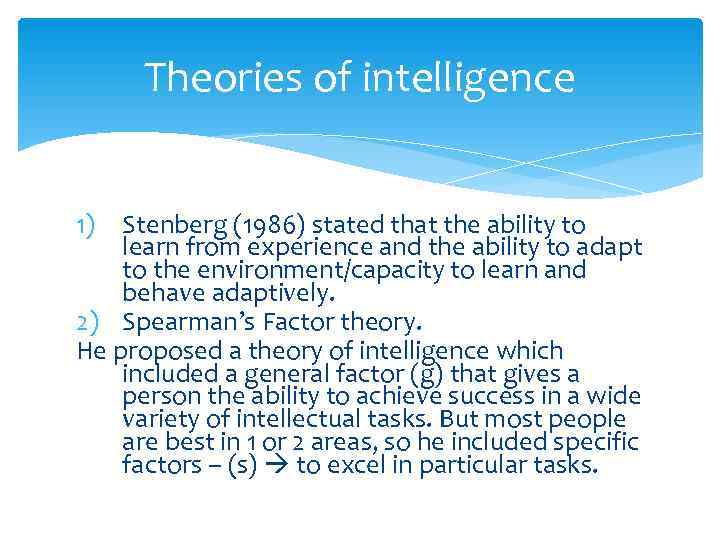
Theories of intelligence 1) Stenberg (1986) stated that the ability to learn from experience and the ability to adapt to the environment/capacity to learn and behave adaptively. 2) Spearman’s Factor theory. He proposed a theory of intelligence which included a general factor (g) that gives a person the ability to achieve success in a wide variety of intellectual tasks. But most people are best in 1 or 2 areas, so he included specific factors – (s) to excel in particular tasks.
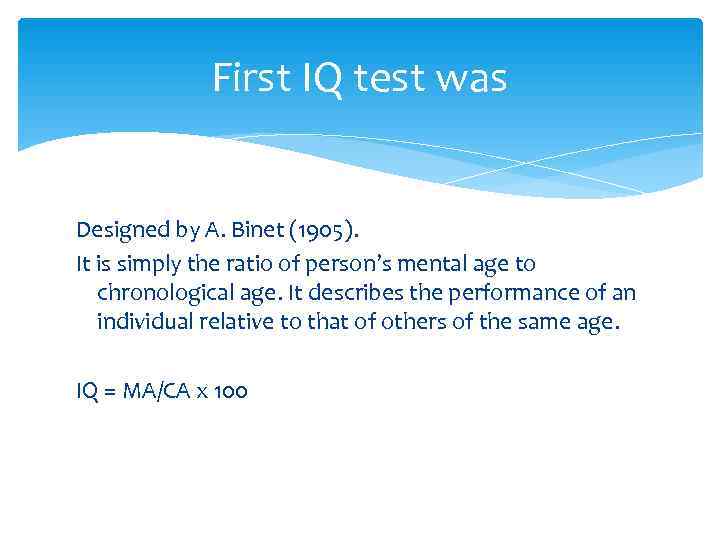
First IQ test was Designed by A. Binet (1905). It is simply the ratio of person’s mental age to chronological age. It describes the performance of an individual relative to that of others of the same age. IQ = MA/CA x 100
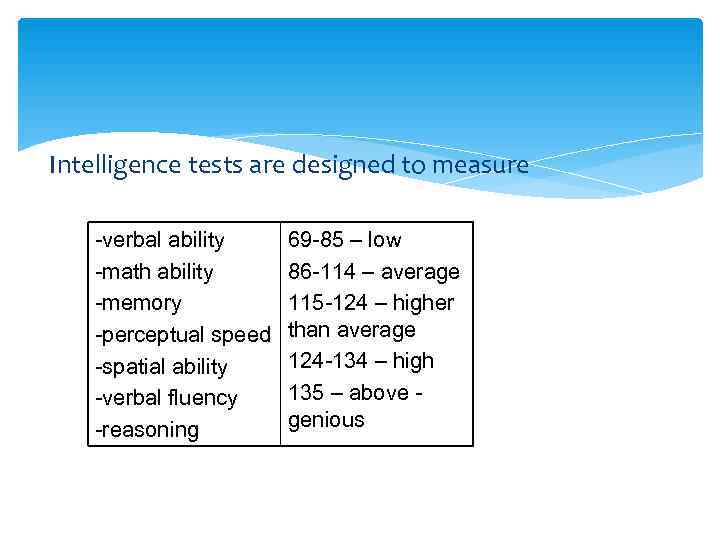
Intelligence tests are designed to measure -verbal ability 69 -85 – low -math ability 86 -114 – average -memory 115 -124 – higher -perceptual speed than average -spatial ability 124 -134 – high -verbal fluency 135 – above - -reasoning genious
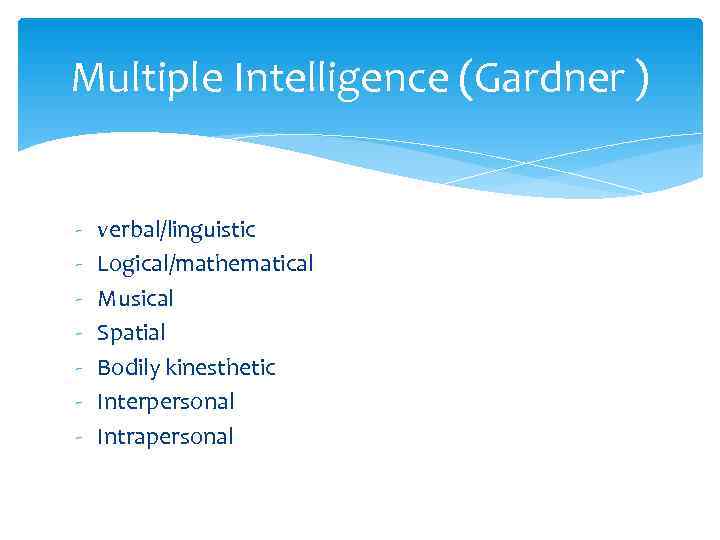
Multiple Intelligence (Gardner ) - verbal/linguistic - Logical/mathematical - Musical - Spatial - Bodily kinesthetic - Interpersonal - Intrapersonal
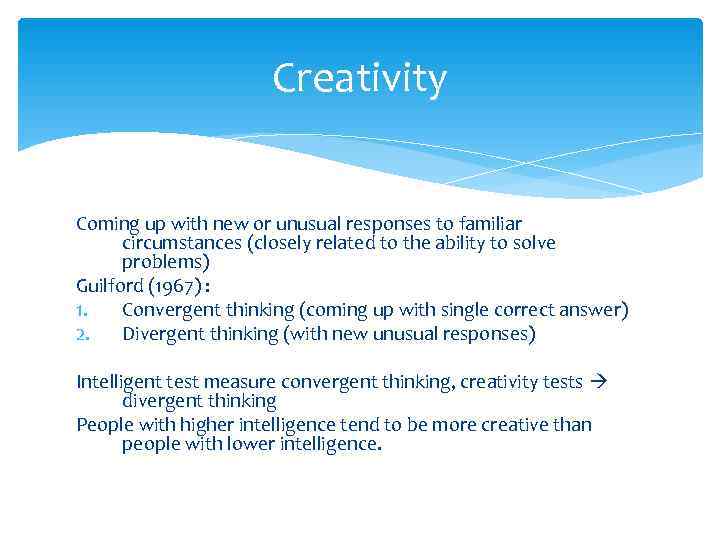
Creativity Coming up with new or unusual responses to familiar circumstances (closely related to the ability to solve problems) Guilford (1967) : 1. Convergent thinking (coming up with single correct answer) 2. Divergent thinking (with new unusual responses) Intelligent test measure convergent thinking, creativity tests divergent thinking People with higher intelligence tend to be more creative than people with lower intelligence.
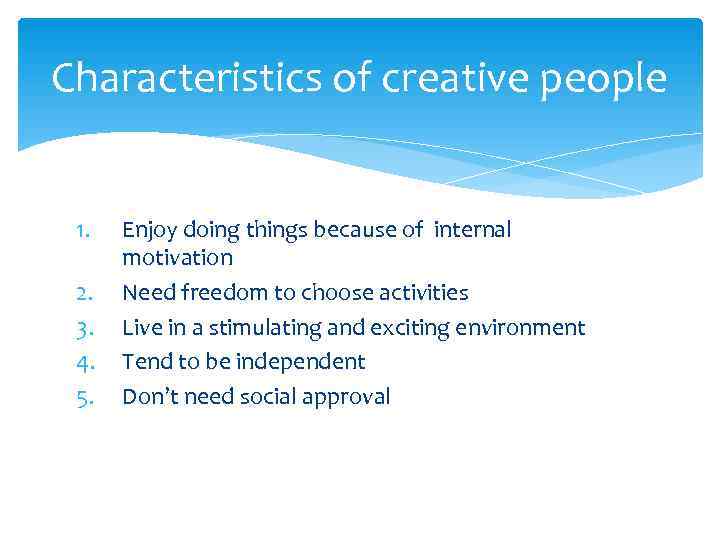
Characteristics of creative people 1. Enjoy doing things because of internal motivation 2. Need freedom to choose activities 3. Live in a stimulating and exciting environment 4. Tend to be independent 5. Don’t need social approval
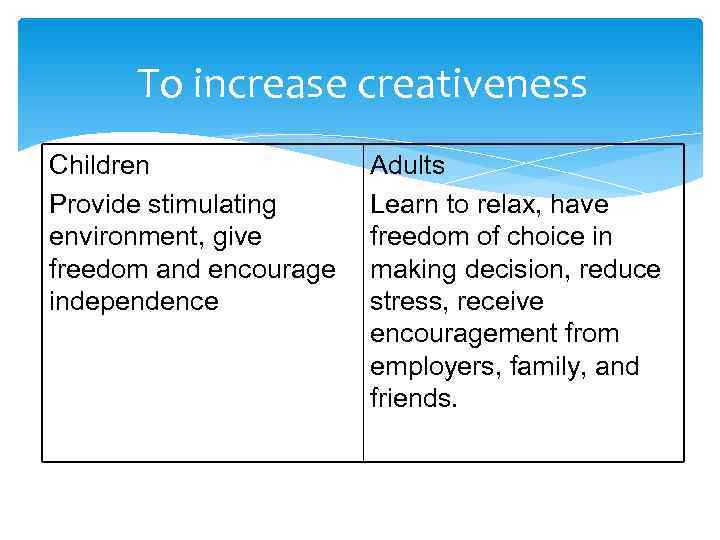
To increase creativeness Children Adults Provide stimulating Learn to relax, have environment, give freedom of choice in freedom and encourage making decision, reduce independence stress, receive encouragement from employers, family, and friends.
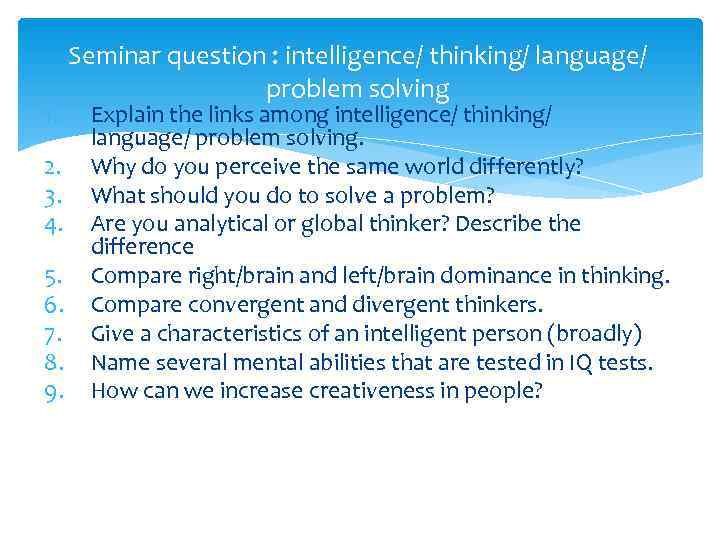
Seminar question : intelligence/ thinking/ language/ problem solving 1. Explain the links among intelligence/ thinking/ language/ problem solving. 2. Why do you perceive the same world differently? 3. What should you do to solve a problem? 4. Are you analytical or global thinker? Describe the difference 5. Compare right/brain and left/brain dominance in thinking. 6. Compare convergent and divergent thinkers. 7. Give a characteristics of an intelligent person (broadly) 8. Name several mental abilities that are tested in IQ tests. 9. How can we increase creativeness in people?
Literature: Ch. 9 pp 361 – 367 Readings Ch 12 pp 470 – 487 Tests/ Questionnaires Multiple intelligence test Left-brain/right-brain dominance Analytical/global thinkers Essay: ‘Genetic and environmental influences on my intelligence’. Make research of genetic and environmental influences and describe their importance in the determination of intelligence. Identify your IQ score and attempts to explain what influenced your intellectual ability. Supply your description with the results from left/right dominance questionnaire and analytical/global thinkers chart. Read the article about multiple intelligence and add this information to the essay about your abilities. Volunteer reports: 1. Genetic influence on intelligence ( pp 478 -479) 2. Environmental influence on intelligence ( pp 479 -480)