


 Скачать презентацию General Psych 2 Altruism Module 55 Stereotypes
93087f729d38a08323dc32ff63fa980a.ppt
- Количество слайдов: 58
 General Psych 2 Altruism – Module 55 Stereotypes and Prejudices –Module 55 March 9, 2004 Class #13
 Altruism • Pure altruism – Action intended to solely benefit another – No external reward to the helper – No internal reward to the helper • Some argue there is no such thing as pure altruism
 Insights into the evolution of helping • Inclusive Fitness – The ability of one’s genes to survive in one’s own offspring AND in any relatives one helps – Helping a close relative promotes the survival of those genes
 Genetic Relatedness and Helping • • • Would you lend your car to your brother? What about your grandfather? What about a cousin? What about an attractive stranger? Michael Cunningham and his colleagues asked people whether they would be willing to help other people in different situations
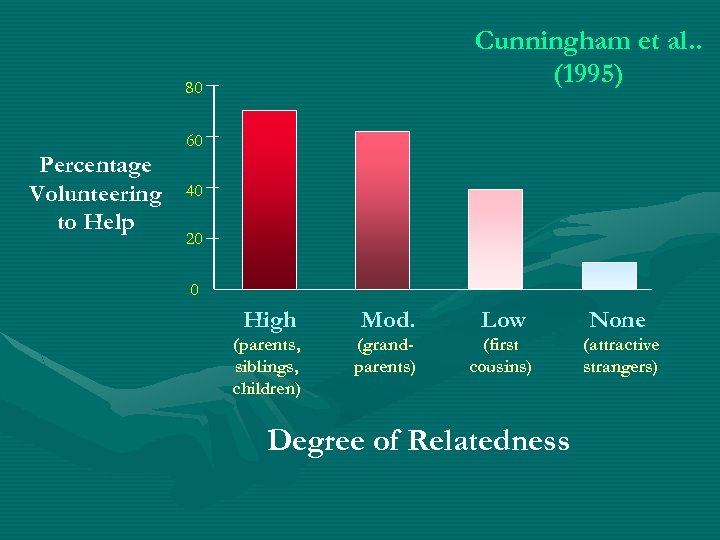 Cunningham et al. . (1995) 80 Percentage Volunteering to Help 60 40 20 0 High Mod. Low None (parents, siblings, children) (grandparents) (first cousins) (attractive strangers) Degree of Relatedness
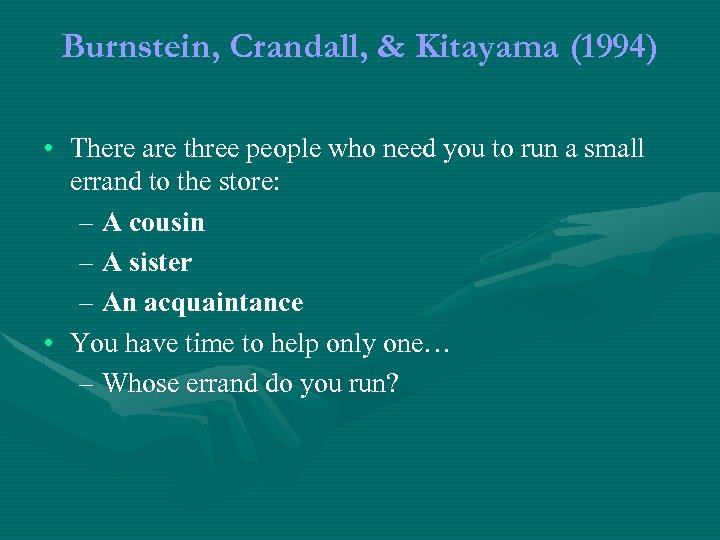 Burnstein, Crandall, & Kitayama (1994) • There are three people who need you to run a small errand to the store: – A cousin – A sister – An acquaintance • You have time to help only one… – Whose errand do you run?
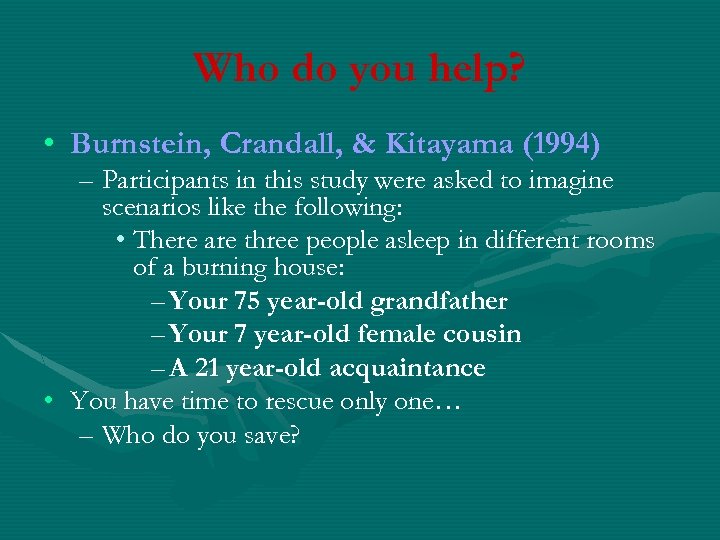 Who do you help? • Burnstein, Crandall, & Kitayama (1994) – Participants in this study were asked to imagine scenarios like the following: • There are three people asleep in different rooms of a burning house: – Your 75 year-old grandfather – Your 7 year-old female cousin – A 21 year-old acquaintance • You have time to rescue only one… – Who do you save?
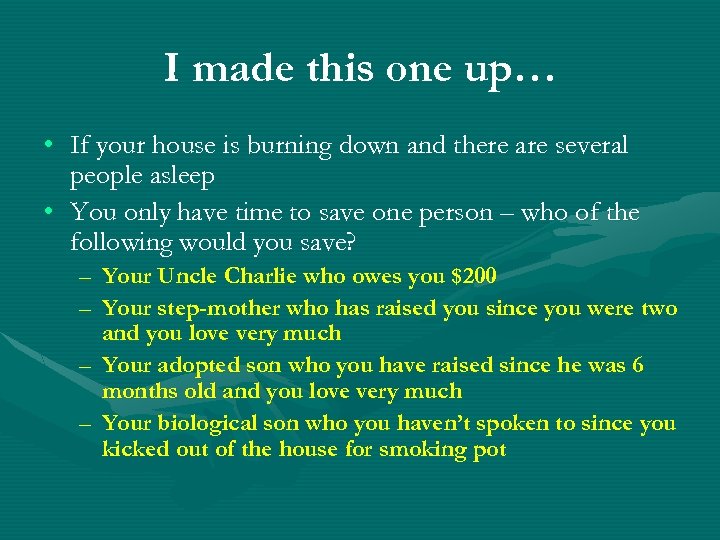 I made this one up… • If your house is burning down and there are several people asleep • You only have time to save one person – who of the following would you save? – Your Uncle Charlie who owes you $200 – Your step-mother who has raised you since you were two and you love very much – Your adopted son who you have raised since he was 6 months old and you love very much – Your biological son who you haven’t spoken to since you kicked out of the house for smoking pot
 Who do you help? • For everyday help, people tended to help close relatives more than non-relatives • The difference became even more pronounced in life-or-death situations – See next two slides…
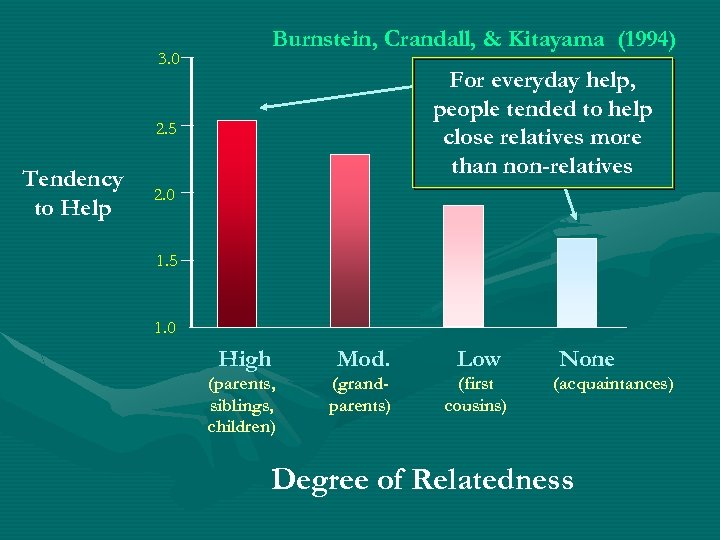 3. 0 Burnstein, Crandall, & Kitayama (1994) For everyday help, people tended to help close relatives more than non-relatives 2. 5 Tendency to Help 2. 0 1. 5 1. 0 High Mod. Low (parents, siblings, children) (grandparents) (first cousins) None (acquaintances) Degree of Relatedness
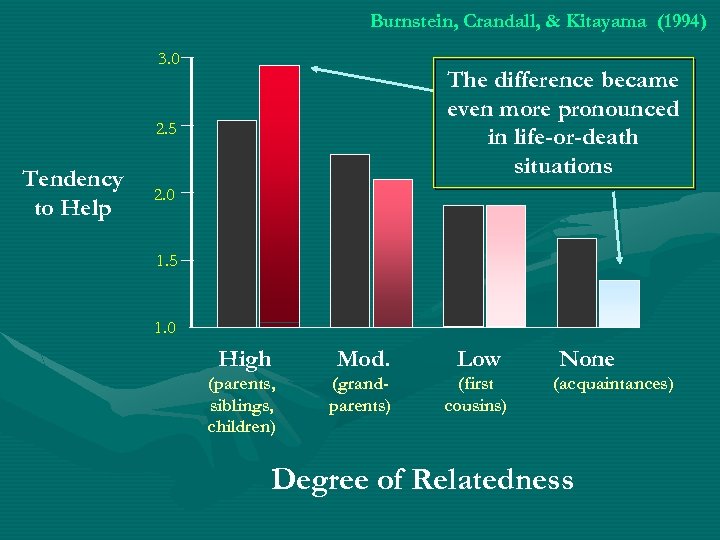 Burnstein, Crandall, & Kitayama (1994) 3. 0 The difference became even more pronounced in life-or-death situations 2. 5 Tendency to Help 2. 0 1. 5 1. 0 High Mod. Low (parents, siblings, children) (grandparents) (first cousins) None (acquaintances) Degree of Relatedness
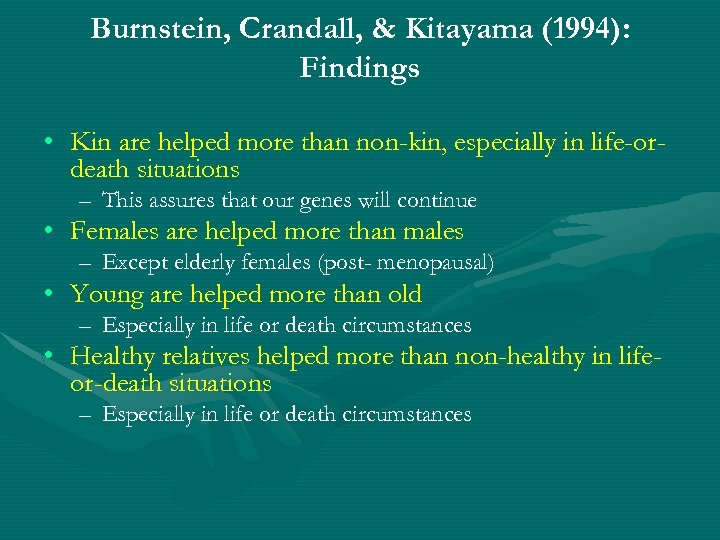 Burnstein, Crandall, & Kitayama (1994): Findings • Kin are helped more than non-kin, especially in life-ordeath situations – This assures that our genes will continue • Females are helped more than males – Except elderly females (post- menopausal) • Young are helped more than old – Especially in life or death circumstances • Healthy relatives helped more than non-healthy in lifeor-death situations – Especially in life or death circumstances
 Gaining Social Status and Approval • Potlatch Ceremony – Ritual in which a host gives guests enormous quantities of goods. – Like philanthropic acts by wealthy individuals in modern society, potlatch increased the status of the giver • Social Responsibility Norm – Societal rule that people should help those who need their assistance • Social Exchange Theory – Weighing all costs before helping – Like an accountant?
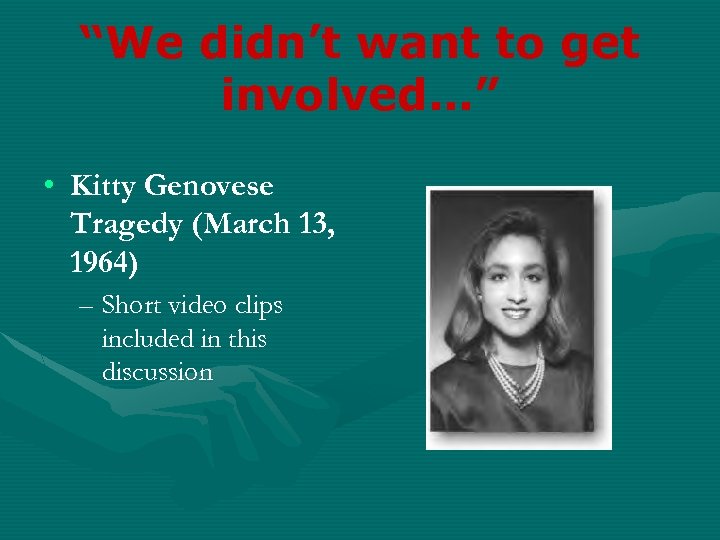 “We didn’t want to get involved…” • Kitty Genovese Tragedy (March 13, 1964) – Short video clips included in this discussion
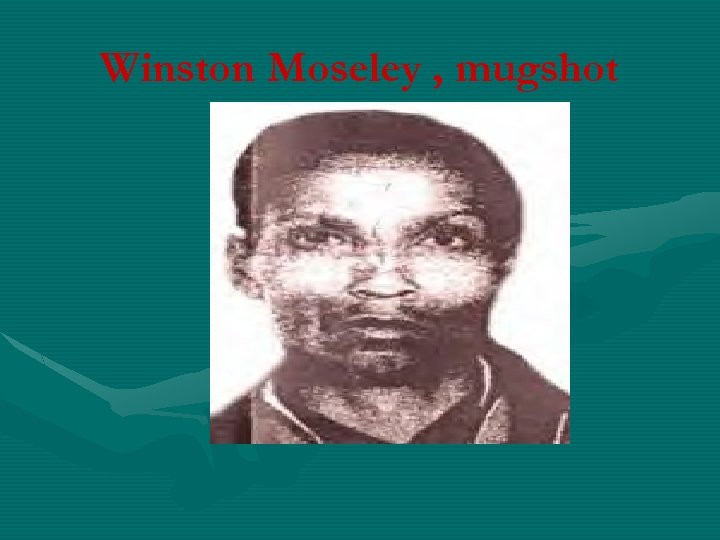 Winston Moseley , mugshot
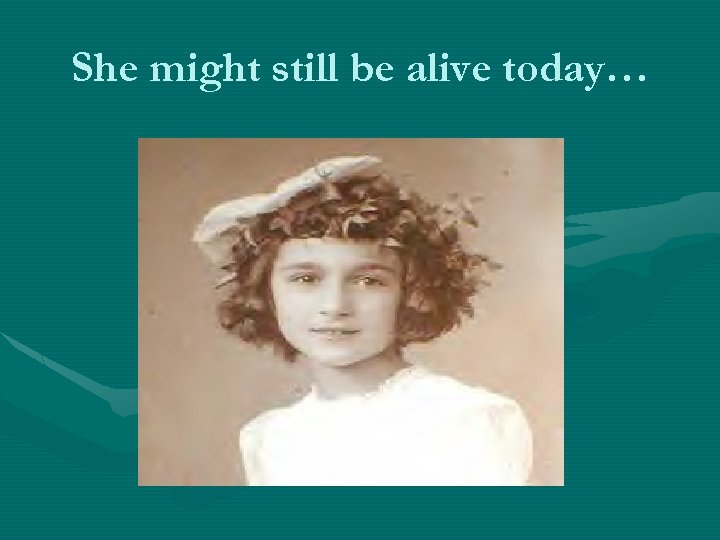 She might still be alive today…
 Diffusion of Responsibility • Tendency for each group member to dilute personal responsibility for acting by spreading it among all other group members… – Example: Bystanders to an emergency may assume someone else will call the police
 Pluralistic Ignorance • Phenomenon that occurs when bystanders to an emergency, trying to look poised, give misleading cues to others that no help is needed – Results suggest that people look to others to provide information… – If no one else seems upset, it suggests this isn’t an emergency
 Latane & Darley (1968): Smoke study • Procedure: – In this study, researchers pumped smoke into a lab while students filled out a questionnaire… • Some students were left alone • Some with 2 other real participants • Some with 2 other confederates who pretended nothing was wrong
 Latane & Darley (1968): Smoke study • DV: Going to get help • IV: Number of people in the room • Results: – See graph on next slide
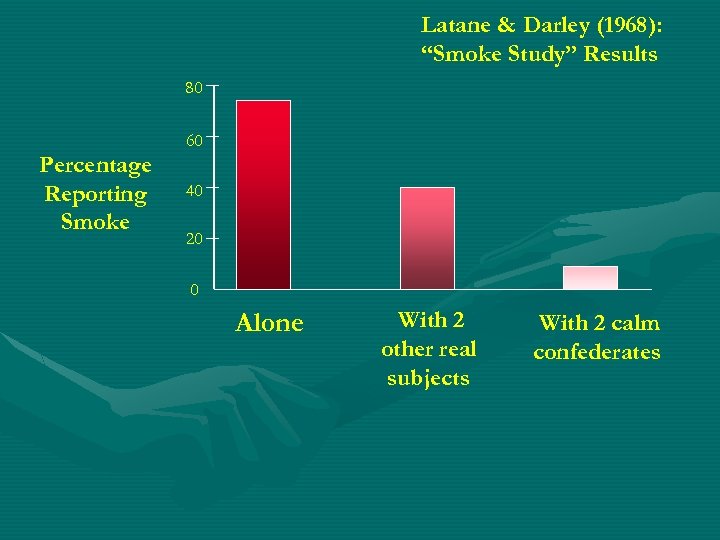 Latane & Darley (1968): “Smoke Study” Results 80 Percentage Reporting Smoke 60 40 20 0 Alone With 2 other real subjects With 2 calm confederates
 Latane & Darley (1968): Smoke study • Informational influence? – Being around others made people less likely to interpret smoke as an emergency
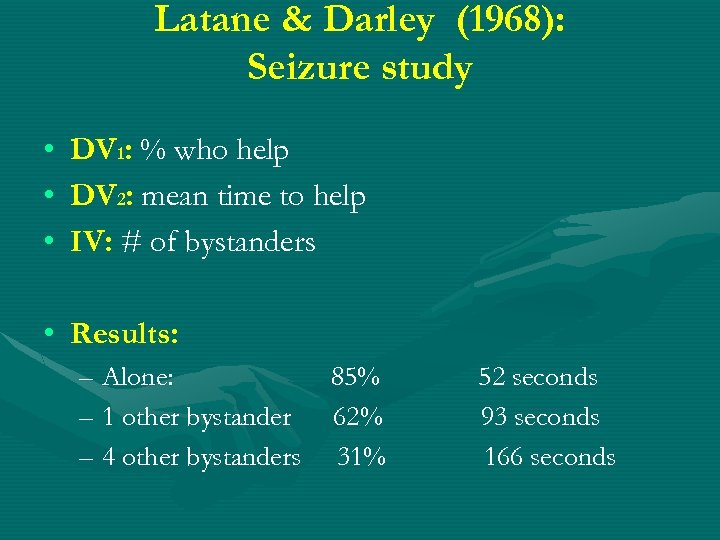 Latane & Darley (1968): Seizure study • • • DV 1: % who help DV 2: mean time to help IV: # of bystanders • Results: – Alone: 85% 52 seconds – 1 other bystander 62% 93 seconds – 4 other bystanders 31% 166 seconds
 Shotland & Straw (1976) • Sometimes people assume help would be seen as an unwelcome intrusion… – When a woman fighting with a man shouted: • “I don’t even know you!” – she was more likely to receive help than if she shouted: “I don’t know why I ever married you!”
 Time Costs… • Darley and Batson (1973) – 40 students from Princeton Theological Seminary • Remember we mentioned this in class 1
 Latané & Darley (1970) Darley and Batson (1973) • Helping is the last step of a process involving multiple decisions: – Helping Decision Tree • 1. Notice the incident • 2. Interpret incident as emergency • 3. Assume responsibility • 4. Know the appropriate response • 5. Implement decision to help • 6. Time factors
 Latané & Darley (1970) Darley and Batson (1973) • If the answer is "no" at any step, helping will not occur • Note: I’ve combined the two research studies here with points 1 -5 coming from the 1970 study and point 6 from the 1973 study
 Stereotypes and Prejudices • Stereotypes – The generalized perceptions, beliefs, and expectations a person has about members in some group – Schemas about entire groups of people – Effects of stereotypes on behavior can be automatic and unconscious • Prejudice – A negative attitude toward an individual based solely on the person’s membership is some group – In one word…prejudgment • Discrimination – Differential treatment of individuals who belong to different groups
 Its getting better, but… • Attitudes towards both women and people of color have improved since the 1940’s • Most people agree that women and men doing the same job should get equal pay • Most agree that white and black children should attend the same school • Will we have a women President in the near future? ? ?
 Can race can influence how a given behavior is interpreted? • Bottom-up processing – Perceptions influenced by the visual field itself – Can be referred to as “true object” perceptions – making sense from our sensations • Top-down processing – These perceptions are influenced by what the person expects or has experienced before – Our experiences memories, and expectations are what's important here – Can lead to biases and misperceptions… • Duncan (1976) • See next slide
 “The ambiguous shove” • Duncan (1976) – White undergraduates viewed two nearly identical videos – Participants were divided and placed randomly in on of two groups… • Group 1: – A black person is seen shoving a white person • Group 2: – A white person is seen shoving a black person
 Duncan (1976) • What do you predict as the results ? – Why?
 Other examples (flaws) of top-down processing… • Allport (1954) – Found evidence for the stereotype that “fat people are jolly” • Dion et al. (1972) – Attractive people are perceived as being more honest than unattractive people • Karr (1978) – Found that participants felt that homosexuals were shallow, yielding, tense
 Ingroup vs. Outgroup • Us vs. Them – Such group identifications can promote an ingroup bias (a favoring of one’s own group over another)
 Scapegoat Theory • Scapegoating begins with frustration which, in turn, causes aggression • This aggression is then displaced and rationalized by blaming a minority group • Obviously, not all people who become frustrated are prejudice, but research has shown that those who are high in prejudice are more likely to become frustrated than those low in prejudice • Apparently, since prejudice people cannot deal with their inner frustrations, they stereotype, blame, and attack less powerful groups
 “If there were no Jews, we would have to invent them” • A Nazi leader was quoted as saying the above… – Cialdini & Richardson (1980) • Despised outgroups can boost an ingroup’s selfesteem • Students experiencing failure or made to feel insecure will often restore their self-esteem by disparaging a rival school or another person
 Motivational Theories of Prejudice and Stereotyping • Prejudice serves to meet certain needs and increases one’s sense of security • Prejudice especially more likely among those high in authoritarianism who have: – An acceptance of very conventional or traditional values – A willingness to unquestioningly follow orders of authority figures – An inclination to act aggressively towards those identified by authority figure as a threat to one’s values or well-being
 Cognitive Theories of Prejudice and Stereotyping • People use schemas and other cognitive shortcuts to organize and make sense of their social world • Sometimes these processes lead to inaccurate stereotypes • For example: – We tend to simplify our perceptions by seeing group members as similar to one another – We also see illusory correlations between an individual’s behavior and group membership
 Learning Theories of Prejudice and Stereotyping • Like attitudes, prejudices can be learned… – Explains how one can develop negative attitudes towards never encountered groups – Prejudice can be the result of observational learning – One can be directly reinforced for expressing prejudice
 Categorization • The classification of persons into groups on the basis of common attributes • Can bias our perceptions • Stone (1997) – – – Radio broadcast Shown a photograph of the player to be analyzed Participants rated the player better if they thought he was black
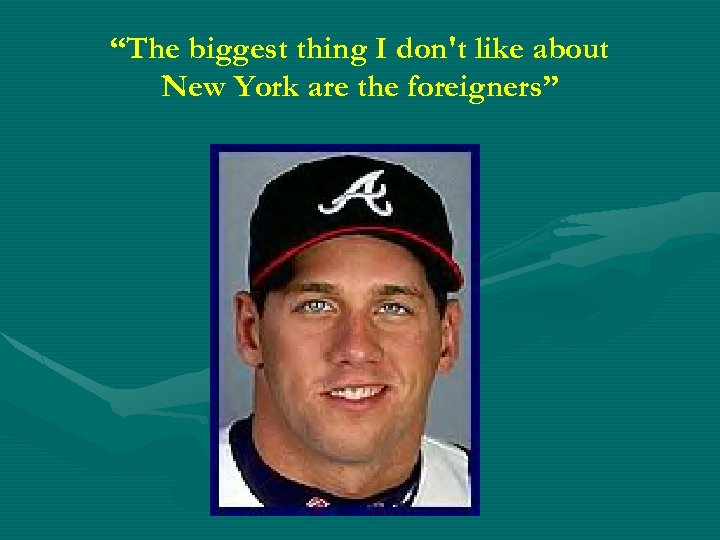 “The biggest thing I don't like about New York are the foreigners”
 Some people think that he isn’t that far off…are they prejudiced too? • Its clear that Rocker doesn't like to mingle with people who speak different languages or look different than he does… – But is that racism or prejudice? – A negative view – yes… – But was there hostility or were these simply irrational judgments being made?
 Borrowing a word from abnormal psychology… • Maybe Rocker is simply xenophobic… – The fear and hatred of strangers and foreigners
 Realistic Group Conflict Theory • Proposal that intergroup conflict, and negative prejudices and stereotypes, emerge out of actual competition between groups for desired resources – Example: Members of different ethnic groups may compete for the same jobs, or the same farmland
 Realistic group conflict theory • Competition for valuable but limited resources breeds hostility… – Loser: becomes frustrated – Winner: becomes threatened • Result: Much conflict • Example: Women and immigrants joining the workforce • When conflict arises there is a higher tendency to rely on stereotypes…“they’re all the same”
 Intergroup Competition • Sherif (1961, 1988): The Robbers Cave Experiment – Two groups of eleven year-old boys were sent to a remote summer camp in Robbers Cave State Park (Oklahoma) – Initially unaware of their fragile co-existence, they formed tribalistic bonds, and were having a great time…and then…
 Experimenters did a bad thing… • They put the boys in direct competition • They competed for medals and attention
 The Robbers Cave Experiment • Raided one another’s cabins • Stole and burned one another’s flags • Came to view one another as “stinkers” “smart-alecks” and “sneaks” • Verbal prejudice became apparent, spiraling downward towards aggressive territorial violence • The groups eventually had to be separated
 Perceived outgroup homogeneity • Phenomenon of overestimating the extent to which members within other groups are similar to each other – Example: “They all look the same to me” – Example: “All men are sports fans”
 Need For Structure • Some people like their lives to be simple and organized… – Can this attitude lead to stereotyping?
 Reducing Prejudice • One hypothesis is - negative stereotypes and prejudice are due to ignorance • From this perspective, simply exposing people to members of different groups should reduce prejudice • But merely putting different groups together has not generally worked
 Reducing Prejudice • Another approach is based on the assumption that prejudice, stereotyping, and discrimination serve important goals for people • A goal-based approach tries to target interventions to the different goals
 Reducing Prejudice • Contact Hypothesis – Stereotypes and prejudice toward a group will diminish as contact with the group increases – Getting to know and hopefully to understand a group – Get two groups to work towards a common goal • Cooperation helps; competition hurts
 Contact Helps When: • Outgroup members have traits and abilities challenging negative stereotypes • Contact is supported by local authorities and norms • Groups are of equal status, at least in contact setting • Contact is at individual level • Contact is rewarding • Groups work toward common goals
 Back to the Rattlers and Eagles… • Importance of common goals was shown in the study of the Rattlers and Eagles (boys in summer camp in Oklahoma). • When their only contact involved competitive games, interactions became increasingly negative • But then researchers forced the boys to cooperate towards common goals (such as starting a bus to take them all to a movie)
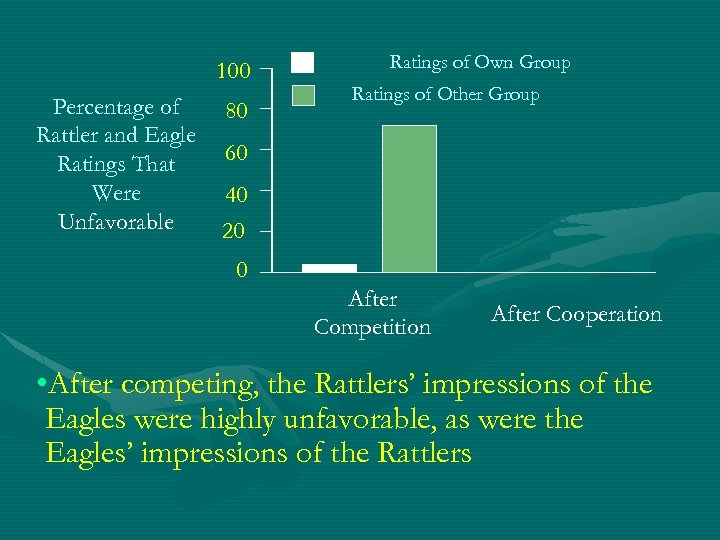 100 Percentage of Rattler and Eagle Ratings That Were Unfavorable 80 Ratings of Own Group Ratings of Other Group 60 40 20 0 After Competition After Cooperation • After competing, the Rattlers’ impressions of the Eagles were highly unfavorable, as were the Eagles’ impressions of the Rattlers
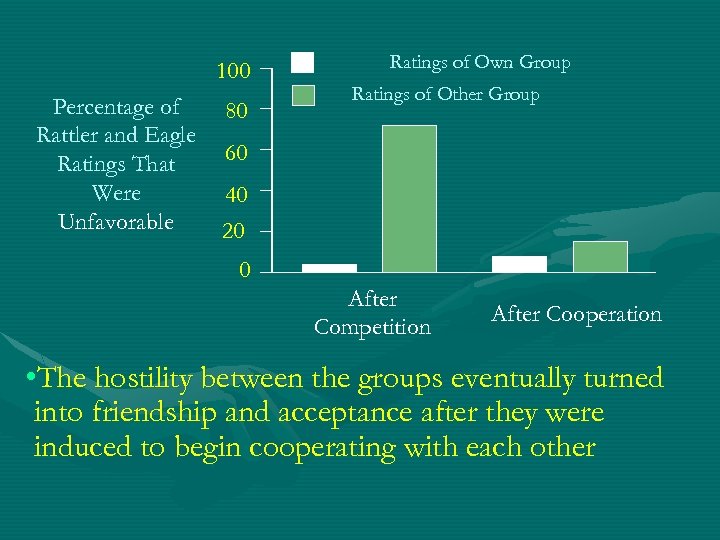 100 Percentage of Rattler and Eagle Ratings That Were Unfavorable 80 Ratings of Own Group Ratings of Other Group 60 40 20 0 After Competition After Cooperation • The hostility between the groups eventually turned into friendship and acceptance after they were induced to begin cooperating with each other
 Maybe we should just eliminate these altogether…