


 Скачать презентацию General Psych 2 Adolescence and Adulthood Mod
6d5c4950a51d14254120faa810a18785.ppt
- Количество слайдов: 32
 General Psych 2 Adolescence and Adulthood – Mod. 9 & 10 March 30, 2004 Class #17
 Module 9: Adolescence n Physical Growth n n Challenges to Self-Esteem n n Numerous stressors n School, opposite sex, respect from others, sense of self-worth, etc. Sexual Interests n n Sudden spurts Becomes a focus as do temptations to drink, smoke, etc. Ethnic Identity n The part of a person’s identity that reflects the racial, religious, or cultural group to which he or she belongs
 Lawrence Kohlberg (1927 -1987) n n n Lawrence Kohlberg was, for many years, a professor at Harvard University He became famous for his work there beginning in the early 1970 s He started as a developmental psychologist and then moved to the field of moral education
 Adolescents and Morality: Kohlberg’s Stages of Moral Reasoning n Kohlberg believed. . . and was able to demonstrate through studies. . . that people progressed in their moral reasoning (ethical behavior) through a series of stages n He believed that there were six identifiable stages which could be more generally classified into three levels
 Level I: Preconventional Morality n Level I: n Typical of most children under the age of nine – behavior tends to be selfish in nature n Stage 1: n n n Moral values reside in external events (bad acts) The child is responsive to rules and evaluative labels, but views them in terms of pleasant or unpleasant consequences of actions, or in terms of the physical power of those who impose the rules Very selfish – may do things just to stay out of trouble Obedience and punishment orientation or to gain concrete rewards Stage 2: n Basically the same as in stage one as bottom line is to satisfy one’s own needs but occasionally others as well
 Level II: Conventional Morality n Level II: n By early adolescence, moral values reside in performing the right role, in maintaining the conventional order and expectancies of others as a value in its own right – uphold laws and social order n Stage 3: Good-boy/good-girl orientation n n Orientation to approval, to pleasing and helping others Conformity to stereotypical images of majority or natural role behavior Action is evaluated in terms of intentions Stage 4: Authority and social-ordermaintaining orientation n Orientation to "doing duty" and to showing respect for authority and maintaining the given social order for its own sake
 Level III: Postconventional Morality n Level III: n Abstract reasoning that not everyone develops… n Stage 5: n n n Morality is defined in terms of institutionalized rules that have a rational basis Society vs. Individual (any conflict favors society) Stage 6: n n n The standards conformed to are internal, and actiondecisions are based on an inner process of thought and judgment concerning right and wrong Social laws are very important but conscience is what dictates behavior – not what others might think Society vs. Individual (any conflict favors individual)
 The Heinz Dilemma: Scenario 1 n n A woman was near death from a unique kind of cancer. There is a drug that might save her. The drug costs $4, 000 per dosage. The sick woman's husband, Heinz, went to everyone he knew to borrow the money and tried every legal means, but he could only get together about $2, 000. He asked the doctor scientist who discovered the drug for a discount or let him pay later. But the doctor scientist refused. Should Heinz break into the laboratory to steal the drug for his wife? Why or why not? n See page 145 of your book for answers from people in different stages of Kohlberg’s moral development theory
 The Heinz Dilemma: Scenario 2 n n Heinz broke into the laboratory and stole the drug. The next day, the newspapers reported the breakin and theft. Brown, a police officer and a friend of Heinz remembered seeing Heinz last evening, behaving suspiciously near the laboratory. Later that night, he saw Heinz running away from the laboratory. Should Brown report what he saw? Why or why not?
 The Heinz Dilemma: Scenario 3 n n Officer Brown reported what he saw. Heinz was arrested and brought to court. If convicted, he faces up to two years in prison. Heinz was found guilty. Should the judge sentence Heinz to prison? Why or why not?
 Dilemma II: The case of the promised rock concert… n Scene 1: n n n Judy is a 16 -year-old girl. Her mother promised her that she could go to a special rock concert coming to their town if she saved up from baby-sitting and lunch money to buy a ticket to the concert. Judy managed to save up the fifteen dollars (the ticket cost) plus another twenty dollars and proudly told her mother she had enough saved to have a “good time at the concert”. Her mother said great, this shows what you can do when you put your mind to it. But later that same evening her mother read a front page article on the dangers of the upcoming concert…how there would be a “bad element” present doing drugs. It was also mentioned that tattoos and piercings would be taking place as well. She called Judy and Judy’s 17 year-old sister in for a “family meeting” and for nearly an hour lectured on the evils of drugs, sex, and rock and roll. She told Judy that she had to spend the money on new clothes for school instead. What Kohlberg stage is Judy’s mother at? ? ? Why? ?
 Dilemma II: The case of the promised rock concert… n Scene 2: n n n n The next day Judy screamed at her mother calling her a liar that should never be trusted The strong-willed Judy later decided to go to the concert anyway. That Saturday she told her mother she was forgiven that she was spending the day with a friend going shopping. In reality, Judy and her friend went to the performance and had a great time A week passed without her mother finding out. In confidence, Judy then told her older sister, Louise, that she had gone to the concert and had lied to her mother about it. Louise wonders whether to tell their mother what Judy did. What Kohlberg stage is Judy at? ? ? Why? ? ? If Judy’s sister was at the top level what would her actions be? ? ? Why? ? ? Portions of previous slides taken from: http: //www. haverford. edu/psych/ddavis/p 109 g/kohlberg. dilemmas. html
 Limitations to Kohlberg’s Theory n Cross-Cultural Studies n n n Levels 1 and 2 appear universal; Level 3 does not Moral judgments in some cultures do not fit into Kohlberg’s stages Gender and Morality n n Men concerned with the abstract, impersonal concept of justice Females concerned with protecting enduring caring relationships and fulfilling human needs
 Erikson (1902 -1994) n Erikson was a follower of Sigmund Freud who broke with his teacher over the fundamental point of what motivates or drives human behavior… n n For Freud it was biology or more specifically the biological instincts of life and aggression For Erikson, who was not trained in biology and/or the medical sciences the most important force driving human behavior and the development of personality was social interaction
 Erikson (1902 -1994) n Felt we developed in psychosocial stages… n n n Emphasized developmental change throughout the human life span In Erikson’s theory, eight stages of development unfold as we go through the life span Each stage consists of a crisis that must be faced According to Erikson, this crisis is not a catastrophe but a turning point of increased vulnerability and enhanced potential The more an individual resolves the crises successfully, the healthier development will be
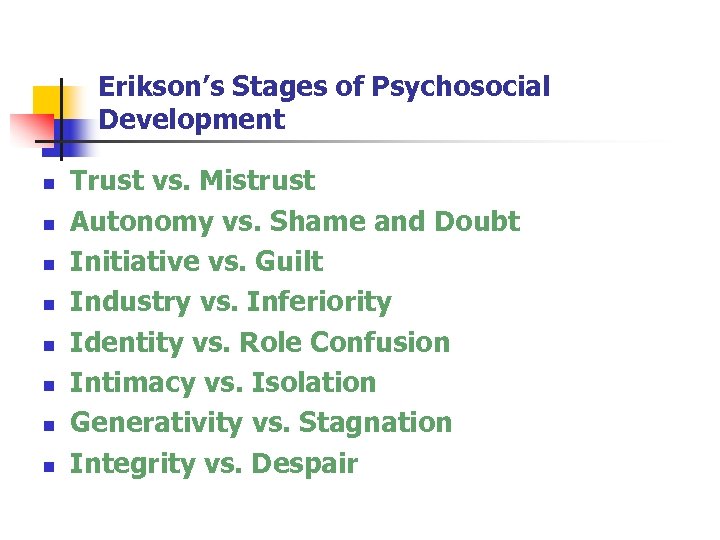 Erikson’s Stages of Psychosocial Development n n n n Trust vs. Mistrust Autonomy vs. Shame and Doubt Initiative vs. Guilt Industry vs. Inferiority Identity vs. Role Confusion Intimacy vs. Isolation Generativity vs. Stagnation Integrity vs. Despair
 Trust vs. Mistrust n Experienced in the first year of life… n n A sense of trust requires a feeling of physical comfort and a minimal amount of fear and apprehension about the future Trust in infancy sets the stage for a lifelong expectation that the world will be a good and pleasant place to live
 Autonomy vs. Shame and Doubt n Occurs in late infancy and toddlerhood (1 -3 years)… n n They start to assert their sense of independence, or autonomy They realize their will Parents need to allow them to do things for themselves If infants are restrained too much or punished too harshly, they are likely to develop a sense of shame and doubt
 Initiative vs. Guilt n Occurs during the preschool years… n n n As preschool children encounter a widening social world, they are challenged more than when they were infants Active, purposeful behavior is needed to cope with these challenges Children are asked to assume responsibility for their bodies, their behavior, their toys, and their pets Developing a sense of responsibility increases initiative Uncomfortable guilt feelings may arise, though, if the child is irresponsible and is made to feel too anxious about being independent
 Competence vs. Inferiority n From about age 5 or 6 to puberty… n n Children develop a sense of industry and curiosity and are eager to learn Or they feel inferior and lose interest in the tasks before them
 Identity vs. Role Confusion n n Adolescents come to see themselves as unique and integrated persons with an ideology Or they become confused about what they want out of life
 Intimacy vs. Isolation n Individuals experience this during the early adulthood years… n n n At this time, individuals face the developmental task of forming intimate relationships with others Erikson describes intimacy as finding oneself yet losing oneself in another If the young adult forms healthy friendships and an intimate relationship with another individual, intimacy will be achieved; if not, isolation will result
 Generativity vs. Stagnation n Individuals experience this during middle adulthood… n A chief concern is to assist the younger generation in developing and leading useful lives… n This is what Erikson means by generativity n The feeling of having done nothing to help the next generation is stagnation
 Integrity vs. Despair n Individuals experience this during late adulthood n n In the later years of life, we look back and evaluate what we have done with our lives Through many different routes, the older person may have developed a positive outlook in most of all of the previous stages of development If so, the retrospective glances will reveal a picture of a life well spent, and the person will feel a sense of satisfaction (integrity will be achieved) If the older adult resolved many of the earlier stages negatively, the retrospective glances likely will yield doubt or gloom (despair)
 Module 9: Adulthood n What developmental changes occur in adulthood? n n n Physical Changes Cognitive Changes Social Changes
 Physical Changes n n n Physical growth continues in early adulthood In middle adulthood, physical changes slowly emerge, including loss of sensory sharpness Most are well into late adulthood before bodily functions show noticeable impairment
 Cognitive Changes n n Important cognitive abilities improve until at least age 60 Adult thought becomes more complex and adaptive than adolescent thought n n Thinking becomes more dialectical Not until late in adulthood do some intellectual abilities decline in some people
 Cognitive Changes n n Crystallized intelligence n One’s accumulated knowledge such as vocabulary n This continues to increase with age Fluid intelligence n One’s ability to reason and problem solve n n For example: to think critically about TV commercials Unfortunately, decrease with age (fortunately this is a slow decrease until at least age 75)
 Social Changes n Early Adulthood: Individuals become concerned with occupational choices as well as issues of love n n Experiences of parenthood are accompanied by personal, social, and often occupational changes Middle Adulthood: People become concerned with producing something that will outlast them, usually through parenthood or job achievements n n Erikson’s crisis of generativity Around age 40, people go through a midlife transition
 Social Changes n Late Adulthood n n Most between 65 and 75 are active and influential politically and socially During old age people become generally more inward looking, cautious, and conforming Coping skills are increasingly developed to take into account the limits of one’s control Relationships found to be more satisfying, supportive, and fulfilling than earlier in life
 Death and Dying n With onset of old age, people become aware that death is approaching… n n Some experience a sharp decline in mental functioning, or terminal drop, a few years or a few months before death According to Erickson, awareness of impending death brings about the crisis of ego integrity versus despair
 Death and Dying n n n Longevity is not related to higher levels of education, income, or occupation Longevity is associated with certain personality characteristics such as being curious, conscientious, and not overemphasizing the importance of negative events in life Longevity is associated with diet, physical and mental exercise, and a sense of control over one’s life