 Скачать презентацию General presentation on Vulnerability Adaptation policies
503340345320667f96ed453bb38c32a1.ppt
- Количество слайдов: 28



• General presentation on Vulnerability, Adaptation policies • Tools Overview General introduction to adaptation to climate change tools 5 -6 th General CC workshop Januaray, 2014 , Cairo, Egypt Mr. Yadh LABBENE, Adaptation Expert
CONTENT 1. Detailed Climate change simulation data (around 20 km) 2. Mainstreaming climate change in the development process 3. Community-based adaptation to CC 4. Sectoral tools
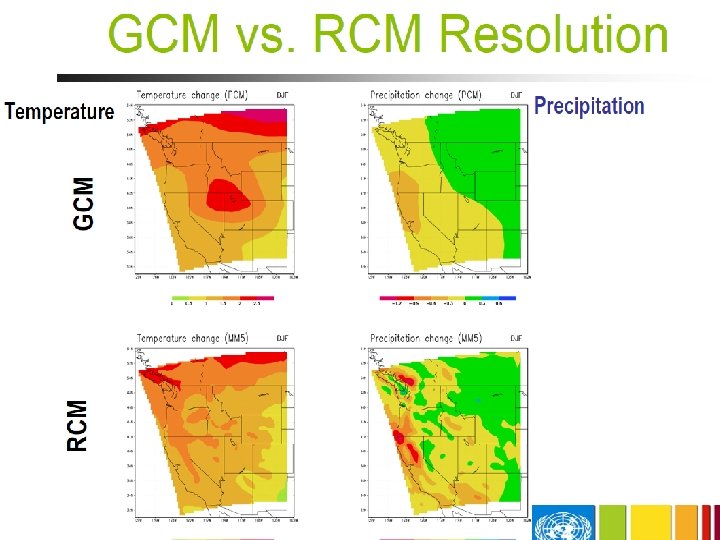
Detailed Climate change simulation data (around 20 km):
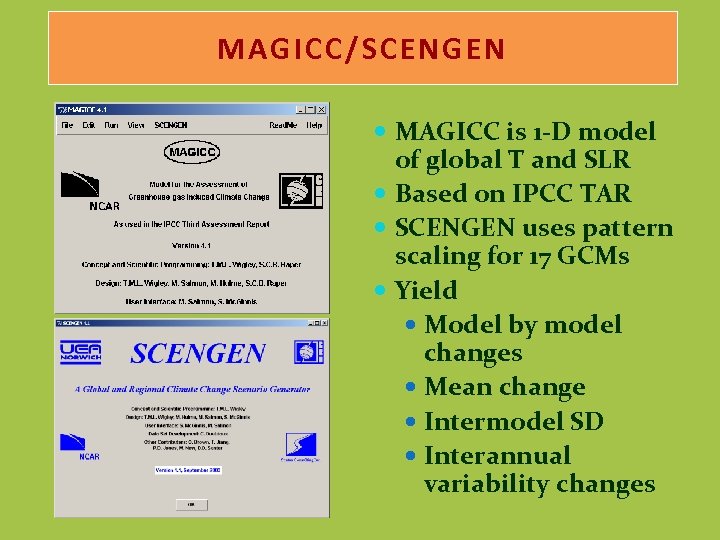
MAGICC/SCENGEN MAGICC is 1 -D model of global T and SLR Based on IPCC TAR SCENGEN uses pattern scaling for 17 GCMs Yield Model by model changes Mean change Intermodel SD Interannual variability changes
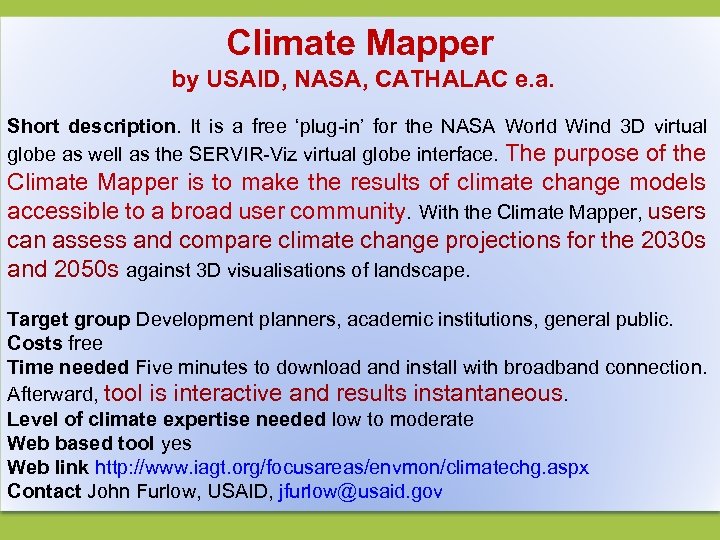
Climate Mapper by USAID, NASA, CATHALAC e. a. Short description. It is a free ‘plug-in’ for the NASA World Wind 3 D virtual globe as well as the SERVIR-Viz virtual globe interface. The purpose of the Climate Mapper is to make the results of climate change models accessible to a broad user community. With the Climate Mapper, users can assess and compare climate change projections for the 2030 s and 2050 s against 3 D visualisations of landscape. Target group Development planners, academic institutions, general public. Costs free Time needed Five minutes to download and install with broadband connection. Afterward, tool is interactive and results instantaneous. Level of climate expertise needed low to moderate Web based tool yes Web link http: //www. iagt. org/focusareas/envmon/climatechg. aspx Contact John Furlow, USAID, jfurlow@usaid. gov
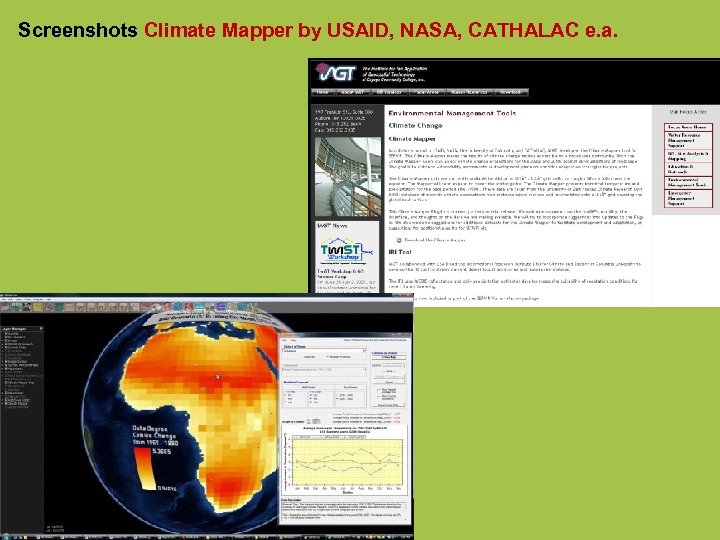
Screenshots Climate Mapper by USAID, NASA, CATHALAC e. a.
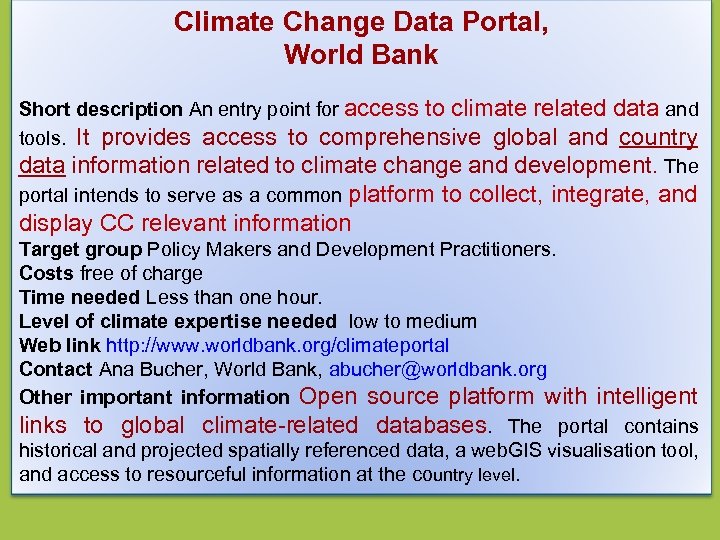
Climate Change Data Portal, World Bank Short description An entry point for access to climate related data and tools. It provides access to comprehensive global and country data information related to climate change and development. The portal intends to serve as a common platform to collect, integrate, and display CC relevant information Target group Policy Makers and Development Practitioners. Costs free of charge Time needed Less than one hour. Level of climate expertise needed low to medium Web link http: //www. worldbank. org/climateportal Contact Ana Bucher, World Bank, abucher@worldbank. org Other important information Open source platform with intelligent links to global climate-related databases. The portal contains historical and projected spatially referenced data, a web. GIS visualisation tool, and access to resourceful information at the country level.
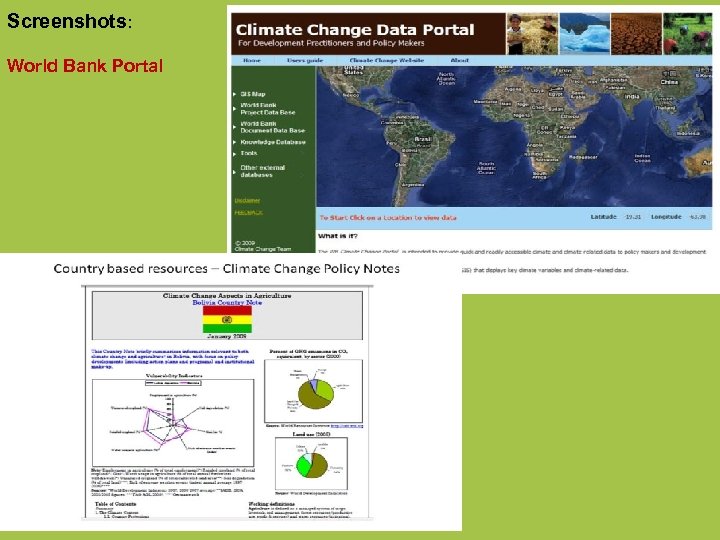
Screenshots: World Bank Portal
Tools to Mainstreaming climate change in the development process
CI: grasp, PIK and GIZ Name of tool CI: grasp (Climate Impacts: Global & Regional Adaptation Support Platform) Short description An interactive information platform will be developed, initially in some pilot countries. The platform will contain 3 main information layers, compiled and collected in a user friendly manner: • Climate change parameter (like temperature, precipitation, wind, etc. ) • Physical and socio-economic impacts (e. g. sea-level rise, chances in agricultural production, losses due to extreme events, etc. ) • Adaptation options and experiences. Decision makers that want to anticipate climate change in their decisions and search for options of adaptation to climate change. These could be e. g. ministries, governmental agencies, sector Target group specialists, development agencies, NGOs, etc. Costs free of charge Time needed 2 hours Level of climate expertise needed moderate Status of application in your organisation voluntary Web link http: //www. ci-grasp. org/ Contact Jan Peter Schemmel, GIZ, jan-peter. schemmel@gtz. de Dr. Jürgen Kropp, PIK, kropp@pik-potsdam. de
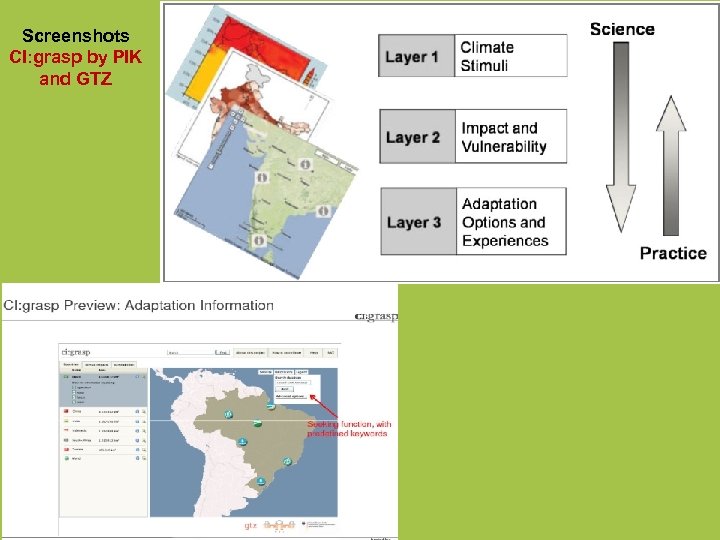
Screenshots CI: grasp by PIK and GTZ
we. ADAPT, Stockholm Environmental Institute (SEI) we. ADAPT is the overall brand for a set of activities, tools and services developed through collaboration between the Short description Stockholm Environment Institute (SEI), the University of Cape Town and an expanding number of other partners. Target group Decision-makers including project officers, planners and advisors in technical assistance agencies, NGOs, donor agencies, as well as researchers and those involved in policy processes. Costs All tools and materials are free for download and use. Time needed Not intended for one-time use but rather on-going. Level of climate expertise needed Some tech-know how is helpful. Platform has been institutionalised at SEI Oxford and working on collaborations with others (SEI Asia, US and Stockholm, UNEP, Sida, Enda, DFID, Oxfam, etc. ) to Status of application in your organisation expand its use. Web based tool wiki. ADAPT is web-based; CCx, Adaptation Layer and ADx prototypes currently available for download with plans to make these tools web-based in the near future. Web link http: //www. weadapt. org/
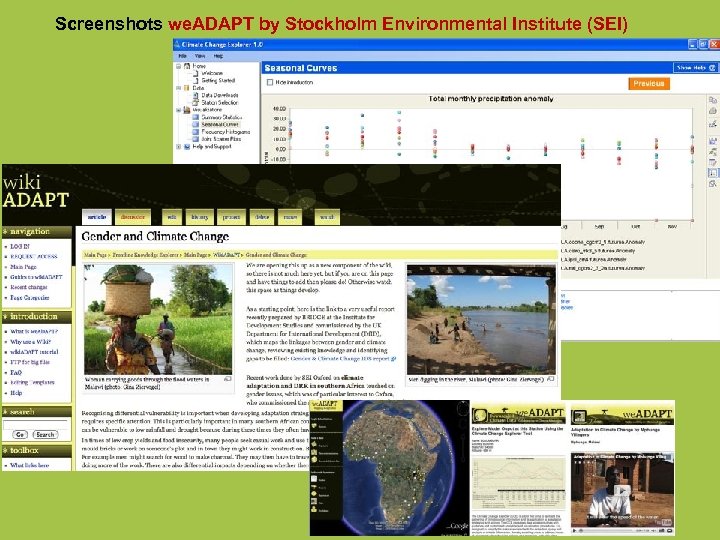
Screenshots we. ADAPT by Stockholm Environmental Institute (SEI)
ALM Adaptation Learning Mechanism, UNDP Short description The Adaptation Learning Mechanism (ALM) supports learning on climate change adaptation through good practice and experience by promoting knowledge exchange and collaboration between practitioners. Target group The ALM targets development practitioners and is seeking to create partnerships across agencies, sectors and levels, i. e. UN, IGO’s, national and local government representatives, Civil Society Organisations, private sector, community-based organisations. Costs free of charge Level of climate expertise needed any level Status of application in your organisation voluntary Web based tool yes Web link http: //www. adaptationlearning. net/ Contact Julia Wolf, UNDP, julia. wolf@undp. org, ALM Project Manager
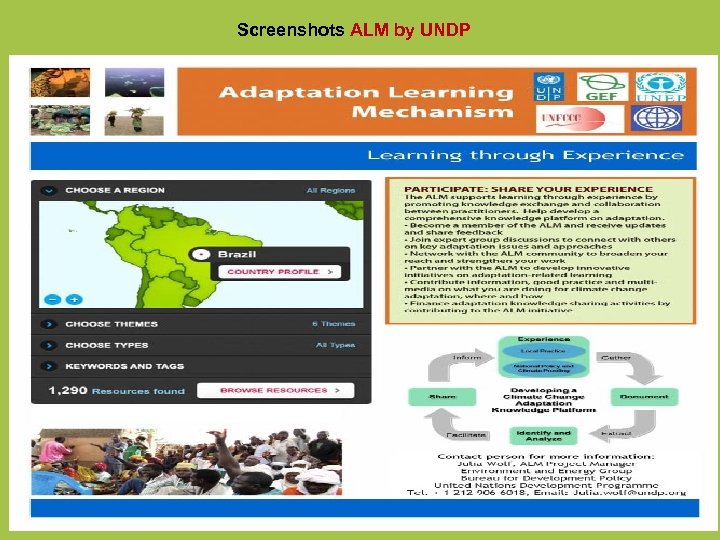
Screenshots ALM by UNDP
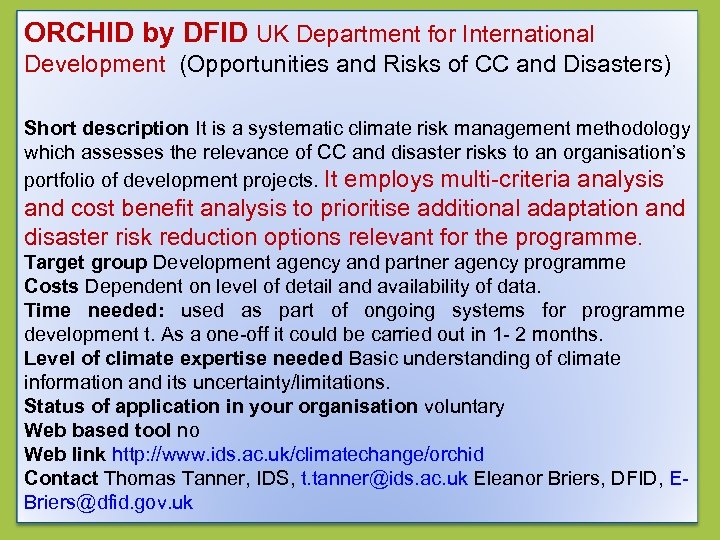
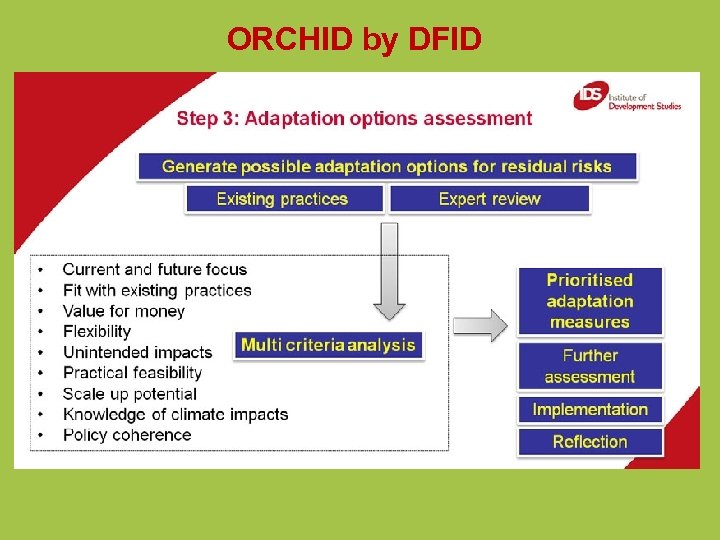
ORCHID by DFID UK Department for International Development (Opportunities and Risks of CC and Disasters) Short description It is a systematic climate risk management methodology which assesses the relevance of CC and disaster risks to an organisation’s portfolio of development projects. It employs multi-criteria analysis and cost benefit analysis to prioritise additional adaptation and disaster risk reduction options relevant for the programme. Target group Development agency and partner agency programme Costs Dependent on level of detail and availability of data. Time needed: used as part of ongoing systems for programme development t. As a one-off it could be carried out in 1 - 2 months. Level of climate expertise needed Basic understanding of climate information and its uncertainty/limitations. Status of application in your organisation voluntary Web based tool no Web link http: //www. ids. ac. uk/climatechange/orchid Contact Thomas Tanner, IDS, t. tanner@ids. ac. uk Eleanor Briers, DFID, EBriers@dfid. gov. uk
ORCHID by DFID
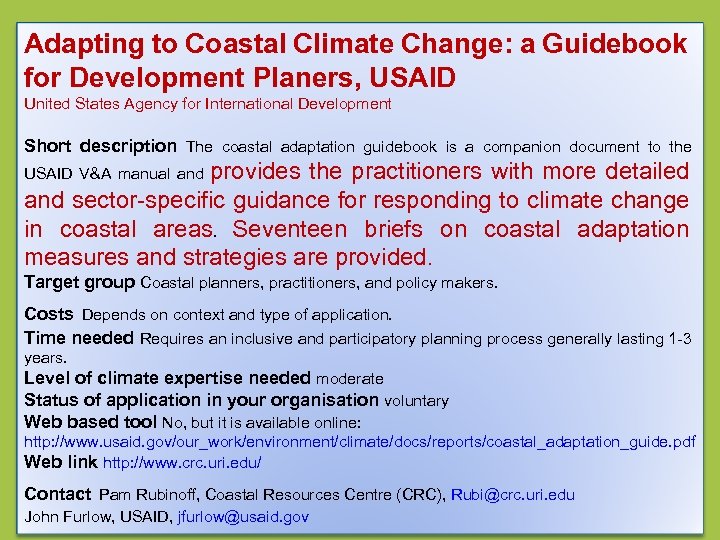
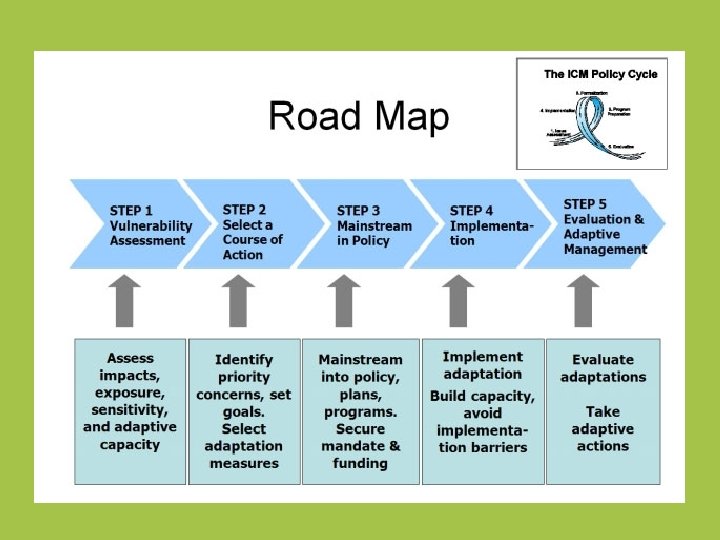
Adapting to Coastal Climate Change: a Guidebook for Development Planers, USAID United States Agency for International Development Short description The coastal adaptation guidebook is a companion document to the provides the practitioners with more detailed and sector-specific guidance for responding to climate change in coastal areas. Seventeen briefs on coastal adaptation measures and strategies are provided. USAID V&A manual and Target group Coastal planners, practitioners, and policy makers. Costs Depends on context and type of application. Time needed Requires an inclusive and participatory planning process generally lasting 1 -3 years. Level of climate expertise needed moderate Status of application in your organisation voluntary Web based tool No, but it is available online: http: //www. usaid. gov/our_work/environment/climate/docs/reports/coastal_adaptation_guide. pdf Web link http: //www. crc. uri. edu/ Contact Pam Rubinoff, Coastal Resources Centre (CRC), Rubi@crc. uri. edu John Furlow, USAID, jfurlow@usaid. gov
Tools of Community-based adaptation to CC
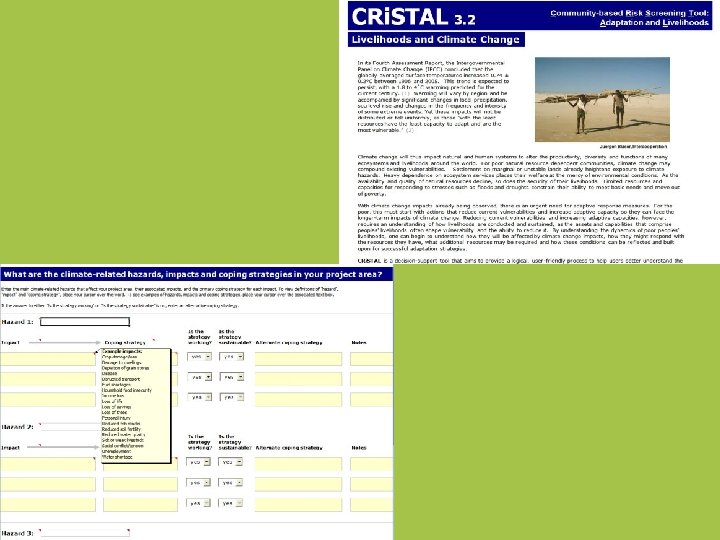
CRi. STAL by IISD (Community-based Risk Screening Tool – Adaptation & Livelihoods) a screening process designed to help project designers and managers integrate risk reduction and CC adaptation into community-level projects (a) Understand Short description CRi. STAL is the links between livelihoods and climate; (b) Assess a project’s impact on community-level adaptive capacity; and (c) Make project adjustments to improve its impact on adaptive capacity and reduce the vulnerability of communities to CC Target group Project planners working at the community level Costs Staff time, travel or field costs associated with community consultations. Time needed: Minimum 1 day upwards, depending on the number and type of stakeholder consultations involved. Level of climate expertise needed: Basic understanding Web link: http: //www. cristaltool. org/ Contact: Anne Hammill, IISD, ahammill@iisd. org
Sectoral tools
Agriculture: Practical Use of Models and Tools by the FAO Which components of the farming system are particularly vulnerable to CC and may thus require special attention ? crop models: DSSAT Can the water/irrigation systems meet the stress of changes in water supply/demand ? irrigation models : CROPWAT 25
Health & climate change software §Tools used as inputs for the MARA/ARMA (Mapping Malaria Risk in Africa) model of climate suitability for stable Plasmodium falciparum malaria transmission - MIASMA - Global malaria model § Ci. MSi. M and DENSim for dengue § Weather and habitat-driven entomological simulation model that links with a simulation model of human population dynamics to project disease outbreaks 26
Health & climate change software §MIASMA: Global malaria model §MARA/ARMA (Mapping Malaria Risk in Africa) model Tools used as inputs for the of climate suitability for stable malaria transmission § Ci. MSi. M and DENSim for dengue Weather and habitat-driven entomological simulation model that links with a simulation model of human population dynamics to disease outbreaks 27
Reference: International Workshop on Mainstreaming Adaptation to Climate Change Guidance and Tools GTZ House Berlin, Potsdam Square May 28 th - 30 th, 2009 organised by DFID — GTZ — USAID — World Bank Thank you
Скачать презентацию General presentation on Vulnerability Adaptation policies
503340345320667f96ed453bb38c32a1.ppt