


 Скачать презентацию General Overview n n n n n Interdependence
2647bcf342da482c4a84f0e6282203e2.ppt
- Количество слайдов: 92
 General Overview n n n n n Interdependence of World Economies Emergence of New Economic Players Formation of More Distinct Trading Groups Shift in Economic and Political Ideologies Sophistication of Technology Increase in Market Concentration Crisis in National Identity Greater Divergence Between Haves and Have-Nots Greater Internationalization of Business Relations Growth in “Global” markets 1
 General Overview n Self-Reference Criterion/Marketing Relativism – stages of involvement—foreign marketing • • None Infrequent International Global – Strategic orientation • Domestic market extension • Multidomestic market concept • Global market concept – role of culture – sociological, psychological, anthropological factors 2
 General Overview n Cateora’s Int’l Marketing Task Paradism – controllables vs. uncontrollables – interaction between controllables & uncontrollables – static vs. dynamic behaviour 3
 General Overview n Levitt’s Globalization Concept – Commonality of Wants and Desires Presumed – Marketing Program Driven by Cost Considerations – Minimizes Adherence to “Marketing Concept” – Provides Cohesiveness and Order for Planning – Management Led to Believe “controllables” are actually controllable 4
 General Overview n Economic Prosperity Derives from Trade – – Absolute Advantage Comparative Advantage Heckscher-Ohlin Factor Endowment Theory Foreign Direct Investment – market imperfections – market failure – Multinational Enterprise – internalization – diversification – eclectic 5
 General Overview n Porter’s Comparative Advantage of Nations – Focus on Firm’s “Value Chain” – Highlights Government’s Role in Business Relations – Evaluates Factors Employed to Create Value – – – unique factors lowest production costs maximum market potential optimal risk-return tradeoff importance of strategic positioning 6
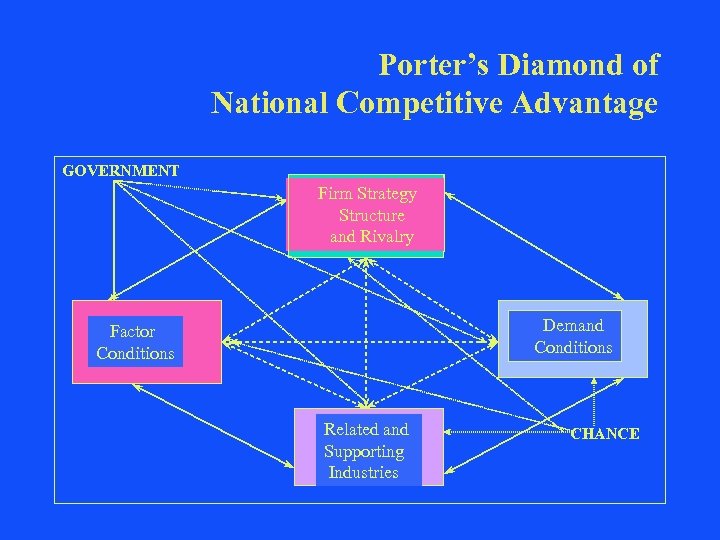 Porter’s Diamond of National Competitive Advantage GOVERNMENT Firm Strategy Structure and Rivalry Demand Conditions Factor Conditions Related and Supporting Industries CHANCE
 General Overview n Govt’s Role in Creating Wealth and Value – Balanced vs. Unbalanced Growth – Facilitators of Trade – Protectionism – tariffs – – quotas voluntary restraints monetary barriers technical standards – local content rules 8
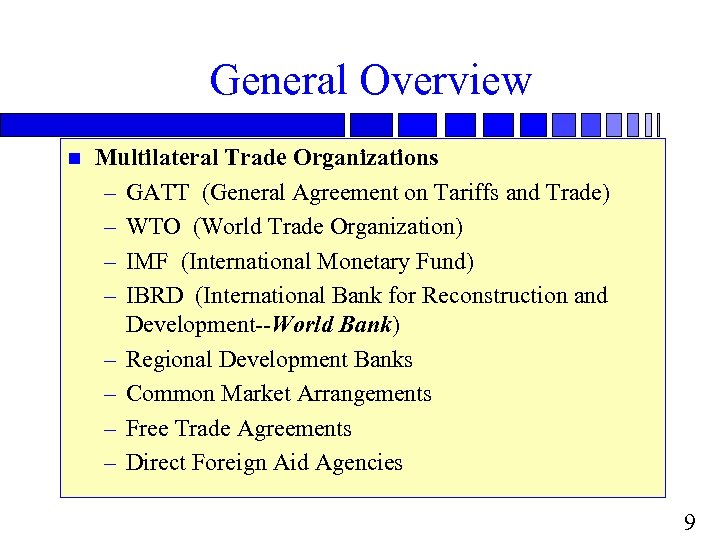 General Overview n Multilateral Trade Organizations – GATT (General Agreement on Tariffs and Trade) – WTO (World Trade Organization) – IMF (International Monetary Fund) – IBRD (International Bank for Reconstruction and Development--World Bank) – Regional Development Banks – Common Market Arrangements – Free Trade Agreements – Direct Foreign Aid Agencies 9
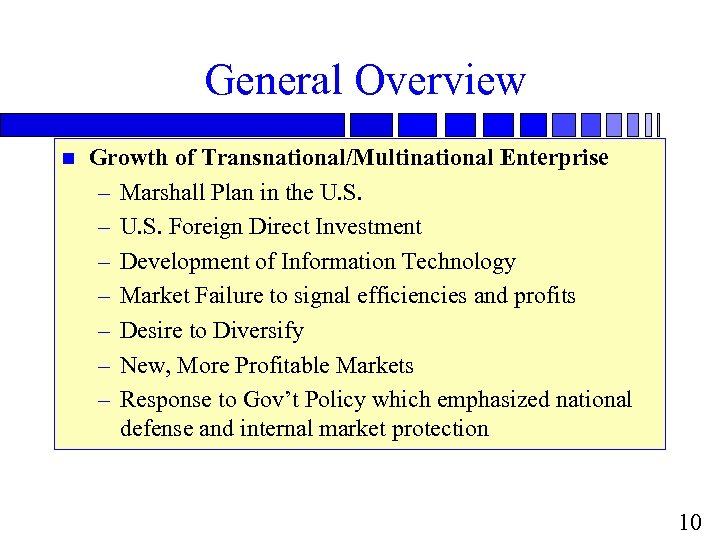 General Overview n Growth of Transnational/Multinational Enterprise – Marshall Plan in the U. S. – U. S. Foreign Direct Investment – Development of Information Technology – Market Failure to signal efficiencies and profits – Desire to Diversify – New, More Profitable Markets – Response to Gov’t Policy which emphasized national defense and internal market protection 10
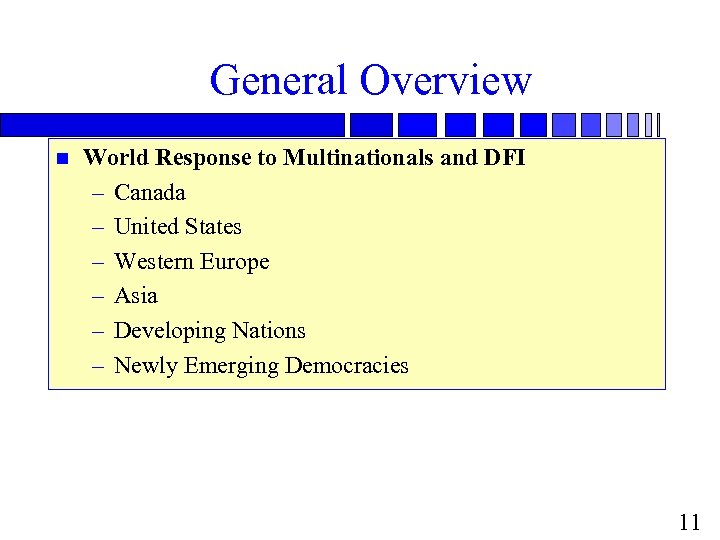 General Overview n World Response to Multinationals and DFI – Canada – United States – Western Europe – Asia – Developing Nations – Newly Emerging Democracies 11
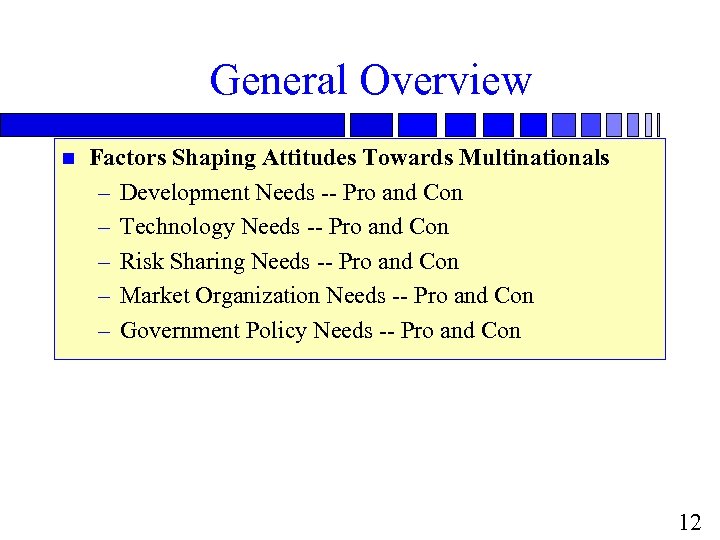 General Overview n Factors Shaping Attitudes Towards Multinationals – Development Needs -- Pro and Con – Technology Needs -- Pro and Con – Risk Sharing Needs -- Pro and Con – Market Organization Needs -- Pro and Con – Government Policy Needs -- Pro and Con 12
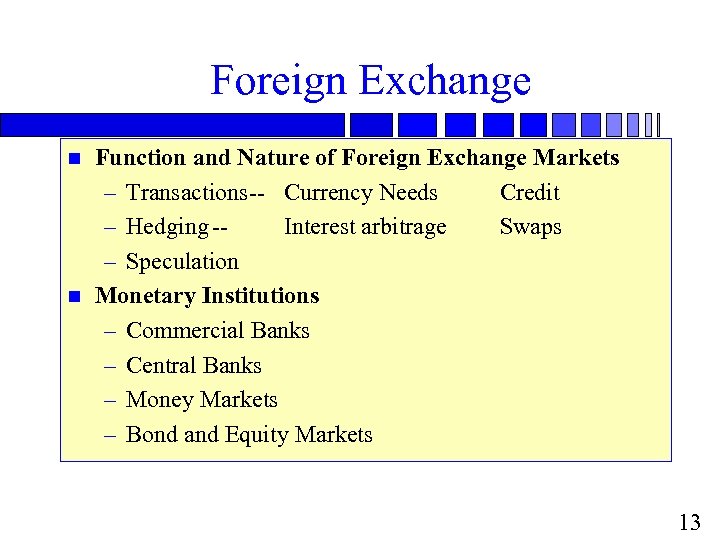 Foreign Exchange n n Function and Nature of Foreign Exchange Markets – Transactions-- Currency Needs Credit – Hedging -Interest arbitrage Swaps – Speculation Monetary Institutions – Commercial Banks – Central Banks – Money Markets – Bond and Equity Markets 13
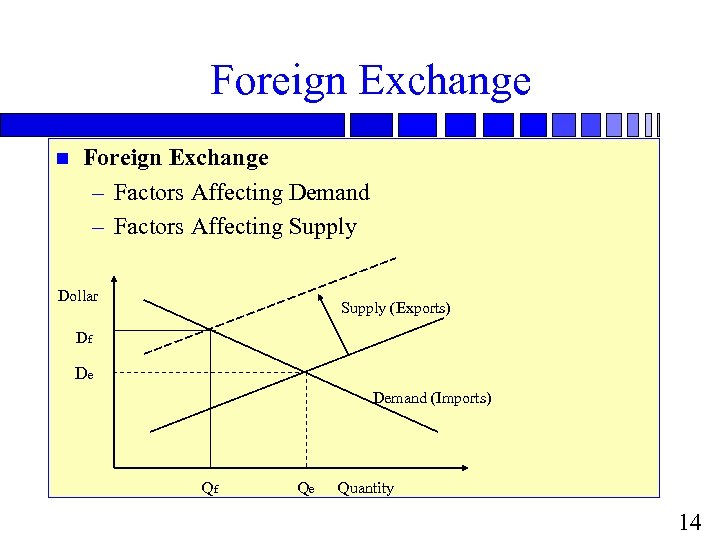 Foreign Exchange n Foreign Exchange – Factors Affecting Demand – Factors Affecting Supply Dollar Supply (Exports) Df De Demand (Imports) Qf Qe Quantity 14
 International Trade and Foreign Exchange n n n Demand Supply of Foreign and Local Currancies Relationship to Terms of Trade – Product Price (in Canadian Dollars) / Product Price (in Yen) Factors that Impact upon Volume of Trade – Internal Efficiencies – Financial Strength of Nations Currency and Credit – Dynamic Innovativeness 15
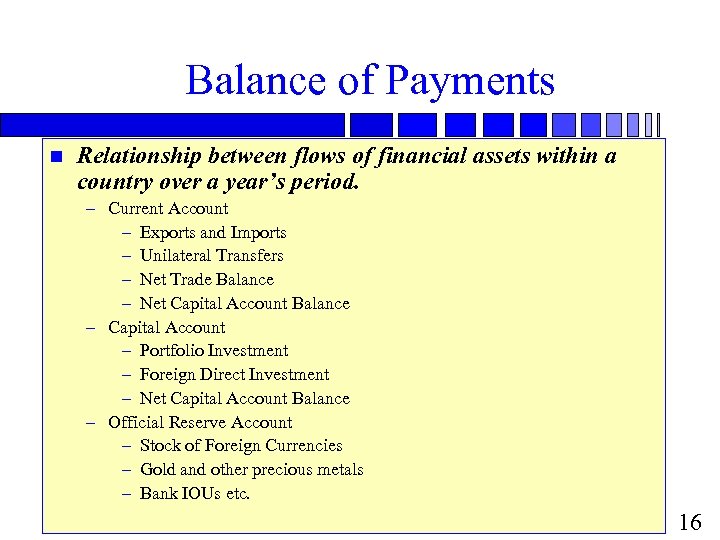 Balance of Payments n Relationship between flows of financial assets within a country over a year’s period. – Current Account – Exports and Imports – Unilateral Transfers – Net Trade Balance – Net Capital Account Balance – Capital Account – Portfolio Investment – Foreign Direct Investment – Net Capital Account Balance – Official Reserve Account – Stock of Foreign Currencies – Gold and other precious metals – Bank IOUs etc. 16
 Balance of Payments n n Relationship Between Balance of Trade and Balance of Payments Relationship Between Balance of Trade and Exchange Rates Relationship Between Interest Rates and Capital Account Government’s Role in Affecting Trade, Exchange Rates, and Balance of Payments 17
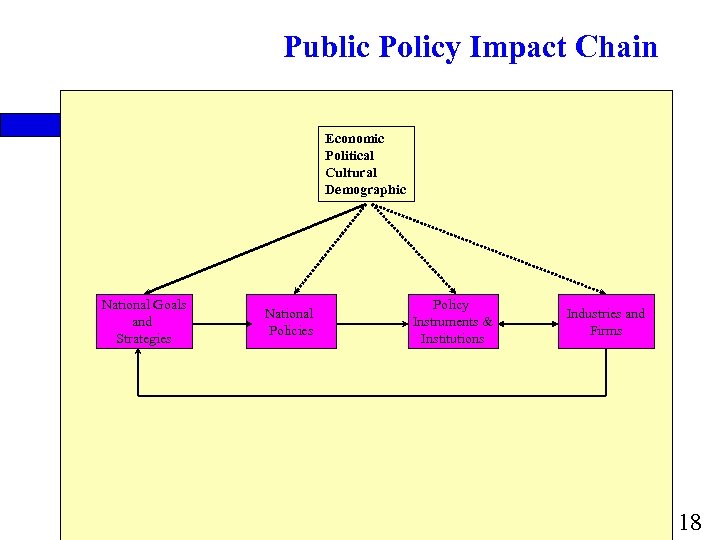 Public Policy Impact Chain Economic Political Cultural Demographic National Goals and Strategies National Policies Policy Instruments & Institutions Industries and Firms 18
 Culture n What is Culture? – Ways of thinking, viewing, and responding to stimuli which is learned – socialization – acculturation – values (terminal and instrumental) n Core Values of Cultures – Canadian Asian – American Native Aboriginal – European African Indian Mexican Winnipeg 19
 Culture n Cross-Cultural Analysis – A systematic comparison of similarities and differences in material and behavioral aspects of culture. – Descriptive – Analytical/functional – Outline of Elements in Cross-cultural Analysis – – – Determine Relevant Motivations Determine Characteristic Behavior Patterns Determine Relevant Cultural Values Determine Important Institutions Determine Relevant Rules, Norms, and Laws Evaluate all the above with respect to mix variables 20
 Culture n n Group and Sub-group Identification – Relevant In-Group Identities – Relevant Out-Group Identities – Boundaries Between In- and Out-Groups Egocentrism Ethnocentrism – Ethnocentrism in the Extended Fishbein Model of Consumer Behavior Role of Country-Of-Origin in Purchase Decision – “Made in Canada” 21
 Culture n Nine Nations of North America – New England – The Foundry – Quebec – Dixie – The Breadbasket – The Empty Quarter – Mex. America – Ecotopia – The Islands 22
 Culture n Culture and Change – Cultural Borrowing – Resistance to Change – Change Congruency – Strategies for Change – planned – unplanned – Consequences of Cultural Intervention – Examples – Quebec – Vietnam Atlanta, GA Faculty of Management 23
 Political Environment n n Types of Governments – Formation and implementation of legislation – Degree of Political Participation – Orientation to Free Market Nationalism – Concept of the nation-state – Economic Manifestations of Nationalism – Conflict with Multinationalism – Fear of Foreign Ownership and/or Control 24
 Political Environment n Response to Nationalistic Fears – Confiscation – Expropriation – Domestication – Nationalization – Direct Economic Sanctions – – – exchange controls local content rules import restrictions tax controls gov’t intervention into factor resource markets 25
 Political Environment – Direct Political Sanctions – Censure for Actions in Domestic Country – Complaint Lodged with Multilateral Body – Violence – Issue of Foreign Direct Investment – – – Need to Conduct Thorough Risk Analysis Factors of Importance to Identify Need to Consider the Method of Entry Patterns in Canada Canadians Investing into Other Economies 26
 International Legal Environment n No Single International Law or Agency – As Many Legal Systems as there are Nations – Issues of Interest to Marketers – – – n Competition Rules Packaging Rules Price Maintenance Channel Agreements Transport/Distribution Product Quality Rules Warranty Law Advertising Price Regulations Patents, Trademark, & Copyright Law Environmental Bases for Legal System – Common vs Code Law – Other Systems 27
 International Legal System n Issue of Jurisdiction – World Court – International Court of Justice – Determining Jurisdiction – Jurisdictional Clauses in Contract – Where Contract was Entered Into – Where Provisions of the Contract were Performed n – Special Issues Legal Recourse – Why Not Litigate – Why Litigate 28
 International Legal Environment – Options to Litigation – Placate Agrieved Party – Conciliation – Arbitration n Protection of Intellectual Property Rights – Difficulty of Policing Property Rights – What is Counterfeit? – Prior Use vs. Registration – Conventions and Treaties 29
 International Legal Environment n Marketing Laws: A Cross-Cultural Comparison – Advertising – Pricing – Channel Relations – Competition – Extraterritoriality – Transport/Distribution 30
 Researching World Markets n n n Major Source of Error is a result of faulty information Tools and techniques remain the same regardless of domestic vs. international basis of research -differences lie in application and the environmental differences. Major questions to ask: – – – Can the Information be Collected? What are the Cost and Time requirements? How Reliable is the information? For what Purposes is the Information Being Collected? Is the Information Primary or Secondary? Does the Information Already Exist? 31
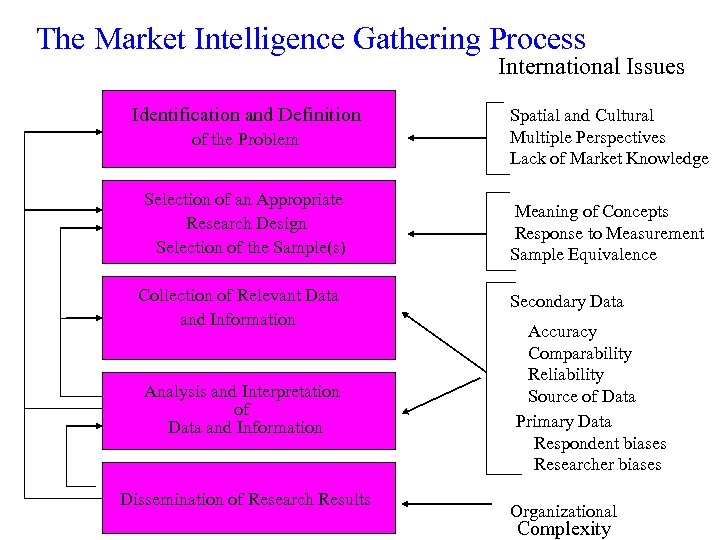 The Market Intelligence Gathering Process International Issues Identification and Definition of the Problem Selection of an Appropriate Research Design Selection of the Sample(s) Collection of Relevant Data and Information Analysis and Interpretation of Data and Information Dissemination of Research Results Spatial and Cultural Multiple Perspectives Lack of Market Knowledge Meaning of Concepts Response to Measurement Sample Equivalence Secondary Data Accuracy Comparability Reliability Source of Data Primary Data Respondent biases Researcher biases Organizational Complexity
 Market Intelligence Gathering: Research Design Issues n n n What is the Project Attempting to Accomplish? Who are the Recipients of the Information? What is the nature of the Management Decision? What Length of Time is Available for the Project? What Funds are Available for the Project? 33
 Market Intelligence: Problem Formulation Issues Spatial and Cultural Separation n Multiple Perspectives n Meaning of Ideas and Concepts n – – – Functional Equivalence Conceptual Equivalence Definitional Equivalence Temporal Equivalence Market Structure Equivalence 34
 Market Intelligence Gathering: Research Design Issues n Measurement Issues – Single versus Cross-cultural Measurement – Translation Issues – Verbal Translation • Back Translation • Parallel Blind Translation • Committee Translation – Non-verbal Translation – Scale Development Issues 35
 Market Intelligence Gathering: Research Design Issues n Sampling Issues – Definition of the Population – Representativeness of the Sample 36
 Market Intelligence Gathering: Secondary and Primary Data Issues n Data Issues – Accuracy – Comparability – Reliability – Affordability 37
 Market Intelligence Gathering: Sources of Information n Secondary Sources – Federal Government – Department of Foreign Affairs – Statistics Canada – Regional International Trade Centres – Department of Commerce (US) – European Commission (EU) – Country Desks, Trade Missions, Embassies – Trade Opportunities Program – Overseas Business Reports – Government Intelligence Units 38
 Market Intelligence Gathering: Sources of Information n Secondary Sources (cont. ) – Service Organizations – Major Banks – Investment Companies – Public Accounting Firms – Transportation Companies – Advertising and Consulting Firms 39
 Market Intelligence Gathering: Sources of Information n Secondary Sources (cont. ) – Others – Economist Intelligence Unit – Business International – Specialized Newsletters – Internet – Industrial Directories – Universities 40
 Market Intelligence Gathering: Sources of Information n Provincial/State Governments – Manitoba Industry, Trade, and Tourism – Economic Development Agencies – Various Sectoral Offices – Aerospace – Agriculture – Health Care – etc. 41
 Market Intelligence Gathering: Sources of Information n International Organizations – IBRD (World Bank) – WTO (World Trade Organization) – WHO (World Health Organization) – FAO (Food and Agriculture Organization) – ILO (International Labour Organization) – OECD (Organization for Economic Coop. & Dev. ) – Trade Groups (LAFTA, EFTA, etc. ) 42
 Market Information Gathering: Sources of Information n Trade Associations – Chambers of Commerce – IATA (International Air Transport Association) – OPEC (Organization of Petroleum Exporting Countries) – Canadian Manufacturers Association – Foreign Trade Tribunals 43
 Market Information Gathering: Sources of Information n Organization’s Own Experience – Foreign National Employees – Experienced Executives – Subsidiaries 44
 Developing Markets and Market Behaviour n Rapid Changes in National Economies – Closed Economies – Developing Economies – Newly Industrialized Economies – Socialist Developed Economies – Capitalist Developed Economies – New Hybrids 45
 Developing Markets and Market Behaviour n Marketing and Economic Development – Challenges “Doing Business as Usual” – Marketer Influences Direction and Magnitude of dev. – Role of Marketer in Static vs. Dynamic Society – Dealing with Expectations? ? ? – W. W. Rostow’s Stages of Development Thesis – – – Traditional Society Preconditions for Takeoff Drive to Maturity High Mass Consumption ? ? ? 46
 Developing Markets and Market Behaviour n – Actual Experiences in Development – Export Driven vs. Import Substitution Bases for Dev. – Differences between Growth and Development – Issue of Income Distribution and Marketing – Need for Awareness of National Development Object. Areas where Marketers can Aid in Development – Transfer of Entrepreneurial Spirit – Transfer of hard and soft Technology – Development of Infrastructure--distribution – Orient society to Demand as well as Supply Planning – Promote Trade as a stimulus for growth in employment 47
 Developing Markets and Market Behaviour n Marketing Functions in Developing vs. Developed Econ. – – – – – Nature of Goods & Service Storage Activities Means of Exchange Production sophistication Local vs. Out-sourcing Transport Infrastructure Communication Infrastructure Sales & Promotion Methods Pricing bases--Role of Bargaining Product Assortment Market Organization Customer Service Issues Role of Planning & Analysis Role of Credit Status Issues Importance of Geography Impact of Business Cycles Entrepreneur Orientation Role of the Family and Other Institutions 48
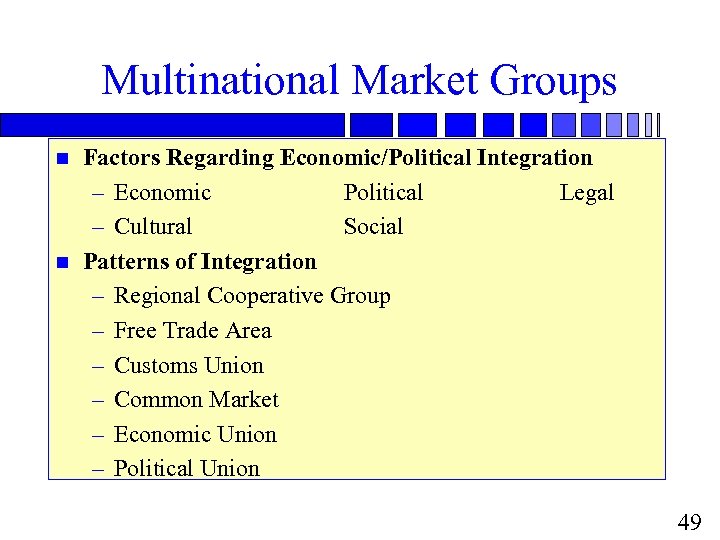 Multinational Market Groups n n Factors Regarding Economic/Political Integration – Economic Political Legal – Cultural Social Patterns of Integration – Regional Cooperative Group – Free Trade Area – Customs Union – Common Market – Economic Union – Political Union 49
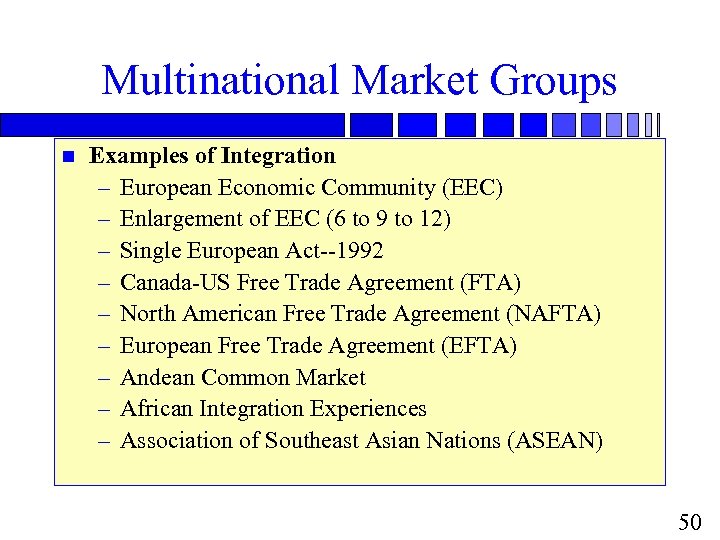 Multinational Market Groups n Examples of Integration – European Economic Community (EEC) – Enlargement of EEC (6 to 9 to 12) – Single European Act--1992 – Canada-US Free Trade Agreement (FTA) – North American Free Trade Agreement (NAFTA) – European Free Trade Agreement (EFTA) – Andean Common Market – African Integration Experiences – Association of Southeast Asian Nations (ASEAN) 50
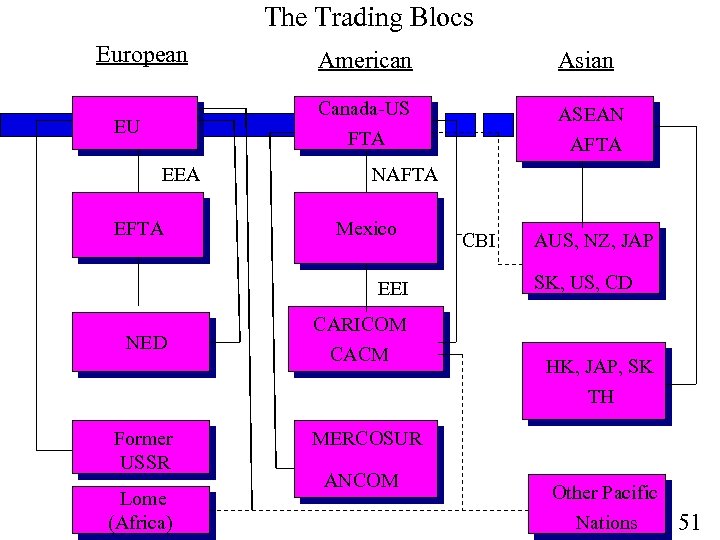 The Trading Blocs European EEA EFTA Asian Canada-US FTA EU American ASEAN AFTA NAFTA Mexico EEI NED Former USSR Lome (Africa) CARICOM CACM CBI AUS, NZ, JAP SK, US, CD HK, JAP, SK TH MERCOSUR ANCOM Other Pacific Nations 51
 Multinational Market Groups – Marketing Implications – – Marketing Strategy Tactical Issues Explicit Barriers and Potentials Marketing Mix Implications at Operative Level 52
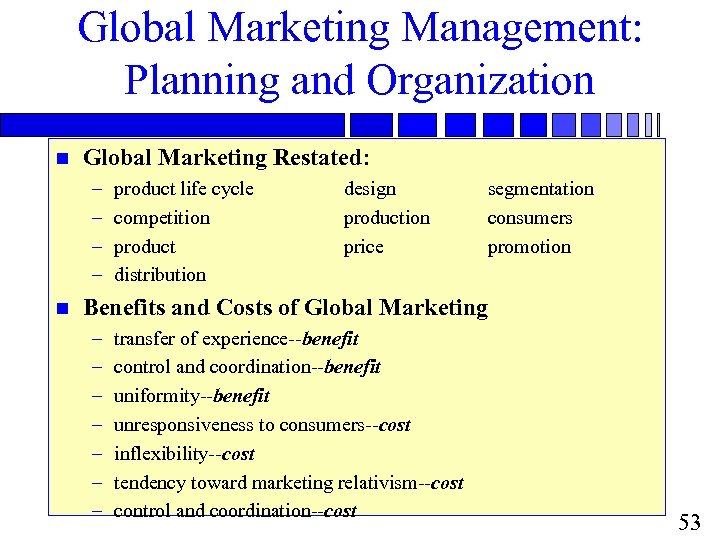 Global Marketing Management: Planning and Organization n Global Marketing Restated: – – n product life cycle competition product distribution design production price segmentation consumers promotion Benefits and Costs of Global Marketing – – – – transfer of experience--benefit control and coordination--benefit uniformity--benefit unresponsiveness to consumers--cost inflexibility--cost tendency toward marketing relativism--cost control and coordination--cost 53
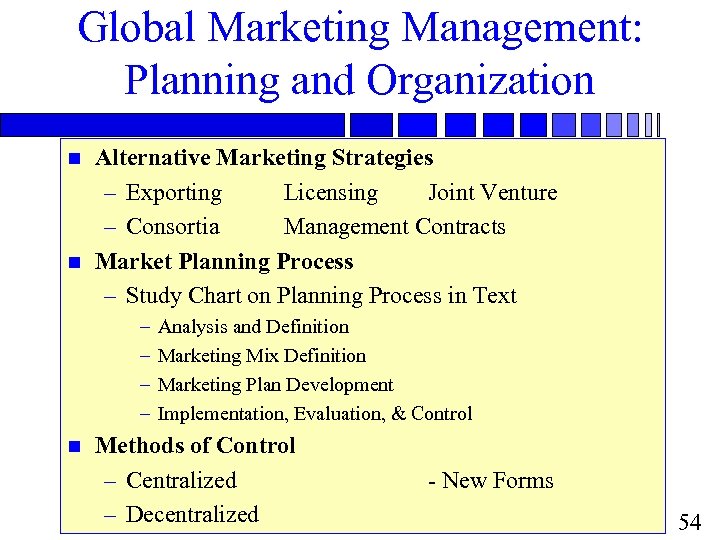 Global Marketing Management: Planning and Organization n n Alternative Marketing Strategies – Exporting Licensing Joint Venture – Consortia Management Contracts Market Planning Process – Study Chart on Planning Process in Text – – n Analysis and Definition Marketing Mix Definition Marketing Plan Development Implementation, Evaluation, & Control Methods of Control – Centralized – Decentralized - New Forms 54
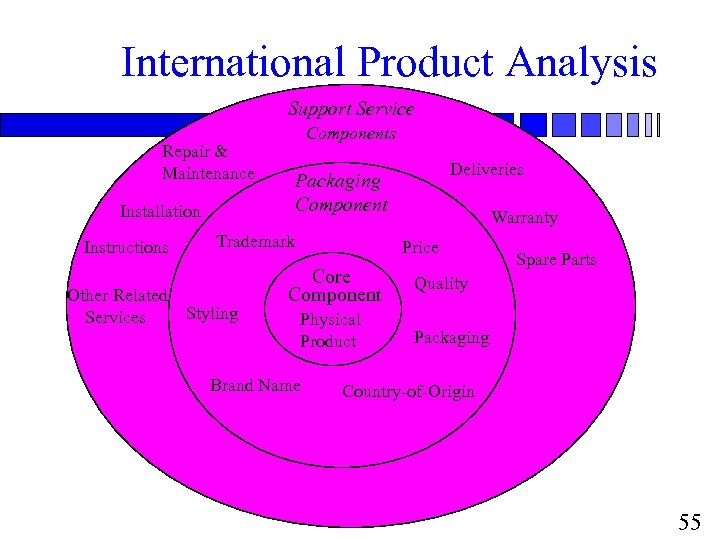 International Product Analysis Support Service Components Repair & Maintenance Installation Instructions Other Related Services Trademark Styling Deliveries Packaging Component Warranty Price Core Component Physical Product Brand Name Spare Parts Quality Packaging Country-of-Origin 55
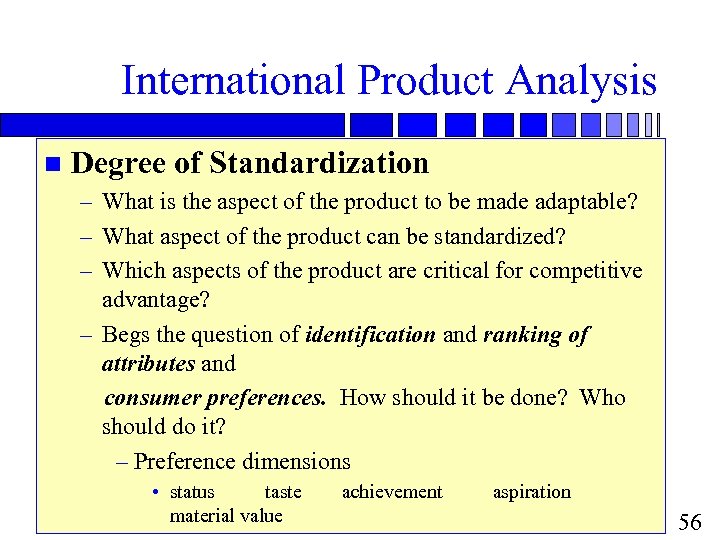 International Product Analysis n Degree of Standardization – What is the aspect of the product to be made adaptable? – What aspect of the product can be standardized? – Which aspects of the product are critical for competitive advantage? – Begs the question of identification and ranking of attributes and consumer preferences. How should it be done? Who should do it? – Preference dimensions • status taste material value achievement aspiration 56
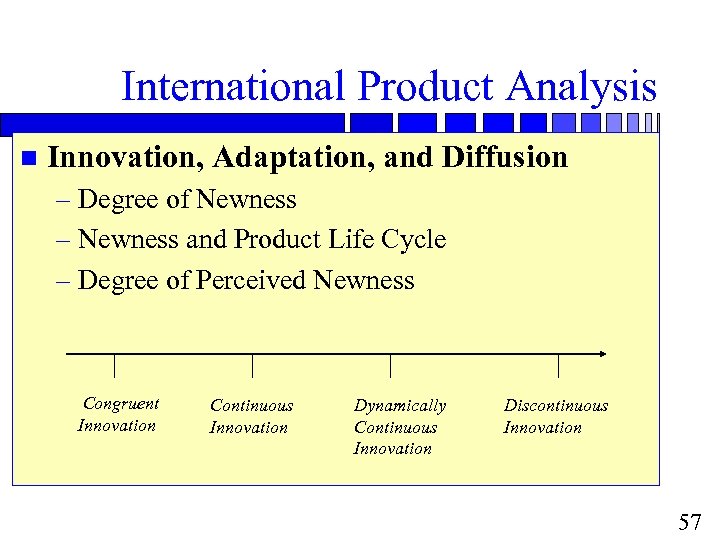 International Product Analysis n Innovation, Adaptation, and Diffusion – Degree of Newness – Newness and Product Life Cycle – Degree of Perceived Newness Congruent Innovation Continuous Innovation Dynamically Continuous Innovation Discontinuous Innovation 57
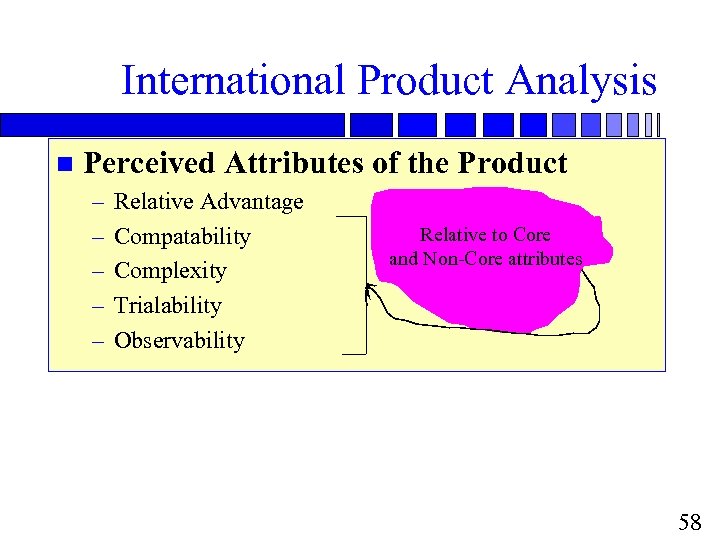 International Product Analysis n Perceived Attributes of the Product – – – Relative Advantage Compatability Complexity Trialability Observability Relative to Core Relative to core and Non-Core attributes non-core attributes 58
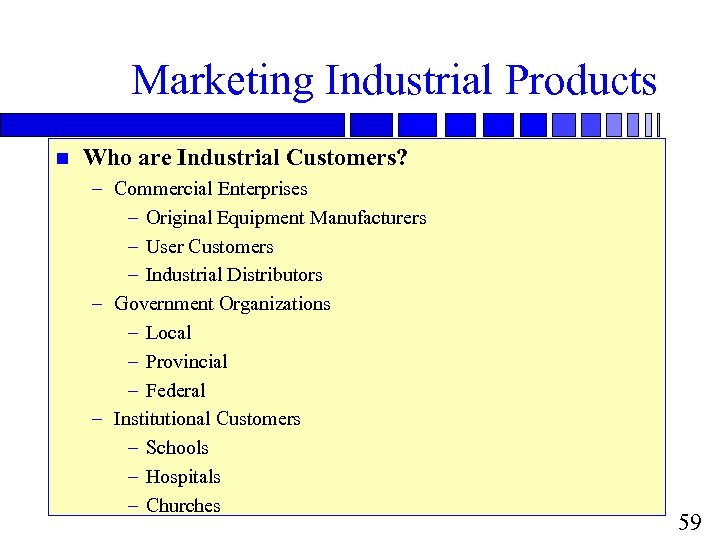 Marketing Industrial Products n Who are Industrial Customers? – Commercial Enterprises – Original Equipment Manufacturers – User Customers – Industrial Distributors – Government Organizations – Local – Provincial – Federal – Institutional Customers – Schools – Hospitals – Churches 59
 Why Enter International Markets? Domestic Market Saturation n Life Cycle Stages n Inherent Perceived Quality Differences n Protect Existing Market Share n 60
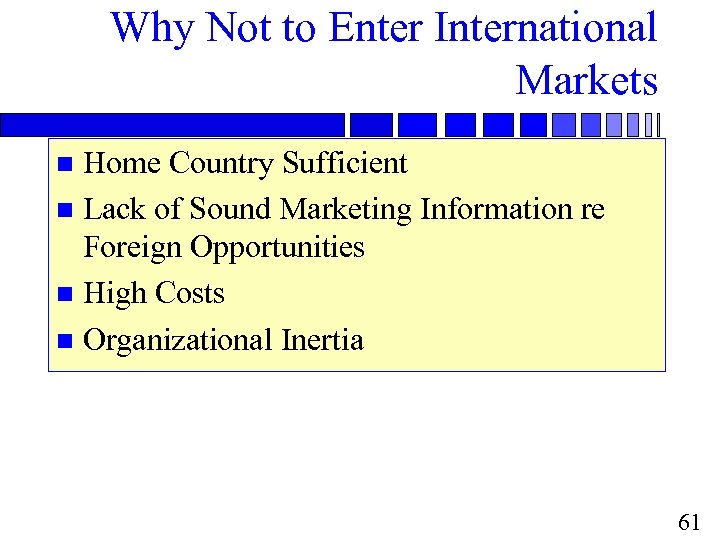 Why Not to Enter International Markets Home Country Sufficient n Lack of Sound Marketing Information re Foreign Opportunities n High Costs n Organizational Inertia n 61
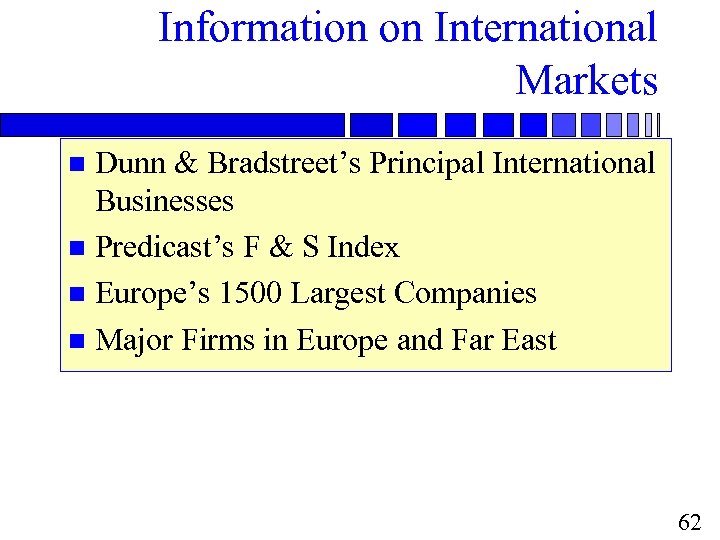 Information on International Markets Dunn & Bradstreet’s Principal International Businesses n Predicast’s F & S Index n Europe’s 1500 Largest Companies n Major Firms in Europe and Far East n 62
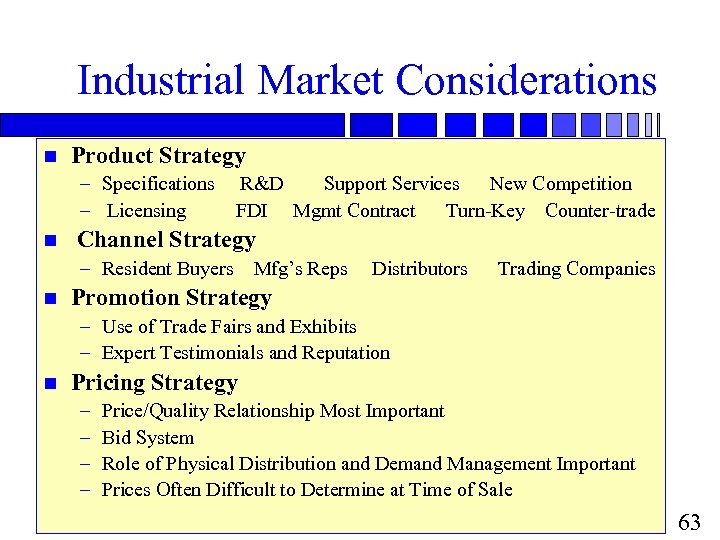 Industrial Market Considerations n Product Strategy – Specifications – Licensing n R&D Support Services New Competition FDI Mgmt Contract Turn-Key Counter-trade Channel Strategy – Resident Buyers Mfg’s Reps n Distributors Trading Companies Promotion Strategy – Use of Trade Fairs and Exhibits – Expert Testimonials and Reputation n Pricing Strategy – – Price/Quality Relationship Most Important Bid System Role of Physical Distribution and Demand Management Important Prices Often Difficult to Determine at Time of Sale 63
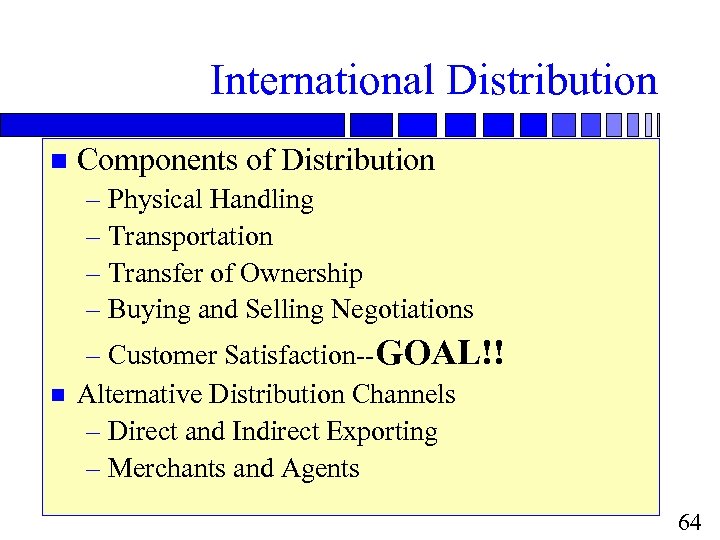 International Distribution n Components of Distribution – Physical Handling – Transportation – Transfer of Ownership – Buying and Selling Negotiations n – Customer Satisfaction--GOAL!! Alternative Distribution Channels – Direct and Indirect Exporting – Merchants and Agents 64
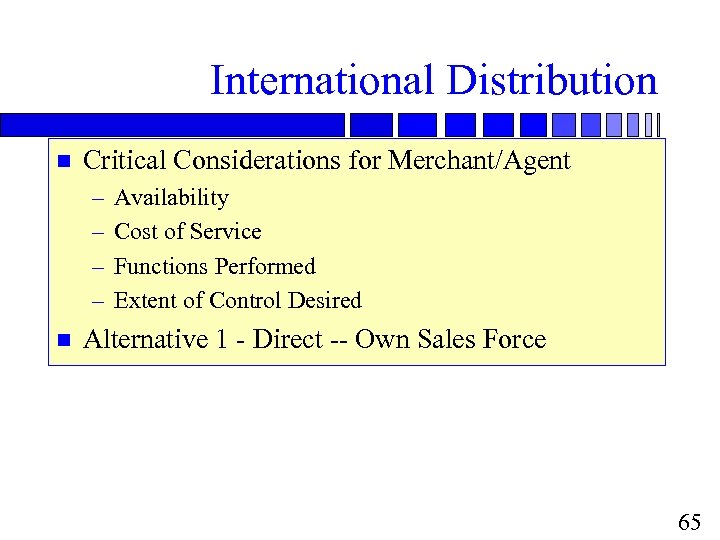 International Distribution n Critical Considerations for Merchant/Agent – – n Availability Cost of Service Functions Performed Extent of Control Desired Alternative 1 - Direct -- Own Sales Force 65
 International Distribution n Alternative 2 - Indirect--Merchant Middleman – Domestic Merchant Middleman – Purchase on Own Account – Minimum Credit Risk – Handles Functions Outside Domestic Market 66
 International Distribution n Alternative 2 - (cont. ) – Varieties of Domestic Merchant Middlemen – – – Export Merchants Export Jobbers Export Buyers Trading Companies Complementary Marketers – Foreign Merchant Middlemen 67
 International Distribution n Alternative 2 - (cont. ) – Varieties of Foreign Merchant Middlemen – – Distributors Import Jobbers Wholesalers and Retailers Affiliated Middlemen 68
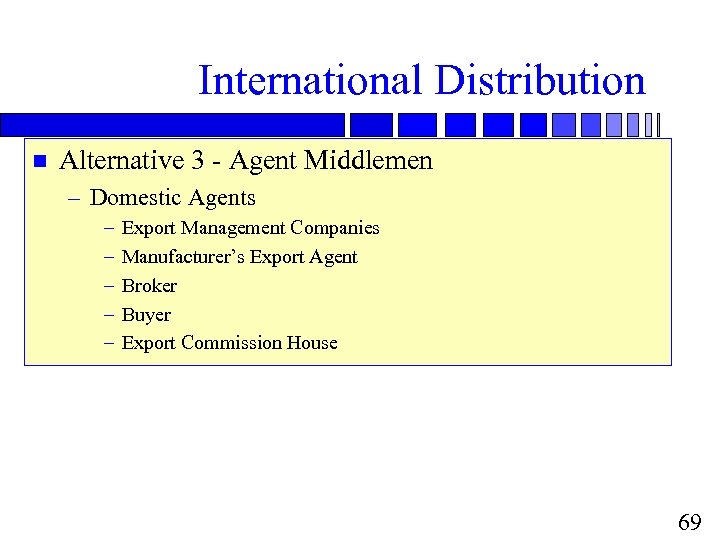 International Distribution n Alternative 3 - Agent Middlemen – Domestic Agents – – – Export Management Companies Manufacturer’s Export Agent Broker Buyer Export Commission House 69
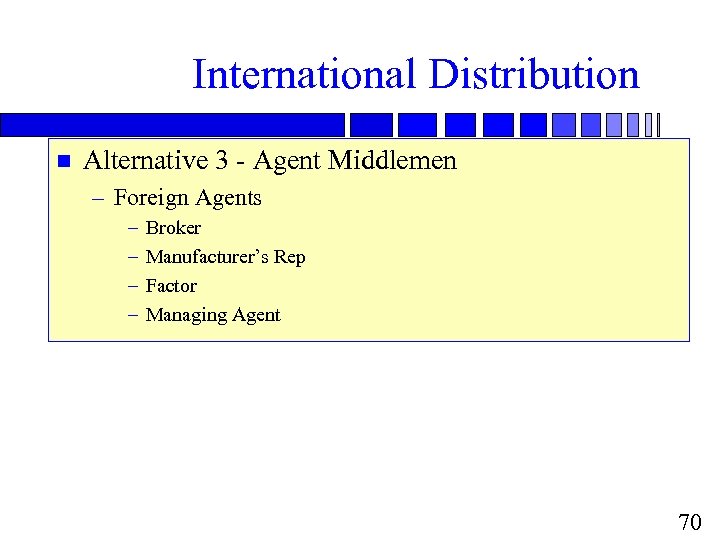 International Distribution n Alternative 3 - Agent Middlemen – Foreign Agents – – Broker Manufacturer’s Rep Factor Managing Agent 70
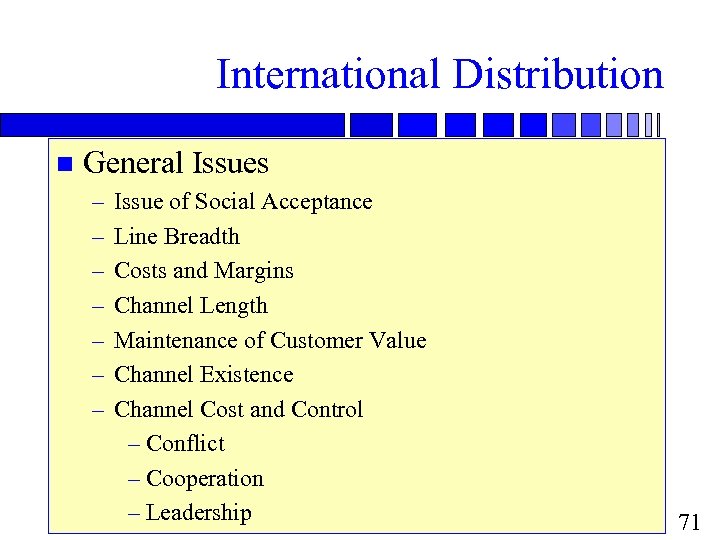 International Distribution n General Issues – – – – Issue of Social Acceptance Line Breadth Costs and Margins Channel Length Maintenance of Customer Value Channel Existence Channel Cost and Control – Conflict – Cooperation – Leadership 71
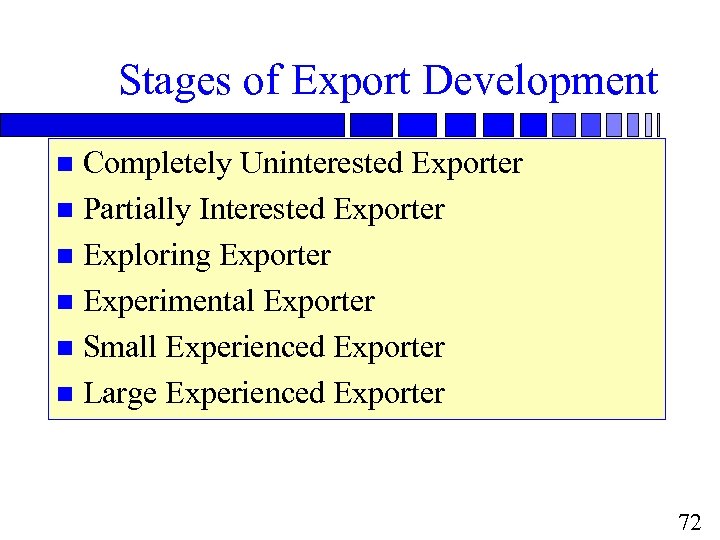 Stages of Export Development Completely Uninterested Exporter n Partially Interested Exporter n Exploring Exporter n Experimental Exporter n Small Experienced Exporter n Large Experienced Exporter n 72
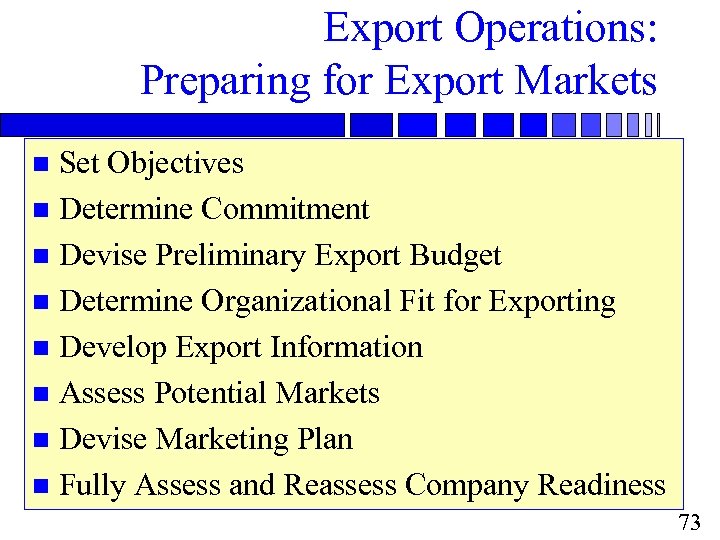 Export Operations: Preparing for Export Markets Set Objectives n Determine Commitment n Devise Preliminary Export Budget n Determine Organizational Fit for Exporting n Develop Export Information n Assess Potential Markets n Devise Marketing Plan n Fully Assess and Reassess Company Readiness n 73
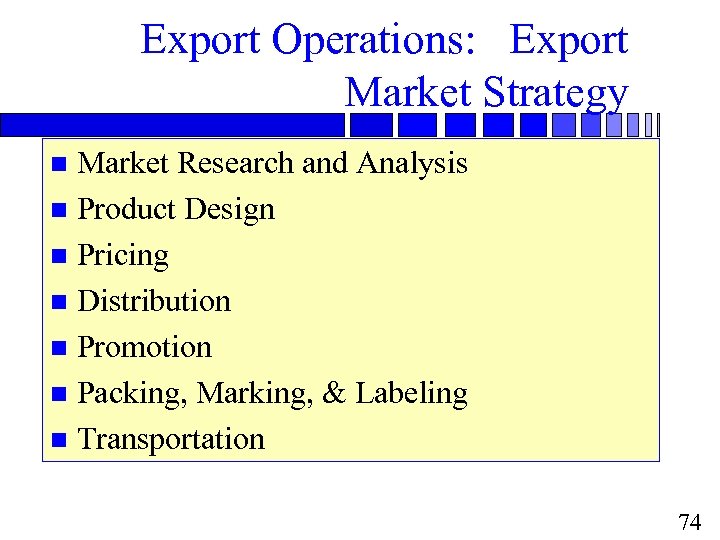 Export Operations: Export Market Strategy Market Research and Analysis n Product Design n Pricing n Distribution n Promotion n Packing, Marking, & Labeling n Transportation n 74
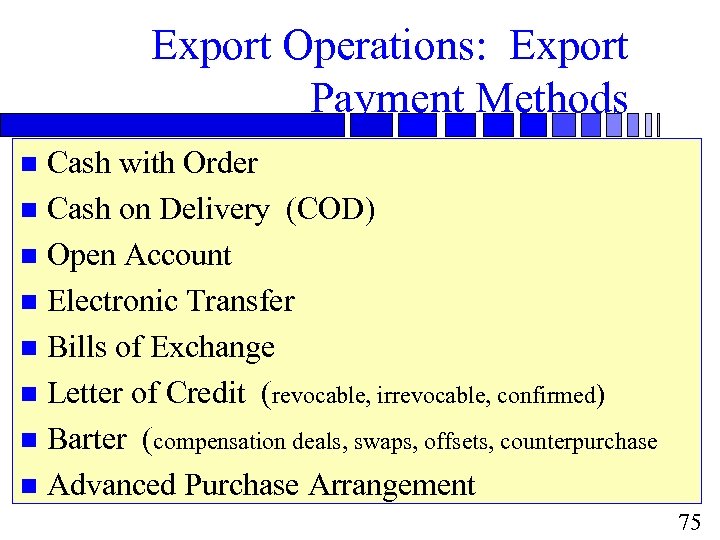 Export Operations: Export Payment Methods Cash with Order n Cash on Delivery (COD) n Open Account n Electronic Transfer n Bills of Exchange n Letter of Credit (revocable, irrevocable, confirmed) n Barter (compensation deals, swaps, offsets, counterpurchase n Advanced Purchase Arrangement n 75
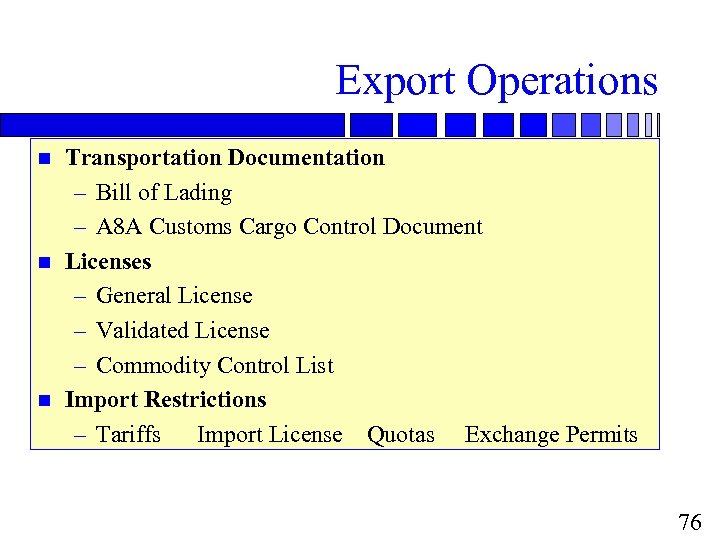 Export Operations n n n Transportation Documentation – Bill of Lading – A 8 A Customs Cargo Control Document Licenses – General License – Validated License – Commodity Control List Import Restrictions – Tariffs Import License Quotas Exchange Permits 76
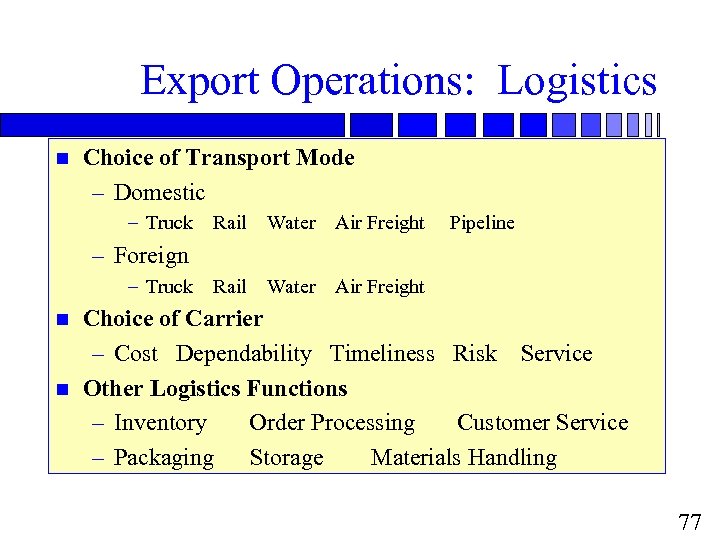 Export Operations: Logistics n Choice of Transport Mode – Domestic – Truck Rail Water Air Freight Pipeline – Foreign – Truck Rail Water Air Freight n n Choice of Carrier – Cost Dependability Timeliness Risk Service Other Logistics Functions – Inventory Order Processing Customer Service – Packaging Storage Materials Handling 77
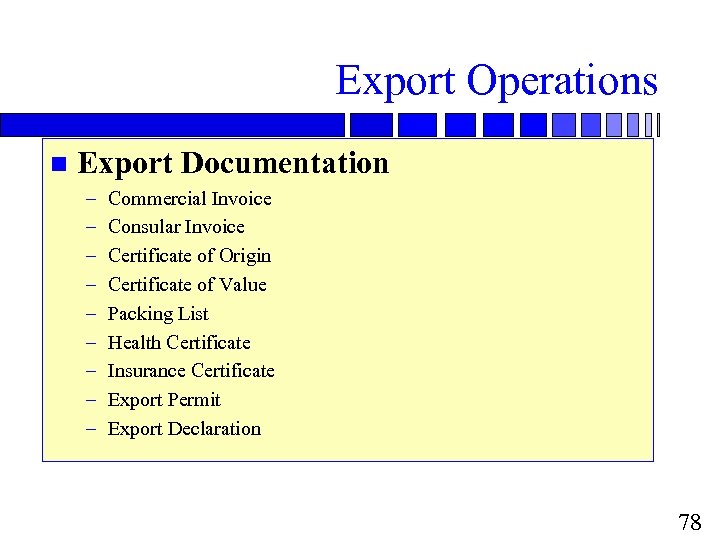 Export Operations n Export Documentation – – – – – Commercial Invoice Consular Invoice Certificate of Origin Certificate of Value Packing List Health Certificate Insurance Certificate Export Permit Export Declaration 78
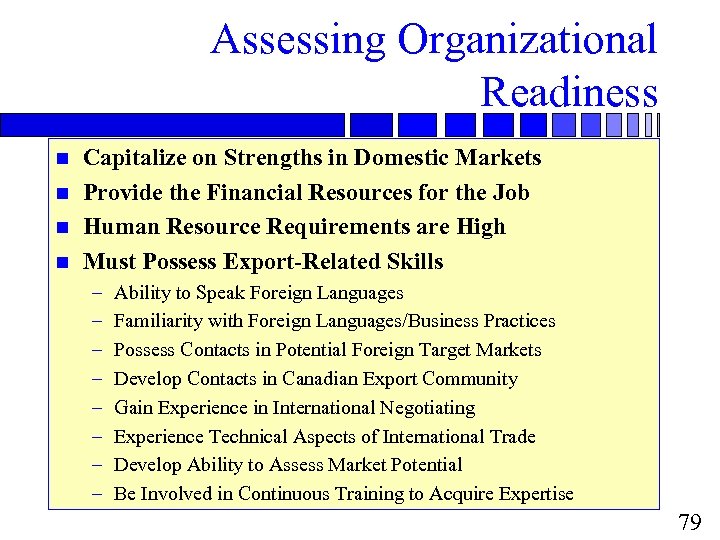 Assessing Organizational Readiness n n Capitalize on Strengths in Domestic Markets Provide the Financial Resources for the Job Human Resource Requirements are High Must Possess Export-Related Skills – – – – Ability to Speak Foreign Languages Familiarity with Foreign Languages/Business Practices Possess Contacts in Potential Foreign Target Markets Develop Contacts in Canadian Export Community Gain Experience in International Negotiating Experience Technical Aspects of International Trade Develop Ability to Assess Market Potential Be Involved in Continuous Training to Acquire Expertise 79
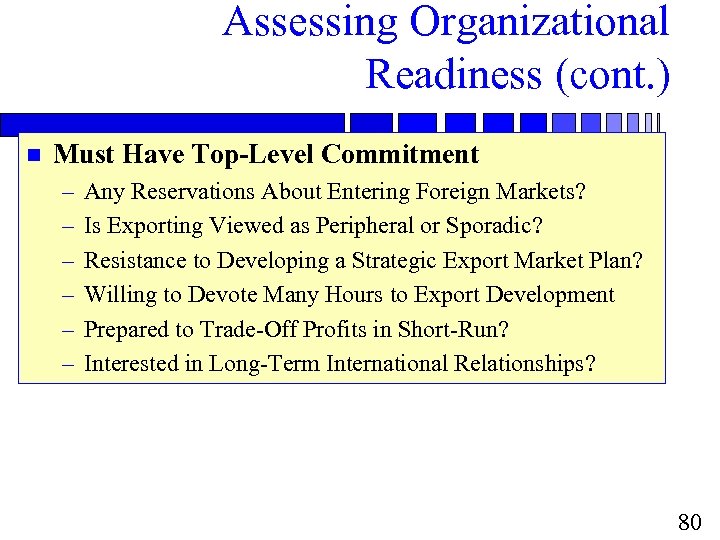 Assessing Organizational Readiness (cont. ) n Must Have Top-Level Commitment – – – Any Reservations About Entering Foreign Markets? Is Exporting Viewed as Peripheral or Sporadic? Resistance to Developing a Strategic Export Market Plan? Willing to Devote Many Hours to Export Development Prepared to Trade-Off Profits in Short-Run? Interested in Long-Term International Relationships? 80
 Assessing Organizational Readiness (cont. ) n Is the Organization Structured for Expansion? – Past Growth Experience--Foreign or Domestic? – Young, Energetic Staff with Drive and Ambition? – Sound Organizational Structure – – – Boundary Spanning Interorganizational Communication Continuous Learning Culture Market Intelligence Sensing Capability Flexibility, Adaptability, Viability 81
 Marketing Communications n n n Public Relations Sales Promotions International Advertising – The message • • Information source Encoding Message channel Decoding Receiver Feedback Noise 82
 Marketing Communications n Legal Issues – Puffing – Comparative Advertising – Specific Product prohibitions – Use of media – Truth in advertising n Language and symbolism Issues 83
 Marketing Communications Production and Cost Limitations n International Control of Information/Advertising n 84
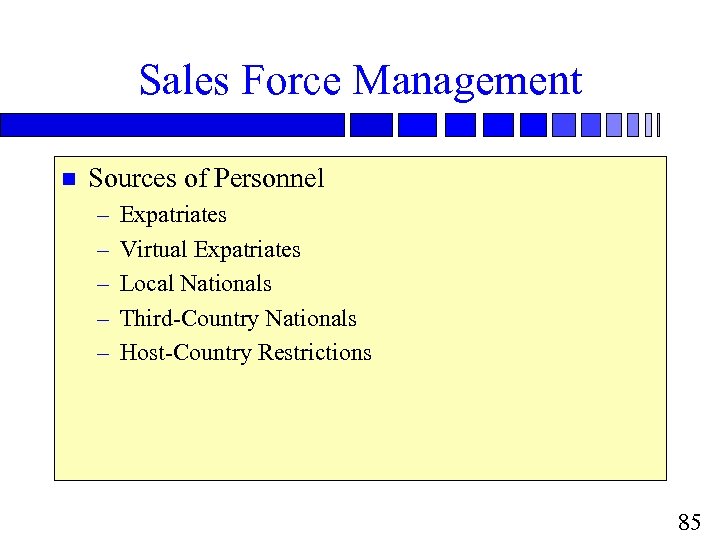 Sales Force Management n Sources of Personnel – – – Expatriates Virtual Expatriates Local Nationals Third-Country Nationals Host-Country Restrictions 85
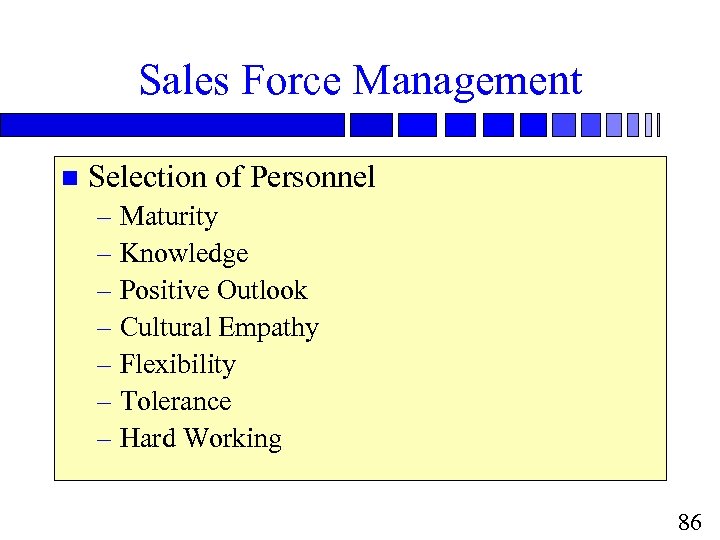 Sales Force Management n Selection of Personnel – Maturity – Knowledge – Positive Outlook – Cultural Empathy – Flexibility – Tolerance – Hard Working 86
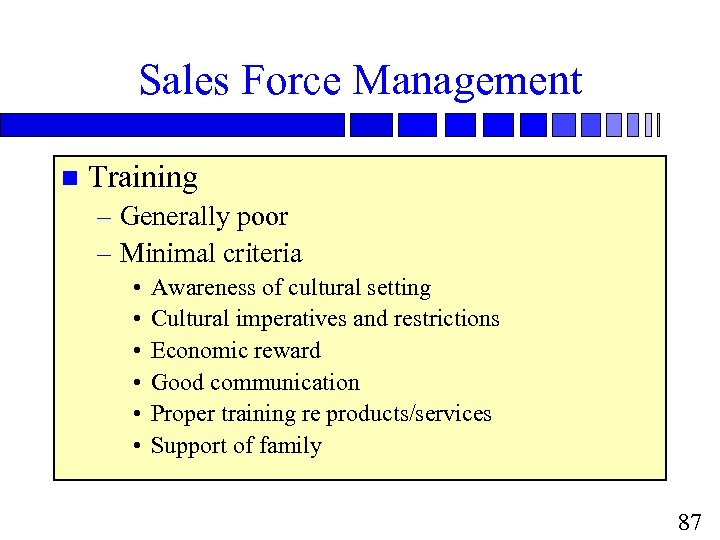 Sales Force Management n Training – Generally poor – Minimal criteria • • • Awareness of cultural setting Cultural imperatives and restrictions Economic reward Good communication Proper training re products/services Support of family 87
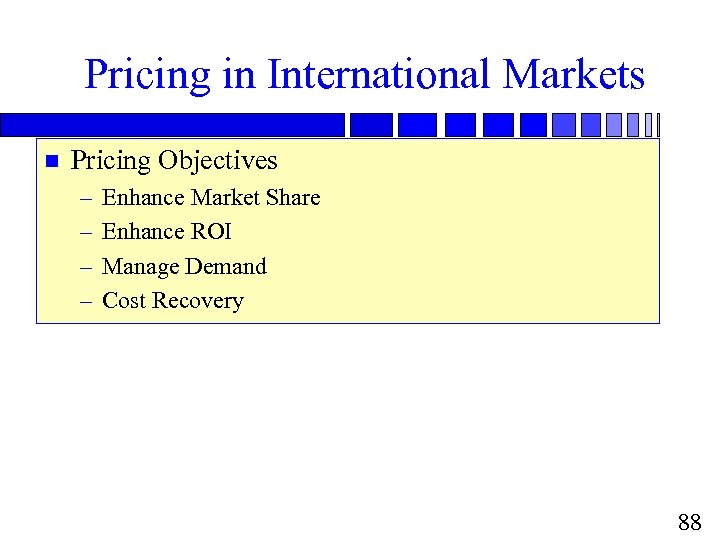 Pricing in International Markets n Pricing Objectives – – Enhance Market Share Enhance ROI Manage Demand Cost Recovery 88
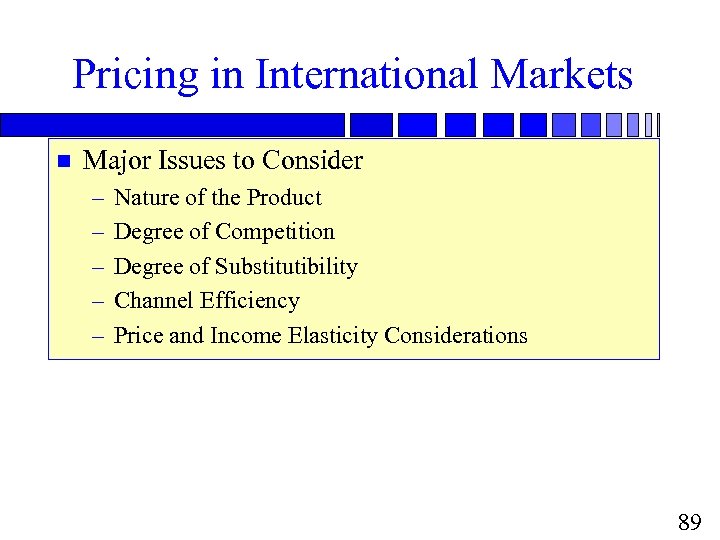 Pricing in International Markets n Major Issues to Consider – – – Nature of the Product Degree of Competition Degree of Substitutibility Channel Efficiency Price and Income Elasticity Considerations 89
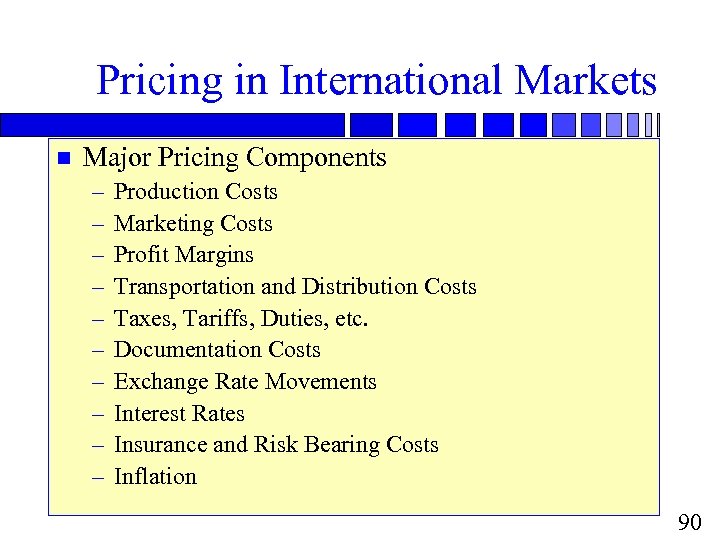 Pricing in International Markets n Major Pricing Components – – – – – Production Costs Marketing Costs Profit Margins Transportation and Distribution Costs Taxes, Tariffs, Duties, etc. Documentation Costs Exchange Rate Movements Interest Rates Insurance and Risk Bearing Costs Inflation 90
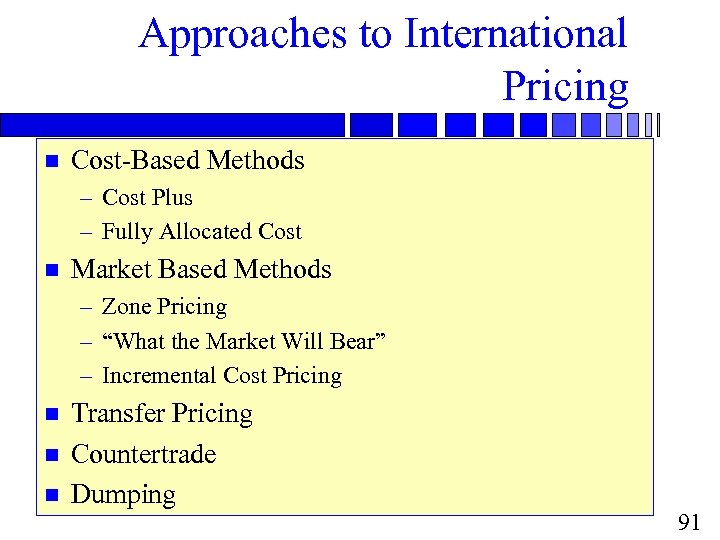 Approaches to International Pricing n Cost-Based Methods – Cost Plus – Fully Allocated Cost n Market Based Methods – Zone Pricing – “What the Market Will Bear” – Incremental Cost Pricing n n n Transfer Pricing Countertrade Dumping 91
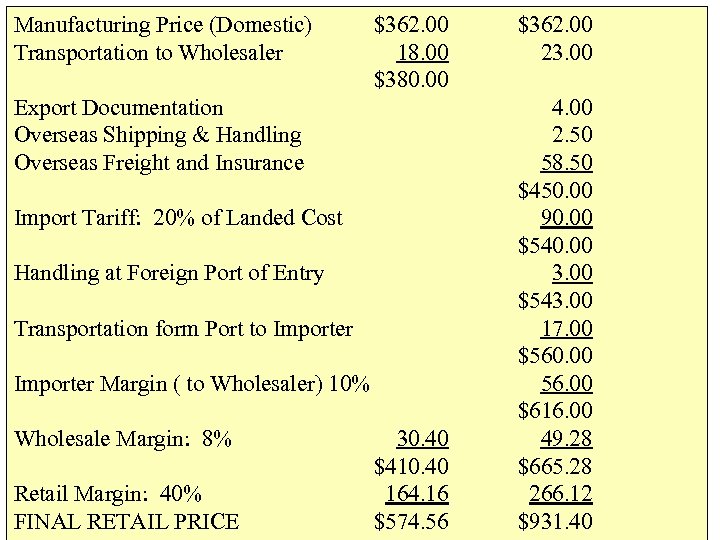 Manufacturing Price (Domestic) Transportation to Wholesaler $362. 00 18. 00 $380. 00 Export Documentation Overseas Shipping & Handling Overseas Freight and Insurance Import Tariff: 20% of Landed Cost Handling at Foreign Port of Entry Transportation form Port to Importer Margin ( to Wholesaler) 10% Wholesale Margin: 8% Retail Margin: 40% FINAL RETAIL PRICE 30. 40 $410. 40 164. 16 $574. 56 $362. 00 23. 00 4. 00 2. 50 58. 50 $450. 00 90. 00 $540. 00 3. 00 $543. 00 17. 00 $560. 00 56. 00 $616. 00 49. 28 $665. 28 266. 12 $931. 40