


 Скачать презентацию GENERAL MEDICINE IN AUSTRALIA AND NEW ZEALAND THE
051a8301ae80dd2151bc140621764ff8.ppt
- Количество слайдов: 66
 GENERAL MEDICINE IN AUSTRALIA AND NEW ZEALAND THE WAY FORWARD INTERNAL MEDICINE SOCIETY OF AUSTRALIA AND NEW ZEALAND ROYAL AUSTRALASIAN COLLEGE OF PHYSICIANS – HEALTH POLICY UNIT DECEMBER 2000 LEB IMSANZ 3/01 1
 INTRODUCTION • General Medicine in Australia and New Zealand – the Way Forward is produced with the support of the Royal Australasian College of Physicians President, Prof Richard Larkins and council, the Health Policy Unit, RACP and the Internal Medicine Society of Australia and New Zealand, Dr Neil Graham, President. December 2000 LEB IMSANZ 3/01 2
 The Document • Aims: – to outline current position of General Medicine in Australasia – Details plans to re-establish GM in a central role in provision of secondary and tertiary care over the next decade LEB IMSANZ 3/01 3
 Goals and Objectives • The Way Forward – Outlines directions for future – Focus for informing consumer groups, health policy makers, health administrators and other health care providers – Constructive framework to inform of strengths of General Medicine, and in particular delivery of cost effective health care in the new millenium LEB IMSANZ 3/01 4
 Training Future Physicians • General Medicine – Significant shortages of General Physicians exist in : • Major metropolitan centres • Rural /provincial centres • Global shortage LEB IMSANZ 3/01 5
 GENERAL PHYSICIANS • Breadth and depth of knowledge and experience – Provide high quality specialist services across spectrum of health and illness, not limited by boundaries of medical subspecialties – Clinicians , teachers and researchers – Integration of multi-disciplinary expertise – Management of undifferentiated, multisystem disease LEB IMSANZ 3/01 6
 GM – THE DISAPPEARING SPECIALTY • General Physicians – – Older than subspecialist Reduced numbers of trainees Declining numbers in teaching hospitals Significant shortages of GM in metropolitan, rural and provincial regions – Crisis levels in some rural areas – In NZ ratio subspecialists: GM in past decade – 2: 1 to >3. 5: 1 LEB IMSANZ 3/01 7
 Slide with age of physicians and specialties LEB IMSANZ 3/01 8
 Reasons for Decline of GM • Multiple and complex – Loss of academic departments in GM – Loss of GM role models – Hospital practice issues – Remuneration – eg procedures vs consultation – Changes in technology LEB IMSANZ 3/01 9
 Medical Subspecialisation • Subspecialistion – Compartmentalization of care – May overlook, misdiagnose or inappropriately manage co-morbidities and unrelated conditions – Multi-system medical problems lead to multiple subspecialists opinions and not always in best interest of patient or delivery of cost- effective care for organisation LEB IMSANZ 3/01 10
 General Physicians • IMSANZ aims to constructively engage health officials, hospital administrators, general practitioners and subspecialty groups in debate on roles and responsibilities of general physicians and general medical units LEB IMSANZ 3/01 11
 General Physicians • GM physicians have a wide range of skills • Suggest Consultation on complex, multi- system or undiagnosed case • Supervisors of ongoing care if significant and multiple co-morbid conditions • Role models and mentors in complex medicine in GM units • Collaborative care with ED, ICU, CCU LEB IMSANZ 3/01 12
 Recommendations: Government 1 • Promote efficient use of health care resources • Provide high standard care • Achieve meaningful population health goals • Recognise health consumers role in determination of appropriate care delivery mechanisms LEB IMSANZ 3/01 13
 Recommendations: Government 2 • Rationalise acute hospital services, facilitate technological developments and achieve economies of scale with community demands for locally accessible, whole patient health services • Recognise that economy and efficiencies result from General Physicians providing ‘whole patient’ health care LEB IMSANZ 3/01 14
 Recommendations: Government 3 • Recognise General Physicians are key participants in clinical epidemiology and critical appraisal, ethics, clinical informatics, health technology assessment, clinical audit and health service research • Aim to provide physical infrastructure and human resources required for practice of internal medicine in non-metropolitan localities LEB IMSANZ 3/01 15
 Recommendations: Hospitals and Universities 1 • Maintain or re-establish General Medicial Units in metropolitan teaching hospitals • Expand General Medical units in non- metropolitan hospitals and rural health services • Workforce planning should consider safeworking hours and on-call conditions LEB IMSANZ 3/01 16
 Recommendations: Hospitals and Universities 2 • Develop training programs and rotations for general medicine advanced trainees • Re-establish/expand academic general medical units in universities and teaching hospitals • Develop audit systems to determine when Generalist care more appropriate than subspecialtist care LEB IMSANZ 3/01 17
 Recommendations: Hospitals and Universities 3 • Determine which hospital level services delivered more efficiently and costeffectively by General Medicine physicians • Determine protocols and pathways of providing care to patients with undifferentiated illness, but whom may later require subspecialist expertise LEB IMSANZ 3/01 18
 Recommendations: RACP and IMSANZ 1 h • Define roles and responsibilities of Generalists • Demonstrate and promote cost effectiveness of general medical units, general physician practice and training in general medicine to health officials, hospital administrators and consumer groups LEB IMSANZ 3/01 19
 Recommendations: RACP and IMSANZ 2 • Promote training and culture of general medicine to undergraduates, interns and RACP basic trainees • Liaise closely with RACP, Health Officials, AMWAC-Australian Medical Workforce Advisory Committee- to optimise training and predict workforce requirements and distribution LEB IMSANZ 3/01 20
 General Medicine and the General Physician 1 • GM enables consultation across broad field of medicine in adolescents and adults • General physicians provide cost effective care in : – Undifferentiated problems – Multi-system disease – Acute presentations of single organ disease of mild- moderate complexity – Ambulatory and post acute care with liaison primary practitioner and allied health services LEB IMSANZ 3/01 21
 General Medicine and the General Physician 2 • General Physicians adopt scientific approach to patient as a whole person-ie holistic approach- GM is a vast specialty with respect to knowledge, experience and skill acquired for effective practice – the learning process continues indefinitely • GM encompasses all medical subspecialties and allows integration of multi-disciplinary expertise LEB IMSANZ 3/01 22
 General Medicine and the General Physician 3 • General physicians can provide cost effective care ‘whole patient’ care to patients with complex comorbidities and provide much needed cost effective care with minimal cross referral to subspecialists – although their roles are complementary rather than competitive • Similar outcomes , with improved cost efficiency have been demonstrated, with referral to subspecialist when appropriate • Allows subspecialists to concentrate on specific areas LEB IMSANZ 3/01 23
 Role of Internal Medicine Society of Australia and New Zealand- IMSANZ 1 • IMSANZ= Australasian Society of General Physicians or Consultant Physicians in Internal Medicine • Aligned with international societies of Internal Medicine- ASIM, CSIM, EFIM LEB IMSANZ 3/01 24
 Role of Internal Medicine Society of Australia and New Zealand- IMSANZ 2 • Mechanism to develop the academic and professional profile and culture of general physicians • Encourage the development or re-establish of general medical units in teaching hospitals and networking in other hospitals to encourage general medical training LEB IMSANZ 3/01 25
 Role of Internal Medicine Society of Australia and New Zealand- IMSANZ 2 • IMSANZ seeks to articulate, advocate for and sponsor the educational, training, research and workforce requirements of general internal medicine • Produce and publicise training guidelines, policy documents, newsletters and journal articles LEB IMSANZ 3/01 26
 Role of Internal Medicine Society of Australia and New Zealand- IMSANZ 3 • Establish databases containing information on the geographic distribution, skills base, academic interests, and specialty affiliations of the general physician membership • Project future workforce and training requirements – work in collaboration with health services, hospitals and universities LEB IMSANZ 3/01 27
 Role of the Royal Australasian College of Physicians 1 • Comprise Fellowship of medical consultants who provide highest quality care in internal medicine, paediatrics and their subspecialties for the people of Australia and New Zealand • RACP represents over 7000 Fellows and its Faculties of Rehabilitation Medicine, Public Health Medicine and Occupational Health Medicine LEB IMSANZ 3/01 28
 Role of the Royal Australasian College of Physicians 2 • RACP encompasses range of associated Special Societies representing the spectrum of specialist practice in Internal Medicine • Core functions of RACP include – Training – Accreditation – Maintenance of professional standards – Research – Policy development in workforce, public health, health financing and systems development LEB IMSANZ 3/01 29
 Current Status of General Medicine in Australia and New Zealand 1 • General physician practice at ris of disappearing from public and private practice • Average of GM physicians considerably older • Fewer trainees and new consultants • Crisis point in many rural and remote areas LEB IMSANZ 3/01 30
 Current Status of General Medicine in Australia and New Zealand 2 - STATE DETAILS • QUEENSLAND – GM units at metropolitan Royal Brisbane and Princess Alexandra and regional centres at Toowoomba, Nambour and Gold Coast – However provincial centres eg Mackay, Rockhampton and Mt Isa precariously low – Estimated need 41 additional general physicians (based on 1: 10, 000 population) LEB IMSANZ 3/01 31
 Current Status of General Medicine in Australia and New Zealand 3 - STATE DETAILS • South Australia – GM units at Royal Adelaide, Modbury and Lyall Mc. Ewin and combined units at Flinders Medical Centre – Many General Physicians in private practice – Need to plan succession of Fellows in regional centres LEB IMSANZ 3/01 32
 Current Status of General Medicine in Australia and New Zealand 4 - STATE DETAILS • Victoria – GM units at RMH, Austin and Repatriation Medical Centre and St Vincent’s- trendaway from GM units – Alfred – minimal GM – Monash – 2 GM units and Acute Aged GM unit - all covered by subspecialists with GM interest LEB IMSANZ 3/01 33
 Current Status of General Medicine in Australia and New Zealand 5 - STATE DETAILS • Victoria – Peripheral metropolitan hospitals- Northern, Western, Dandenong, Sandringham, Frankston and Ringwood maintain GM services – Need succession planning – Rural Victoria – strong GM presence with ageing physicians – Rural Victoria estimates need for 20 physicians – including those with subspecialty interest LEB IMSANZ 3/01 34
 Current Status of General Medicine in Australia and New Zealand - STATE DETAILS 6 • New South Wales – Minimal GM units in tertiary centres- most disbanded – Royal North Shore maintains GM unit and Acute Aged Care- also advanced trainee rotations – Liverpool, Concord, John Hunter and Newcastle Mater Misericordiae include GM units – Newcastle – GM unit and rural rotations – District hospitals maintain GM units – Wollongong retains GM roster, often triages to local smaller hospitals – Estimated needs of 12+ GM physicians – see rural requirements cf Dubbo LEB IMSANZ 3/01 35
 Current Status of General Medicine in Australia and New Zealand - STATE DETAILS 7 • ACT – Canberra Hospital – no GM unit – Calvary Hospital – GM unit – mixed physicians – GM training program awaiting AT applicant LEB IMSANZ 3/01 36
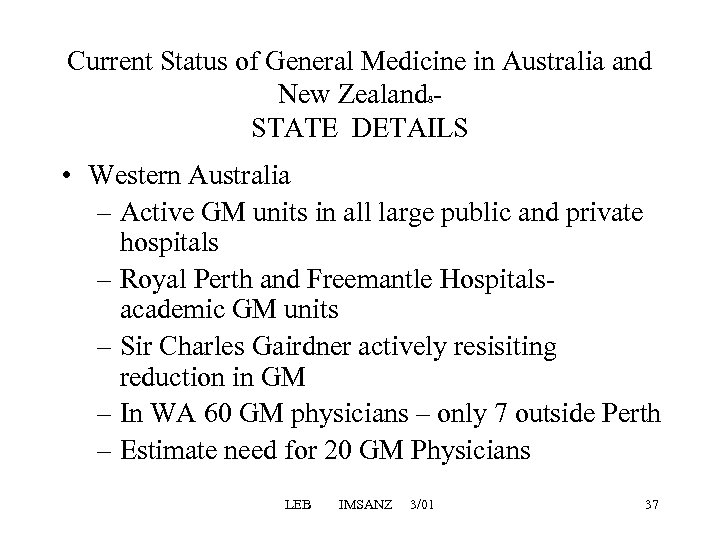 Current Status of General Medicine in Australia and New Zealand - STATE DETAILS 8 • Western Australia – Active GM units in all large public and private hospitals – Royal Perth and Freemantle Hospitals- academic GM units – Sir Charles Gairdner actively resisiting reduction in GM – In WA 60 GM physicians – only 7 outside Perth – Estimate need for 20 GM Physicians LEB IMSANZ 3/01 37
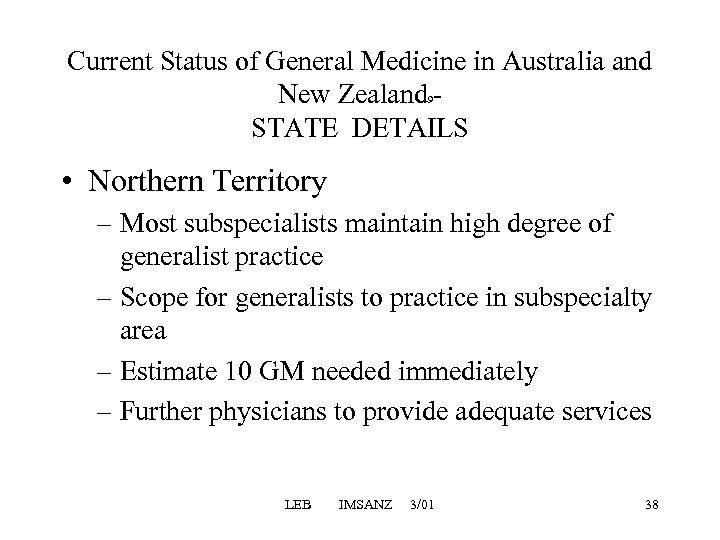 Current Status of General Medicine in Australia and New Zealand - STATE DETAILS 9 • Northern Territory – Most subspecialists maintain high degree of generalist practice – Scope for generalists to practice in subspecialty area – Estimate 10 GM needed immediately – Further physicians to provide adequate services LEB IMSANZ 3/01 38
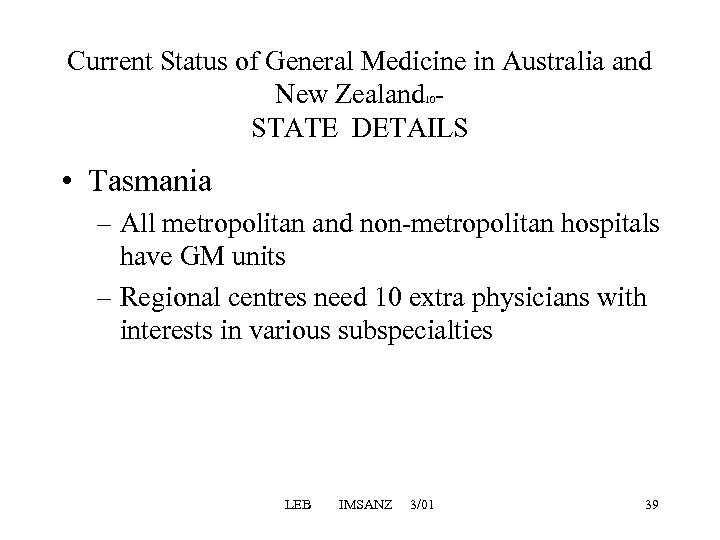 Current Status of General Medicine in Australia and New Zealand - STATE DETAILS 10 • Tasmania – All metropolitan and non-metropolitan hospitals have GM units – Regional centres need 10 extra physicians with interests in various subspecialties LEB IMSANZ 3/01 39
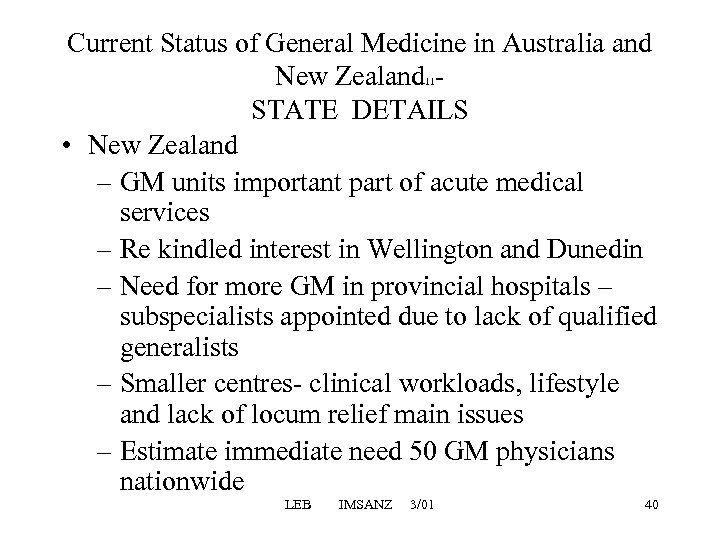 Current Status of General Medicine in Australia and New Zealand - STATE DETAILS • New Zealand – GM units important part of acute medical services – Re kindled interest in Wellington and Dunedin – Need for more GM in provincial hospitals – subspecialists appointed due to lack of qualified generalists – Smaller centres- clinical workloads, lifestyle and lack of locum relief main issues – Estimate immediate need 50 GM physicians nationwide 11 LEB IMSANZ 3/01 40
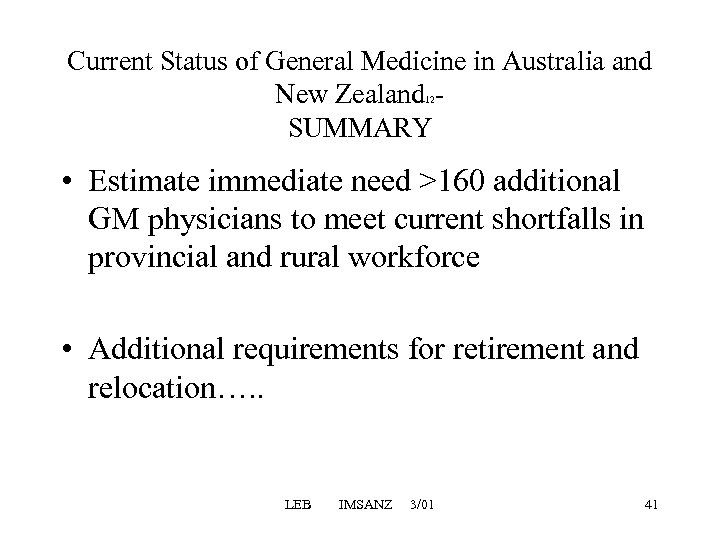 Current Status of General Medicine in Australia and New Zealand - SUMMARY 12 • Estimate immediate need >160 additional GM physicians to meet current shortfalls in provincial and rural workforce • Additional requirements for retirement and relocation…. . LEB IMSANZ 3/01 41
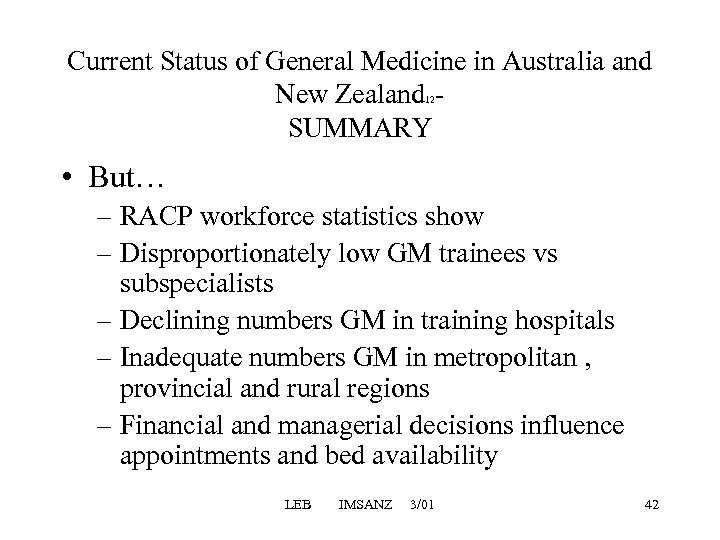 Current Status of General Medicine in Australia and New Zealand - SUMMARY 12 • But… – RACP workforce statistics show – Disproportionately low GM trainees vs subspecialists – Declining numbers GM in training hospitals – Inadequate numbers GM in metropolitan , provincial and rural regions – Financial and managerial decisions influence appointments and bed availability LEB IMSANZ 3/01 42
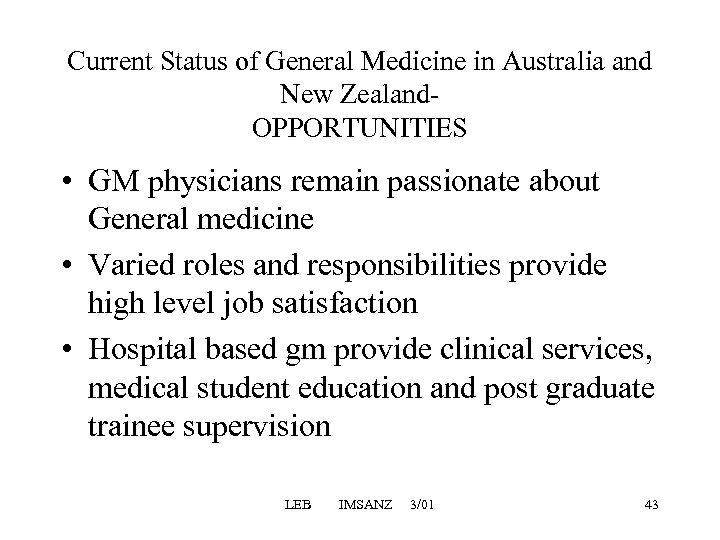 Current Status of General Medicine in Australia and New Zealand- OPPORTUNITIES • GM physicians remain passionate about General medicine • Varied roles and responsibilities provide high level job satisfaction • Hospital based gm provide clinical services, medical student education and post graduate trainee supervision LEB IMSANZ 3/01 43
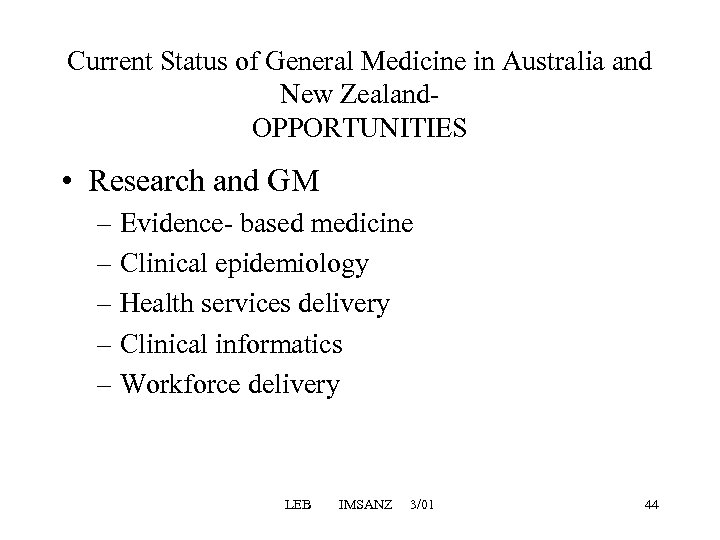 Current Status of General Medicine in Australia and New Zealand- OPPORTUNITIES • Research and GM – Evidence- based medicine – Clinical epidemiology – Health services delivery – Clinical informatics – Workforce delivery LEB IMSANZ 3/01 44
 Current Status of General Medicine in Australia and New Zealand- OPPORTUNITIES • ‘Access’ in health policy promotes tertiary level service delivery at regional and provincial level rather than central level • This necessitates redistribution of resources and workforce to regional hospitals with transfer to GM from subspecialist care • Hospital managers and colleagues value GM assistance in multi-system disease –reduced cost and improved integration of health service delivery LEB IMSANZ 3/01 45
 Current Status of General Medicine in Australia and New Zealand- OPPORTUNITIES • New Zealand – GM coexists with specialty units which enables – Rapid cross-referral on basis of valid and defined selection criteria – GM assessment of majority of surgical patients – Integration of geriatricians into GM units- enhances evaluation and rehabilitation – Broad based undergraduate and postgraduate teaching and clinical education LEB IMSANZ 3/01 46
 Factors Contributing to Current Status of GM • In the past 20 years, internal medicine evolved with appreciation of basic physiological, immunological and pathological mechanisms common to all tissue, organ and disease processes • Unification of all physicians into common intellectual and clinical territory • Reduction in reliance on procedures LEB IMSANZ 3/01 47
 Reasons for Decline in GM • Expansion of subspecialisation • Advances in technology driven subspecialisation • Historical inequality in remuneration between proceduralist and non-proceduralist • Increasing full-time subspecialists in teaching hospitals • Loss of academic departments of GM LEB IMSANZ 3/01 48
 Reasons for Decline in GM • Limited research opportunities for GM due to clinical care and teaching • Fewer GM role models and mentors • Lack of definition of GM • Perceived lack of career pathway and prospects for employment • Inadequately structured training programs in GM • Concern re volumes of medical knowledge required LEB IMSANZ 3/01 49
 Impacts of GM on Health Care • GM provide cost efficient and effective, quality, whole-of-patient care. • Major impacts of loss of GM units – Compartmentalisation of care – Overlooked, misdiagnosed, or inappropriately managed significant co-morbidities – Increased cross-referral between subspecialists with multiple providors and increased costs LEB IMSANZ 3/01 50
 Impacts of GM on Health Care • Major impacts of loss of GM units – Patient inconvenience- increased visits to multiple subspecialists and longer hospital stays coordinating care and opinions from multiple referrals – Concerns re ‘hospitalism’ if acute care devolved to Emergency physicians or intensivists – Increasing shortage of GM in all regions – Subspecialists increase costs without commensurate returns in improved patient outcomes LEB IMSANZ 3/01 51
 RACP Advanced Training in GM • Training begins in undergraduate years – fosters essential skills and attitudes • Clinical skills essential, also teaching, administrative and research interests • 85% of RACP AT’s train as subspecialists • 70% of GM trainees switch to subspecialities at end year 1 AT LEB IMSANZ 3/01 52
 RACP Advanced Training in GM • Reasons for subspeciality preference– Loss of academic GM departments in tertiary centres – Difficulty obtain adequate trianing in subspecialty areas – Lack of GM role models and mentors – Perception of fewer job opportunities – Perception career paths only in regional or rural centres LEB IMSANZ 3/01 53
 RACP Advanced Training in GM • Reasons for subspecialty preferences – Perception of GM as clinical services and teaching only , with little access to research and procedures – Perception of little academic stimulus eg pathways to higher degrees – Perception of personal inability to manage the explosion of medical knowledge effectively – Negative labelling of GM by hospitals, societies and patient support groups LEB IMSANZ 3/01 54
 Future Training in GM • Dual accreditation – AT’s in GM may receive dual accreditaion to achieve training in subspecialties – May achieve post –FRACP training and accreditation Specific GM Training programs *North Queensland Program *Victorian Rural Physicians Network Program LEB IMSANZ 3/01 55
 Role of the General Physician • General Practitioners –GP’s – have ‘gatekeeper’ role in both Australia and New Zealand • GM provides integrated health care with cost effective investigation, treatment and management options for complex medical problems • Ageing populations have multiple co- morbidities • GM provides integrated overview of medical management with quality and cost efficiency appreciated by hospitals and health care managers LEB IMSANZ 3/01 56
 The Way Forward 1 • What is General Medicine? • Aim: define GM in relation to current consultant practice and promote widely • Who: IMSANZ, RACP-Medical Workforce Advisory Committee • Time: 2001 -2002 • Outcome: Current definition will assist RACP, AMWAC, Health Authorities, hospital , trainees and fellow physicians identify role of GM LEB IMSANZ 3/01 57
 The Way Forward 2 • How is GM practised? • Aim: identify innovative GM practice and develop new models of service delivery • Who: RACP, IMSANZ, tertiary hospitals • Time: 2001 -2002 • Outcome: Career guidance for RACP trainees and service development for healthcare providers LEB IMSANZ 3/01 58
 The Way Forward 3 • How to attract GM trainees? • Aim: develop structured mentor program for BT’s and AT’s and improve lifestyle and career prospects • Who: IMSANZ, RACP GM SAC, DPT’s, Health Officials • Time: 2001 onwards • Outcome: GM mentors at each site, with resource support from IMSANZ and coordinated activities LEB IMSANZ 3/01 59
 The Way Forward 4 • What are trainee preferences in GM program? • Aim: develop AT training program using models from North Queensland Victoria • Who: IMSANZ, regional physicians, RACP Rural Workforce and Training Program • Time: 2001 -2003 • Outcome: develop co-ordinated 3 year AT program on non-metropolitan and provincial centres LEB IMSANZ 3/01 60
 The Way Forward 5 • How do we stop losing AT’s to subspecialties? • Aim: improve GM AT retention in training programs • Who: IMSANZ, DPT’s, GM units in tertiary and non- metropolitan hospitals • Time: 2001 onwards • Outcome: improved retention and increased graduates in GM LEB IMSANZ 3/01 61
 The Way Forward 6 • How do we prepare trainees for ‘the market place’? • Aim: determine need for dual RACP accreditation appropriate for specialist consultant practice • Who: GM SAC, IMSANZ, RACP training programs, health administrators • Time: 2001 -2002 • Outcome: improve transition from training to GM practice including specialty interest LEB IMSANZ 3/01 62
 The Way Forward 7 • How do we ensure IMSANZ represents GM interest? • Aim: promote GM to Governments, health departments, hospitals and RACP using the document –General Medicine in Australia and New Zealand- the Way Forward • Who: IMSANZ councillors • Time: 2001 - onwards • Outcome: decision makers consult IMSANZ on role of GM in health service delivery LEB IMSANZ 3/01 63
 References 1. Scott IA, Greenberg P. General internal medicine in Australia and New Zealand – a renaissance. MJA 1998; 168: 104 -5. 2. Wartman SA, Wilson M, Kahn N. The generalist health care workforce: issues and goals. J Gen Intern Med 1994; 9: S 7 -13. RACP. Requirements for Physician Training - Internal Medicine. January, 2000. 4. Willison DJ, Soumerai SB, Mc. Laughlin TJ, Gurwitz JH, et al. Consultation between cardiologists and generalists in the management of acute myocardial infarction. Implications for quality of care. Arch Intern Med 1998; 158: 1778 -1783. 5. Regueiro CR, Hamel MB, Davis RB, Desbiens N, et al. A comparison of generalist and pulmonologist care for patients hospitalised with severe chronic obstructive pulmonary disease: resource intensity, hospital costs, and survival. Am J Med 1998; 105: 366 -372. 6. Greenfield S, Rogers W, Mangotich M, Outcomes of patients with hypertension and non-insulin dependant diabetes melitus treated by different systems and specialties - results from the Medical Outcomes Studies. JAMA 1995; 274: 1436 -1444. 7. Dent. O. Clinical workforce in Internal Medicine and Paediatrics in Australia, 1997. Fellowship Affairs, February 1999, pp 31 -46. 8. Smith BJ, Darzins P, Heller RF. RACP survey of advanced trainees’ job aspirations: the fate of those who pass the clinical exam of the RACP. Fellowship Affairs December 1993: 31 -33. 9. Hadfield C. Rural manpower in Queensland – a start to tackling the problem? IMSANZ Newsletter June 1997: 6 -7. 10. Hadfield C, Internal Medicine Workforce Survey, Provincial Queensland, January 1999. Unpublished. 11. Greenberg PB. Casemix funding: Implications for general physicians. Fellowship Affairs November 1995: 35 -37. 12. Greenbeck MR. Educating physicians for the 21 st century. Acad Med 1995; 70: 179 -185. 13. Ladenson PW (ed) The Consultation Guide. Baltimore: Williams and Wilkins, 1999. 14. Niall J. Optimal decision making and general medicine [letter], Fellowship Affairs, February 1999: 7. 15. Hillman K. The changing role of acute-care hospitals. MJA 1999; 170: 325 -328. 16. Scott I, Phillips P. Hospitals and Hospitalists: An alternative view. MJA 1999; 171: 312 -314 17. Bennett J. The general physician – dinosaur or superman? J R Coll Physicians Lond 1997; 31: 6 -7. LEB IMSANZ 3/01 64 Rhodes JM, Harrison B, Black D, Spiro S, Almond S, Moore S. General internal medicine and specialty medicine – time to rethink the relationship.
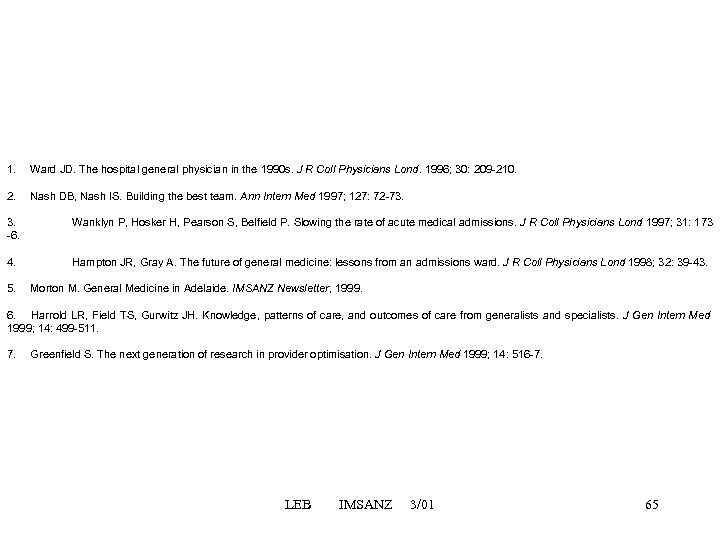 1. Ward JD. The hospital general physician in the 1990 s. J R Coll Physicians Lond. 1996; 30: 209 -210. 2. Nash DB, Nash IS. Building the best team. Ann Intern Med 1997; 127: 72 -73. Wanklyn P, Hosker H, Pearson S, Belfield P. Slowing the rate of acute medical admissions. J R Coll Physicians Lond 1997; 31: 173 -6. 4. Hampton JR, Gray A. The future of general medicine: lessons from an admissions ward. J R Coll Physicians Lond 1998; 32: 39 -43. 5. Morton M. General Medicine in Adelaide. IMSANZ Newsletter, 1999. 6. Harrold LR, Field TS, Gurwitz JH. Knowledge, patterns of care, and outcomes of care from generalists and specialists. J Gen Intern Med 1999; 14: 499 -511. 7. Greenfield S. The next generation of research in provider optimisation. J Gen Intern Med 1999; 14: 516 -7. LEB IMSANZ 3/01 65
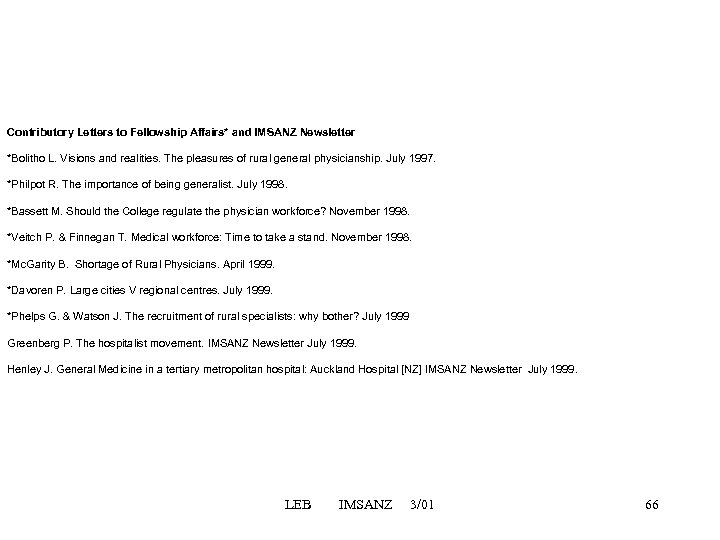 Contributory Letters to Fellowship Affairs* and IMSANZ Newsletter *Bolitho L. Visions and realities. The pleasures of rural general physicianship. July 1997. *Philpot R. The importance of being generalist. July 1998. *Bassett M. Should the College regulate the physician workforce? November 1998. *Veitch P. & Finnegan T. Medical workforce: Time to take a stand. November 1998. *Mc. Garity B. Shortage of Rural Physicians. April 1999. *Davoren P. Large cities V regional centres. July 1999. *Phelps G. & Watson J. The recruitment of rural specialists: why bother? July 1999 Greenberg P. The hospitalist movement. IMSANZ Newsletter July 1999. Henley J. General Medicine in a tertiary metropolitan hospital: Auckland Hospital [NZ] IMSANZ Newsletter July 1999. LEB IMSANZ 3/01 66