


 Скачать презентацию General financial guidelines for IUC Networks
b534c0f4efecb794e70c615ed8724d92.ppt
- Количество слайдов: 30
 General financial guidelines for IUC / Networks / Platforms 25 January 2016, Programme Manager training Kathleen Wuytack
 1. Introduction 2. Budget lines 3. Programme versus project budgets and expenditure 4. Financial framework
 1. Introduction
 INTRODUCTION • Reference for IUC, NETWORK: IUC financial guidelines (with some exceptions at the management level for NETWORK) • Principles of alignment with financial guidelines of the partner universities through negotiation (in particular in the context of local guidelines for travel, mileage, scholarships, etc. ) • Partner specific financial guidelines and procedures do be included in a Management Manual • The IUC Programme, NETWORK fund cooperation – The share of investment costs in the overall budget is to be kept limited. – Key aim is to improve the basic conditions in which academics have to do “their job” – Academic personnel is to be provided by either the partner university or the Flemish universities – Selected input or in-kind cofunding is assumed by the local universities (office space, waivering of tuition fees, staff support, renovation of buildings, etc) 4
 BASICS of the FINANCIAL GUIDELINES (1) • Currency : EUR (specific EUR bank account to be opened by the local university for the management of the funds) • Partner Programme (PP) for 5 years • Detailed budget per AP with timeframe of 12 months • Project budgets and programme level budget (PSU) for IUC and NETWORK • Split of the budget in North and South budget for IUC • Budget lines: • • • A. Investment costs B. Operational costs C. Personnel costs D. Scholarship costs E 1. Coordination costs North E 2. Coordination costs South 5
 BASICS of the FINANCIAL GUIDELINES (2) • IUC budgets are currently annual budgets i. e. activity programme based funding (12 -month period – 1 January year ‘X’ to 31 December year ‘x+1’) – Balances can not be rolled over : unspent money is lost – Only invoices dated within activity period (12 months) are acceptable – Distinction between date of order and invoice date (date of order before 31/12 of year ‘x’ but purchased until 31/03 of year ‘X+1’ are accepted) – Date related expenses (e. g. mission related expenses, subscription costs, scholarship costs, etc. ) need to be accounted for in the respective activity programme year • Flexibility in implementation compared to planning – 15% between budget lines as compared to planned budget – 15% between projects as compared to planned project budgets • New regulatory framework as of 2017: upcoming changes to be clarified 6
 BASICS of the FINANCIAL GUIDELINES (3) • Original invoices required for each expense • Expenditures >5. 500 EUR : min. 3 price quotations needed; report on the selection procedure and motivation for the selected supplier if not the cheapest; BUT local procedure to be taken into account! • Expenditures > for purchases done in Belgium, above 8. 500 EUR ‘law on public expenditure’ to be followed • No import duties accepted • VAT : – No tax accepted for goods bought in Belgium that will be exported (tax exemption to be arranged for unless amount is smaller than € 125) 7
 2. Budget lines
 A - INVESTMENT COSTS • Goods with a long service life / assets that are being depreciated • All goods are intended for the partner university / universities • For each purchase beyond € 5. 500 at least three quotations must be requested – All costs relating to the shipment of material and equipment, including packaging, transport and insurance are to be included under A if they are included in the same invoice • If imported, negotiate with national government in view to obtain tax exemption. • All investment goods are to be listed in the programme inventory and labelled Ø Examples : LAN, satellite dishes, PCs, servers, telephone sets, photocopy machines, software licenses (unless annually renewable), Lab equipment, vehicles, furniture, aircon 9
 B - OPERATIONAL COSTS • These goods and services can be distinguished from goods which are classified under “investment costs” by the fact that they – (1) have a limited service life, or – (2) cannot function on their own (e. g. spare parts), or – (3) are strongly activity-related Ø Examples (not exhaustive list !) – – – – Maintenance of material, spare parts Consumer goods: chemicals for labs, office supplies, photocopies, documentation, books Communication: use of phone, fax, e-mail, internet, … Conference subscription fee Local travel costs: • Local travel, both in Belgium and in the partner country • Local residential costs • Local per diem • Mileage allowance International travel costs: • Flights and other travel related costs (airport taxes, insurance, …) • Residential costs (hotel and per diem in context of international travel) Shipment costs (all cost related to the shipping of materials and equipment, including packaging, transport and insurance) 10
 B – comments regarding international travel costs and residential costs • International travel costs are the costs linked to the travel (door to door) by Belgian and local personnel • Types of expenses – Plane ticket, including airport tax – Service fee of the travel agent or airline company – Indirect travel costs : • • • Visa International passport Costs arising from obtaining the necessary certificates Obligatory vaccinations Travel insurance • Residential costs are costs linked to the stay abroad of Belgians or local personnel. – Hotel accommodation costs in the partner country – Hotel accommodation in Belgium : max. € 100 / night – Per diem • Calculation of the per diem: number of nights abroad • In Belgium : € 75 / day • Mission : max. three weeks !! 11
 C - PERSONNEL COSTS – basic principles • Academic staff that bears responsibility for the implementation of (parts of) the partner programme is made available by both the Flemish university and the partner institution. Wages are not included in the programme budget, not even partially. • No personnel can be hired on the programme for employment in Belgium. • Topping-up is not allowed • Visiting lecturers of the North and/or other units of the IUC / NETWORK partner universities do not receive any fee. Only their incurred travelling expenses and board and lodging costs are reimbursed. • Visiting lecturers of other universities in the country / region of the partner, may receive a fee – by means of a service contract - as per the salary rates of the IUC partner university. 12
 C – Personnel costs – eligible types of payment for input of personnel • Project related: – Service contracts • Technical or non-technical ad-hoc support services (lab work, data collection and basic analysis) • Consultants only selectively if no institutional experts nor Flemish expertise available or too costly (travel) – Support services (local employment contract for field workers, nurse, data collector, …) • Programme related - a full-time progamme manager (or equivalent for NETWORK programme) 13
 D - SCHOLARSHIP COSTS • Scholarship costs are costs linked to having scholars study / conduct research either in Belgium or in the country/region of origin • Allowances and guidelines for scholarships facilitating a stay in Belgium (valid since 01/09/2013) are available as a separate document to be found on the VLIR-UOS website, under ‘standard forms and models’: http: //www. vliruos. be/media/3573194/allowances_and_guidelines_for_sch olarships__2013__final_2013 -09 -06_extended. pdf • Guidelines for local scholarships are still available in this document “VLIRUOS financial guidelines concerning IUC Programmes”. 14
 D - SCHOLARSHIP COSTS – types of scholarships • The scholarships in Belgium – Short-term allowances are awarded for all academic education, training or research stays lasting between 7 days and 6 months. – Study scholarships are granted in the frame of an academic education or training programme lasting for more than six months and maximum two academic years (in principle minimum 60 ECTS). – Doctoral (Ph. D) scholarships are granted in the frame of an academic research programme (16 -24 months in Belgium). • Local Scholarships – As a general principle local scholarships may be funded from the project budget but the amounts are to be in line with university and if possible national guidelines and need to be endorsed in the IUC management manual – Types of scholarships that can be identified: • Short-term scholarships or in the region • Study scholarships (e. g. Master) in partner country or in the region • Local Ph. D scholarships 15
 3. Programme versus project budgets and expenditure
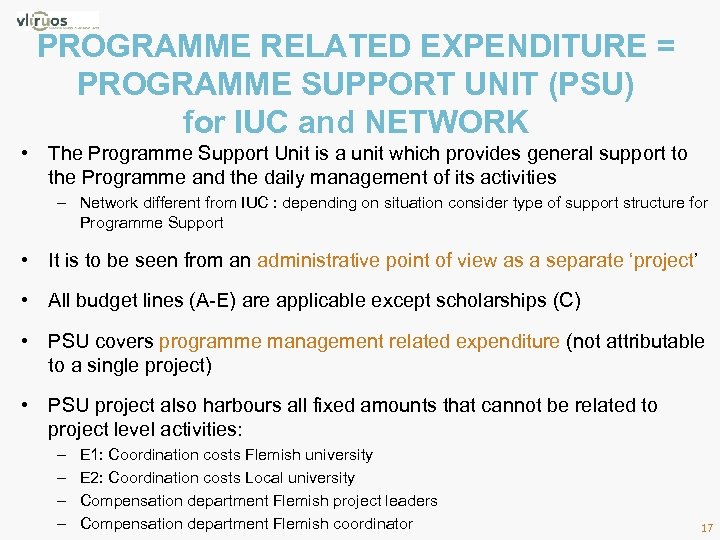 PROGRAMME RELATED EXPENDITURE = PROGRAMME SUPPORT UNIT (PSU) for IUC and NETWORK • The Programme Support Unit is a unit which provides general support to the Programme and the daily management of its activities – Network different from IUC : depending on situation consider type of support structure for Programme Support • It is to be seen from an administrative point of view as a separate ‘project’ • All budget lines (A-E) are applicable except scholarships (C) • PSU covers programme management related expenditure (not attributable to a single project) • PSU project also harbours all fixed amounts that cannot be related to project level activities: – – E 1: Coordination costs Flemish university E 2: Coordination costs Local university Compensation department Flemish project leaders Compensation department Flemish coordinator 17
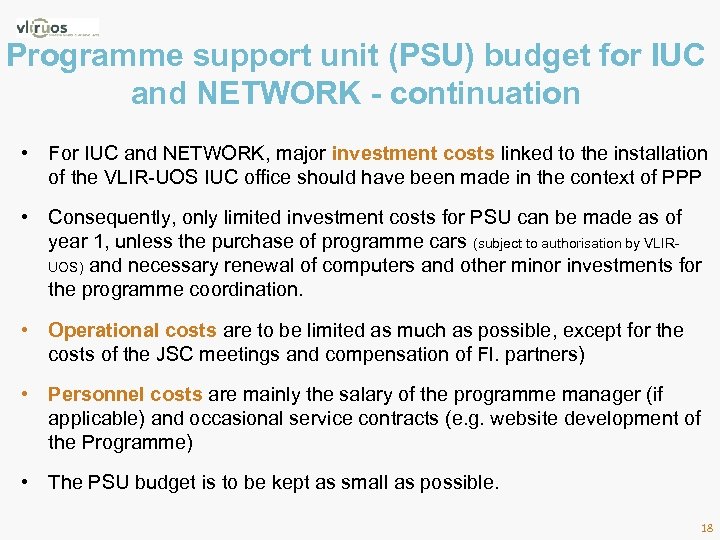 Programme support unit (PSU) budget for IUC and NETWORK - continuation • For IUC and NETWORK, major investment costs linked to the installation of the VLIR-UOS IUC office should have been made in the context of PPP • Consequently, only limited investment costs for PSU can be made as of year 1, unless the purchase of programme cars (subject to authorisation by VLIRUOS) and necessary renewal of computers and other minor investments for the programme coordination. • Operational costs are to be limited as much as possible, except for the costs of the JSC meetings and compensation of Fl. partners) • Personnel costs are mainly the salary of the programme manager (if applicable) and occasional service contracts (e. g. website development of the Programme) • The PSU budget is to be kept as small as possible. 18
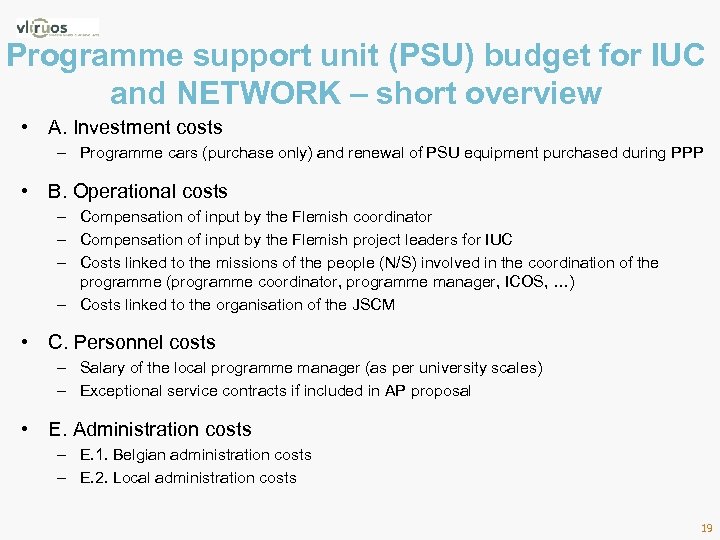 Programme support unit (PSU) budget for IUC and NETWORK – short overview • A. Investment costs – Programme cars (purchase only) and renewal of PSU equipment purchased during PPP • B. Operational costs – Compensation of input by the Flemish coordinator – Compensation of input by the Flemish project leaders for IUC – Costs linked to the missions of the people (N/S) involved in the coordination of the programme (programme coordinator, programme manager, ICOS, …) – Costs linked to the organisation of the JSCM • C. Personnel costs – Salary of the local programme manager (as per university scales) – Exceptional service contracts if included in AP proposal • E. Administration costs – E. 1. Belgian administration costs – E. 2. Local administration costs 19
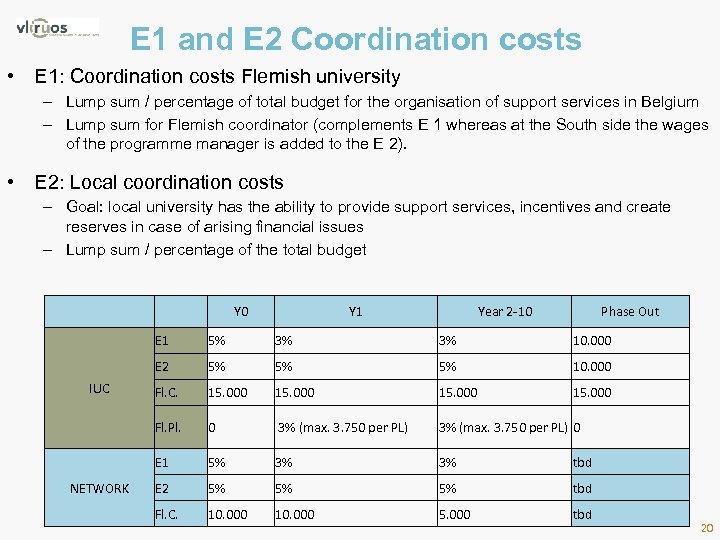 E 1 and E 2 Coordination costs • E 1: Coordination costs Flemish university – Lump sum / percentage of total budget for the organisation of support services in Belgium – Lump sum for Flemish coordinator (complements E 1 whereas at the South side the wages of the programme manager is added to the E 2). • E 2: Local coordination costs – Goal: local university has the ability to provide support services, incentives and create reserves in case of arising financial issues – Lump sum / percentage of the total budget Y 0 Y 1 Year 2 -10 Phase Out E 1 3% 10. 000 5% 5% 5% 10. 000 Fl. C. 15. 000 Fl. Pl. 0 3% (max. 3. 750 per PL) 0 E 1 NETWORK 3% E 2 IUC 5% 5% 3% 3% tbd E 2 5% 5% 5% tbd Fl. C. 10. 000 5. 000 tbd 20
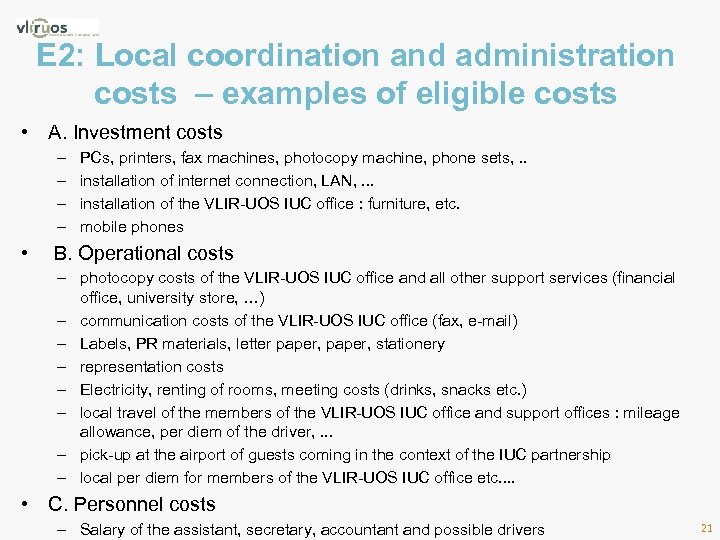 E 2: Local coordination and administration costs – examples of eligible costs • A. Investment costs – – PCs, printers, fax machines, photocopy machine, phone sets, . . installation of internet connection, LAN, . . . installation of the VLIR-UOS IUC office : furniture, etc. mobile phones • B. Operational costs – photocopy costs of the VLIR-UOS IUC office and all other support services (financial office, university store, …) – communication costs of the VLIR-UOS IUC office (fax, e-mail) – Labels, PR materials, letter paper, stationery – representation costs – Electricity, renting of rooms, meeting costs (drinks, snacks etc. ) – local travel of the members of the VLIR-UOS IUC office and support offices : mileage allowance, per diem of the driver, . . . – pick-up at the airport of guests coming in the context of the IUC partnership – local per diem for members of the VLIR-UOS IUC office etc. . • C. Personnel costs – Salary of the assistant, secretary, accountant and possible drivers 21
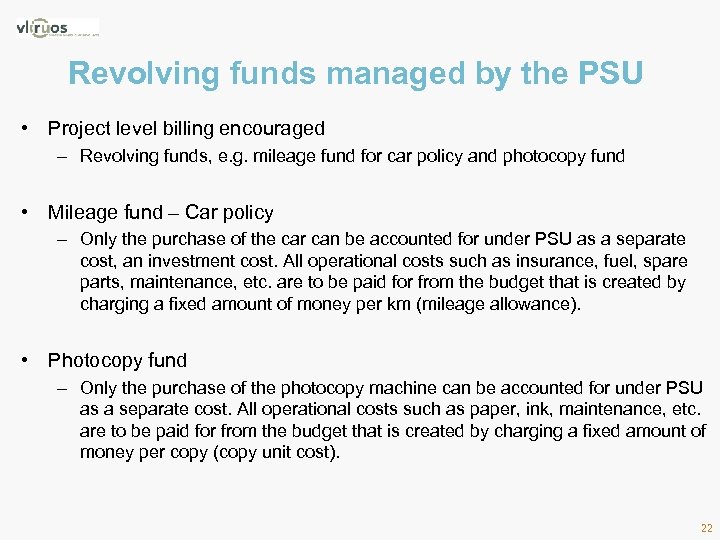 Revolving funds managed by the PSU • Project level billing encouraged – Revolving funds, e. g. mileage fund for car policy and photocopy fund • Mileage fund – Car policy – Only the purchase of the car can be accounted for under PSU as a separate cost, an investment cost. All operational costs such as insurance, fuel, spare parts, maintenance, etc. are to be paid for from the budget that is created by charging a fixed amount of money per km (mileage allowance). • Photocopy fund – Only the purchase of the photocopy machine can be accounted for under PSU as a separate cost. All operational costs such as paper, ink, maintenance, etc. are to be paid for from the budget that is created by charging a fixed amount of money per copy (copy unit cost). 22
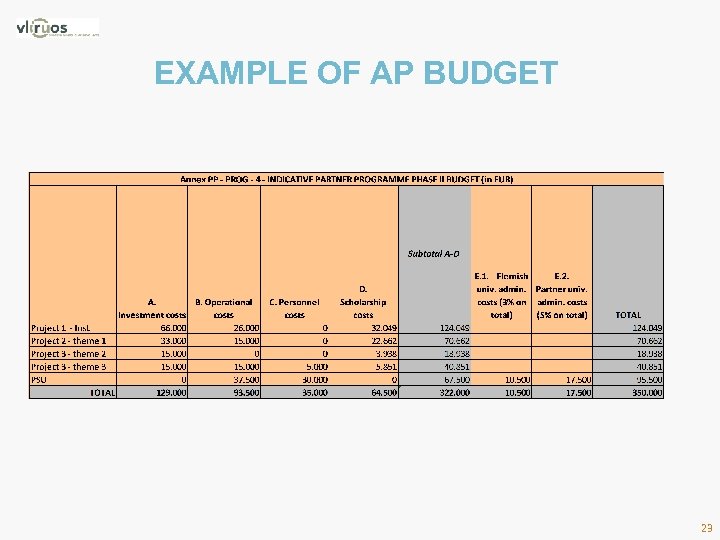 EXAMPLE OF AP BUDGET 23
 4. Financial framework
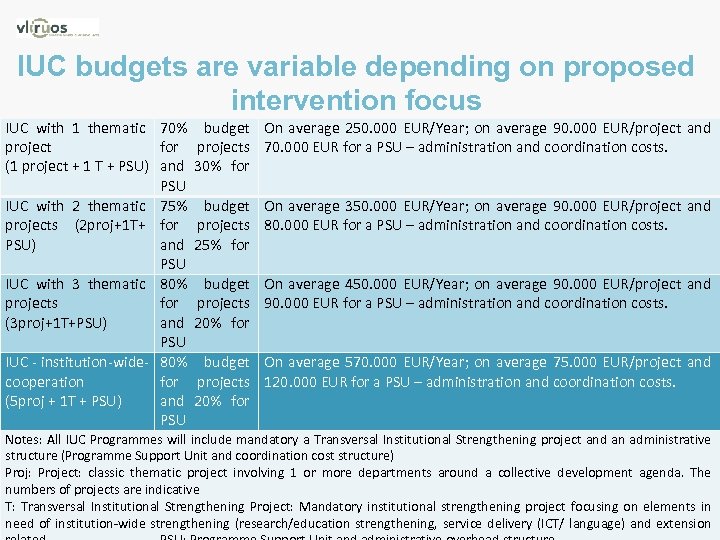 IUC budgets are variable depending on proposed intervention focus IUC with 1 thematic 70% budget project for projects (1 project + 1 T + PSU) and 30% for PSU IUC with 2 thematic 75% budget projects (2 proj+1 T+ for projects PSU) and 25% for PSU IUC with 3 thematic 80% budget projects for projects (3 proj+1 T+PSU) and 20% for PSU IUC - institution-wide- 80% budget cooperation for projects (5 proj + 1 T + PSU) and 20% for PSU On average 250. 000 EUR/Year; on average 90. 000 EUR/project and 70. 000 EUR for a PSU – administration and coordination costs. On average 350. 000 EUR/Year; on average 90. 000 EUR/project and 80. 000 EUR for a PSU – administration and coordination costs. On average 450. 000 EUR/Year; on average 90. 000 EUR/project and 90. 000 EUR for a PSU – administration and coordination costs. On average 570. 000 EUR/Year; on average 75. 000 EUR/project and 120. 000 EUR for a PSU – administration and coordination costs. Notes: All IUC Programmes will include mandatory a Transversal Institutional Strengthening project and an administrative structure (Programme Support Unit and coordination cost structure) Proj: Project: classic thematic project involving 1 or more departments around a collective development agenda. The numbers of projects are indicative T: Transversal Institutional Strengthening Project: Mandatory institutional strengthening project focusing on elements in need of institution-wide strengthening (research/education strengthening, service delivery (ICT/ language) and extension 25
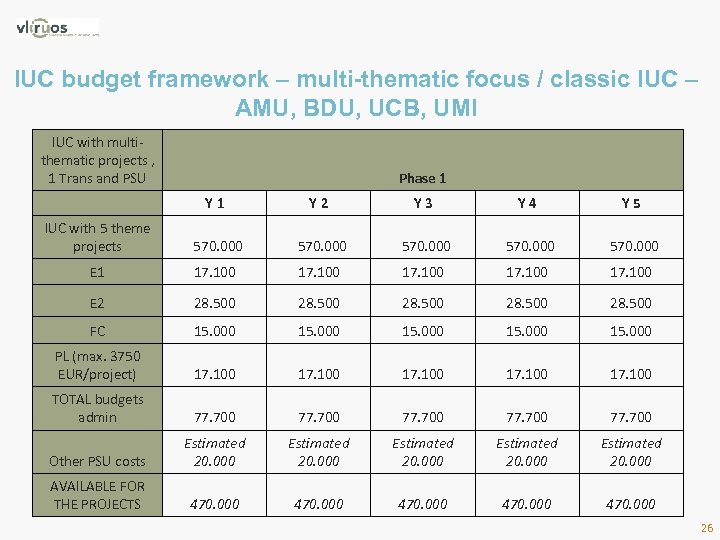 IUC budget framework – multi-thematic focus / classic IUC – AMU, BDU, UCB, UMI IUC with multithematic projects , 1 Trans and PSU Phase 1 Y 2 Y 3 Y 4 Y 5 IUC with 5 theme projects 570. 000 E 1 17. 100 E 2 28. 500 FC 15. 000 PL (max. 3750 EUR/project) 17. 100 TOTAL budgets admin 77. 700 Other PSU costs Estimated 20. 000 AVAILABLE FOR THE PROJECTS 470. 000 26
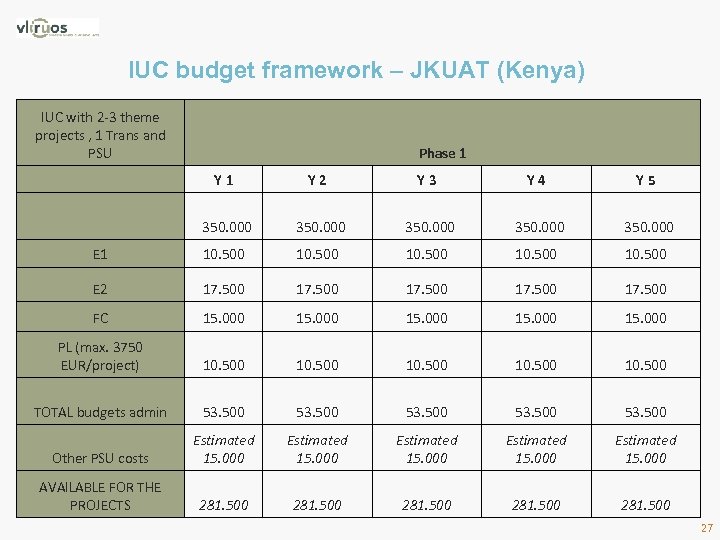 IUC budget framework – JKUAT (Kenya) IUC with 2 -3 theme projects , 1 Trans and PSU Phase 1 Y 2 Y 3 Y 4 Y 5 350. 000 E 1 10. 500 E 2 17. 500 FC 15. 000 PL (max. 3750 EUR/project) 10. 500 TOTAL budgets admin 53. 500 Other PSU costs Estimated 15. 000 AVAILABLE FOR THE PROJECTS 281. 500 27
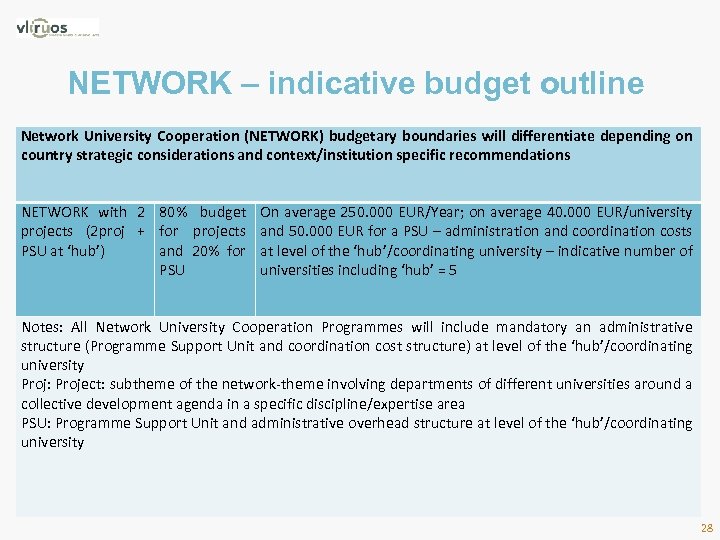 NETWORK – indicative budget outline Network University Cooperation (NETWORK) budgetary boundaries will differentiate depending on country strategic considerations and context/institution specific recommendations NETWORK with 2 80% budget projects (2 proj + for projects PSU at ‘hub’) and 20% for PSU On average 250. 000 EUR/Year; on average 40. 000 EUR/university and 50. 000 EUR for a PSU – administration and coordination costs at level of the ‘hub’/coordinating university – indicative number of universities including ‘hub’ = 5 Notes: All Network University Cooperation Programmes will include mandatory an administrative structure (Programme Support Unit and coordination cost structure) at level of the ‘hub’/coordinating university Proj: Project: subtheme of the network-theme involving departments of different universities around a collective development agenda in a specific discipline/expertise area PSU: Programme Support Unit and administrative overhead structure at level of the ‘hub’/coordinating university 28
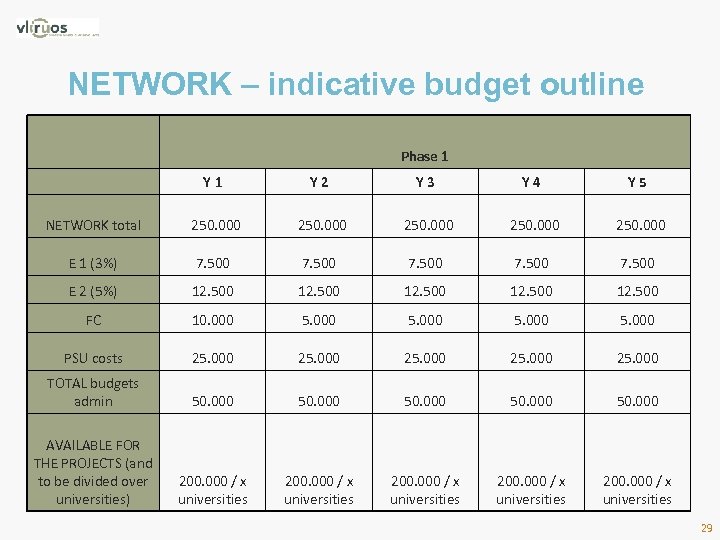 NETWORK – indicative budget outline Phase 1 Y 2 Y 3 Y 4 Y 5 NETWORK total 250. 000 E 1 (3%) 7. 500 E 2 (5%) 12. 500 FC 10. 000 5. 000 PSU costs 25. 000 TOTAL budgets admin 50. 000 AVAILABLE FOR THE PROJECTS (and to be divided over universities) 200. 000 / x universities 29
 Thank you!