 Скачать презентацию General Education Area E Legislation By Harold Marcuse
54db66fbbe2e955d599d9a7ac11b01ad.ppt
- Количество слайдов: 15



General Education: Area E Legislation By Harold Marcuse, history CUAPP chair 1. What is the proposal before us? (with overview of GE program) 2. Why do we need this change? 3. Will it create any problems? (Data analysis)
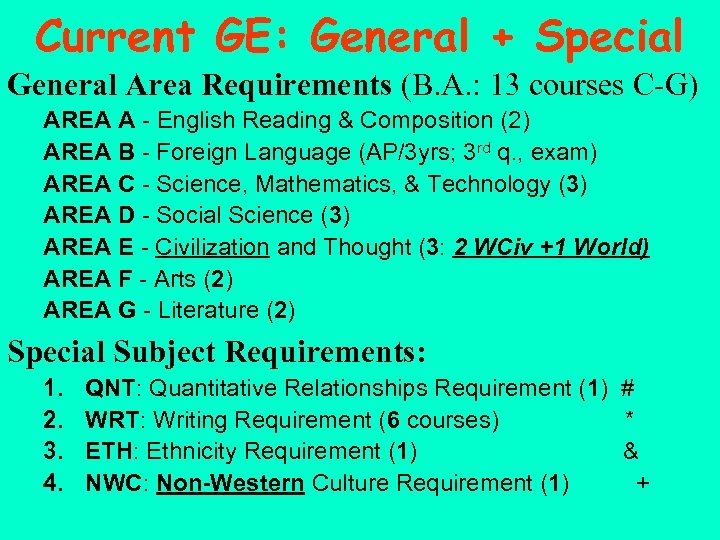
Current GE: General + Special General Area Requirements (B. A. : 13 courses C-G) AREA A - English Reading & Composition (2) AREA B - Foreign Language (AP/3 yrs; 3 rd q. , exam) AREA C - Science, Mathematics, & Technology (3) AREA D - Social Science (3) AREA E - Civilization and Thought (3: 2 WCiv +1 World) AREA F - Arts (2) AREA G - Literature (2) Special Subject Requirements: 1. 2. 3. 4. QNT: Quantitative Relationships Requirement (1) # WRT: Writing Requirement (6 courses) * ETH: Ethnicity Requirement (1) & NWC: Non-Western Culture Requirement (1) +
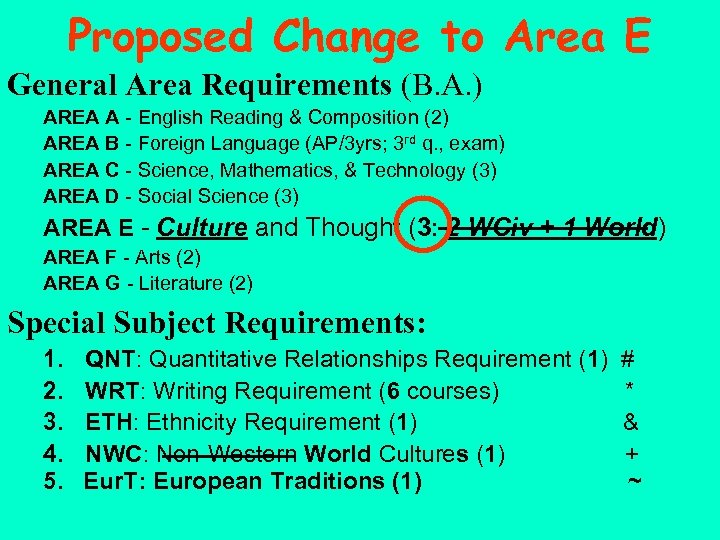
Proposed Change to Area E General Area Requirements (B. A. ) AREA A - English Reading & Composition (2) AREA B - Foreign Language (AP/3 yrs; 3 rd q. , exam) AREA C - Science, Mathematics, & Technology (3) AREA D - Social Science (3) AREA E - Culture and Thought (3: 2 WCiv + 1 World) AREA F - Arts (2) AREA G - Literature (2) Special Subject Requirements: 1. 2. 3. 4. 5. QNT: Quantitative Relationships Requirement (1) WRT: Writing Requirement (6 courses) ETH: Ethnicity Requirement (1) NWC: Non-Western World Cultures (1) Eur. T: European Traditions (1) # * & + ~
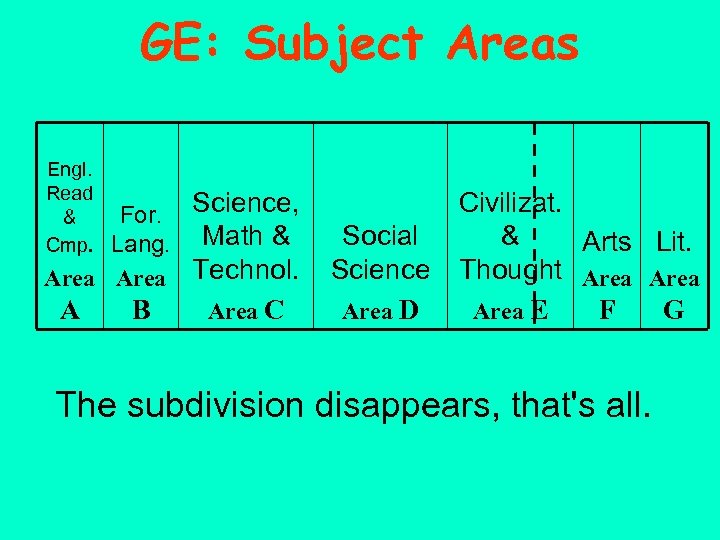
GE: Subject Areas Engl. Read & Cmp. For. Science, Lang. Math & Area Technol. B A Area C Social Science Area D Civilizat. & Arts Lit. Thought Area F G Area E The subdivision disappears, that's all.
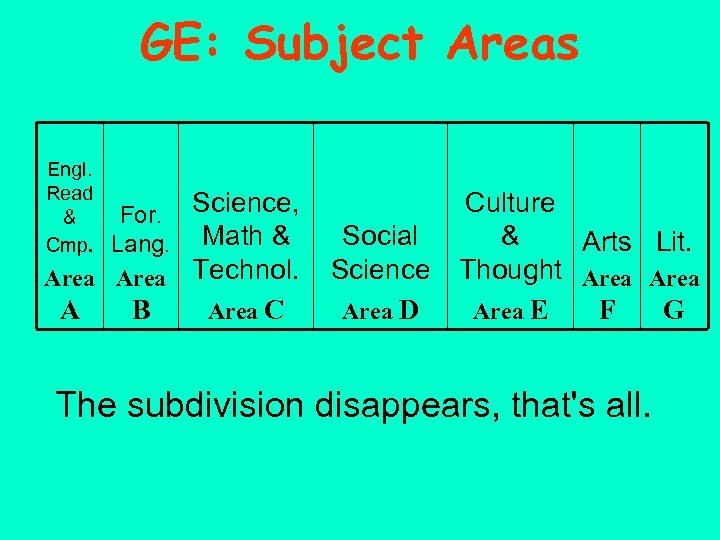
GE: Subject Areas Engl. Read & Cmp. For. Science, Lang. Math & Area Technol. B A Area C Social Science Area D Culture & Arts Lit. Thought Area F G Area E The subdivision disappears, that's all.
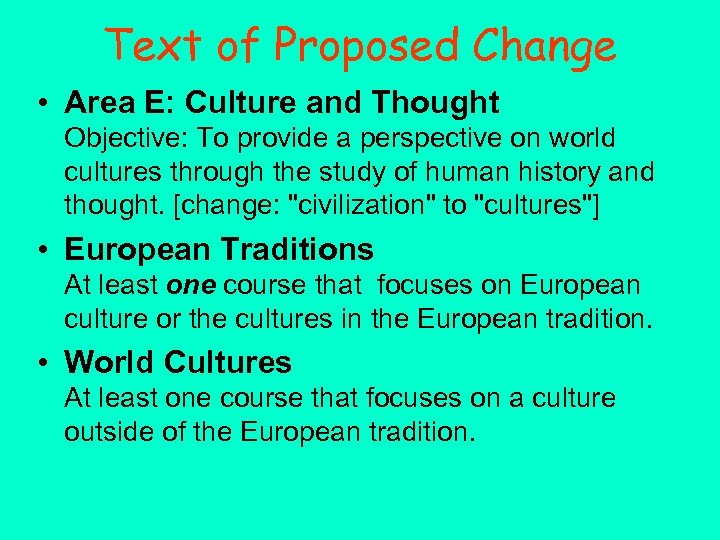
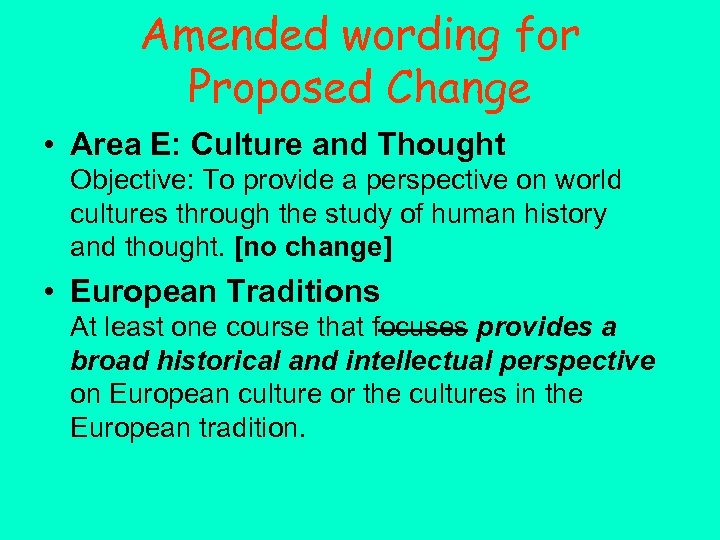
Text of Proposed Change • Area E: Culture and Thought Objective: To provide a perspective on world cultures through the study of human history and thought. [change: "civilization" to "cultures"] • European Traditions At least one course that focuses on European culture or the cultures in the European tradition. • World Cultures At least one course that focuses on a culture outside of the European tradition.
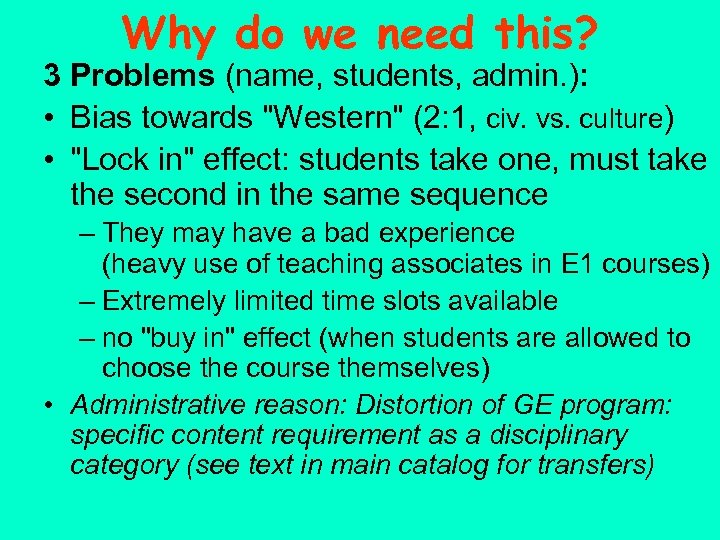
Why do we need this? 3 Problems (name, students, admin. ): • Bias towards "Western" (2: 1, civ. vs. culture) • "Lock in" effect: students take one, must take the second in the same sequence – They may have a bad experience (heavy use of teaching associates in E 1 courses) – Extremely limited time slots available – no "buy in" effect (when students are allowed to choose the course themselves) • Administrative reason: Distortion of GE program: specific content requirement as a disciplinary category (see text in main catalog for transfers)
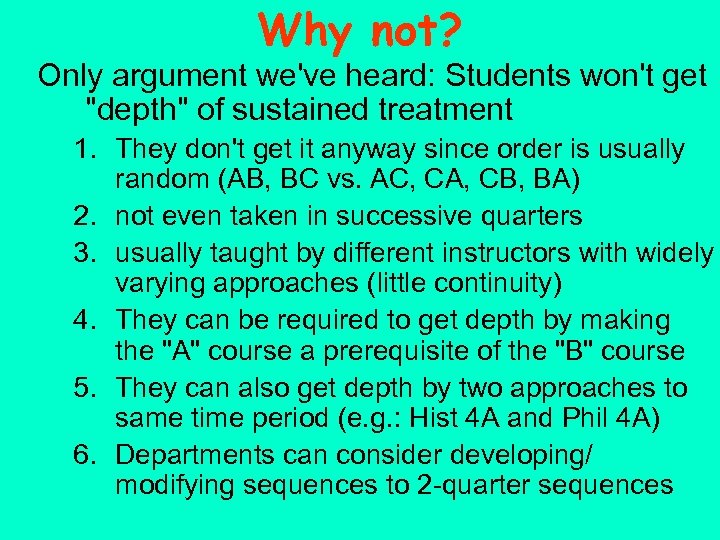
Why not? Only argument we've heard: Students won't get "depth" of sustained treatment 1. They don't get it anyway since order is usually random (AB, BC vs. AC, CA, CB, BA) 2. not even taken in successive quarters 3. usually taught by different instructors with widely varying approaches (little continuity) 4. They can be required to get depth by making the "A" course a prerequisite of the "B" course 5. They can also get depth by two approaches to same time period (e. g. : Hist 4 A and Phil 4 A) 6. Departments can consider developing/ modifying sequences to 2 -quarter sequences
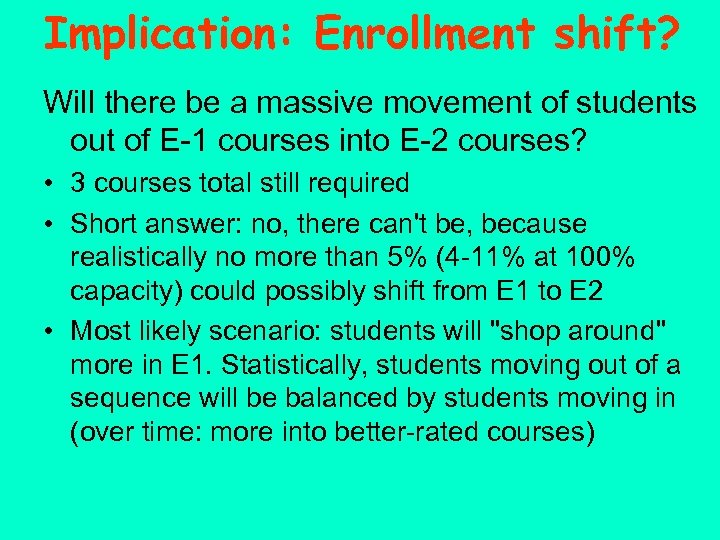
Implication: Enrollment shift? Will there be a massive movement of students out of E-1 courses into E-2 courses? • 3 courses total still required • Short answer: no, there can't be, because realistically no more than 5% (4 -11% at 100% capacity) could possibly shift from E 1 to E 2 • Most likely scenario: students will "shop around" more in E 1. Statistically, students moving out of a sequence will be balanced by students moving in (over time: more into better-rated courses)
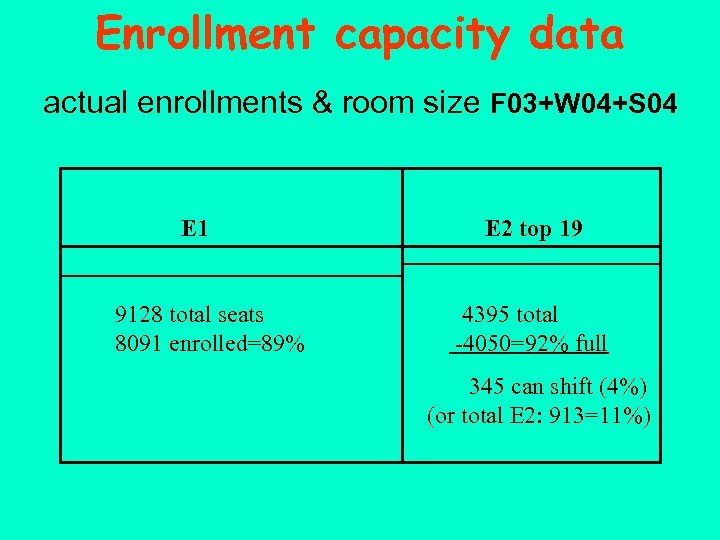
Enrollment capacity data actual enrollments & room size F 03+W 04+S 04 E 1 9128 total seats 8091 enrolled=89% E 2 top 19 4395 total -4050=92% full 345 can shift (4%) (or total E 2: 913=11%)
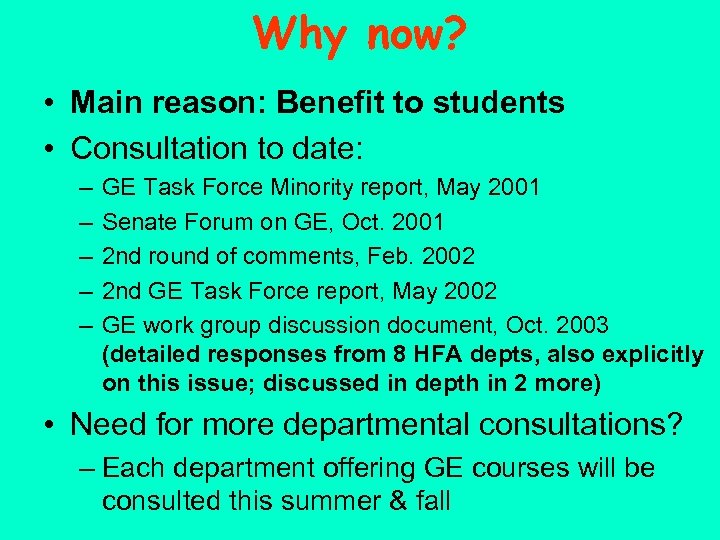
Why now? • Main reason: Benefit to students • Consultation to date: – – – GE Task Force Minority report, May 2001 Senate Forum on GE, Oct. 2001 2 nd round of comments, Feb. 2002 2 nd GE Task Force report, May 2002 GE work group discussion document, Oct. 2003 (detailed responses from 8 HFA depts, also explicitly on this issue; discussed in depth in 2 more) • Need for more departmental consultations? – Each department offering GE courses will be consulted this summer & fall
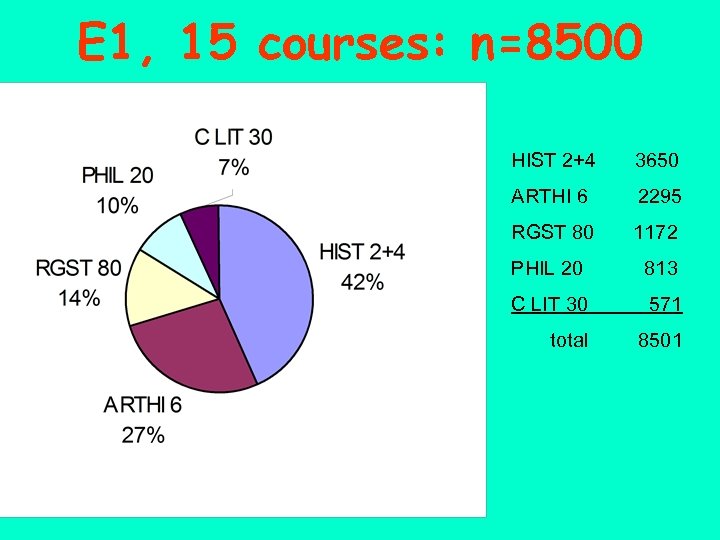
E 1, 15 courses: n=8500 HIST 2+4 3650 ARTHI 6 2295 RGST 80 1172 PHIL 20 813 C LIT 30 571 total 8501
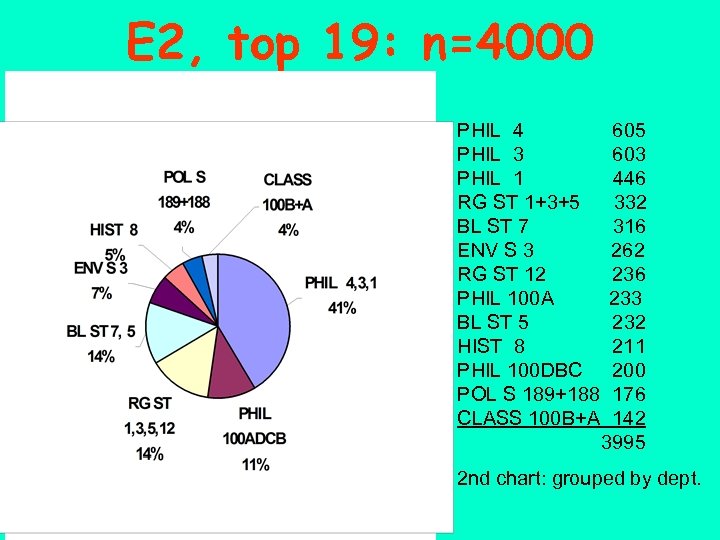
E 2, top 19: n=4000 PHIL 4 PHIL 3 PHIL 1 RG ST 1+3+5 BL ST 7 ENV S 3 RG ST 12 PHIL 100 A BL ST 5 HIST 8 PHIL 100 DBC POL S 189+188 CLASS 100 B+A 605 603 446 332 316 262 236 233 232 211 200 176 142 3995 2 nd chart: grouped by dept.
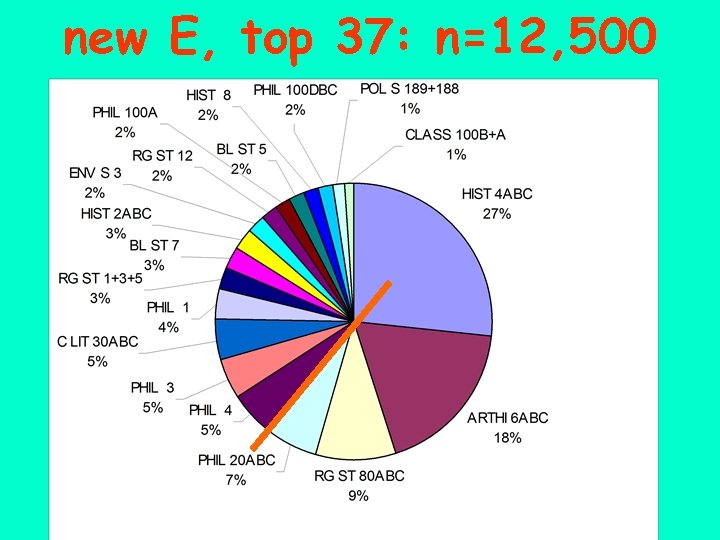
new E, top 37: n=12, 500
Amended wording for Proposed Change • Area E: Culture and Thought Objective: To provide a perspective on world cultures through the study of human history and thought. [no change] • European Traditions At least one course that focuses provides a broad historical and intellectual perspective on European culture or the cultures in the European tradition.
Скачать презентацию General Education Area E Legislation By Harold Marcuse
54db66fbbe2e955d599d9a7ac11b01ad.ppt