


 Скачать презентацию GENERAL DYNAMICS C 4 Systems Service Oriented Architecture
dfee12efb46d5fa5a2f1edb99df14c61.ppt
- Количество слайдов: 23
 GENERAL DYNAMICS C 4 Systems Service Oriented Architecture Key to Net-centric Interoperability Guy Bieber Senior Systems Architect GENERAL DYNAMICS C 4 Systems General Dynamics C 4 Systems © 2004 General Dynamics. All rights reserved 1
 GENERAL DYNAMICS C 4 Systems 2 © 2004 General Dynamics. All rights reserved
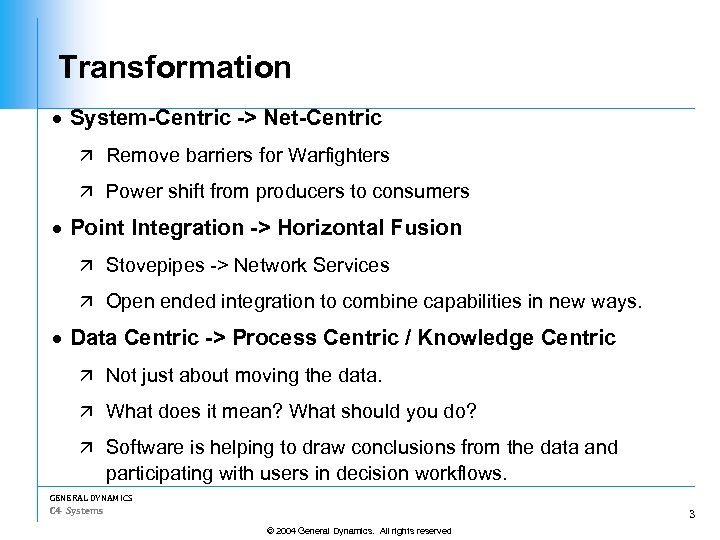 Transformation · System-Centric -> Net-Centric ä Remove barriers for Warfighters ä Power shift from producers to consumers · Point Integration -> Horizontal Fusion ä Stovepipes -> Network Services ä Open ended integration to combine capabilities in new ways. · Data Centric -> Process Centric / Knowledge Centric ä Not just about moving the data. ä What does it mean? What should you do? ä Software is helping to draw conclusions from the data and participating with users in decision workflows. GENERAL DYNAMICS C 4 Systems 3 © 2004 General Dynamics. All rights reserved
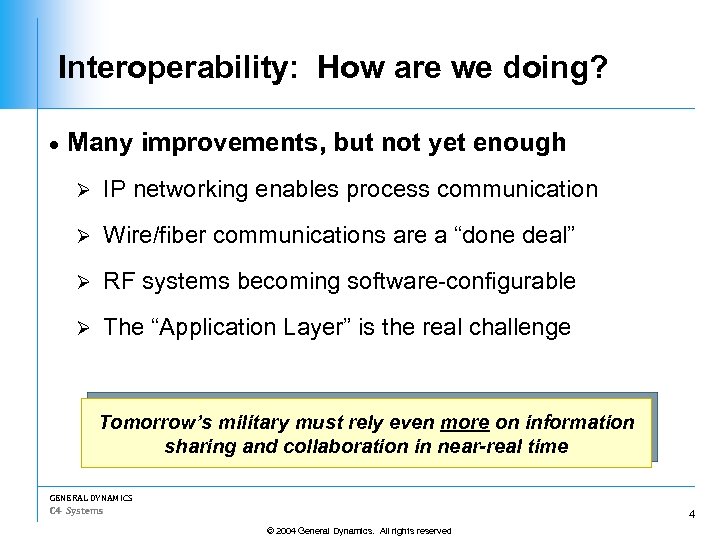 Interoperability: How are we doing? · Many improvements, but not yet enough Ø IP networking enables process communication Ø Wire/fiber communications are a “done deal” Ø RF systems becoming software-configurable Ø The “Application Layer” is the real challenge Tomorrow’s military must rely even more on information sharing and collaboration in near-real time GENERAL DYNAMICS C 4 Systems 4 © 2004 General Dynamics. All rights reserved
 What Do Our War. Fighters Need? · Ease of use Reduced training load Ø Ability to focus on fighting, not IT Ø Rapid access to current/useful interpretation of information · Flexibility · Adapt to changing conditions and partnerships Ø Collaborate with US/Allies/Coalition & even Non. Governmental Organizations Ø Survivability · Reliability/Availability · GENERAL DYNAMICS C 4 Systems 5 © 2004 General Dynamics. All rights reserved
 Problems and Constraints · Software stovepipes exist, resist and persist Absent architectural change, they’ll outlive us Ø What’s the right change? Ø Ø Can we effectively achieve one? Industry and Services require encouragement · “Programs of Record” · Today’s primary method for allocating funding Ø PORs are inclined to fight off non-POR “invaders” Ø Must “Do No Harm” while enabling radical change GENERAL DYNAMICS C 4 Systems 6 © 2004 General Dynamics. All rights reserved
 Barriers to Interoperable Net-Centricity · We haven’t agreed on how to connect components Ø · Widely-used client-server model is static and brittle Ø · There are hundreds of middleware products/standards Interfaces are private, leading to stovepiped systems Present systems assume static, reliable networks Ø Ø · Tactical networks are not highly available or reliable Future networks will still be highly dynamic Much existing application software is “hard-wired” Ø Far too much embedded context dependent information Proper adoption of SOAs can remove these barriers GENERAL DYNAMICS C 4 Systems 7 © 2004 General Dynamics. All rights reserved
 Evolving to Revolutionary Capability · Numerous challenges exist Procedural (e. g. CONOPs and TTPs) Ø Bureaucratic (Industry/Service stakeholders) Ø Financial (who pays and who loses? ) Ø Technical – perhaps the easiest Ø · Start the journey with a first step Commit to embracing interoperable architectures Ø Adopt Service-Oriented Architecture principles Ø SOA’s designed to accommodate change - allows Do. D to leverage business innovation GENERAL DYNAMICS C 4 Systems 8 © 2004 General Dynamics. All rights reserved
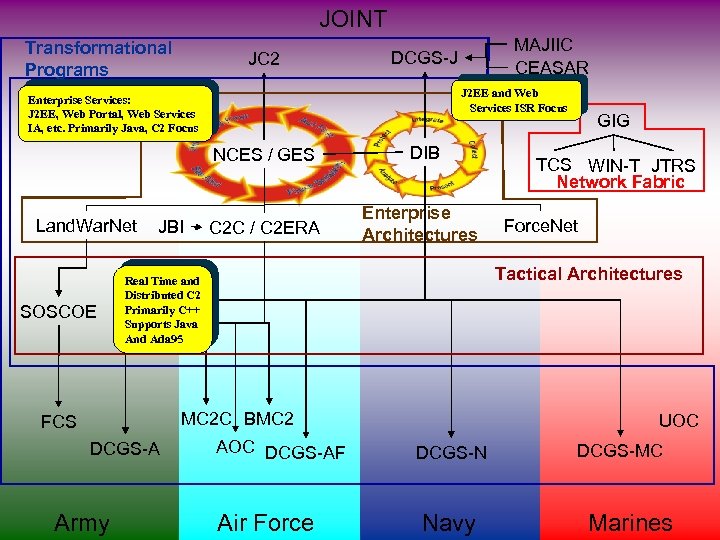 JOINT Transformational Programs JC 2 DCGS-J J 2 EE and Web Services ISR Focus Enterprise Services: J 2 EE, Web Portal, Web Services IA, etc. Primarily Java, C 2 Focus NCES / GES Land. War. Net SOSCOE JBI MAJIIC CEASAR C 2 C / C 2 ERA DIB Enterprise Architectures MC 2 C BMC 2 DCGS-A TCS WIN-T JTRS Network Fabric Force. Net Tactical Architectures Real Time and Distributed C 2 Primarily C++ Supports Java And Ada 95 FCS GIG AOC DCGS-AF UOC DCGS-N DCGS-MC GENERAL DYNAMICS C 4 Systems Army Air Force Navy © 2004 General Dynamics. All rights reserved Marines 9
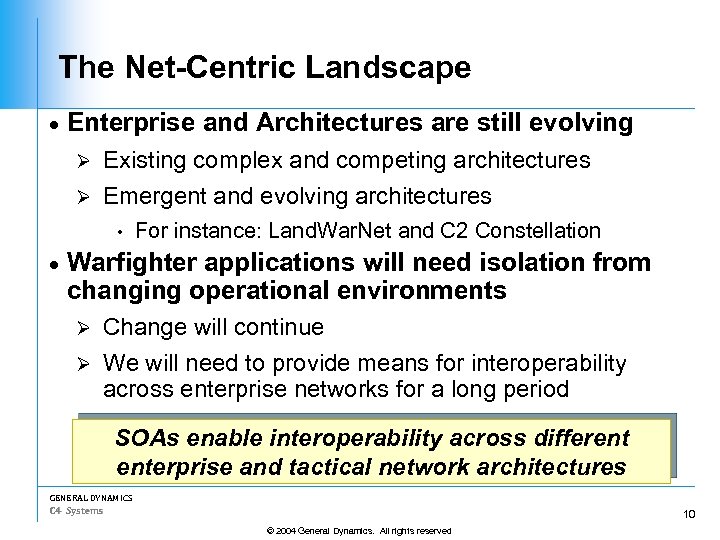 The Net-Centric Landscape · Enterprise and Architectures are still evolving Existing complex and competing architectures Ø Emergent and evolving architectures Ø • · For instance: Land. War. Net and C 2 Constellation Warfighter applications will need isolation from changing operational environments Change will continue Ø We will need to provide means for interoperability across enterprise networks for a long period Ø SOAs enable interoperability across different enterprise and tactical network architectures GENERAL DYNAMICS C 4 Systems 10 © 2004 General Dynamics. All rights reserved
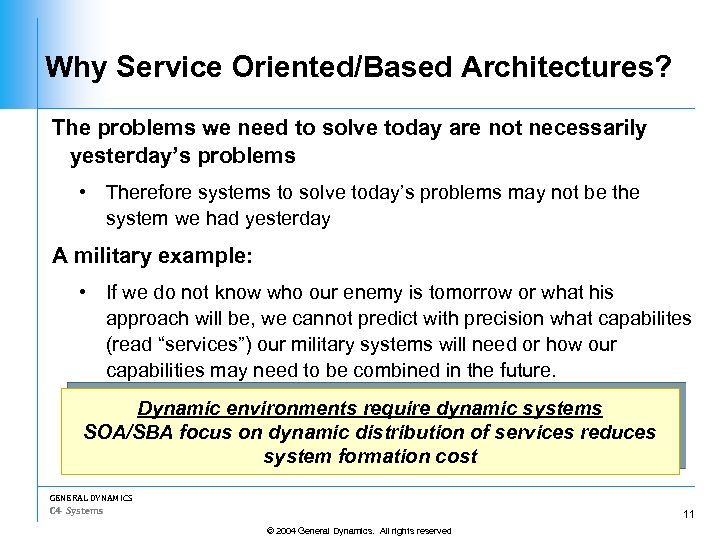 Why Service Oriented/Based Architectures? The problems we need to solve today are not necessarily yesterday’s problems • Therefore systems to solve today’s problems may not be the system we had yesterday A military example: • If we do not know who our enemy is tomorrow or what his approach will be, we cannot predict with precision what capabilites (read “services”) our military systems will need or how our capabilities may need to be combined in the future. Dynamic environments require dynamic systems SOA/SBA focus on dynamic distribution of services reduces system formation cost GENERAL DYNAMICS C 4 Systems 11 © 2004 General Dynamics. All rights reserved
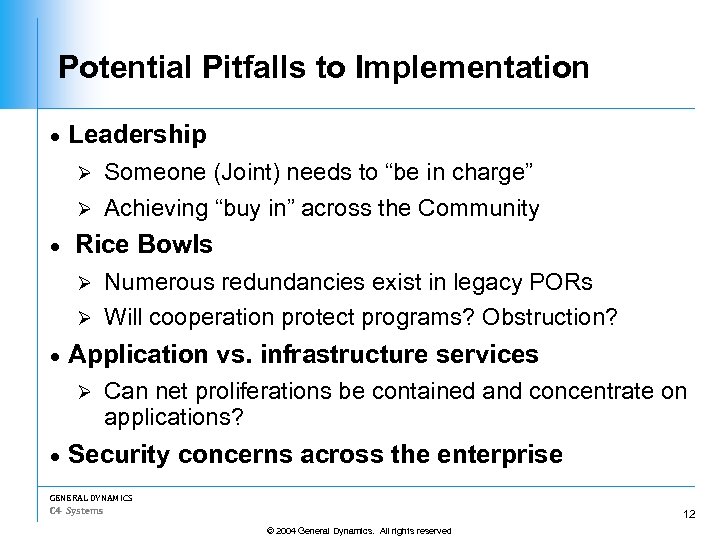 Potential Pitfalls to Implementation · Leadership Someone (Joint) needs to “be in charge” Ø Achieving “buy in” across the Community Ø · Rice Bowls Numerous redundancies exist in legacy PORs Ø Will cooperation protect programs? Obstruction? Ø · Application vs. infrastructure services Ø · Can net proliferations be contained and concentrate on applications? Security concerns across the enterprise GENERAL DYNAMICS C 4 Systems 12 © 2004 General Dynamics. All rights reserved
 What’s a Service Oriented Architecture? Built around a collection of reusable software components with well-defined interfaces • Components may perform work (“service”) for others on a network, and inherently provide: • Ability to “discover” the existence of services Ø Ability to convey information necessary for usage Ø • Descriptions, including formats & protocols SOAs enable dynamic formation of systems and net – critical for effective net-centric operations GENERAL DYNAMICS C 4 Systems 13 © 2004 General Dynamics. All rights reserved
 Some Potential SOA Benefits Ease integration across heterogeneous environments and applications · Facilitate reuse of existing applications · Facilitate efficient integration of existing systems Ø Reduce retraining impact of new major systems Ø Allow evolution by facilitating deployment of “best of breed” capabilities Ø Accelerate transition to integrated functionality Ø Business (warfighting) processes should drive decisions on technical specifics – not the converse! GENERAL DYNAMICS C 4 Systems 14 © 2004 General Dynamics. All rights reserved
 A Few Key SOA Principles Identify & expose specific sub-functions that existing applications can execute for others · Agree to common interface standards · Leverage existing tools in business world · Inter-process messaging Ø Publish and subscribe Ø Web Services Ø Deployable network services Ø Objective is “loosely coupled” aggregation of services GENERAL DYNAMICS C 4 Systems 15 © 2004 General Dynamics. All rights reserved
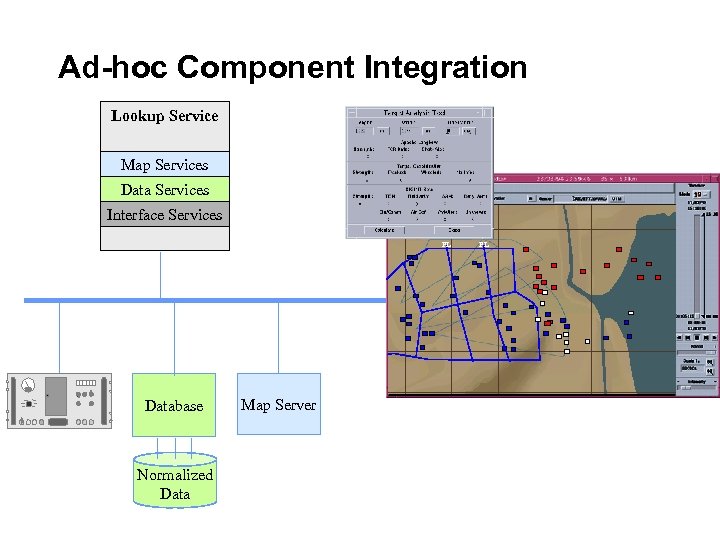 Ad-hoc Component Integration Lookup Service Map Services Data Services Interface Services PL Local Area Network Database Normalized Data Map Server PL
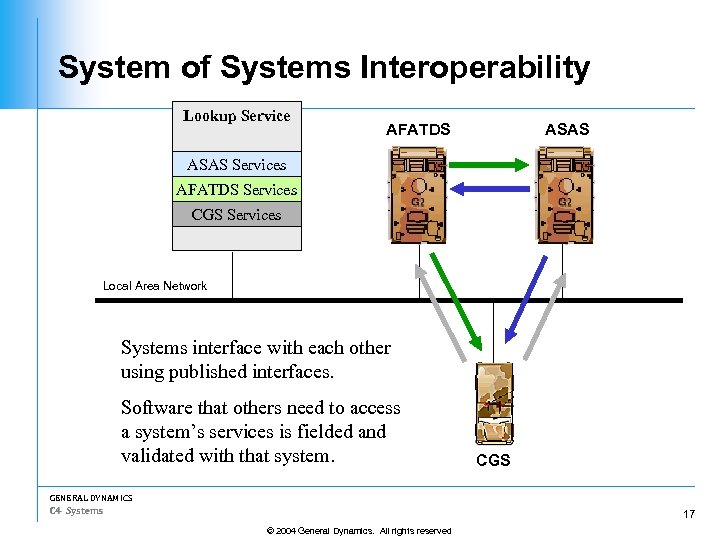 System of Systems Interoperability Lookup Service AFATDS ASAS Services AFATDS Services CGS Services Local Area Network Systems interface with each other using published interfaces. Software that others need to access a system’s services is fielded and validated with that system. CGS GENERAL DYNAMICS C 4 Systems 17 © 2004 General Dynamics. All rights reserved
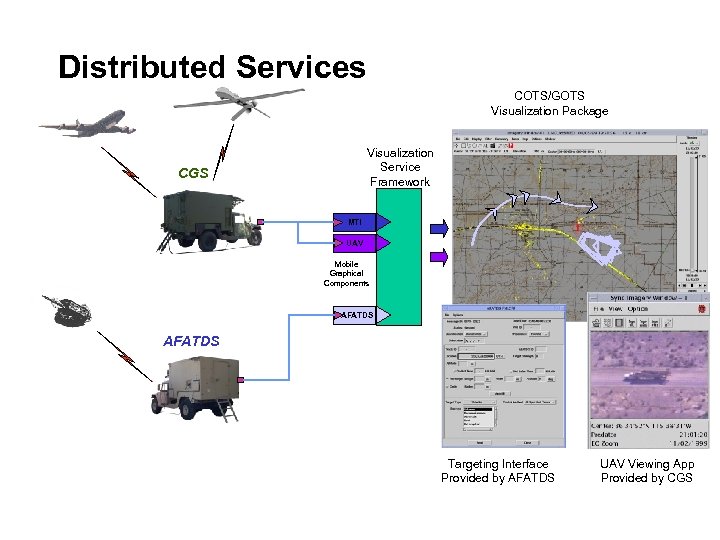 Distributed Services COTS/GOTS Visualization Package Visualization Service Framework CGS MTI UAV Mobile Graphical Components AFATDS Targeting Interface Provided by AFATDS UAV Viewing App Provided by CGS
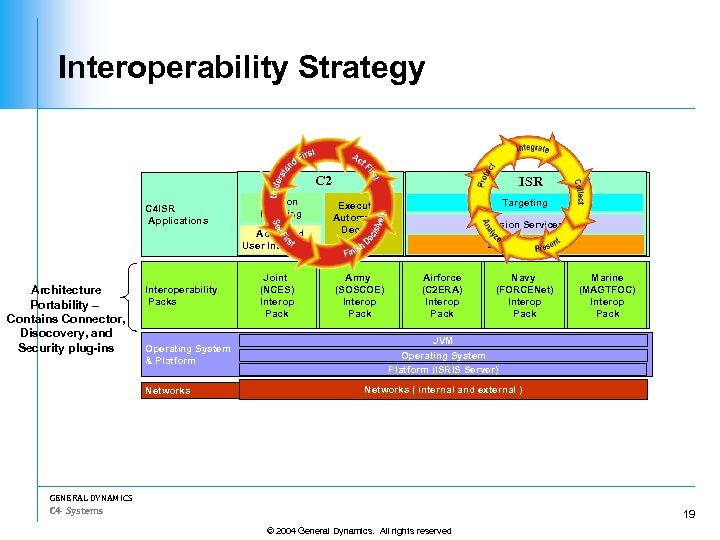 Interoperability Strategy C 2 C 4 ISR Applications Mission Planning Advanced User Interaction Architecture Portability – Contains Connector, Disocovery, and Security plug-ins Interoperability Packs Operating System & Platform Networks Joint (NCES) Interop Pack ISR Targeting Execution Automation / Decision Aides Army (SOSCOE) Interop Pack Fusion Services Sensor Services Airforce (C 2 ERA) Interop Pack Navy (FORCENet) Interop Pack Marine (MAGTFOC) Interop Pack JVM Operating System Platform (ISRIS Server) Networks ( internal and external ) GENERAL DYNAMICS C 4 Systems 19 © 2004 General Dynamics. All rights reserved
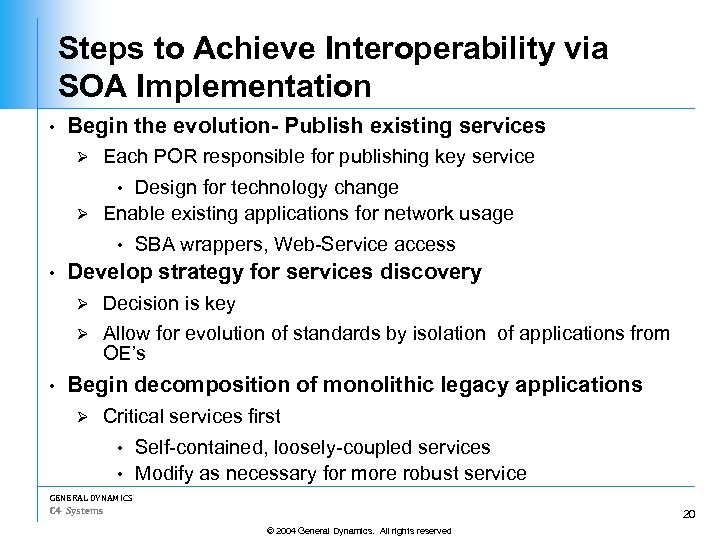 Steps to Achieve Interoperability via SOA Implementation • Begin the evolution- Publish existing services Ø Each POR responsible for publishing key service Design for technology change Ø Enable existing applications for network usage • • • SBA wrappers, Web-Service access Develop strategy for services discovery Ø Ø • Decision is key Allow for evolution of standards by isolation of applications from OE’s Begin decomposition of monolithic legacy applications Ø Critical services first Self-contained, loosely-coupled services • Modify as necessary for more robust service • GENERAL DYNAMICS C 4 Systems 20 © 2004 General Dynamics. All rights reserved
 Steps to Achieve Interoperability to via SOA Implementation • Re-choreograph existing business (war fighting) processes to capitalize on deployable services Ø Focus on applications needed by war fighters first Ø Providing flexibility to the user is key to innovation Ø Make services user-transparent, who uses will change …Finally…. . • Establish de-confliction rules among services Ø Important to get agreement on deployment from “owners” of critical data • Get serious about the security solution Ø Security policy must address evolution of service/data usage Ø Objective, reduce HW complexity at mobile levels • • Eliminate multiple LANS, Workstation complexity - MILS workstation, perhaps GENERAL DYNAMICS C 4 Systems 21 © 2004 General Dynamics. All rights reserved
 Recommendations and Conclusions · Government/industry collaboration is key Frank and open dialog, leading to quick decisions Ø NDIA provides an excellent, unbiased forum Ø · Service “equities” and flagship programs should be incorporated wherever feasible Essential to achieve “buy in” across Government Ø Necessary to garner prime contractor support Ø · Establish joint Govt/industry execution team Joint SOA will enable net-centric interoperability! GENERAL DYNAMICS C 4 Systems 22 © 2004 General Dynamics. All rights reserved
 GENERAL DYNAMICS C 4 Systems 23 © 2004 General Dynamics. All rights reserved