 Скачать презентацию Gene Technology Chapter 1 GCSE Science Biology 1
be4d03a4912eeec36ab186a367e942e2.ppt
- Количество слайдов: 9



Gene Technology Chapter 1 GCSE Science Biology 1
Genetic Engineering Perhaps the gene can carry out a very useful function such as the production of a specific protein. Chapter 1 GCSE Science This involves removing a gene from one organism and placing it in a different species. But why is this done?
Producing Human Insulin Chapter 1 GCSE Science Insulin is a hormone produced by specific cells in the pancreas. Its job is to regulate the blood glucose level within the correct range. Some people cannot produce insulin because their pancreatic cells don’t function properly. This is a form of diabetes called Type 1 Diabetes. Fortunately, this condition can be treated by injecting insulin made by genetic engineering techniques.
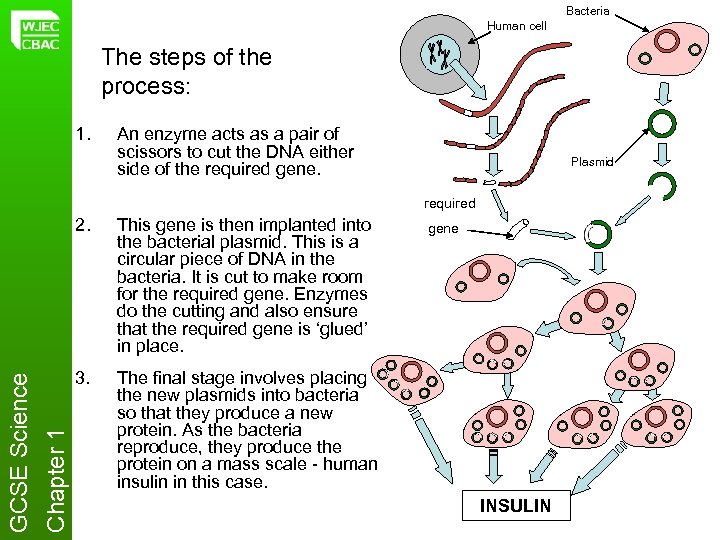
Bacteria Human cell The steps of the process: 1. An enzyme acts as a pair of scissors to cut the DNA either side of the required gene. Plasmid required This gene is then implanted into the bacterial plasmid. This is a circular piece of DNA in the bacteria. It is cut to make room for the required gene. Enzymes do the cutting and also ensure that the required gene is ‘glued’ in place. 3. Chapter 1 GCSE Science 2. The final stage involves placing the new plasmids into bacteria so that they produce a new protein. As the bacteria reproduce, they produce the protein on a mass scale - human insulin in this case. gene INSULIN
The Advantages of Genetic Engineering In 1993 a blood clotting protein was first produced using genetically engineered sheep cells. Haemophiliacs are treated with an injection of this protein to help their blood clot. Chapter 1 GCSE Science In theory, this process could be used to mass produce any protein.
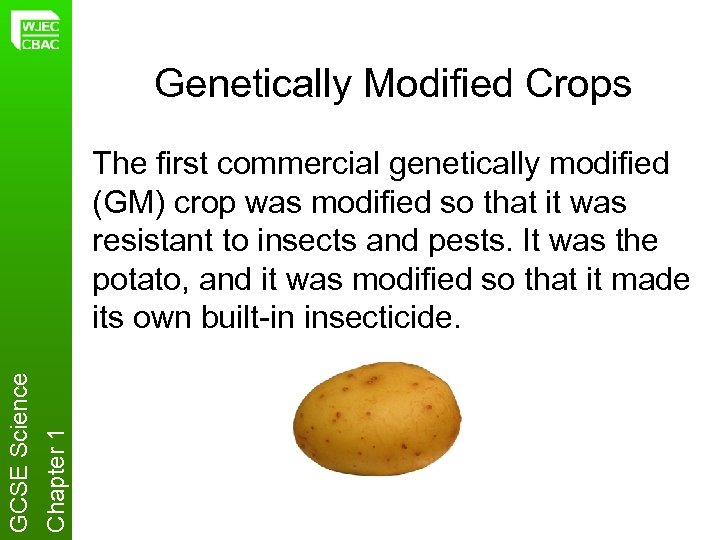
Genetically Modified Crops Chapter 1 GCSE Science The first commercial genetically modified (GM) crop was modified so that it was resistant to insects and pests. It was the potato, and it was modified so that it made its own built-in insecticide.
Opposition It is feared that this could add to the spread of antibiotic resistance in the world, in turn leading to more superbugs such as MRSA. Chapter 1 GCSE Science Some people fear that problems arise from modifying food genetically. The main concern is that the animals eating such crops will transfer antibiotic resistance to the bacteria in their gut.
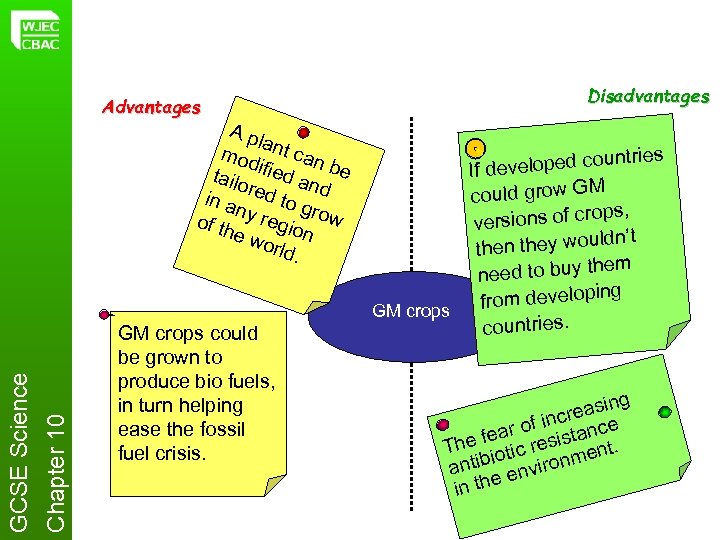
Advantages Chapter 10 GCSE Science Ap la mod nt can tailo ified an be r in a ed to g d n of th y regio row n ew orld. GM crops could be grown to produce bio fuels, in turn helping ease the fossil fuel crisis. Disadvantages untries developed co If M could grow G ops, versions of cr ldn’t then they wou em need to buy th ing from develop GM crops countries. g easin r of inc tance ar he fe tic resis ent. T io m antib environ in the
Genetic Engineering – For or Against? There is fierce debate going on, for and against GM crop production and research. For a taste of this debate go to: put GM into the search engine www. greenpeace. org go to: ‘What we do’ Chapter 1 GCSE Science www. royalsoc. ac. uk
Скачать презентацию Gene Technology Chapter 1 GCSE Science Biology 1
be4d03a4912eeec36ab186a367e942e2.ppt