


 Скачать презентацию Gender Roles in Production and Marketing within the
4be4794a56ca93b7433827120e51499a.ppt
- Количество слайдов: 18
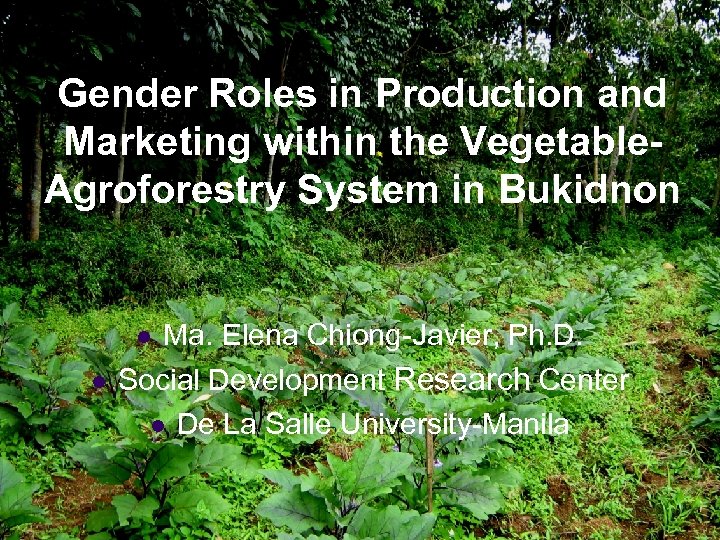 Gender Roles in Production and Marketing within the Vegetable. Agroforestry System in Bukidnon l l Ma. Elena Chiong-Javier, Ph. D. Social Development Research Center l De La Salle University-Manila
 This paper is based on findings from a collaborative research on “Agroforestry and Sustainable Vegetable Production in Southeast Asian Watersheds” (funded by USAID through Virginia Tech’s SANREM III Program and spearheaded by North Carolina A&T University)
 l l l Research Goals: alleviate poverty and food scarcity and reduce environmental degradation through economicallyviable, resource-conserving technologies and gender-friendly socioeconomic policies that will reward especially small women and men farmer-stakeholders Objectives o T = Technology (sustainable & profitable VAF integration) o M = Market (market value chain) o P = Policy (promotive options and frameworks) o E = Environmental & Socioeconomic Impact (assessment) o G = Gender (improved women’s participation & welfare) o S = Scaling Up (VAF management & dissemination) Multiple partnerships involving institutions in the US, Vietnam, Indonesia, & the Philippines, including WAC, WVC (at least 28 scientists)
 The DLSU-SDRC Involvement Market value chain research on vegetable-agroforestry (VAF) products in Barangay Songco, Lantapan Municipality, Bukidnon l Gender studies, especially women’s participation in VAF production and marketing l
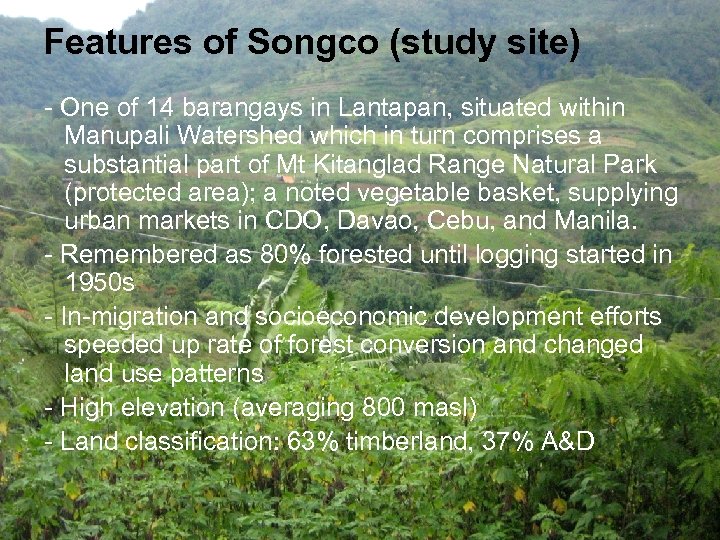 Features of Songco (study site) - One of 14 barangays in Lantapan, situated within Manupali Watershed which in turn comprises a substantial part of Mt Kitanglad Range Natural Park (protected area); a noted vegetable basket, supplying urban markets in CDO, Davao, Cebu, and Manila. - Remembered as 80% forested until logging started in 1950 s - In-migration and socioeconomic development efforts speeded up rate of forest conversion and changed land use patterns - High elevation (averaging 800 masl) - Land classification: 63% timberland, 37% A&D
 Site features… l l l l Longer rainy season (May-December) and many ground water resources 1 st class soil types suitable for agriculture Moderate to severely-rolling slopes (70 -80% quarter slopes) Severe erosion potential estimated at 40% 2002 population: 2, 947 persons (46% women and 54% men) in 568 households Land uses: 81. 6% forestry, 17. 1% agricultural, 1. 3% industrial/agro-industrial and residential Private agricultural lands are predominantly vegetable gardens; trees are along boundaries or contours (fewer no. of purely AF farms compared to monocropped vegetable gardens)
 Site features…. l l l Slopes than can be plowed are usually planted to vegetables (top 5: Chinese cabbage or umbok, beans, cabbage, tomato, & potato; other popular preferences bell pepper, carrot, sayote, sweetpeas, & eggplant)) Steeper areas or “bakilid” are used for AF species including eucalyptus, acacia mangium, musizi, & falcata trees, assorted fruit trees and rootcrops like sweet potatoes, taro, & cassava Mostly unpaved and rugged roads 5 waiting sheds serve as “bagsakan” (collection point & weighing station) found on main barangay road Agriculture-based ecocomy: majority of households grow vegetables for the market
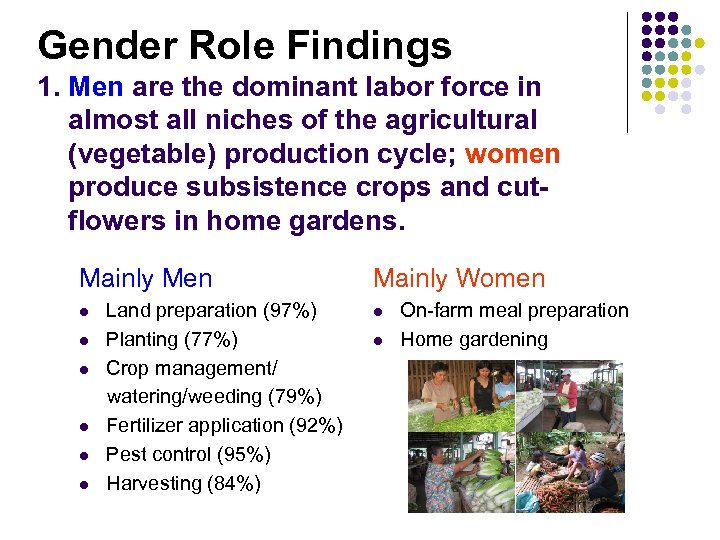 Gender Role Findings 1. Men are the dominant labor force in almost all niches of the agricultural (vegetable) production cycle; women produce subsistence crops and cutflowers in home gardens. Mainly Men l l l Land preparation (97%) Planting (77%) Crop management/ watering/weeding (79%) Fertilizer application (92%) Pest control (95%) Harvesting (84%) Mainly Women l l On-farm meal preparation Home gardening
 2. Timber production is also a predominantly male task; female participation is limited to tree care. 3. Men rather than women control the following agricultural domains: l l l Farm-level decision making, viz. , purchase of inputs (66%) & timing of harvest (58%) Involvement in farmers’ organizations, associations or cooperatives (69 -100%) Participation in agricultural training & extension (54%).
 4. However, women are actively engaged in obtaining financing or capital for farm inputs and labor requirements. 5. Male spouses dominate in post-harvest tasks of sorting, grading, & transporting VAF products. 6. Vegetable marketing is dominated more by women but timber marketing is done by men. 7. AF crop preferences are also gendered: abaca, coffee, falcata, eucalyptus & gmelina for men; corn, banana, rootcrops, & cut flowers for women.
 Findings on Women Marketers l l Known as “biyahidors” (one who buys-and-sells) Handle mostly micro vegetable trading & vending enterprises (it is the men who are in large-scale trading) Study subjects are mostly married, have been in the trade for 8 -40 yrs. Failures in vegetable “gardening” (poor harvest, unprofitable income, lack of capital, fluctuating market prices) pushed them to try selling their own produce before venturing to buy other farmers’ crops for sale to the market
 Market participation sustained by economic profitability of vegetable marketing & informal social-market alliances of women biyahidors. l Carry 4 -5 varieties of vegetables in their stocks (umbok is favored followed by carrots, potatoes, l cauliflower, eggplant, beans, bell pepper/atsal, chayote, broccoli, & squash) l Goods procured from an average of 6 regular (suki) suppliers, mostly friends, neighbors, and kinsmen who deliver goods to biyahidor’s house.
 Women biyahidors… l Weekly revolving capital of P 1000 -6000 -covering cost of goods, hauling fee (P 5/sack), trucking (P 35/sack), market stall rental or bodega fee (P 5/sack) l l Gross ROI on lower-priced (less than P 10/k) vegetables is generally 100%; more expensive goods earn lesser Main business problems: Ø Ø Ø Lack of capital & borrowing from usurers Failure to recover capital due to selling on credit or at a loss Helplessness over fluctuating market prices Poor quality of goods due to mishandling/bad roads & poor command over prices Overall: difficulty of sustaining business
 Women biyahidors… l Some business practices/strategies to safeguard investment: Ø Ø Ø Ø Keep standard entitlement: biyahidor can crop off “less than 25%” (may be negotiated by supplier) of the farmgate price/kilo to account for spoilage during transporting Stretch capital by going to supplier’s farm and purchase at farm gate prices Be present at harvest time to monitor quality, help sort/classify, oversee packing/sacking, and ensure the sale does not go to another trader Be willing to travel long distance to procure supplies in scarcity or in demand Cultivate suki relationships with suppliers and buyers Maintain low selling prices to attract buyers Choose cash buyers over those who buy on credit
 Summary and Implications l l Gender considerations must be considered in helping improve the lives of small upland farmers and marketers; farm roles are gender differentiated and vary by crop. Amidst increasing commercial/market influences, farm roles in the upland VAF system still reflect a persistently traditional pattern with men assuming most of the productive tasks and women lending support (but they dominate in reproductive/home- and child-related work).
 l l Thus it seems that any assistance to increase farm productivity, whether for vegetables or tree crops, will continue to be cornered by men (because they occupy almost all niches) unless and until greater efforts are exerted to really target women stakeholders. Because timber marketing is a male role, any development of tree-based market enterprises shall also remain male-directed and –oriented unless more women become involved in this sphere.
 l l However, since women and vegetable marketing are linked, it follows that the development of vegetable-related market enterprises shall most likely impact directly and positively on women’s welfare. The needs of this upland women sector include access to micro-financing, efficient & updated market information, simplified business management strategies, and formal organization.
 Maraming Salamat…. Thank You!