



 GENDER ORDER
 SEX AND GENDER n n Ann Oakley: “Sex” refers to the biological division into male and female. n “Gender” refers to the parallel and socially unequal division into femininity and masculinity, socially constructed aspects of differences between women and men.
 STRUCTURE OF GENDER - - - Individual identity. Gender statuses (values, norms and expectations). Cultural ideals. Stereotypes of masculinity and femininity. Gender division of labor in households, institutions and organizations. Gender imagery: the cultural representations of gender and embodiment of gender in symbolic language and artistic production that reproduce and legitimate gender statuses. Gender ideology: the justification of gender statuses, particularly, their different evaluation.
 Gender hierarchy n Gender hierarchy describes a situation where social power and control over labor, resources, and products are associated with masculinity
 Theories of gender hierarchy n n n Sociobiology. For sociobiologists, cultural institutions are keeping with what is asserted to be natural sex inequality. Man the Hunter: Subordination rooted in human origins. “Male supremacist complex”: warfare and popular control. Neo-Marxist concepts. Cultural theories.
 OCCUPATIONAL SEGREGATION BY SEX IN EMPLOYMENT n This term refers to the unequal distribution of men and women in the occupational structure.
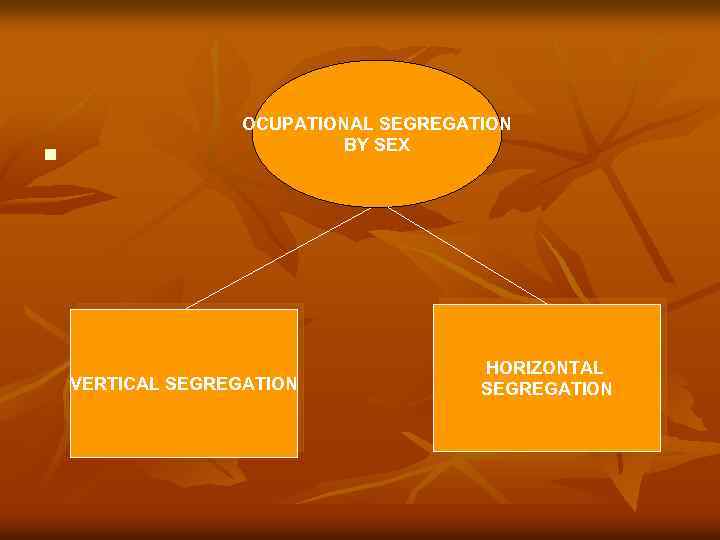 n OCUPATIONAL SEGREGATION BY SEX VERTICAL SEGREGATION HORIZONTAL SEGREGATION
 Vertical segregation describes the clustering of men at the top of occupational hierarchies and women at the bottom. n Horizontal segregation describes the fact that at the same occupational level men and women have different job tasks.
 Cultural mechanisms of occupational segregation by sex Stereotypes: “Man’s” & “woman’s” jobs. Gender stereotypes are one-sided and exaggerated images of men and women which are deployed repeatedly in everyday life.
 Domestic division of labor n The division of tasks, roles and duties, within the household.
 Some findings of British & American studies n n 1. Women, including employed women, continue to bear the main burden of domestic work. 2. Men’s slightly increased participation in domestic labor does not offset women’s increased employment. 3. There is relative stability in the level of housework time expended by men whether the wife works or not. 4. Men tend to be more involved with domestic tasks when they have young children.
 Myths as a tool of the gender order n n n 1. Myth about motherhood. 2. Myth about domesticity. 3. Myth about chastity. 4. Myth about passivity. 5. Beauty myth.
 Beauty myth Problem is a contradiction between a desirable condition and real condition. You must be beautiful, but look at the mirror. What to do? To buy …
 Beauty Myth n n Naomi Wolf: “The affluent, educated, liberated women of the First World, who can enjoy freedoms unavailable to any women before, do not feel as free as they want to. <…. > Many are ashamed to admit that such trivial concerns – to do with physical appearance, bodies, faces, hair, clothes – matter so much”.
 Beauty myth Naomi Wolf: n “The qualities that a given period calls beautiful in women are merely symbols of the female behavior that period considers desirable: The beauty myth is always actually prescribing behavior and not appearance. ” John Galbraith: “… Woman in her role of consumer has been essential to the development of our industrial society… Behavior that is essential for
 THE PERFORMANCE OF GENDER n n People in their everyday interactions are “doing gender" and, in so doing, they are constructing masculine dominance and feminine deference. The performance of gender is never a simple voluntary act: it is shaped by gender power.
 feminization of poverty n The phrase "feminization of poverty" refers to the fact that a higher and higher proportion of the poor are women. Growing rates of divorce, separation, and single-parent families have placed women at a particular disadvantage.