


 Скачать презентацию Gender and Work Presentation for M H A
d09657ea7d02a1874e43f96fe01d4acd.ppt
- Количество слайдов: 32
 Gender and Work Presentation for M. H. A. candidates Dane M. Partridge, Ph. D. Associate Professor of Management University of Southern Indiana March 2005
 Gender and Education n Educational System and Gender q Evidence of gender disparity in terms of kinds of jobs children think about re: future employment n n Where does this come from? Are boys and girls encouraged to take different academic programs that lead to different skills, many of which are gender role stereotyped? Evolution over time: In 1970, women earned only 9% of bachelor’s degrees in business, 4% of master’s; in 1995, 48% and 37%, respectively
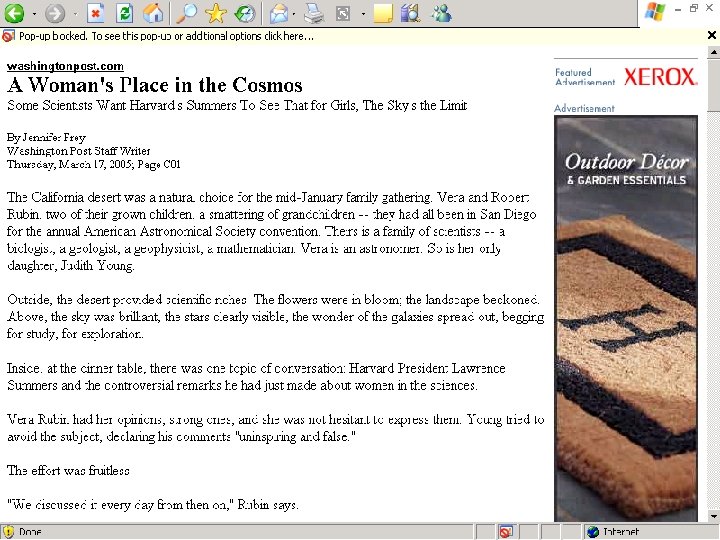
 Gender and Education n Educational System and Gender q Evidence of gender disparity in terms of kinds of jobs children think about re: future employment n Evolution over time: Doctorates in physics earned by women have increased from 3% of total in 1970 to 15. 5% in 2002; engineering, <1% to 17%, etc.
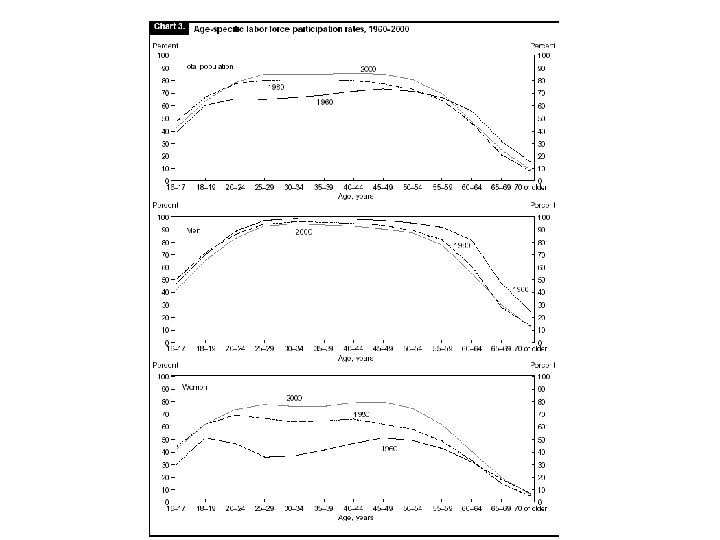
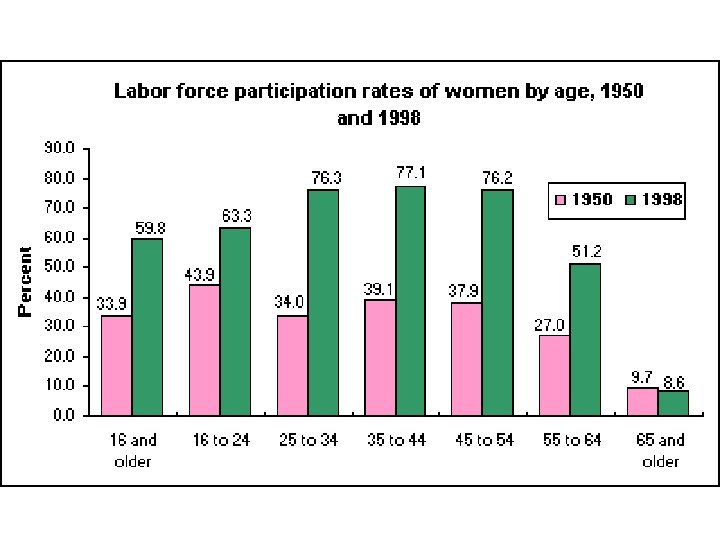
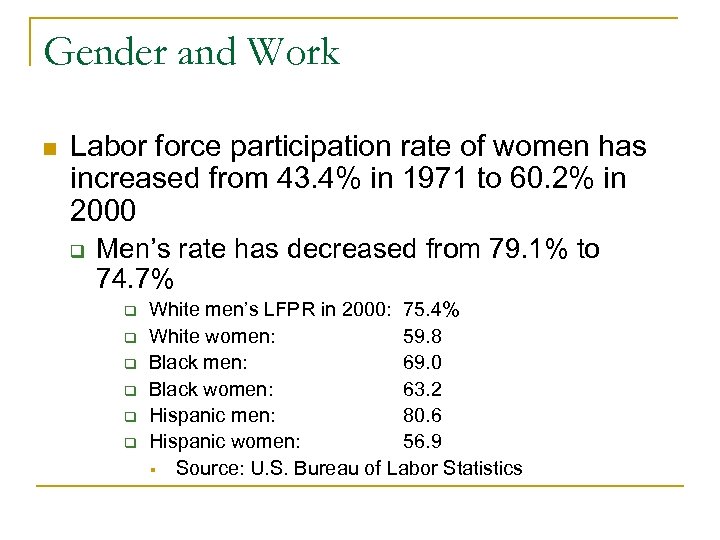 Gender and Work n Labor force participation rate of women has increased from 43. 4% in 1971 to 60. 2% in 2000 q Men’s rate has decreased from 79. 1% to 74. 7% q q q White men’s LFPR in 2000: 75. 4% White women: 59. 8 Black men: 69. 0 Black women: 63. 2 Hispanic men: 80. 6 Hispanic women: 56. 9 § Source: U. S. Bureau of Labor Statistics
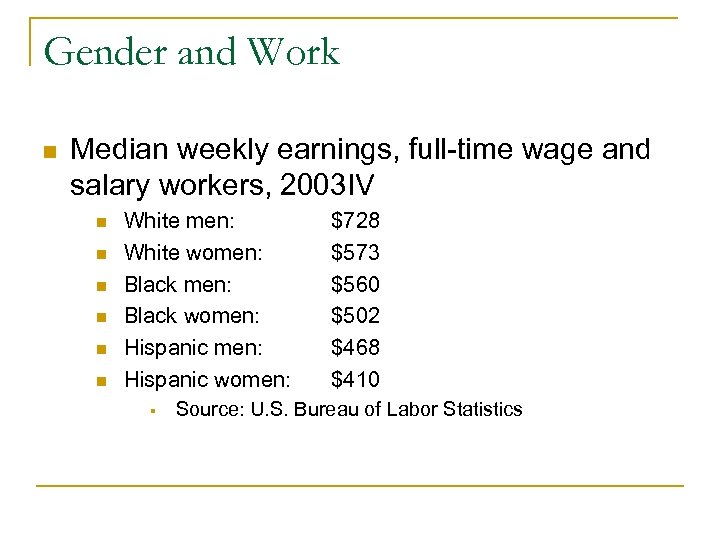 Gender and Work n Median weekly earnings, full-time wage and salary workers, 2003 IV n n n White men: White women: Black women: Hispanic women: § $728 $573 $560 $502 $468 $410 Source: U. S. Bureau of Labor Statistics
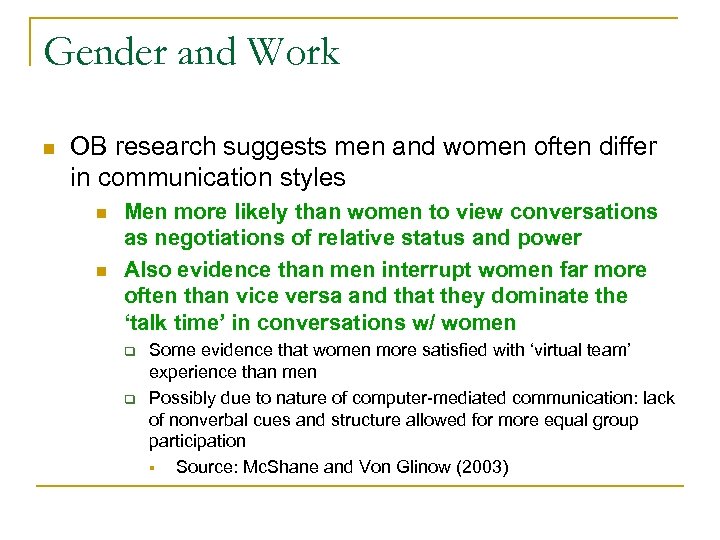 Gender and Work n OB research suggests men and women often differ in communication styles n n Men more likely than women to view conversations as negotiations of relative status and power Also evidence than men interrupt women far more often than vice versa and that they dominate the ‘talk time’ in conversations w/ women q q Some evidence that women more satisfied with ‘virtual team’ experience than men Possibly due to nature of computer-mediated communication: lack of nonverbal cues and structure allowed for more equal group participation § Source: Mc. Shane and Von Glinow (2003)
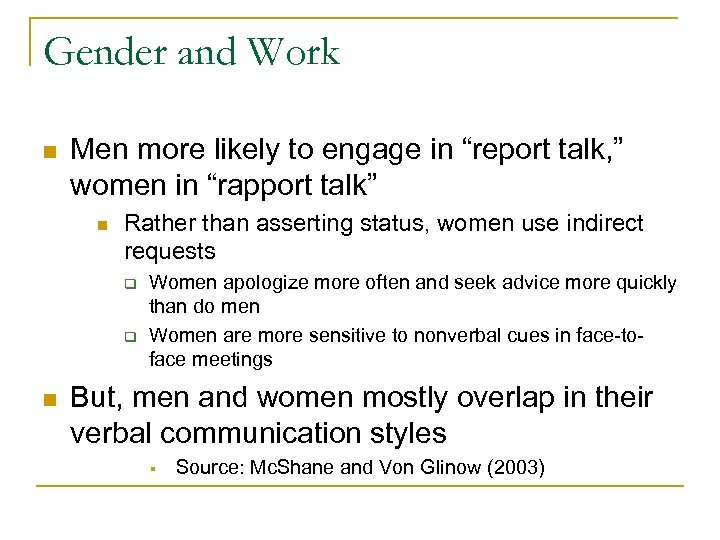 Gender and Work n Men more likely to engage in “report talk, ” women in “rapport talk” n Rather than asserting status, women use indirect requests q q n Women apologize more often and seek advice more quickly than do men Women are more sensitive to nonverbal cues in face-toface meetings But, men and women mostly overlap in their verbal communication styles § Source: Mc. Shane and Von Glinow (2003)
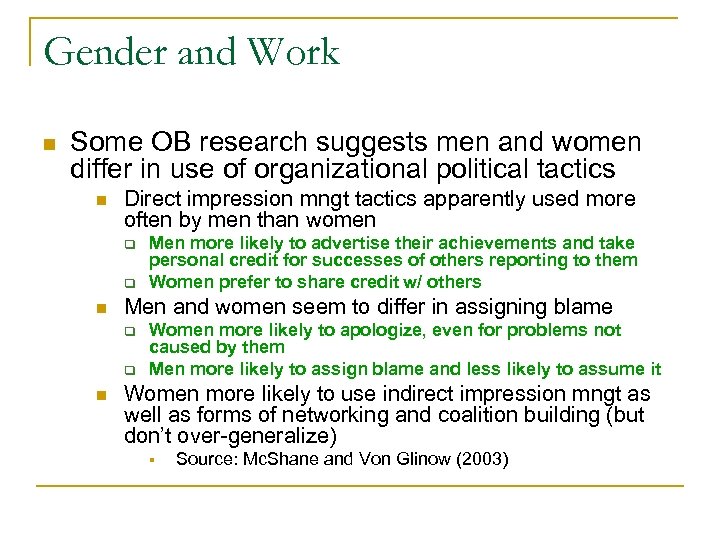 Gender and Work n Some OB research suggests men and women differ in use of organizational political tactics n Direct impression mngt tactics apparently used more often by men than women q q n Men and women seem to differ in assigning blame q q n Men more likely to advertise their achievements and take personal credit for successes of others reporting to them Women prefer to share credit w/ others Women more likely to apologize, even for problems not caused by them Men more likely to assign blame and less likely to assume it Women more likely to use indirect impression mngt as well as forms of networking and coalition building (but don’t over-generalize) § Source: Mc. Shane and Von Glinow (2003)
 Gender and Work n OB research suggests men and women differ to limited extent in conflict management style n n n Women pay more attention than do men to the relationship btwn the parties Women tend to adopt collaborative style in business settings, more willing to compromise to protect the relationship Men tend to be more competitive and take short-term orientation § Source: Mc. Shane and Von Glinow (2003)
 Gender and Work n Gender Issues in Leadership n Common belief that men and women lead differently q n Suggested that these qualities make women particularly well-suited given stronger emphasis on teams and EI q n 76% of male and female chief executives believe than leadership and mngt skills of women differ markedly from male counterparts § Women generally seen as consensus builders, more participative leaders Arguments consistent w/ sex-role stereotypes, that men are more task-oriented and women more people-oriented Research suggests that male and female leaders equally people-oriented, but female leaders tend to be more participative q Stereotyping may lead to greater negative consequences for autocratic female leaders § Source: Mc. Shane and Von Glinow (2003)
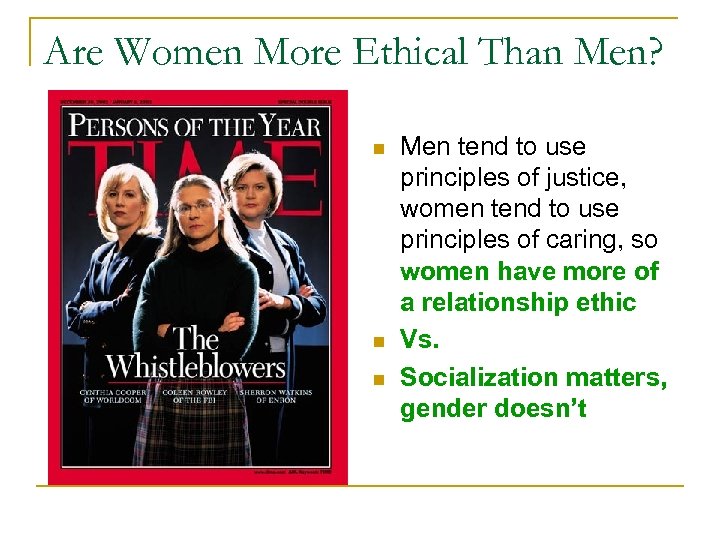 Are Women More Ethical Than Men? n n n Men tend to use principles of justice, women tend to use principles of caring, so women have more of a relationship ethic Vs. Socialization matters, gender doesn’t
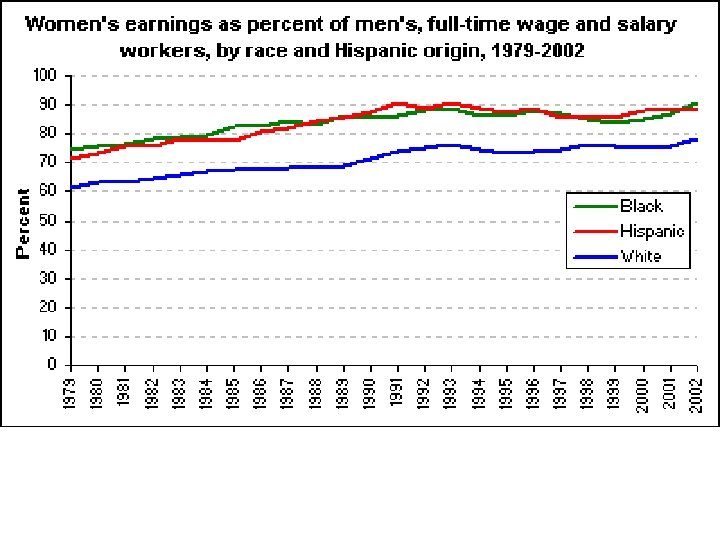
 Gender and Work n Male/female earnings gap has persisted to considerable extent over last 25 years n q 75. 5% in 2003 (down from high of 76. 6% in 2002) Equal Pay Act (1963) n n n Prohibits pay discrimination based on gender Men and women must receive equal pay for “equal work” Allows pay differences based on q q n Seniority Merit Productivity Any factor other than gender Cannot lawfully pay women less than men by labeling identical work differently
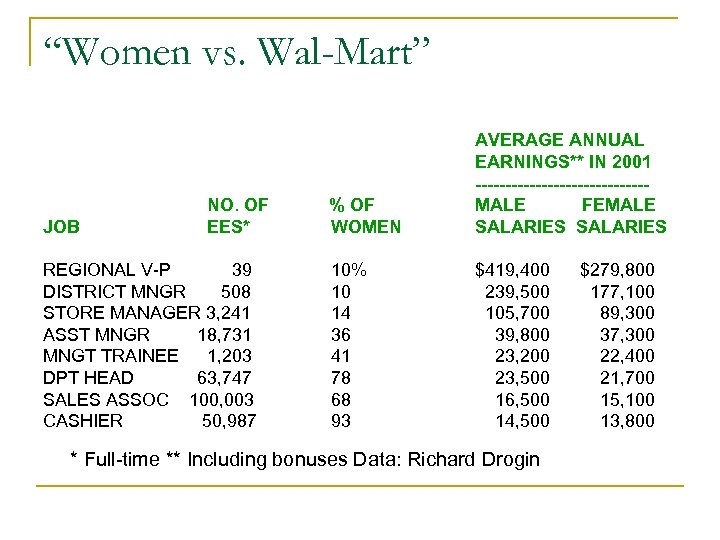 “Women vs. Wal-Mart” JOB NO. OF EES* REGIONAL V-P 39 DISTRICT MNGR 508 STORE MANAGER 3, 241 ASST MNGR 18, 731 MNGT TRAINEE 1, 203 DPT HEAD 63, 747 SALES ASSOC 100, 003 CASHIER 50, 987 % OF WOMEN AVERAGE ANNUAL EARNINGS** IN 2001 --------------MALE FEMALE SALARIES 10% 10 14 36 41 78 68 93 $419, 400 239, 500 105, 700 39, 800 23, 200 23, 500 16, 500 14, 500 * Full-time ** Including bonuses Data: Richard Drogin $279, 800 177, 100 89, 300 37, 300 22, 400 21, 700 15, 100 13, 800
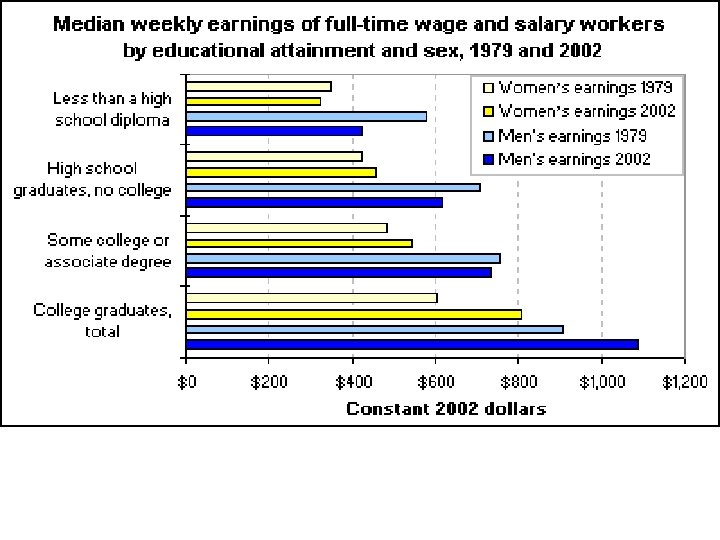
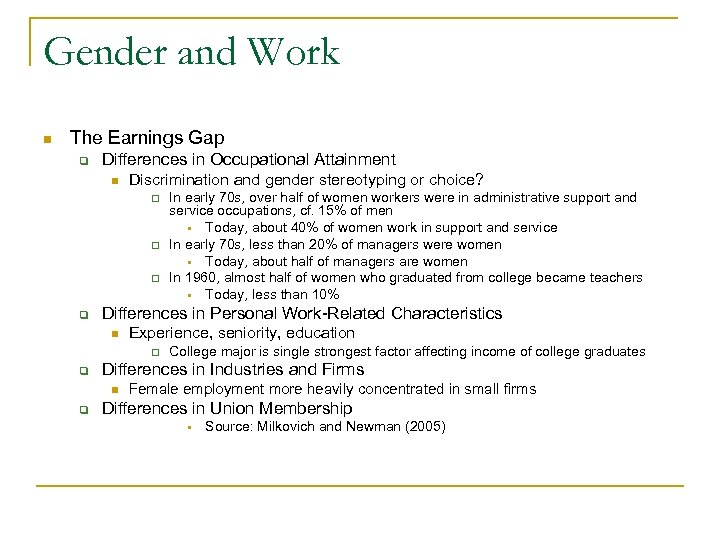 Gender and Work n The Earnings Gap q Differences in Occupational Attainment n Discrimination and gender stereotyping or choice? q q Differences in Personal Work-Related Characteristics n Experience, seniority, education q q College major is single strongest factor affecting income of college graduates Differences in Industries and Firms n q In early 70 s, over half of women workers were in administrative support and service occupations, cf. 15% of men § Today, about 40% of women work in support and service In early 70 s, less than 20% of managers were women § Today, about half of managers are women In 1960, almost half of women who graduated from college became teachers § Today, less than 10% Female employment more heavily concentrated in small firms Differences in Union Membership § Source: Milkovich and Newman (2005)
 Assertiveness Gap? n Study of MBAs entering job market, interviewing for position paying $61 K q q n Men and women have different attitudes about competing and winning q q n n 71% of male candidates believed they were better than other candidates, told hiring managers so, asked for more money 70% of female candidates believed themselves to be equal to other candidates, willing to accept offered salary In research study involving computer maze, men performed 50% better when competing against others in group rather than when paid piecerate In research study involving runners, boys ran faster if they ran against other boys, even faster if they ran against girls; girls ran at same speed either running alone or w/ competitor Social risks: “Consistent assertiveness in a woman rankles people” Men may be more comfortable with selling themselves than women § Source: Washington Post, 7/8/03
 Gender and Work n In AFSCME v. State of Washington case, jobs of maintenance carpenter (2. 3% female) and secretary (98. 5% female) were deemed to be “equal” in value or worth by job evaluation study n q q q Prevailing market rate 7/1/80 for carpenter, $1707/mo. , for secretary, $1122/mo. What to do? Market rates are defense to paying dissimilar jobs differently under Civil Rights Act (unlike Equal Pay Act, and equal work) “Comparable worth” advocates that women performing jobs judged to be equal on some measure of worth should be paid the same as men n n Not mandated by federal law Some states, for public employees; Ontario, public and private
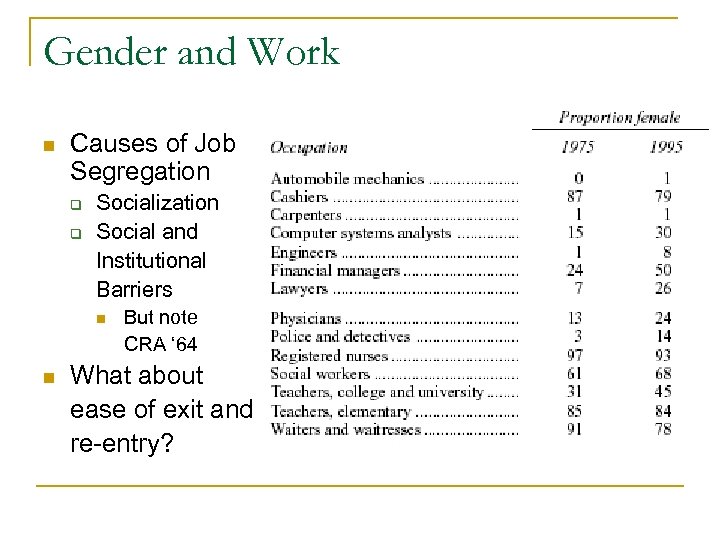 Gender and Work n Causes of Job Segregation q q Socialization Social and Institutional Barriers n n But note CRA ‘ 64 What about ease of exit and re-entry?
 Redefining Achievement n Should achievement be redefined, so as to better reflect women’s lives and realities? q n To achieve work/life balance? How would you define success in your life, re: career, family, other activities?
 Power: Do Women Really Want It? n n Should ‘power’ be redefined? q Do women have to follow ‘the boys’ scorecard’? Suggested that women view power differently from way men do q Seen in terms of influence, not rank n q Many fast-track women ambivalent about what’s next n n ‘Making a difference’ This despite fact they foresee day in which there is parity in gender representation at top of corporate America Do women lack power in business because they just don’t want it enough? q Do women want to ‘fill the pipeline’? n n Only 9% of teenage girls anticipate careers in business, cf. 15% of boys Women make up 36% of MBA students, cf. 47% med school and 49% law school q Half of entering classes at law and medical schools are fresh out of college, but most first-year business students have had three to five years work experience – biological clocks are ticking (New York Times, 11/6/04)
 Power: Do Women Really Want It? n GE study of 135, 000 professional ees q Women quit at higher rate n n n Female voluntary turnover 8%, cf. 6. 5% for males (2, 000+ more women quit each year) Catalyst studies q 26% of professional women who are not yet in most senior position indicate they don’t want it q But, while 57% of men aspire to be CEO, so do 55% of women… (Wall Street Journal, 6/23/04) Women have made more progress in moving into top positions in academe than in business or government q 21% of college presidents are female q USI’s new provost (Linda Bennett) is female n n n q 16% of law firm partners are female 14% of U. S. Senate and 14% of U. S. House female 8% of major co top mngrs (EVP+) female, 4% of CEOs of Fortune 500 female However, may not hold true for sciences (where perception is that gov’t has been more open and fair…)
 Power: Do Women Really Want It? n n Gender differences q Citigroup mngr reports that when she interviews candidates for “stretch assignments, ” women often tell her they’re not ready – men almost never do May be it’s not that women can’t get high-level jobs, but rather they’re choosing not to… q “Dirty secret: women demand a lot more satisfaction in their lives than men do” (Jamie Gorelick) n n “Women have to play be the same rules as men do, and right now there are really brutal rules for women who want to have families” (Hilary Clinton) To get to highest levels of power, women may be forced to choose between work and children q Or may need stay-at-home spouse n n “Glass ceiling” or “maternal wall” “The Opt-Out Revolution”
 Power: Do Women Really Want It? n Between one-quarter and one-third of professional women are out of work force q Number of children being cared for by stay-at-home moms has increased by nearly 13% in less than a decade n q Two-thirds of mothers 25 -44 work fewer than 40 hrs/wk n q Percentage of new mothers who go back to work fell to 55% in 2000, from 59% in 1998 Only 5% work 50+ hrs White male MBAs: 95% working full-time; white female MBAs: 67% (African-American female MBAs more similar to white men than women)
 Power: Do Women Really Want It? n n Belkin suggests that women today have the equal right to make same bargain men have made for centuries – to take time from family in pursuit of success Instead, women are redefining success q n In doing so, redefining work? Suggested that balance between work and life is different for women than men q But, pull of motherhood or push of job dissatisfaction?
 Power: Do Women Really Want It? n Significant organizational challenge in redesigning organizations to take advantage of mothers ready to re-enter work force q Attract, retain, motivate, plus now re-integrate? q Many professional women who quit their jobs to raise children now trying to go back – and they’re finding it harder than they ever imagined n n Two-thirds of highly-educated women who left jobs mainly for family reasons want to return to work Deloitte & Touche planning to launch “Personal Pursuits” program, which will allow ees to take unpaid leave for as long as five years q n Training sessions for those on leave, mentors to stay in touch “There’s a part of every woman who has had what it takes to succeed on Wall Street that yearns for that type of overachieving applause that you got, and that motherhood does not allow you to have. There’s just no applause. And I miss that. ” § Source: Wall Street Journal, 5/6/04
 Selling Yourself n Strategies consultants offer for mothers planning to return to work q q q n Present your volunteer work with active business words Never apologize for the time off Convey that you’re truly committed to working again While you’re out of work: q q Be strategic about volunteer work you do Keep abreast of your field § Source: Wall Street Journal, 5/6/04
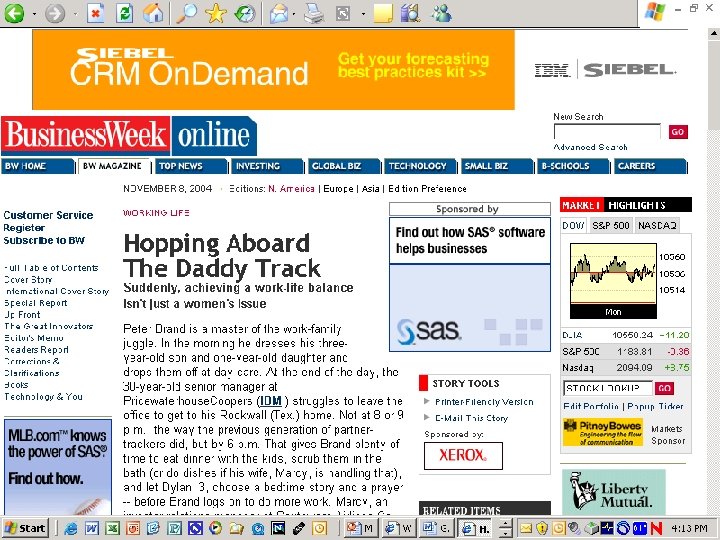
 Power: Do Women Really Want It? n Some evidence of growing dissatisfaction on part of men w/ price required to advance in corporate America, desire for same flexibility and balance that women want q Belkin suggests that instead of women being forced to act like men, men are being freed to act like women n q Number of married men who are full-time caregivers to their children has increased 18% (to what and from when? ) Working men born between 1965 and 1979 now spend ~3. 5 hrs/day with their children – same amount as working women n n Among all working men, ~2. 7 hrs, up from 1. 8 hrs in 1977 70% of men report they would take a pay cut to spend more time at home w/ family, almost half would turn down promotion if it meant less family time q n Biggest change is new unwillingness to relocate § (Business Week, 11/8/04) Family-friendly organization? q Better opportunities to work flexible hours, share jobs, not relocate