 Скачать презентацию GEF and Integration of Activities in Biodiversity and
47a86d03dac4745abbeddc0a1404613e.ppt
- Количество слайдов: 21



GEF and Integration of Activities in Biodiversity and International Waters 3 rd International Water Conference June 2005 – Bahia, Brazil
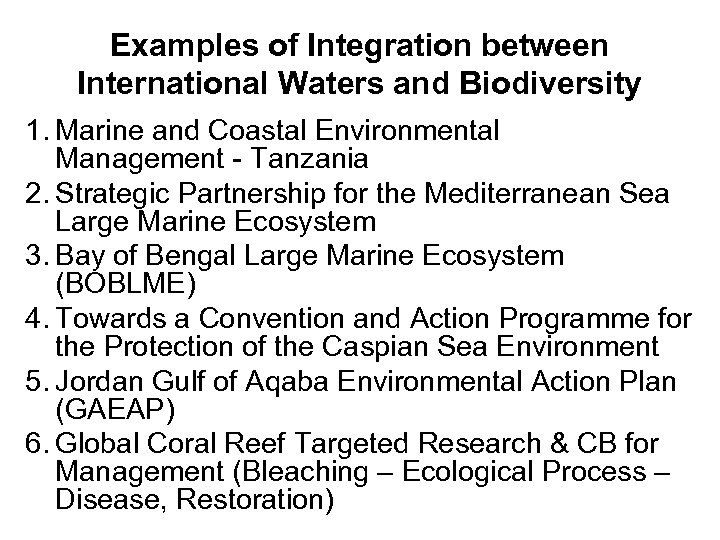
Examples of Integration between International Waters and Biodiversity 1. Marine and Coastal Environmental Management - Tanzania 2. Strategic Partnership for the Mediterranean Sea Large Marine Ecosystem 3. Bay of Bengal Large Marine Ecosystem (BOBLME) 4. Towards a Convention and Action Programme for the Protection of the Caspian Sea Environment 5. Jordan Gulf of Aqaba Environmental Action Plan (GAEAP) 6. Global Coral Reef Targeted Research & CB for Management (Bleaching – Ecological Process – Disease, Restoration)
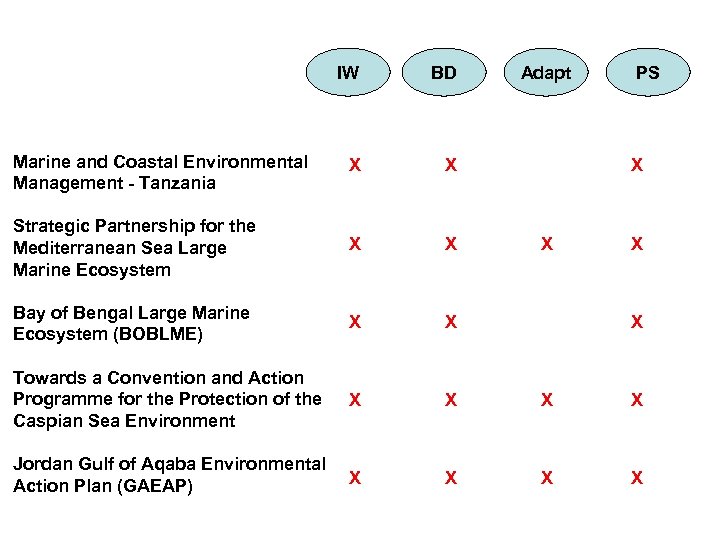
IW BD Adapt PS Marine and Coastal Environmental Management - Tanzania X X Strategic Partnership for the Mediterranean Sea Large Marine Ecosystem X X Bay of Bengal Large Marine Ecosystem (BOBLME) X X Towards a Convention and Action Programme for the Protection of the Caspian Sea Environment X X Jordan Gulf of Aqaba Environmental Action Plan (GAEAP) X X X X
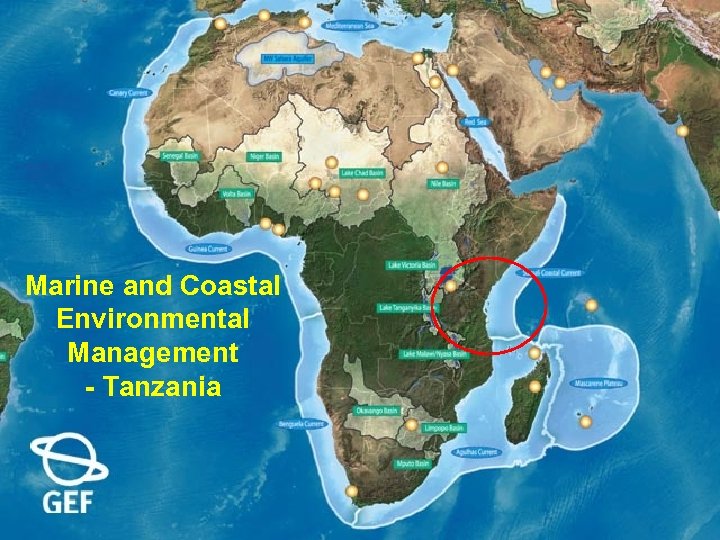
Marine and Coastal Environmental Management - Tanzania
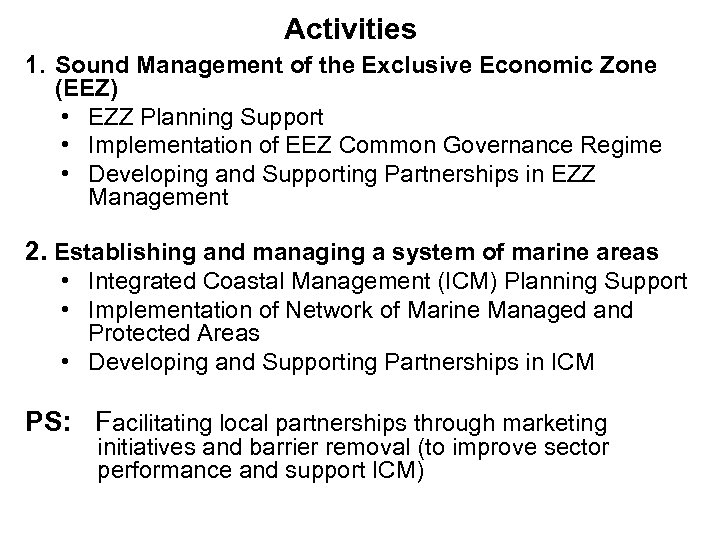
Activities 1. Sound Management of the Exclusive Economic Zone (EEZ) • EZZ Planning Support • Implementation of EEZ Common Governance Regime • Developing and Supporting Partnerships in EZZ Management 2. Establishing and managing a system of marine areas • Integrated Coastal Management (ICM) Planning Support • Implementation of Network of Marine Managed and Protected Areas • Developing and Supporting Partnerships in ICM PS: Facilitating local partnerships through marketing initiatives and barrier removal (to improve sector performance and support ICM)
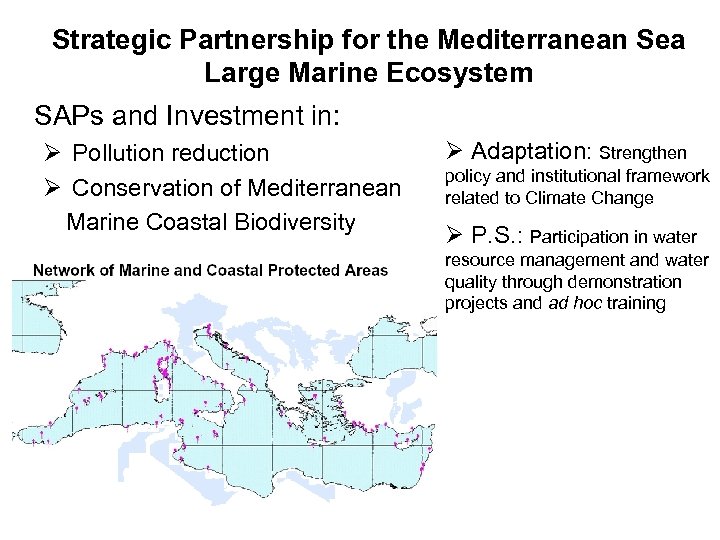
Strategic Partnership for the Mediterranean Sea Large Marine Ecosystem SAPs and Investment in: Ø Pollution reduction Ø Conservation of Mediterranean Marine Coastal Biodiversity Ø Adaptation: Strengthen policy and institutional framework related to Climate Change Ø P. S. : Participation in water resource management and water quality through demonstration projects and ad hoc training
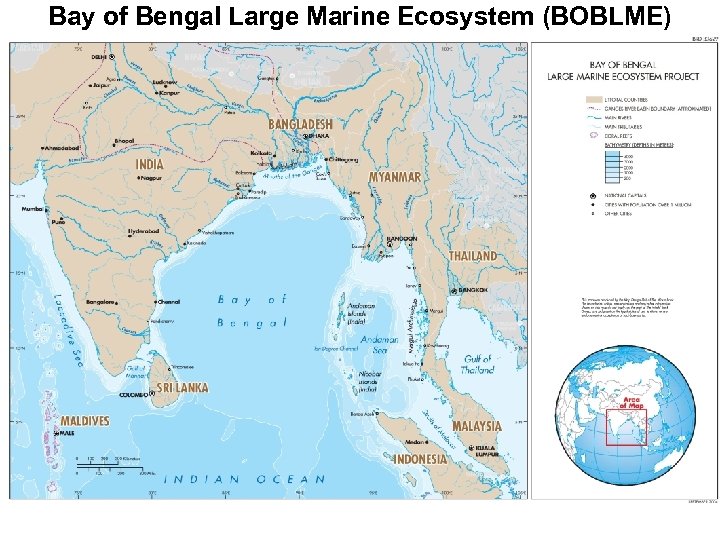
Bay of Bengal Large Marine Ecosystem (BOBLME)
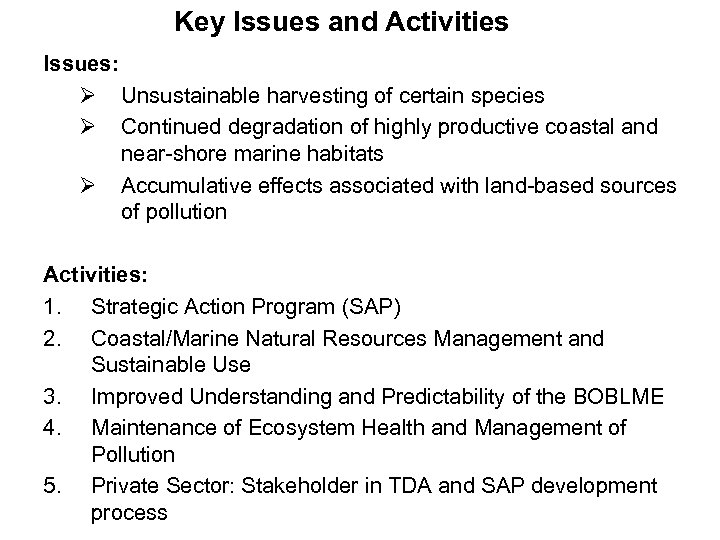
Key Issues and Activities Issues: Ø Unsustainable harvesting of certain species Ø Continued degradation of highly productive coastal and near-shore marine habitats Ø Accumulative effects associated with land-based sources of pollution Activities: 1. Strategic Action Program (SAP) 2. Coastal/Marine Natural Resources Management and Sustainable Use 3. Improved Understanding and Predictability of the BOBLME 4. Maintenance of Ecosystem Health and Management of Pollution 5. Private Sector: Stakeholder in TDA and SAP development process
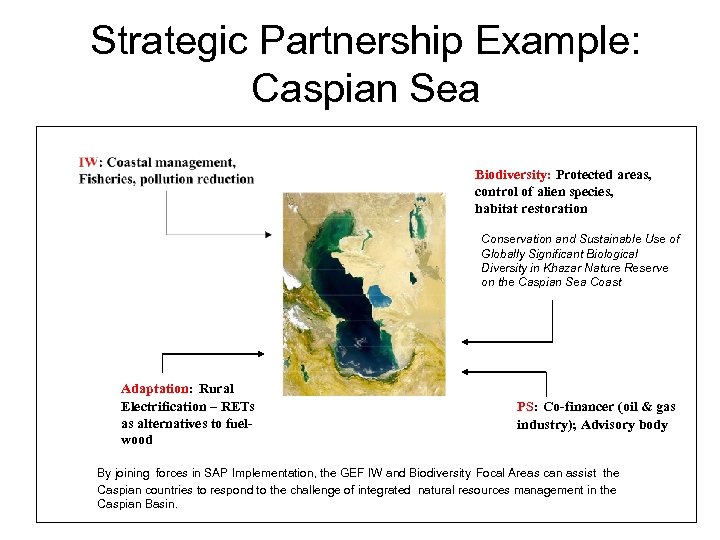
Strategic Partnership Example: Caspian Sea Biodiversity: Protected areas, control of alien species, habitat restoration Conservation and Sustainable Use of Globally Significant Biological Diversity in Khazar Nature Reserve on the Caspian Sea Coast Adaptation: Rural Electrification – RETs as alternatives to fuelwood PS: Co-financer (oil & gas industry); Advisory body By joining forces in SAP Implementation, the GEF IW and Biodiversity Focal Areas can assist the Caspian countries to respond to the challenge of integrated natural resources management in the Caspian Basin.
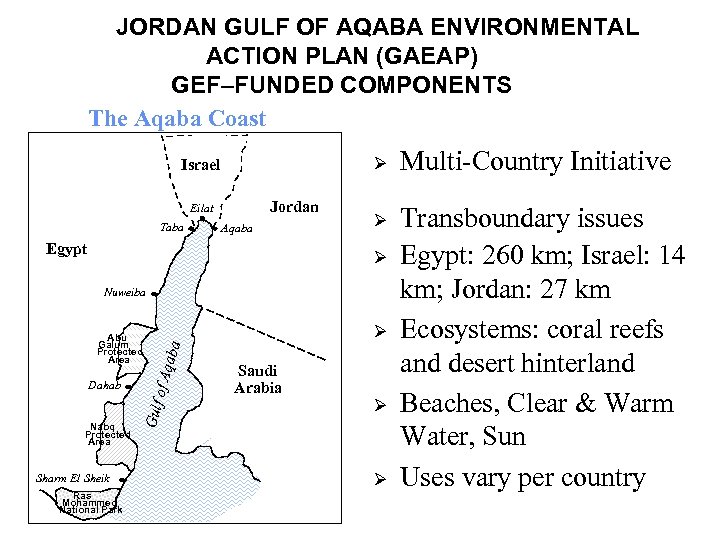
JORDAN GULF OF AQABA ENVIRONMENTAL ACTION PLAN (GAEAP) GEF–FUNDED COMPONENTS The Aqaba Coast Ø Israel Jordan Eilat Taba Aqaba Egypt Multi-Country Initiative Ø Transboundary issues Egypt: 260 km; Israel: 14 km; Jordan: 27 km Ecosystems: coral reefs and desert hinterland Beaches, Clear & Warm Water, Sun Uses vary per country Ø Nuweiba Nabq Protected Area Sharm El Sheik Ras Mohammed National Park aba of Aq Dahab Ø Gulf Abu Galum Protected Area Saudi Arabia Ø Ø
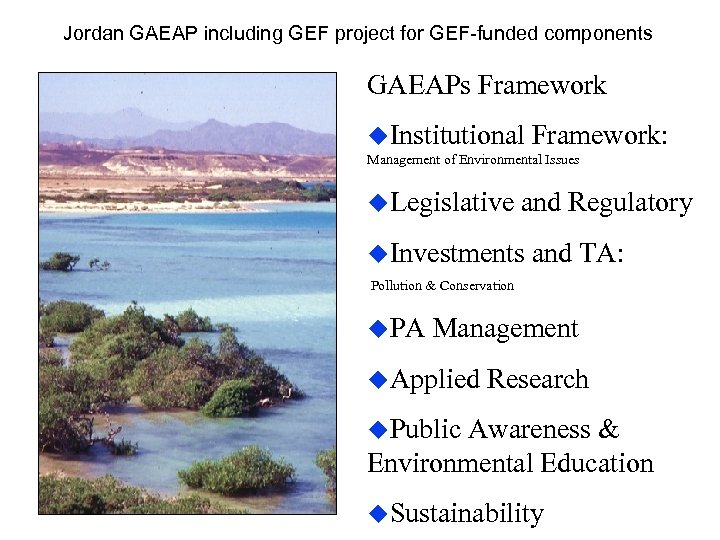
Jordan GAEAP including GEF project for GEF-funded components GAEAPs Framework u. Institutional Framework: Management of Environmental Issues u. Legislative and Regulatory u. Investments and TA: Pollution & Conservation u. PA Management u. Applied Research u. Public Awareness & Environmental Education u. Sustainability
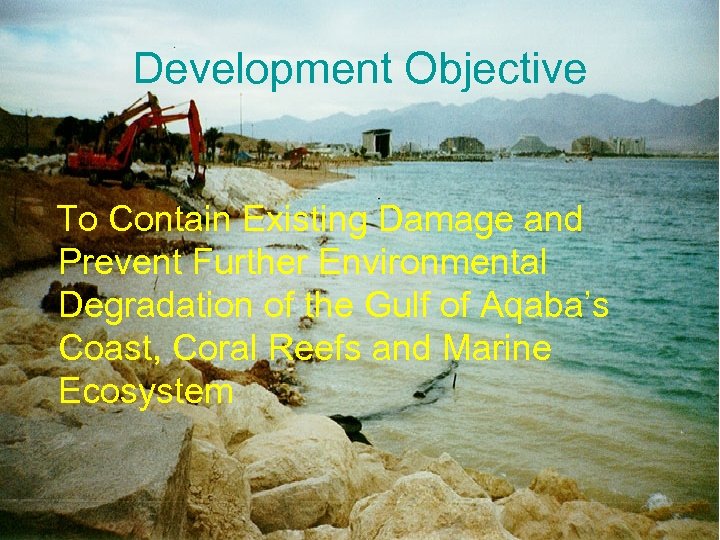
Development Objective To Contain Existing Damage and Prevent Further Environmental Degradation of the Gulf of Aqaba’s Coast, Coral Reefs and Marine Ecosystem
Project Activities • Development of an Institutional & Legislative/Regulatory Framework • Creation of an Environmental Department under ARA which became an Environmental Commission under ASEZA using project institutional set-up as a model • Environmental law with full jurisdictional powers over resource management and pollution control • EIA (implemented)and CZM Guidelines • GIS (planning tool) and MIS data base management
Project Activities • Marine water monitoring – physical-chemical properties – benthic habitats: fish and corals – sedimentation rates • Air pollution monitoring – stack emissions – outdoors ambient air quality – indoors ambient air quality
Project Activities • Industrial pollution abatement – industrial audit – emergency response plan – a permit-based regulatory structure • Marine vessel pollution prevention – new regulation in line with MARPOL – solid waste, sanitary water and waste oil recovery
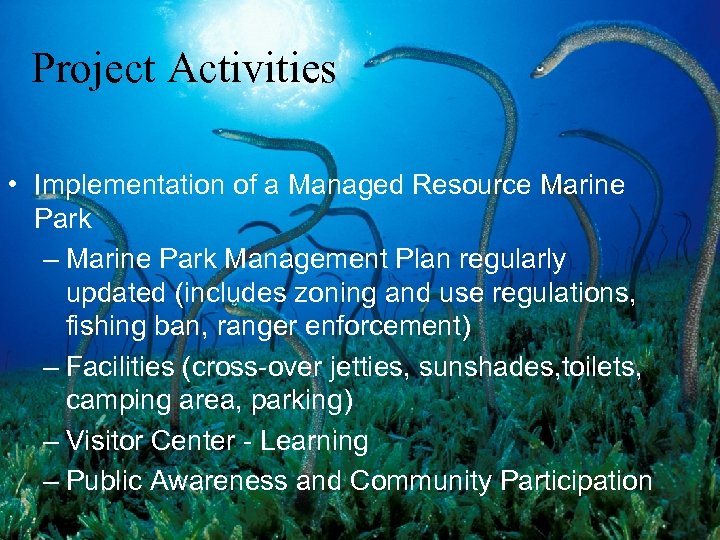
Project Activities • Implementation of a Managed Resource Marine Park – Marine Park Management Plan regularly updated (includes zoning and use regulations, fishing ban, ranger enforcement) – Facilities (cross-over jetties, sunshades, toilets, camping area, parking) – Visitor Center - Learning – Public Awareness and Community Participation
Regional Cooperation • Joint monitoring and research programs (MERC) • Data exchange • Compatible GIS and MIS data management procedures • Transboundary consultation and cooperation within the framework of the marine park • Coordinated responses and measures to combat environmental problems
Key Lessons • COMMITMENT/OWNERSHIP, Equal Importance at the highest level of authority and at the local population level • Participatory Preparation & Implementation Lengthy Process • SWOT Analysis
u. Institutional: u. Decentralization vs Centralization u. Decentralized Coastal Zone Management Institution with Decision Making Authority optimal u. Staff Incentives u. Close Relationships with Community & Investors u. Enabling vs Policing Role & Promotion of Private/Public Partnership u. Training
u. Legal & Regulatory Framework accompanied by Enforceable Tools and Personnel essential u. Needed Investments & TA (transfer of experiences) u. PA Management with all concerned Partners crucial coupled with Monitoring & Applied Research u. Public Awareness & Environmental Education: uimportance of using local language & listening
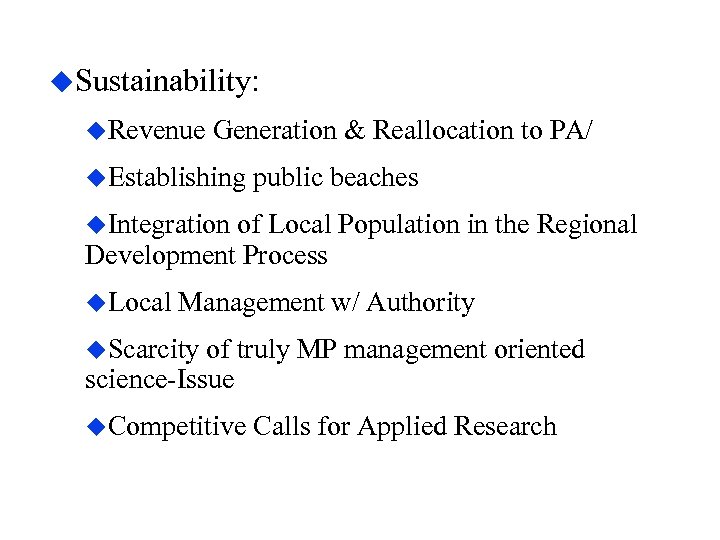
u. Sustainability: u. Revenue Generation & Reallocation to PA/ u. Establishing public beaches u. Integration of Local Population in the Regional Development Process u. Local Management w/ Authority u. Scarcity of truly MP management oriented science-Issue u. Competitive Calls for Applied Research
Скачать презентацию GEF and Integration of Activities in Biodiversity and
47a86d03dac4745abbeddc0a1404613e.ppt