


 Скачать презентацию GE 541 Institutional and Organizational Innovations in Transport
a70ac7699d6fbea0ed899e864398d80e.ppt
- Количество слайдов: 36
 GE 541 Institutional and Organizational Innovations in Transport Systems September 16 - 18, 2008 (Lectures 4 & 5)
 Parallel to the physical innovations (e. g. containers) there has been a flurry of non-physical innovations in transportation There are the institutional and organizational innovations.
 Such nonmaterial innovations are of two types: A. Change of economic institutions governing B. transport. e. g. deregulations, privatization liberalization B. Change of operational processes of goods transport
 Economic Institutions Governing Transport Recent Reform: The rise of free trade regimes - creation of IMF and the World Bank General Agreement on Tariffs & Trade (GATT) WTO NAFTA, EU, MERCOSUR
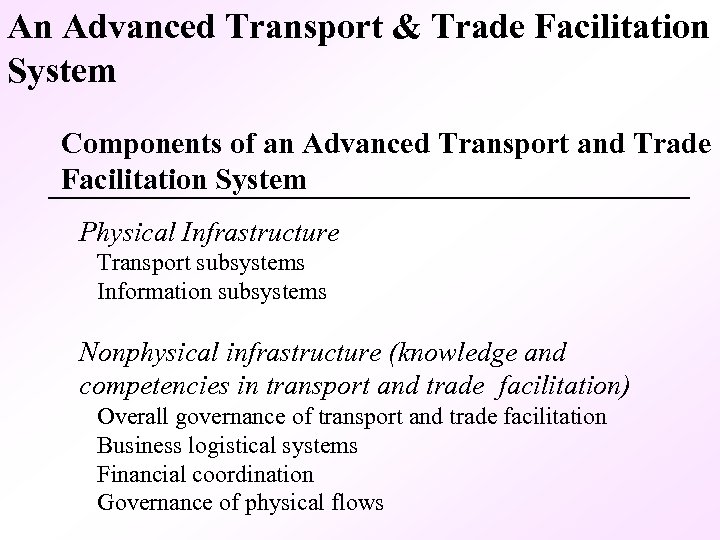 An Advanced Transport & Trade Facilitation System Components of an Advanced Transport and Trade Facilitation System Physical Infrastructure Transport subsystems Information subsystems Nonphysical infrastructure (knowledge and competencies in transport and trade facilitation) Overall governance of transport and trade facilitation Business logistical systems Financial coordination Governance of physical flows
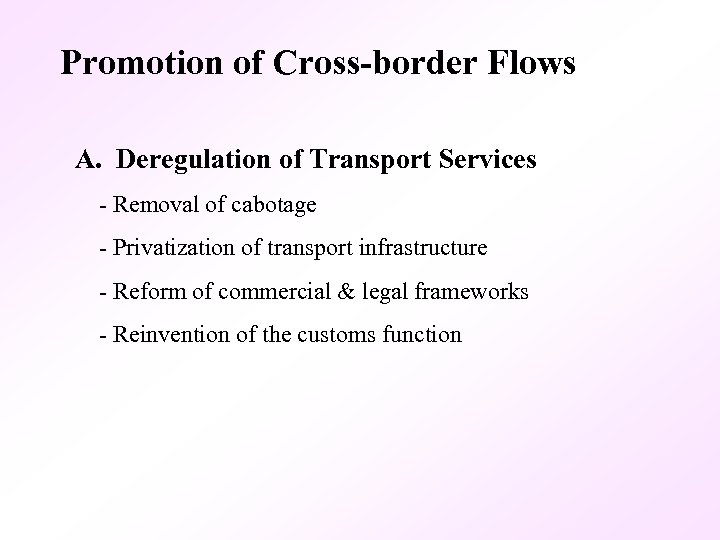 Promotion of Cross-border Flows A. Deregulation of Transport Services - Removal of cabotage - Privatization of transport infrastructure - Reform of commercial & legal frameworks - Reinvention of the customs function
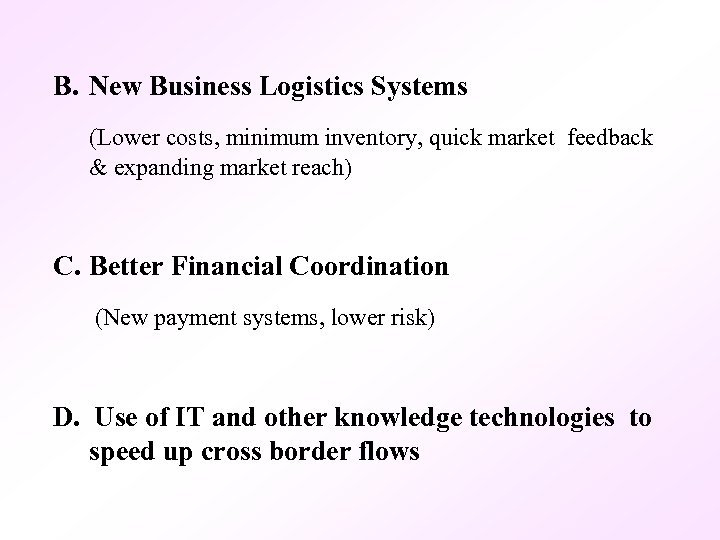 B. New Business Logistics Systems (Lower costs, minimum inventory, quick market feedback & expanding market reach) C. Better Financial Coordination (New payment systems, lower risk) D. Use of IT and other knowledge technologies to speed up cross border flows
 Factors Underlying the Transformation of the Transport Enterprise
 Cost per Ton-Mile, 1995 Dollars Railroad Operating Costs per Revenue Ton-Mile, 1980 -1995, in 1995 Dollars
 Operating Costs of Less than Truckload and Truckload Carriers, 1988 -1995, in 1995 dollars per vehicle mile
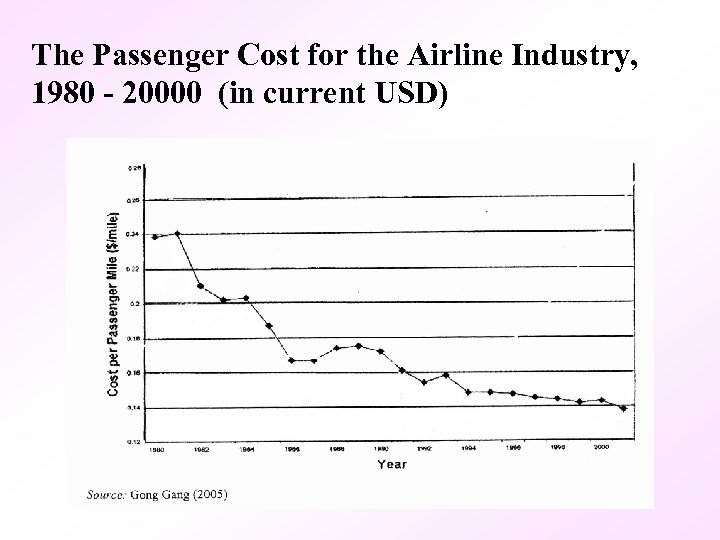 The Passenger Cost for the Airline Industry, 1980 - 20000 (in current USD)
 Post 1990, Transport Logistical Structure • The Logistical Channel • Just-in-Time (JIT) • Quick Response Services • Containers tracked around the world & ‘visible’ in transit • Old paper system on cargo replaced by Electronic Data Interchange (EDI) and e-mail
 Freight flow faster, cheaper and more reliable New types of Transport & Logistical Services (e. g. reliability & timeliness - strategic outsourcing of a firm’s distribution function - flexibility in destination choices - additional production value and strategic competitive advantage - operation of distribution & warehousing facilities - where to source intermediate goods
 Management of value chains of other firms Moving into e-commerce Consumer demand oriented “pull” system
 The Evolution of Novel Freight Service Attributes, Logistical Systems, and Economic Benefits
 Worldwide Logistics Costs Exceed $1 Trillion, of which $610 Million is Non-Transport Logistics Service Charges
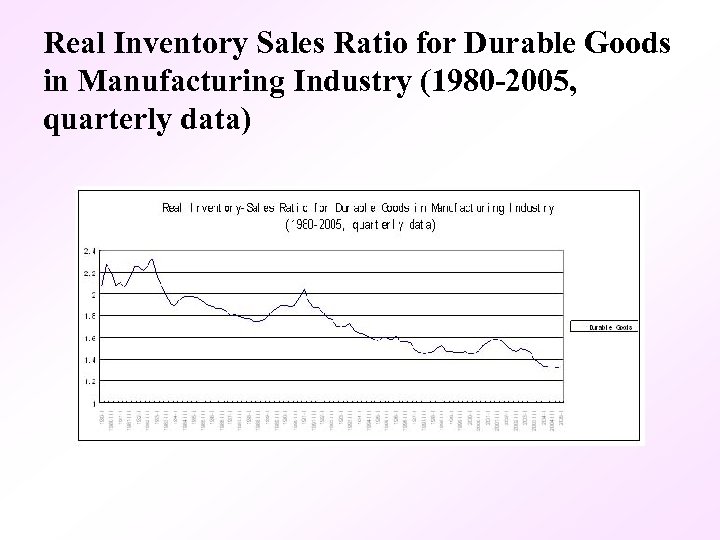 Real Inventory Sales Ratio for Durable Goods in Manufacturing Industry (1980 -2005, quarterly data)
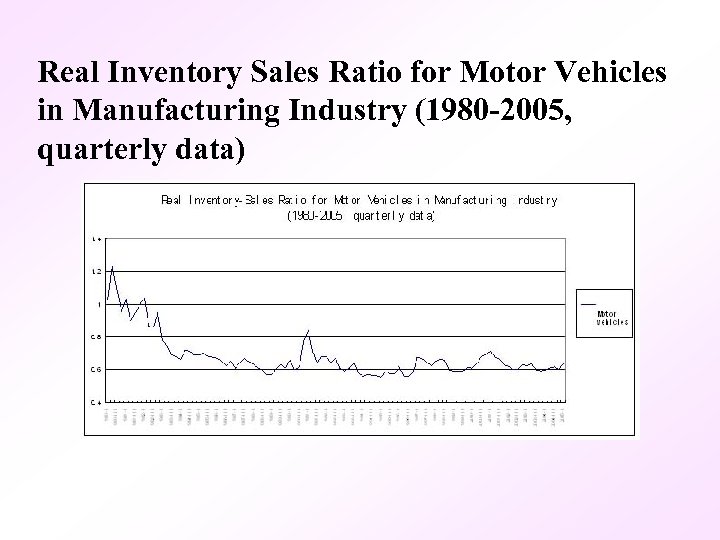 Real Inventory Sales Ratio for Motor Vehicles in Manufacturing Industry (1980 -2005, quarterly data)
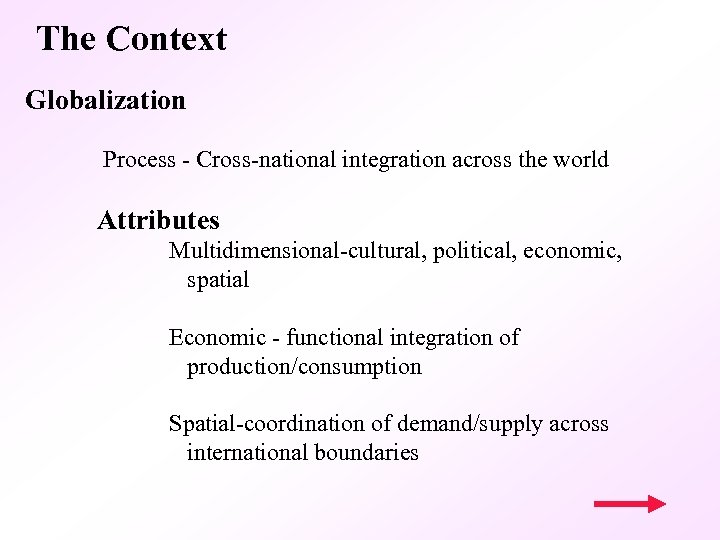 The Context Globalization Process - Cross-national integration across the world Attributes Multidimensional-cultural, political, economic, spatial Economic - functional integration of production/consumption Spatial-coordination of demand/supply across international boundaries
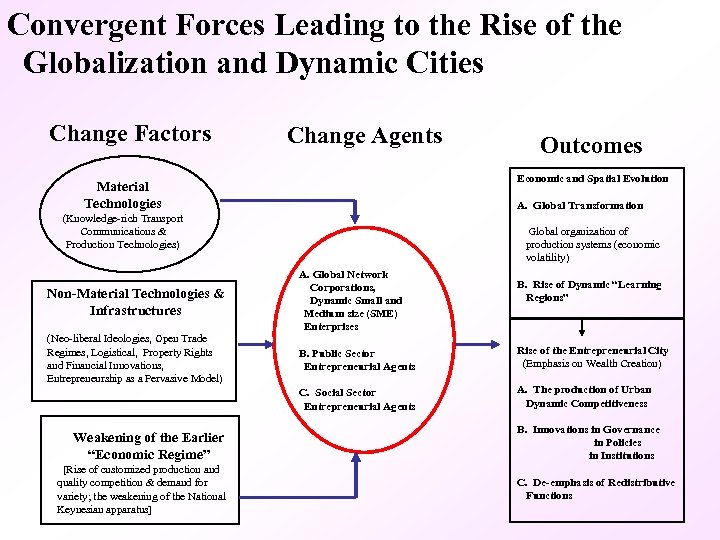 Convergent Forces Leading to the Rise of the Globalization and Dynamic Cities Change Factors Change Agents Economic and Spatial Evolution Material Technologies A. Global Transformation (Knowledge-rich Transport Communications & Production Technologies) Non-Material Technologies & Infrastructures (Neo-liberal Ideologies, Open Trade Regimes, Logistical, Property Rights and Financial Innovations, Entrepreneurship as a Pervasive Model) Outcomes Global organization of production systems (economic volatility) A. Global Network Corporations, Dynamic Small and Medium size (SME) Enterprises B. Rise of Dynamic “Learning Regions” [Rise of customized production and quality competition & demand for variety; the weakening of the National Keynesian apparatus] Rise of the Entrepreneurial City (Emphasis on Wealth Creation) C. Social Sector Entrepreneurial Agents Weakening of the Earlier “Economic Regime” B. Public Sector Entrepreneurial Agents A. The production of Urban Dynamic Competitiveness B. Innovations in Governance in Policies in Institutions C. De-emphasis of Redistributive Functions
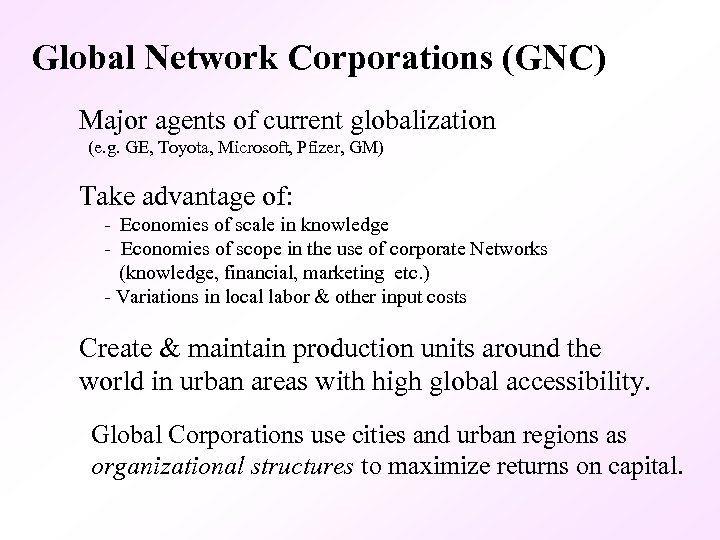 Global Network Corporations (GNC) Major agents of current globalization (e. g. GE, Toyota, Microsoft, Pfizer, GM) Take advantage of: - Economies of scale in knowledge - Economies of scope in the use of corporate Networks (knowledge, financial, marketing etc. ) - Variations in local labor & other input costs Create & maintain production units around the world in urban areas with high global accessibility. Global Corporations use cities and urban regions as organizational structures to maximize returns on capital.
 continued…. Production Consequences Competitive and comparative advantages Global Sourcing – harmonization across economic systems JIT- lean and flexible production Flexible Specialization – horizontal replacing vertical integration Cost Advantages of Spatial Economies in addition to scale and scope economies Increasing Trade as % of GDP
 Transport Implications of Globalization Objective - Reliable delivery through low-cost/high-value services World-wide coordination of production and distribution Capture upstream /downstream advantages of material-component-output linkages for cost reduction across supply chain Attribute - Technology Advances - Transportation - larger, faster - Information Systems - Logistics Innovations
 Transportation Logistics: Supply Chain Strategic and Operational Issues
 Logistics – Definition and Components Definition – Integrated management of overall value chain through time compression. Objectives – Efficient movement and storage of raw materials, intermediate and final goods with associated information flows through the supply chain. Effective inventory management and distribution for cost minimization. Right product, right place at right time.
 Transportation and Supply Chain Links
 Types of Logistics Integrated Logistics Management- Global Optimization Transport Logistics Inbound/Outbound Logistics – movement of goods through the supply chain Effective management of transportation, warehousing and distribution Pull Logistics
 Transportation Logistics: Strategic Issues in the Value Chain
 Elements of the Integrated System of TNT
 Trends Pre production/Post production decisions to location and production decisions Internet and e-commerce Traditional to Web logistics Reverse Logistics
 Traditional Logistics Supply Chain
 Rethinking the Logistics Supply Chain: Web
 Supply Chain Characteristics of Newly Industrializing Countries Source: Modified from Waller (1995).
 Logistics Challenges in Indonesia Note: SKU = stock keeping unit Source: Knoop, (1996)
 Comparative Information on Selected Logistics Markets
 Time Delay and Exports