 Скачать презентацию GDE Report Barry Barish ALCPG Albuquerque 29
c083e1dc994e9d0859376662e9947e70.ppt
- Количество слайдов: 44



GDE Report Barry Barish ALCPG – Albuquerque 29 -Sept-09 ALCPG - Albuquerque Global Design Effort 1
Progress since TILC 09 - April 09 • AAP Review at TILC 09 (highlights) • PAC Review – May 09 (highlights) • New R&D Plan – ver 4 • SCRF Progress (gradient; S 1 tests at FLASH) • CLIC / ILC Collaboration • ILC Implementation: Industrialization & Governance Studies • ------------------------------------------------ • New Baseline (AD&I) – N Walker 4: 45 pm today • Public Lecture – “The Mysterious Universe” J Brau – Thursday night at 7: 30 pm 29 -Sept-09 ALCPG - Albuquerque Global Design Effort 2
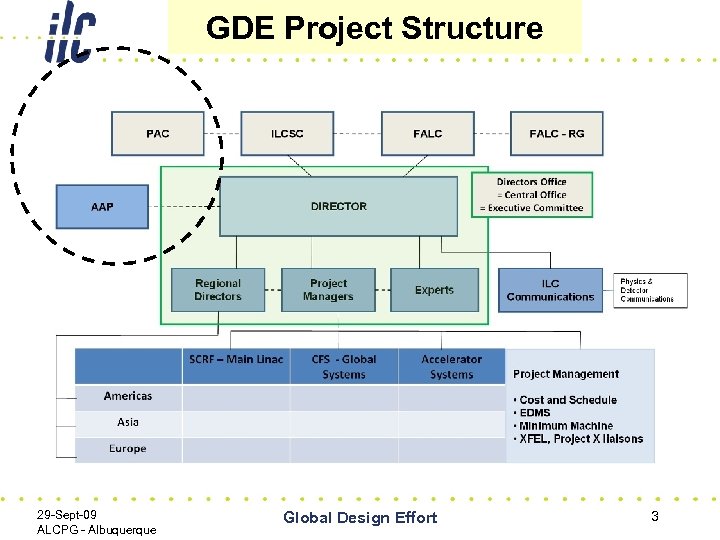
GDE Project Structure 29 -Sept-09 ALCPG - Albuquerque Global Design Effort 3
Technical Reviews • Accelerator Advisory Panel (Willis & Elsen) – On-going reviews by assigned AAP members to particular systems (attend meetings, etc) Example result: Questions regarding plug compatibility have resulted in studies, report – Technical Review – first one 3. 5 days at TILC 09 in April. Internal + 4 -5 external reviewers. Yearly through TDP phase with continuity. First review: Overall coverage + focus areas • ILCSC PAC Review: – 1. 5 days (1 day GDE); higher level review and will use AAP review as input. 29 -Sept-09 ALCPG - Albuquerque Global Design Effort 4
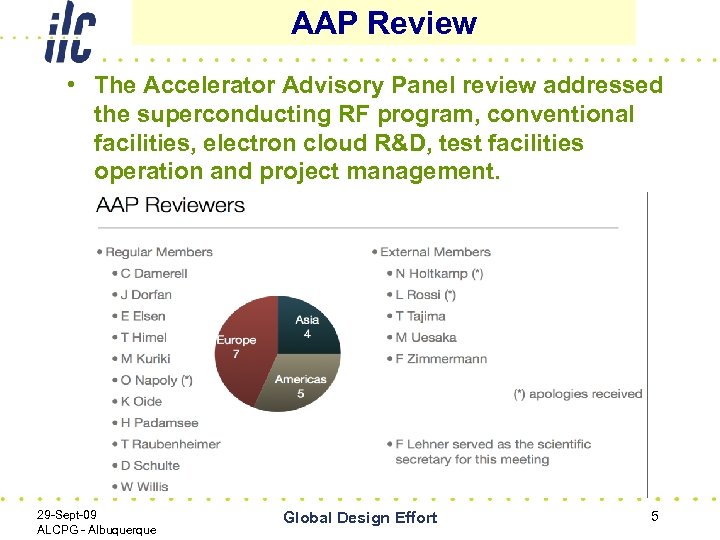
AAP Review • The Accelerator Advisory Panel review addressed the superconducting RF program, conventional facilities, electron cloud R&D, test facilities operation and project management. 29 -Sept-09 ALCPG - Albuquerque Global Design Effort 5
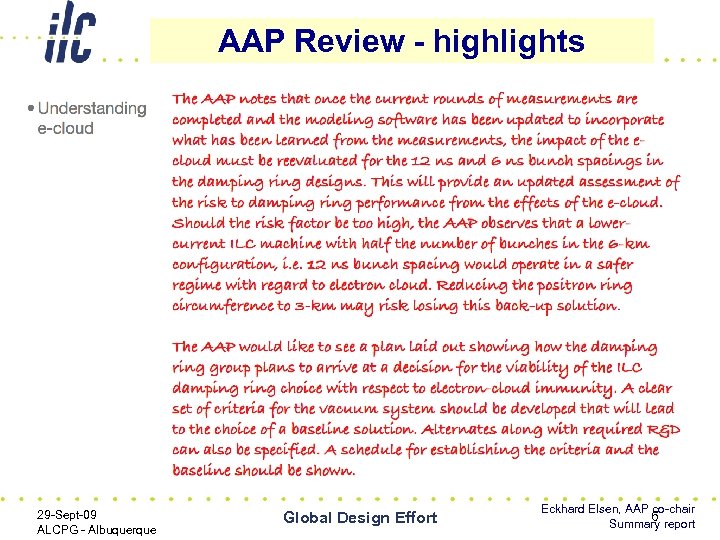
AAP Review - highlights 29 -Sept-09 ALCPG - Albuquerque Global Design Effort Eckhard Elsen, AAP co-chair 6 Summary report
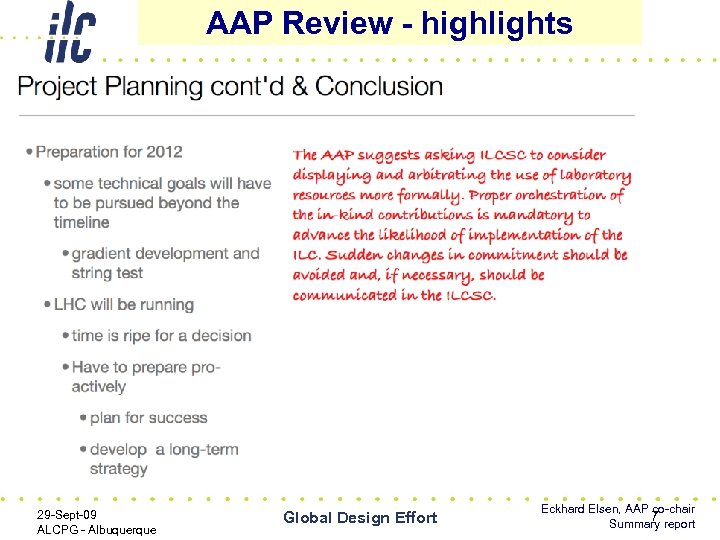
AAP Review - highlights 29 -Sept-09 ALCPG - Albuquerque Global Design Effort Eckhard Elsen, AAP co-chair 7 Summary report
Laboratory Commitments to ILC R&D • The system with work packages and associated laboratory based MOU’s became obsolete during the 2008 funding interruption in the UK & US. • This system has been replaced by an ad-hoc series of bilateral agreements with the GDE and the national labs for work scope or facility access e. g. FP 7 projects such as Hi-Grade in the EU, ATF 2 at KEK, ART program in the US, which are embedded in a variety of management structures. A common R&D program has also been established with Project X at Fermilab. • This has given rise to situations where internal lab priorities have had the result of moving critical personnel away from the GDE program. • Both the AAP and the PAC flagged this issue and suggested it be discussed at ILCSC, which contains several lab directors. 29 -Sept-09 ALCPG - Albuquerque Global Design Effort 8
AAP Review • The full report is available through GDE website • The next AAP review will take place in Oxford, UK in January 2010 • The focus of this review will be the new machine baseline. 29 -Sept-09 ALCPG - Albuquerque Global Design Effort 9
PAC Review – May 09, Vancouver • “Satisfactory progress is being made towards a Technical Design Report in 2012. At some time in the future, ILCSC guidance will be needed for activities beyond that date. ” • “The PAC supports the GDE Director’s AAP process, and endorses the conclusions of the AAP’s recent review. It looks forward to seeing the response to the AAP’s recommendations. ” • “There is some concern by the PAC on whethere will be enough cavities available to obtain meaningful statistics on the yield, and more information on the needed statistics would be helpful. Some help on this may be forthcoming from the XFEL, Project X and Quantum Beam projects. ” 29 -Sept-09 ALCPG - Albuquerque Global Design Effort 10
PAC Review – May 09, Vancouver (continued) Renamed “Accelerator Design and Integration” (AD&I) • “The PAC supports the “Minimum Machine” activities to carefully review the RDR design ……. . . The Committee believes that this activity should not compromise the existing ILC physics goals, and reiterates its belief that the 1 Te. V upgrade option should be maintained. ” The next review is scheduled for Nov 2, 3 in Pohang, Korea. 29 -Sept-09 ALCPG - Albuquerque Global Design Effort 11
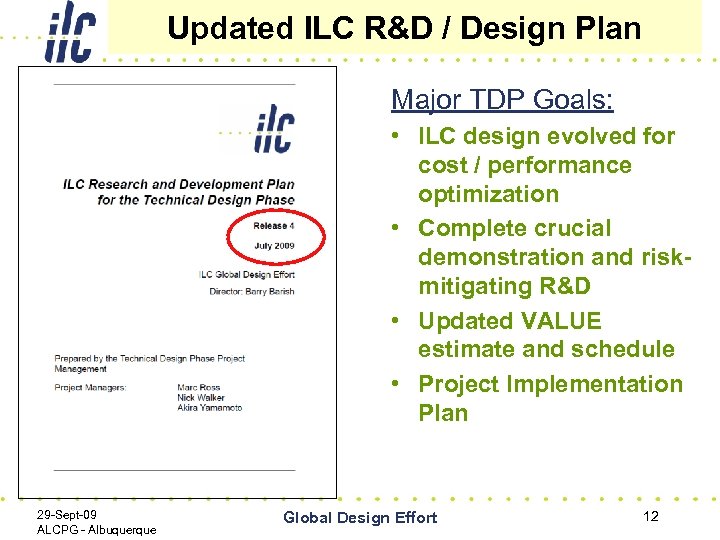
Updated ILC R&D / Design Plan Major TDP Goals: • ILC design evolved for cost / performance optimization • Complete crucial demonstration and riskmitigating R&D • Updated VALUE estimate and schedule • Project Implementation Plan 29 -Sept-09 ALCPG - Albuquerque Global Design Effort 12
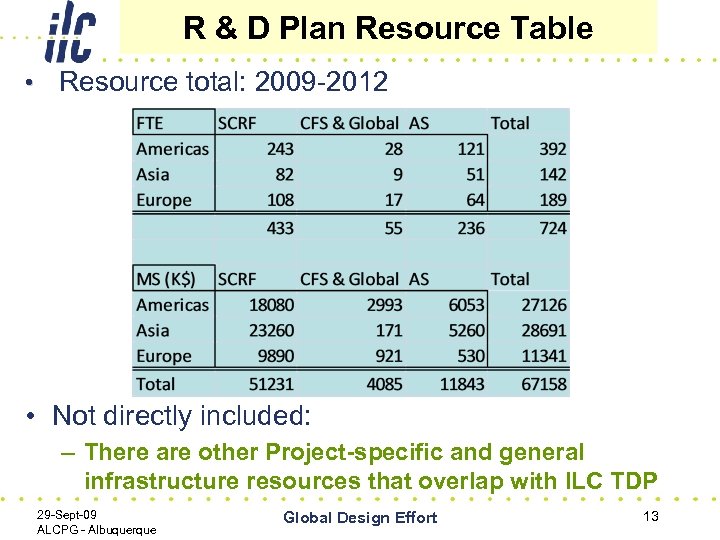
R & D Plan Resource Table • Resource total: 2009 -2012 • Not directly included: – There are other Project-specific and general infrastructure resources that overlap with ILC TDP 29 -Sept-09 ALCPG - Albuquerque Global Design Effort 13
2009 – 2012: Resource Outlook • Flat year-to-year resource basis – Focused on technical enabling R & D – Limited flexibility to manage needed ILC design and engineering development • Well matched between ILC technical and institutional priorities with some exceptions: – Positron system beam demonstrations – CF & S criteria optimization and site development 29 -Sept-09 ALCPG - Albuquerque Global Design Effort 14
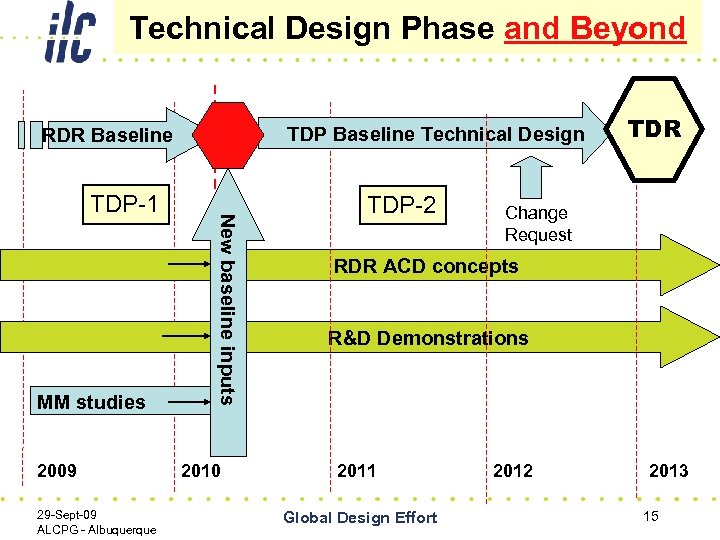
Technical Design Phase and Beyond TDP Baseline Technical Design RDR Baseline MM studies 2009 29 -Sept-09 ALCPG - Albuquerque New baseline inputs TDP-1 2010 TDP-2 TDR Change Request RDR ACD concepts R&D Demonstrations 2011 Global Design Effort 2012 2013 15
ILC R&D Beyond 2012 ? • The AAP points to uncertainties beyond 2012 in their conclusions: – “Some aspects of the R&D for the ILC will have to continue beyond 2012. ” – “The milestone 2012 is however timely placed. The LHC will be providing operating experience of a large facility and with some luck the first physics discoveries will emerge. ” – “The HEP community is thus well prepared for the decision for the next facility. In a sense the construction of the ILC seems the natural evolution of that process, in which case the efforts for the ILC have to be ramped up without delay. ” – “Nature may be less kind or science policy makers not ready for a decision on the next big HEP project. In this case the large community must be engaged to facilitate the decision for the construction of the next HEP project. ” • We need to prepare for uncertainties in the path to the ILC after 2012, including what LHC tells us. 29 -Sept-09 ALCPG - Albuquerque Global Design Effort 16
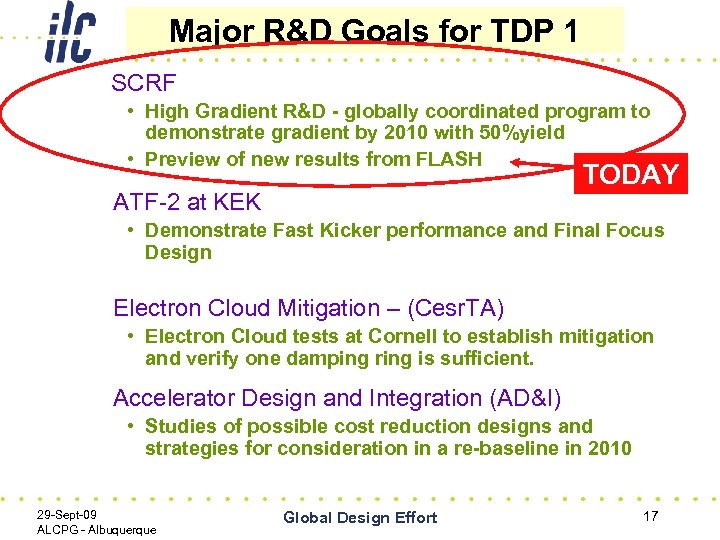
Major R&D Goals for TDP 1 SCRF • High Gradient R&D - globally coordinated program to demonstrate gradient by 2010 with 50%yield • Preview of new results from FLASH TODAY ATF-2 at KEK • Demonstrate Fast Kicker performance and Final Focus Design Electron Cloud Mitigation – (Cesr. TA) • Electron Cloud tests at Cornell to establish mitigation and verify one damping ring is sufficient. Accelerator Design and Integration (AD&I) • Studies of possible cost reduction designs and strategies for consideration in a re-baseline in 2010 29 -Sept-09 ALCPG - Albuquerque Global Design Effort 17
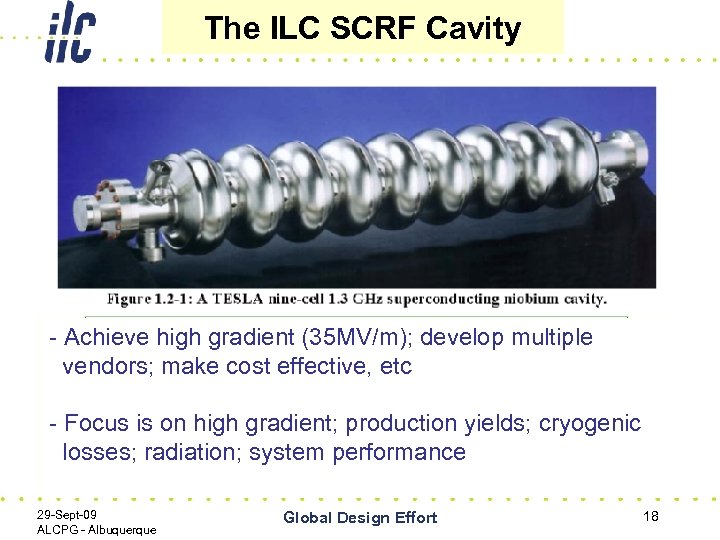
The ILC SCRF Cavity - Achieve high gradient (35 MV/m); develop multiple vendors; make cost effective, etc - Focus is on high gradient; production yields; cryogenic losses; radiation; system performance 29 -Sept-09 ALCPG - Albuquerque Global Design Effort 18
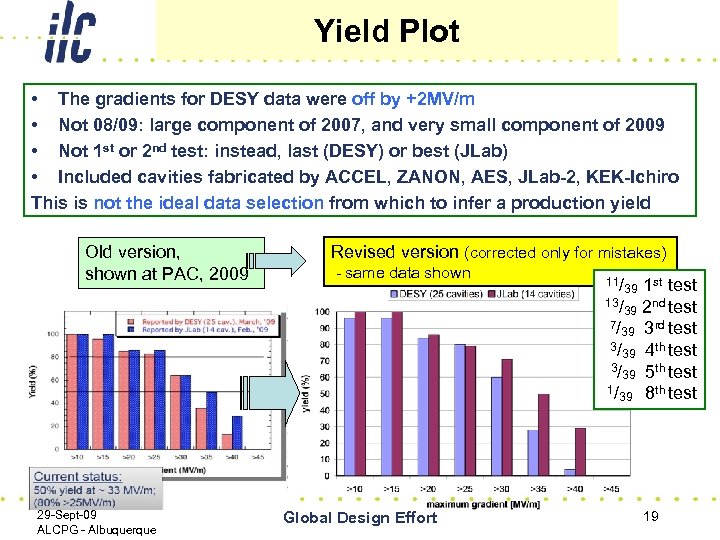
Yield Plot • The gradients for DESY data were off by +2 MV/m • Not 08/09: large component of 2007, and very small component of 2009 • Not 1 st or 2 nd test: instead, last (DESY) or best (JLab) • Included cavities fabricated by ACCEL, ZANON, AES, JLab-2, KEK-Ichiro This is not the ideal data selection from which to infer a production yield Old version, shown at PAC, 2009 29 -Sept-09 ALCPG - Albuquerque Revised version (corrected only for mistakes) - same data shown Global Design Effort 11/ 1 st test 13/ nd 39 2 test 7/ rd 39 3 test 3/ th 39 4 test 3/ th 39 5 test 1/ th 39 8 test 39 19
Definition of ‘Yield’ • Original S 0 concept assumed: – Surface can be reset according to the EP process, and – Multiple processes may be integrated for statistics. • Several years of experience shows – Repeat processing may cause degradation • Processing and Test recipe has been updated – Complete the process and test only with the first cycle • no further processing if the results are acceptable • Revision of the definition of ‘yield’ is required – Process (R&D) and Production definitions are different – A common means for collection and evaluation of the data is required 29 -Sept-09 ALCPG - Albuquerque Global Design Effort 20
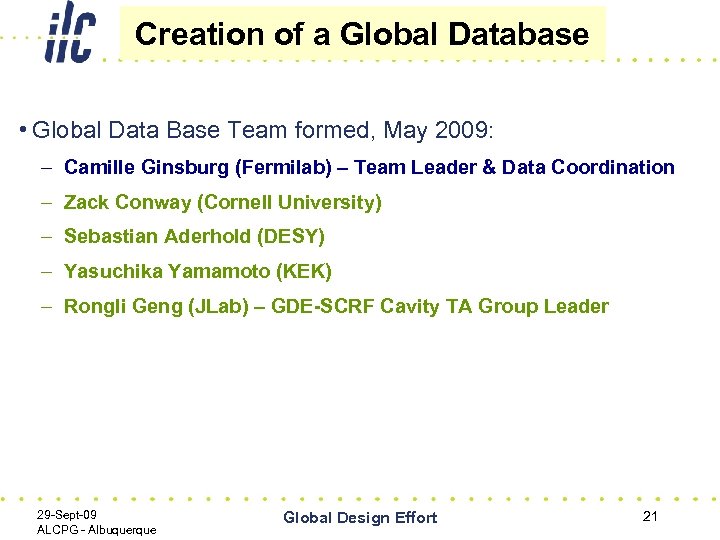
Creation of a Global Database • Global Data Base Team formed, May 2009: – Camille Ginsburg (Fermilab) – Team Leader & Data Coordination – Zack Conway (Cornell University) – Sebastian Aderhold (DESY) – Yasuchika Yamamoto (KEK) – Rongli Geng (JLab) – GDE-SCRF Cavity TA Group Leader 29 -Sept-09 ALCPG - Albuquerque Global Design Effort 21
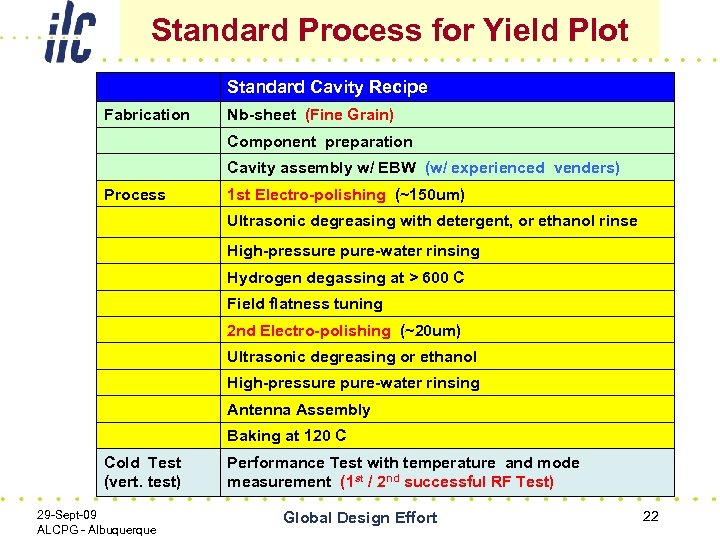
Standard Process for Yield Plot Standard Cavity Recipe Fabrication Nb-sheet (Fine Grain) Component preparation Cavity assembly w/ EBW (w/ experienced venders) Process 1 st Electro-polishing (~150 um) Ultrasonic degreasing with detergent, or ethanol rinse High-pressure pure-water rinsing Hydrogen degassing at > 600 C Field flatness tuning 2 nd Electro-polishing (~20 um) Ultrasonic degreasing or ethanol High-pressure pure-water rinsing Antenna Assembly Baking at 120 C Cold Test (vert. test) 29 -Sept-09 ALCPG - Albuquerque Performance Test with temperature and mode measurement (1 st / 2 nd successful RF Test) Global Design Effort 22
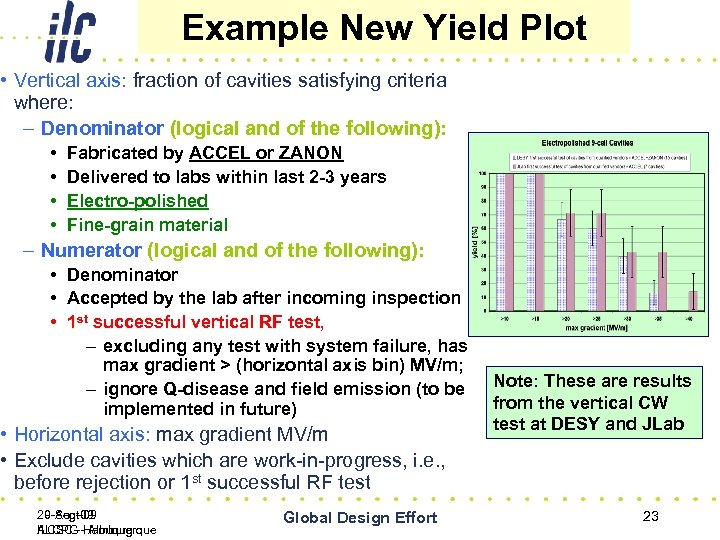
Example New Yield Plot • Vertical axis: fraction of cavities satisfying criteria where: – Denominator (logical and of the following): • • Fabricated by ACCEL or ZANON Delivered to labs within last 2 -3 years Electro-polished Fine-grain material – Numerator (logical and of the following): • Denominator • Accepted by the lab after incoming inspection • 1 st successful vertical RF test, – excluding any test with system failure, has max gradient > (horizontal axis bin) MV/m; – ignore Q-disease and field emission (to be implemented in future) • Horizontal axis: max gradient MV/m • Exclude cavities which are work-in-progress, i. e. , before rejection or 1 st successful RF test 29 -Sept-09 20 -Aug-09 ALCPG Albuquerque ILCSC - -Hamburg Global Design Effort Note: These are results from the vertical CW test at DESY and JLab 23
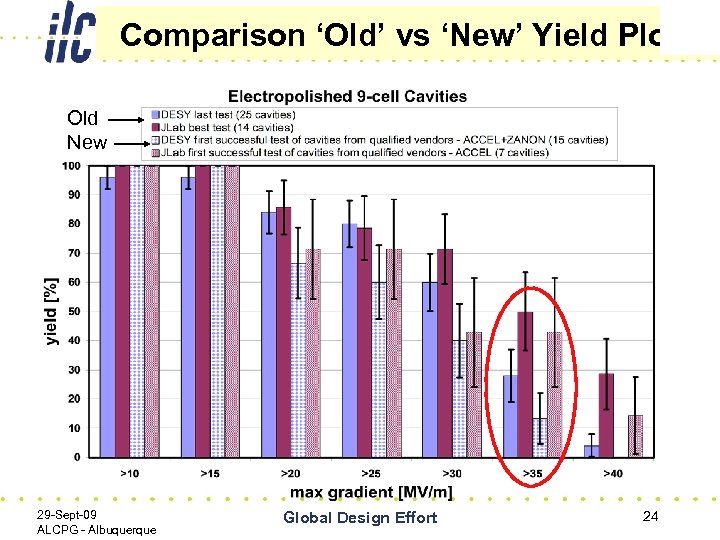
Comparison ‘Old’ vs ‘New’ Yield Plots Old New 29 -Sept-09 ALCPG - Albuquerque Global Design Effort 24
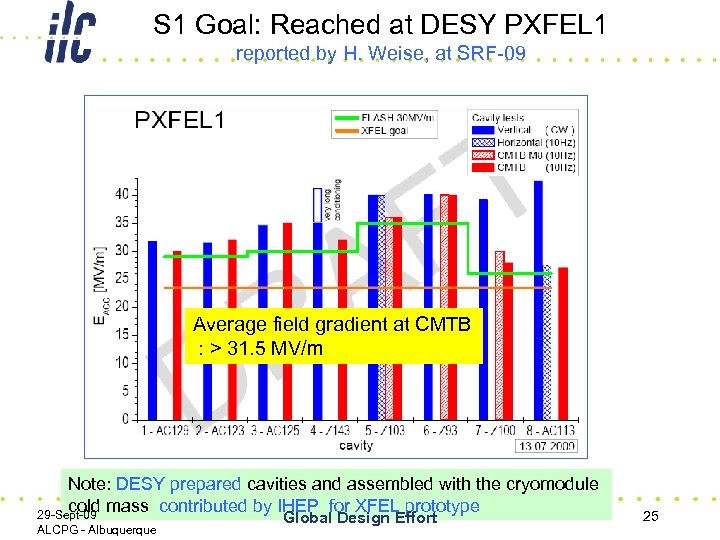
S 1 Goal: Reached at DESY PXFEL 1 reported by H. Weise, at SRF-09 Average field gradient at CMTB : > 31. 5 MV/m Note: DESY prepared cavities and assembled with the cryomodule cold mass contributed by IHEP for XFEL prototype 29 -Sept-09 ALCPG - Albuquerque Global Design Effort 25
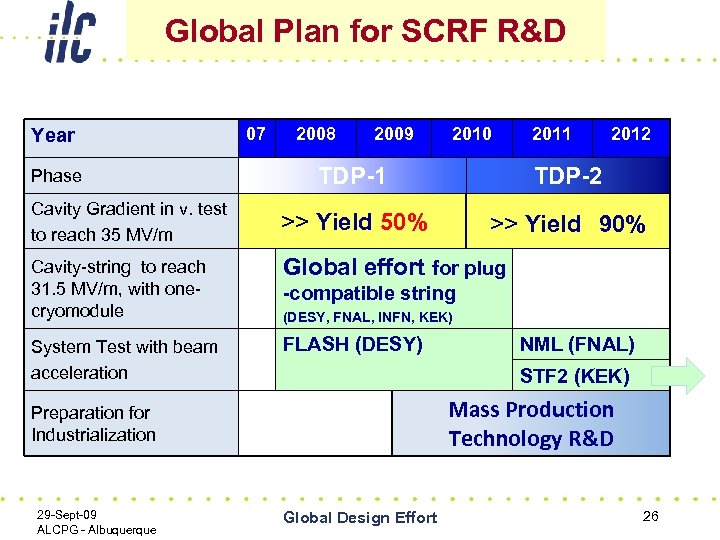
Global Plan for SCRF R&D Year Phase Cavity Gradient in v. test to reach 35 MV/m 07 2008 2009 2010 2011 2012 TDP-1 TDP-2 >> Yield 50% >> Yield 90% Cavity-string to reach 31. 5 MV/m, with onecryomodule Global effort for plug System Test with beam acceleration FLASH (DESY) -compatible string (DESY, FNAL, INFN, KEK) STF 2 (KEK) Mass Production Technology R&D Preparation for Industrialization 29 -Sept-09 ALCPG - Albuquerque NML (FNAL) Global Design Effort 26
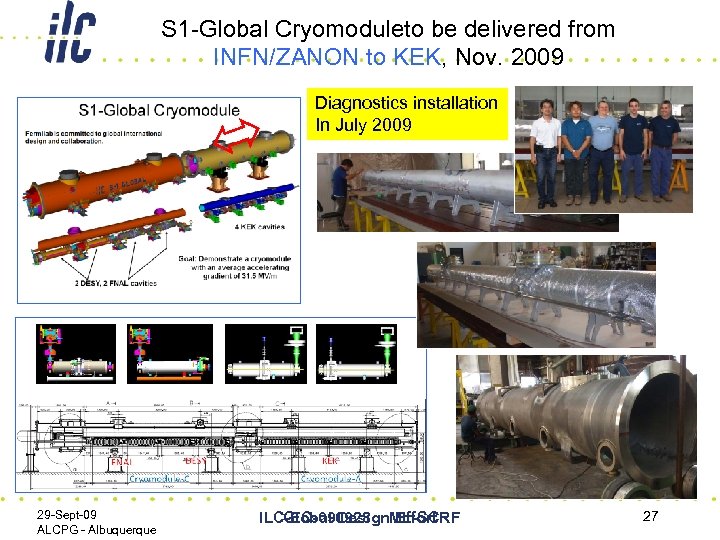
S 1 -Global Cryomoduleto be delivered from INFN/ZANON to KEK, Nov. 2009 Diagnostics installation In July 2009 29 -Sept-09 ALCPG - Albuquerque ILC-EC-090928 ML-SCRF Global Design Effort 27
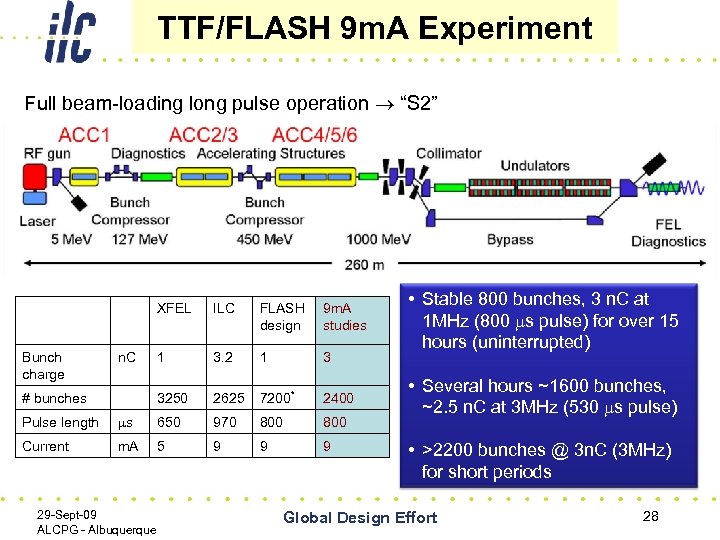
TTF/FLASH 9 m. A Experiment Full beam-loading long pulse operation “S 2” XFEL Bunch charge # bunches FLASH design 9 m. A studies 1 3. 2 1 3 3250 n. C ILC 2625 7200* 2400 Pulse length ms 650 970 800 Current m. A 5 9 9 9 29 -Sept-09 ALCPG - Albuquerque • Stable 800 bunches, 3 n. C at 1 MHz (800 ms pulse) for over 15 hours (uninterrupted) • Several hours ~1600 bunches, ~2. 5 n. C at 3 MHz (530 ms pulse) • >2200 bunches @ 3 n. C (3 MHz) for short periods Global Design Effort 28
9 m. A Experiment Status • Successfully completed 2 -week dedicated experiment – Total 5 -week interruption to FLASH photon user programme when shutdown for dump-repair is included (thanks to DESY) • Commissioning of new hardware – 3 MHz laser – Simcon-DSP LLRF system(s) – New instrumentation in dump line • Detailed data analysis now just beginning – Will take some months of analysis • Stable operation with high beam-loading (high beam-powers) demonstrated, but – Not all (original) 9 m. A goals were achieved – Routine operation of long bunch trains still requires work – Planning for next shifts (proposal) now underway 29 -Sept-09 ALCPG - Albuquerque Global Design Effort 29
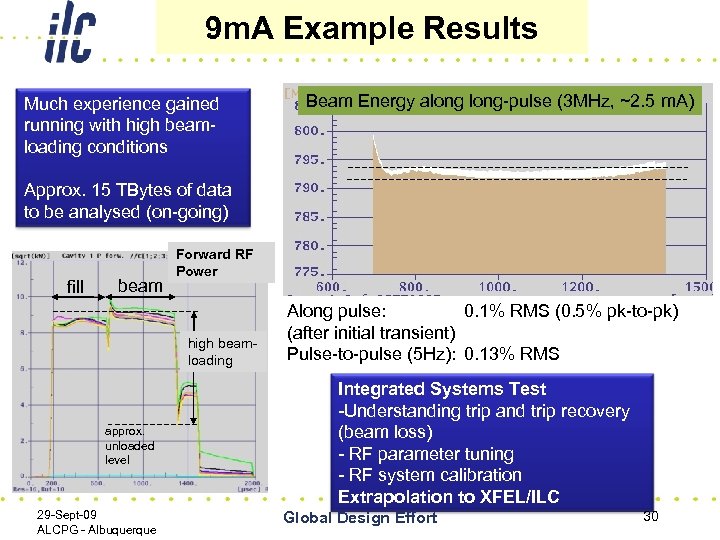
9 m. A Example Results Much experience gained running with high beamloading conditions Beam Energy along-pulse (3 MHz, ~2. 5 m. A) Approx. 15 TBytes of data to be analysed (on-going) fill beam Forward RF Power high beamloading approx. unloaded level 29 -Sept-09 ALCPG - Albuquerque Along pulse: 0. 1% RMS (0. 5% pk-to-pk) (after initial transient) Pulse-to-pulse (5 Hz): 0. 13% RMS Integrated Systems Test -Understanding trip and trip recovery (beam loss) - RF parameter tuning - RF system calibration Extrapolation to XFEL/ILC Global Design Effort 30
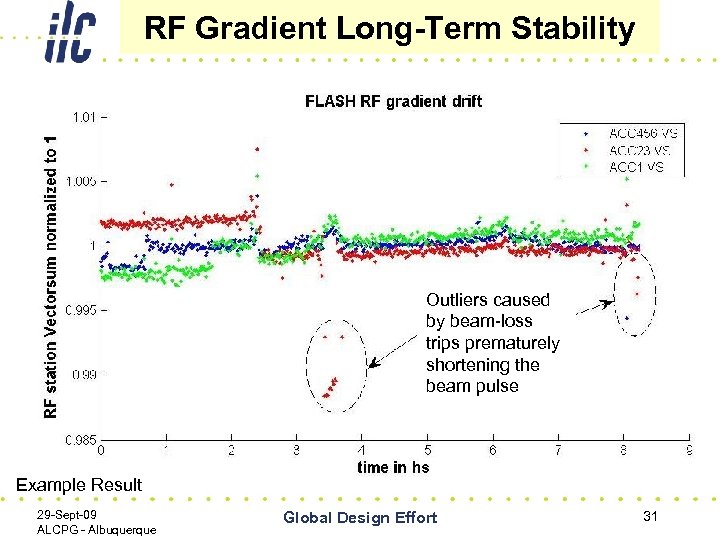
RF Gradient Long-Term Stability Outliers caused by beam-loss trips prematurely shortening the beam pulse Example Result 29 -Sept-09 ALCPG - Albuquerque Global Design Effort 31
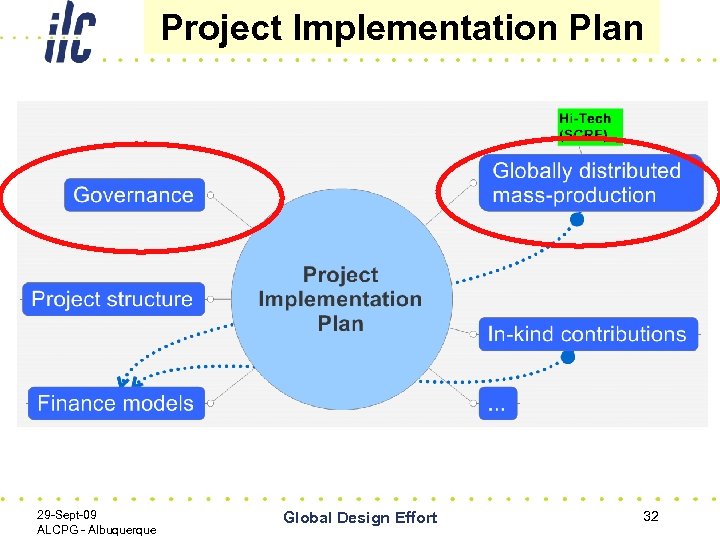
Project Implementation Plan 29 -Sept-09 ALCPG - Albuquerque Global Design Effort 32
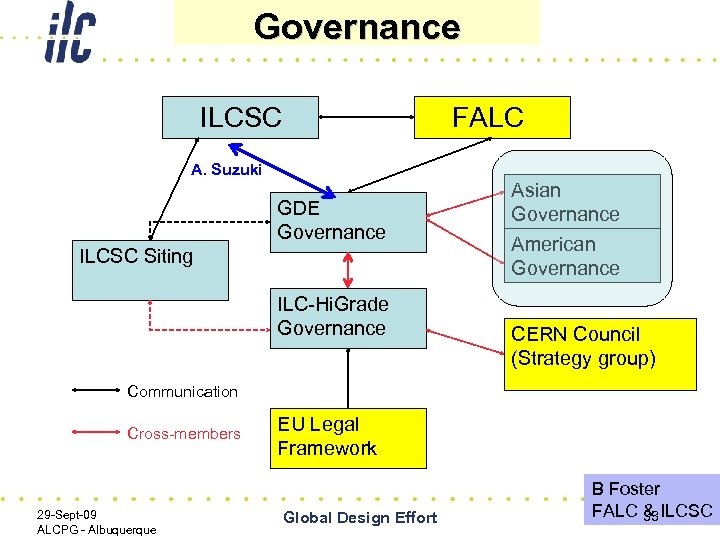
Governance ILCSC FALC A. Suzuki GDE Governance ILCSC Siting ILC-Hi. Grade Governance Asian Governance American Governance CERN Council (Strategy group) Communication Cross-members 29 -Sept-09 ALCPG - Albuquerque EU Legal Framework Global Design Effort B Foster FALC & ILCSC 33
Studies of other Large Projects Inferences 1) Achieving a consensus and implementing a method of governance is a long-drawnout and complex process. It needs strong involvement and buy-in from funding authorities and governments at all stages. The statement of the OECD science ministers in 2004: “. . They agreed that the planning and implementation of such a large, multi-year project should be carried out on a global basis, and should involve consultations among not just scientists, but also representatives of science funding agencies from interested countries. Accordingly, Ministers endorsed the statement prepared by the OECD Global Science Forum Consultative Group on High-Energy Physics…” is important in this regard. 2) All the schemes explored by the monitored projects seem to be viable, including negotiation of an international treaty (ITER) and foundation of a company with limited liability (XFEL, FAIR). There does not seem to be much difference in the complexity of time taken between the various options : n. b. Do. E in US has signed the ITER treaty. 3) The ILC laboratory has to have its own legal standing as a legal entity and the ability to hire staff directly. Questions such as pension rights, tax status need to be solved well in advance of setting up the organisation. 29 -Sept-09 ALCPG - Albuquerque Global Design Effort B Foster FALC & ILCSC 34
Studies of other Large Projects Inferences 4) Strong management structure essential, with clear responsibles and delegation down to appropriate level for decision making. Clear reporting paths to single bodies. Appropriate regional management structures need to be considered. 5) In-kind contributions will have important role in project. Essential to have large enough common fund to be able to react to changes in cost estimates and have enough management flexibility to be able to optimise resources. Need agreement on how to deal with cost changes on particular items. 6) Need common project management tools and well defined procedure to make changes in projects specification if necessary as development progresses. 7) Need early agreement on site selection procedure, which should be extremely well defined and call for site proposals with an agreed timetable. 8) Do not under-estimate the length of time taken e. g. to agree on official translations of documents to by signed by partners across the world! 29 -Sept-09 Slide 35 ALCPG - Albuquerque Global Design Effort B Foster FALC & ILCSC 35
Related Studies The EU initiative on European Scientific Infrastructures mentioned in context of ESS – will be important for future European Infrastructures but not directly applicable for fully international projects such as ILC – nevertheless, interesting for ILC. CERN Council Strategy Group – planning to revise current European Plan, taking close account of world situation, in around 2012. Fits in well with GDE plans. OECD study – OECD Megascience forum, in particular secretariat led by S. Michelowski, intend to produce study on large international infrastructures. Good contacts between GDE and OECD and will work closely together as this work continues. 29 -Sept-09 ALCPG - Albuquerque Global Design Effort B Foster FALC & ILCSC 36
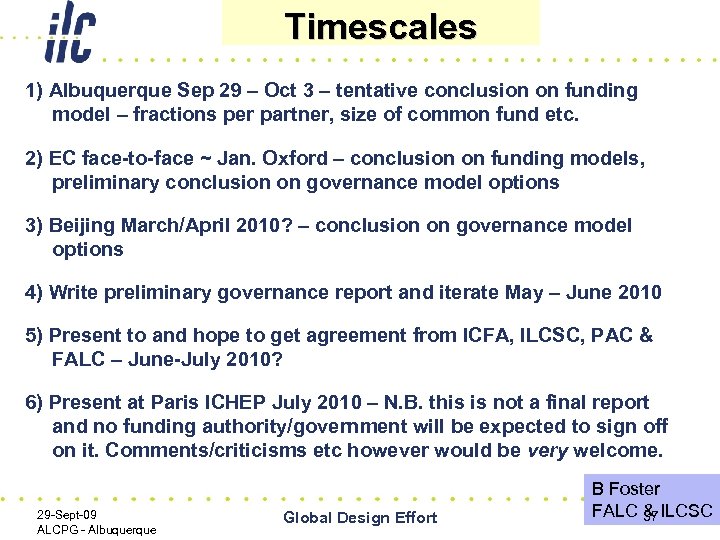
Timescales 1) Albuquerque Sep 29 – Oct 3 – tentative conclusion on funding model – fractions per partner, size of common fund etc. 2) EC face-to-face ~ Jan. Oxford – conclusion on funding models, preliminary conclusion on governance model options 3) Beijing March/April 2010? – conclusion on governance model options 4) Write preliminary governance report and iterate May – June 2010 5) Present to and hope to get agreement from ICFA, ILCSC, PAC & FALC – June-July 2010? 6) Present at Paris ICHEP July 2010 – N. B. this is not a final report and no funding authority/government will be expected to sign off on it. Comments/criticisms etc however would be very welcome. 29 -Sept-09 ALCPG - Albuquerque Global Design Effort B Foster FALC & ILCSC 37
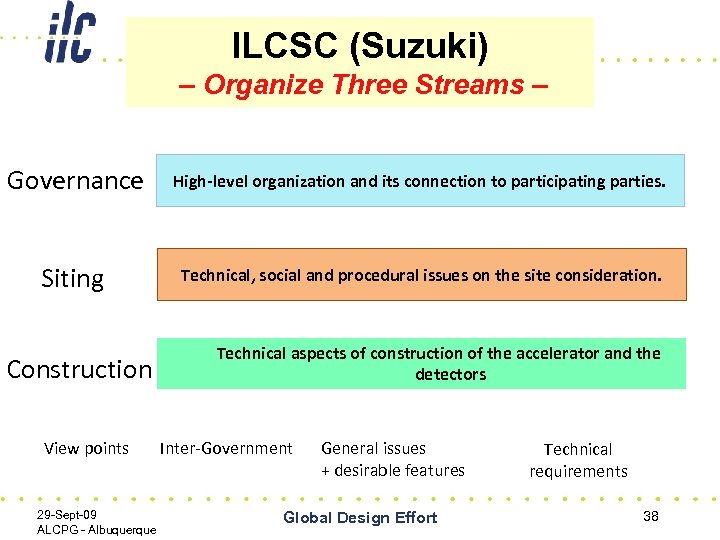
ILCSC (Suzuki) – Organize Three Streams – Governance High-level organization and its connection to participating parties. Siting Technical, social and procedural issues on the site consideration. Construction View points 29 -Sept-09 ALCPG - Albuquerque Technical aspects of construction of the accelerator and the detectors Inter-Government General issues + desirable features Global Design Effort Technical requirements 38
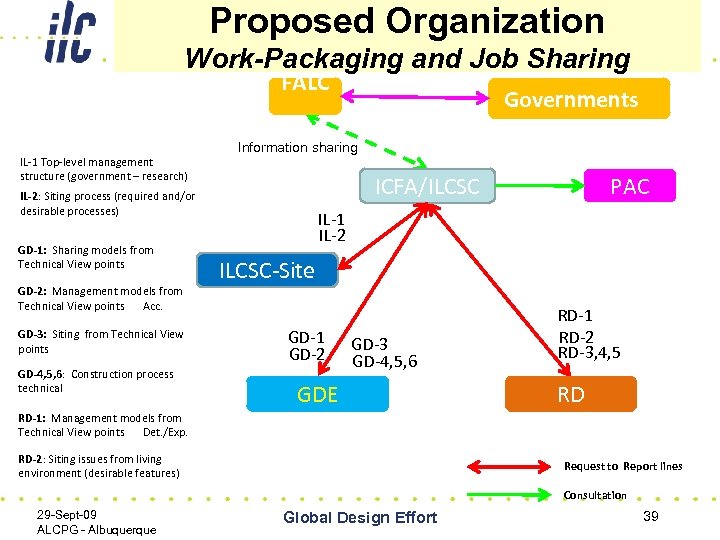
Proposed Organization Work-Packaging and Job Sharing FALC IL-1 Top-level management structure (government – research) Information sharing ICFA/ILCSC IL-2: Siting process (required and/or desirable processes) GD-1: Sharing models from Technical View points GD-2: Management models from Technical View points Acc. GD-3: Siting from Technical View points GD-4, 5, 6: Construction process technical Governments PAC IL-1 IL-2 ILCSC-Site GD-1 GD-2 GD-3 GD-4, 5, 6 GDE RD-1 RD-2 RD-3, 4, 5 RD RD-1: Management models from Technical View points Det. /Exp. RD-2: Siting issues from living environment (desirable features) Request to Report lines Consultation 29 -Sept-09 ALCPG - Albuquerque Global Design Effort 39
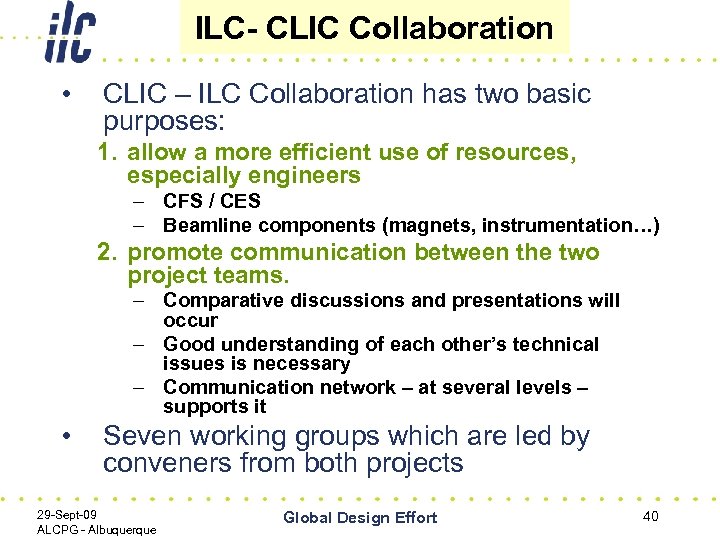
ILC- CLIC Collaboration • CLIC – ILC Collaboration has two basic purposes: 1. allow a more efficient use of resources, especially engineers – CFS / CES – Beamline components (magnets, instrumentation…) 2. promote communication between the two project teams. – Comparative discussions and presentations will occur – Good understanding of each other’s technical issues is necessary – Communication network – at several levels – supports it • Seven working groups which are led by conveners from both projects 29 -Sept-09 ALCPG - Albuquerque Global Design Effort 40
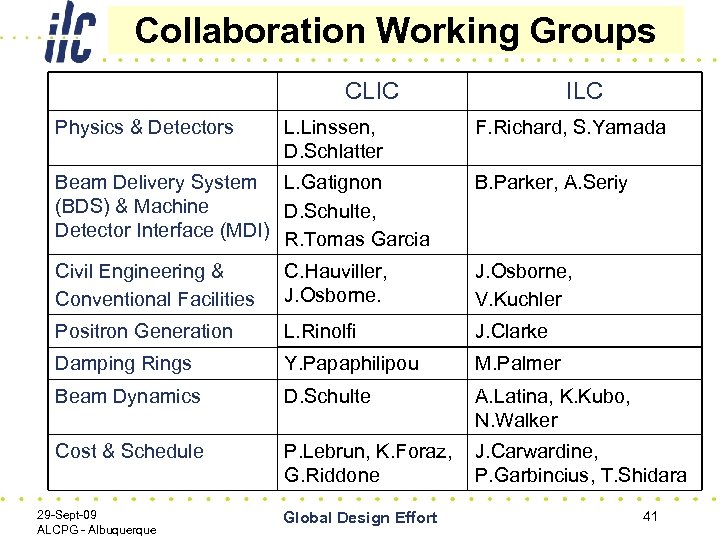
Collaboration Working Groups CLIC Physics & Detectors L. Linssen, D. Schlatter ILC F. Richard, S. Yamada Beam Delivery System L. Gatignon (BDS) & Machine D. Schulte, Detector Interface (MDI) R. Tomas Garcia B. Parker, A. Seriy Civil Engineering & Conventional Facilities C. Hauviller, J. Osborne, V. Kuchler Positron Generation L. Rinolfi J. Clarke Damping Rings Y. Papaphilipou M. Palmer Beam Dynamics D. Schulte A. Latina, K. Kubo, N. Walker Cost & Schedule P. Lebrun, K. Foraz, G. Riddone J. Carwardine, P. Garbincius, T. Shidara 29 -Sept-09 ALCPG - Albuquerque Global Design Effort 41
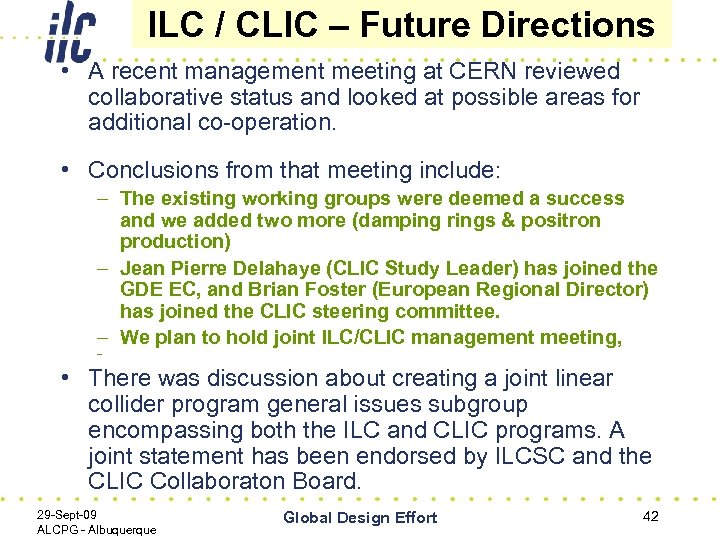
ILC / CLIC – Future Directions • A recent management meeting at CERN reviewed collaborative status and looked at possible areas for additional co-operation. • Conclusions from that meeting include: – The existing working groups were deemed a success and we added two more (damping rings & positron production) – Jean Pierre Delahaye (CLIC Study Leader) has joined the GDE EC, and Brian Foster (European Regional Director) has joined the CLIC steering committee. – We plan to hold joint ILC/CLIC management meeting, – • There was discussion about creating a joint linear collider program general issues subgroup encompassing both the ILC and CLIC programs. A joint statement has been endorsed by ILCSC and the CLIC Collaboraton Board. 29 -Sept-09 ALCPG - Albuquerque Global Design Effort 42
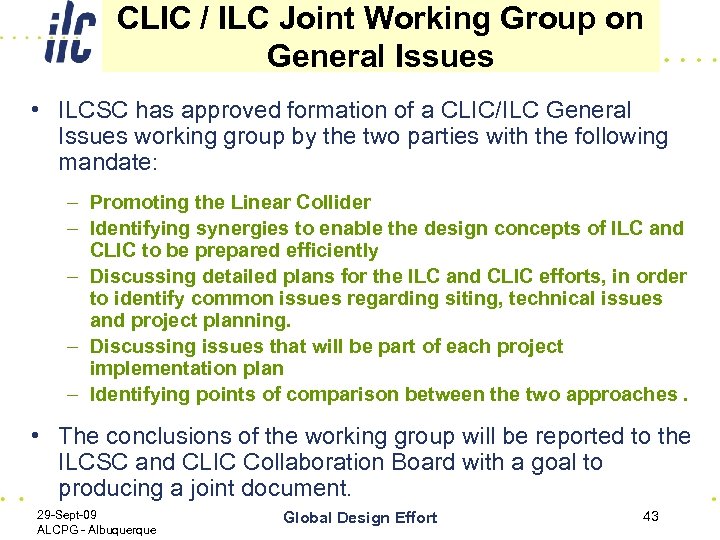
CLIC / ILC Joint Working Group on General Issues • ILCSC has approved formation of a CLIC/ILC General Issues working group by the two parties with the following mandate: – Promoting the Linear Collider – Identifying synergies to enable the design concepts of ILC and CLIC to be prepared efficiently – Discussing detailed plans for the ILC and CLIC efforts, in order to identify common issues regarding siting, technical issues and project planning. – Discussing issues that will be part of each project implementation plan – Identifying points of comparison between the two approaches. • The conclusions of the working group will be reported to the ILCSC and CLIC Collaboration Board with a goal to producing a joint document. 29 -Sept-09 ALCPG - Albuquerque Global Design Effort 43
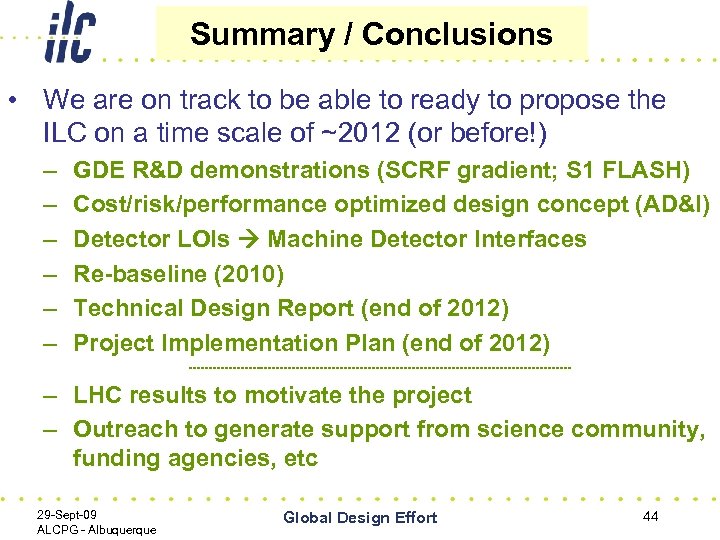
Summary / Conclusions • We are on track to be able to ready to propose the ILC on a time scale of ~2012 (or before!) – – – GDE R&D demonstrations (SCRF gradient; S 1 FLASH) Cost/risk/performance optimized design concept (AD&I) Detector LOIs Machine Detector Interfaces Re-baseline (2010) Technical Design Report (end of 2012) Project Implementation Plan (end of 2012) ------------------------------------------------ – LHC results to motivate the project – Outreach to generate support from science community, funding agencies, etc 29 -Sept-09 ALCPG - Albuquerque Global Design Effort 44
Скачать презентацию GDE Report Barry Barish ALCPG Albuquerque 29
c083e1dc994e9d0859376662e9947e70.ppt