


 Скачать презентацию GCSE Physics Magnetism and Electromagnetism 1 Lesson
b4ea29a8cf186d2ae25fc1a926e0c21a.ppt
- Количество слайдов: 44
 GCSE Physics Magnetism and Electromagnetism 1
 Lesson 6 - Transformers Aims: • To recall the structure of a transformer, and understand that a transformer changes the size of an alternating voltage by having different numbers of turns on the input and output sides. • To know and be able to use the relationship between input (primary) and output (secondary) voltages and the turns ratio for a transformer : 2
 What is a transformer? 3
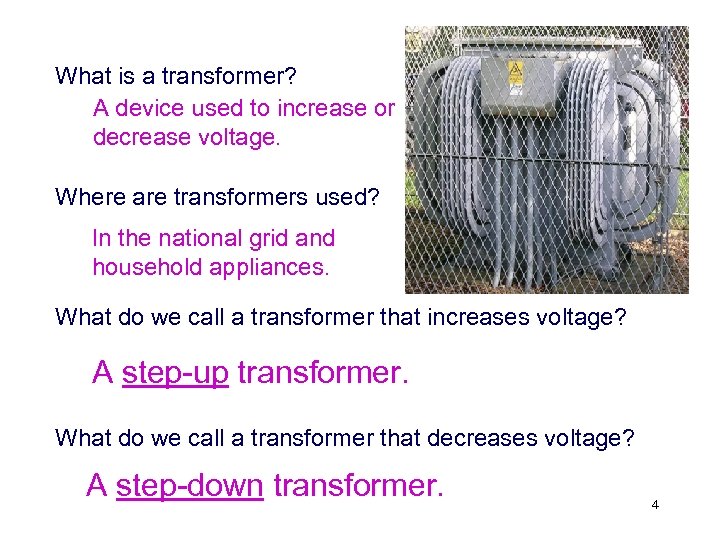 What is a transformer? A device used to increase or decrease voltage. Where are transformers used? In the national grid and household appliances. What do we call a transformer that increases voltage? A step-up transformer. What do we call a transformer that decreases voltage? A step-down transformer. 4
 Transformers • A transformer has two electromagnetic coils. • When the electricity changes in the first coil an electric voltage is created across the second coil. • Transformers are used to change the voltage and current of the electricity that comes from BELCO. 5
 How does it work? 6
 Transformers • A transformer can change the voltage and current of an electrical supply. • Some devices need low voltage and some need high voltage. • Only a. c. voltage can be transformed from one voltage to another, this is why mains electricity needs to be a. c. • To understand a transformer we need to learn more about coils and cores. 7
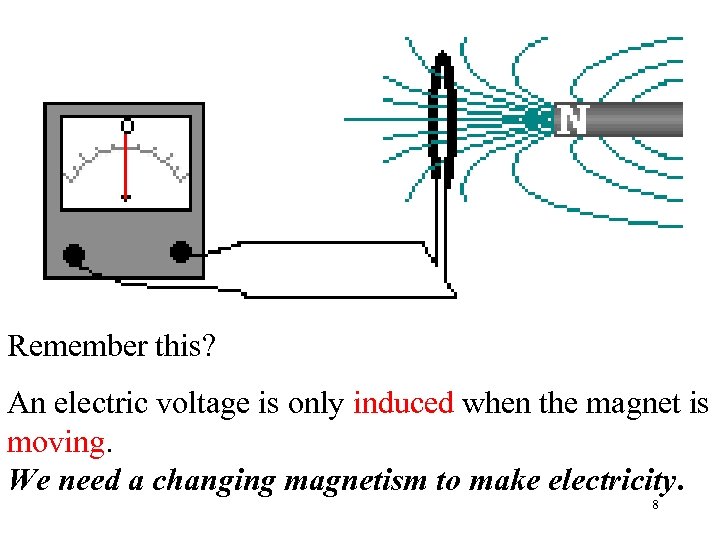 Remember this? An electric voltage is only induced when the magnet is moving. We need a changing magnetism to make electricity. 8
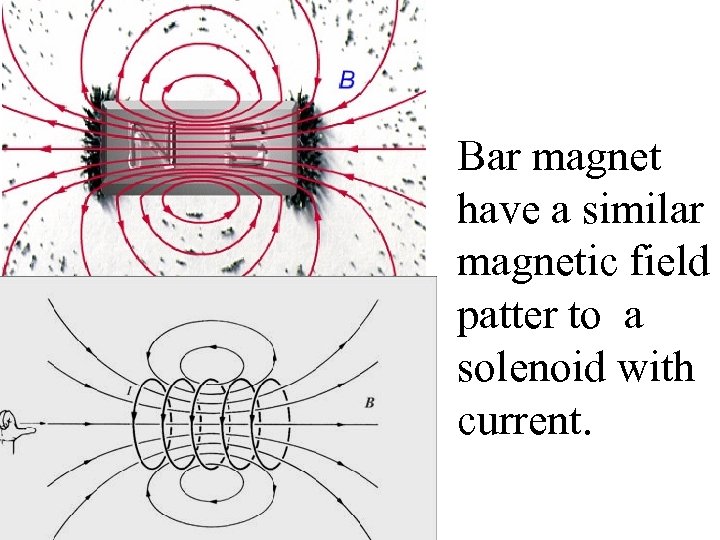 Bar magnet have a similar magnetic field patter to a solenoid with current.
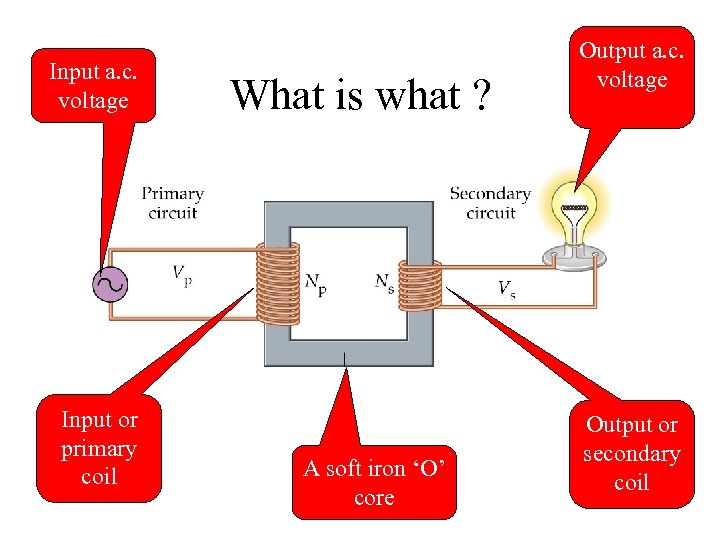 Input a. c. voltage Input or primary coil What is what ? A soft iron ‘O’ core Output a. c. voltage Output or secondary coil 10
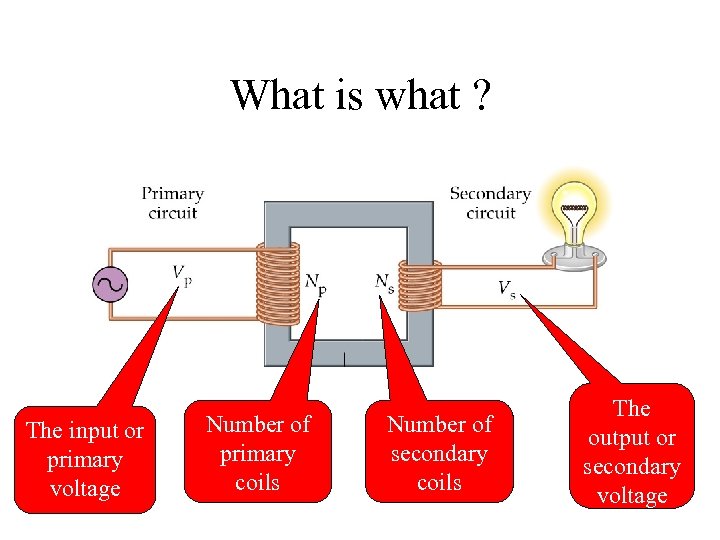 What is what ? The input or primary voltage Number of primary coils Number of secondary coils The output or secondary voltage 11
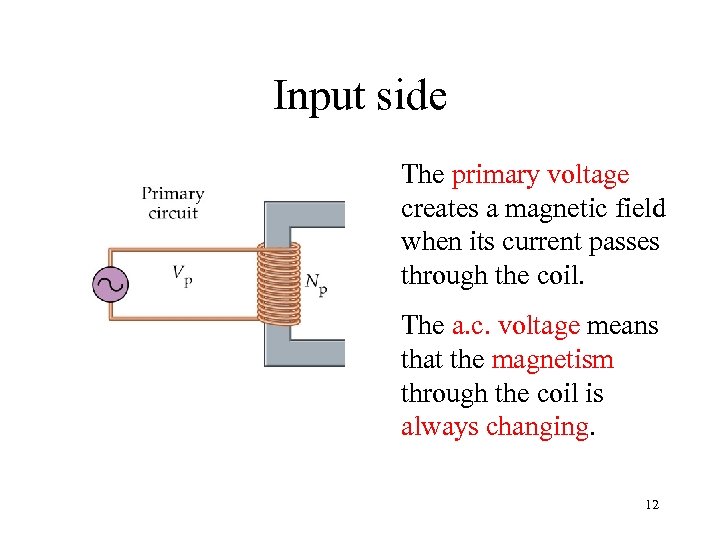 Input side The primary voltage creates a magnetic field when its current passes through the coil. The a. c. voltage means that the magnetism through the coil is always changing. 12
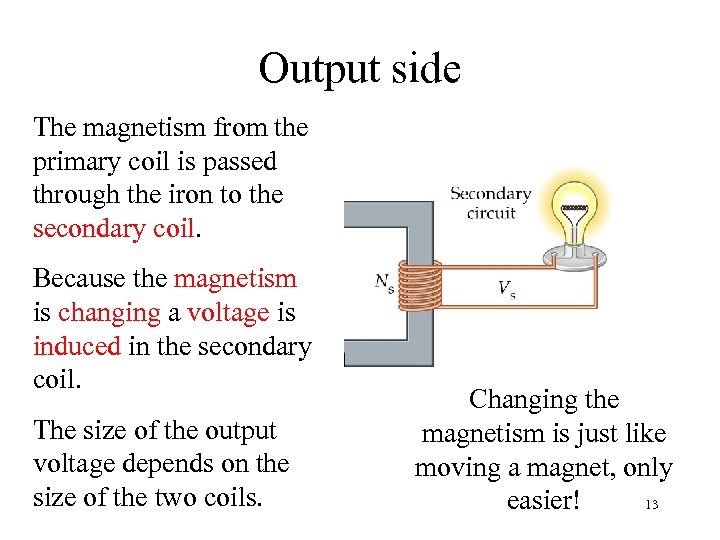 Output side The magnetism from the primary coil is passed through the iron to the secondary coil. Because the magnetism is changing a voltage is induced in the secondary coil. The size of the output voltage depends on the size of the two coils. Changing the magnetism is just like moving a magnet, only 13 easier!
 Soft iron core • Iron is a soft magnetic material, this means that it is very easy to magnetize and very easy to demagnetize. • In a transformer the direction of electricity is changing many times each second. • Every fraction of a second the core needs to change its magnetism. We use iron because it can change its magnetism from one direction to another very easily. 14
 Lamp demonstration 15
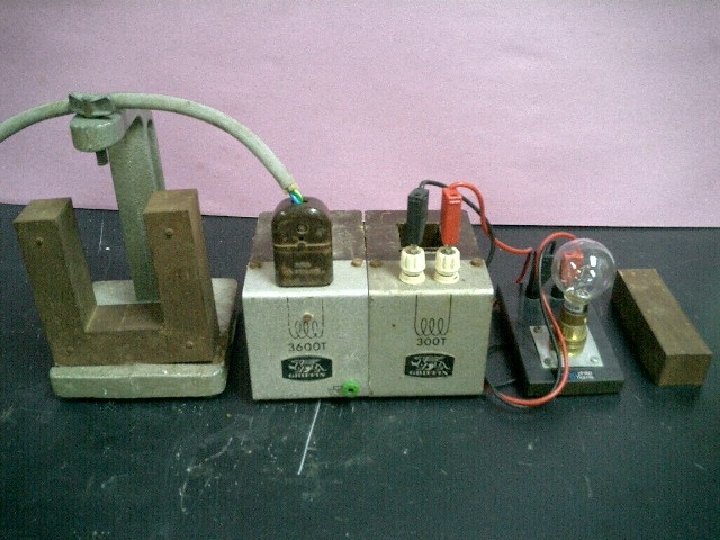
 Transformers • Transformers change the voltage and current of an a. c. electrical supply. • In the following experiment mains electricity at 220 volts enters the circuit. • After leaving the transformer the voltage has been reduced to approximately 11 volts. 16
 17
17
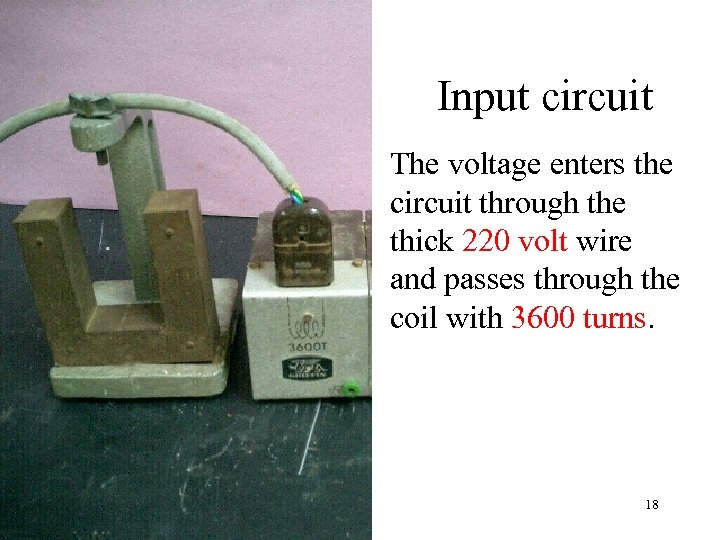 Input circuit The voltage enters the circuit through the thick 220 volt wire and passes through the coil with 3600 turns. 18
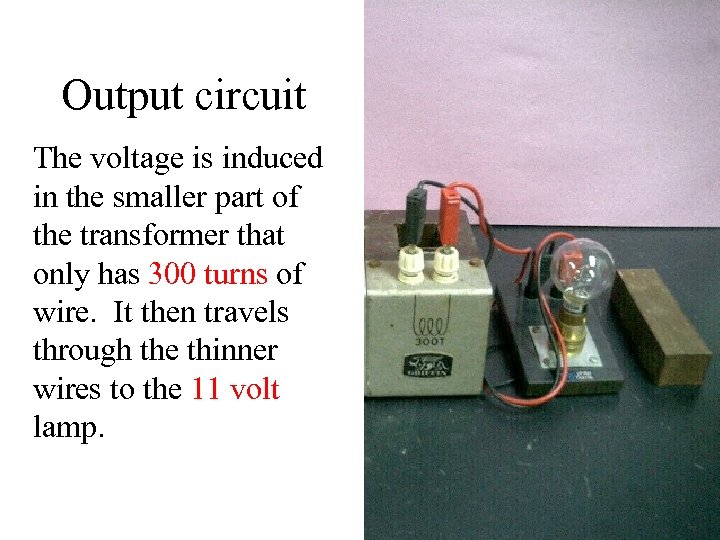 Output circuit The voltage is induced in the smaller part of the transformer that only has 300 turns of wire. It then travels through the thinner wires to the 11 volt lamp. 19
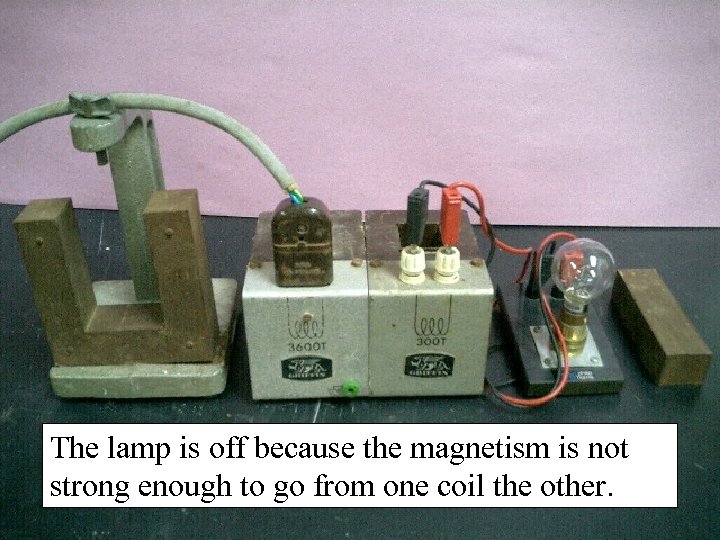 The lamp is off because the magnetism is not strong enough to go from one coil the other. 20
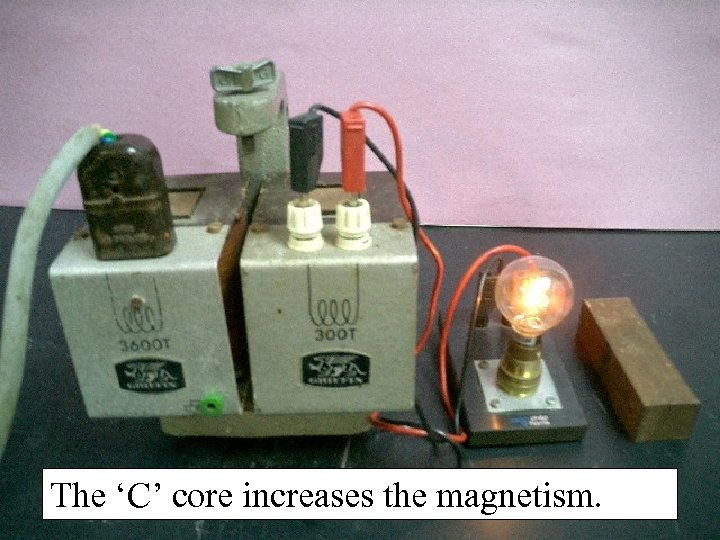 The ‘C’ core increases the magnetism. 21
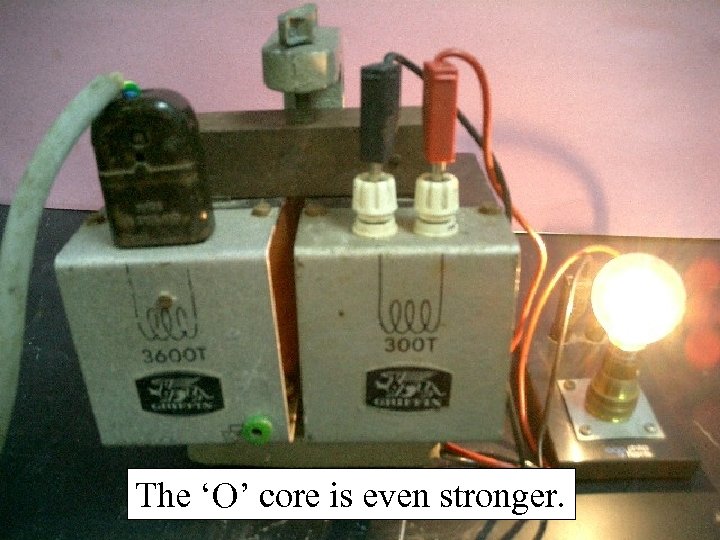 The ‘O’ core is even stronger. 22
 Step up and Step down … and an equation to learn! 23
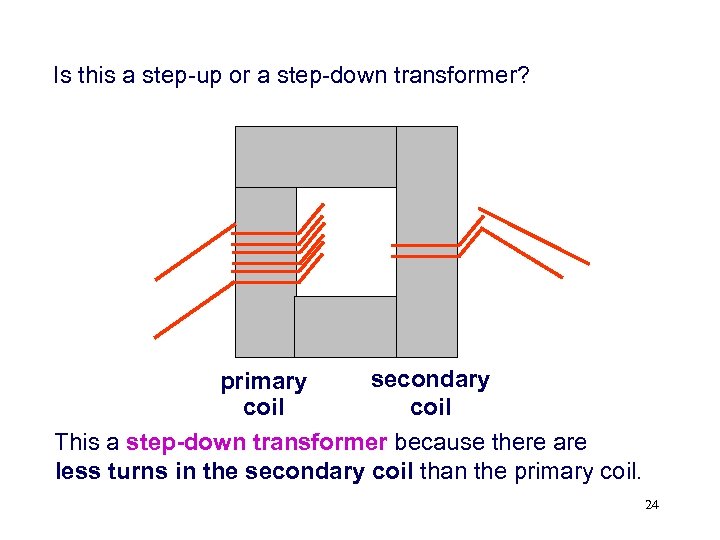 Is this a step-up or a step-down transformer? secondary primary coil This a step-down transformer because there are less turns in the secondary coil than the primary coil. 24
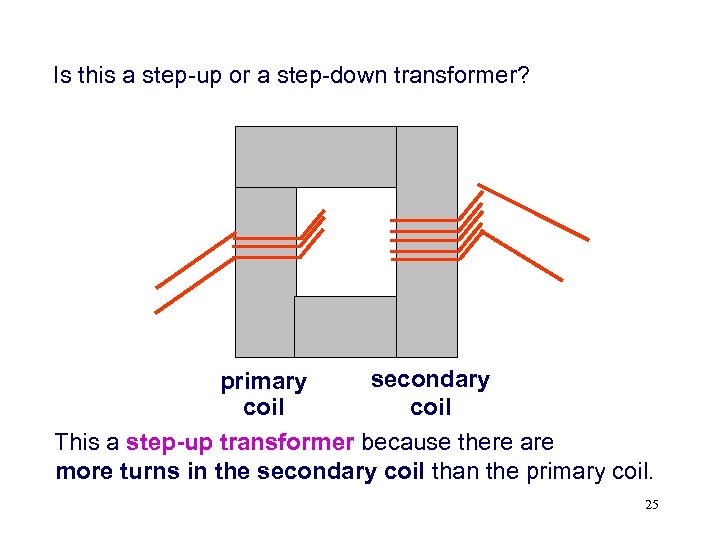 Is this a step-up or a step-down transformer? secondary primary coil This a step-up transformer because there are more turns in the secondary coil than the primary coil. 25
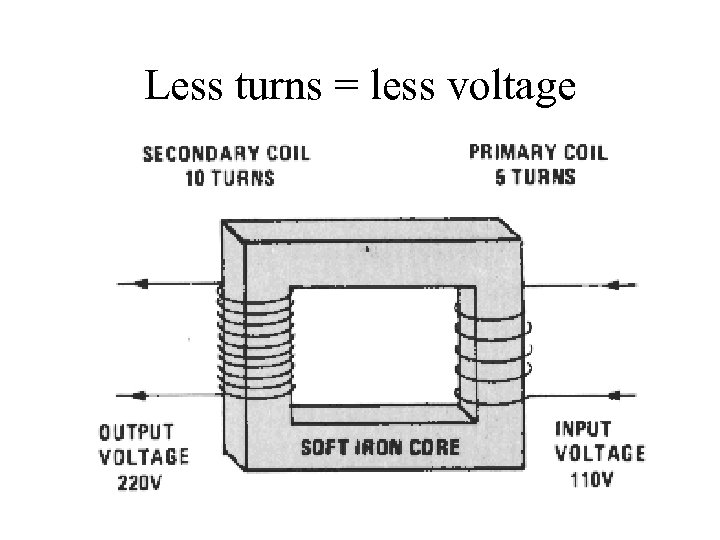 Less turns = less voltage 26
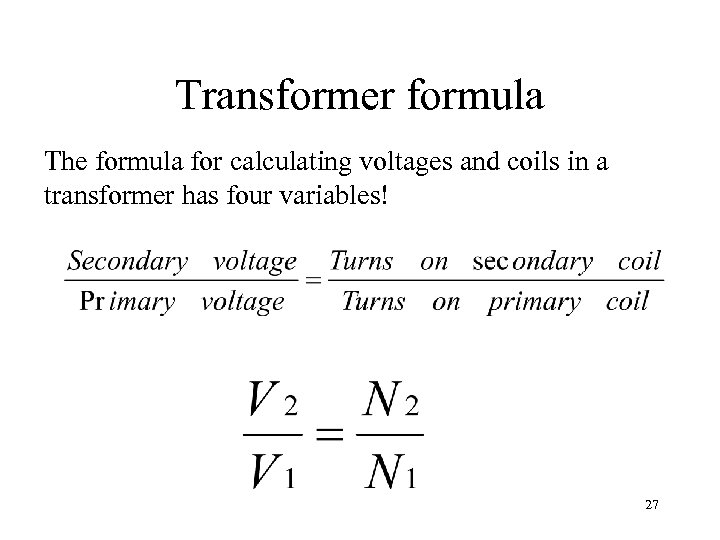 Transformer formula The formula for calculating voltages and coils in a transformer has four variables! 27
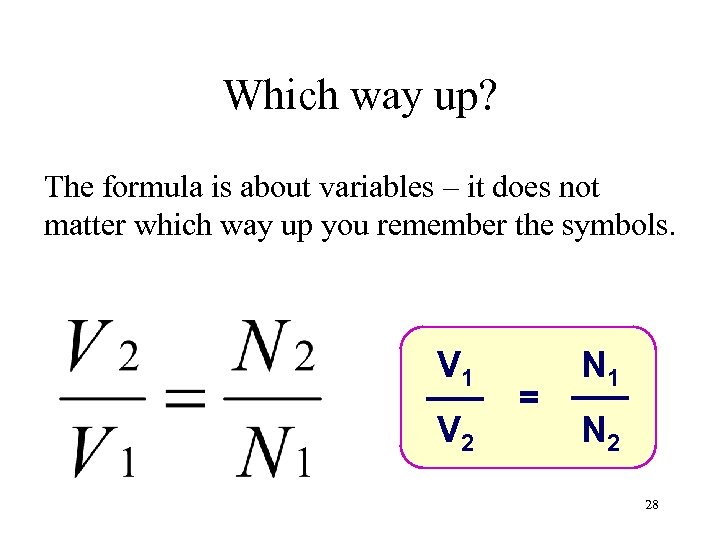 Which way up? The formula is about variables – it does not matter which way up you remember the symbols. V 1 V 2 = N 1 N 2 28
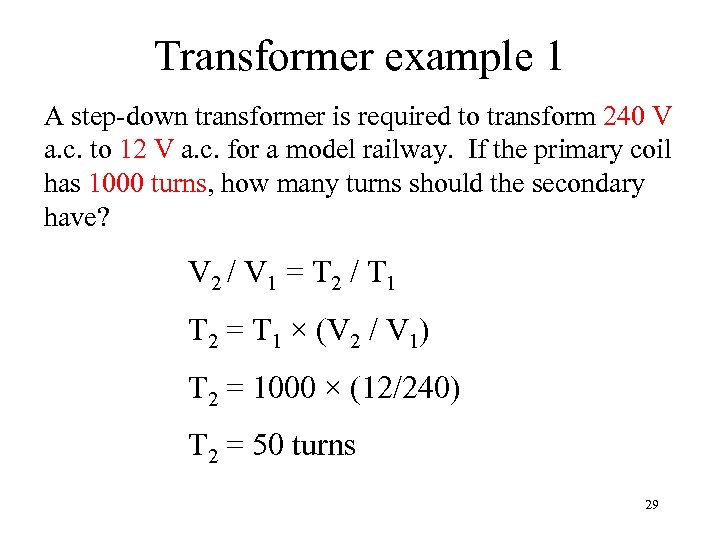 Transformer example 1 A step-down transformer is required to transform 240 V a. c. to 12 V a. c. for a model railway. If the primary coil has 1000 turns, how many turns should the secondary have? V 2 / V 1 = T 2 / T 1 T 2 = T 1 × (V 2 / V 1) T 2 = 1000 × (12/240) T 2 = 50 turns 29
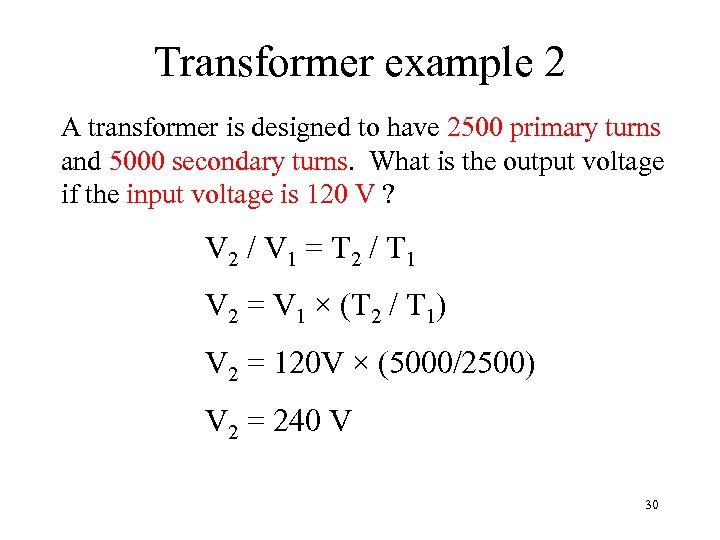 Transformer example 2 A transformer is designed to have 2500 primary turns and 5000 secondary turns. What is the output voltage if the input voltage is 120 V ? V 2 / V 1 = T 2 / T 1 V 2 = V 1 × (T 2 / T 1) V 2 = 120 V × (5000/2500) V 2 = 240 V 30
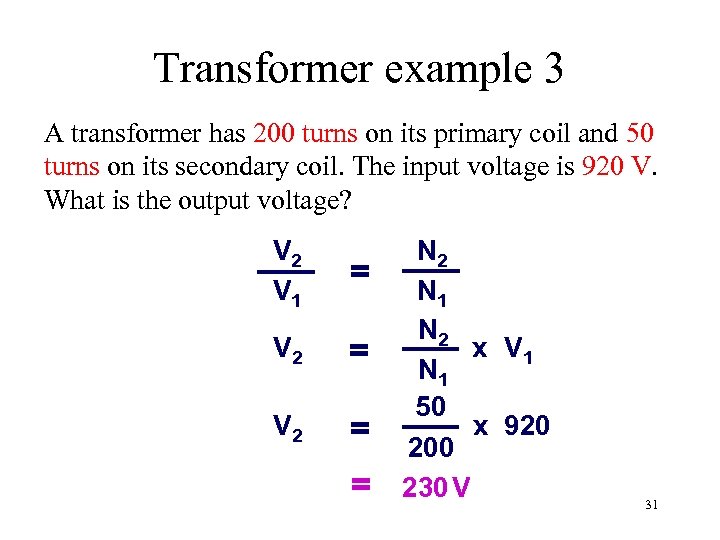 Transformer example 3 A transformer has 200 turns on its primary coil and 50 turns on its secondary coil. The input voltage is 920 V. What is the output voltage? V 2 V 1 = V 2 = = N 2 N 1 N 2 x V 1 N 1 50 x 920 200 230 V 31
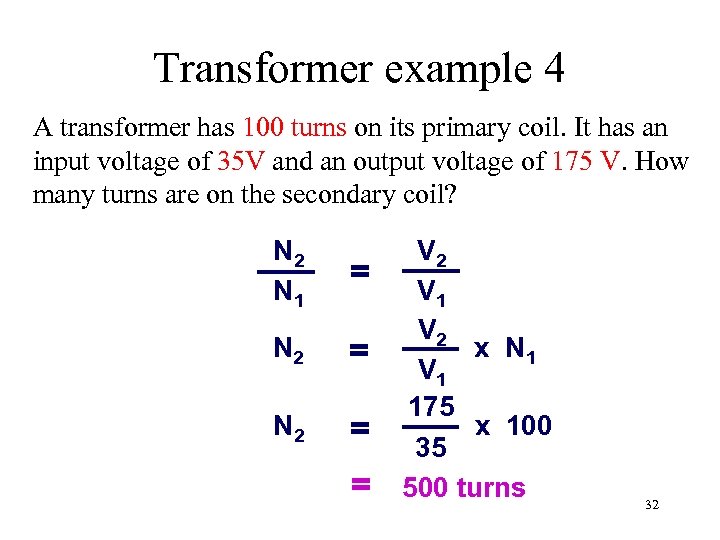 Transformer example 4 A transformer has 100 turns on its primary coil. It has an input voltage of 35 V and an output voltage of 175 V. How many turns are on the secondary coil? N 2 N 1 = N 2 = = V 2 V 1 V 2 x N 1 V 1 175 x 100 35 500 turns 32
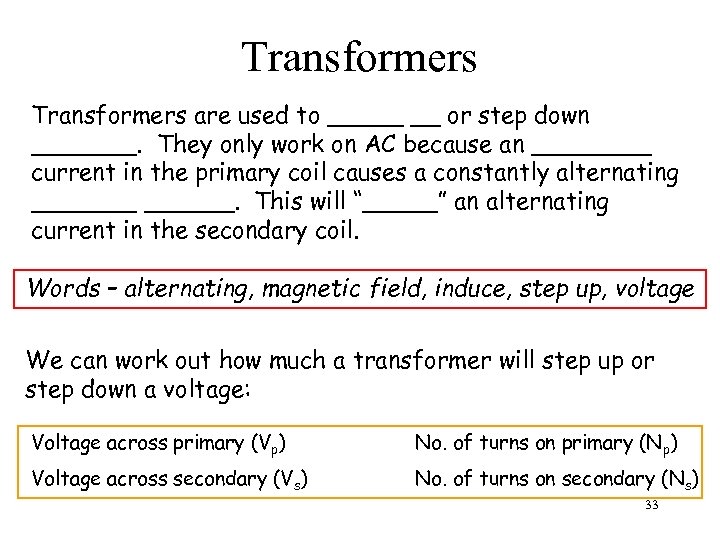 Transformers are used to _____ __ or step down _______. They only work on AC because an ____ current in the primary coil causes a constantly alternating _______. This will “_____” an alternating current in the secondary coil. Words – alternating, magnetic field, induce, step up, voltage We can work out how much a transformer will step up or step down a voltage: Voltage across primary (Vp) No. of turns on primary (Np) Voltage across secondary (Vs) No. of turns on secondary (Ns) 33
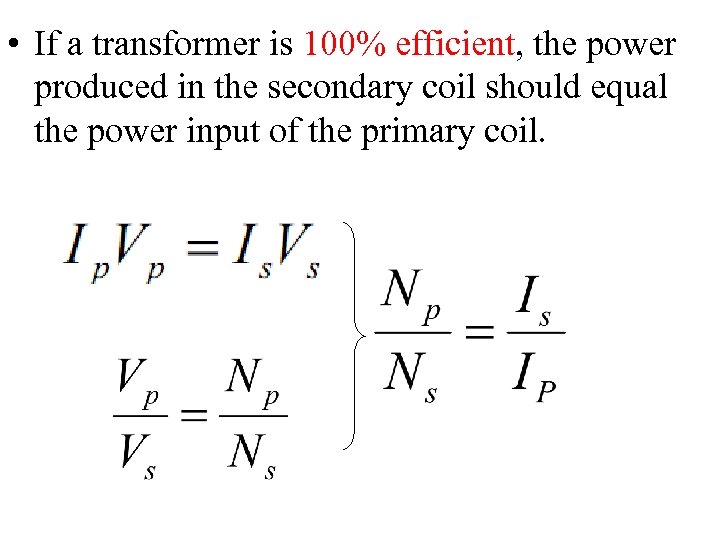 • If a transformer is 100% efficient, the power produced in the secondary coil should equal the power input of the primary coil.
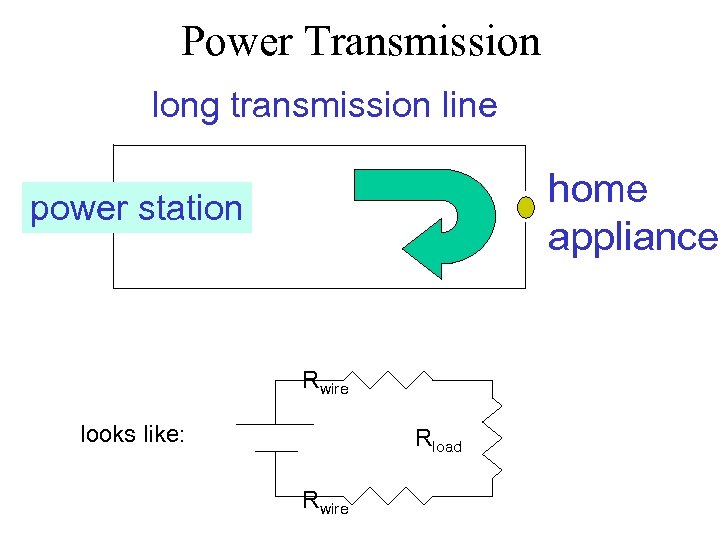 Power Transmission long transmission line home appliance power station Rwire looks like: Rload Rwire
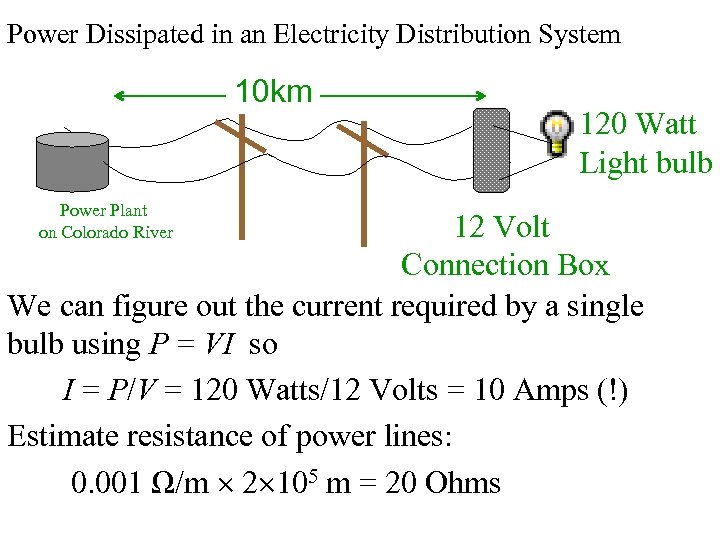 Power Dissipated in an Electricity Distribution System 10 km Power Plant on Colorado River 120 Watt Light bulb 12 Volt Connection Box We can figure out the current required by a single bulb using P = VI so I = P/V = 120 Watts/12 Volts = 10 Amps (!) Estimate resistance of power lines: 0. 001 Ω/m 2 105 m = 20 Ohms
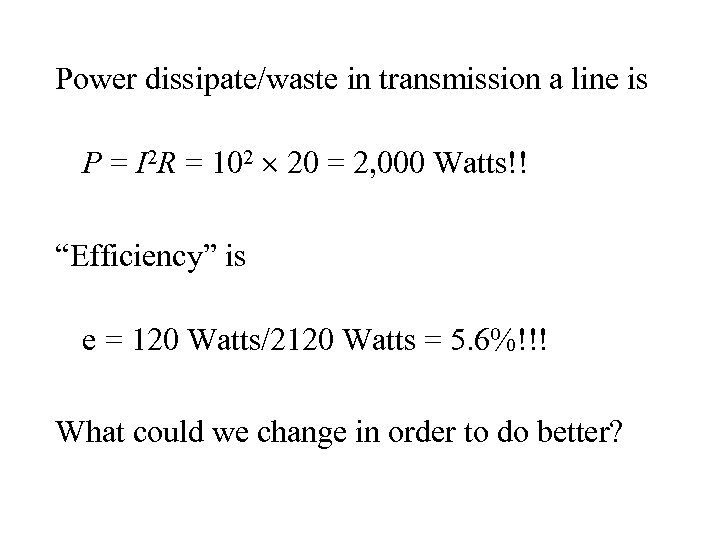 Power dissipate/waste in transmission a line is P = I 2 R = 102 20 = 2, 000 Watts!! “Efficiency” is e = 120 Watts/2120 Watts = 5. 6%!!! What could we change in order to do better?
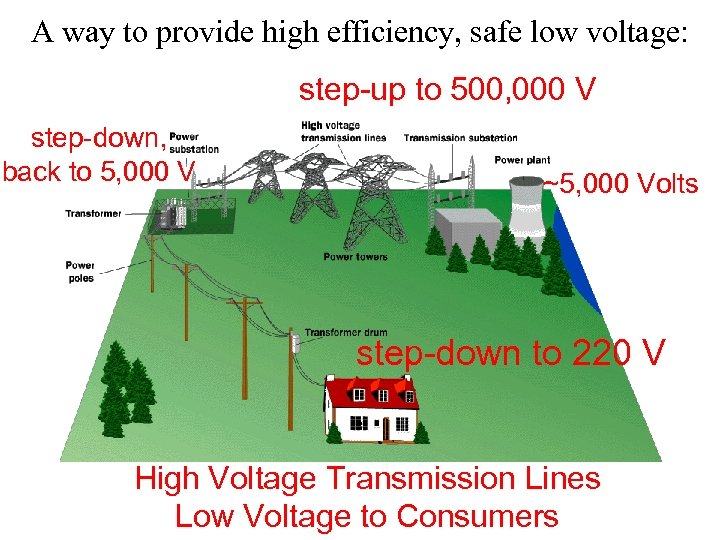
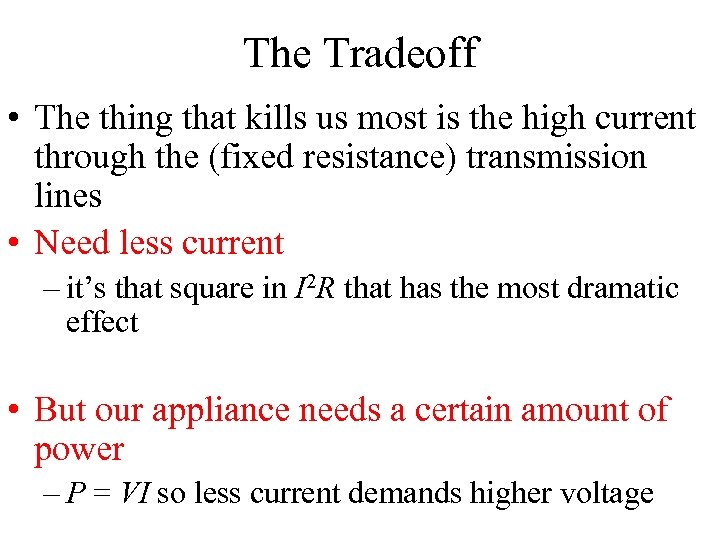 The Tradeoff • The thing that kills us most is the high current through the (fixed resistance) transmission lines • Need less current – it’s that square in I 2 R that has the most dramatic effect • But our appliance needs a certain amount of power – P = VI so less current demands higher voltage
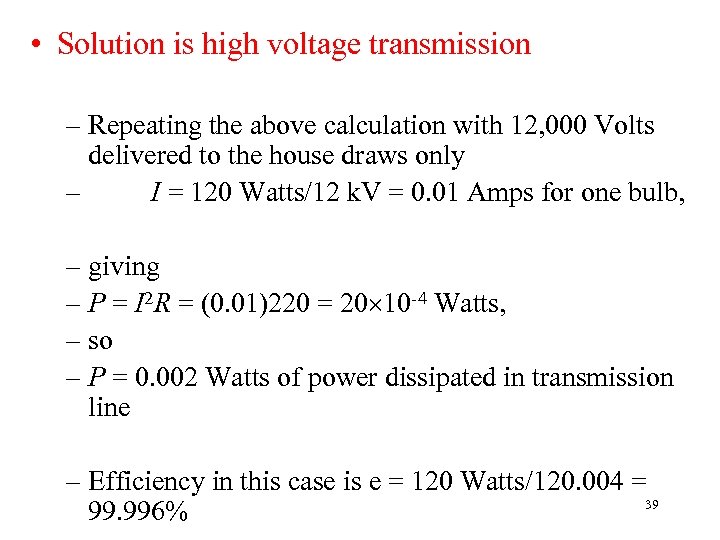 • Solution is high voltage transmission – Repeating the above calculation with 12, 000 Volts delivered to the house draws only – I = 120 Watts/12 k. V = 0. 01 Amps for one bulb, – giving – P = I 2 R = (0. 01)220 = 20 10 -4 Watts, – so – P = 0. 002 Watts of power dissipated in transmission line – Efficiency in this case is e = 120 Watts/120. 004 = 39 99. 996%
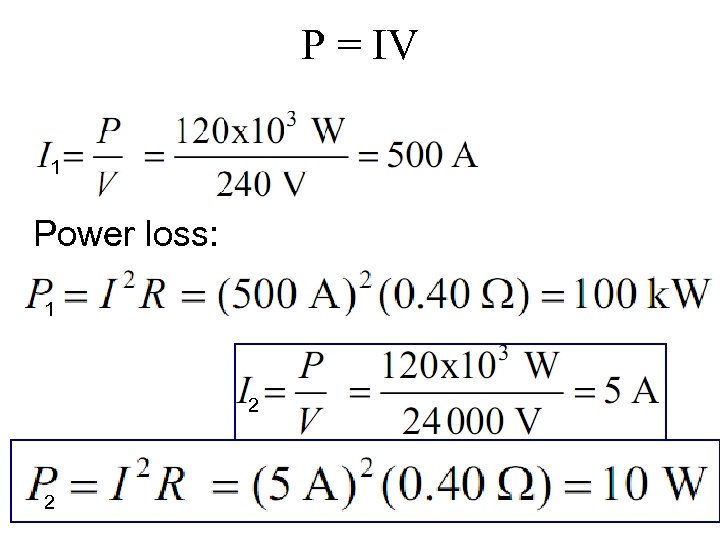
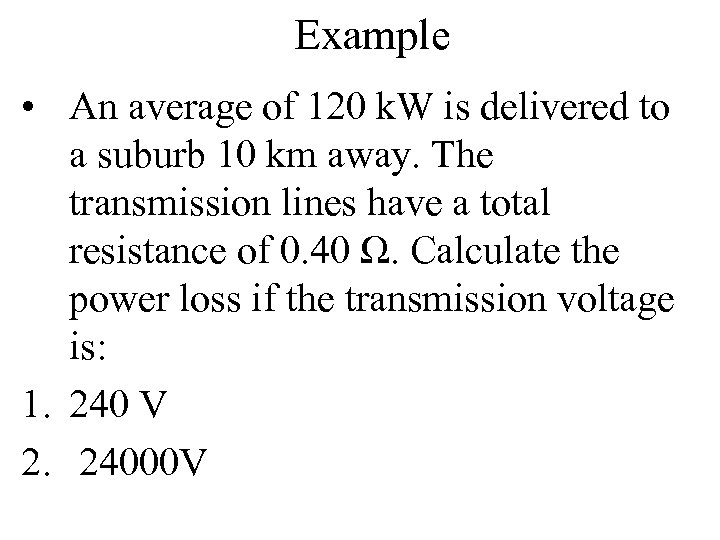 Example • An average of 120 k. W is delivered to a suburb 10 km away. The transmission lines have a total resistance of 0. 40 Ω. Calculate the power loss if the transmission voltage is: 1. 240 V 2. 24000 V
 P = IV 1 Power loss: 1 2 2
 DANGER! • But having high voltage in each household is a recipe for disaster – sparks every time you plug something in – risk of fire – not cat-friendly • Need a way to step-up/step-down voltage at will – can’t do this with DC, so go to AC
 A way to provide high efficiency, safe low voltage: step-up to 500, 000 V step-down, back to 5, 000 V ~5, 000 Volts step-down to 220 V High Voltage Transmission Lines Low Voltage to Consumers
 Power Transmission • Electric power is usually transmitted over high voltage power lines. • Copper wire has a resistance and over long runs some energy will be lost to the surroundings as heat. • A low current (high voltage) minimizes this loss.