


 Скачать презентацию GCSE Information Evening for Pupils in Year
cf1c45ecc5d1e1fc18e1070e8ff9db1b.ppt
- Количество слайдов: 49
 GCSE Information Evening for Pupils in Year 10
 Order of Presentation l Mr R Gilpin (Headteacher) – l Miss K Foster (Deputy Headteacher) – l l l introduction what happens next? How you can help your child? Mr D Wade (Science) Mrs L Davies (English) Mrs M Stevens (Maths) Mrs E Bottell (SENCO) Mrs J Pitt – (Assistant Head) - Data and tracking
 What are GCSEs? Background l In years 7 and 8 pupils follow the National Curriculum for keystage 3 l At the end of Year 8 pupils choose 4 optional courses l Most pupils will take GCSE courses, with a few following BTEC or Foundation courses
 GCSEs l l It usually takes two school years to study for a GCSE – 5 school terms. Students in Year 9 will now be working with the three-year Keystage 4 programme. The new GCSE syllabuses are largely 100% examined, although practical subjects still have coursework as elements. BTEC courses continue to be coursework based – with an examined element.
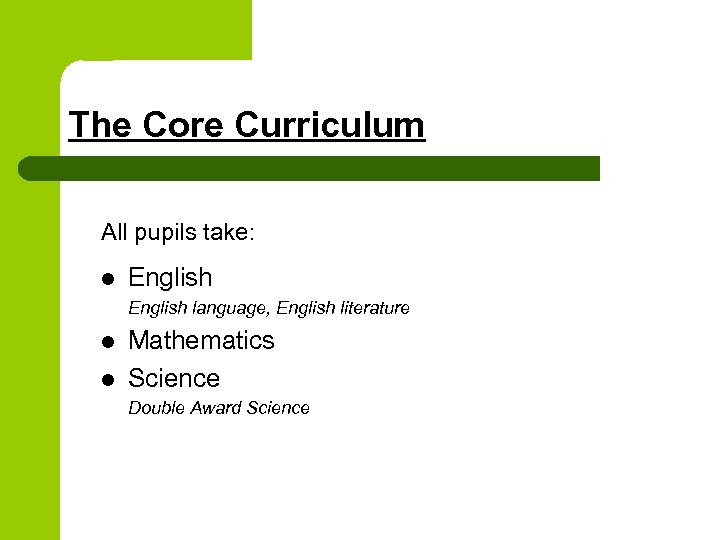 The Core Curriculum All pupils take: l English language, English literature l l Mathematics Science Double Award Science
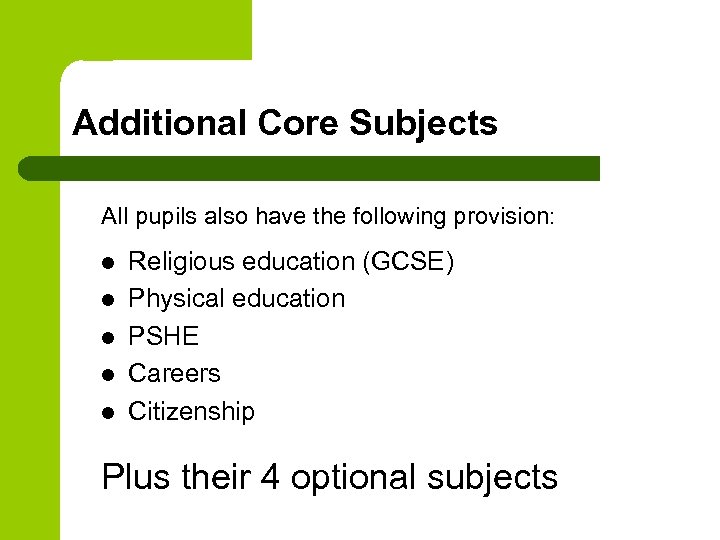 Additional Core Subjects All pupils also have the following provision: l l l Religious education (GCSE) Physical education PSHE Careers Citizenship Plus their 4 optional subjects
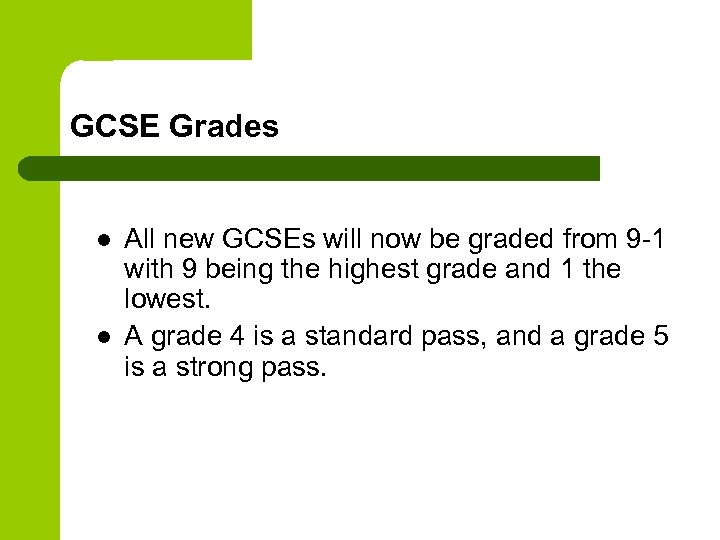 GCSE Grades l l All new GCSEs will now be graded from 9 -1 with 9 being the highest grade and 1 the lowest. A grade 4 is a standard pass, and a grade 5 is a strong pass.
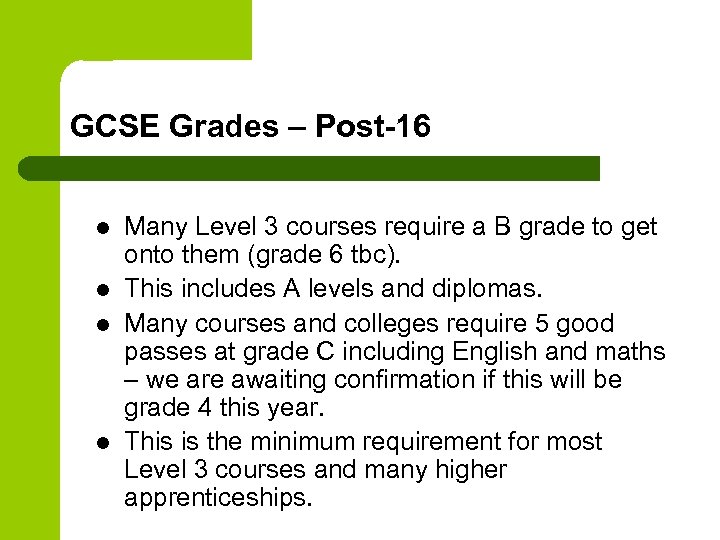 GCSE Grades – Post-16 l l Many Level 3 courses require a B grade to get onto them (grade 6 tbc). This includes A levels and diplomas. Many courses and colleges require 5 good passes at grade C including English and maths – we are awaiting confirmation if this will be grade 4 this year. This is the minimum requirement for most Level 3 courses and many higher apprenticeships.
 BTEC courses l l BTEC courses are vocationally based and each one counts as one GCSE They are mostly assignment-based with some examined material They are graded using Pass, Merit and Distinction which broadly equated to GCSE grades 4, 5. 5 and 7. At present we only offer H&SC BTEC.
 More about the Core Subjects l l l Science – Mr D Wade English - Mrs L Davies Maths – Mrs M Stevens
 Science 2017 – 19/20 Combined Science Triple Science
 GCSE Science – Mr Wade l At Pittville, Year 9 and 10 students are now embarking on the AQA Science GCSE course. Those who chose Triple Science as an option will study AQA Triple Science and everyone else will study AQA Combined GCSE Science. l This consists of the main three science disciplines: Biology (33% of grade) Chemistry (33% of grade) Physics (33% of grade) l l l
 GCSE Science l Each discipline will be divided equally between years 10 and 11 for year 10 students, and between years 9, 10 and 11 for year 9 students. l There is no coursework (or controlled assessment) so the final qualification is based on examinations only. l There will be a number of required practical activities for each course which will be assessed during the final examinations (attendance to these is essential).
 GCSE Science Biology This subject consists of a number of topics including: l Cell biology l Organisation l Infection and response l Bioenergetics l Homeostasis and response l Inheritance, variation and evolution l Ecology
 GCSE Science Chemistry This subject consists of a number of topics including: l Atomic structure and the periodic table l Bonding, structure and the properties of matter l Quantitative chemistry l Chemical changes l Energy changes l The rate and extent of chemical change l Organic chemistry l Chemical analysis l Chemistry of the atmosphere l Using resources
 GCSE Science Physics This subject consists of a number of topics including: l Forces l Energy l Waves l Electricity l Magnetism and electromagnetism l Particle model of matter l Atomic structure l Space physics (Triple Science only)
 Science in Year 11 l During Year 11, all GCSE students will complete their courses for each of the three disciplines and will begin a comprehensive revision programme. l Throughout the courses, there will be regular assessments to monitor students’ progress and help them improve, in preparation for the final exams in year 11.
 Science Assessment l There will be 6 exam papers at the end of year 11. There will be two papers for biology, two for chemistry and two for physics. l Each of the Combined Science papers will be 1 hour and 15 minutes long, and each of the Triple Science papers will be 1 hour and 45 minutes long. l This is designed to further knowledge and skills in Science and is acceptable for entry on to Science Alevel courses.
 Revision Guides l At the start of the GCSE courses, students will be offered the opportunity to purchase revision guides. l As a school, we are able to secure substantial discounts which would not be available in high street shops.
 GCSE English 2017 -19 GCSE English Language GCSE English Literature STEP Up To English Mrs Louise Davies Head of Communications Faculty
 GCSE ENGLISH l Students will work towards TWO GCSE courses in their English lessons: GCSE English Language l GCSE English Literature l l Some students will study ‘Step Up To English’
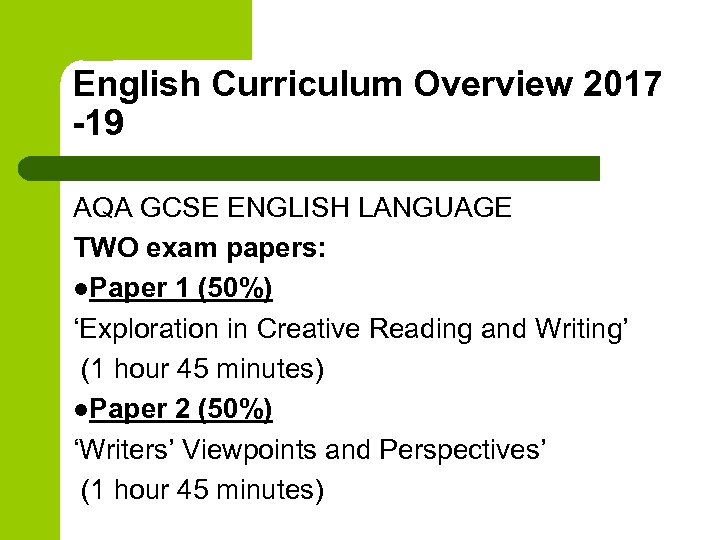 English Curriculum Overview 2017 -19 AQA GCSE ENGLISH LANGUAGE TWO exam papers: l. Paper 1 (50%) ‘Exploration in Creative Reading and Writing’ (1 hour 45 minutes) l. Paper 2 (50%) ‘Writers’ Viewpoints and Perspectives’ (1 hour 45 minutes)
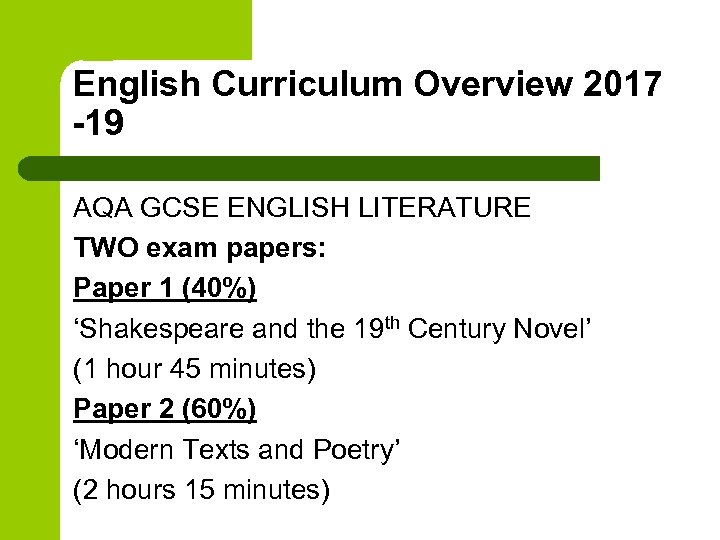 English Curriculum Overview 2017 -19 AQA GCSE ENGLISH LITERATURE TWO exam papers: Paper 1 (40%) ‘Shakespeare and the 19 th Century Novel’ (1 hour 45 minutes) Paper 2 (60%) ‘Modern Texts and Poetry’ (2 hours 15 minutes)
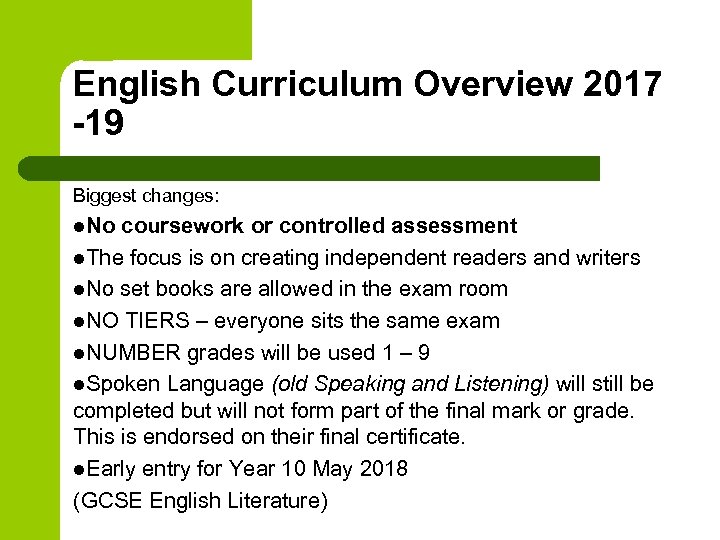 English Curriculum Overview 2017 -19 Biggest changes: l. No coursework or controlled assessment l. The focus is on creating independent readers and writers l. No set books are allowed in the exam room l. NO TIERS – everyone sits the same exam l. NUMBER grades will be used 1 – 9 l. Spoken Language (old Speaking and Listening) will still be completed but will not form part of the final mark or grade. This is endorsed on their final certificate. l. Early entry for Year 10 May 2018 (GCSE English Literature)
 How can you help your child in English? l l Please encourage your child to read a variety of different texts at home Talk to them about what they are doing in the English classroom and the books they are studying Encourage them to look at helpful revision websites, revision guides and recommended films of their set texts Encourage students to talk to their class teacher/ English Department if they need support
 Mathematics 2017 -19/20 GCSE Mathematics GCSE Statistics Mrs Mandy Stevens
 GCSE Mathematics l l All students will work towards GCSE mathematics in their mathematics lessons Those students who have chosen additional maths as an option will complete GCSE Statistics at the end of year 10
 Mathematics overview 2017 -19/20 Two Tiers of entry l Higher Tier, grades achievable 9 to 4 l Foundation Tier, grades achievable 5 to 1 These numbers replace the old A* to G grades l 100% examination no coursework or class assessments l
 Mathematics overview 2017 -19/20 Edexcel GCSE mathematics Three exam papers: l. Paper 1 Non Calculator 80 marks (1 hour 30 minutes) l. Paper 2 Calculator 80 marks (1 hour 30 minutes) l. Paper 3 Calculator 80 marks (1 hour 30 minutes)
 Mathematics overview 2017 -19/20 Biggest changes: l Number grades rather than letters l The volume and difficulty of the subject content has increased for both tiers. l 3 exams rather than 2, each lasting 90 minutes. l Students will be required to memorise formulae.
 How can you help your child in Mathematics? l l Please encourage your child to practise basic skills. Make sure your child completes all homework set on time. Encourage them to look at helpful revision websites and revision guides. Urge your child to talk to their class teacher/Maths Department if they need support.
 SEND 2017 – 19/20 SENDCo – Miss E Bottell BTEC/Study Support Access Arrangements
 Pittville Learning Centre l Foundation Level learning opportunities for students l Provides access to Post 16 study l Additional time to secure grades in other ‘core’ subjects l Personalised learning pathways
 Pittville Learning Centre l SEND Faculty l Lead TAs for individuals who can coach/support during exams l Homework Club – Mon/Tues/Thurs (for those identified)
 Additional support l l l Access Arrangements are on-going Represents a young person’s ‘normal way of working’ Homework and coursework/controlled assessment support including use of laptop, reader scribe etc. Tutor support during prep time Focused in class support
 Data Tracking 2017 – 19/20 Mrs J Pitt Student Tracking
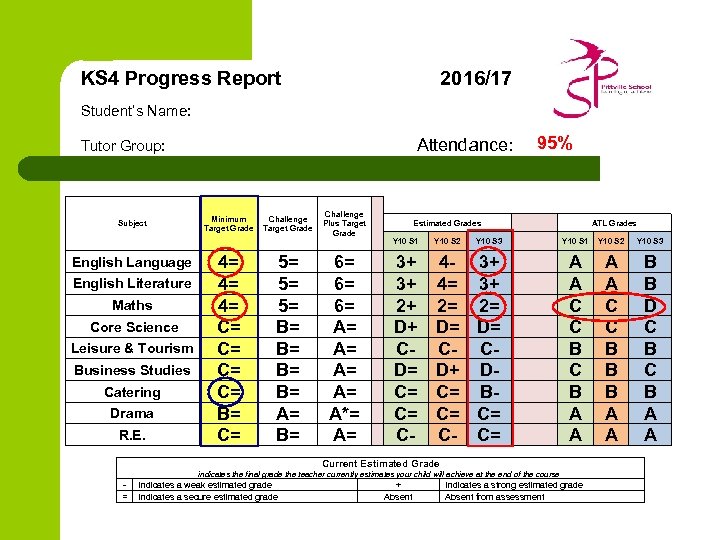 2016/17 KS 4 Progress Report Student’s Name: Tutor Group: Subject English Language English Literature Maths Core Science Leisure & Tourism Business Studies Catering Drama R. E. Minimum Target Grade 4= 4= 4= C= C= B= C= 95% Attendance: Challenge Target Grade 5= 5= 5= B= B= A= B= Challenge Plus Target Grade 6= 6= 6= A= A= A*= A= Estimated Grades Y 10 S 1 Y 10 S 2 Y 10 S 3 3+ 3+ 2+ D+ CD= C= C= C- 44= 2= D= CD+ C= C= C- 3+ 3+ 2= D= CDBC= C= Y 10 S 1 Y 10 S 2 Y 10 S 3 A A C C B B B A A B B D C B A A Current Estimated Grade Indicates a weak estimated grade Indicates a secure estimated grade + Absent ATL Grades indicates the final grade the teacher currently estimates your child will achieve at the end of the course = Indicates a strong estimated grade Absent from assessment
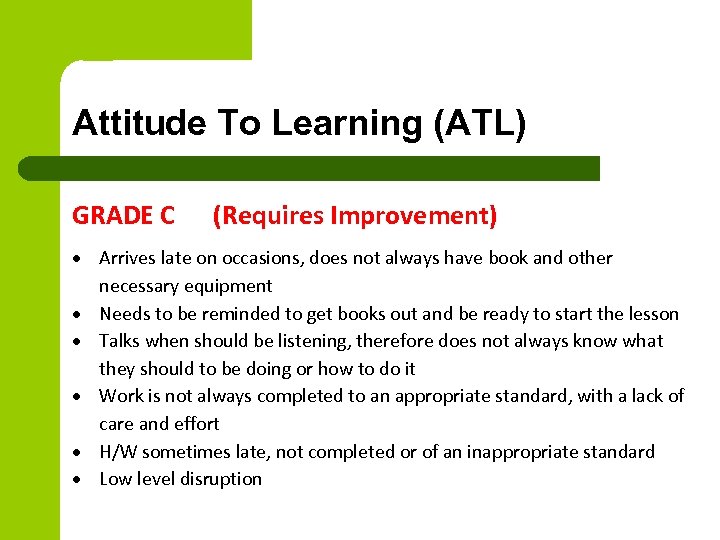 Attitude To Learning (ATL) GRADE C (Requires Improvement) Arrives late on occasions, does not always have book and other necessary equipment Needs to be reminded to get books out and be ready to start the lesson Talks when should be listening, therefore does not always know what they should to be doing or how to do it Work is not always completed to an appropriate standard, with a lack of care and effort H/W sometimes late, not completed or of an inappropriate standard Low level disruption
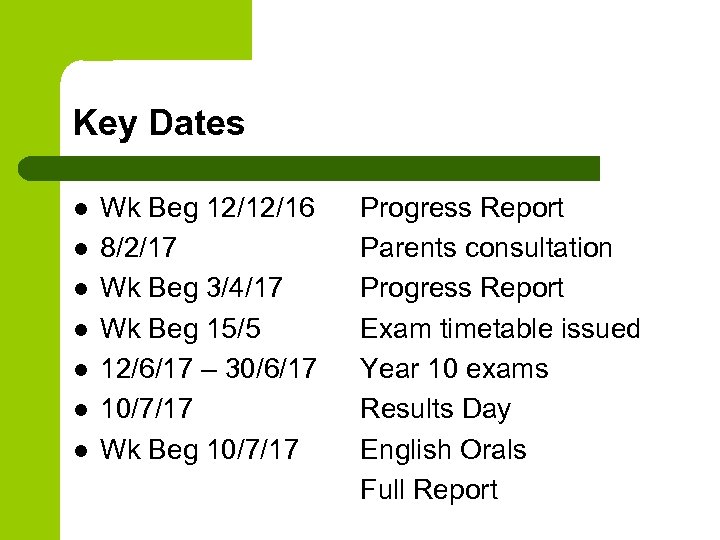 Key Dates l l l l Wk Beg 12/12/16 8/2/17 Wk Beg 3/4/17 Wk Beg 15/5 12/6/17 – 30/6/17 10/7/17 Wk Beg 10/7/17 Progress Report Parents consultation Progress Report Exam timetable issued Year 10 exams Results Day English Orals Full Report
 How to help your child through their GCSEs A parents guide
 What can I do to help my child? l l Research has shown that pupil attainment is highly influenced by parent support The greatest improvement in grades comes from parent support at home
 What can I do to help my child? l l Attendance Equipment – do they have everything they need for school, especially if they have controlled assessments or exams Organisation – a lot more is expected of pupils in Year 10 and they may need help Make sure there is somewhere quiet they can study
 Where to work when at home? l l l Ideally where they can be observed Needs to be at a table or desk Not where they can see a TV Music can help, but should not be distracting No access to games consoles such as Playstation or Wii Not too much time on the computer
 What can I do to help my child? l l l Take an interest Work with teachers Keep your child focused on where they want to be at the end of Year 11 Be there for them if they have worries or are finding the work difficult Keep them aware of these study tips:
 Study tips l l Plan homework and revision and manage time well – don’t start every task the day before it is due in Work in 30 minute chunks and then take a SHORT break to refresh the mind But - keep working on one task until it is complete – swapping tasks confuses the brain! Revision works best when done little and often – START EARLY! whether for tests or exams.
 Study tips l l Don’t work late at night Put away distractions – especially mobile phones, laptops, X-boxes etc…… Healthy living works – plenty of sleep, eat properly and drink plenty of water Use school staff for help and advice!
 “Our Pact” l l Take control of your child’s screen time! ourpact. com allows you to Ø Ø Ø Block child’s Internet Block child’s apps Schedule Internet and app use according to your child’s daily routine Establish screen-free bedtime, dinnertime, study time and family time Block Internet and apps at-a-touch
 Showmyhomework l l Your child should have given you a copy of their Showmyhomework slip, which includes a PIN for you, as parents to log on to. Showmyhomework can be used online or downloaded as an APP You, and your child can set up notifications and use the site to help organise work. You can also access the site through the School Website – although this will be for the whole school, rather than dedicated to one student.
 Any questions?