


 Скачать презентацию GCSE History Introductory Unit Initial Task
2e48dd6bb5b156bfad24096a0518cd5f.ppt
- Количество слайдов: 33
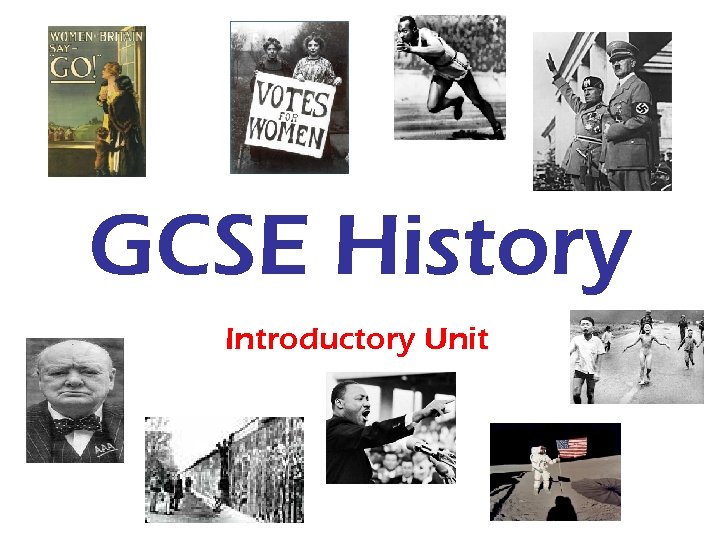 GCSE History Introductory Unit
 Initial Task • Have a look through the exam paper that the Year 11 s have just done. – What topics are covered on each paper? – Which questions would you have answered? – Which parts would you have found easy? – Are there any questions you don’t understand? – How do you think you would have done? – What questions do you have about the course / topics / types of questions?
 Course Outline Year 10 1) International Relations 1945 -89 The Cold War The Vietnam War The collapse of Communism 2) Civil Rights in USA / South Africa (Coursework) 3) Depth Study—Britain 1906 -18 The Liberal Reforms Votes for Women Britain and the First World War Year 11 4) World War One (Coursework) 5) International Relations 1918 -39 Versailles and the League of Nations Causes of World War II 6) Depth Study—Germany 1919 -45 The Weimar Republic Nazi Germany
 GCSE Assessment Objectives Assessment Objective 1 - EXTENDED WRITING Candidates must demonstrate the ability to recall, select, organise and deploy knowledge of the specification content to communicate it through description, analysis and explanation of: • the events, people, changes and issues studied; • the key features and characteristics of the periods, societies or situations studied. Assessment Objective 2 - SOURCES Candidates must demonstrate the ability to use historical sources critically in their context, by comprehending, analysing, evaluating and interpreting them. Assessment Objective 3 - INTERPRETATIONS Candidates must demonstrate the ability to comprehend, analyse and evaluate, in relation to thehistorical context, how and why historical events, people, situations and changes have been interpreted and represented in different ways.
 Homework Task ongoing, but for last day of term • We are going to put together a huge timeline of the Twentieth Century to help build our understanding of chronology and the links between the major events. • Choose a topic, person, or event in the Twentieth Century that you are interested in. • It could be something or someone that you know a lot or nothing about. • Your task is to produce at least one powerpoint slide that summarises the main points.
 • Why? – To give you a light introduction to the GCSE course – To get into the habit of independent research and presentation – To introduce you to the wealth of materials available on the internet – To give me more of an idea of the history you enjoy and identify with • How? – Choose a topic, event or person – Borrow relevant books – Do some general research on the internet and find the best five to ten websites with relevant information – You will need to include information on – • When did this happen? • Why did it happen / was it important? • What did it lead to / was its impact? • How did it change the world? – Collect the information and visual sources that you need. Use ‘Copy and paste’ and make notes which will help you to make a really good presentation. – Work out what you are going to say and what you want the audience to see – this is not the same thing! – Get the basics right first before fiddling around with fonts, colours and animation
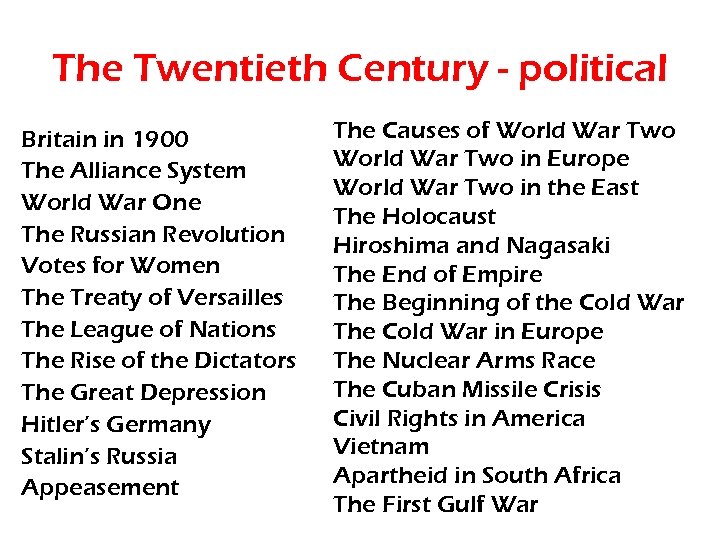 The Twentieth Century - political Britain in 1900 The Alliance System World War One The Russian Revolution Votes for Women The Treaty of Versailles The League of Nations The Rise of the Dictators The Great Depression Hitler’s Germany Stalin’s Russia Appeasement The Causes of World War Two in Europe World War Two in the East The Holocaust Hiroshima and Nagasaki The End of Empire The Beginning of the Cold War The Cold War in Europe The Nuclear Arms Race The Cuban Missile Crisis Civil Rights in America Vietnam Apartheid in South Africa The First Gulf War
 The Twentieth Century – social and cultural changes • The rise of the computer • The impact of the internet • Changing fashions • Changing tastes in music • The dominance of American culture • Space travel • Changes in travel • The changing role of women
 Task • Read the information sheet on the impact of the Second World War. • Match the labels with the photos. • Which of the events do you think was the most significant result of the Second World War?
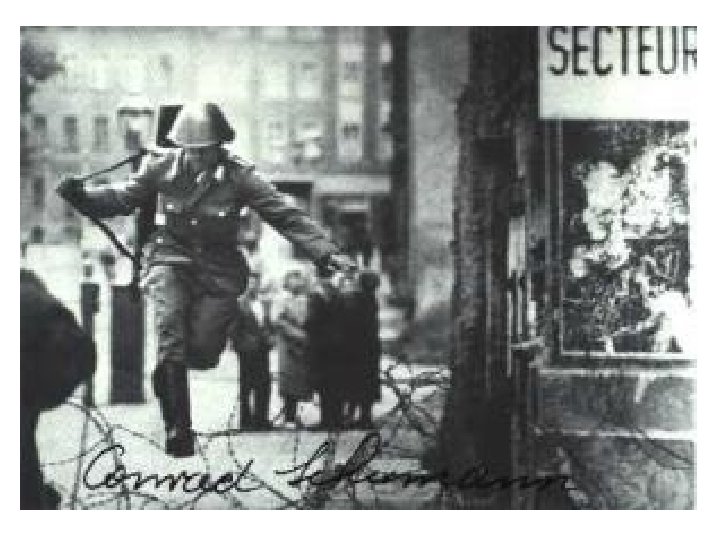
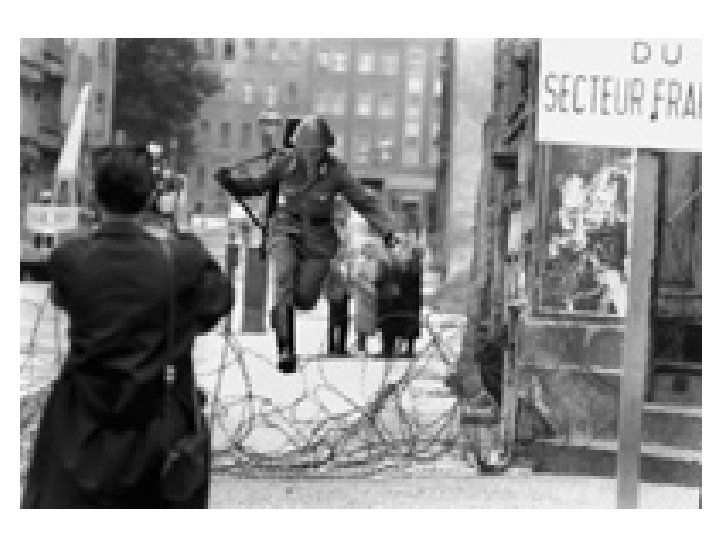
 Your task • Solve the mystery of why Conrad Schumann is jumping the fence. • Read the clues. If you want to you can cut them up, move them around and stick them onto a new sheet to help you solve the mystery. • Discussion. • Newspaper article task.
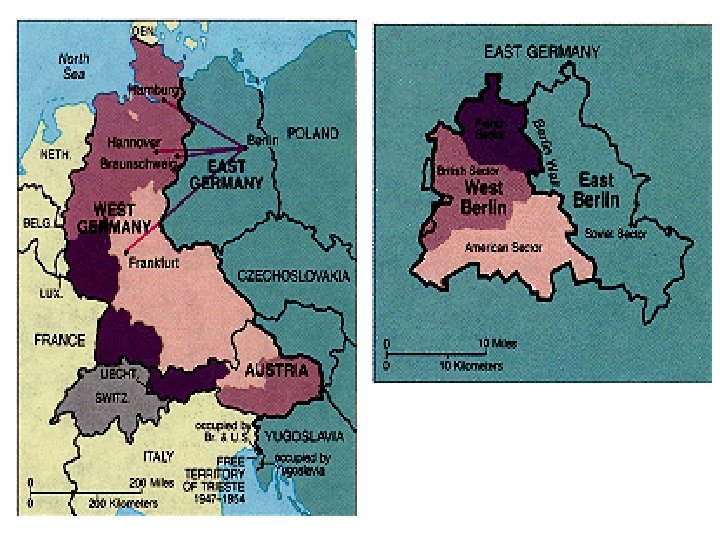
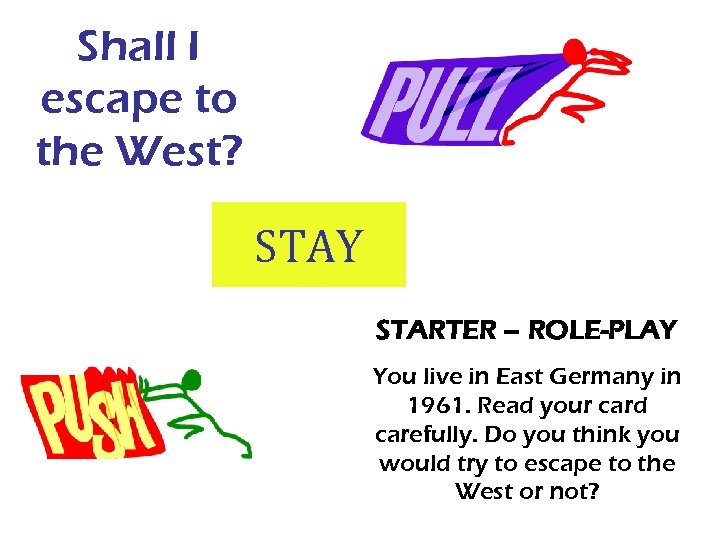 Shall I escape to the West? STAY STARTER – ROLE-PLAY You live in East Germany in 1961. Read your card carefully. Do you think you would try to escape to the West or not?
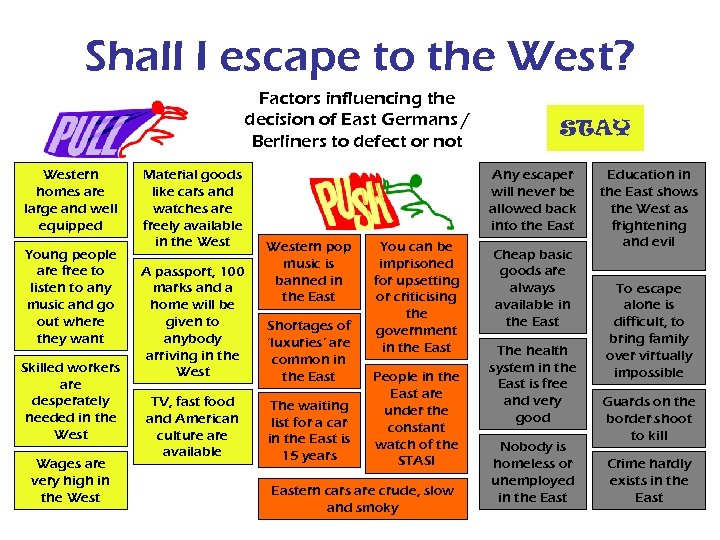 Shall I escape to the West? Factors influencing the decision of East Germans / Berliners to defect or not Western homes are large and well equipped Young people are free to listen to any music and go out where they want Skilled workers are desperately needed in the West Wages are very high in the West Material goods like cars and watches are freely available in the West A passport, 100 marks and a home will be given to anybody arriving in the West TV, fast food and American culture available STAY Any escaper will never be allowed back into the East Western pop music is banned in the East Shortages of ‘luxuries’ are common in the East The waiting list for a car in the East is 15 years You can be imprisoned for upsetting or criticising the government in the East People in the East are under the constant watch of the STASI Eastern cars are crude, slow and smoky Cheap basic goods are always available in the East The health system in the East is free and very good Nobody is homeless or unemployed in the East Education in the East shows the West as frightening and evil To escape alone is difficult, to bring family over virtually impossible Guards on the border shoot to kill Crime hardly exists in the East
 How to make a Cold War… • Take two superpowers • Give them different underlying beliefs • Add some suspicion and misunderstanding • Stir in generous amounts of propaganda • Heat up with nuclear weapons and spies • And serve…
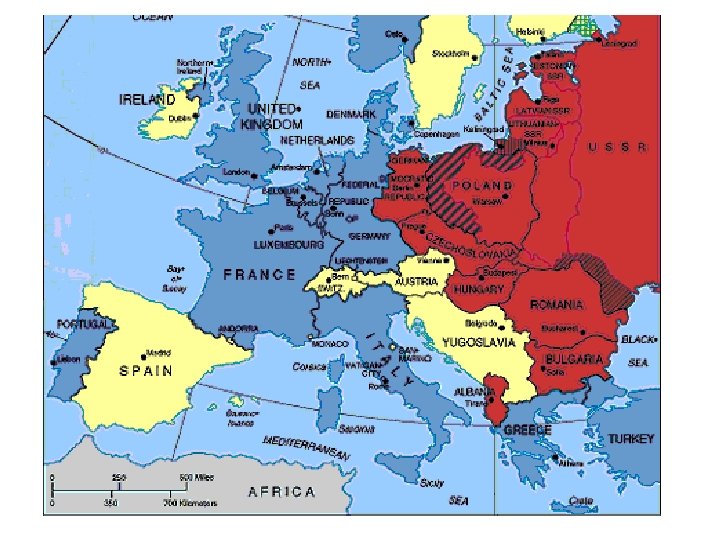
 You should now know…. • The main differences between West and East Germany / Berlin • The ‘push’, ‘pull’ and ‘stay’ factors that affected people’s decisions to defect from the East • The ‘basic ingredients’ of the Cold War • The main differences between capitalism and communism
 ‘We didn’t start the fire’ Billy Joel • Listen to this song, look at the images and think about these questions. – What is the song about? – Why do you think Billy Joel wrote this song? – What themes does it cover? – Why do you think it got to number one? – Is it a useful piece of evidence? If so, for what?
 Discuss • What were the ‘ingredients for a Cold War’? • Why was the Cold War play such a significant part in post-war history? Tasks • Find the page in your notes with a comic strip about the main events of the Cold War up to 1961. • Try to complete thought bubbles • Which side seems most to blame for the distrust and suspicion? • Write answers to the questions on Propaganda on the next page
 Effective presentations • Not too much text on each line. • Mixture of text and images. • DO NOT just read out what appears on the screen – your audience will soon be BORED! • What you say should be more detailed than what appears – only key words on screen.
 THE NUCLEAR ARMS RACE
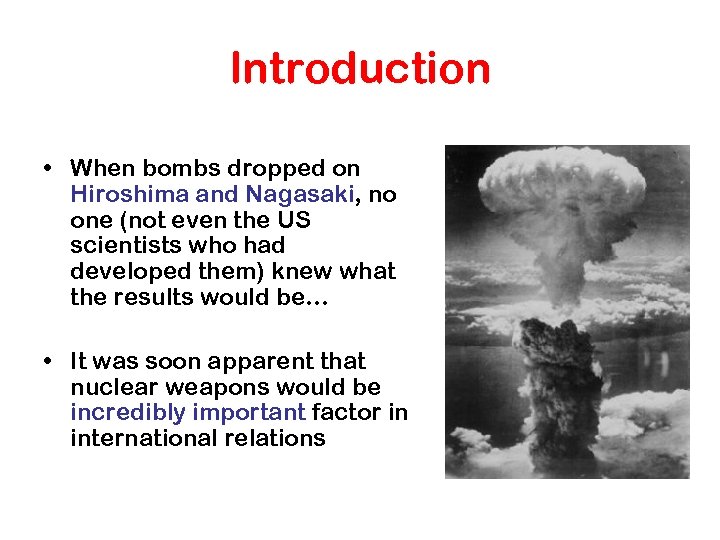 Introduction • When bombs dropped on Hiroshima and Nagasaki, no one (not even the US scientists who had developed them) knew what the results would be… • It was soon apparent that nuclear weapons would be incredibly important factor in international relations
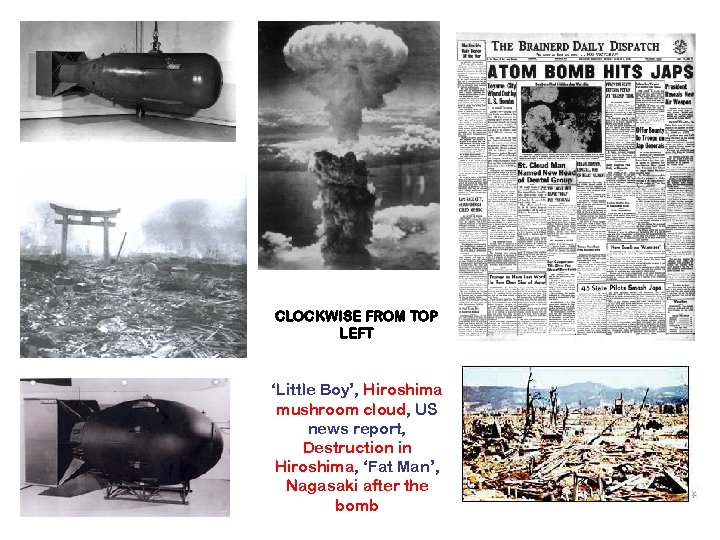 CLOCKWISE FROM TOP LEFT ‘Little Boy’, Hiroshima mushroom cloud, US news report, Destruction in Hiroshima, ‘Fat Man’, Nagasaki after the bomb
 Development of Arms Race • Stage 1 – 1945 -49 - USSR plays catch-up – Fearing that USA would use weapons against them, USSR developed own atom bomb, using info from spies - succeeded in 1949. • Stage 2 – 1949 -57 – More and Bigger – Both sides tried to build more and bigger. – USA develops H-bomb (100 times more powerful than Hiroshima and Nagasaki bombs) • Stage 3 – 1957 -63 – Where are how launched – Development of Intercontinental Ballistic Missiles that could be fired from USSR and USA and vice versa – Satellites, short-range missiles in Turkey and Cuba, submarines
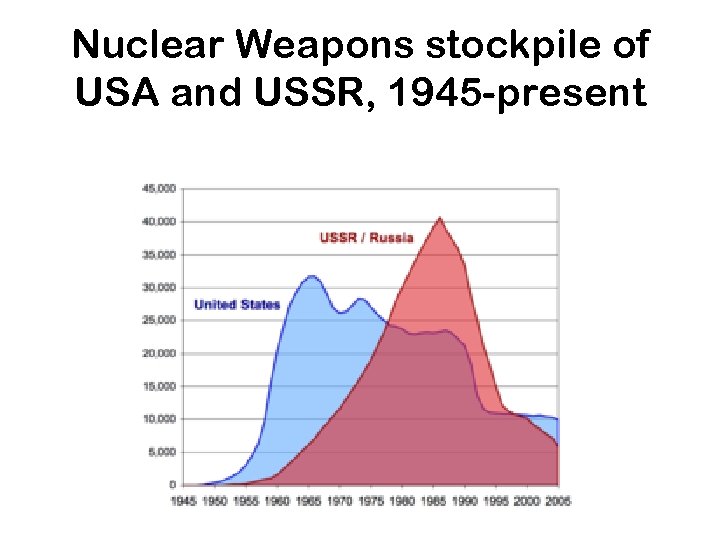 Nuclear Weapons stockpile of USA and USSR, 1945 -present
 MAD! ‘Mutually Assured Destruction’ • By 1962, both sides had enough to destroy each other many times over • Some people argued this would make the world a safer place – if one side used a weapon, neither side could ‘win’ in the end. • Others felt this was a very dangerous state of affairs. A small-scale conflict, impulsive action or a mistake could trigger Nuclear Holocaust affecting billions of people…
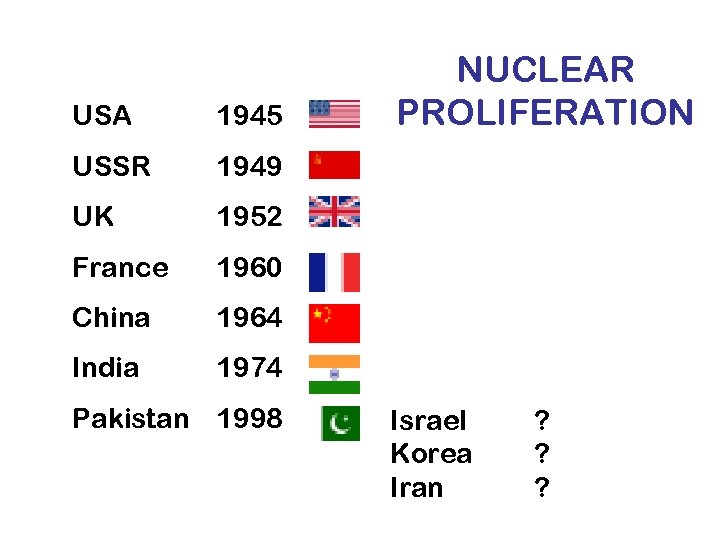 USA 1945 USSR 1949 UK 1952 France 1960 China 1964 India NUCLEAR PROLIFERATION 1974 Pakistan 1998 Israel Korea Iran ? ? ?
 What would be the impact of a nuclear bomb like the ones dropped on Hiroshima and Nagasaki in SE London?
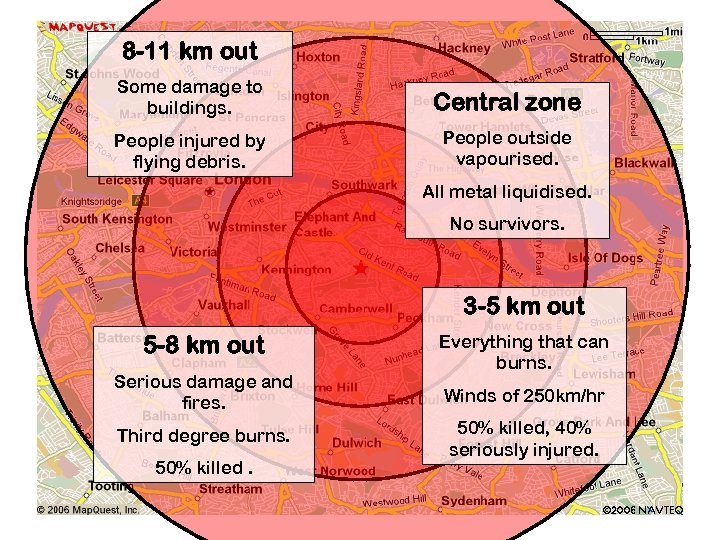 8 -11 km out Some damage to buildings. Central zone People injured by flying debris. People outside vapourised. All metal liquidised. No survivors. 3 -5 km out 5 -8 km out Serious damage and fires. Third degree burns. 50% killed. Everything that can burns. Winds of 250 km/hr 50% killed, 40% seriously injured.
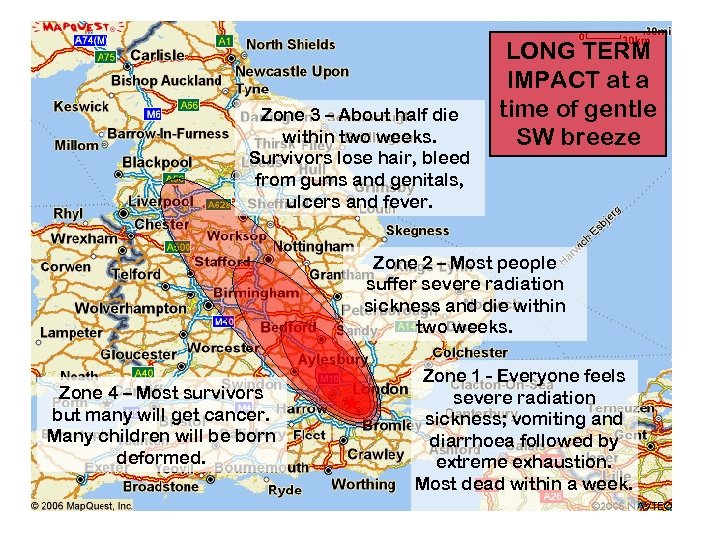 Zone 3 – About half die within two weeks. Survivors lose hair, bleed from gums and genitals, ulcers and fever. LONG TERM IMPACT at a time of gentle SW breeze Zone 2 – Most people suffer severe radiation sickness and die within two weeks. Zone 4 – Most survivors but many will get cancer. Many children will be born deformed. Zone 1 - Everyone feels severe radiation sickness; vomiting and diarrhoea followed by extreme exhaustion. Most dead within a week.
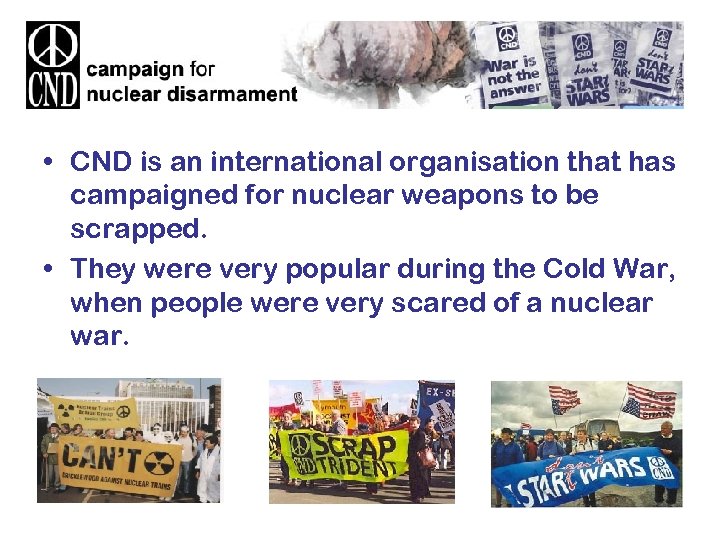 • CND is an international organisation that has campaigned for nuclear weapons to be scrapped. • They were very popular during the Cold War, when people were very scared of a nuclear war.
 Effective presentations • Not too much text on each line. • Mixture of text and images. • DO NOT just read out what appears on the screen – your audience will soon be BORED! • What you say should be more detailed than what appears – only key words on screen.