 Скачать презентацию GCM 8 12 05 Retrieval of biophysical vegetation parameters from
790a52123273cebde1ef29af7dfe51ec.ppt
- Количество слайдов: 52



GCM 8/12/05: Retrieval of biophysical (vegetation) parameters from EO sensors Dr. Mat Disney mdisney@geog. ucl. ac. uk Chandler House room 216 020 7679 4290 www. geog. ucl. ac. uk/~mdisney
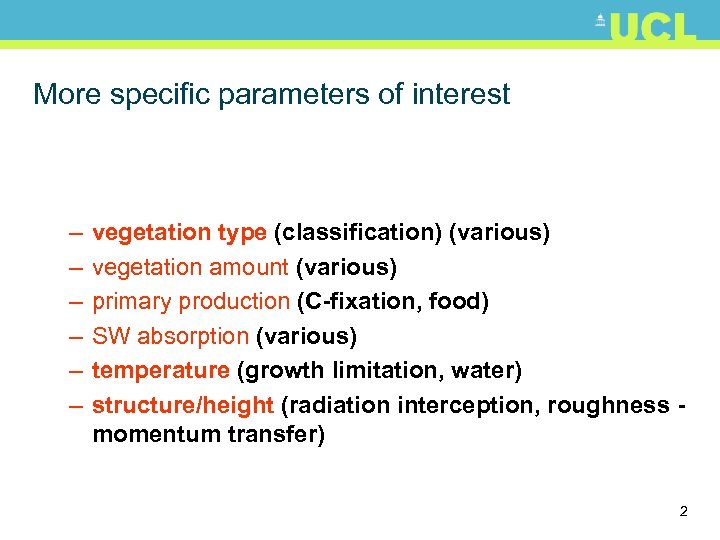
More specific parameters of interest – – – vegetation type (classification) (various) vegetation amount (various) primary production (C-fixation, food) SW absorption (various) temperature (growth limitation, water) structure/height (radiation interception, roughness - momentum transfer) 2
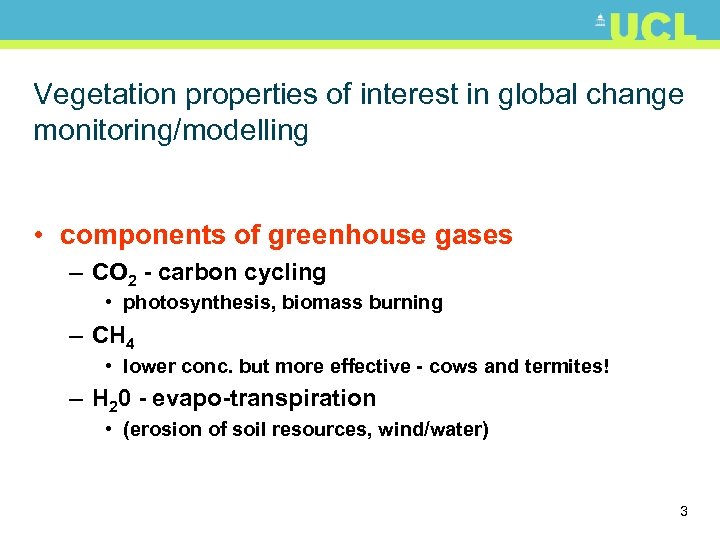
Vegetation properties of interest in global change monitoring/modelling • components of greenhouse gases – CO 2 - carbon cycling • photosynthesis, biomass burning – CH 4 • lower conc. but more effective - cows and termites! – H 20 - evapo-transpiration • (erosion of soil resources, wind/water) 3
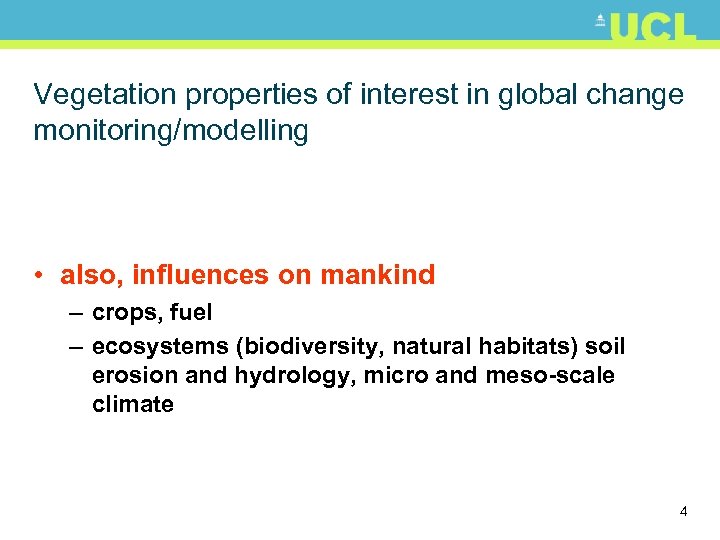
Vegetation properties of interest in global change monitoring/modelling • also, influences on mankind – crops, fuel – ecosystems (biodiversity, natural habitats) soil erosion and hydrology, micro and meso-scale climate 4
Explicitly deal here with • LAI/f. APAR – Leaf Area Index/fraction Absorbed Photsynthetically active radiation (vis. ) • Productivity (& biomass) – PSN - daily net photosynthesis – NPP - Net primary productivity - ratio of carbon uptake to that produced via transpiration. NPP = annual sum of daily PSN. • BUT, other important/related parameters – – BRDF (bidirectional reflectance distribution function) albedo i. e. ratio of outgoing/incoming solar flux Disturbance (fires, logging, disease etc. ) Phenology (timing) 5
definitions: • LAI - one-sided leaf area per unit area of ground dimensionless • f. APAR - fraction of PAR (SW radiation waveband used by vegetation) absorbed - proportion 6
Appropriate scales for monitoring • spatial: – global land surface: ~143 x 106 km – 1 km data sets = ~143 x 106 pixels – GCM can currently deal with 0. 25 o - 0. 1 o grids (25 -30 km - 10 km grid) • temporal: – depends on dynamics • 1 month sampling required e. g. for crops • Maybe less frequent for seasonal variations? • Instruments? ? 7
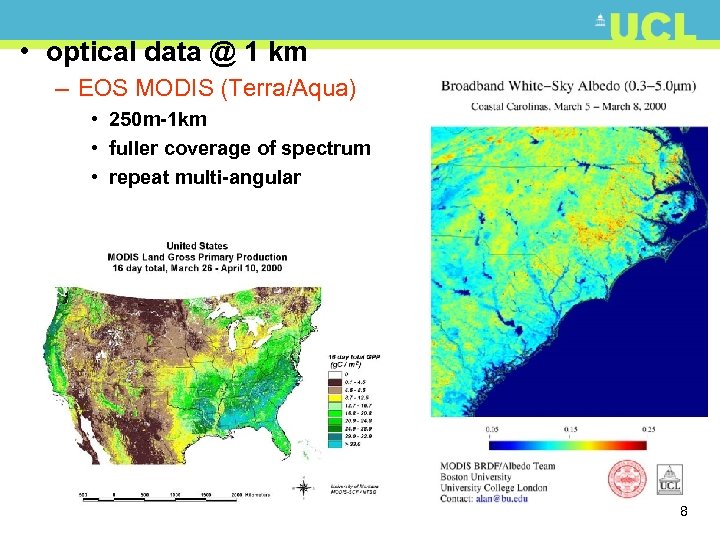
• optical data @ 1 km – EOS MODIS (Terra/Aqua) • 250 m-1 km • fuller coverage of spectrum • repeat multi-angular 8
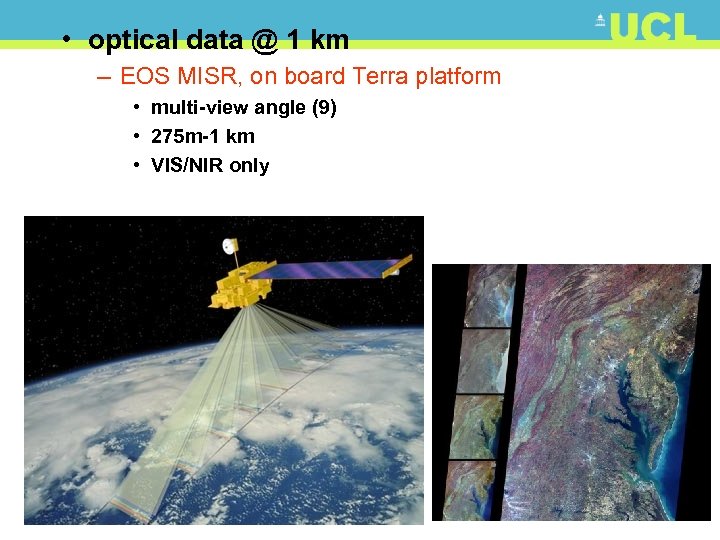
• optical data @ 1 km – EOS MISR, on board Terra platform • multi-view angle (9) • 275 m-1 km • VIS/NIR only 9
• optical data @ 1 km – ENVISAT MERIS • 1 km • good spectral sampling VIS/NIR - 15 programmable bands between 390 nm an 1040 nm. • little multi-angular – AVHRR • > 1 km • Only 2 broad channels in vis/NIR & little multiangular • BUT heritage of data since 1981 10
Future? – production of datasets (e. g. EOSDIS) • e. g. MODIS products • NPOESS follow on missions • P-band RADAR? ? – cost of large projects (`big science') high • B$7 EOS • little direct `commercial' value at moderate resolution • data aimed at scientists, policy. . 11
LAI/f. APAR · direct quantification of amount of (green) vegetation · structural quantity · uses: · · · radiation interception (f. APAR) evapo-transpiration (H 20) photosynthesis (CO 2) i. e. carbon respiration (CO 2 hence carbon) leaf litter-fall (carbon again!) Look at MODIS algorithm · Good example of algorithm development · see ATBD: http: //modis. gsfc. nasa. gov/data/atbd/land_atbd. html 12
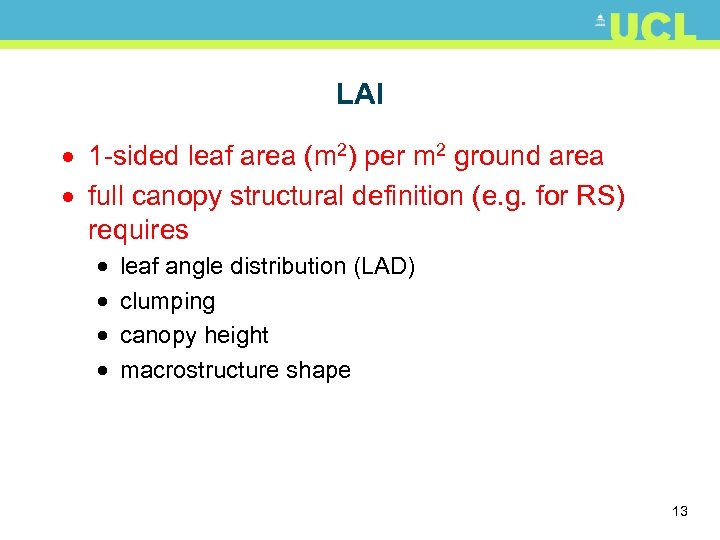
LAI · 1 -sided leaf area (m 2) per m 2 ground area · full canopy structural definition (e. g. for RS) requires · · leaf angle distribution (LAD) clumping canopy height macrostructure shape 13
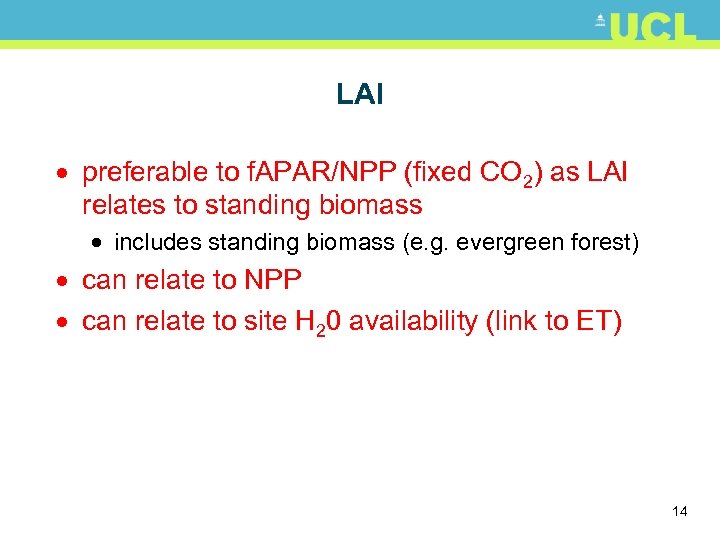
LAI · preferable to f. APAR/NPP (fixed CO 2) as LAI relates to standing biomass · includes standing biomass (e. g. evergreen forest) · can relate to NPP · can relate to site H 20 availability (link to ET) 14
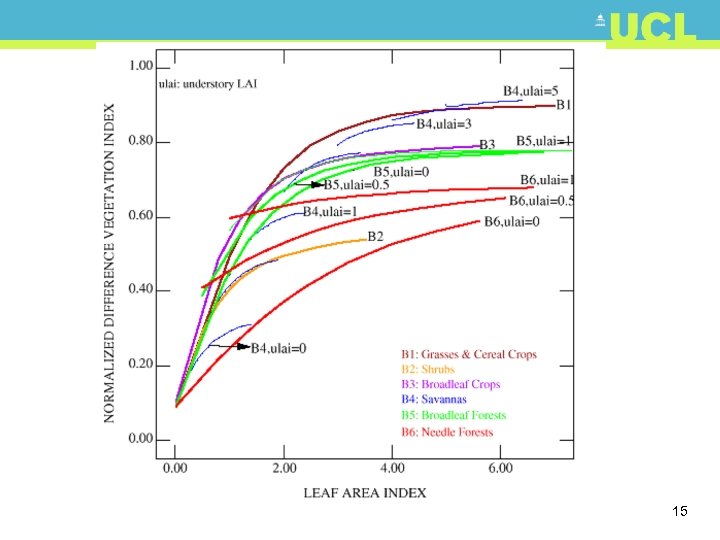
15
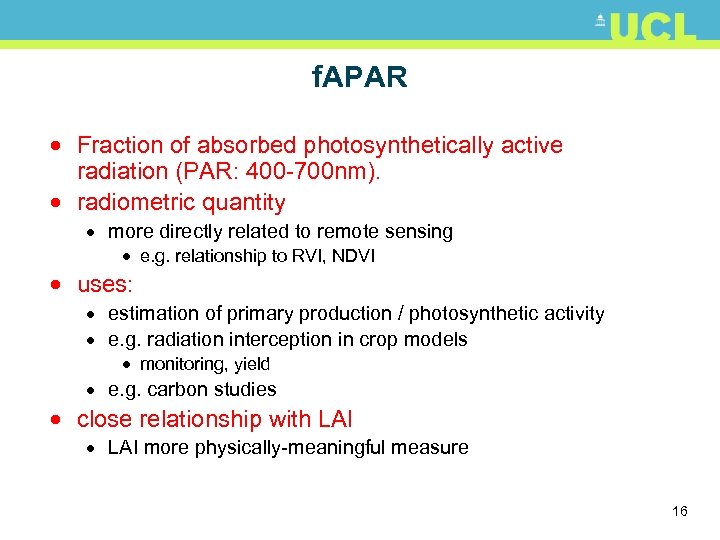
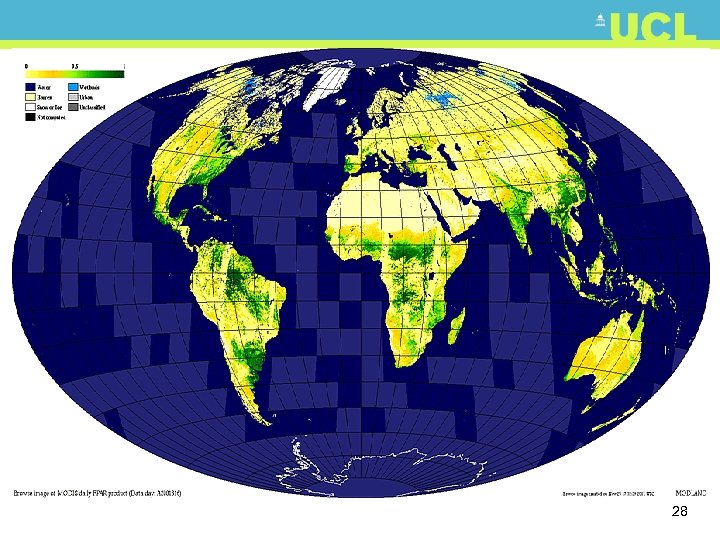
f. APAR · Fraction of absorbed photosynthetically active radiation (PAR: 400 -700 nm). · radiometric quantity · more directly related to remote sensing · e. g. relationship to RVI, NDVI · uses: · estimation of primary production / photosynthetic activity · e. g. radiation interception in crop models · monitoring, yield · e. g. carbon studies · close relationship with LAI · LAI more physically-meaningful measure 16
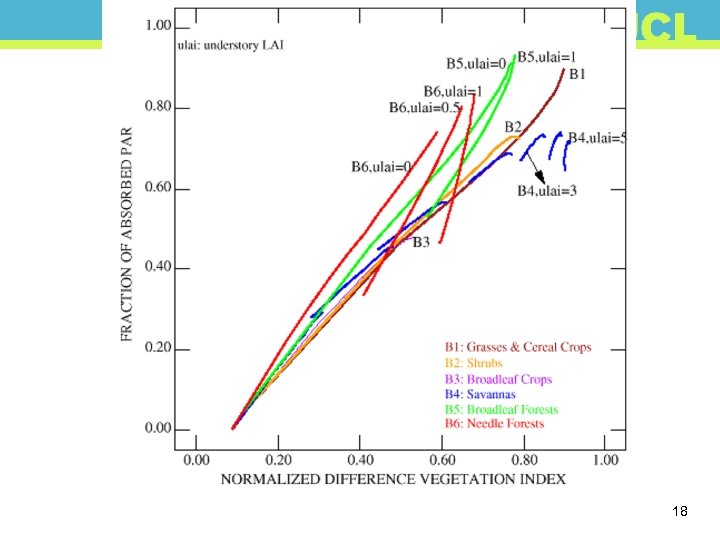
Issues · empirical relationship to VIs can be formed · but depends on LAD, leaf properties (chlorophyll concentration, structure) · need to make relationship depend on land cover · relationship with VIs can vary with external factors, tho’ effects of many can be minimised 17
18
Estimation of LAI/f. APAR · initial field experiments on crops/grass · correlation of VIs - LAI · developed to airborne and satellite · global scale - complexity of natural structures 19
Estimation of LAI/f. APAR · canopies with different LAI can have same VI · effects of clumping/structure · can attempt different relationships dept. on cover class · can use fuller range of spectral/directional information in BRDF model · f. APAR related to LAI · varies with structure · can define through · clumped leaf area · ground cover 20
Estimation of LAI/f. APAR · f. APAR relationship to VIs typically simpler · linear with asymptote at LAI ~6 · BIG issue of saturation of VI signal at high LAI (>5 say) • need to define different relationships for different cover types 21
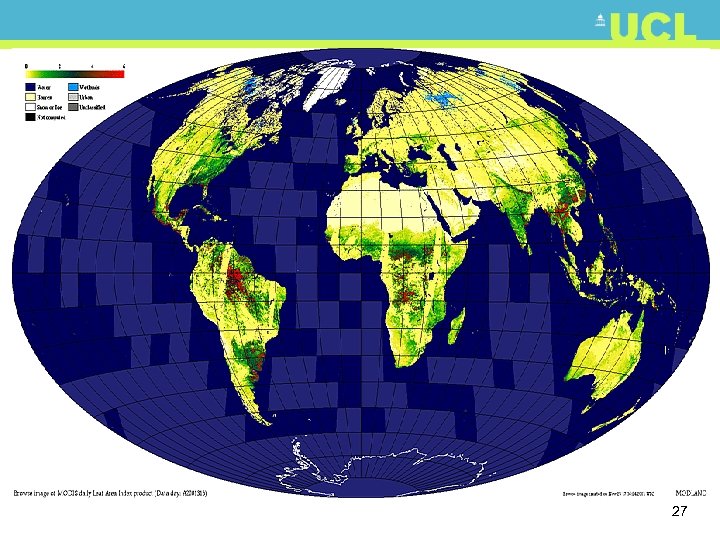
MODIS LAI/f. APAR algorithm · RT (radiative transfer) model-based · define 6 cover types (biomes) based on RT (structure) considerations · · · grasses & cereals shrubs broadleaf crops savanna broadleaf forest needle forest 22
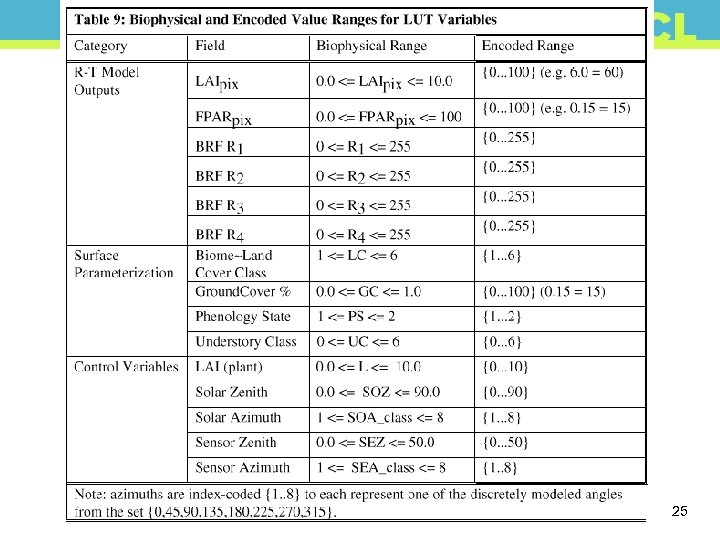
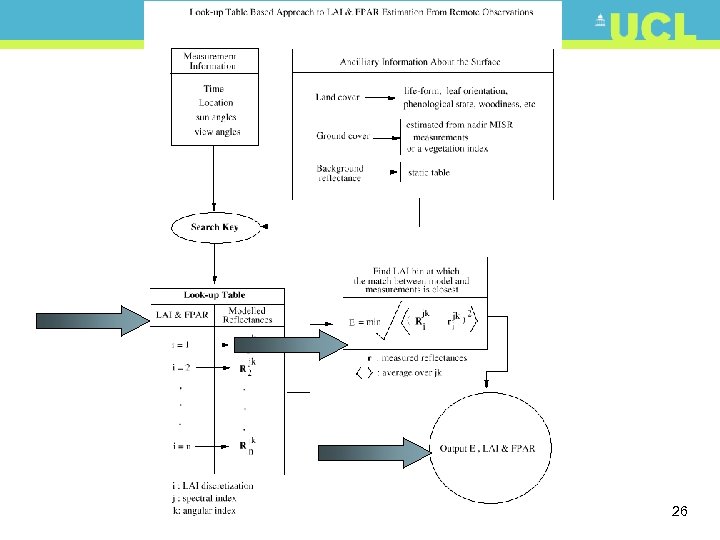
MODIS LAI/f. APAR algorithm · have different VI-parameter relationships · can make assumptions within cover types · e. g. , erectophile LAD for grasses/cereals · e. g. , layered canopy for savanna · use 1 -D and 3 D numerical RT (radiative transfer) models (Myneni) to forward-model for range of LAI · result in look-up-table (LUT) of reflectance as fn. of view/illumination angles and wavelength · LUT ~ 64 MB for 6 biomes 23
Method · preselect cover types (algorithm) · minimise RMSE as fn. of LAI between observations and appropriate models (stored in look-up-table – LUT) · if RMSE small enough, f. APAR / LAI output · backup algorithm if RMSE high - VI-based 24
25
26
27
28
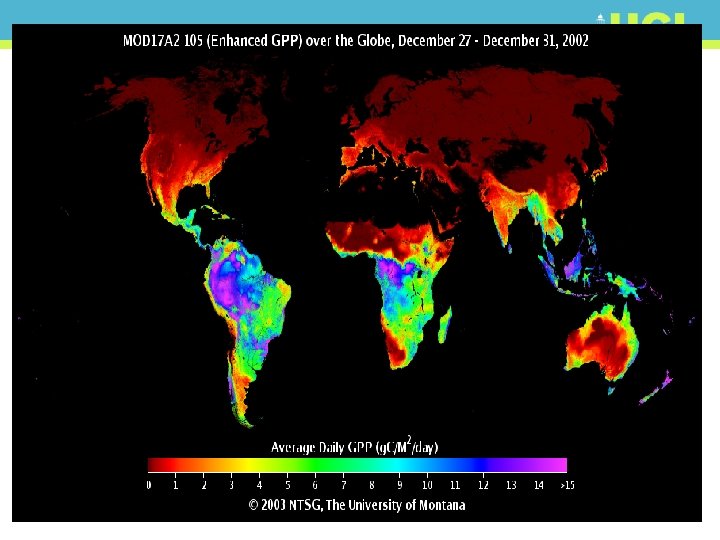
Productivity: PSN and NPP · (daily) net photosynthesis (PSN) · (annual) net primary production (NPP) · relate to net carbon uptake · important for understanding global carbon budget · how much is there, where is it and how is it changing · Hence climate change, policy etc. 29
PSN and NPP · C 02 removed from atmosphere – photosynthesis · C 02 released by plant (and animal) – respiration (auto- and heterotrophic) – major part is microbes in soil. . · Net Photosynthesis (PSN) · net carbon exchange over 1 day: (photosynthesis respiration) 30
PSN and NPP · Net Primary Productivity (NPP) · annual net carbon exchange · quantifies actual plant growth · Conversion to biomass (woody, foliar, root) – (not just C 02 fixation) 31
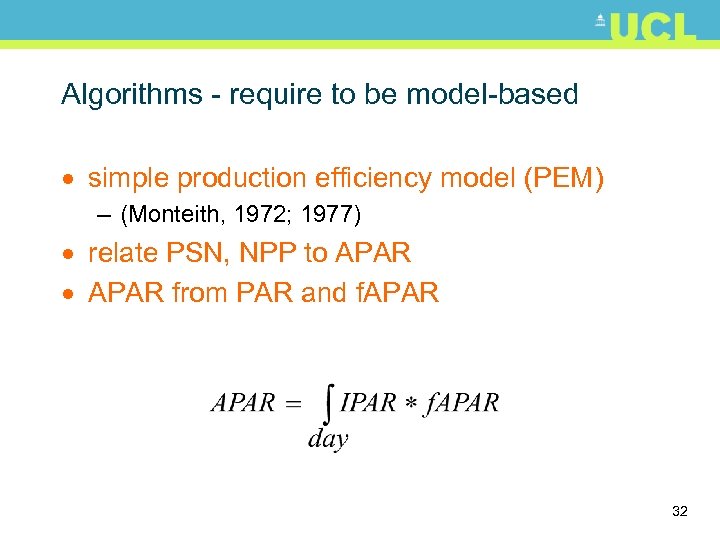
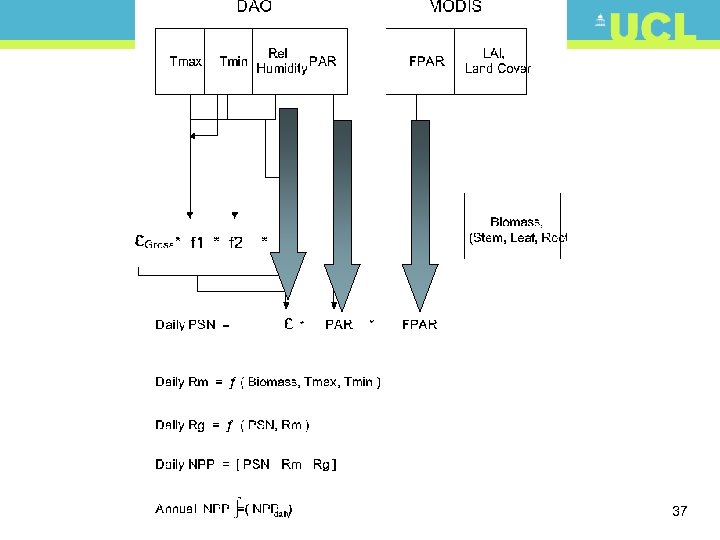
Algorithms - require to be model-based · simple production efficiency model (PEM) – (Monteith, 1972; 1977) · relate PSN, NPP to APAR · APAR from PAR and f. APAR 32
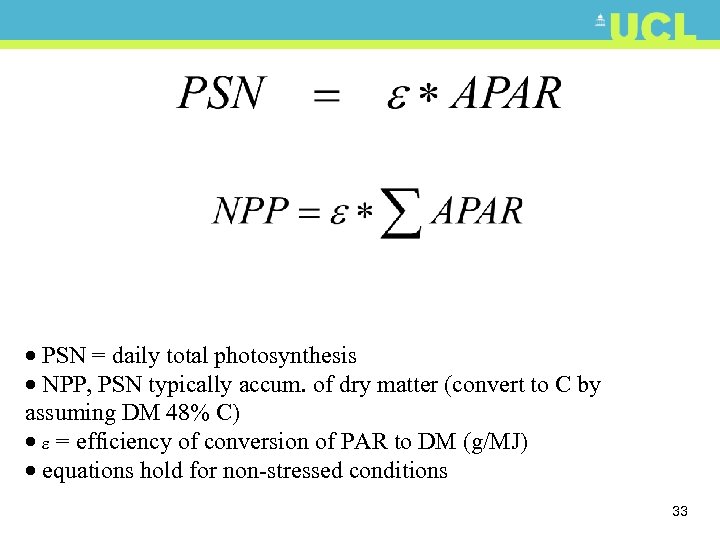
· PSN = daily total photosynthesis · NPP, PSN typically accum. of dry matter (convert to C by assuming DM 48% C) · = efficiency of conversion of PAR to DM (g/MJ) · equations hold for non-stressed conditions 33
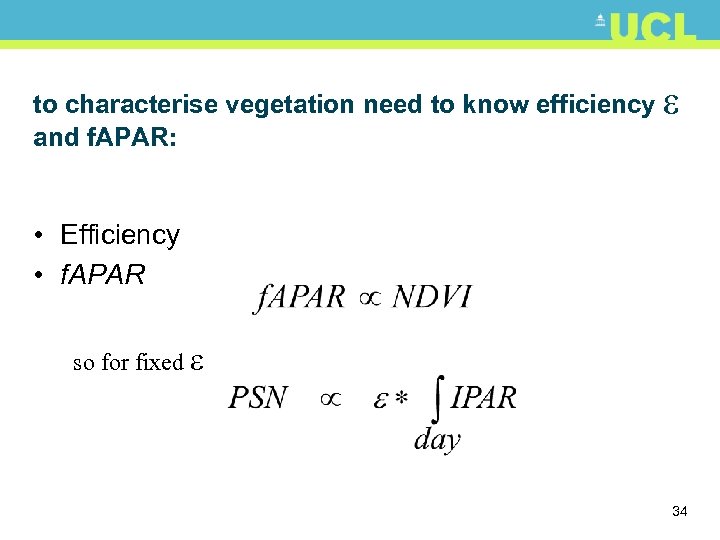
to characterise vegetation need to know efficiency and f. APAR: • Efficiency • f. APAR so for fixed 34
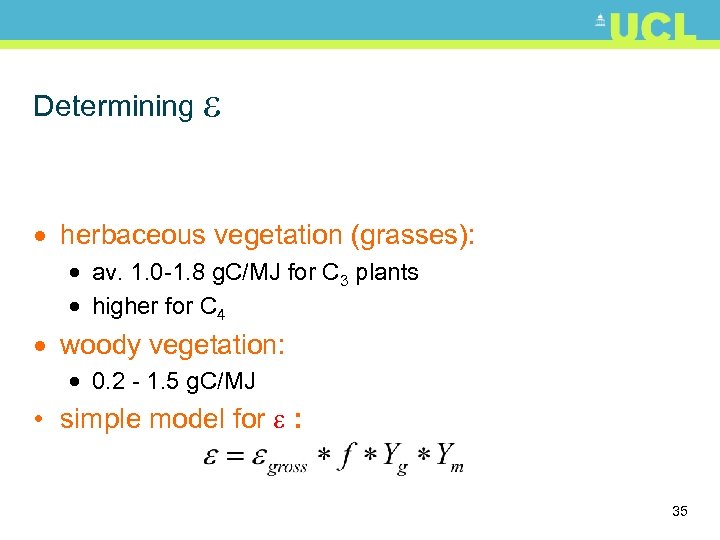
Determining · herbaceous vegetation (grasses): · av. 1. 0 -1. 8 g. C/MJ for C 3 plants · higher for C 4 · woody vegetation: · 0. 2 - 1. 5 g. C/MJ • simple model for : 35
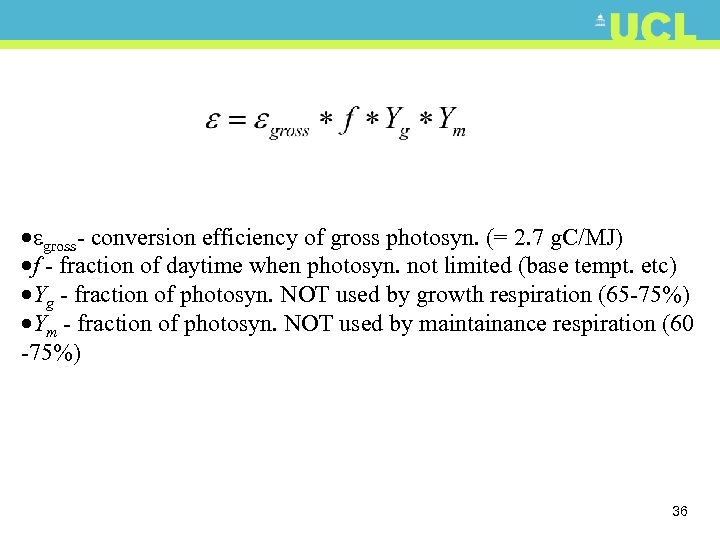
· gross- conversion efficiency of gross photosyn. (= 2. 7 g. C/MJ) ·f - fraction of daytime when photosyn. not limited (base tempt. etc) ·Yg - fraction of photosyn. NOT used by growth respiration (65 -75%) ·Ym - fraction of photosyn. NOT used by maintainance respiration (60 -75%) 36
37
38
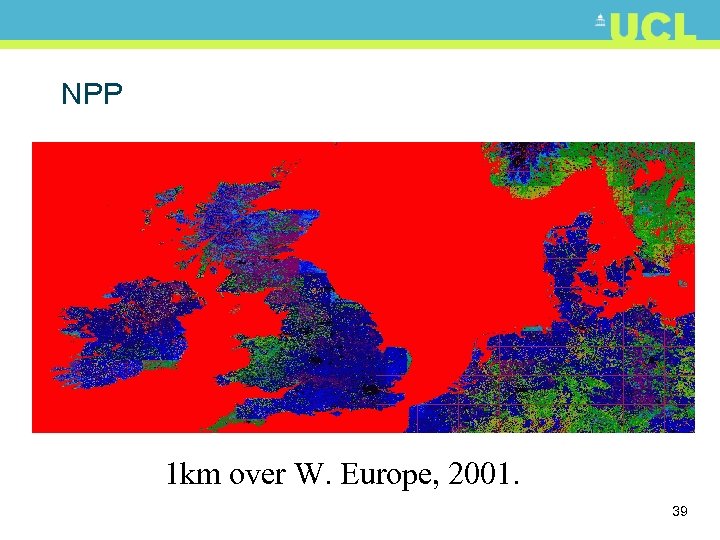
NPP 1 km over W. Europe, 2001. 39
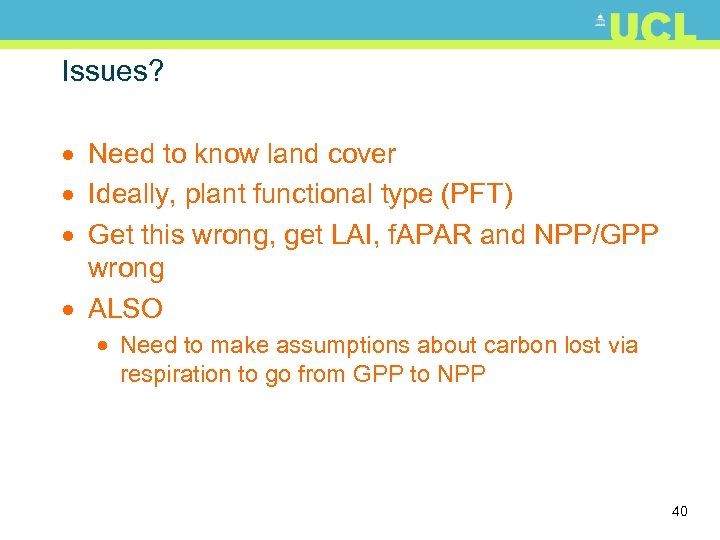
Issues? · Need to know land cover · Ideally, plant functional type (PFT) · Get this wrong, get LAI, f. APAR and NPP/GPP wrong · ALSO · Need to make assumptions about carbon lost via respiration to go from GPP to NPP 40
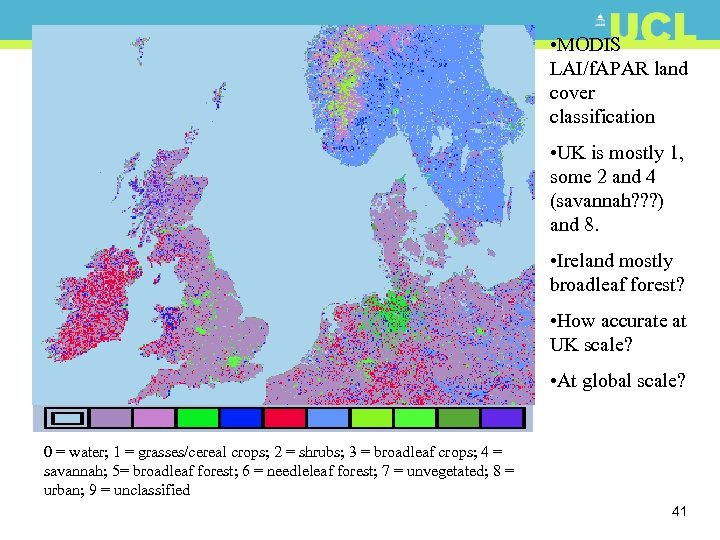
• MODIS LAI/f. APAR land cover classification • UK is mostly 1, some 2 and 4 (savannah? ? ? ) and 8. • Ireland mostly broadleaf forest? • How accurate at UK scale? • At global scale? 0 = water; 1 = grasses/cereal crops; 2 = shrubs; 3 = broadleaf crops; 4 = savannah; 5= broadleaf forest; 6 = needleleaf forest; 7 = unvegetated; 8 = urban; 9 = unclassified 41
Compare/assimilate with models · Dynamic Global Vegetation Models · e. g. LPJ, SDGVM, Biome. BGC. . . • Driven by climate (& veg. Parameters) · Model vegetation productivity – hey-presto - global terrestrial carbon Nitrogen, water budgets. . . · BUT - how good are they? · Key is to quantify UNCERTAINTY 42
Why carbon? CO 2, CH 4 etc. greenhouse gases Importance for understanding (and Kyoto etc. . . ) Lots in oceans of course, but less dynamic AND less prone to anthropgenic distrubance de/afforestation land use change (HUGE impact on dynamics) Impact on us more direct
![Data-Model Fusion [Using multiple streams of datasets with parameter optimization] C stock and flux](https://present5.com/presentation/790a52123273cebde1ef29af7dfe51ec/image-44.jpg "Data-Model Fusion [Using multiple streams of datasets with parameter optimization] C stock and flux")
Data-Model Fusion [Using multiple streams of datasets with parameter optimization] C stock and flux measurement Inventory analyses Process-based information Climate data Remote sensing information CO 2 column from space Inverse modeling Process-based modeling Retrospective and forward ana 44 Canadell et al. 2000
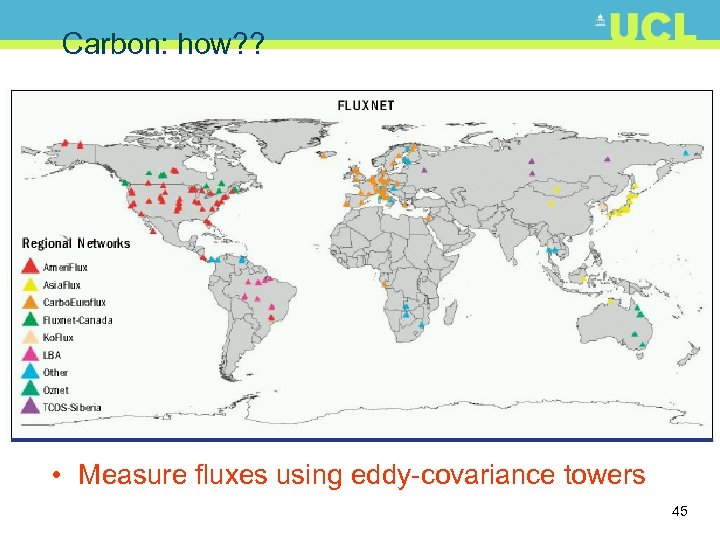
Carbon: how? ? • Measure fluxes using eddy-covariance towers 45
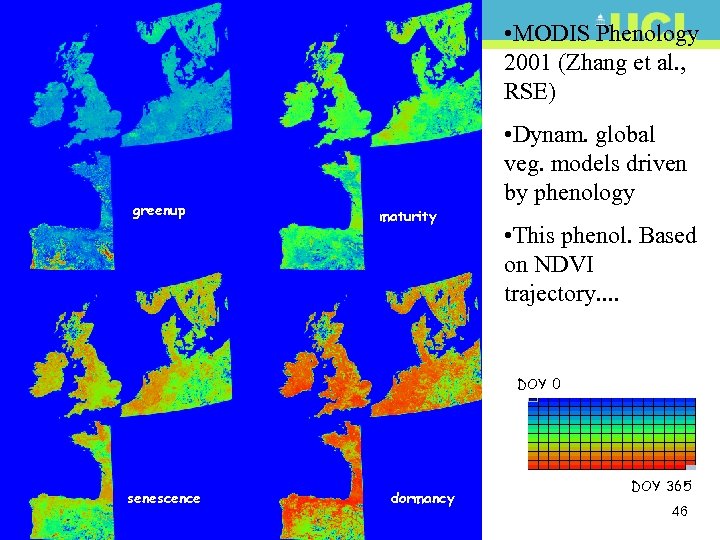
• MODIS Phenology 2001 (Zhang et al. , RSE) greenup • Dynam. global veg. models driven by phenology maturity • This phenol. Based on NDVI trajectory. . DOY 0 senescence dormancy DOY 365 46
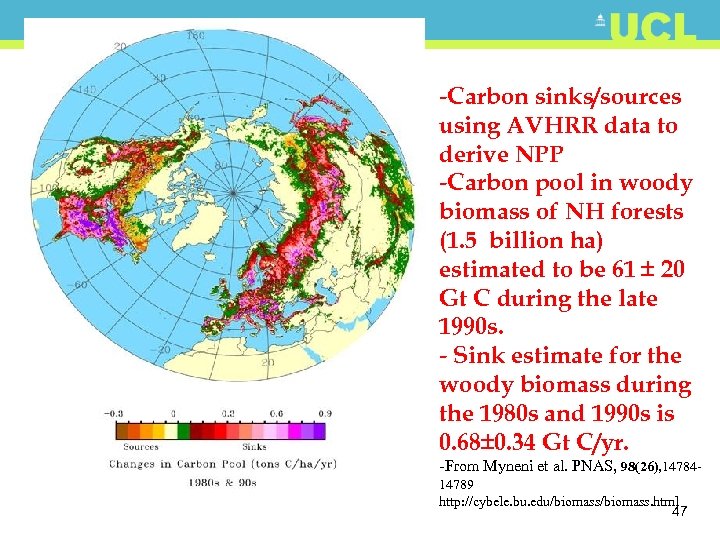
-Carbon sinks/sources using AVHRR data to derive NPP -Carbon pool in woody biomass of NH forests (1. 5 billion ha) estimated to be 61 20 Gt C during the late 1990 s. - Sink estimate for the woody biomass during the 1980 s and 1990 s is 0. 68 0. 34 Gt C/yr. -From Myneni et al. PNAS, 98(26), 1478414789 http: //cybele. bu. edu/biomass. html 47
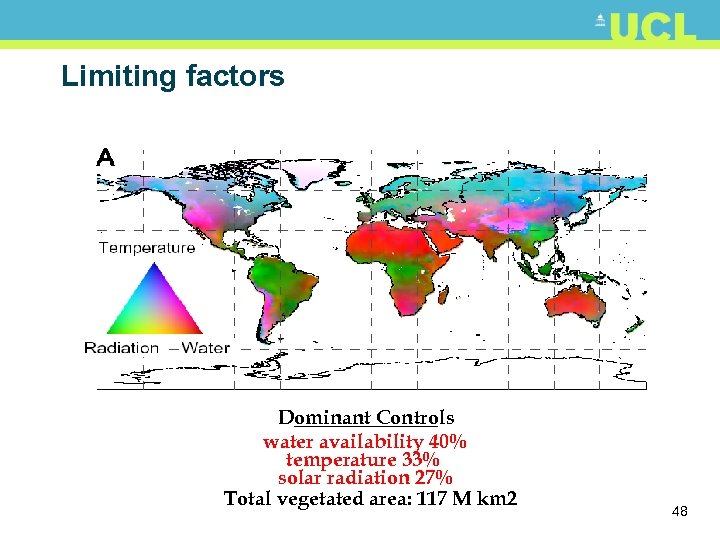
Limiting factors Dominant Controls water availability 40% temperature 33% solar radiation 27% Total vegetated area: 117 M km 2 48
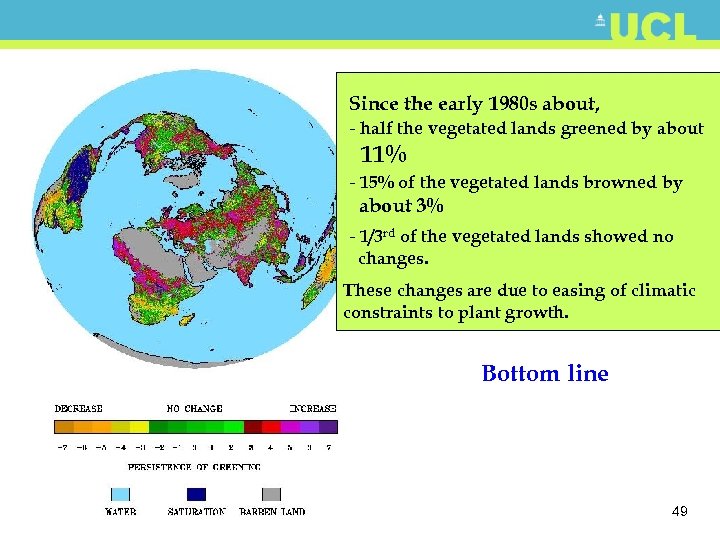
Since the early 1980 s about, - half the vegetated lands greened by about 11% - 15% of the vegetated lands browned by about 3% - 1/3 rd of the vegetated lands showed no changes. These changes are due to easing of climatic constraints to plant growth. Bottom line 49
EO data: current · Global capability of MODIS, MISR, AVHRR. . . etc. · · Estimate vegetation cover (LAI) Dynamics (phenology, land use change etc. ) Productivity (NPP) Disturbance (fire, deforestation etc. ) · Compare with models · AND/OR use to constrain/drive models (assimilation) 50
EO data: future? · BIG limitation of saturation of reflectance signal at LAI > 5 · Spaceborne LIDAR, P-band RADAR to overcome this? · Use structural information, multi-angle etc. ? · What does LAI at 1 km (and lower) mean? · Heterogeneity/mixed pixels · Large boreal forests? Tropical rainforests? · Combine multi-scale measurements – fine scale in some places, scale up across wider areas…. · EOS era (MODIS etc. ) coming to an end ? ? 51
References • • • Cox et al. (2000) Acceleration of global warming due to carbon-cycle feedbacks in a coupled climate model, Nature, 408, 184 -187. Dubayah, R. (1992) Estimating net solar radiation using Landsat Thematic Mapper and Digital Elevation data. Water resources Res. , 28: 2469 -2484. Monteith, J. L. , (1972) Solar radiation and productivity in tropical ecosystems. J. Appl. Ecol, 9: 747 -766. Monteith, J. L. , (1977). Climate and efficiency of crop production in Britain. Phil. Trans. Royal Soc. London, B 281: 277 -294. Myneni et al. (2001) A large carbon sink in the woody biomass of Northern forests, PNAS, Vol. 98(26), pp. 14784 -14789 Running, S. W. , Nemani, R. , Glassy, J. M. (1996) MOD 17 PSN/NPP Algorithm Theoretical Basis Document, NASA. • http: //cybele. bu. edu • http: //www. globalcarbonproject. org 52
Скачать презентацию GCM 8 12 05 Retrieval of biophysical vegetation parameters from
790a52123273cebde1ef29af7dfe51ec.ppt