


 Скачать презентацию Gauteng Department of Education Presentation to National Council
0881b6b4f3456dcbc39acb83d23b4e69.ppt
- Количество слайдов: 35
 Gauteng Department of Education Presentation to National Council of Provinces (NCOP) 23 February 2005
 This presentation focuses on: ¨ 2004 Grade 12 results ¨ Grade 12 Recovery Plan ¨ LTSM Plan for 2005 ¨ Learners under trees process
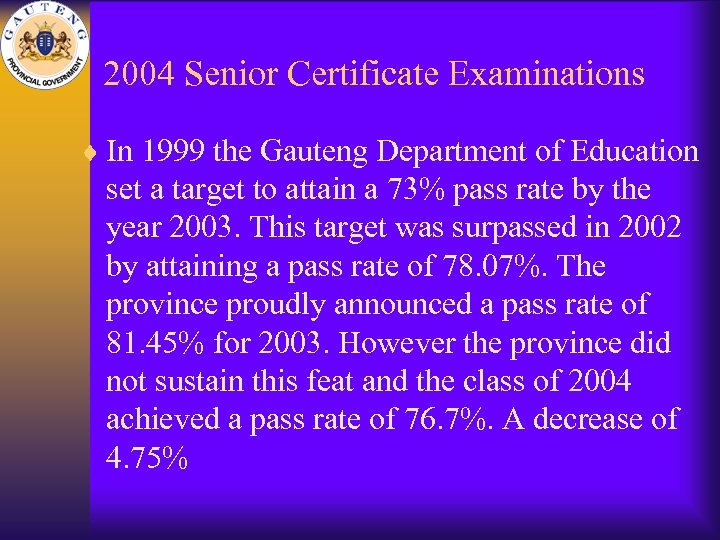 2004 Senior Certificate Examinations ¨ In 1999 the Gauteng Department of Education set a target to attain a 73% pass rate by the year 2003. This target was surpassed in 2002 by attaining a pass rate of 78. 07%. The province proudly announced a pass rate of 81. 45% for 2003. However the province did not sustain this feat and the class of 2004 achieved a pass rate of 76. 7%. A decrease of 4. 75%
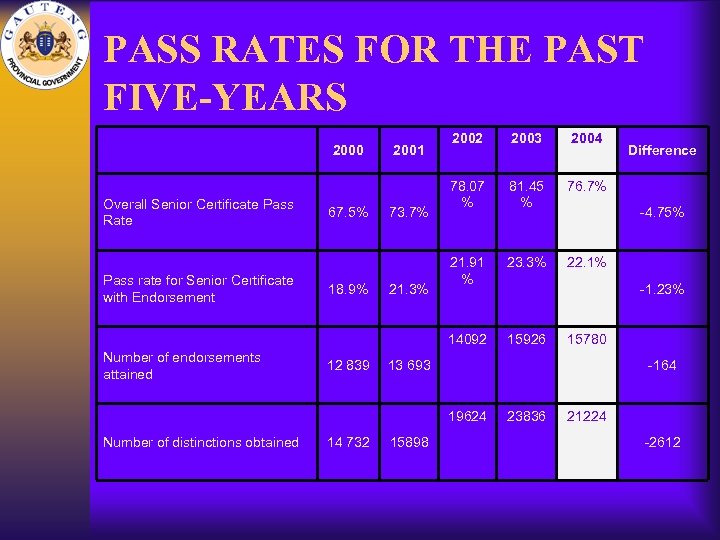 PASS RATES FOR THE PAST FIVE-YEARS Overall Senior Certificate Pass Rate Pass rate for Senior Certificate with Endorsement Number of endorsements attained 2000 67. 5% 18. 9% 12 839 2001 73. 7% 21. 3% 2002 2003 2004 78. 07 % 81. 45 % 76. 7% 21. 91 % 23. 3% 22. 1% 14092 15926 14 732 -4. 75% -1. 23% 15780 13 693 -164 19624 Number of distinctions obtained 15898 Difference 23836 21224 -2612
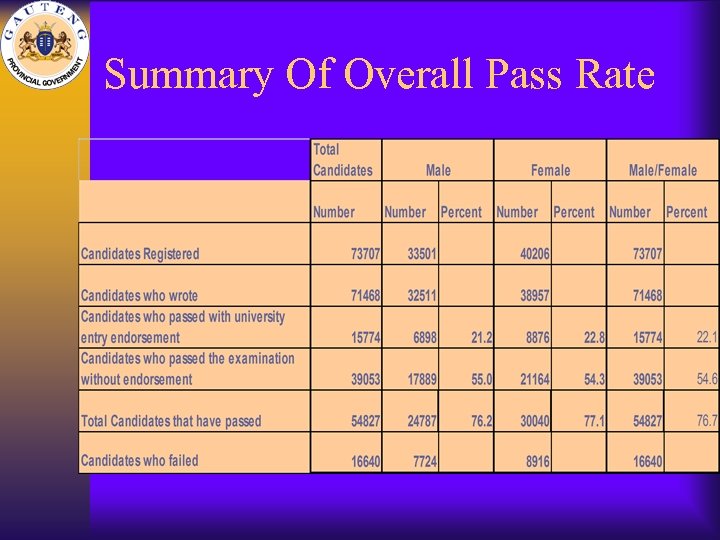 Summary Of Overall Pass Rate
 ENROLMENT The number of Senior Certificate entries for 2004 increased from 70293 to 73530 (+4. 60%). The number of candidates who failed was only 164 less than the previous year, although the percentage failure was 4. 75%.
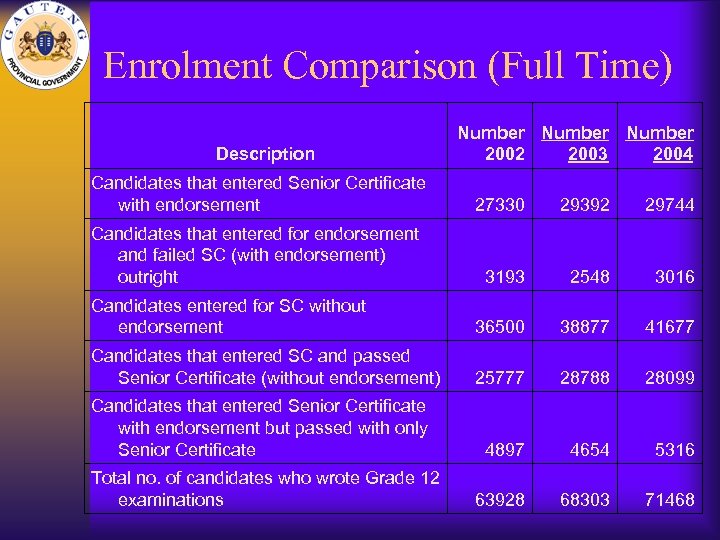 Enrolment Comparison (Full Time) Description Number 2002 2003 2004 Candidates that entered Senior Certificate with endorsement 27330 29392 29744 Candidates that entered for endorsement and failed SC (with endorsement) outright 3193 2548 3016 Candidates entered for SC without endorsement 36500 38877 41677 Candidates that entered SC and passed Senior Certificate (without endorsement) 25777 28788 28099 Candidates that entered Senior Certificate with endorsement but passed with only Senior Certificate 4897 4654 5316 63928 68303 71468 Total no. of candidates who wrote Grade 12 examinations
 What Changed ¨ There was a substantial decrease in English Second Language pass rate. The failures increased by 5662 which led to a overall increase of the failure rate by 5. 56%. A failure in a language results in a failure of the year for 70% of all candidates. ¨ However there was a marked increase of the Afrikaans Second Language pass rate. The number of candidates that failed decreased by 2301 which led to a overall decrease of the failure rate by 2. 25%
 What Changed ¨ The change in these two pass rates counter act one another resulting in an overall failure of 3. 3%(5. 56 - 2. 25) ¨ The above figure is largely responsible for the overall increase of the failure rate which was 4. 75% ¨ Only 1. 4% of the decrease in pass rate is as a result of increased failures in other subjects
 The Effect of Other Subjects Substantial increase in failures occurred in Accounting SG, Physical Science SG, Business Economics SG, Mathematics SG and Biology SG as seen in the next slide.
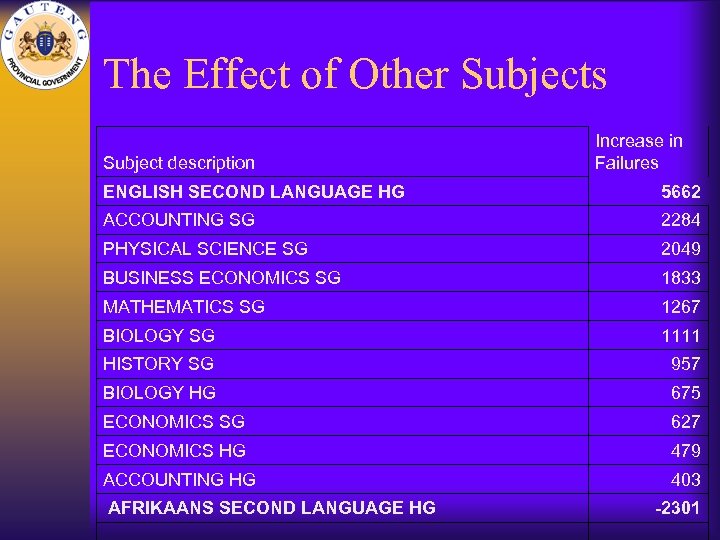 The Effect of Other Subjects Subject description Increase in Failures ENGLISH SECOND LANGUAGE HG 5662 ACCOUNTING SG 2284 PHYSICAL SCIENCE SG 2049 BUSINESS ECONOMICS SG 1833 MATHEMATICS SG 1267 BIOLOGY SG 1111 HISTORY SG 957 BIOLOGY HG 675 ECONOMICS SG 627 ECONOMICS HG 479 ACCOUNTING HG 403 AFRIKAANS SECOND LANGUAGE HG -2301
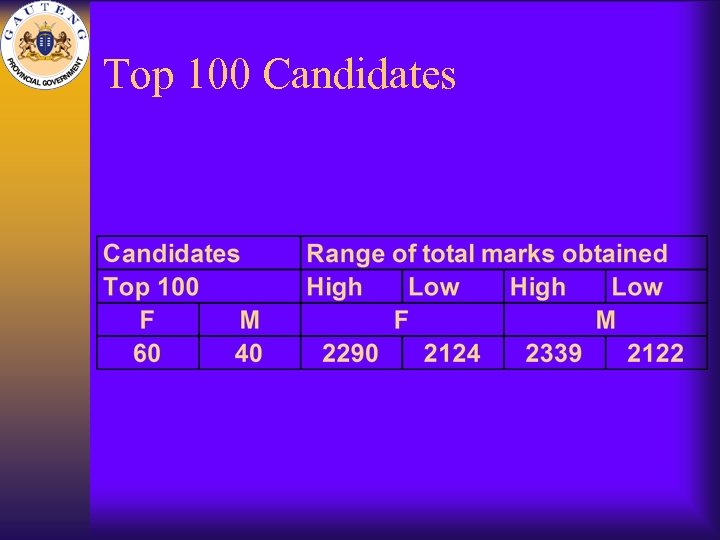 Top 100 Candidates
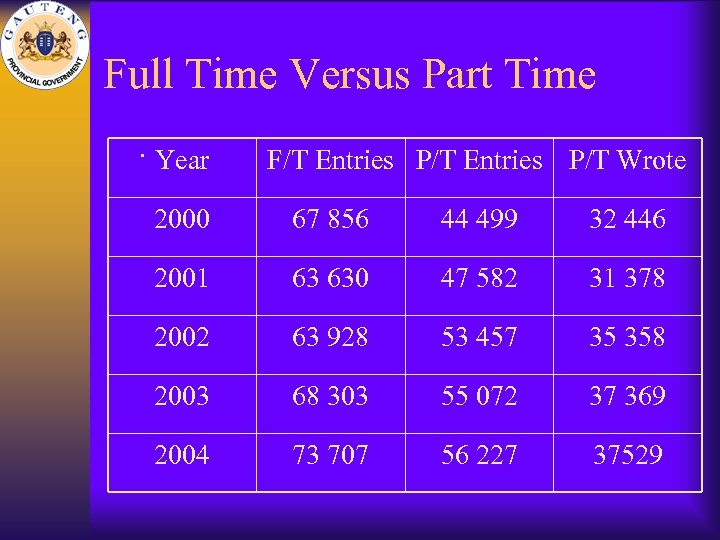 Full Time Versus Part Time. Year F/T Entries P/T Wrote 2000 67 856 44 499 32 446 2001 63 630 47 582 31 378 2002 63 928 53 457 35 358 2003 68 303 55 072 37 369 2004 73 707 56 227 37529
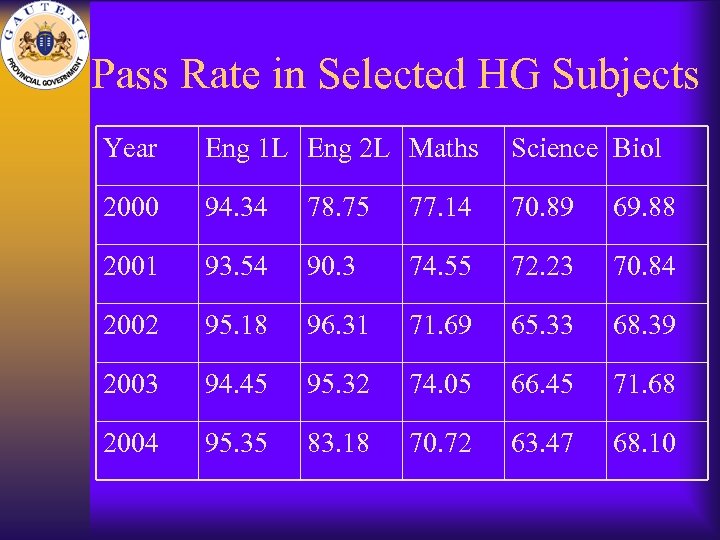 Pass Rate in Selected HG Subjects Year Eng 1 L Eng 2 L Maths Science Biol 2000 94. 34 78. 75 77. 14 70. 89 69. 88 2001 93. 54 90. 3 74. 55 72. 23 70. 84 2002 95. 18 96. 31 71. 69 65. 33 68. 39 2003 94. 45 95. 32 74. 05 66. 45 71. 68 2004 95. 35 83. 18 70. 72 63. 47 68. 10
 Continuous Assessment ¨ Even though Continuous Assessment will not drastically alter the candidates final marks, the effect of CASS is more in the preparation for writing exams. ¨ Formal testing, standardized preparatory exams, etc. all have a positive effect on preparing candidates and can possibly be classified as the most successful intervention program. ¨ It is particularly our quality assurance moderation process that lends credibility to learners work.
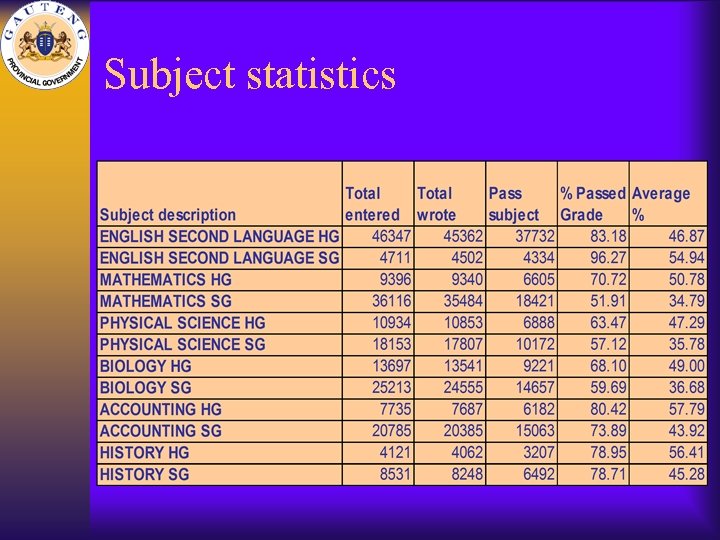 Subject statistics
 GRADE 12 RECOVERY PLAN Introduction ¨ ¨ ¨ ¨ Pass rate declined from 81, 45% with 23, 1% endorsement rate in 2003 to 76, 4% overall and 22, 3% endorsement rate in 2004 Reasons are varied but poor performance in English L 2 GH had major impact Performance in ex-DET and ex-HOR schools especially worrying Need to bounce back immediately to 2003 pass rate Intervention by nature will have to be targeted and intense but should also have a developmental dimension that will ensure systemic improvements and sustainability of learner performance The recovery plan has two elements: direct access to quality curriculum support for identified category of learners all schools to develop a school based support programme focusing on grade 10 to 12 with minimum assessment management systems operational and strict district monitoring The plan should start not later than the 1 st week of March 2005
 INTERVENTION PROJECT The focused intervention will consist of two thrusts ¨ Direct support to an identified category of learners ¨ School based support programmes
 Direct Learner Support (1) ¨ A service provider will be appointed ¨ Subjects include the gateway subjects, also ¨ “at risk” learners who scored between 35% and 50% in the Grade 11 examinations in 2004 ¨ Ttuition to be provided for a total of 38 160 learners (just over 50% of possible full-time candidates. ) ¨ Utilise allocated SSIP budget , this makes provision for R 314. 00 per learner/subject ¨ Classes in specific geographic areas
 Direct Learner Support (continue) ¨ Curriculum content to be presented would be prioritised on the basis of moderator/examiner reports ¨ Intervention should start no later than the first week in March 2005 ¨ Extend into part of the April vacation, thereafter Saturday mornings and “winter “school” in June/July ¨ District monitoring requirements – Annexure 1
 MATRIC SUPPORT PROGRAMME 1. Peer-group Study Syndicates ¨ All schools/ sites to audit resources provided to SSIP sites ¨ These resources to be packaged per subject ¨ a roster for rotation from school to school in a defined geographic area to be drawn up. ¨ The learners then working in syndicate groups could have access to the materials on a rotation basis. ¨ Within schools the most able learner in a particular subject could be tasked to lead a study group ¨ Educators would be involved in the management of the resources, and providing additional tuition, on request from the learners
 MATRIC SUPPORT PROGRAMME 2. Assessment Management System Basic Documentation to be available in an organized accessible manner (Annexure 2) 3. Schools to ensure full participation of teachers in subject clusters 4. School support programmes should be linked to the requirements of IQMS 5. School Improvement Plans (SIP) 6. District Improvement Plans (DIP)
 LTSM REPORT ON PREPARATIONS FOR DEVELOPMENT AND PROCUREMENT 2005/6 Introduction ¨ LTSM focuses on Learner Support Materials for Grade 1 -12 ¨ ¨ ¨ (in all Public ordinary schools) and Teacher Support Materials for the implementing grades (Gr 7 and 10) Provisioning for LTSM entails 100% budget allocation for the implementing grades and 10% top-up for other grades The latter is linked to a vigorous retrieval system Life-span of book (3 -5 years) Stationery supply constitutes full replacement and is based on Norms and Standards for curriculum delivery The LTSM SUPPLY chain incorporates 2 processes: policy and strategy development and the procurement, supply and allocation
 Steps in the LTSM process Map IN THE PRE-PROCUREMENT PROCESS ¨ Development of LTSM ¨ Call for publishers’ submissions ¨ Evaluation of LTSM ¨ Approval, rejection and conditional approval depending on the appropriateness ¨ Development and distribution of catalogue
 IN THE PROCUREMENT PROCESS ¨ Requisitioning of desired LTSM ¨ Capturing of requisitions ¨ Placement of Orders with suppliers, publishers and printers respectively ¨ Delivery to schools ¨ Distribution to end-users ¨ Retrieval of LTSM from end-users
 Preparation for readiness to implement LOETA policy ¨ District LTSM coordinators appointed and orientated on pre-procurement and some procurement aspects ¨ School LTSM coordinators have been trained ¨ e-Tool used for all school’s procurement ¨ Budget allocations to be finalized by April 2005
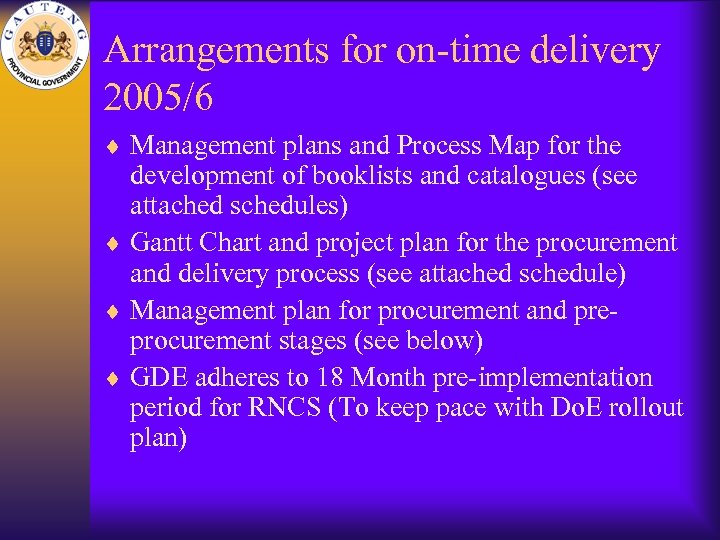 Arrangements for on-time delivery 2005/6 ¨ Management plans and Process Map for the development of booklists and catalogues (see attached schedules) ¨ Gantt Chart and project plan for the procurement and delivery process (see attached schedule) ¨ Management plan for procurement and preprocurement stages (see below) ¨ GDE adheres to 18 Month pre-implementation period for RNCS (To keep pace with Do. E rollout plan)
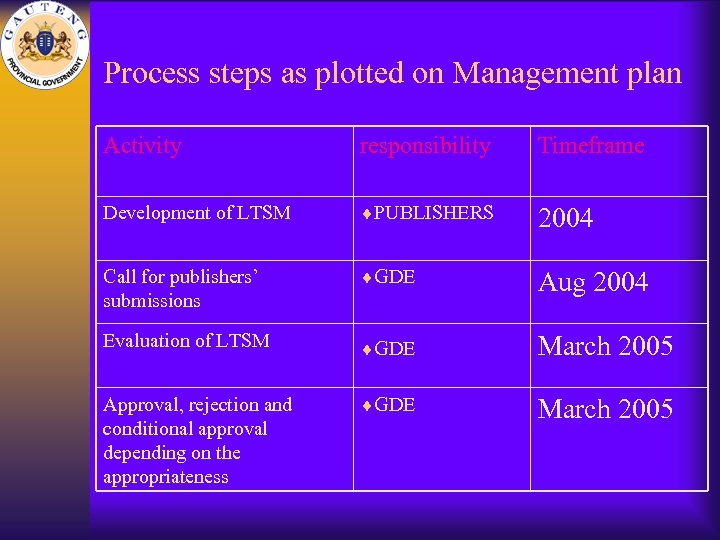 Process steps as plotted on Management plan Activity responsibility Timeframe Development of LTSM ¨PUBLISHERS 2004 Call for publishers’ submissions ¨GDE Aug 2004 Evaluation of LTSM ¨GDE March 2005 Approval, rejection and conditional approval depending on the appropriateness ¨GDE March 2005
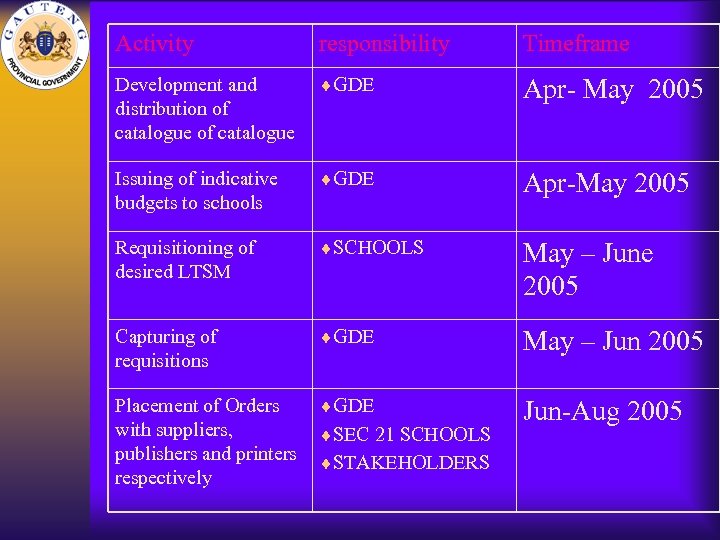 Activity responsibility Timeframe Development and distribution of catalogue ¨GDE Apr- May 2005 Issuing of indicative budgets to schools ¨GDE Apr-May 2005 Requisitioning of desired LTSM ¨SCHOOLS May – June 2005 Capturing of requisitions ¨GDE May – Jun 2005 Placement of Orders with suppliers, publishers and printers respectively ¨GDE Jun-Aug 2005 ¨SEC 21 SCHOOLS ¨STAKEHOLDERS
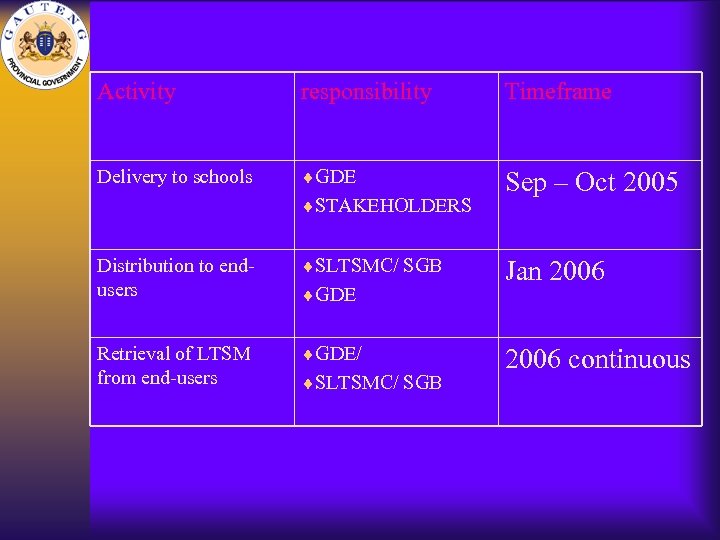 Activity responsibility Timeframe Delivery to schools ¨GDE Sep – Oct 2005 ¨STAKEHOLDERS Distribution to endusers ¨SLTSMC/ SGB Retrieval of LTSM from end-users ¨GDE/ ¨GDE ¨SLTSMC/ SGB Jan 2006 continuous
 SOME MAJOR STEPS TAKEN BY GDE AS PER POLICY ¨ Negotiation of evaluation criteria with materials developers/ Stakeholders GDE adopts and implements an outcomes -based approach of giving criteria upfront to the materials developers ( RNCS-compliant criteria contained in the evaluation instrument)
 ¨ Development of an evaluation instrument ¨ The GDE is preparing an RNCS-based evaluation instrument to be utilized by evaluators, educators at the evaluation centre (for Grade 10 a National instrument is to be utilized) The instrument is caters for both qualitative and quantitative evaluation of LTSM ¨ Upon completion of the evaluation process will develop an electronic catalogue that provides details, images and short reviews of the approved materials
 Delivery will assist in achieving the following in 2006: ¨ facilitating the implementation of the National Curriculum Statements in schools by providing a framework for educator development as well as classroom practice and management, monitoring, evaluation and support ¨ Preparing educators adequately to deal with the pedagogic transformation required by the NCS in terms of curriculum content, didactic approaches and assessment ¨ Availing new resources and competences to comply with the delivery of new subjects and assessment standards
 PROGRESS ON REMOVAL OF LEARNERS UNDER TREES ¨There are no learners physically receiving instruction under trees or outside, full-time.
 ¨ Although none of our schools are operating as full- time institutions under trees, we do however have a situation at two schools where a problems are experienced during certain class periods. Especially during language periods where the schools offer a number of different languages and learners then split into numerous small groups, there are not enough classrooms to accommodate all these various small groups. Mobile classrooms are being provided to these two school to resolve the problem.