 Скачать презентацию Gastrointestinal Drugs By Karen Ruffin RN MSN Ed
b79f7c319954281bc829efccb09b641e.ppt
- Количество слайдов: 104



Gastrointestinal Drugs By Karen Ruffin RN, MSN Ed.
Acid-Controlling Agents
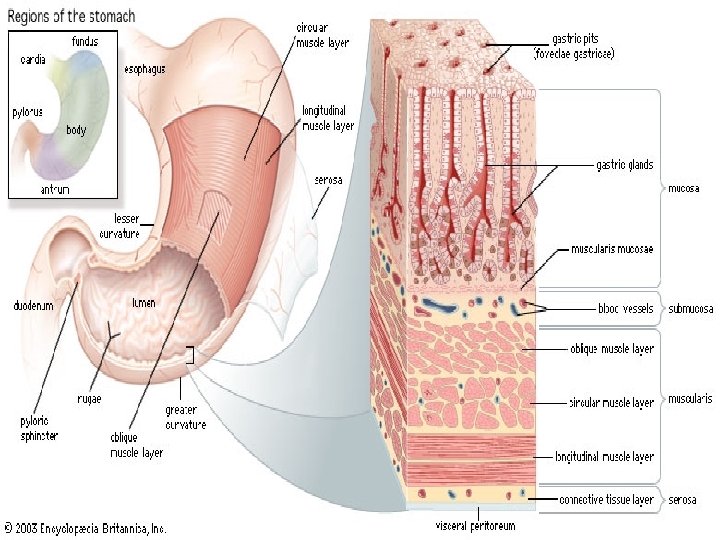
Acid-Related Pathophysiology The stomach secretes: o o o Hydrochloric acid (HCl) Bicarbonate Pepsinogen Intrinsic factor Mucus Prostaglandins
Glands of the Stomach o Cardiac o Pyloric o Gastric* * The cells of the gastric gland are the largest in number and of primary importance when discussing acid control
Cells of the Gastric Gland o Parietal cells n Produce and secrete HCl n Primary site of action for many acid-controller drugs
Hydrochloric Acid o Secreted by the parietal cells when stimulated by food o Maintains stomach at p. H of 1 to 4 o Secretion also stimulated by: n Large fatty meals n Excessive amounts of alcohol n Emotional stress
Cells of the Gastric Gland (cont'd) o Chief cells n Secrete pepsinogen, a proenzyme n Pepsinogen becomes pepsin when activated by exposure to acid n Pepsin breaks down proteins (proteolytic)
Cells of the Gastric Gland (cont'd) o Mucoid cells n Mucus-secreting cells (surface epithelial cells) n Provide a protective mucous coat n Protect against self-digestion by HCl
Acid-Related Diseases o Caused by imbalance of the three cells of the gastric gland their secretions o Most common: hyperacidity o Clients report symptoms of overproduction of HCl by the parietal cells as indigestion, sour stomach, heartburn, acid stomach
Acid-Related Diseases (cont'd) o PUD: peptic ulcer disease o GERD: gastroesophageal reflux disease o Helicobacter pylori (H. pylori) n Bacterium found in GI tract of 90% of patients with duodenal ulcers, and 70% of those with gastric ulcers n Combination therapy is used most often to eradicate H. pylori
Treatment for H. pylori o Eight regimens approved by the FDA o H. pylori is not associated with acute perforating ulcers o It is suggested that factors other than the presence of H. pylori lead to ulceration
Types of Acid-Controlling Agents o Antacids o H 2 antagonists o Proton pump inhibitors
Antacids: Mechanism of Action o. Promote gastric mucosal defense mechanisms o. Secretion of: n Mucus: protective barrier against HCl n Bicarbonate: helps buffer acidic properties of HCl n Prostaglandins: prevent activation of proton pump which results in HCl production
Antacids: Mechanism of Action (cont'd) o Antacids DO NOT prevent the overproduction of acid o Antacids DO neutralize the acid once it’s in the stomach
Antacids: Drug Effects o. Reduction of pain associated with acidrelated disorders n Raising gastric p. H from 1. 3 to 1. 6 neutralizes 50% of the gastric acid n Raising gastric p. H 1 point (1. 3 to 2. 3) neutralizes 90% of the gastric acid n Reducing acidity reduces pain
Antacids (cont'd) o Used alone or in combination
Antacids: Aluminum Salts o Forms: carbonate, hydroxide o Have constipating effects o Often used with magnesium to counteract constipation o Examples n Aluminum carbonate: Basaljel n Hydroxide salt: Alterna. GEL n Combination products (aluminum and magnesium): Gaviscon, Maalox, Mylanta, Di-Gel
Antacids: Magnesium Salts o Forms: carbonate, hydroxide, trisilicate o Commonly cause diarrhea; usually used with other agents to counteract this effect o Dangerous when used with renal failure — the failing kidney cannot excrete extra magnesium, resulting in hypermagnesemia
Antacids: Magnesium Salts (cont'd) o Examples n Hydroxide salt: magnesium hydroxide (MOM) n Carbonate salt: Gaviscon (also a combination product) n Combination products such as Maalox, Mylanta (aluminum and magnesium)
Antacids: Calcium Salts Forms: many, but carbonate is most common o May cause constipation o Their use may result in kidney stones o Long duration of acid action may cause increased gastric acid secretion (hyperacidity rebound) o Often advertised as an extra source of dietary calcium n Example: Tums (calcium carbonate)
Antacids: Sodium Bicarbonate o o o Highly soluble Buffers the acidic properties of HCl Quick onset, but short duration May cause metabolic alkalosis Sodium content may cause problems in patients with HF, hypertension, or renal insufficiency (fluid retention)
Antacids and Antiflatulents o Antiflatulents: used to relieve the painful symptoms associated with gas o Several agents are used to bind or alter intestinal gas and are often added to antacid combination products
Antacids and Antiflatulents (cont'd) OTC antiflatulents o Activated charcoal o Simethicone n Alters elasticity of mucus-coated bubbles, causing them to break n Used often, but there are limited data to support effectiveness
Antacids: Side Effects Minimal, and depend on the compound used o Aluminum and calcium n Constipation o Magnesium n Diarrhea o Calcium carbonate n Produces gas and belching; often combined with simethicone
Antacids: Drug Interactions o Adsorption of other drugs to antacids n Reduces the ability of the other drug to be absorbed into the body o Chelation n Chemical binding, or inactivation, of another drug n Produces insoluble complexes n Result: reduced drug absorption
Antacids: Nursing Implications o Assess for allergies and preexisting conditions that may restrict the use of antacids, such as: n Fluid imbalances n Pregnancy – Renal disease – GI obstruction – HF o Patients with HF or hypertension should use low-sodium antacids such as Riopan, Maalox, or Mylanta II
Antacids: Nursing Implications o Use with caution with other medications due to the many drug interactions o Most medications should be given 1 to 2 hours after giving an antacid o Antacids may cause premature dissolving of enteric-coated medications, resulting in stomach upset
Antacids: Nursing Implications o Be sure that chewable tablets are chewed thoroughly, and liquid forms are shaken well before giving o Administer with at least 8 ounces of water to enhance absorption (except for the “rapid dissolve” forms) o Caffeine, alcohol, harsh spices, and black pepper may aggravate the underlying GI condition
Antacids: Nursing Implications o Monitor for side effects n Nausea, vomiting, abdominal pain, diarrhea n With calcium-containing products: constipation, acid rebound o Monitor for therapeutic response n Notify heath care provider if symptoms are not relieved
Histamine Type 2 (H 2) Antagonists
H 2 Antagonists o Reduce acid secretion o All available OTC in lower dosage forms o Most popular drugs for treatment of acid-related disorders n cimetidine (Tagamet) n famotidine (Pepcid) n ranitidine (Zantac)
H 2 Antagonists: Mechanism of Action o Block histamine (H 2) at the receptors of acid-producing parietal cells o Production of hydrogen ions is reduced, resulting in decreased production of HCl
H 2 Antagonists: Indications GERD PUD Erosive esophagitis Adjunct therapy in control of upper GI bleeding o Pathologic gastric hypersecretory conditions (Zollinger-Ellison syndrome) o o
H 2 Antagonists: Side Effects o Overall, less than 3% incidence of side effects o Cimetidine may induce impotence and gynecomastia o May see: n Headaches, lethargy, confusion, diarrhea, urticaria, sweating, flushing, other effects
H 2 Antagonists: Drug Interactions o Cimetidine (Tagamet) n Binds with P-450 microsomal oxidase system in the liver, resulting in inhibited oxidation of many drugs and increased drug levels n All H 2 antagonists may inhibit the absorption of drugs that require an acidic GI environment for absorption
H 2 Antagonists: Drug Interactions (cont'd) SMOKING has been shown to decrease the effectiveness of H 2 blockers (increases gastric acid production)
H 2 Antagonists: Nursing Implications o Assess for allergies and impaired renal or liver function o Use with caution in patients who are confused, disoriented, or elderly (higher incidence of CNS side effects) o Take 1 hour before or after antacids o For intravenous doses, follow administration guidelines
Proton Pump Inhibitors
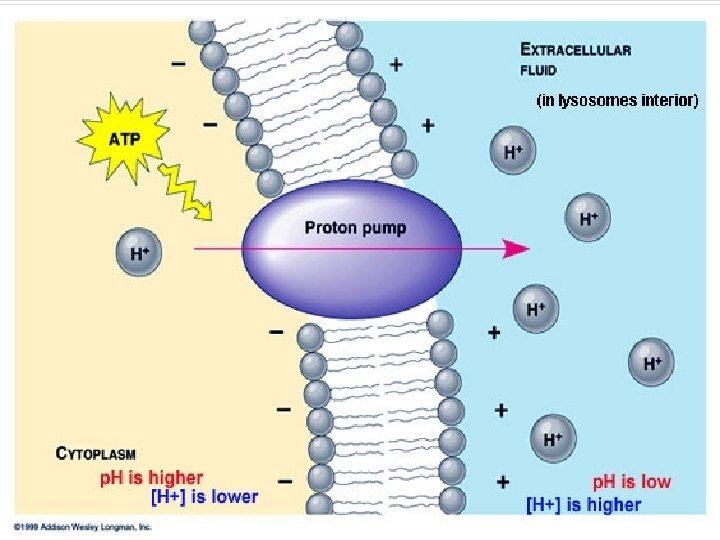
Proton Pump o The parietal cells release positive hydrogen ions (protons) during HCl production o This process is called the “proton pump” o H 2 blockers and antihistamines do not stop the action of this pump
Proton Pump Inhibitors: Mechanism of Action o Irreversibly bind to H+/K+ ATPase enzyme o Result: achlorhydria—ALL gastric acid secretion is blocked
Proton Pump Inhibitors: Drug Effect o Total inhibition of gastric acid secretion n n lansoprazole (Prevacid) omeprazole (Prilosec)* rabeprazole (Acip. Hex) pantoprazole (Protonix) esomeprazole (Nexium) *The first in this new class of drugs
Proton Pump Inhibitors: Indications o GERD maintenance therapy o Erosive esophagitis o Short-term treatment of active duodenal and benign gastric ulcers o Zollinger-Ellison syndrome o Treatment of H. pylori–induced ulcers
Proton Pump Inhibitors: Side Effects o Safe for short-term therapy o Incidence low and uncommon
Proton Pump Inhibitors: Nursing Implications o Assess for allergies and history of liver disease o pantoprazole (Protonix) is the only proton pump inhibitor available for parenteral administration, and can be used for patients who are unable to take oral medications o May increase serum levels of diazepam, phenytoin, and cause increased chance for bleeding with warfarin
Proton Pump Inhibitors: Nursing Implications Instruct the patient taking omeprazole (Prilosec): o It should be taken before meals o The capsule should be swallowed whole, not crushed, opened, or chewed o It may be given with antacids o Emphasize that the treatment will be short term
Other Drugs o sucralfate (Carafate) o misoprostol (Cytotec)
sucralfate (Carafate) o Cytoprotective agent o Used for stress ulcers, erosions, PUD o Attracted to and binds to the base of ulcers and erosions, forming a protective barrier over these areas o Protects these areas from pepsin, which normally breaks down proteins (making ulcers worse)
sucralfate (Carafate) (cont'd) o Little absorption from the gut o May cause constipation, nausea, and dry mouth o May impair absorption of other drugs, especially tetracycline o Binds with phosphate; may be used in chronic renal failure to reduce phosphate levels o Do not administer with other medications
misoprostol (Cytotec) o Synthetic prostaglandin analog o Prostaglandins have cytoprotective activity n Protect gastric mucosa from injury by enhancing local production of mucus or bicarbonate n Promote local cell regeneration n Help to maintain mucosal blood flow
misoprostol (Cytotec) (cont'd) o Used for prevention of NSAID-induced gastric ulcers o Doses that are therapeutic enough to treat duodenal ulcers often produce abdominal cramps, diarrhea
Antidiarrheals and Laxatives
Diarrhea o Abnormal frequent passage of loose stool or o Abnormal passage of stools with increased frequency, fluidity, and weight, or with increased stool water excretion
Diarrhea (cont'd) Acute diarrhea o Sudden onset in a previously healthy person o Lasts from 3 days to 2 weeks o Self-limiting o Resolves without sequelae
Diarrhea (cont'd) Chronic diarrhea o Lasts for more than 3 weeks o Associated with recurring passage of diarrheal stools, fever, loss of appetite, nausea, vomiting, weight loss, and chronic weakness
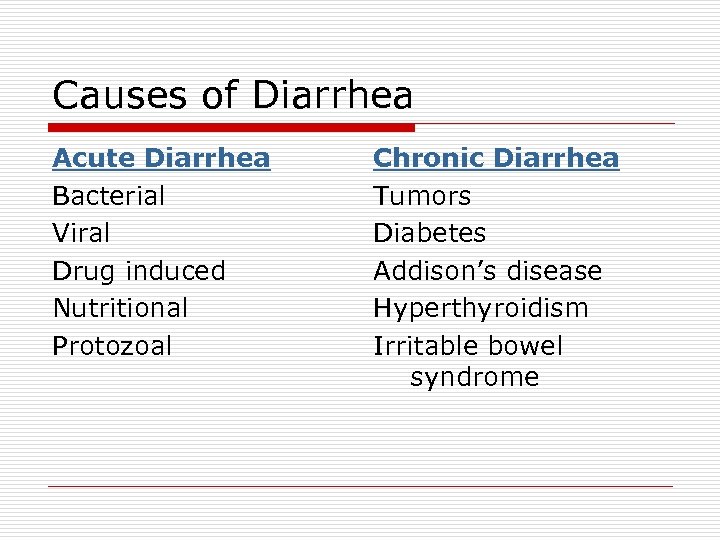
Causes of Diarrhea Acute Diarrhea Bacterial Viral Drug induced Nutritional Protozoal Chronic Diarrhea Tumors Diabetes Addison’s disease Hyperthyroidism Irritable bowel syndrome
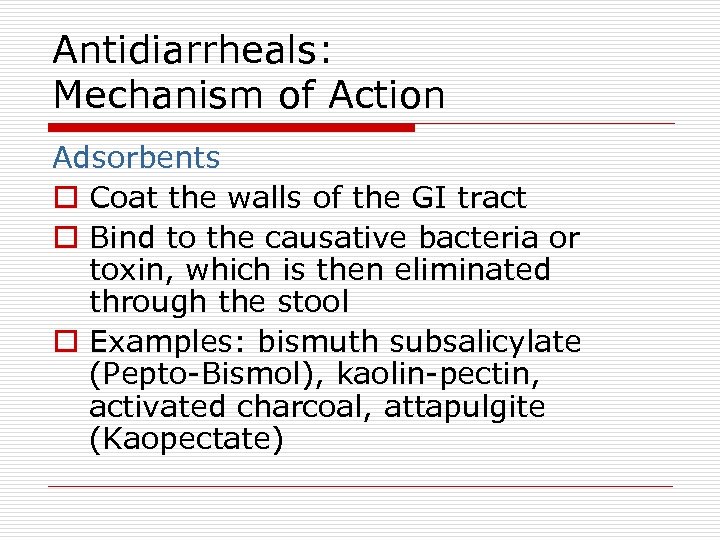
Antidiarrheals: Mechanism of Action Adsorbents o Coat the walls of the GI tract o Bind to the causative bacteria or toxin, which is then eliminated through the stool o Examples: bismuth subsalicylate (Pepto-Bismol), kaolin-pectin, activated charcoal, attapulgite (Kaopectate)
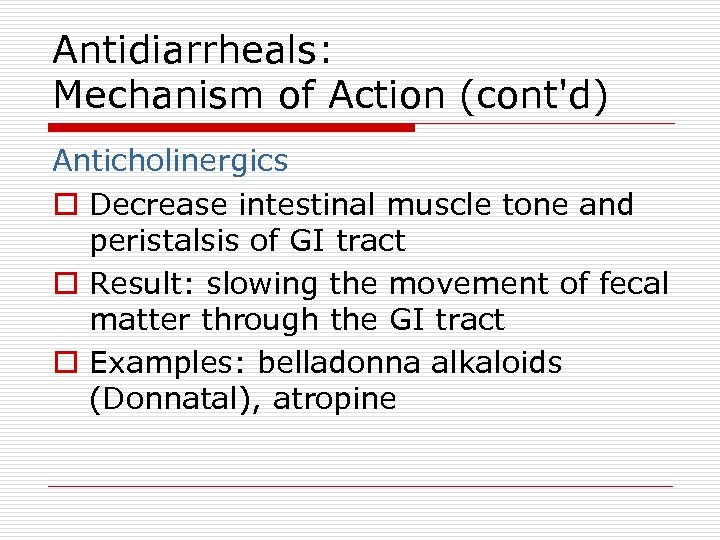
Antidiarrheals: Mechanism of Action (cont'd) Anticholinergics o Decrease intestinal muscle tone and peristalsis of GI tract o Result: slowing the movement of fecal matter through the GI tract o Examples: belladonna alkaloids (Donnatal), atropine
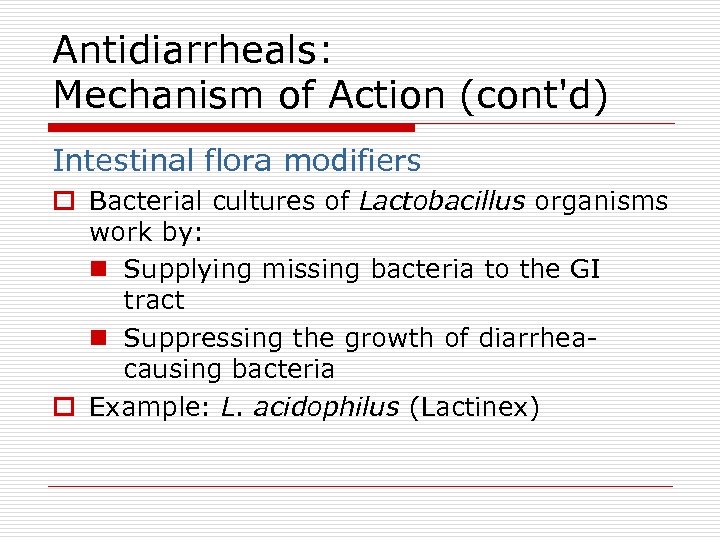
Antidiarrheals: Mechanism of Action (cont'd) Intestinal flora modifiers o Bacterial cultures of Lactobacillus organisms work by: n Supplying missing bacteria to the GI tract n Suppressing the growth of diarrheacausing bacteria o Example: L. acidophilus (Lactinex)
Antidiarrheals: Mechanism of Action (cont'd) Opiates o Decrease bowel motility and relieve rectal spasms o Decrease transit time through the bowel, allowing more time for water and electrolytes to be absorbed o Examples: paregoric, opium tincture, codeine, loperamide (Imodium), diphenoxylate (Lomotil)
Antidiarrheal Agents: Side Effects Adsorbents o Increased bleeding time o Constipation, dark stools o Confusion, twitching o Hearing loss, tinnitus, metallic taste, blue gums
Antidiarrheal Agents: Side Effects (cont'd) Anticholinergics o Urinary retention, hesitancy, impotence o Headache, dizziness, confusion, anxiety, drowsiness o Dry skin, rash, flushing o Blurred vision, photophobia, increased intraocular pressure o Hypotension, hypertension, bradycardia, tachycardia
Antidiarrheal Agents: Side Effects (cont'd) Opiates o o o Drowsiness, sedation, dizziness, lethargy Nausea, vomiting, anorexia, constipation Respiratory depression Bradycardia, palpitations, hypotension Urinary retention Flushing, rash, urticaria
Antidiarrheal Agents: Interactions o Adsorbents decrease the absorption of many agents, including digoxin, clindamycin, quinidine, and hypoglycemic agents o Adsorbents cause increased bleeding time when given with anticoagulants o Antacids can decrease effects of anticholinergic antidiarrheal agents
Antidiarrheal Agents: Nursing Implications o Obtain thorough history of bowel patterns, general state of health, and recent history of illness or dietary changes, and assess for allergies o DO NOT give bismuth subsalicylate to children younger than age 16 or teenagers with chickenpox because of the risk of Reye’s syndrome
Antidiarrheal Agents: Nursing Implications o Use adsorbents carefully in geriatric patients or those with decreased bleeding time, clotting disorders, recent bowel surgery, confusion o Anticholinergics should not be administered to patients with a history of glaucoma, BPH, urinary retention, recent bladder surgery, cardiac problems, myasthenia gravis
Antidiarrheal Agents: Nursing Implications o Teach patients to take medications exactly as prescribed and to be aware of their fluid intake and dietary changes o Assess fluid volume status, I&O, and mucous membranes before, during, and after initiation of treatment
Antidiarrheal Agents: Nursing Implications o Teach patients to notify their physician immediately if symptoms persist o Monitor for therapeutic effect
Laxatives
Constipation o Abnormally infrequent and difficult passage of feces through the lower GI tract o Symptom, not a disease o Disorder of movement through the colon and/or rectum o Can be caused by a variety of diseases or drugs
Laxatives: Mechanism of Action Bulk forming o High fiber o Absorbs water to increase bulk o Distends bowel to initiate reflex bowel activity o Examples: n psyllium (Metamucil) n methylcellulose (Citrucel) n Polycarbophil (Fiber. Con)
Laxatives: Mechanism of Action (cont'd) Emollient o Stool softeners and lubricants o Promote more water and fat in the stools o Lubricate the fecal material and intestinal walls o Examples: n Stool softeners: docusate salts (Colace, Surfak) n Lubricants: mineral oil
Laxatives: Mechanism of Action (cont'd) Hyperosmotic o Increase fecal water content o Result: bowel distention, increased peristalsis, and evacuation o Examples: n n polyethylene glycol (Go. LYTELY) sorbitol (increases fluid movement into intestine) glycerin lactulose (Chronulac)
Laxatives: Mechanism of Action (cont'd) Saline o Increase osmotic pressure within the intestinal tract, causing more water to enter the intestines o Result: bowel distention, increased peristalsis, and evacuation
Laxatives: Mechanism of Action (cont'd) o Saline laxative examples: n n magnesium sulfate (Epsom salts) magnesium hydroxide (MOM) magnesium citrate sodium phosphate (Fleet Phospho-Soda, Fleet enema)
Laxatives: Mechanism of Action (cont'd) Stimulant o Increases peristalsis via intestinal nerve stimulation o Examples: n castor oil (Granulex) n senna (Senokot) n cascara
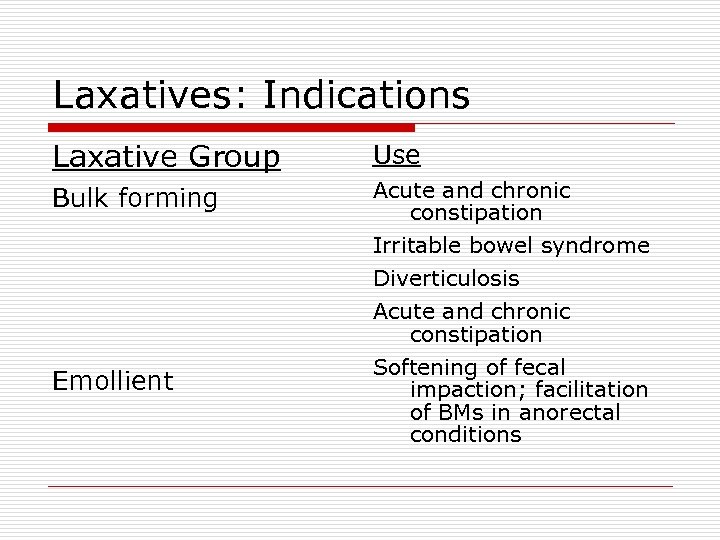
Laxatives: Indications Laxative Group Use Bulk forming Acute and chronic constipation Irritable bowel syndrome Diverticulosis Acute and chronic constipation Softening of fecal impaction; facilitation of BMs in anorectal conditions Emollient
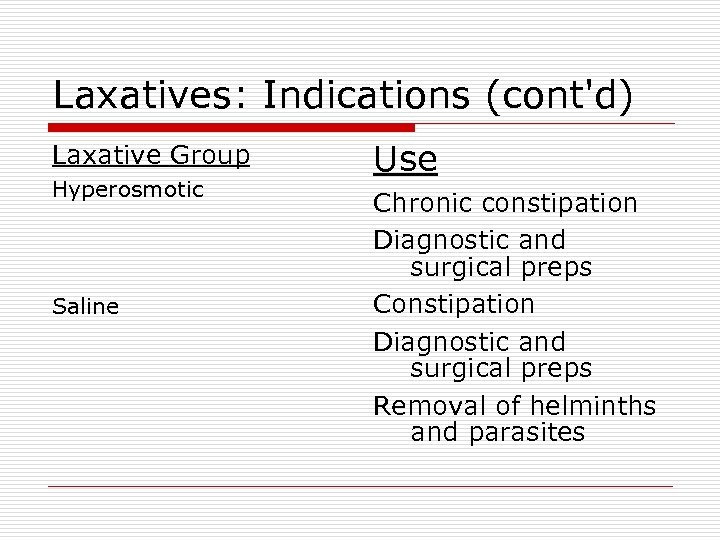
Laxatives: Indications (cont'd) Laxative Group Hyperosmotic Saline Use Chronic constipation Diagnostic and surgical preps Constipation Diagnostic and surgical preps Removal of helminths and parasites
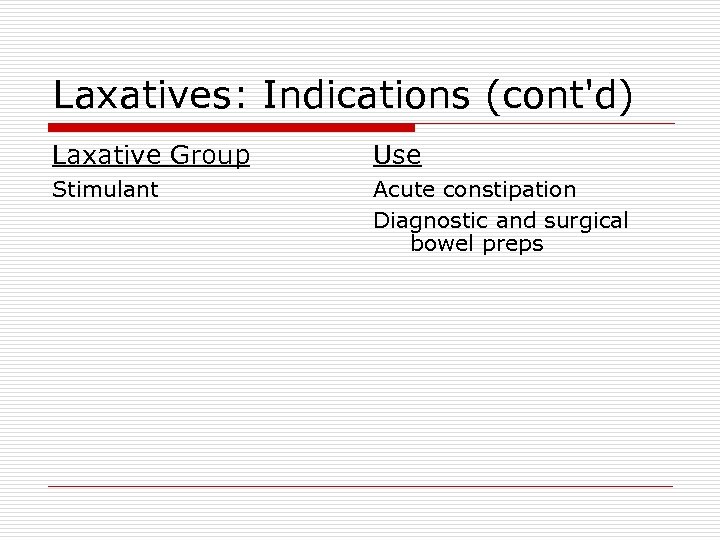
Laxatives: Indications (cont'd) Laxative Group Use Stimulant Acute constipation Diagnostic and surgical bowel preps
Laxatives: Side Effects o Bulk forming n Impaction n Fluid overload o Emollient n Skin rashes n Decreased absorption of vitamins o Hyperosmotic n Abdominal bloating n Rectal irritation
Laxatives: Side Effects (cont'd) Saline o n n n n Magnesium toxicity (with renal insufficiency) Cramping Diarrhea Increased thirst Stimulant Nutrient malabsorption Skin rashes Gastric irritation Rectal irritation
Laxatives: Side Effects (cont'd) All laxatives can cause electrolyte imbalances!
Laxatives: Nursing Implications o Obtain a thorough history of presenting symptoms, elimination patterns, and allergies o Assess fluid and electrolytes before initiating therapy o Patients should not take a laxative or cathartic if they are experiencing nausea, vomiting, and/or abdominal pain
Laxatives: Nursing Implications o A healthy, high-fiber diet and increased fluid intake should be encouraged as an alternative to laxative use o Long-term use of laxatives often results in decreased bowel tone and may lead to dependency o All laxative tablets should be swallowed whole, not crushed or chewed, especially if enteric coated
Laxatives: Nursing Implications o Patients should take all laxative tablets with 6 to 8 ounces of water o Patients should take bulk-forming laxatives as directed by the manufacturer with at least 240 m. L (8 ounces) of water
Laxatives: Nursing Implications o Bisacodyl and cascara sagrada should be given with water due to interactions with milk, antacids, and H 2 blockers o Patients should contact their provider if they experience severe abdominal pain, muscle weakness, cramps, and/ or dizziness, which may indicate fluid or electrolyte loss
Laxatives: Nursing Implications o Monitor for therapeutic effect
Antiemetic and Antinausea Agents
Definitions o Nausea n Unpleasant feeling that often precedes vomiting o Emesis (vomiting) n Forcible emptying of gastric, and occasionally, intestinal contents o Antiemetic agents n Used to relieve nausea and vomiting
VC and CTZ o Vomiting center (VC) o Chemoreceptor trigger zone (CTZ) n Both located in the brain n Once stimulated, cause the vomiting reflex
Mechanism of Action o Many different mechanisms of action o Most work by blocking one of the vomiting pathways, thus blocking the stimulus that induces vomiting
Indications o Specific indications vary per class of antiemetics o General use: prevention and reduction of nausea and vomiting
Mechanism of Action and Indications o Anticholinergic agents (ACh blockers) n Bind to and block acetylcholine (ACh) receptors in the inner ear labyrinth n Block transmission of nauseating stimuli to CTZ n Also block transmission of nauseating stimuli from the reticular formation to the VC n Scopolamine n Also used for motion sickness
Mechanism of Action o Antihistamine agents (H 1 receptor blockers) n Inhibit ACh by binding to H 1 receptors n Prevent cholinergic stimulation in vestibular and reticular areas, thus preventing N&V n Diphenhydramine (Benadryl), meclizine (Antivert), promethazine (Phenergan) n Also used for nonproductive cough, allergy symptoms, sedation
Mechanism of Action (cont'd) o Neuroleptic agents n Block dopamine receptors on the CTZ n chlorpromazine (Thorazine), prochlorperazine (Compazine) n Also used for psychotic disorders, intractable hiccups
Mechanism of Action (cont'd) o Prokinetic agents n Block dopamine in the CTZ n Cause CTZ to be desensitized to impulses it receives from the GI tract n Also stimulate peristalsis in GI tract, enhancing emptying of stomach contents n Metoclopramide (Reglan) n Also used for GERD, delayed gastric emptying
Mechanism of Action (cont'd) o Serotonin blockers n Block serotonin receptors in the GI tract, CTZ, and VC n Dolasetron (Anzemet), granisetron (Kytril), ondansetron (Zofran) n Used for N&V for patients receiving chemotherapy and postoperative nausea and vomiting
Mechanism of Action (cont'd) o Tetrahydrocannabinoids (THC) n Major psychoactive substance in marijuana n Inhibitory effects on reticular formation, thalamus, cerebral cortex n Alter mood and body’s perception of its surroundings
Mechanism of Action (cont'd) o Tetrahydrocannabinoids (cont'd) n dronabinol (Marinol) n Used for N&V associated with chemotherapy, and anorexia associated with weight loss in AIDS patients
Side Effects o Vary according to agent used o Stem from their nonselective blockade of various receptors
Nursing Implications o Assess complete nausea and vomiting history, including precipitating factors o Assess current medications o Assess for contraindications and potential drug interactions
Nursing Implications o Many of these agents cause severe drowsiness; warn patients about driving or performing any hazardous tasks o Taking antiemetics with alcohol may cause severe CNS depression o Teach patients to change position slowly to avoid hypotensive effects
Nursing Implications o For chemotherapy, antiemetics are often given ½ to 3 hours before a chemotherapy agent o Monitor for therapeutic effects o Monitor for adverse effects
Скачать презентацию Gastrointestinal Drugs By Karen Ruffin RN MSN Ed
b79f7c319954281bc829efccb09b641e.ppt