


 Скачать презентацию Gas Regional Initiative North West Region Secondary
fe38692286437f09a4163395cc3dc417.ppt
- Количество слайдов: 10
 Gas Regional Initiative – North West Region Secondary capacity markets Project update RCC meeting The Hague – 5 th July, 2010
 Survey Ø Survey process 6 -week consultation process (from 6 April till 21 May) Questionnaire posted on the ERGEG website and publicized by platforms, associations (EFET, BDEW, bne, Dutch Energiened) and Program Office Confidentiality guaranteed Ø Threefold objective of the survey to assess shippers’ interest in secondary markets to understand the way secondary markets are used by shippers: i. to understand the reasons which make a shipper sell or buy secondary capacity ii. to understand the reasons which prevent a shipper from selling or buying secondary capacity iii. to identify the obstacles encountered if not successful. to evaluate shippers’ expectations about the functioning and design of the existing platforms Ø Strong interest from the market 34 respondents representing 10 different countries (Germany 31% ; United. Kingdom 24% ; France 12%) RCC meeting The Hague – 5 th July, 2010 2
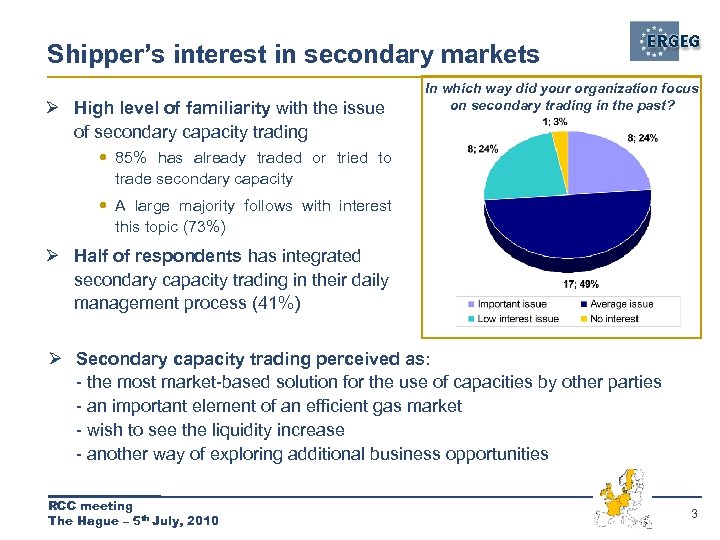 Shipper’s interest in secondary markets Ø High level of familiarity with the issue of secondary capacity trading In which way did your organization focus on secondary trading in the past? 85% has already traded or tried to trade secondary capacity A large majority follows with interest this topic (73%) Ø Half of respondents has integrated secondary capacity trading in their daily management process (41%) Ø Secondary capacity trading perceived as: - the most market-based solution for the use of capacities by other parties - an important element of an efficient gas market - wish to see the liquidity increase - another way of exploring additional business opportunities RCC meeting The Hague – 5 th July, 2010 3
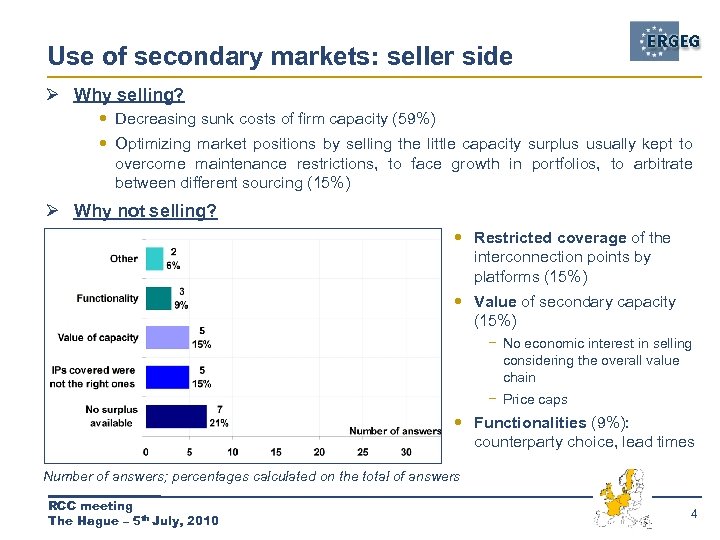 Use of secondary markets: seller side Ø Why selling? Decreasing sunk costs of firm capacity (59%) Optimizing market positions by selling the little capacity surplus usually kept to overcome maintenance restrictions, to face growth in portfolios, to arbitrate between different sourcing (15%) Ø Why not selling? Restricted coverage of the interconnection points by platforms (15%) Value of secondary capacity (15%) − No economic interest in selling considering the overall value chain − Price caps Functionalities (9%): counterparty choice, lead times Number of answers; percentages calculated on the total of answers RCC meeting The Hague – 5 th July, 2010 4
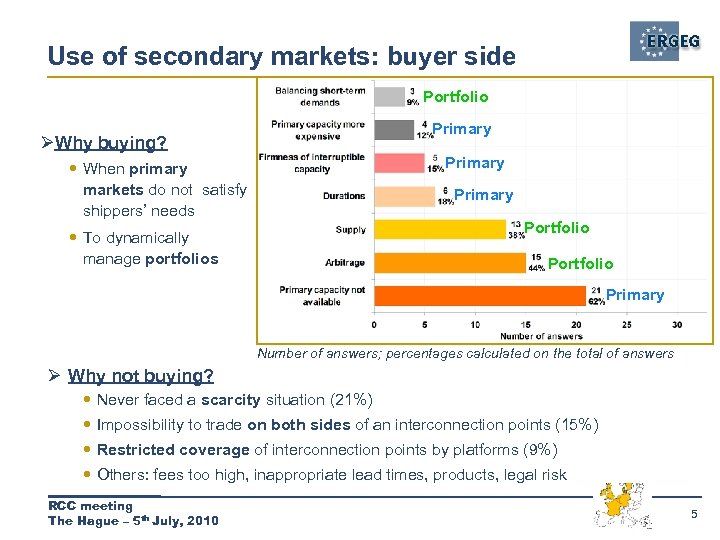 Use of secondary markets: buyer side Portfolio Primary ØWhy buying? Primary When primary markets do not satisfy shippers’ needs Primary Portfolio To dynamically manage portfolios Portfolio Primary Number of answers; percentages calculated on the total of answers Ø Why not buying? Never faced a scarcity situation (21%) Impossibility to trade on both sides of an interconnection points (15%) Restricted coverage of interconnection points by platforms (9%) Others: fees too high, inappropriate lead times, products, legal risk RCC meeting The Hague – 5 th July, 2010 5
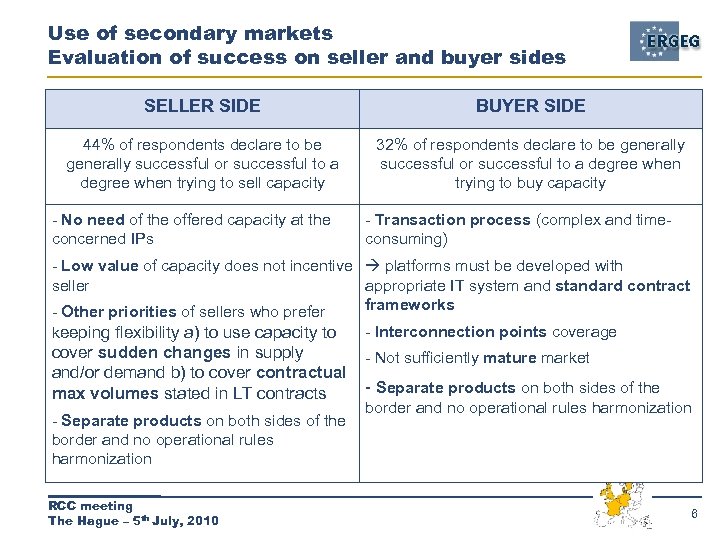 Use of secondary markets Evaluation of success on seller and buyer sides SELLER SIDE BUYER SIDE 44% of respondents declare to be generally successful or successful to a degree when trying to sell capacity 32% of respondents declare to be generally successful or successful to a degree when trying to buy capacity - No need of the offered capacity at the concerned IPs - Transaction process (complex and timeconsuming) - Low value of capacity does not incentive platforms must be developed with seller appropriate IT system and standard contract frameworks - Other priorities of sellers who prefer keeping flexibility a) to use capacity to - Interconnection points coverage cover sudden changes in supply and/or demand b) to cover contractual max volumes stated in LT contracts - Not sufficiently mature market - Separate products on both sides of the border and no operational rules harmonization RCC meeting The Hague – 5 th July, 2010 - Separate products on both sides of the border and no operational rules harmonization 6
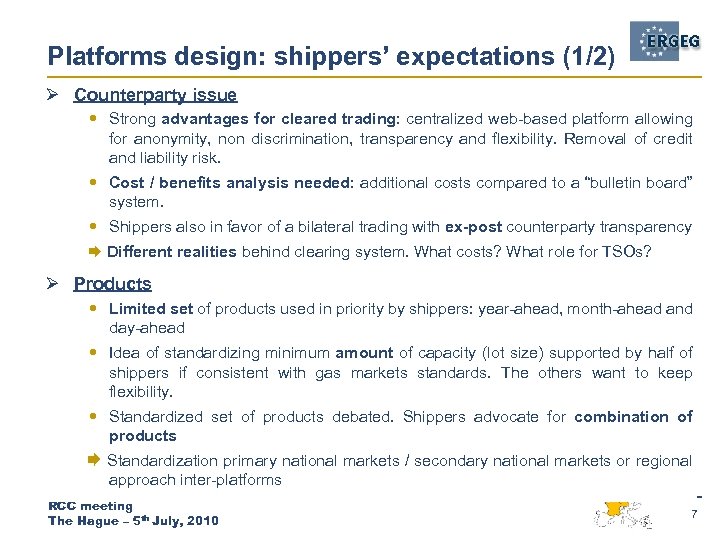 Platforms design: shippers’ expectations (1/2) Ø Counterparty issue Strong advantages for cleared trading: centralized web-based platform allowing for anonymity, non discrimination, transparency and flexibility. Removal of credit and liability risk. Cost / benefits analysis needed: additional costs compared to a “bulletin board” system. Shippers also in favor of a bilateral trading with ex-post counterparty transparency Different realities behind clearing system. What costs? What role for TSOs? Ø Products Limited set of products used in priority by shippers: year-ahead, month-ahead and day-ahead Idea of standardizing minimum amount of capacity (lot size) supported by half of shippers if consistent with gas markets standards. The others want to keep flexibility. Standardized set of products debated. Shippers advocate for combination of products Standardization primary national markets / secondary national markets or regional approach inter-platforms RCC meeting The Hague – 5 th July, 2010 7
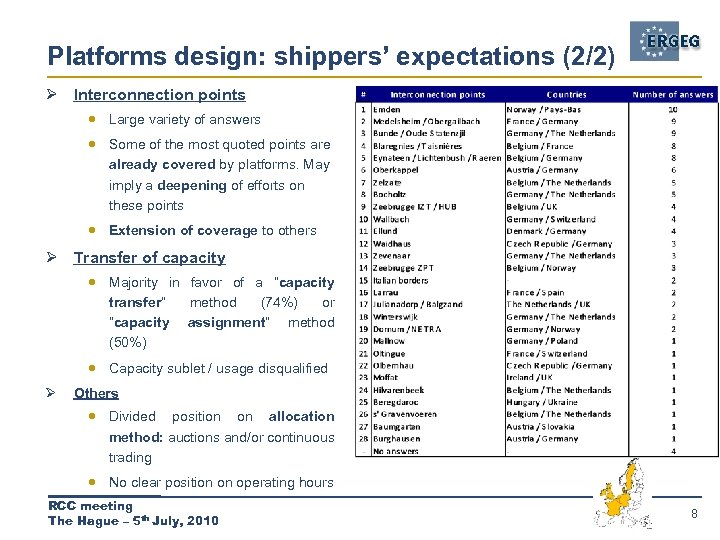 Platforms design: shippers’ expectations (2/2) Ø Interconnection points Large variety of answers Some of the most quoted points are already covered by platforms. May imply a deepening of efforts on these points Extension of coverage to others Ø Transfer of capacity Majority in favor of a “capacity transfer” method (74%) or “capacity assignment” method (50%) Capacity sublet / usage disqualified Ø Others Divided position on allocation method: auctions and/or continuous trading No clear position on operating hours RCC meeting The Hague – 5 th July, 2010 8
 Conclusion Linking primary and secondary markets ● Shipper, regulators and other stakeholders should jointly define the target model for capacity products. Primary and secondary markets cannot be structured separately. ● One aim of the project: to achieve operational consistency with the proposals developed by ERGEG in CAM framework guidelines and the guidelines on congestion management procedures ● Encompassing target model: entry / exit models, standardized capacity products, combined products. RCC meeting The Hague – 5 th July, 2010 9
 Thank you for your attention Betsy Annen – CRE betsy. annen@cre. fr Bernhard Schaefer – E. ON Ruhrgas bernhard. schaefer@eon-ruhrgas. com RCC meeting The Hague – 5 th July, 2010 10