 Скачать презентацию Gas Delivery and Virtual Process Chamber Concept for
808caf56bb81ac6d132987a95b8e9d15.ppt
- Количество слайдов: 16



Gas Delivery and Virtual Process Chamber Concept for Gas Assisted Material Processing in Focused Ion Beam System 48 th International Conference EIPBN 2004, San Diego CA ©Valery Ray VALERYRAY@AOL. COM 1 EIPBN 2004 Presentation, San Diego CA
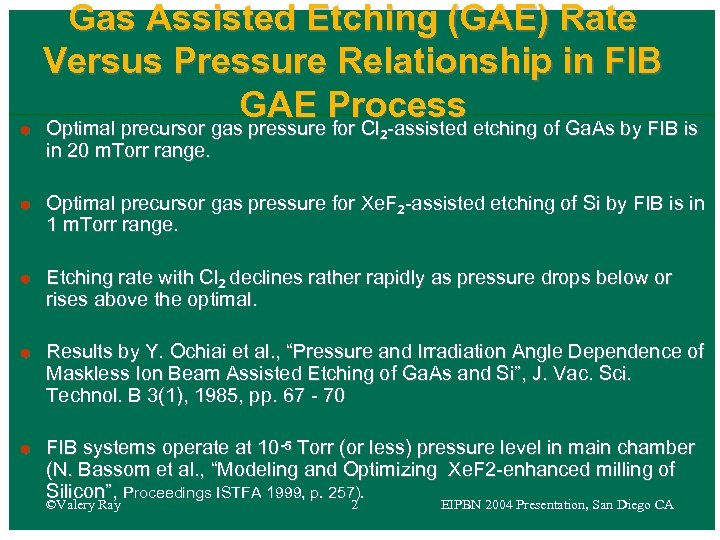
à Gas Assisted Etching (GAE) Rate Versus Pressure Relationship in FIB GAE Process Optimal precursor gas pressure for Cl -assisted etching of Ga. As by FIB is 2 in 20 m. Torr range. à Optimal precursor gas pressure for Xe. F 2 -assisted etching of Si by FIB is in 1 m. Torr range. à Etching rate with Cl 2 declines rather rapidly as pressure drops below or rises above the optimal. à Results by Y. Ochiai et al. , “Pressure and Irradiation Angle Dependence of Maskless Ion Beam Assisted Etching of Ga. As and Si”, J. Vac. Sci. Technol. B 3(1), 1985, pp. 67 - 70 à FIB systems operate at 10 -5 Torr (or less) pressure level in main chamber (N. Bassom et al. , “Modeling and Optimizing Xe. F 2 -enhanced milling of Silicon”, Proceedings ISTFA 1999, p. 257). ©Valery Ray 2 EIPBN 2004 Presentation, San Diego CA
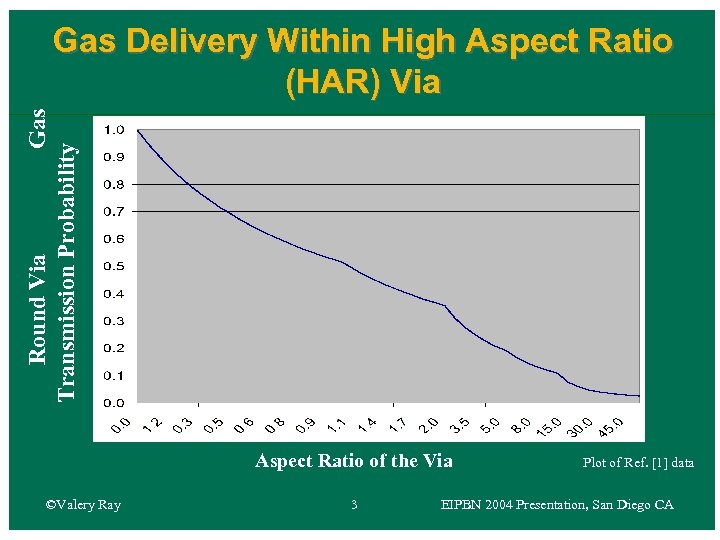
Round Via Gas Transmission Probability Gas Delivery Within High Aspect Ratio (HAR) Via Aspect Ratio of the Via ©Valery Ray 3 Plot of Ref. [1] data EIPBN 2004 Presentation, San Diego CA
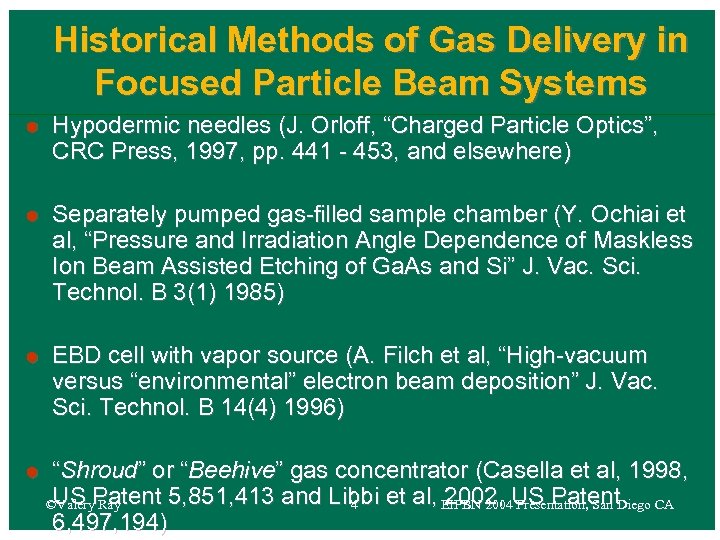
Historical Methods of Gas Delivery in Focused Particle Beam Systems à à Hypodermic needles (J. Orloff, “Charged Particle Optics”, CRC Press, 1997, pp. 441 - 453, and elsewhere) Separately pumped gas-filled sample chamber (Y. Ochiai et al, “Pressure and Irradiation Angle Dependence of Maskless Ion Beam Assisted Etching of Ga. As and Si” J. Vac. Sci. Technol. B 3(1) 1985) EBD cell with vapor source (A. Filch et al, “High-vacuum versus “environmental” electron beam deposition” J. Vac. Sci. Technol. B 14(4) 1996) “Shroud” or “Beehive” gas concentrator (Casella et al, 1998, US Ray 2002, Presentation, San Diego CA ©Valery. Patent 5, 851, 413 and Libbi et al, EIPBN 2004 US Patent 4 6, 497, 194)
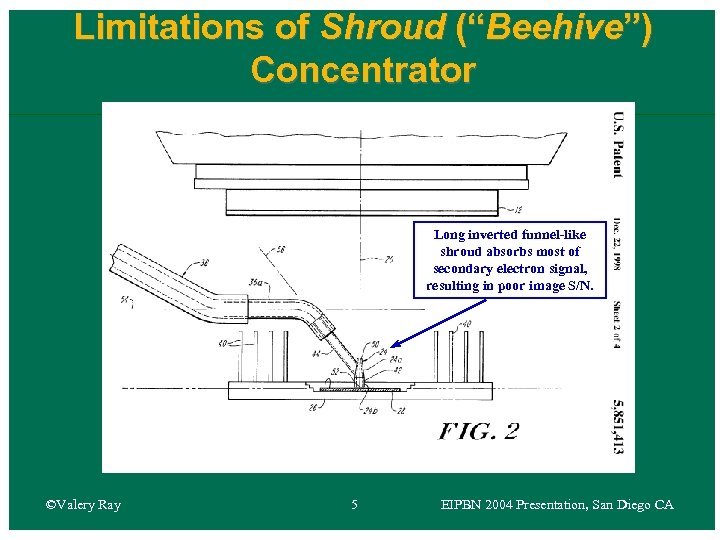
Limitations of Shroud (“Beehive”) Concentrator Long inverted funnel-like shroud absorbs most of secondary electron signal, resulting in poor image S/N. ©Valery Ray 5 EIPBN 2004 Presentation, San Diego CA
Electrostatic Bias of Shroud Concentrator à à à Introduction of shroud concentrator significantly reduces level of secondary electron signal available for detection. Experiments demonstrated that image contrast is improved by factor of eight by positive electrostatic bias applied to shroud (“Beehive”) concentrator, however S/N remains low. Results by V. Ray et al. , “Improvements of Secondary Electron Imaging and Endpoint San Diego CA ©Valery Ray 6 EIPBN 2004 Presentation, Detection…” ISTFA 2003 Conference Proceedings,
Effects of Vacuum Vessel Geometry on Gas Concentration à à Theoretical calculations predict localized gas concentration in the center of a spherical vacuum vessel by factor of seven larger then at the vessel walls. Attempt of experimental measurements of the distribution indicated uniform pressure distribution within the vessel. Results by S. B. Nesterov et al. , “Influence of the vacuum chamber shape on the non-uniformity of gas distribution”, Vacuum 53 (1999) pp. 193 -196. ©Valery Ray 7 EIPBN 2004 Presentation, San Diego CA Ã
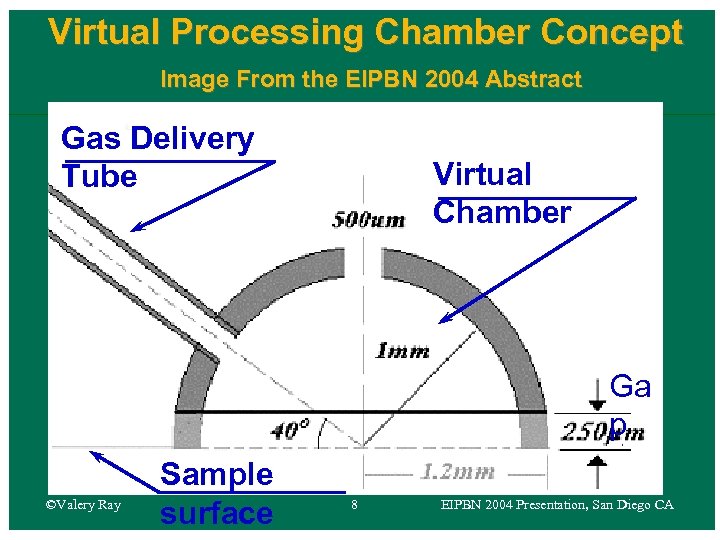
Virtual Processing Chamber Concept Image From the EIPBN 2004 Abstract Gas Delivery Tube Virtual Chamber Ga p ©Valery Ray Sample surface 8 EIPBN 2004 Presentation, San Diego CA
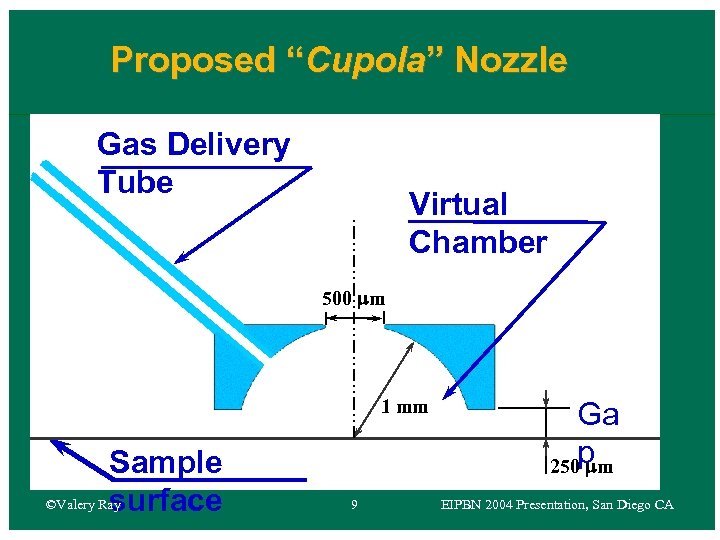
Proposed “Cupola” Nozzle Gas Delivery Tube Virtual Chamber 500 m 1 mm Sample ©Valery Ray surface 9 Ga 250 p m EIPBN 2004 Presentation, San Diego CA
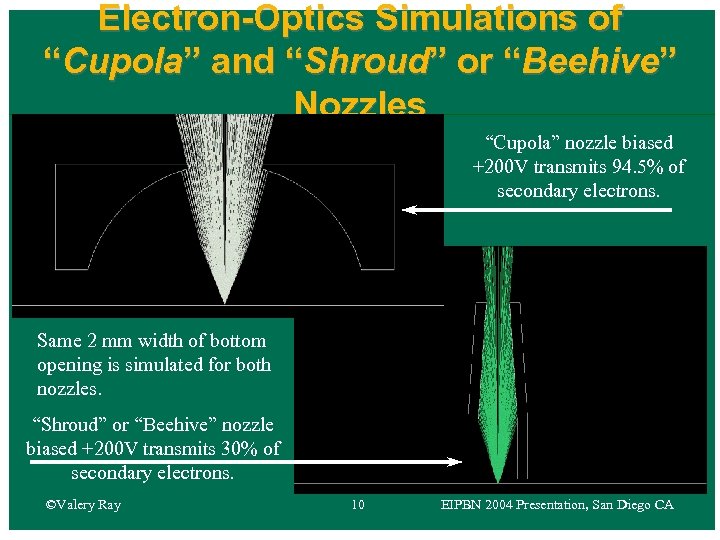
Electron-Optics Simulations of “Cupola” and “Shroud” or “Beehive” Nozzles “Cupola” nozzle biased +200 V transmits 94. 5% of secondary electrons. Same 2 mm width of bottom opening is simulated for both nozzles. “Shroud” or “Beehive” nozzle biased +200 V transmits 30% of secondary electrons. ©Valery Ray 10 EIPBN 2004 Presentation, San Diego CA
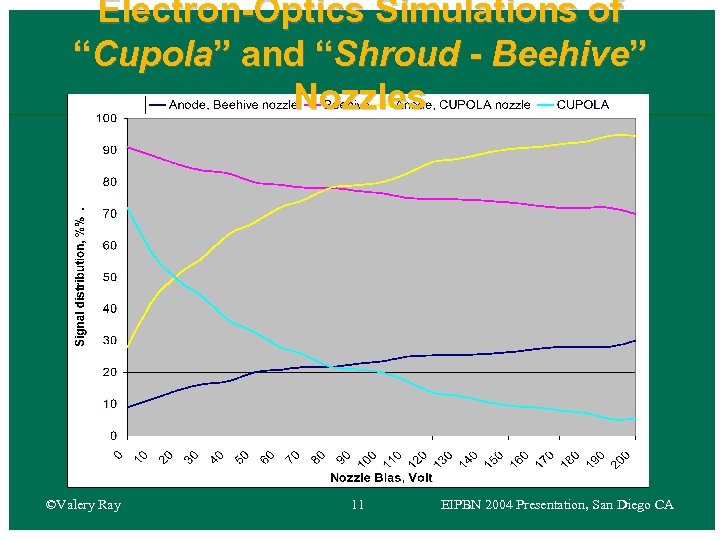
Electron-Optics Simulations of “Cupola” and “Shroud - Beehive” Nozzles ©Valery Ray 11 EIPBN 2004 Presentation, San Diego CA
Conclusions 1. Proposed virtual processing chamber concept and “CUPOLA” nozzle geometry provide viable advancement of gas delivery techniques for charged particle beam processing apparatus. The concept is equally applicable to Focused Ion Beam (FIB) and Focused Electron Beam (FEB) systems. 2. Secondary electron trajectory simulations of “CUPOLA” geometry suggest that ~80% of the signal could be extracted through the “CUPOLA” under 100 V positive bias conditions, a X 4 improvement comparatively to the existing “Beehive” nozzles. 3. Secondary electron trajectory simulations suggest that a significant fraction of the secondary electrons are absorbed by the gas delivery nozzles and set a basis for experimental investigation of possibility to monitor the nozzle current for the purposes of detecting material-dependent transitions in a secondary electron emission. ©Valery Ray 12 EIPBN 2004 Presentation, San Diego CA
Ongoing and Future work à à 3 D Simulations of “CUPOLA” nozzle, including reduced dimensions and effects of bias on primary ion and electron beams. Technology suitable for manufacturing of “CUPOLA” nozzle geometry? Micro-machining, electroforming, laser, or FIB processing? à Experimental monitoring of nozzle current during the milling of HAR via could be of high practical interest for detection of material-dependent transitions in ©Valery Ray 13 EIPBN 2004 Presentation, San Diego CA secondary electron emission.
REFERENCES Ã Ã 1. J. F. O’Hanlon “A Users Guide to Vacuum Technology” John Wiley & Sons, 1989. 2. J. Orloff, M. Utlaut, L. Swanson “High Resolution Focused Ion Beams, FIB and Its Applications” Kluwer Academic Publishers, 2003. 3. Casella et al. , US Patent 5, 851, 413 “Gas Delivery Systems for Particle Beam Processing”, 1998 4. Other publications as referenced throughout the presentation ©Valery Ray 14 EIPBN 2004 Presentation, San Diego CA
Acknowledgements à Author would like to thank Mr. Nicholas Antoniou, Dr. Neil Bassom, Mr. Gavin Hartigan and Dr. Kun Liu, all of FEI Company, for there’s contributions to the abstract of this presentation. ©Valery Ray 15 EIPBN 2004 Presentation, San Diego CA
Acknowledgements à Special thanks are due to INTEGRATED ENGINEERING SOFTWARE company from Winnipeg, Canada, for providing evaluation copy of LORENZ-2 E particle trajectory simulation software. ÃWWW. INTEGRATEDSOFT. COM ©Valery Ray 16 EIPBN 2004 Presentation, San Diego CA
Скачать презентацию Gas Delivery and Virtual Process Chamber Concept for
808caf56bb81ac6d132987a95b8e9d15.ppt