


 Скачать презентацию Game AI versus AI Héctor Muñoz-Avila Game
6434493d1e7cf4d47d90f169515126b2.ppt
- Количество слайдов: 23
 Game AI versus AI Héctor Muñoz-Avila
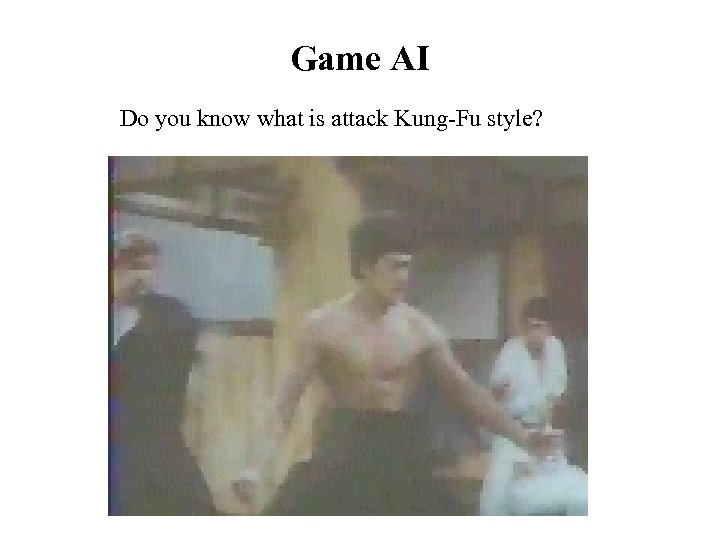 Game AI Do you know what is attack Kung-Fu style?
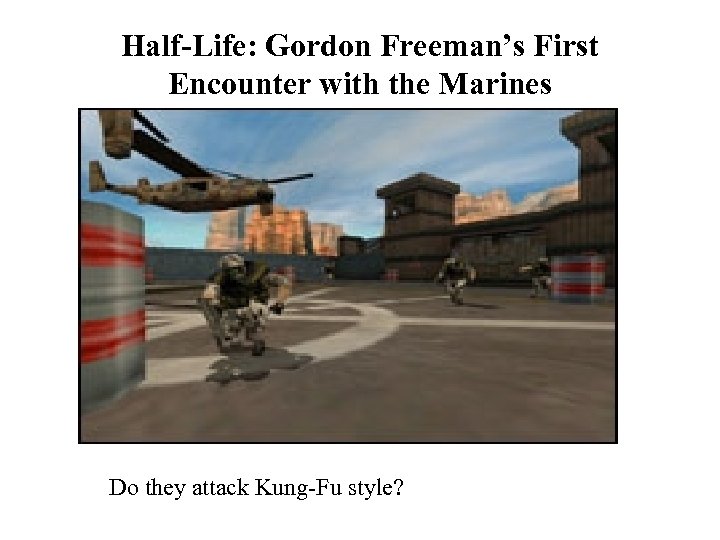 Half-Life: Gordon Freeman’s First Encounter with the Marines Do they attack Kung-Fu style?
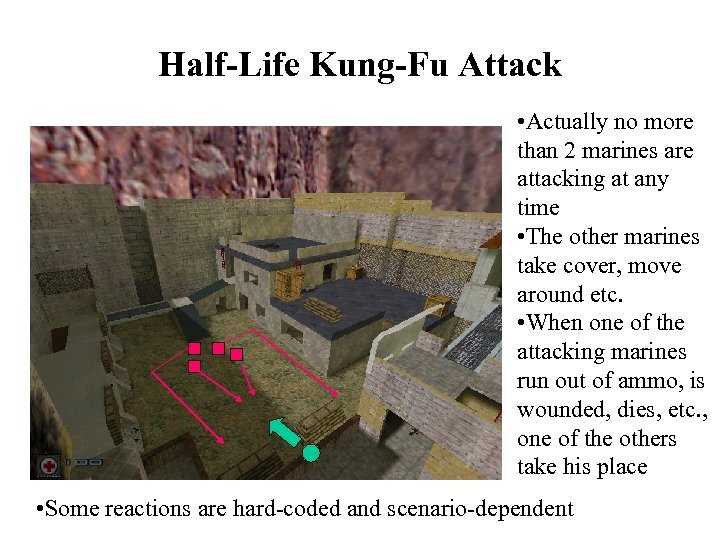 Half-Life Kung-Fu Attack • Actually no more than 2 marines are attacking at any time • The other marines take cover, move around etc. • When one of the attacking marines run out of ammo, is wounded, dies, etc. , one of the others take his place • Some reactions are hard-coded and scenario-dependent
 Game AI • Term refers to the algorithms controlling: – The computer-controlled units/opponents – Gaming conditions (e. g. , weather) – Path finding • Attack Kung-Fu style is an example of game AI for the computer opponent • Programming intentional mistakes is also part of controlling the computer opponent “AI”
 Programming “Good” AI Opponent (according to Lars Liden; Ch. 2) • Move before firing • Make mob/enemy visible (but the Alien vs. Predator does the opposite)
 Programming “Good” AI Opponent (II) (according to Lars Liden; Ch. 2) • • Have horrible aim (rather than doing less damage) Miss the first time Warn the player (e. g. , music, sound) Kung-Fu attacks
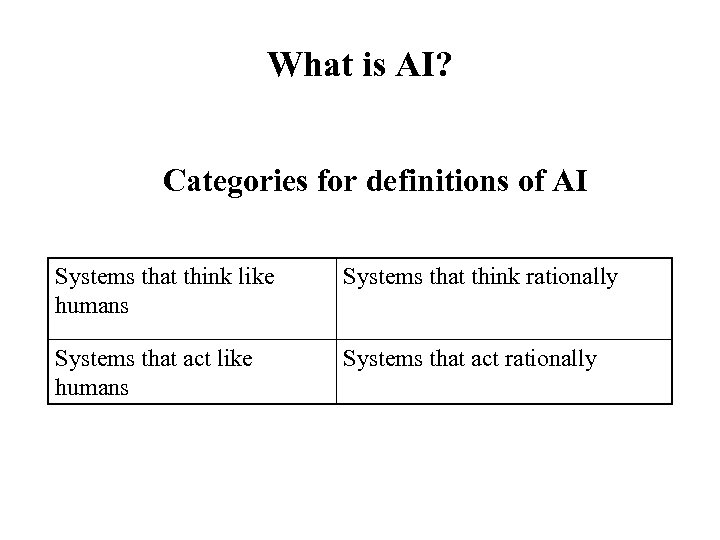 What is AI? Categories for definitions of AI Systems that think like humans Systems that think rationally Systems that act like humans Systems that act rationally
 The Turing Test: Preliminaries • Designed by Alan Turing (1950) • The Turing test provides a satisfactory operational definition of AI • It’s a behavioral test (i. e. , test if a system acts like a human) • Problem: it is difficult to make a mathematical analysis of it
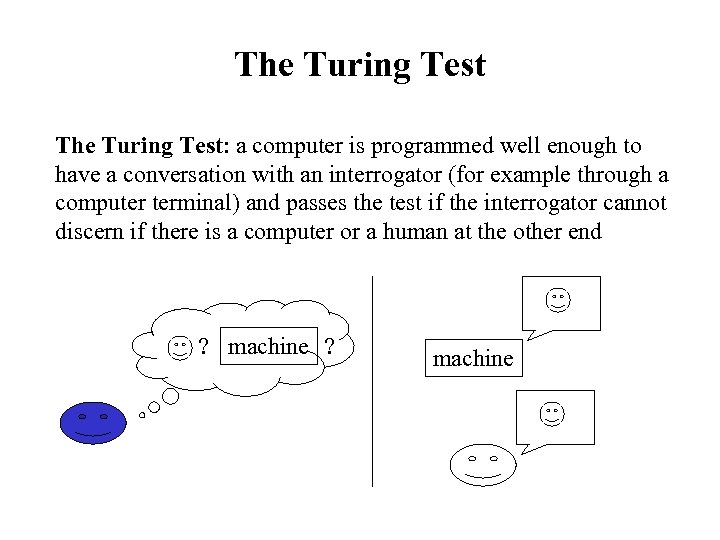 The Turing Test: a computer is programmed well enough to have a conversation with an interrogator (for example through a computer terminal) and passes the test if the interrogator cannot discern if there is a computer or a human at the other end ? machine ? machine
 The Turing Test vs. AI Fields For a program to pass the Turing Test, it needs to pass the exhibit the following capabilities: • Natural language processing • Knowledge representation • Automated reasoning • Machine learning
 Loebner Prize • Each year (since 1994) a competition is made to see if a computer passes the Turing Test • The first program to pass it will receive 100 k • Controversial: Minsky offer 100 if anyone finish it • Still, it is interesting to observe capabilities • Machines seems to have come close to fulfill Turing’s prediction (5 minutes)
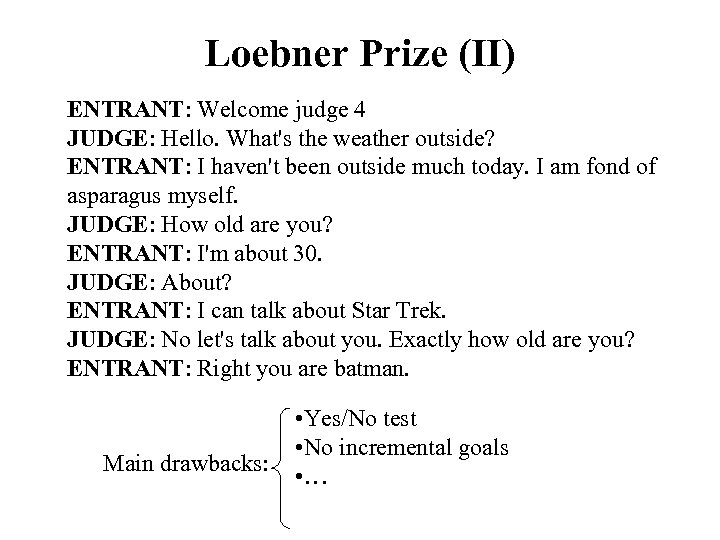 Loebner Prize (II) ENTRANT: Welcome judge 4 JUDGE: Hello. What's the weather outside? ENTRANT: I haven't been outside much today. I am fond of asparagus myself. JUDGE: How old are you? ENTRANT: I'm about 30. JUDGE: About? ENTRANT: I can talk about Star Trek. JUDGE: No let's talk about you. Exactly how old are you? ENTRANT: Right you are batman. Main drawbacks: • Yes/No test • No incremental goals • …
 Other Predictions from Turing • Predicted that by the year 2000 a computer will have 30% chances to fool a person for 5 minutes • Anticipated the major arguments against AI: • The mathematical objection to AI • Argument from Informality
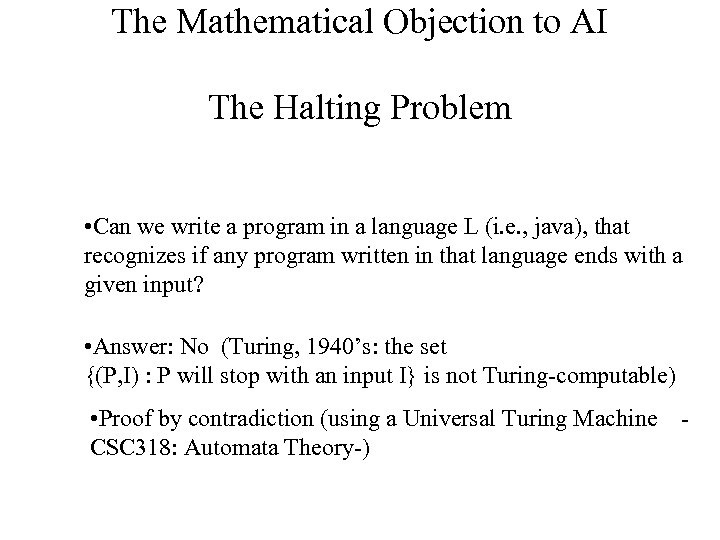 The Mathematical Objection to AI The Halting Problem • Can we write a program in a language L (i. e. , java), that recognizes if any program written in that language ends with a given input? • Answer: No (Turing, 1940’s: the set {(P, I) : P will stop with an input I} is not Turing-computable) • Proof by contradiction (using a Universal Turing Machine CSC 318: Automata Theory-)
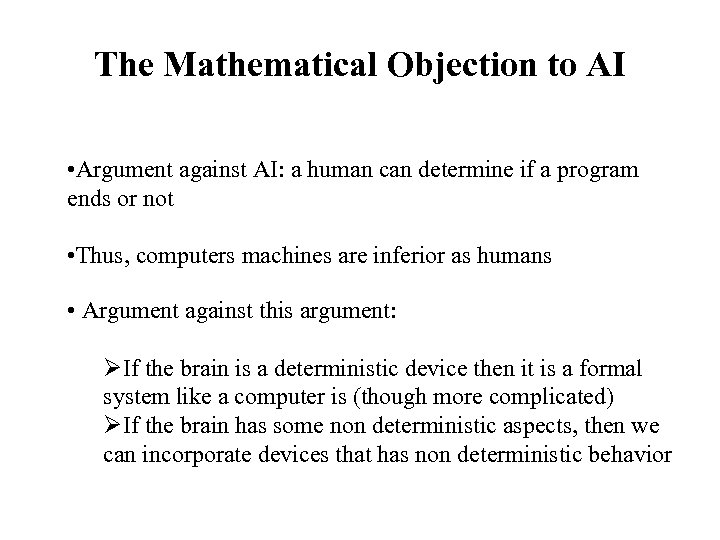 The Mathematical Objection to AI • Argument against AI: a human can determine if a program ends or not • Thus, computers machines are inferior as humans • Argument against this argument: ØIf the brain is a deterministic device then it is a formal system like a computer is (though more complicated) ØIf the brain has some non deterministic aspects, then we can incorporate devices that has non deterministic behavior
 Point of View in Our Course • These discussions refer to pros and cons of constructing a machine that behaves like a human • A wide range of techniques have been developed as a result of the interest in AI • In practice, some of these techniques have been effectively used to enhance computer games • Studying these successfully applied techniques for games and promising directions is the focus of our course • We left the discussion of whether a Game exhibit a humanlike behavior or not to cognitive scientist or philosophers
 AI: Genesis • Logical reasoning calculus was conceived (Leibniz, 17 century) • Leibiz’ motivation: solve intellectual arguments by calculation • Boolean logic (Boole, 1847) • Predicate Logic (Frege, 1879): Begriffsschrift • Incompleteness Theorem (Goedel, 1940’s)
 AI: Some Historical Highlights • Turing’s article about what machines can do • Term AI is coined at the Dartmouth conference (1956) • General Problem Solver (Newell & Simon; 1958) • Period of great expectations
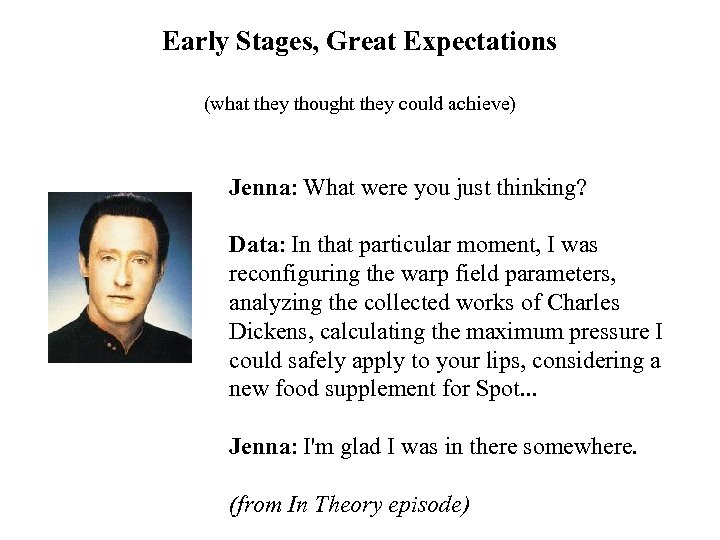 Early Stages, Great Expectations (what they thought they could achieve) Jenna: What were you just thinking? Data: In that particular moment, I was reconfiguring the warp field parameters, analyzing the collected works of Charles Dickens, calculating the maximum pressure I could safely apply to your lips, considering a new food supplement for Spot. . . Jenna: I'm glad I was in there somewhere. (from In Theory episode)
 AI: Some Historical Highlights (cont’d) • Perceptrons: limits to neural networks (Minksy and Papert; 1969) • Knowledge-based systems (1970’s) • AI becomes an industry. Early successes of Expert systems
 AI: Some Historical Highlights (cont’d) • It becomes clear that expert systems are hard to create (problem known as the Knowledge Acquisition bottle-neck) • Renaissance of neural networks as connectionism • 1990’s: more consolidated approaches to AI, more realistic expectations, fielded applications: ØApplications of machine learning to data-mining ØApplications of various AI techniques to computer games
 Some Subareas of AI • Search • Planning • Natural language processing • Machine learning • Case-based reasoning • Robotics • Computer vision • Neural networks